Feeds:
Posts
Comments

Archive for October, 2025

Enter a deep woods this time of year and experience an intensity of quiet that most of us rarely encounter. No traffic din or sirens, no lawn mowers or leaf blowers, even birdsong is only intermittent, since most of our feathered friends have headed south.

Stand still or sit on a rock for a spell and absorb the soft quiet that hovers in the trees [1].

Research has proven that quiet solitude provides benefits, including improved mental clarity, reduced stress and anxiety, lower blood pressure, and enhanced creativity [2].

For Jesus followers, there are even more benefits with profound effect.

Andrew Murray (1828-1917), a South African pastor, teacher, and author stated:

Of course, he wasn’t talking about a walk in the woods—valuable as that is. Murray wanted his readers to know that blessing, strength, and great gain result from quiet solitude with God, as we spend time with him in worship, meditation on his Word, prayer, and listening.

But Murray only summarized the results of stillness before God. Others have added more specificity, including the benefits listed below.

QUIETNESS IS . . .

. . . REVITALIZATION

As dew refreshes grass and flowers during the stillness of the night, so God’s presence revitalizes us as we sit quietly with him [3].

. . . TRUST IN GOD

As we rest in God’s Presence, focusing on him, he quietly builds bonds of trust between us and him [4].

. . . TRANSFORMATION

Stillness transforms heart and mind [5].

. . . PEACE

Resting in God’s presence is the best way to receive his gift of peace [6].

. . . SPIRITUAL GROWTH

“In order to grow in grace, we must spend a great deal of time in quiet solitude” [7].

. . . STRENGTH

“In quietness and trust we collect God’s strength” [8].

. . . TRUTH

“It is in quiet solitude that we catch the deep and mysterious truths that flow from the soul of the things God allows to enter our lives” [9].

. . . INTIMACY WITH GOD

“We cannot realize true intimacy with God until we learn to come before him in quietness of spirit, mind, and body” [10].

. . . PLEASURE

The practice of creating quiet is not meant to be a constrictive discipline; it’s meant to be a restful pleasure as we enjoy the glorious presence of our Heavenly Father [11].

No wonder God inspired a psalmist to write: “Be still and know that I am God.” (Psalm 46:10). The benefits are many and far-reaching—down into our own spirits and outward into the lives of others, as these delights impact our responses and reactions.

In fact:
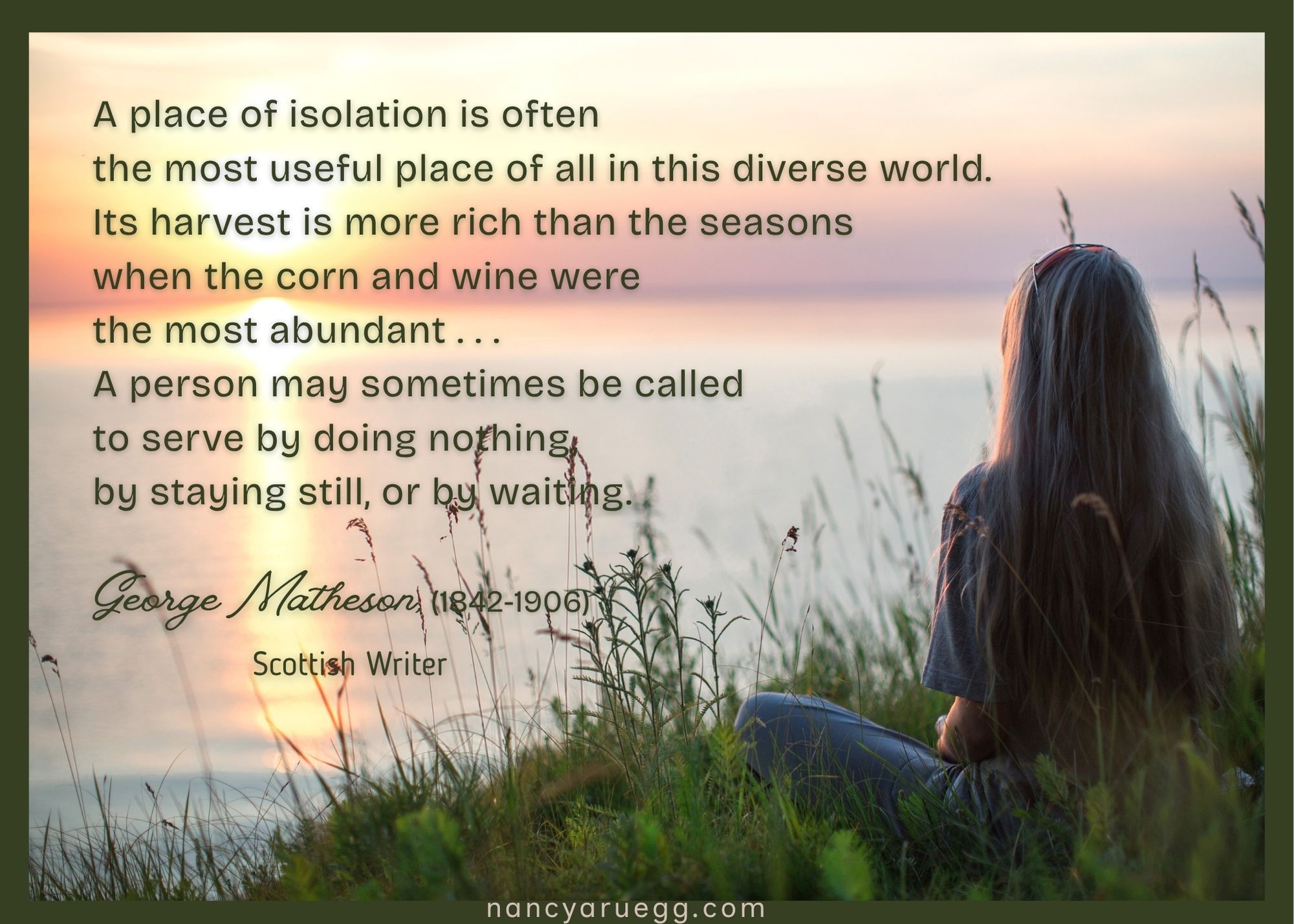
Let’s choose to sit for a spell by the Rock of our salvation, and absorb in our spirit the soft quiet that hovers in the heavenlies around us (Ephesians 1:3).

*     *     *     *     *     *     *     *     *     *

Now it’s your turn! How do you make time for quiet? How has stillness before God impacted your life? Have you found ways to quiet the inner noise that interferes with focusing on God?

Please share in the comment section below!


[1] The last eight words based on a line from Sara Teasdale’s poem, “Silence.”

[2] https://www.psychologytoday.com/us/blog/what-the-wild-things-are/202501/the-benefits-of-quiet-solitude

[3] Sarah Young, Jesus Calling, 258.

[4] Young, 119.

[5] Young, 161.

[6] Young, 267.

[7] L. B. Cowman, Streams in the Desert, Jim Reimann, ed., 372.

[8] F. Elaine Olsen, Beyond the Scars, 105.

[9] L. B. Cowman, Streams in the Desert, 406.

[10] Linda Dillow, Satisfy the Thirsty Soul, 49.

[11] An impression I recorded one morning not long ago.

Image credits: http://www.pxhere.com; http://www.canva.com (4).

Processing…
Success! You're on the list.

Read Full Post »

‘Won’t be long and we’ll either be the asker or receiver of the question, “What would you like for Christmas?”

Here’s one answer you likely won’t hear: “Give me some tests and challenges, please!”

And yet, in the Bible we find this encouragement written by James, the half-brother of Jesus:

What could he possibly have meant? How can tests and challenges be considered gifts?

And then we might remember the saying, “What doesn’t kill you makes you stronger.”

James does mention strength that comes from perseverance, contributing to maturity and spiritual competency (v. 3). But difficult circumstances produce even more, including these ten aspects of the gift of trials:

GREATER GODLINESS

Pressure will make us into the kind of people God wants us to be—more responsive to him, more like him [1]. (And isn’t that who we want to be also?)

HEIGHTENED AWARENESS OF GOD’S PRESENCE

In the darkness of adversity, we’re able to see more clearly the radiance of his face. It happens as we spend time with him, and he ministers to us [2].

INCREASED SPIRITUAL POWER

God creates more friction when he desires to create more power in our lives [3].

Think of Joseph’s trials before becoming prime minister of Egypt, or David’s troubles while on the run from King Saul, or Jonah’s suffering in the belly of the great fish before preaching in Nineveh.

STRENGTHENED CONFIDENCE

Trouble strengthens our confidence that with God, we can endure whatever difficulties the future may hold [4].

A CLEARED PATHWAY

Some storms come, not to disrupt our lives, but to clear our path [5].

For example, a young couple we know put an offer on a house they really liked, but the sale fell through. Highly disappointing, of course, but that cleared the path for a better-suited home at a better price.

And during the season of waiting, they learned lessons in faith and perseverance.

ENHANCED EMPATHY

The pressure we endure helps us understand the challenges faced by others, equipping us to empathize and help [6].

ETERNAL INFLUENCE

God will make our sacrifice of suffering count for all eternity [7]. The person who serenely trusts God to bring good out of their pain demonstrates the power of faith and draws others to Christ.

SWEET DISCOVERIES

“It is often through the most difficult trials that God brings the sweetest discoveries of himself” [8].

During a particularly trying season, I sensed God next to me in the car every day while driving to the school where I taught. His sweet presence was so palpable I sometimes had to blink away tears.  

A SIGN OF VALUE

Trials indicate we’re precious to God. Otherwise, why would he spend so much time and energy perfecting us [9]?

ENHANCED JOY

Paul wisely advised we think on those things that are excellent and praiseworthy [10], turning our minds from what hurts to what helps—gratitude. To do so magnifies our joy, even during troublesome times.

These bits are from my gratitude journal:

  • An hour-plus of fun with the toddlers at church. Who can think about troubles when playing with little ones?
  • Six different species of birds, frolicking in the backyard trees–a veritable circus to enjoy.
  • The prayer of a friend that warmed the heart and lifted the spirit
  • The treasure of family, whose love and support are especially meaningful during stressful times
  • The good medicine of laughter. I texted our younger son that his third niece had taken her first steps. “I don’t understand what the big deal is,” he wrote back. “I’ve been doing that for years!”

And there you have it. Ten facets of the sheer gift that tests and challenges bring into our lives—all wrapped in God’s unfailing love.

The question is, will we receive it?


[1] Selwyn Hughes, Every Day Light, 142; Romans 12:1; 2 Corinthians 3:18

[2] Sarah Young, Jesus Calling, 361; Psalm 89:15-17a

[3] Based on an A.B. Simpson quote.

[4]Sarah Young, Jesus Always, 152; Philippians 4:13 AMP

[5] Unknown.

[6] A.B. Simpson, quoted in Streams in the Desert, 197; Philippians 1:6 AMP

[7] F. Elaine Olsen, Beyond the Scars, 163.

[8] L. B. Cowman, Streams in the Desert, Jim Reimann, ed., 143.

[9] L. B. Cowman, 77.

[10] Philippians 4:8

Image credits: http://www.canva.com (4); http://www.stockcake.com.

Processing…
Success! You're on the list.

Read Full Post »

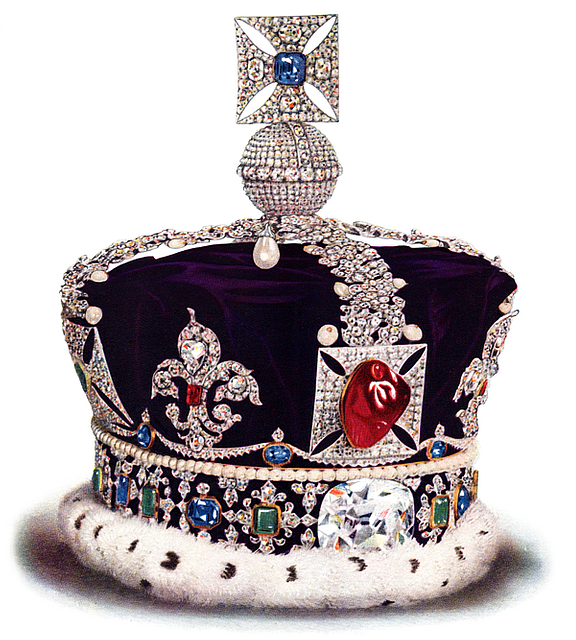
In 1937, the Imperial State Crown of England was created for the coronation of King George VI. It is inarguably one of the most beautiful in the world.

The number of jewels staggers the imagination. Among them: eleven emeralds, seventeen sapphires, 269 pearls, and 2868 diamonds [1].

Front and center, just above the ermine band, sits the largest diamond—the “Star of Africa II, weighing 317.4 carats. (“Star of Africa I,” which is even larger, sits atop the British royal scepter.)

Puritan preacher and author, Thomas Watson (1620-1686), named one of God’s attributes as the most sparkling jewel of God’s crown. But before I reveal his answer, which of God’s quality traits would you consider his “attribute of attributes?”

  1. Love
  2. Holiness
  3. Power
  4. Infinitude

Watson chose B, perhaps because of the word’s meaning: separate and set apart. God is completely removed from every other creature, given his omnipotence, omniscience, and omnipresence. In addition, he is perfect in purity, goodness, faithfulness, and so much more.

In heaven the seraphim (fiery angels!) continually celebrate God’s holiness. The prophet Isaiah heard them saying:

The Apostle John, during his vision of heaven, heard a similar chant [2].

We can’t help but notice the repetition of holy three times, and if you’re like me, that makes us curious. Why three times?

First, “holy” in triplicate may seek to honor each Person of the Trinity: Father, Son, and Spirit.

Second, repetition indicates emphasis.

The ancient Hebrew language included no punctuation, no bold print, no way to indicate greater importance. When writers wanted to highlight something, they’d repeat it.

Other examples would include:

  • In Genesis chapter one “God saw that it was good” is repeated six times.
  • 1 Kings 9:26-10:29 includes the word gold fifteen times to emphasize King Solomon’s wealth.
  • Psalm 130:6 offers heartfelt longing: “I wait for the Lord more than the watchmen wait for the morning, more than watchmen wait for the morning.”
  • Psalm 136 includes “His love endures forever” twenty-six times.
  • In Ezekiel 21:27, the prophet related God’s soon-coming judgment on Jerusalem—“A ruin! A ruin! I will make it a ruin!”

But nowhere in scripture do we see a triple-repetition of an attribute for anyone but God and only for this one attribute [3]. God’s holiness is superlative; he is infinitely holy. And that holiness impacts everything else about him.

His love is holy love. His power is holy power. His justice is holy justice. All his attributes are characterized by purity and splendor beyond those of anyone else.

Gaze upon the crowning jewel of God’s holiness and be overcome with awe and reverence, as well as “a sense of our incredible, desperate need for a fresh infusion of who He is”—because he’s instructed us to be holy too [4].

“Oh, I can’t do that,” someone will say. “Even at my age I still do and say things I shouldn’t, and then leave undone the things I should do. Being holy is impossible!”

Here’s what that person doesn’t understand:

“What God’s truth demands; His grace will provide.” “Faithful is he that calls, who also will do it” [5].

The more we expand our awareness of God’s holiness, the more honor and respect we’ll long to give him through obedience—obedience that he rewards with blessing.

Just how do we expand that awareness? Through Bible study that instructs, prayer that empowers, worship that inspires, and practicing his presence that encourages.

*     *     *     *     *     *     *     *     *     *

Holy God, who is like you? You are majestic in holiness beyond my comprehension; you are awesome in glory that takes my breath away. Every moment you are continually working wonders. There is no one holy like you! There is no one besides you!

I praise you, Father, for working your holiness into my spirit, enabling me to reflect your holy love, your holy goodness, your holy compassion to those around me. Empower me this day, I pray. AMEN.

(Exodus 15:11; 1 Samuel 2:2; Philippians 2:13)


[1] https://www.rct.uk/collection/31701/the-imperial-state-crown

[2] Revelation 4:8

[3] James MacArthur, Gripped by the Greatness of God, 28.

[4] MacArthur, 31.

[5] Francis Frangipane, Holiness, Truth, and the Presence of God, 23; 1 Thessalonians 5:24

Images: http://www.picryl.com; http://www.flickr.com; http://www.canva.com; http://www.rawpixel.com; http://www.heartlight.org; http://www.dailyverses.net; http://www.canva.com.

Processing…
Success! You're on the list.

Read Full Post »

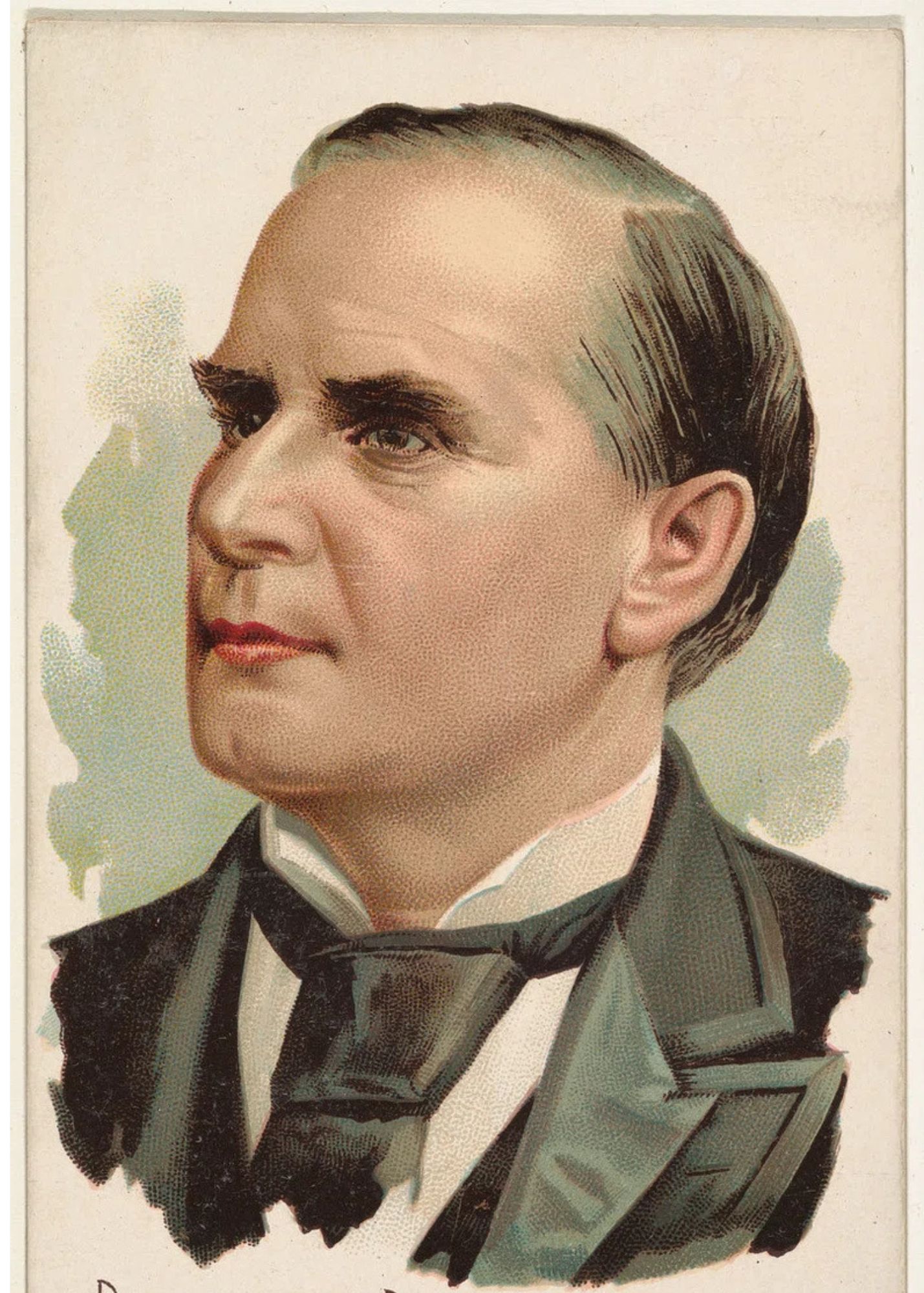
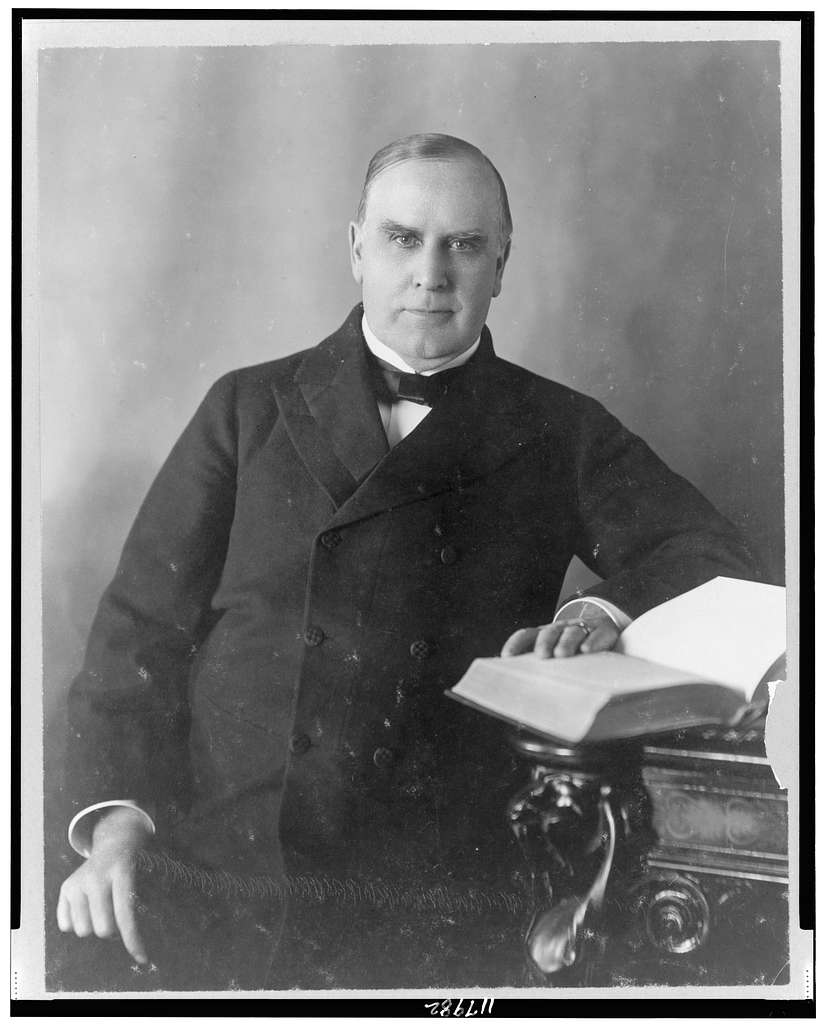
Nineteen-year-old William hunkered low in the mule-drawn wagon he drove, to avoid the bullets whizzing over his head.

Once he reached the front lines of his Ohio regiment, William and a few others began serving up tin plates of warm food and cups of hot coffee to the hundreds of soldiers—using the wagon as a shield.

The mission required numerous trips, but William did not stop until everyone had been fed.

No one had told the young commissary sergeant to attempt the undertaking. William took it upon himself, knowing that after three days of heavy fighting and not much breakfast, the men would be exhausted and famished.

His action during this crucial battle at Antietam, Maryland, may have helped turn the tide against the Confederates, who soon retreated back to Virginia.

William continued to distinguish himself as the Civil War wore on, living out his Christian faith with courage, compassion, integrity, and more. He earned the rank of major before General Lee surrendered in April, 1865.

William, 1865

Several years before William had proclaimed at his baptism, “Here I take my stand for life” [1].

Stand he did.

William read the Bible daily, testified to his faith, and lived a moral life. He also sought God’s guidance when making decisions [2].

After the war William returned to Ohio, becoming a lawyer in 1867. He garnered respect as an outstanding prosecuting attorney.  

Leaders in the Republican Party noted his intelligence, winning personality, and integrity. They drafted him to run for the U.S. Congress in 1876, and William won. He served fourteen years, distinguishing himself on the Ways and Means Committee [3].

In 1890, however, William’s re-election bid failed due to gerrymandering. His district suddenly included three thousand more Democratic voters. Still, he lost by only three hundred votes.

Some may have thought they’d stymied William’s political career. Instead, he received a promotion, elected as Ohio’s governor in 1891. His success in that position led to an easily-won second term.

In June of 1896, the Republic Convention named William McKinley, Jr. as their presidential candidate. He won the popular vote and the electoral college.

In his first inaugural address, William repeated the oath administered to him. Then he added:

“This is the obligation I have reverently taken before the Lord this day. To keep it will be my single purpose and prayer . . .

“ . . . faith teaches that there is no safer reliance than upon the God of our fathers . . . who will not forsake us so long as we obey His commandments and walk humbly in His footsteps” [4].

One of McKinley’s most difficult decisions occurred in 1898: what to do about the Philippines after the Spanish-American War. Should he:

  • Affirm their independence, which would lead to chaos and misrule due to dire instability?
  • Allow a European power to take control?
  • Or make the Philippines a U. S. Territory to prevent exploitation?

The last option would require financial investment from America, and some Filipinos would certainly resist American-annexation [5].

To a group of church leaders at the White House, McKinley later shared:

“The truth is, I didn’t want the Philippines. I did not know what to do.  . . . I sought counsel from all sides—Democrats as well as Republicans—but got little help.  . . .

“. . . I walked the floor of the White House night after night . . . and am not ashamed to tell you I went down on my knees and prayed Almighty God for light and guidance more than one night. And one night late it came to me this way.”

William explained the Philippines clearly needed help and the United States should “by God’s grace do the very best we could by them as our fellow-men for whom Christ died.

“And then,” William concluded, “I went to bed, and went to sleep and slept soundly [6].

In 1900, McKinley easily won a second term, the first president to do so since Grant in 1872.

But on September 6, 1901, an anarchist, Leon Czolgosz, shot the president in the abdomen. Immediately, men nearby wrestled the assailant to the ground.

William instructed, “Don’t let them hurt him.” And then to his secretary, “My wife—be careful how you tell her—oh, be careful” [7].

Even in extreme crisis, William displayed honorable Christian character.

For eight days he lingered; the nation hoped and prayed for recovery. But as William grew increasingly weak, he told his doctors, “It is useless, gentlemen. I think we ought to have a prayer.”

Later the president recited from his favorite hymn, “Nearer My God to Thee.”

And finally William spoke his last words: “Good-bye, good-bye all. It is God’s way. His will, not ours be done” [8].

President McKinley did indeed stand tall on his Christian faith, from the day he first proclaimed it until his dying breath.


[1] https://www.tribtoday.com/news/local-news/2018/11/methodist-faith-affected-mckinleys-life/

[2] www.tribtoday.com

[3] https://www.whitehousehistory.org/the-life-and-presidency-of-william-mckinley

[4] https://courierheraldtoday.com/william-mckinley-american-patriot-and-man-of-faith/

[5] https://shec.ashp.cuny.edu/items/show/878

[6] www.preachingtoday.com

[7] https://gentlereformation.com/2024/02/19/the-last-words-of-william-mckinley/

[8] www.gentlereformation.com

Additional source:

https://www.britannica.com/biography/William-McKinley

Image credits: http://www.picryl.com; http://www.commons.wikimedia.org; http://www.canva.com; http://www.rawpixel.com (2); http://www.picryl.com (2).

Processing…
Success! You're on the list.

Read Full Post »

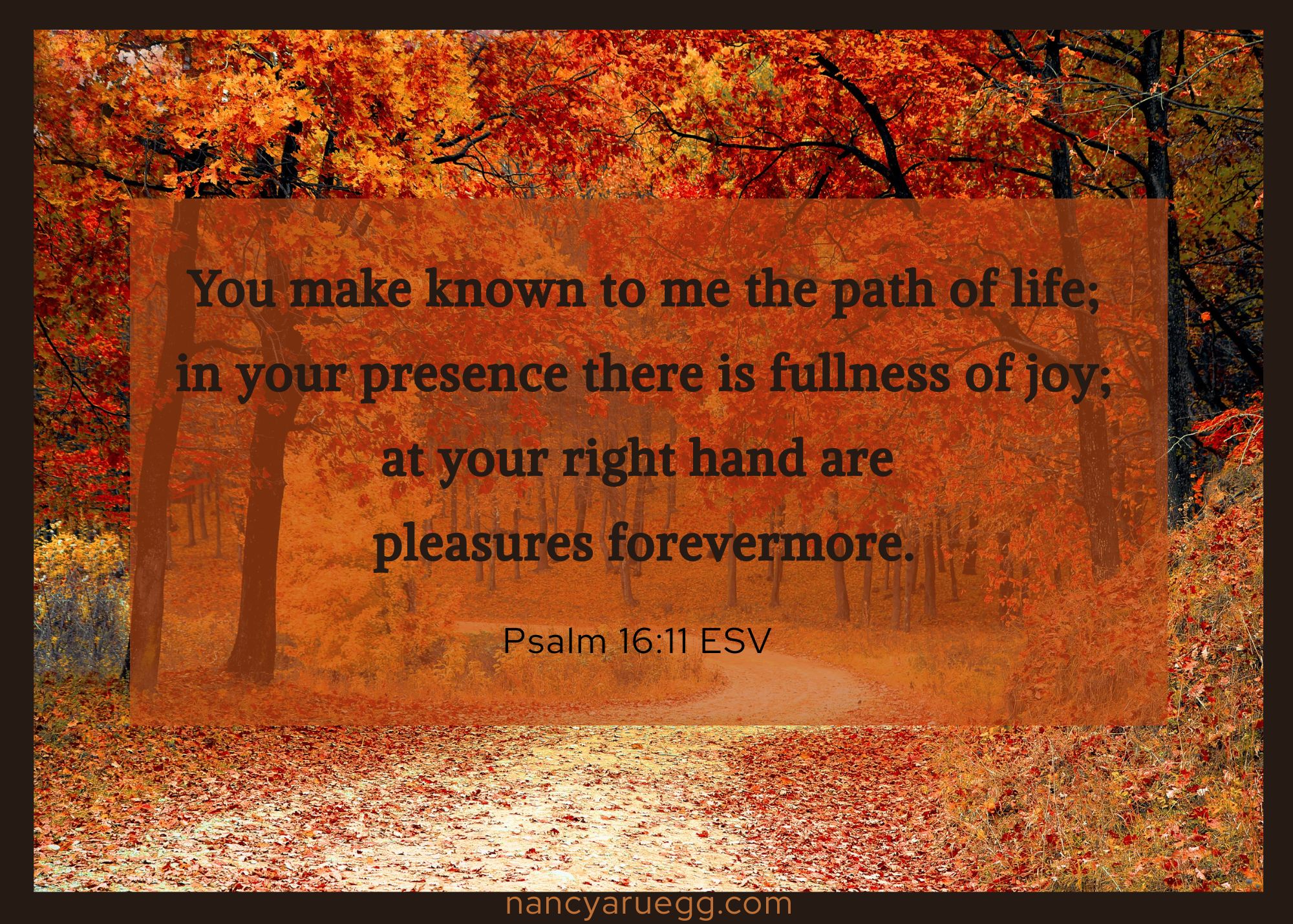
Doesn’t that sound perfectly blissful—fullness of joy? According to the verse above, that kind of joy can be found in the presence of our Heavenly Father, at his right hand of favor.

That’s because, “There has never been a parent on earth who wants joy for his or her children as much as your Father in heaven wants joy for you, his child” [1].

To that end, God has provided numerous ways for us to experience his joy—all augmented as we share in each pleasure with him.

Just for fun, I took that phrase fullness of joy and challenged myself to create an acronym from its letters, to name some of the joy-makers our Heavenly Father provides. Then I dressed up each statement with the best-fitted quotes I could find:

F oster your relationship with God; F east on a world filled with his wonders (Psalm 92:4).

“When I am consciously aware of him,

life fills with wonder and wonder brings joy” [2].

U se time, gifts, and talents to bless others (Proverbs 11:25).

“In spreading my joy, God restored ME. MY JOY WAS FULL!

. . . As we pour out ourselves for others,

we ourselves are renewed” [3].

L ive in community with other believers (Psalm 133:1).

“When large numbers of people share their joys in common,

the happiness of each is greater

because each adds fuel to the others’ flame” [4].

L ift your voice in prayer (John 16:24).

“When I think upon and converse with Thee,

ten thousand delightful thoughts spring up,

then a thousand sources of pleasure are unsealed,

then a thousand refreshing joys spread over my heart,

crowding every moment with happiness . . .

I love Thee above the powers of language to express” [5].

N ourish your spirit with scripture (Psalm 19:8).

“[The Bible] is a mine of wealth, a paradise of glory,

and a river of pleasure” [6].

E xperience God’s presence (Psalm 21:6).

“The difference between tears and laughter

is found in being aware of the presence of God” [7].

S pend time outdoors, reveling in creation (Psalm 104:24-25).

“Time outdoors accomplishes a three-fold blessing:

better health, better mind, and better spirit” [8].

S ing (Psalm 100:1)!

“Nothing is more indicative of a fulfilled life,

a contented soul, and a happy heart

than the expression of song” [9].

O ffer encouragement to others (Proverbs 11:25).

“When someone does something good, applaud—

you’ll make two people happy” [10].

F ill your heart with gratitude (Psalm 9:1-2).

“Joy doesn’t cause us to be grateful;

joy is born out of our gratitude” [11].

J ump for joy–because sometimes you have to reach for it (Psalm 28:7)!

“Begin to rejoice in the Lord,

and your bones will flourish like an herb,

and your cheeks will glow

with the bloom of health and freshness.

Worry, fear, distrust, care—all are poisonous!

Joy is balm and healing,

and if you will but rejoice, God will give power” [12].

O ffer praise for who God is (Psalm 145).

“As I decreased my praise time, my joy also decreased.

I found out that when I made a habit

of intentionally giving God the praise he deserves,

I appreciated life so much better” [13].

Y ield to God’s ways, designed for our good that we may prosper (Psalm 19:7-8).

“The ultimate purpose of obedience is joy” [14].

By way of these Joy-Makers and more, we can experience the fullness of joy God wants to bring to our lives—the kind that permeates each moment as we abide in his presence.

(P.S. Continue your praise, guided by the free resource offered below as part of our newsletter!)


[1] Timothy Keller, Prayer: Experiencing Awe and Intimacy with God, p. 238.

[2] Deanna Chadwell, contributor to Soul Bare, 83.

[3] Barbara Johnson, Pack Up Your Gloomies in a Great Big Box, 197.

[4] St. Augustine, Confessions.

[5] From a Puritan prayer included in Valley of Vision by Arthur Bennett.

[6] Anonymous.

[7] Beth Moore, Believing God Bible study workbook, 44.

[8] F. Elaine Olson, Peace for the Journey, 191.

[9] John MacArthur, Ephesians, 256.

[10] Sam Goldwyn.

[11] Brother David Steindl-Rast.

[12] A. B. Simpson.

[13] Thelma Wells, contributor to Boundless Love, 231.

[14] Timothy Keller with Kathy Keller, Songs of Jesus, 199.

Image credits: http://www.canva.com; http://www.stockvault.net (Mohamad Hassan); http://www.pexels.com (Mattheus Bertelli); http://www.publicdomainpictures.net; http://www.freerangestock.com; http://www.commonswikimedia.org (Jason Clendenen); http://www.stockcake.com.

Processing…
Success! You're on the list.

Read Full Post »

Still Traveling

Impressions Becoming Expressions

Living Our Days

Gaining a heart of wisdom

He Said What?!

I'm Patty, and my husband and I are living with our adult son who has autism and epilepsy. I love sharing lessons learned from life around me, especially life with Aaron.

Meditations of my Heart

Impressions Becoming Expressions

Linda Stoll

Impressions Becoming Expressions

Debby Thompson

Impressions Becoming Expressions

Signora Sheila

Notes on Life, Faith & Italy

Colleen Scheid

Writing, Acting, Living in God's Love

Mitch Teemley

The Power of Story

Heidi Viars

Finding the Image of God