Feeds:
Posts
Comments

Archive for October, 2023

David Bussau sat with three of his teenage friends in the dining hall of Sedgley Boys’ Home, an orphanage in New Zealand.

“How’d you guys like to work for me?” he asked.

David had lived in the orphanage himself until recently. Now he was out on his own, living at a boardinghouse. But David had prepared for this eventuality, saving money from odd jobs while living at Sedgley.

Currently he was running his own hot dog stand, and now he was ready to expand. With the help of his friends, David became proprietor of three hot dog stands, then two other food stands, followed by a bakery, and a pancake company. David improved each business and sold them for a substantial profit.

In 1965 at age 25, David married Carol Crowder, a girl from his church. Not long after they moved to Sydney, Australia.

Sydney, Australia 1960s

David found work as a construction foreman, and quickly learned the business. Before long he was part-owner of the company.

Over the next ten years, the Bussaus became parents to two daughters. His boss retired and David purchased his shares of the company. Soon he owned three construction companies, and reached the status of millionaire—before his thirty-fifth birthday.

David knew money wouldn’t satisfy. He wanted to live on enough and use his God-given wealth and talent as an entrepreneur to serve others. But how?

In 1974 a cyclone devastated Darwin, Australia. David and twenty volunteers traveled two thousand miles to help with reconstruction.
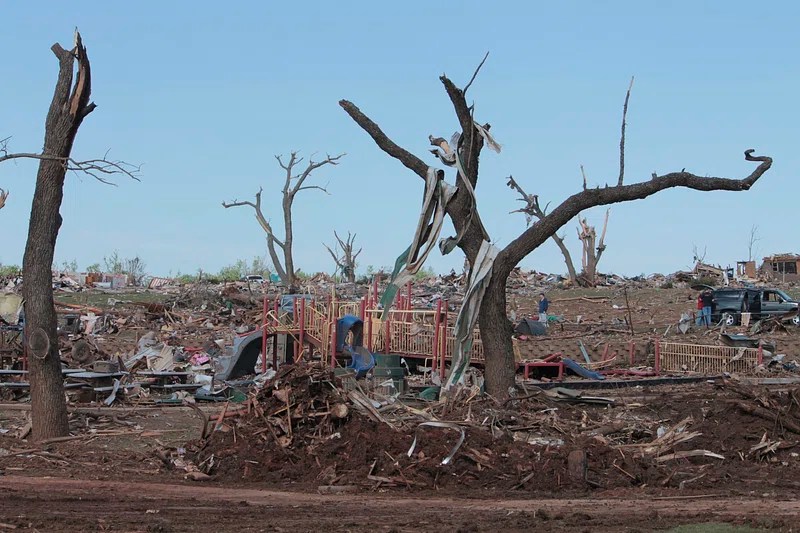
Of course, several weeks of work made little difference. So David made arrangements for his businesses in Sydney to carry on without him and moved his family to Darwin. In addition to supervising construction crews, David raised funds throughout Australia for the flattened city.

By 1976 Darwin was nearly rebuilt, and the Bussaus’ pastor in Sydney presented them a new opportunity in Bali, to rebuild a church destroyed by earthquake. Their answer: yes.

“This was my first real exercise in faith,” David said later. “Even when I’m out of my depth I like to take on a challenge. I jumped into it trusting and believing that God would redeem if I screwed up.” [1]

In the remote village of Blimbingsari, the Bussaus lived in a thatch-roofed home with no electricity, running water, or phone. But the community of one thousand Christians were willing to work hard to have a church again.

Water was the top priority, in order to make concrete for a sturdy structure. But bringing water to the village meant bypassing two Hindu villages. David and his crew built a dam and laid pipe, providing water to them first.

That project yielded another blessing. Now the villagers could irrigate their rice fields and harvest twice a year, not just once. 

While working toward church construction, David learned of the systemic debt plaguing the rice farmers. Landowners required sixty percent of the crop as rent; the remaining proceeds didn’t cover most families’ expenses. 

They often mortgaged their children to manage mounting debts, but it was rarely enough.

David created a solution: micro-financing. He began with his interpreter, Ketut, whose wife knew how to use a sewing machine.  

David lent them fifty dollars to purchase an old one. They sold the crafted items in surrounding villages, and as the business grew Ketut paid back the loan.

Even better, they made enough to buy a second machine and hire another worker. Before long Ketut and his family were ready to diversify. They opened an import/export business as well as a taxi service, employing more community members.

And so began the villagers’ escape from chronic debt into sustainable, successful businesses.

When the church was complete, village leaders asked the Bussaus to stay and help build a hotel. People could then be trained to work in the growing tourist industry.

David and Carol agreed. (Their two daughters loved living in Bali, making the decision even easier.)

To further develop his ability to provide micro-loans, David founded a non-profit organization called “Maha Bhoga Marga”— “The Way of Prosperity.” Over the decades he’s founded seventeen international ministries.

David also joined forces with a colleague to form Opportunity International (O.I.). As of 2021, it has served over 18 million clients in thirty countries. [2]

An O. I. savings and loans ready to open in Ghana, 2011

“O. I. creates a job in the developing world every thirty seconds, and they estimate that every permanent job created directly lifts six people out of poverty.” [3]

David explains their success: “Our original intent wasn’t to set up an international organization, it just grew. That’s the way God works. [When you] do what He puts in front of you, the more doors He opens up. The result is that God is glorified through it.” [4]

Now in his eighties, David still travels internationally, furthering the work God gave him to do: bringing people out of poverty one micro-loan at a time and glorifying God through it.


[1]  https://www.issuu.com/opportunity/docs/oia_agency_issue08

[2] https://opportunity.org/content/News/Publications/Annual%20Report/annual-report-2021/annual-report-2021.pdf

[3] https://www.hopechannel.com/read/david-bussau-creates-opportunity

[4]  https://www.issuu.com/opportunity/docs/oia_agency_issue08

Other sources:

https://christiantoday.com.au/news/cma-courageous-leadership-conference-melbourne-and-interview-with-micro-finance-pioneer-david-bussau.html

https://www.discoverwalks.com/blog/australia/top-10-sensational-facts-about-david-bussau/

https://opportunity.org/news/blog/2021/december/back-to-the-beginning-david-bussau

Photo credits: http://www.commons.wikimedia.org; http://www.rawpixel.com; http://www.flickr.com; http://www.commonswikimedia.org; http://www.rawpixel.com; http://www.commonswikimedia.org (2).; http://www.piqsels.com.

Read Full Post »

Next to the Word of God, music deserves the highest praise.

She is the mistress and governess of those humble emotions . . .

which control men or more often overwhelm them . . .

Whether you wish to comfort the sad, subdue frivolity,

encourage the despairing, humble the proud,

calm the passionate, or appease those full of hate . . .

What more effective means than music could you find?

–Martin Luther

Many of you know the name Martin Luther, the great monk-become-reformer who took issue with the Catholic hierarchy on a number of doctrinal matters and church practices. He subsequently became the founder of Protestantism in the 1500s.

Luther and like-minded individuals faced persecution, exile, and even martyrdom for their scripture-based beliefs. Their concerns included:

  • Requiring indulgences (monetary payments) to the church for the forgiveness of sins (Ephesians 2:8-9)
  • Reserving the reading, interpreting, and teaching of the Bible to only priests (Psalm 1:1-2)
  • Not giving precedence to the true treasure of the church: “the most holy gospel of the glory and grace of God” (Philippians 3:7-9).

During those dark times of persecution, Martin Luther may well have written his best-known hymn, “A Mighty Fortress Is Our God.” (No one knows exactly when he composed it.)

The lyrics present a bold proclamation of faith, celebrating God’s sovereign power over all earthly and spiritual forces, and the hope we possess because of Christ.

We too face dark times as contemptible powers threaten to undo our brothers and sisters of faith abroad and (on a lesser scale for now) here in the U.S.

Across the centuries, Luther’s hymn offers timely encouragement, comfort, and strength.

One way to augment the impact of such rich and meaningful lyrics is to rewrite them in our own words as a prayer. In the process we can learn the meanings of words (like bulwark and Sabaoth in this hymn), find scriptures that affirm the lyrics, and extrapolate with related thoughts of our own.

Of course, there’s no need to makes rhymes, or fit our meditation to the tune!

What follows is one example of such an exercise:

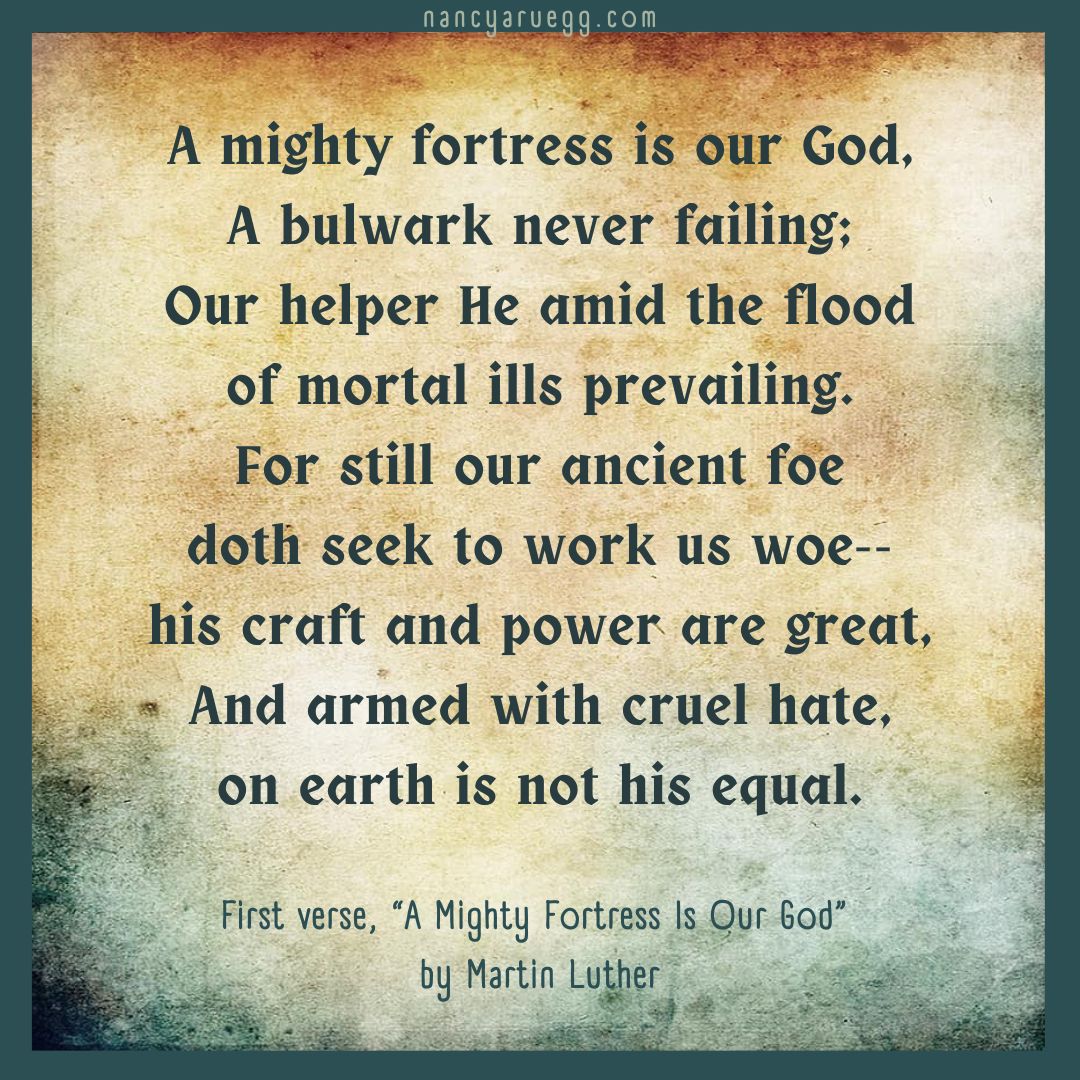
Verse 1:

I praise You, O God, for being like a mighty fortress.

You are our bulwark—an impenetrable wall of defense—

protecting us against the forces of evil in this world.

Satan and his demons do wield considerable power;

they seek to destroy Your work and Your people.

But You, O God, are our Helper and Sustainer

through all the trouble they cause. [1]

Verse 2:

Without You we’d have no hope of victory.

But hallelujah! You’ve provided the Way for us

to triumph over the challenges that beset us.

That Way is our Lord and Savior, Jesus Christ,

the Commander of the heavenly army of angels,

who are obedient to all His commands.

With Him on our side, we can rest secure;

His final victory over evil is guaranteed. [2]

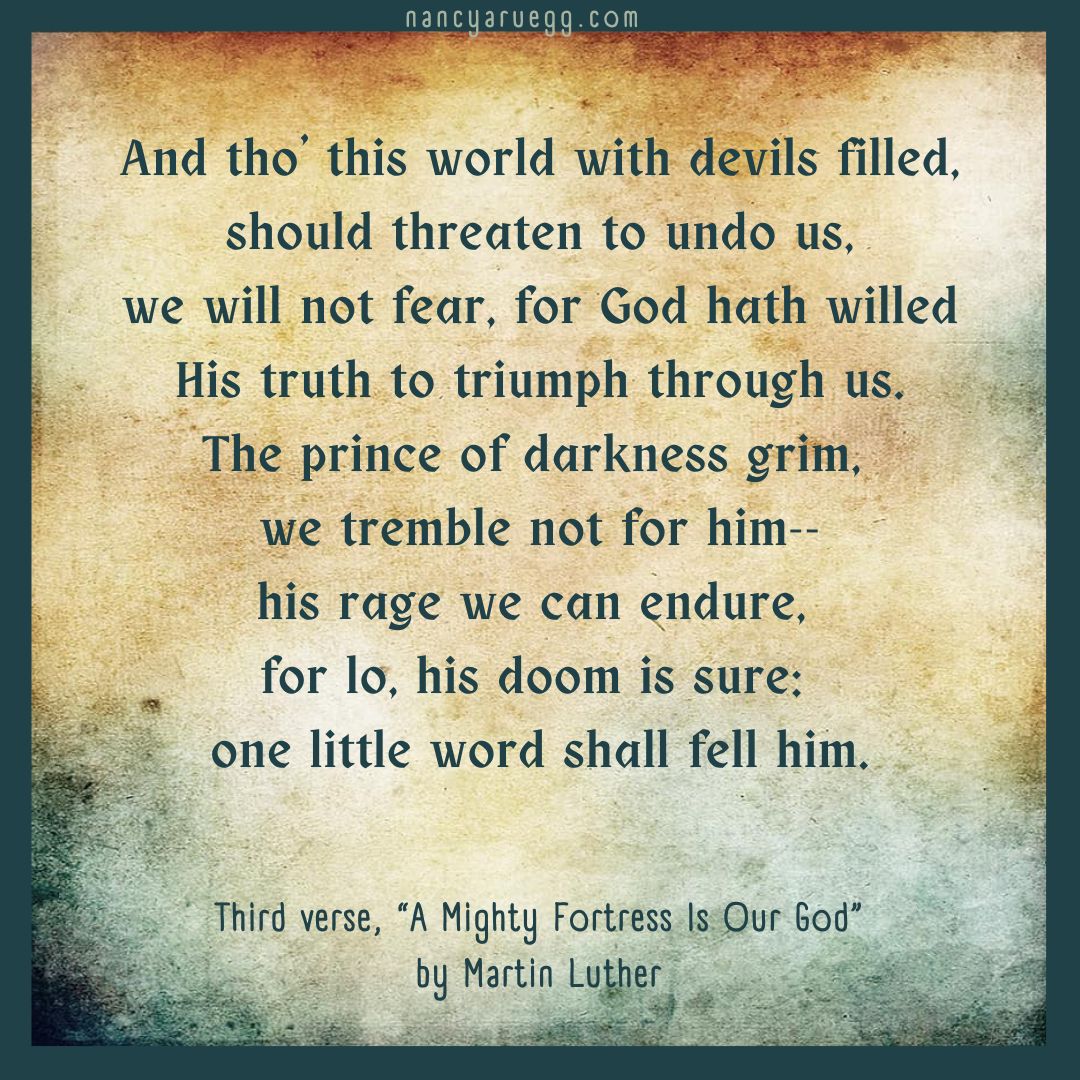
Verse 3:    

I praise You, O God, for Your truth that leads to triumph—

the truth of Your Word, with all its promises and principles—

it is our weapon of resistance that makes the devil flee.

One day his power will be broken. He’ll be exposed

for who he is: a cruel deceiver. But even now,

as he strives to poison the hearts of humanity with

self-centeredness, greed, hatred, and more,

we can crush his efforts with one little word: “Liar!” [3]

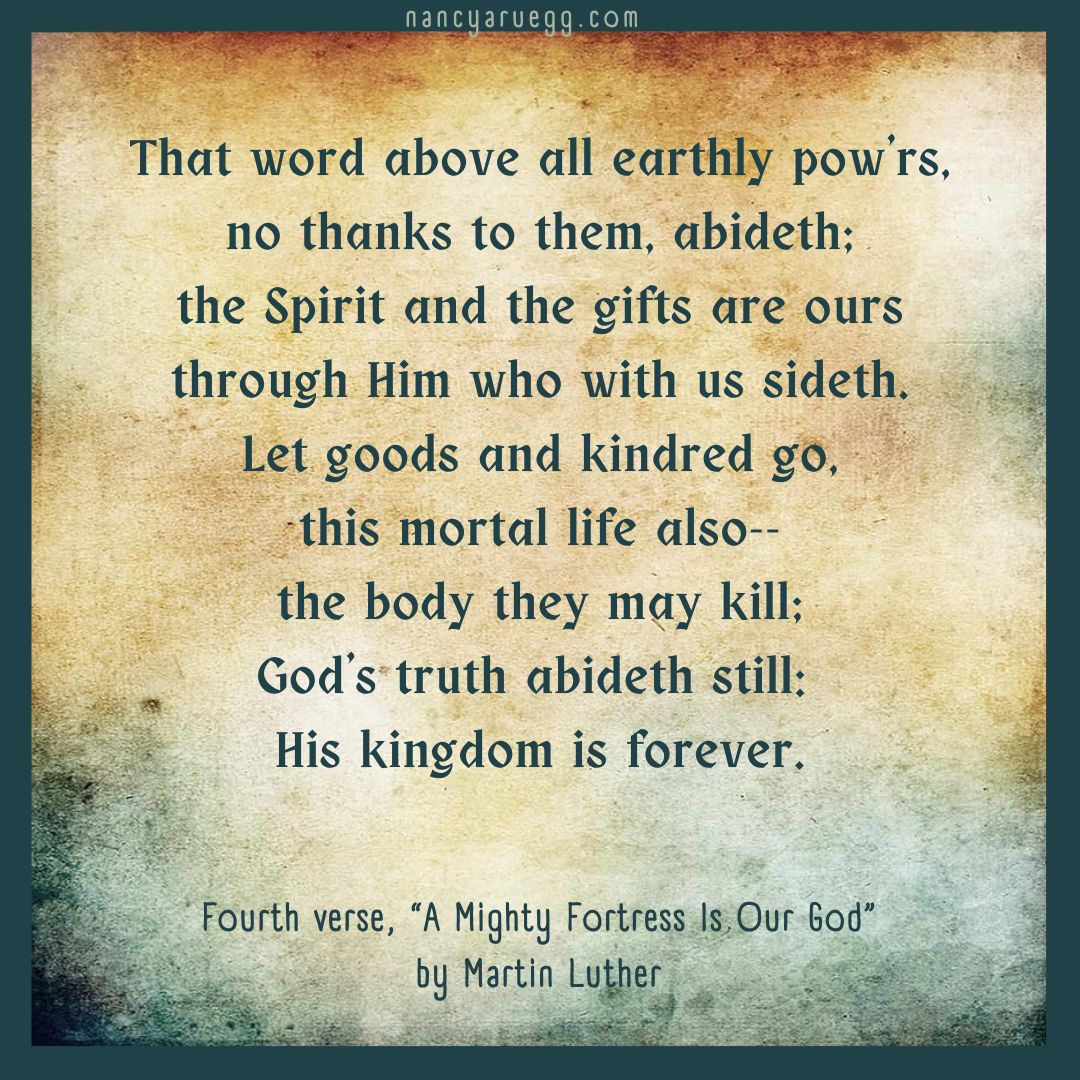
Verse 4:

Yes, earthly powers oppose You and try to nullify your Word.

But their wicked deeds have always come to naught and always will.

We praise You for bestowing within us Your Spirit and His gifts,

Your presence at our side. We have no need to fear.

Help us hold lightly those things dear to us—even people.

Help us keep an eternal perspective on life.

May we courageously face death—faith-filled and with joy,

because we trust Your unfailing Word. Your kingdom is forever! [4]

*     *     *     *     *

In a world full of turmoil and uncertainty, Lord, we look to You—our mighty bastion of strength, help, hope, truth, and empowering presence. AMEN!


[1] Psalm 62:2; 2 Thessalonians 3:3; Genesis 3:1-6; 2 Timothy 4:18.

[2] Psalm 3:1-3; Romans 8:31-39; 1 Peter 1:20; Psalm 103:20-21; Revelation 19:11-16

[3] Bryce Young, https://www.desiringgod.org/articles/what-one-little-word-will-fell-satan and 1 John 2:15-17; Isaiah 41:13-14; Deuteronomy 31:8

[4] Psalm 103:19; Matthew 24:35; Ephesians 4:11, 5:18; Matthew 10:37, 10:28; Psalm 145:13

Art credits: Luther portrait, http://www.commons.wikimedia.org. Sunrise image, http://www.canva.com. Soldiers, http://www.picryl.com. Parchment background, http://www.pickist.com.

Read Full Post »

According to American theologian R. C. Sproul (1939-2017): “Prayer does change things, all kinds of things. But the most important thing it changes is __________ [1].”

What would you put it the blank? A few possibilities include:

  1. The lives of those we pray for
  2. The way events unfold
  3. The attitudes and perspective of those prayed for
  4. Us—the people doing the praying

Sproul wrote, the most important thing prayer changes is us.

Author and Bible teacher Kay Arthur (1939- ) wrote similarly: “You cannot spend time in prayer, even intercessory prayer [for others], and not have it impact you personally [2].”

Such statements as these beg the question how. How could our prayers for others affect us?

One possibility comes readily to mind. Praying for others and watching miraculous answers unfold strengthens our faith, which contributes to peace of mind and heart.

On the other hand, in those situations when God chooses to postpone his response and yet we continue to pray, the waiting teaches us patience and persistence.

But might there be more ways intercessory prayer impacts us? A bit of research turned up the following. You may be surprised as I was by how many there are.

Intercessory prayer fosters unity in our hearts with those we pray for. We can even find ourselves growing in compassion and affinity for them.

I’ve prayed for Kiana for a number of years now. We’ve never met; I know very little about this young woman in India and yet love for her has bloomed in my heart just the same. I’m looking forward to meeting Kiana in heaven and hearing her story [3].

Intercessory prayer teaches us selflessness as our thoughts are directed away from ourselves and toward others.

Intercessory prayer changes our perspective as we see our desires for a person or situation shift to what God wants to do. We remember: his expansive plan always includes more benefit than we can perceive [4].

We also acknowledge that even times of pain and trouble produce worthwhile results.

Esther Ahn Kim was a Korean Christian who spent six years in a Japanese prison during Word World II as a result of her faith. No doubt many prayed for her release, and yet freedom wasn’t granted. However, at least two guards and many of Esther’s fellow prisoners became believers in Jesus—because of her [5].

Intercessory prayer shifts our attitudes from fear and anger to peace and calm as we affirm the truth of scripture, including:  

  • Whatever transpires has been allowed by God
  • We will never understand all the workings of God this side of heaven
  • Even suffering achieves purpose [6]

Intercessory prayer develops humility as we acknowledge our limited ability to impact people or circumstances and affirm only God can affect any change he chooses.

Intercessory prayer augments our usefulness and causes spiritual growth.

When Pastor Hendricks learned that Matt T. had been asked to teach the Sunday School class for junior high boys, his eyebrows went up. Matt was just out of college and still had some growing up to do himself.

But before long, Pastor Hendricks began hearing reports of the once-rowdy boys eagerly participating in the class. He invited Matt to lunch and asked about his secret of success.

Matt showed him a little black book with one page for each boy. On each page were comments like, “Having trouble in math,” “comes to church against his parents’ wishes,” and “wants to be a missionary but doesn’t feel capable.” Matt was praying over the pages every day.

Pastor Hendricks observed: When we pray for others, we become more like Jesus. And as we grow, God shows us more, and uses us more [7].

Isn’t that just like our Heavenly Father? Even as we seek to bless others with our prayers, God is also blessing us.

P.S. Please join me in prayer for the suffering people of Israel and the innocents of Gaza. Let’s pray that the perpetrators of evil are thwarted at every turn [8].


[1] The Prayer of the Lord

[2] His Imprint, My Expression, 157.

[3] You can read how I learned about Kiana at https://nancyaruegg.com/2019/12/12/advent-ure/  

[4] Ephesians 2:20

[5] https://www.thegospelcoalition.org/article/esther-ahn-kim-steadfast-in-persecution/

[6] Romans 11:33-36; James 1:2-4

[7] https://www.lifeway.com/en/articles/sermon-prayer-life-of-a-christian-colossians-4

[8] Psalm 125:4-5

Photo credits: http://www.freerange.com; http://www.canva.com; http://www.pickpik.com; http://www.dailyverses.net; http://www.canva.com.

Read Full Post »

On careful scrutiny, we find

that God’s grace-filled fingerprints

are all over our lives.

—Patsy Clairmont [1]

“Amen!” we say, when life is good.

“I’m not so sure,” we may falter, when life is hard.

But our loving Heavenly Father would have us know several truths, before we presume he’s withholding his grace (his favor, generosity, and loving kindness).

First, we need to remember: not one of us deserves his grace.

All of us have compiled a “long and sorry record as sinners”[2] that should result in punishment. 

 And yet he offers grace upon grace [3].

Second, God proved his over-arching favor with one incomprehensible act.

He sent his Son Jesus to die in our place, to pay the debt for our sins, and provide a way to heaven for us.

Our Savior kneels down and gazes upon the darkest acts of our lives. But rather than recoil in horror, he reaches out in kindness and grace and says, “I can clean that if you want.” And from the basin of his grace he scoops a palm full of mercy and washes away our sin.” [4]

Max Lucado

That alone provides a supreme, grace-filled fingerprint upon our lives. But there is more.

Out of his grace, God supplies an abundance.

Of course, a Kempis wasn’t referring to a problem-free life with every desire fulfilled. That’s not what God has promised.

Those of us who’ve known God for a while can attest to the supreme value of such blessings as God’s strengthening presence, inexplicable peace, effervescent joy, unfailing provision, and more.

Our challenge is to see the evidence of God’s grace. The more we look, the more we’ll find.

Fourth, God’s grace works within us to provide great benefit.

He’s graciously shaping us into what is useful and beautiful to him, what is satisfying and fulfilling to us. Not that the process is always agreeable and pleasant.

We’d do well to keep in mind:

Fifth, even when the severest trouble comes, God’s grace will see us through.

The grace of God, which is sufficient, will enable us to make of our troubles the pearls they can become. It is no mere figure of speech. It is something more than a simile to say that one enters heaven through pearly gates. [6]

Peter Marshall

Consider these men who entered heaven through the pearly gates of calamity:

  • Stephen was the first martyr of the Christian faith. There’s no record that he cried out in terror as men threw rocks at him. Instead, scripture tells us he was praying, “Lord Jesus, receive my spirit.”[7]
  • Polycarp became a disciple of the Apostle John. As he faced martyrdom, Polycarp declared: “Eighty and six years have I served Christ, nor has He ever done me any harm. How, then, could I blaspheme my King who saved me? . . . I bless Thee for deigning me worthy of this day and this hour that I may be among Thy martyrs and drink the cup of my Lord Jesus Christ.” Polycarp was burned alive.
  • Matthew Ayairga wasn’t a Christian when he plus twenty believers were captured by ISIS in 2015. These twenty men of strong faith greatly influenced Matthew’s life. When the executioners asked him if he believed in Jesus Christ, Matthew said, “Their God is my God.” The young man was beheaded that day along with the others, but found life with Christ for all eternity [8].

Each of these martyrs discovered:

*     *     *     *     *     *     *     *     *     *

O Sovereign God! We praise you for the grace of your sustaining power. May we recognize more readily your fingerprints of grace, and in the process become more gracious ourselves–more loving, grateful, and obedient to you.

May that growing awareness prepare us to praise you, serve you, and prosper in our spirits—even unto death.


[1] The Best Devotions of Patsy Clairmont

[2] Romans 3:23 MSG

[3] John 1:16

[4] Grace for the Moment, 352.

[5] Keeping the Heart

[6] The Best of Peter Marshall, 89.

[7] Acts 7:59-60

[8] Matthew 10:39

Art & photo credits: http://www.pickpik.com; http://www.canva.com; http://www.pikist.com; http://www.canva.com; http://www.pexels.com.

Read Full Post »

Still Traveling

Impressions Becoming Expressions

Living Our Days

Gaining a heart of wisdom

He Said What?!

I'm Patty, and my husband and I are living with our adult son who has autism and epilepsy. I love sharing lessons learned from life around me, especially life with Aaron.

Meditations of my Heart

Impressions Becoming Expressions

Linda Stoll

Impressions Becoming Expressions

Debby Thompson

Impressions Becoming Expressions

Signora Sheila

Notes on Life, Faith & Italy

Colleen Scheid

Writing, Acting, Living in God's Love

Mitch Teemley

The Power of Story

Heidi Viars

Finding the Image of God