Feeds:
Posts
Comments

Archive for the ‘Excellence’ Category

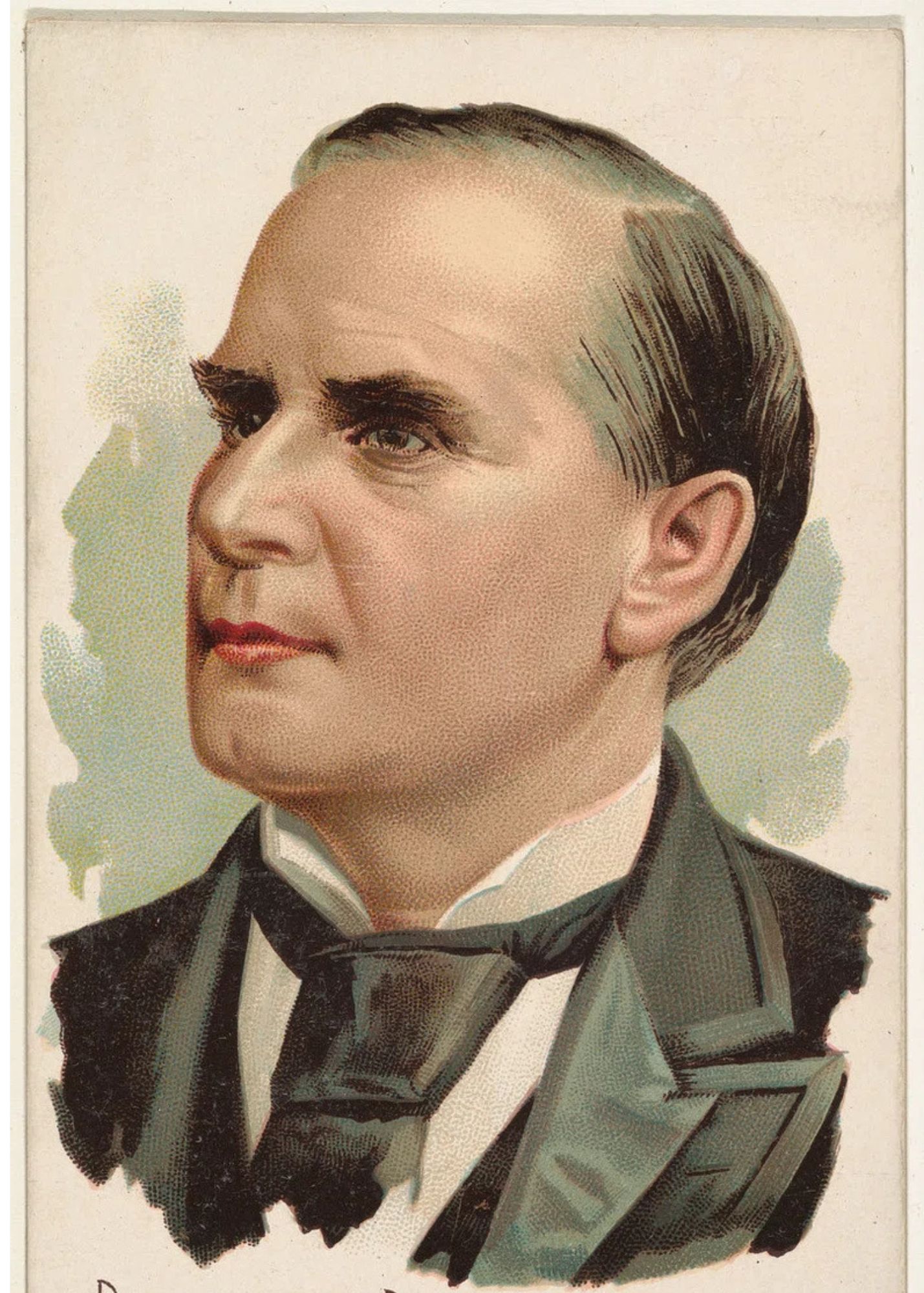
Nineteen-year-old William hunkered low in the mule-drawn wagon he drove, to avoid the bullets whizzing over his head.

Once he reached the front lines of his Ohio regiment, William and a few others began serving up tin plates of warm food and cups of hot coffee to the hundreds of soldiers—using the wagon as a shield.

The mission required numerous trips, but William did not stop until everyone had been fed.

No one had told the young commissary sergeant to attempt the undertaking. William took it upon himself, knowing that after three days of heavy fighting and not much breakfast, the men would be exhausted and famished.

His action during this crucial battle at Antietam, Maryland, may have helped turn the tide against the Confederates, who soon retreated back to Virginia.

William continued to distinguish himself as the Civil War wore on, living out his Christian faith with courage, compassion, integrity, and more. He earned the rank of major before General Lee surrendered in April, 1865.

William, 1865

Several years before William had proclaimed at his baptism, “Here I take my stand for life” [1].

Stand he did.

William read the Bible daily, testified to his faith, and lived a moral life. He also sought God’s guidance when making decisions [2].

After the war William returned to Ohio, becoming a lawyer in 1867. He garnered respect as an outstanding prosecuting attorney.  

Leaders in the Republican Party noted his intelligence, winning personality, and integrity. They drafted him to run for the U.S. Congress in 1876, and William won. He served fourteen years, distinguishing himself on the Ways and Means Committee [3].

In 1890, however, William’s re-election bid failed due to gerrymandering. His district suddenly included three thousand more Democratic voters. Still, he lost by only three hundred votes.

Some may have thought they’d stymied William’s political career. Instead, he received a promotion, elected as Ohio’s governor in 1891. His success in that position led to an easily-won second term.

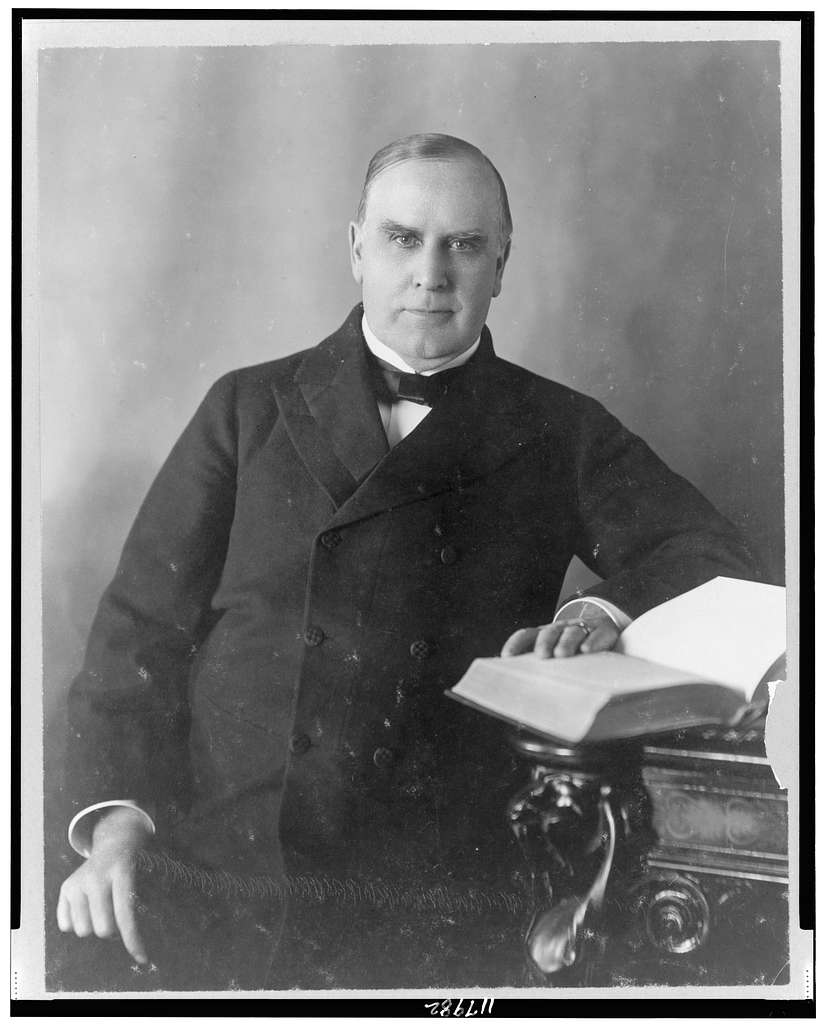
In June of 1896, the Republic Convention named William McKinley, Jr. as their presidential candidate. He won the popular vote and the electoral college.

In his first inaugural address, William repeated the oath administered to him. Then he added:

“This is the obligation I have reverently taken before the Lord this day. To keep it will be my single purpose and prayer . . .

“ . . . faith teaches that there is no safer reliance than upon the God of our fathers . . . who will not forsake us so long as we obey His commandments and walk humbly in His footsteps” [4].

One of McKinley’s most difficult decisions occurred in 1898: what to do about the Philippines after the Spanish-American War. Should he:

  • Affirm their independence, which would lead to chaos and misrule due to dire instability?
  • Allow a European power to take control?
  • Or make the Philippines a U. S. Territory to prevent exploitation?

The last option would require financial investment from America, and some Filipinos would certainly resist American-annexation [5].

To a group of church leaders at the White House, McKinley later shared:

“The truth is, I didn’t want the Philippines. I did not know what to do.  . . . I sought counsel from all sides—Democrats as well as Republicans—but got little help.  . . .

“. . . I walked the floor of the White House night after night . . . and am not ashamed to tell you I went down on my knees and prayed Almighty God for light and guidance more than one night. And one night late it came to me this way.”

William explained the Philippines clearly needed help and the United States should “by God’s grace do the very best we could by them as our fellow-men for whom Christ died.

“And then,” William concluded, “I went to bed, and went to sleep and slept soundly [6].

In 1900, McKinley easily won a second term, the first president to do so since Grant in 1872.

But on September 6, 1901, an anarchist, Leon Czolgosz, shot the president in the abdomen. Immediately, men nearby wrestled the assailant to the ground.

William instructed, “Don’t let them hurt him.” And then to his secretary, “My wife—be careful how you tell her—oh, be careful” [7].

Even in extreme crisis, William displayed honorable Christian character.

For eight days he lingered; the nation hoped and prayed for recovery. But as William grew increasingly weak, he told his doctors, “It is useless, gentlemen. I think we ought to have a prayer.”

Later the president recited from his favorite hymn, “Nearer My God to Thee.”

And finally William spoke his last words: “Good-bye, good-bye all. It is God’s way. His will, not ours be done” [8].

President McKinley did indeed stand tall on his Christian faith, from the day he first proclaimed it until his dying breath.


[1] https://www.tribtoday.com/news/local-news/2018/11/methodist-faith-affected-mckinleys-life/

[2] www.tribtoday.com

[3] https://www.whitehousehistory.org/the-life-and-presidency-of-william-mckinley

[4] https://courierheraldtoday.com/william-mckinley-american-patriot-and-man-of-faith/

[5] https://shec.ashp.cuny.edu/items/show/878

[6] www.preachingtoday.com

[7] https://gentlereformation.com/2024/02/19/the-last-words-of-william-mckinley/

[8] www.gentlereformation.com

Additional source:

https://www.britannica.com/biography/William-McKinley

Image credits: http://www.picryl.com; http://www.commons.wikimedia.org; http://www.canva.com; http://www.rawpixel.com (2); http://www.picryl.com (2).

Processing…
Success! You're on the list.

Read Full Post »

In ancient times, someone noticed that candles held up high extended the light further and made the room brighter. That observation led to an invention.

He (or she!) crisscrossed two small boards, fastened them together, hammered a spike through each of the four ends, and fixed a candle on each spike. Last he suspended the contraption from the rafters [1].

Perhaps something similar to this!

Voilà! The first chandelier was born.

Fast forward to the 1600s. Artisans began producing the first crystal chandeliers that reflected and refracted the light, creating more ambient light than candles alone, not to mention stunning beauty.

1600s rock crystal chandelier, from the Nethercutt Collection, Sylmar, CA

Some designers incorporated mirrors, increasing the luminosity even further.

Louis XIV of France famously ordered numerous chandeliers—forty-three of them—for the Hall of Mirrors at Versailles. Thousands of crystals maximized the light of approximately twenty thousand candles, which was also reflected in the 357 pieces of mirrored glass [2] 

A chandelier offers us a radiant picture of the kingdom of God with the crystals and mirrors representing us. Just as a chandelier glorifies a room with its resplendent light, so we’re called to glorify GOD by reflecting his resplendent light to those around us [3].

But how do we do that? Consider these possibilities:

We Glorify God by Trusting Him (Psalm 147:11)

It must warm God’s heart when his saints keep returning to him for strength and comfort during a difficult season. Such people, calmed by the profound and inexplicable peace of God, stand in beautiful contrast to the angry or anxious around them.

We Glorify God by Enjoying Him (Psalm 96:6-8)

That enjoyment will surely create a noticeable glow of contentment on our faces, as we delight in his mercy, goodness, compassion, and more.

We Glorify God by Letting Him Love Us (Romans 8:35-39)

We may know God loves us, but how often do we rest in his warmth, contemplating his love-gifts throughout the day, like:

  • a multi-hued sunrise
  • the cheery song of a cardinal
  • a friendly wave from a neighbor
  • an uplifting word of encouragement
  • the long-awaited rain pattering on the roof
  • a sweet memory that suddenly comes to mind and makes you smile

This is just a short-list of possibilities. God continually expresses his love. Receive it—no, better yet, revel in it and glorify him for his lavish demonstrations and the grace behind each one.

We Glorify God by Living His Ways (Matthew 5:16)

Years ago a church member told me she’d recently been driving along the main street of our neighborhood and caught up with a car going the speed limit.

“Who goes the speed limit these days?” She laughed and then continued. “But to be honest, I began to get frustrated, because I was in a hurry to get home! And then the car turned down your street and I could see who was driving–your son!

“Imagine: a teenager going the speed limit! I just had to tell you: he’s a good driver, even when he thinks no one’s paying attention.”

E. honored us, his parents, that day, by choosing character over convenience. But better yet he honored God. Without even knowing, he reflected the light of Christ and His character to that church member.

Now imagine the dazzling light-display we can create corporately to glorify God–as we all trust him, enjoy him, let him love us, and live by his ways.

Surely we can even outshine those chandeliers in the Hall of Mirrors!


[1] https://chandelierrental.com/the-history-of-a-chandelier/

[3] James 1:17; Matthew 5:16; 2 Corinthians 3:18

Image credits: http://www.flickr.com (2); http://www.pexels.com; http://www.canva.com (2); http://www.pxhere.com; http://www.publicdomainpictures.net; http://www.pickpik.com; http://www.stockcake.com.

Processing…
Success! You're on the list.

Read Full Post »

Remember the Sesame Street game, “One of These Things Is Not Like the Others?”

See if you can find the misfit in this list of especially nutritious superfoods. One of these things is not like the others! Berries, cruciferous vegetables, cucumber, fish, leafy greens, legumes, nuts, olive oil, tomatoes, whole grains, and yogurt [1].

Did you choose cucumber? You win! Go eat some broccoli as a special winner’s treat!

And know this: prioritizing these foods on our plates leads to beneficial outcomes, including more energy, lower blood pressure and cholesterol, plus less risk of diabetes, depression, cognitive decline and even some cancers.

It’s no secret: our souls also need to be fed well. Choose the best options and experience such outcomes as these: lower anxiety, less depression, more contentment in life, and improved ability to handle life’s challenges with confidence and hope [2].

In addition, the well-fed soul tends to be resilient, able to navigate the ups and downs of everyday life [3].

So what are the best options for feeding our souls? There are a number of them, but for today, we’ll concentrate on just five.

No doubt they’re familiar to you. But I’d encourage you to at least skim-read below for an A-HA moment or two. I found worthwhile insights among the following; perhaps you will too.

BIBLE STUDY

The Center for Bible Engagement conducted extensive research to determine what happens when people engage with scripture at least four times per week. They found that people involved in Bible study are:

  • more pro-active in their faith (improving their quality of life as a result)
  • less likely to deal with bitterness, unforgiveness, discouragement, and more
  • more likely to resist temptations such as excess drinking, lashing out in anger, gossiping, or lying [4]

There’s much joy to be experienced in Bible study as well.

Theologian Jonathan Edwards (1703-1758) wrote that the Bible communicated “such refreshing food,” that “almost every sentence seemed to be full of wonders” [5].

I couldn’t agree more and know many of you would also.

PRAYER

And what might those changes include?

  • Less anxiety and more peace (Philippians 4:6-7)
  • Improved attitude as trust replaces doubt and hope replaces despair (Isaiah 40:31)
  • More understanding of God’s will (Colossians 1:9)
  • Greater endurance (Colossians 1:9-11)
  • Fine-tuned perspective as we allow God to reorient our thinking (Romans 12:2)

PRAISE AND WORSHIP

“Praise . . . is one great means of promoting the growth of the spiritual life. It helps to remove our burdens, to excite our hope, and to increase our faith.

“It is a healthful and invigorating exercise which quickens the pulse of the believer and prepares him for fresh enterprises in his Master’s service” (Charles Spurgeon) [6].

Here’s a praise-appetizer to whet your taste for glorifying God:

GRATITUDE

Gratitude is not just for those times when blessings abound.

“What was the prayer Daniel prayed right before being thrown in the lions’ den . . . ? Thanksgiving. What was Jonah’s prayer right before he was finally delivered onto dry land? Thanksgiving. How are we instructed to pray in Philippians 4:6 when we feel anxious? With thanksgiving. And what is the outcome . . . ? Peace” [7].

And that’s just one of many glorious benefits of gratitude—even when circumstances don’t seem to call for it. You can augment the positive impact by keeping a gratitude journal [8].

COMMUNITY

If we’re going to grow spiritually, we need the encouragement, prayer, and insight of other Jesus followers. Character and wisdom do not develop in a vacuum; interaction with others is an important factor [9].

All of these things—Bible study, prayer, praise and worship, gratitude, and community—are alike, in that they lead to the exceptionally satisfying life Christ offers [10].

Bon appétit!


[1] https://www.health.harvard.edu/blog/10-superfoods-to-boost-a-healthy-diet-2018082914463

[2] https://www.focusonthefamily.com/get-help-how-practicing-spiritual-disciplines-can-positively-impact-your-mental-health/

[3] https://www.healthline.com/health/emotionalhealth

[4] https://www.centerforbibleengagement.org/post/bible-engagement-a-key-to-spiritual-growth

[5] www.gracequotes.org

[6] Morning by Morning, 306.

[7] Lysa Terkhuerst, Embraced, 257.

[8] See https://nancyaruegg.com/2020/11/19/one-single-strategy-for-an-exceptional-life/

[9] Kenneth T. Aiken, Proverbs (from the Daily Study Bible Series), 170.

[10] John 10:10; Colossians 1:9-10; 1 Thessalonians 5:17; Psalm 34:1-3; Proverbs 27:17

Image credits: http://www.freerangestock.com; http://www.stockcake.com; http://www.canva.com; http://www.rawpixel.com; http://www.pickpik.com; http://www.stockvault.net.

Processing…
Success! You're on the list.

Read Full Post »

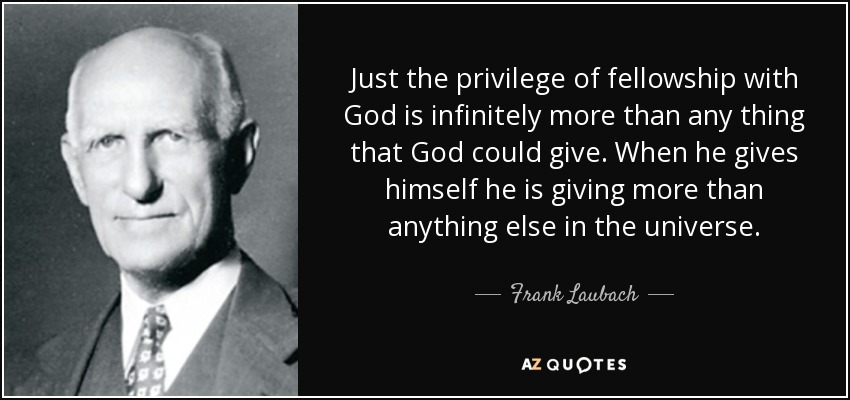
Frank Laubach (1884-1970): missionary to the Philippines, college dean, author, and developer of a highly-successful literacy program.

These are a few of the accomplishments of the devout Christian hero we met in last week’s post, “Toward Undiscovered Continents.”

His fifty-six books included those about the Philippines and teaching literacy, but also about growing into an intimate relationship with God, something he’d greatly desired, like King David centuries before:

In a letter dated March 23, 1930, Frank wrote, “Can I bring God back in my mind-flow every few seconds so that God shall always be in my mind [1]?”

He decided to make the rest of his life an experiment, and for the next forty years Frank disciplined himself to become more aware and more submissive to his heavenly Father—moment by moment.

As the habit grew, Frank wrote it was “the most amazing thing I ever ran across.” In another letter he tried to describe the sheer joy he experienced one afternoon:

“God was so close and so amazingly lovely that I felt like melting all over with a strange and blissful contentment [2].”

Surely all of us desire such loveliness and contentment in God’s presence.

But how did Frank manage to accomplish such a goal? And how might we hope to achieve that kind of intimacy with God?

First, we have to be patient with ourselves. Seeking to experience God throughout the day takes time and practice. About seven weeks into his experiment, Frank admitted:

“When for a half hour or so He slips out of mind—as He does many times a day, I feel as though I had deserted Him, as though I had lost something very precious in my life [3].”

So how did Frank become more consistent in his focus?   

 Here are a few of his practical suggestions (The comments in brackets are my own):

  • In the chinks of time between things, pray: “Lord, think your thoughts in my mind. What is on Your mind for me to do now?”
  • Instead of talking to your “inner self,” talk to Jesus. Imagine Him with you.
  • Pursue a two-way conversation in prayer. Ask, “God, what are You saying to me?” Let your imagination consider what you suppose He might answer. [It’s worthwhile to record these responses in a journal. Do keep in mind, God will never contradict what he’s already said in scripture.]

Can you imagine him saying, “I have been waiting for this moment all your life, waiting until you opened the channel so that I could speak. I have wonderful plans for you which cannot be realized until you listen as you are listening now [4].”

  • Make a daily habit to prayerfully read about the life of Jesus, from the Bible-books of Matthew, Mark, Luke, and John. Try different translations to keep the experience fresh.

[Or, listen to scripture being read to you. Here’s an APP to try: https://www.bible.com/audio-bible/111/MAT.1.NIV .]  

Frank urges, “Walk with Jesus through Galilee by walking with Him through the pages of His earthly history [5].”

  • Hum a favorite prayer-hymn or chorus to yourself. [One possibility: “Take My Life and Let It Be,” with its upbeat tune.]
  • We invite Christ to share—all day long–in everything we do, say, or think. We don’t need to stop our work, but “we try to call Him to mind at least one second of each minute [6].” [How’s that for a lofty but highly worthy goal?]

The websites listed below offer more of Frank’s suggestions.

With him we can attest: “Now that I have discovered Him I find that it is a continuous discovery. Every day is rich with new aspects of Him and His working [7].”

Doesn’t that sound delightful? Let’s make the most of our minutes, availing ourselves of that “melt-all-over, blissful contentment” in the presence of God that Frank Laubach wrote about.

https://www.azquotes.com/quote/803882


[1] https://renovare.org/articles/living-each-moment-with-a-sense-of-gods-presence-frank-laubach.

[2] Quoted by Nayswami Nakin at https://www.ananda.org/blog/laubach-christian-literacy-god/ .

[3] Letters of a Modern Mystic, quoted by Richard J. Foster and James Bryan Smith, www.renovare.org.   

[4] These first three suggestions come from Laubach’s book, Prayer: The Mightiest Force in All the World, highlighted by Bill Gaultiere, at https://www.soulshepherding.org/christ-answer-inspiration-frank-laubach/.

[5] From The Game with Minutes, by Frank Laubach, quoted by Dr. Tom Sweeney at  https://the-magpie.org/2017/02/28/laubach-on-experiencing-god-every-minute/.

Image credits: http://www.dailyverses.net; http://www.pexels.com (Mk7Bober); http://www.heartlight.org; Nancy Ruegg; http://www.pickpik.com; http://www.azquotes.com.

Processing…
Success! You're on the list.

Read Full Post »

“God preserved me so I might tell the story of my life and of God’s goodness to me,” wrote Jeanette Li in her autobiography. And readers might expect her to share stories indicating a life of continual blessing.

They would be wrong.

Jeanette Li (known first as Li Mao Ya, or “Jasmine Bud”), was born in 1899 and grew up in Southeast China with a large extended family of forty-plus people. They lived in hardship and poverty along with most everyone else in the village.

At age six, Jeanette suffered her first trauma—her beloved father died.

Many more ordeals followed, including:

At age 9: Jeanette contracted malaria and received treatment at a mission hospital. One blessing: while there, she and her mother, Taai-So, became Christians.

Perhaps a mission such as this one in central China

When Jeanette was released, they returned home, only to be turned away by their Buddhist family because they’d become Christians.  Taai-So and Jeanette returned to the mission and lived there.

Age 10: The mission was closed due to political strife; all their missionary-friends had to leave.

Age 16: Against Jeanette’s will, Taai-So arranged a marriage for Jeanette, in order to provide for her daughter’s future. Jeanette went to live with her husband’s family under the thumb of a domineering mother-in-law.

Age 20: Jeanette bore a son. But her husband was rarely home, first because he was in school, and then because he was hired as a teacher some distance away. Eventually he married someone else.

Age 32: Jeanette left all she knew to live and serve in bitter-cold Manchuria, requiring her to learn a new language and culture. For thirteen years she traveled by cart on unpaved roads, telling people about Jesus.

Age 38: War broke out between China and Japan in 1937, lasting eight years. Millions died in combat or the result of starvation or disease.

Age 47: The Communists warred against the Nationalists in a three-year civil war, resulting in more suffering and the death of another million-plus people.

Jeanette returned to South China, to the mission where she and her mother had lived. Jeanette was questioned many times by Communist Army officials.

Age 50: All foreign missionaries were constrained to leave China as the Communist Party took power. Jeanette assumed responsibility for the mission-orphanage.

Age 51: She suffered imprisonment for seventeen months, accused of being a counter-revolutionary. Jeanette had to sleep on the floor “in a damp cell infested by mosquitoes, with hardly any food”[1].

They forced her to perform hard labor, and interrogated her day and night. she became ill with fever and developed hemorrhaging dysentery. Her captors offered no medical treatment [2].

Some would ask, “Where was God in all this? The poor woman endured such hardship, pain, and unfair treatment!”

Jeanette would have us know that God graciously involved himself throughout her life, blessing her, and bringing her joy:

He was there during the siege of malaria that took Jeanette and her mother to the regional mission. God spared Jeanette’s life and introduced them to Jesus.

When they returned home, God used the family upheaval to lead the two back to the mission. Taai-So obtained employment and they grew in their Christian faith.

God brought good out of the abandonment of Jeanette’s husband, providing the opportunity for her to obtain a teaching certificate. She was able to support her son as a teacher and then as school administrator.

God fulfilled Jeanette’s desire to tell others about Jesus and made it possible for her to serve in Manchuria, teaching in village after village.

God led her to return to South China where he used her to assume leadership of the mission-orphanage, putting to use her skills as educator and administrator.

God sustained Jeanette during her imprisonment as she suffered acute misery with grace, courage, and stamina—a witness to all in the prison of God’s power at work in her life.

God also spared her life as illness and weakness nearly overcame her.

After her release, God provided for her recovery and subsequent missionary-work in Canton.

God bestowed a miraculous escape from Communist China, first to Hong Kong where she ministered to children and refugees, and finally, in 1962, to Los Angeles, California where her son already lived.

Throughout her life, Jeanette was one of those “true saints who [could] wear the mismatched pairing of suffering and joy” [3]. And as a result,  she drew attention to Christ.

May we do the same.

Addendum: For six years prior to a fatal stroke, Jeanette ministered in the Chinese community of Los Angeles, told her story at every opportunity, and wrote her autobiography.


[1] https://www.placefortruth.org/blog/jeanette-li-and-her-faith-in-gods-promises

[2] Ibid.

[3] https://jenniferdukeslee.com/on-suffering-and-joy-a-lesson-from-the-garden-tomato/ 

Other Sources:

https://www.bdcconline.net

https://rpwitness.org

Image credits: http://www.commons.wikimedia.org; http://www.getarchive.net (2); http://www.canva.com (2); http://www.freebibleimages.org; http://www.getarchives.net.

Processing…
Success! You're on the list.

Read Full Post »

Lott Carey ran his hands over the polished wood of his new desk. He shook his head in wonder while contemplating the most recent turn-of-events in his life.

Lord, I can scarce believe where you’ve brought me, he prayed.

Surely no one but a prophet could have predicted this day for Lott, a former slave from Virginia, born about 1780. 

Thank you, Father, for placing me in a God-fearing family, and for our kind master who kept us together—my grandmother, parents, and me. Thank you for their faithfulness to raise me up knowing you.

Lott rested his elbows on the desk and covered his eyes at the next memory, when his master sent him to work in a tobacco warehouse in Richmond.

He was twenty-four, joined with a group of carousing men, and began drinking heavily.

Months later, he returned to church and reestablished his faith in Christ.

Thank you, Lord, for never giving up on me, even when I turned my back on you.

Lott smiled to think how God engineered the ensuing events. First came the desire to read, and Lott signed up for night school at First Baptist Church. He also studied writing, math, the Bible, and other subjects.

Then God provided a promotion to supervisor at the tobacco warehouse, providing a better salary. Lott saved every extra penny and purchased his freedom [1].

Looking back, God, I can see how you’ve cared for me all along the way. You’ve gone before me, you’ve been with me, and have never forsaken me [2].

Next came the realization that God had given him a gift for preaching, and his church licensed him to do so. Lott ministered to a small black congregation for a time, and under his leadership, it grew to over eight hundred members. Lott began receiving invitations to preach all over Virginia.

That turned out to be a short stretch of road, didn’t it Father! You used my teacher, Mr. Crane, and others to turn my heart toward Africa, which I found exciting but also overwhelming.

The fact that my church family provided strong affirmation encouraged me that this was your plan.

For six years the idea of becoming a missionary in Africa had grown increasingly urgent in Lott’s heart. Finally, in 1821, the dream became a reality when he, his second wife, three children and two more co-workers with their families set sail for Sierra Leone.

They were the first black Americans to serve as missionaries in Africa.

West Africa

Lott shook his head. Never would I have expected my life journery to take me across the ocean!” he mused.

Not long after disembarking, the group discovered that the American Colonization Society, responsible for purchasing land for them, had not done so. The team had to work as laborers for nearly a year until support arrived from the States.

An even more grievous event that year: Lott’s wife became ill and died.

Such agonizing setbacks might have done me in, Lord, but you upheld me. Thank you for your sustaining presence.

One uplifting circumstance: God used Lott to establish a mission among the nearby Mandingo tribe.

In 1822 the neighboring state of Liberia was founded by the America Colonization Society as a place for freed slaves to resettle and govern themselves.

Lott became Liberia’s health officer and government inspector in the capital city of Monrovia, while also serving as pastor for several churches.

These have been exciting times, Lord. You’ve also helped me found the Monrovia Mission Society, to help us spread the good news of Christ all over Africa.

He suddenly chuckled. AND you made me physician of the colony!

Lott marveled how much he’d learned just through observation and experience while ministering to the sick. He’d also absorbed knowledge from scientific practitioners who visited the colony [3].

But most surprising of all, Lord, is where I currently sit, at this desk—the GOVERNOR’S desk!

Who would ever guess that an illiterate, former slave like me would be chosen provisional governor of Liberia while the elected governor returns home because of illness?

Lott surveyed the desktop with its books and papers–his domain now.

God, you’ve taken me on an extraordinary journey. As I assume these responsibilities, thank you in advance for your continued enablement to do what you require. May I serve you well, AMEN.

Little did Lott know that he’d shortly be organizing a defense force against hostile tribes, that he and seven co-workers would die in a gun powder explosion while preparing to rescue negotiators from the enemy. He was just forty-nine years old.

And yet during his short life, Lott set for us a stellar example of hard work, strong faith, and prayerful compliance with whatever God set before him to do.

His legacy lives on in the Lott Carey Global Christian Missional Community, established in 1897 and “dedicated to broadening the reach of the Christian faith across the globe” [4].


[1] He also purchased freedom for his first wife who later died, and their two children. The cost: $850. (https://landmarkevents.org/lott-carey-sails-for-africa-1821/; https://docsouth.unc.edu/neh/taylor/taylor.html).

[2] Deuteronomy 31:18 NIV

[3] https://docsouth.unc.edu/neh/taylor/taylor.html , 44.

Additional Sources:

http://www.imb.org, “Missionaries You Should Know: Lott Carey.”

https://www.thetravelingteam.org/articles/lott-carey

Image credits: http://www.stockcake.com; http://www.picryl.com; http://www.canva.com; http://www.flickr.com (Juan Freire); http://www.heartlight.org; http://www.canva.com.

Processing…
Success! You're on the list.

Read Full Post »

Twenty-one-year-old James Gribble, a streetcar conductor, scanned the avenue ahead, but his mind swirled with visions of the future. Life was treating him well in Philadelphia with its many amenities in 1904, compared to his hometown of Mechanicsburg, PA. What opportunities might lie ahead?

Then it happened. A woman stepped off the still-moving trolley, caught her skirt under a wheel, and was pulled under. She died at the scene.

James agonized over the terrible accident. “Oh God, deliver me, and I’ll serve you!” he wrote in his journal.

That Sunday James attended church and accepted Jesus into his life. That evening he was baptized.

On Monday while reading his Bible, James came to Matthew 28:19a:

He told his pastor, “I think God wants me to become a missionary.”

For several years James received mentoring and instruction, then joined the African Inland Mission. To his delight, the team included a pretty young doctor, Florence Newberry. In 1908 they established a mission station in West Central Africa and started ministering to the nearby tribes.

The station was located in what is now the Central African Republic, south of Chad.

James wanted to become better-acquainted with Florence, but patients kept her busy from morning till night. Suddenly genius struck. James could pretend he was sick!

During the appointment he suggested courtship. Florence preferred they remain friends, still devastated over a previous beau uninterested in foreign mission work.

Twice more over the next four years James would approach her about courtship; twice more she declined.

James and another missionary traveled inland to establish a new station.

West African tribesmen, 1912

Soon his partner became ill and had to return to base camp, then James succumbed to black water fever. He expected to die.

Afterward James wrote about the vision God gave him on his sickbed—a panoramic view of the tribes of West Central Africa. God said, “Thou shalt be instrumental in carrying the gospel to these.” James knew then he’d survive.

During a prayer vigil in 1912, Florence’s thoughts turned to James. Her heart had warmed toward the trustworthy and kind missionary, so passionate about sharing Christ with the African people. Florence sensed the Spirit whispering to her, “Why not?”  

The two were married within a few months.

Sometime later Florence developed appendicitis and required hospitalization. For thirty days they traveled the three hundred miles to the nearest hospital.

As she slowly recovered, the doctor told James, “You must take her back to America. She cannot live in the tropics.”

Florence did return home and six months later James followed. They lived in Chicago for several years while Florence regained strength. Their only child Marguerite was born there in 1915.

Daily James would pray over a map of Africa. He found his attention drawn to a town named Bozoum, in Ubangi-Shari (now the Central African Republic). He wondered why.

Bozoum is located in the northwestern province of Ouham-Pende.

The couple shared their hope with area churches: to establish base camps across central Africa as a barrier against encroaching Islam. When they returned in 1918, two nurses and another family joined them.

The group desired to enter a French-controlled area, but it took eighteen months to receive permission. They named their base, Camp-Wait-Some-More.

Finally able to move on, they arrived in Carnot. While waiting there another eighteen months, they spent their time learning the language and praying.

A new official arrived, and James made an appointment with him.

He asked James, “Where do you intend to set up camp, now that you’ve received permission?”

Permission?! James was stunned. “Where would you recommend?”

Then came Surprise #2. “I think Bozoum would be a good place.”

Now James knew why God had inspired him to pray particularly for this town.

In 1921, Florence and James became ill again. She had to return to the States, taking their daughter with her. Eighteen months later Florence traveled back to Africa, but without Marguerite. Though an anguishing decision, the couple determined she should remain in America to attend school.

In 1923 a young recruit was due to arrive, but he died within miles of reaching their mission station, causing more heartache.

James wrote:

Not long after, James succumbed to black water fever again; this time the forty-year-old did not survive.

He’d previously written to Florence, “I shall be content with the lowest seat in heaven if only there I may sit and see the redeemed of the Lord come in from those fields where I have a been a pioneer missionary.”

Except James had not witnessed one person becoming a Christ-follower during his years in Africa.

Some might say those years of pain and hardship had accomplished nothing. And what about God’s promise: ““Thou shalt be instrumental in carrying the gospel to these?”

James had been instrumental, by bringing others to join in their work. Even his own daughter returned to Africa, ministering with her husband for thirty-one years.

James had served as a foundation builder—constructing base camps, encouraging others, and giving himself to prayer. He followed in the footsteps of the Apostle Paul:

Today, 70% of the population of the Central African Republic are Christians.

In my mind’s eye I see James in heaven, greeting saint after saint from West Central Africa, just as he imagined. But instead of sitting, I think James is standing and celebrating with all his heart.

Sources:

Photo credits: http://www.flickr.com; http://www.rawpixel.com; http://www.picryl.com; http://www.flickr.com; http://www.commons.wikimedia.org; http://www.nara.getarchive.net; http://www.commons.wikimedia.org.

Processing…
Success! You're on the list.

Read Full Post »

No Christmas season would be complete without the reading of the second chapter of Luke—the account of Mary and Joseph traveling to Bethlehem, presiding over the birth of Jesus in a stable or cave, and receiving shepherd-guests.

Toward the end of the account, as those shepherds were spreading the word of Jesus’ birth, Luke wrote, “Mary treasured up all these things and pondered them in her heart” (v. 19).

Indeed. She had much to process:

  • Her baby was the Messiah, the Promised One, who would save his people from their sin. I wonder if she studied him, looking for signs that he was different from other infants.
  • This was the Prince of Peace cradled in her arms. Yet he had been born to a common village girl in very primitive conditions.  Did that seem strange to her?
  • The shepherds had learned of his birth when angels visited them, just as the angel, Gabriel, had visited Mary and then Joseph.  Gabriel had also visited Zechariah, the father of John the Baptist. Four angel visitations in a matter of months. Never had that happened before.

I find myself pondering, too—pondering Mary herself–this dear, young girl who carried a tremendous burden for a long time.

Dear means beloved and valued. Mary is certainly that for numerous reasons.

  • She embraced Gabriel’s announcement with great faith. “May it be to me as you have said,” (Luke 1:38). She put herself in the care of God in spite of incomprehensible circumstances.
  • Her prayer, the Magnificat (Luke 1:46-55), gives indication of a heart fully committed to God.
  • She endured much: shame for her pregnancy, a long, uncomfortable journey to Bethlehem, and crude circumstances for the birth of her Son.

Mary was young—perhaps between thirteen and fifteen years of age. That was the typical age for a girl to be married in Bible times.

Yet, young as Mary was, Gabriel praised her for being “endued with grace” (v. 28, AMP). In addition, Mary demonstrated stamina, maturity, and gentleness beyond her years.

No doubt God graced her with these traits. But I have to believe Mary also had freedom of choice, as we all do, to embrace God’s way for her.

What I ponder most, however, is the fact Mary carried a tremendous burden, given to her by an elderly man, Simeon, eight days after Jesus was born.

You undoubtedly remember the story. Joseph and Mary took Jesus to the temple at Jerusalem to be circumcised.

There they met the righteous and devout Simeon who had been waiting decades for the Messiah. The Holy Spirit had revealed to him he would not die until he had seen the Lord Christ.

Immediately upon seeing the Child, Simeon knew this was the One.

He praised God for keeping his promise, blessed Mary and Joseph, and then spoke particularly to Mary, saying Jesus would cause some to rise and some to fall, he would be spoken against, the thoughts of many hearts would be revealed, and a sword will pierce your own soul too (Luke 2:21-35).

Those last words must have caused Mary’s eyes to grow wide and her heart to skip a beat. Wasn’t the worst behind her? Surely Mary wanted to ask Simeon, “What do you mean?” Scripture gives us no indication that she did so.

For thirty-three years those last words of Simeon must have echoed in Mary’s mind again and again. How does a person live with such long-term foreboding? Perhaps her mind turned back to the night of Gabriel’s visitation.

Perhaps, for thirty-three years, Mary repeated what she had told the archangel: “I am the Lord’s servant. May it be to me as you have said” (1:38).

Mary may very well have developed the calm assurance that even when God’s ways are baffling, we can rest assured he is orchestrating events to accomplish far more than we could ever imagine (Ephesians 3:20). She’d been witness to such orchestration in Bethlehem.

Mary knew that even our personal hardships can fulfill purposes that extend far beyond ourselves.

That’s a lesson for all of us to embrace with calm assurance.

(Revised and reblogged from December 15, 2014, while we enjoy a blessed week with family!)

Photo credit: http://www.stocksnap.io.

Processing…
Success! You're on the list.

Read Full Post »

Years ago when our middle granddaughter was a preschooler, we took her to an arcade. In the back corner stood a few free games and among them, two old Tetris side by side.

Some of you will remember this game. Shapes drift down from the screen-top; the player must manipulate them, fitting them together in a solid wall as they reach the bottom—without leaving holes.

After a quick explanation of how to play, E. happily started pushing buttons. I decided to play the neighboring game. Bad mistake.

Video games never were my forte, and the passing years had not contributed to my skills. Frustration began to build as hole after hole appeared in my wall.

At game’s end, E. cried with joyful triumph, “Look Nana! Look at the pretty design I made!”

Though her screen displayed many colorful shapes, there were numerous holes. But that didn’t matter to E. In her view she’d created an eye-catching piece of art.

E. taught me a lesson that day. My attitude could often be improved if I just focused on the positive of what IS and not on the negative of what ISN’T.

All too frequently I’ve strived for unattainable goals, wasted time on unimportant details, or sacrificed rest while slaving through a lengthy to-do-list. I’ve also cared too much what other people thought.

All of these traits are symptoms of perfectionism.

Why are we perfectionists so strict on ourselves? Perhaps it’s because we don’t want to be:

  • ashamed of our performance or handiwork
  • blamed when our efforts aren’t up to par
  • judged inferior or lacking in some way

To move away from such fears and toward the freedom Christ offers (John 8:36), we need to CHILL by affirming these attitudes and actions.

I am:

  • C elebrating more often what’s right, criticizing less often what’s wrong
  • H appy with “good enough” when appropriate
  • I nspiring others with my imperfections!
  • L istening to the truth
  • L oved by God as I am

To jump-start such declarations, consider the following.

CELEBRATE

When faulty efforts occur, we can CELEBRATE this: “A flawed rose still smells sweet” (Unknown). I can still carry the fragrance of Christ as I rely upon him through the mistakes and failures.

(Be) HAPPY

“We don’t have to be perfect to be wonderful” (Unknown).

Lots of fantastic people in this world display admirable qualities, but not one of them is perfect.

You’re wonderful too! Give yourself the same grace you give others.

INSPIRE

“There’s no need to be perfect in order to inspire others. Let people get inspired by how you deal with your imperfections”—Ziad K. Abdelnour.

Also true:

LISTEN

Listen to such truths as these to silence the voice of perfectionism:

  • Jesus did live a perfect life yet was criticized incessantly. However, all he cared about was his Father’s approval, which God bestowed (Matthew 3:17). You know who else is approved? Everyone who believes in Jesus!

Everyone who believes has God’s approval

through faith in Jesus Christ.

Romans 3:22a GW

  • The godly Apostle Paul admitted—after thirty-years as a Jesus-follower— he hadn’t achieved perfection. Even so, he found satisfaction in pressing on toward spiritual maturity (Philippians 3:12-13).
  • We can combat the striving as we embrace God’s desires for us—to lie down in his green pastures now and then, and not fill every minute with activity—to lead us beside quiet waters, and not struggle in a churning ocean of busyness (Psalm 23:1-3).

(Receive) LOVE

God has made it clear: “[He] loves us because of who he is, not because of who we are” (Unknown, 1 John 4:10).

His love for us is:

  • Sacrificial (Romans 5:8)
  • Lavish (1 John 3:1)
  • Patient, kind, unfailing, and more (1 Corinthians 13:4-8)
  • Forgiving (Ephesians 4:32)
  • Everlasting (Jeremiah 31:3)

So! When perfectionism insists we aim even beyond excellence, let’s remember:

There are no perfect daughters, wives or mothers; no perfect sons, husbands, or fathers; no perfect employees, no perfect homes. No one has it 100% together.

“What we do have is a perfect God who is able to lead us through this imperfect life with unfailing strength, incomparable wisdom, and infinite love” (Unknown).

Like our granddaughter E., we can celebrate with joyful triumph the cumulating designs of our lives—imperfect though they may be.

Let’s CHILL!

Art & photo credits: http://www.flickr.com; http://www.canva.com (4); http://www.pixabay.com; http://www.canva.com.

TAKE NOTE! A newsletter launches this month that will include additional topics to what’s on the blog. Please sign up below and check out the first installment. Thank you!

Processing…
Success! You're on the list.

Read Full Post »

Remember Peter Piper who picked a peck of pickled peppers? I wonder what he’d choose if he picked a peck of puzzling proverbs? And how many puzzling proverbs would Peter Piper pick?

Perhaps you’ve encountered some biblical proverbs that raised questions rather than supplied insight—at least at first reading. I certainly have.

Below are five examples. (Perhaps Peter Piper would pick these too!)

PUZZLING PROVERB #1

But how is instruction like a garland or jewelry?

When we receive the wise teaching of godly parents (and our Heavenly Father), our lives are crowned with the blessing and honor of maturity, integrity, and wisdom. We also radiate to others the beauty of godliness, like a chain of distinction around our necks [1].

I wonder too if this garland on the head alludes to the peace of mind that comes from living wisely, and the chain over the chest intimates joy of heart for those who follow biblical instruction.

PUZZLING PROVERB #2

But rest is necessary. So what’s the meaning here?

It’s a warning against apathy and a lack of responsibility, because it’s so easy to:

  • put off to tomorrow what we don’t feel like doing today
  • avoid certain tasks because they’re challenging
  • over-indulge in leisure and accomplish little

We’d do well to remember:

The enjoyment of leisure would be nothing if we only had leisure. It is the joy of work well done that enables us to [truly] enjoy rest.

— Elizabeth Elliot

PUZZLING PROVERB #3

“Banquet Still Life” by Abrahan van Beyeren (1620-1690)

Is this a summary of Aesop’s fable, “The Grasshopper and the Ants,” or might there be a spiritual lesson here?

Actually, it’s both. Yes, God would have us live responsibly and save for the future, but he’d also have us share from our resources and enjoy the blessing of generosity.

The wise also store up within their spirits the choice nourishment of God’s Word and the oil of divine influence, to be ready for the work God calls them to do [2].

PUZZLING PROVERB #4

How can it be part of God’s glory (his splendorous attributes) to conceal a matter, and why is it the glory of a king to seek answers?

One reason God doesn’t reveal everything to us is this: knowledge of all things would overwhelm and frustrate our finite minds.

Second, if God answered all our why questions (like “Why did So-and-So have to die? She was so young!”), it’s likely we still wouldn’t be satisfied. We’d want to suggest he accomplish his plans some other less painful way.  

But. Living with uncertainty does teach us endurance and trust as we wait for the day when all will be made clear.

On the other hand, we do well to prayerfully seek guidance for our decisions. This is especially true for those in authority. It’s to their credit to learn the facts of a matter, consider probable solutions in light of outcomes and impact on others, and apply wisdom [3].

PUZZLING PROVERB #5

But what about those saints who’ve exhibited great wisdom, yet have suffered adversity, ill health, and/or untimely, undeserved death?

Obviously, King Solomon is not suggesting that wisdom results in complete protection from difficulty. His point is, by following the wise ways of scripture, we can avoid many of the troubles and heartaches that fools bring upon themselves.

In addition, true wisdom leads us to seek truth. Truth leads to Christ, and he leads us to the way of salvation and eternal safety in heaven [4].

I wonder, do you suppose Peter Piper is wise enough to be guided by these once-puzzling, now-clarified proverbs?

Are we?


[1] John 15:10-11; 1 Samuel 2:30; https://biblestudycourses.org/proverbs-bible-study-courses-sect-1/proverbs-1-8-19-exploring-the-passage/ ; Proverbs 1:8-9 NLT

[2] Acts 20:35; Barnes Notes on the Bible for Proverbs 6:1-11; Matthew 25:1-13; Deuteronomy 8:3b

[3] John 13:7; Psalm 119:130; https://www.bibleref.com/Proverbs/25/Proverbs-25-2.

[4] Proverbs 2:3-5, 9-11; John 1:17b; John 14:6; Acts 4:12

Art & photo credits: http://www.rawpixel.com; http://www.pexels.com; http://www.henikirbyhistory.getarchive.net; commons.wikimedia.org; http://www.pickpic.com; http://www.pexels.com; http://www.dailyverses.net.

Read Full Post »

Older Posts »

Still Traveling

Impressions Becoming Expressions

Living Our Days

Gaining a heart of wisdom

He Said What?!

I'm Patty, and my husband and I are living with our adult son who has autism and epilepsy. I love sharing lessons learned from life around me, especially life with Aaron.

Meditations of my Heart

Impressions Becoming Expressions

Linda Stoll

Impressions Becoming Expressions

Debby Thompson

Impressions Becoming Expressions

Signora Sheila

Notes on Life, Faith & Italy

Colleen Scheid

Writing, Acting, Living in God's Love

Mitch Teemley

The Power of Story

Heidi Viars

Finding the Image of God