Feeds:
Posts
Comments

Archive for the ‘Faith’ Category

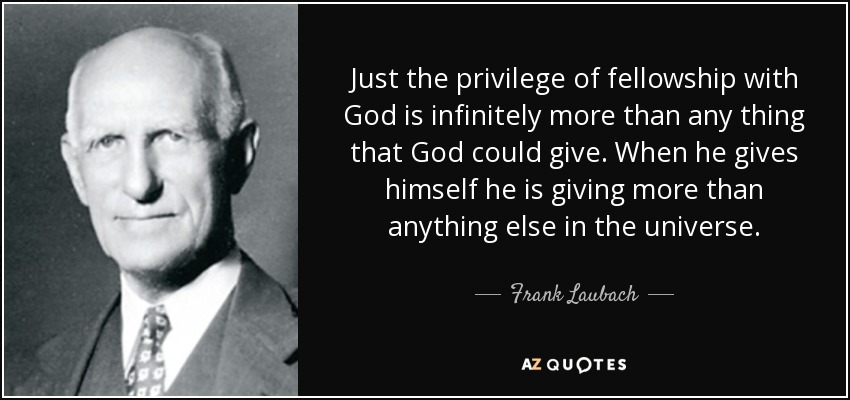
Frank Laubach (1884-1970): missionary to the Philippines, college dean, author, and developer of a highly-successful literacy program.

These are a few of the accomplishments of the devout Christian hero we met in last week’s post, “Toward Undiscovered Continents.”

His fifty-six books included those about the Philippines and teaching literacy, but also about growing into an intimate relationship with God, something he’d greatly desired, like King David centuries before:

In a letter dated March 23, 1930, Frank wrote, “Can I bring God back in my mind-flow every few seconds so that God shall always be in my mind [1]?”

He decided to make the rest of his life an experiment, and for the next forty years Frank disciplined himself to become more aware and more submissive to his heavenly Father—moment by moment.

As the habit grew, Frank wrote it was “the most amazing thing I ever ran across.” In another letter he tried to describe the sheer joy he experienced one afternoon:

“God was so close and so amazingly lovely that I felt like melting all over with a strange and blissful contentment [2].”

Surely all of us desire such loveliness and contentment in God’s presence.

But how did Frank manage to accomplish such a goal? And how might we hope to achieve that kind of intimacy with God?

First, we have to be patient with ourselves. Seeking to experience God throughout the day takes time and practice. About seven weeks into his experiment, Frank admitted:

“When for a half hour or so He slips out of mind—as He does many times a day, I feel as though I had deserted Him, as though I had lost something very precious in my life [3].”

So how did Frank become more consistent in his focus?   

 Here are a few of his practical suggestions (The comments in brackets are my own):

  • In the chinks of time between things, pray: “Lord, think your thoughts in my mind. What is on Your mind for me to do now?”
  • Instead of talking to your “inner self,” talk to Jesus. Imagine Him with you.
  • Pursue a two-way conversation in prayer. Ask, “God, what are You saying to me?” Let your imagination consider what you suppose He might answer. [It’s worthwhile to record these responses in a journal. Do keep in mind, God will never contradict what he’s already said in scripture.]

Can you imagine him saying, “I have been waiting for this moment all your life, waiting until you opened the channel so that I could speak. I have wonderful plans for you which cannot be realized until you listen as you are listening now [4].”

  • Make a daily habit to prayerfully read about the life of Jesus, from the Bible-books of Matthew, Mark, Luke, and John. Try different translations to keep the experience fresh.

[Or, listen to scripture being read to you. Here’s an APP to try: https://www.bible.com/audio-bible/111/MAT.1.NIV .]  

Frank urges, “Walk with Jesus through Galilee by walking with Him through the pages of His earthly history [5].”

  • Hum a favorite prayer-hymn or chorus to yourself. [One possibility: “Take My Life and Let It Be,” with its upbeat tune.]
  • We invite Christ to share—all day long–in everything we do, say, or think. We don’t need to stop our work, but “we try to call Him to mind at least one second of each minute [6].” [How’s that for a lofty but highly worthy goal?]

The websites listed below offer more of Frank’s suggestions.

With him we can attest: “Now that I have discovered Him I find that it is a continuous discovery. Every day is rich with new aspects of Him and His working [7].”

Doesn’t that sound delightful? Let’s make the most of our minutes, availing ourselves of that “melt-all-over, blissful contentment” in the presence of God that Frank Laubach wrote about.

https://www.azquotes.com/quote/803882


[1] https://renovare.org/articles/living-each-moment-with-a-sense-of-gods-presence-frank-laubach.

[2] Quoted by Nayswami Nakin at https://www.ananda.org/blog/laubach-christian-literacy-god/ .

[3] Letters of a Modern Mystic, quoted by Richard J. Foster and James Bryan Smith, www.renovare.org.   

[4] These first three suggestions come from Laubach’s book, Prayer: The Mightiest Force in All the World, highlighted by Bill Gaultiere, at https://www.soulshepherding.org/christ-answer-inspiration-frank-laubach/.

[5] From The Game with Minutes, by Frank Laubach, quoted by Dr. Tom Sweeney at  https://the-magpie.org/2017/02/28/laubach-on-experiencing-god-every-minute/.

Image credits: http://www.dailyverses.net; http://www.pexels.com (Mk7Bober); http://www.heartlight.org; Nancy Ruegg; http://www.pickpik.com; http://www.azquotes.com.

Processing…
Success! You're on the list.

Read Full Post »

A view from Signal Hill

Frank Laubach trudged up Signal Hill again, despair shrouding his heart. After patient waiting and great effort he’d reached an impasse, with no path forward toward success.

Frank had spent seven years earning college and seminary degrees, married Effa Seely in 1912, and together they’d sought to follow God’s plan and become missionaries.

In 1915 the couple traveled to the Philippines, eager to work with the Muslim Moro people on Mindanao.

Mindanao is the large island to the south among the Philippines.

But just a few weeks after their arrival, the U.S. Army post commander stationed there required them to leave, insisting the area was too dangerous for Christians.

First they moved to north Mindanao, and ministered among the people there. In 1922, Frank and Effa moved their growing family to Manila where Frank became dean of Union College and established churches.

Surely he could take satisfaction in these accomplishments. But his heart’s desire was still set on working among the Moros.

Nearly eight years later, the trouble in southern Mindanao finally subsided. Frank left his family in Manila and returned, only to be rejected wherever he went. No one would listen to Frank, and after a month he had to admit defeat.

Moro people of Mindanao

One evening atop Signal Hill, Frank poured out his heart to God again and asked, “Why have my efforts failed?”

And this time God answered, identifying the problem. Frank saw the Moro people only as potential converts to Christianity, not as people to love.

“You feel superior to them because you are white,” God said. “If you can forget you are an American and think only how I love them, they will respond.”

The truth compelled Frank to pray, “Drive me out of myself, Lord. Come and take possession of me and think your thoughts in my mind.”

God then revealed his course of action for Frank. “If you want the Moros to be fair to your faith, be fair to theirs. Study the Koran with them.”*

The next day Frank told the Moro priests he wanted to study the Koran. Eagerly they talked with him, and Frank began to build relationships with these men, sharing the good news about the great prophet they already knew: Jesus.

Most of the Moro people couldn’t read. Frank knew that literacy would be important for teaching about Christ, so he worked to provide a dictionary of their language, Maranaw, and established a school. The Moros expressed enthusiastic gratitude.

Frank procured a printing press and devised an adult literacy program that proved highly successful. But as the Great Depression reached the Philippines, the program seemed destined to collapse. How would they pay for materials?

Frank’s solution: “Each One Teach One.” Everyone who learned to read was urged to teach someone else, using the materials they had. And as Frank taught, he shared about Christ.

Over the ensuing years, Frank wrote books about his teaching methods which were adopted around the world. An estimated sixty million people have learned to read, thanks to Frank’s techniques.

But more important are the thousands of people he brought into a rich experience with God——through his other writings.

For Frank, that night on Signal Hill was the beginning of growing intimacy with God, revealed in his subsequent journal entries, articles, and books.

One habit in particular transformed his life. Like Brother Lawrence three centuries before, Frank sought to live moment by moment in relationship with God.

Frank’s Letters by a Modern Mystic trace the beginning of this journey toward intimacy.

“I resolved that I would succeed better this year with my experiment of filling every minute full of the thought of God than I succeeded last year” (1-3-1930).

“This year I have started out trying to live all my waking moments in conscious listening to the inner voice, asking without ceasing, ​’What, Father, do you desire said? What, Father, do you desire done this minute’” (1-20-1930)?

“It is exactly that ​‘moment by moment,’ every waking moment, surrender, responsiveness, obedience, sensitiveness, pliability, ​’lost in His love,’ that I now have the mind-bent to explore with all my might” (1-26-1930).

So began his life-long practice of constant, blessed connection with his heavenly Father, which he eagerly desired for others.

https://www.azquotes.com/quote/803882

“Why do I harp on this inner experience? Because I feel convinced that for me and for you who read there lie ahead undiscovered continents of spiritual living compared with which we are infants in arms” (Frank Laubach, 1884-1970).

And what will result from such a pursuit? No doubt we’ll experience a level of shalom in the presence of God that for now we can only imagine.

Let’s explore! Next week we’ll consider Frank’s suggestions that will take us to those “continents of spiritual living!”


*https://www.ananda.org/blog/laubach-christian-literacy-god/

Additional Sources:

https://www.jcsvillage.org/blog/2017/3/23/frank-laubachs-great-experiment

https://renovare.org/articles/living-each-moment-with-a-sense-of-gods-presence-frank-laubach

Image credits: http://www.flickr.com; http://www.picryl.com; http://www.flickr.com; http://www.azquotes.com.

Processing…
Success! You're on the list.

Read Full Post »

‘Ever watch home-makeover shows? I especially enjoy those where designers and their teams tackle old, dilapidated wrecks, with the goal of preserving as much original charm as possible.

And while they describe the process, you can hear the passion in their voices for the work they do.

Often they must remove dumpsters full of garbage, old appliances, and demolition refuse. Substandard wiring and plumbing have to be replaced, and sometimes even the foundation needs shoring up.

The designer also searches the home for such treasures as original doors, old fixtures, or hardware that can be restored.

Some walls are covered with faded, grimy wallpaper, causing a depressive atmosphere. What a difference when the paper is removed and replaced by a pastel shade of paint. The room radiates cheer.

For weeks the team repairs, rejuvenates, and re-beautifies in order to “return the home to its former glory.”

And when the project is complete, the previous eyesore is transformed into an eyeful of delights: refinished floors, gleaming woodwork, glittering chandeliers, and more.

A house that once appeared ready for the wrecking ball has been revived, ready to stand strong for another hundred years.

Like the attentive designers overseeing such projects, God too is an attentive Designer, overseeing projects of his own: you and me.

Although we may not be so dilapidated that we’re dreadful wrecks of humanity, all of us have to admit: there’s the grime of sin dingy-ing up the walls of our souls.

There may also be a sense of outdated faith because we’ve not paid much attention to God lately. Or we need the Designer’s help to remove substandard habits in favor of those that revitalize our spirits—less screen time and more scripture time, for example.

The Bible has much to say about our Designer’s work. For example:

Our Designer Revives

As you read that verse, do you hear the passion in his voice? Imagine: The God of heaven desires to dwell within us. Our part is to invite him to do so, with a repentant and humble heart.

Then, as he moves in God breathes new life into our spirits—new life that includes unsurpassed peace and pure joy through his Son, Jesus [1].

That’s not to say we never experience discouragement, pain, or crisis. But as we rely upon God, he shores up our foundation of faith and strength.

One morning years ago I confessed to my early morning prayer group that ongoing frustration at school plagued many of us on the faculty. Betty prayed for me.

Minutes later as I drove to school, God took my breath away with his artistry as shimmering sunbeams reached heavenward from behind great billowing clouds.

It seemed the glory of God was right there, just beyond that cloud bank. And I could almost hear him say, “You’re going to be fine—I’m right here to help you!”

I felt revived and ready to face the day.

Our Designer Restores

On a tour of antebellum homes in Charleston, South Carolina, we watched an artisan painstakingly remove layers of old paint from an intricately-carved fireplace surround–paint so thick it had obliterated the full beauty of the design.

Over our lifetimes, we can accumulate layers of erroneous thinking, harmful habits, and guilt. Underneath, however, are the people God created us to be–people intricately designed for purpose, to reflect “the unfading beauty of a gentle and quiet spirit,” and intended to enjoy his shalom [2].

Our Designer Renews

No doubt, when homeowners plan extensive renovations, they choose their designer carefully, wanting someone who’s congenial to work with, helpful, and trustworthy.

Imagine a designer who’s also encouraging, patient when faced with dozens of questions, and respectful of everyone. Such conduct wields positive influence on those around her.

Our Creator-Designer manifests all the above-mentioned traits and more. As we spend time with him through His Word, we find ourselves growing to be like him in our thoughts and attitudes, actions and reactions.

We experience renewal because:

Hallelujah!


[1] 2 Corinthians 5:17

[2] 1 Peter 3:4; Philippians 1:6;  https://www.preceptaustin.org/shalom

Image credits: http://www.stocksnap.io; http://www.pexels.com (landsmann); http://www.stockcake.com; http://www.heartlight.org; http://www.freerangestock.com; http://www.canva.com; http://www.flickr.com

Processing…
Success! You're on the list.

Read Full Post »

The decision had been narrowed down to two schools for our granddaughter Emma*, a rising seventh-grader. Which would be the best choice for next year–Willow Hills or Sheridan? She’d taken the tests and been accepted by both; each offered its own set of benefits.

Our son Derek and daughter-in-law Heidi received input from others, but their comments only added to the list of pros and cons. No definitive answer came to light.

Emma spent a school day shadowing another student at Sheridan. “It was OK,” she reported afterward. “The teachers were nice.” But nothing she’d seen or experienced had convinced her, “This is the place I want to be!”

All through this process Derek, Heidi and Emma (as well as little sister Madison) had been praying God would make clear the best choice.  The deadline was nearing and the uncertainty felt like a heavy weight upon their minds and hearts.

No doubt you’ve faced similar decisions. It’s not a comfortable place to be.

So why does God allow such distress? Why don’t the answers to our prayers become evident immediately?

There are a number of reasons. Among them:

Uncertainty reveals the frailty of self-reliance.

We can’t see the big picture, and to be honest, very little in our lives is under our full control. Times of uncertainty press us into a place of trusting God [1].

We do well to affirm he’s our devoted heavenly Father. We can trust that what he’s lovingly planned is exactly what we’d choose for ourselves if we could see the entire storyline [2].

So our son and his family (Nana and Papa too!) waited and prayed. All we could do was trust our faithful God to reveal his good and wise plan in his good time.

Uncertainty provides a platform for God to display his grace, wisdom, and power.

These attributes and more become apparent as the answer unfolds and we see his lovingkindness in the plan he’s designed, the wisdom behind it, and the power he’s wielded to make events play out just so.

In the meantime, we must realize the uncertainty we face is only apparent uncertainty. Our future and our provision are certain to God. We’d also do well to remember that “uncertain seasons are often some of the most powerful moments we experience with God” [3]

Uncertainty allows us to experience God in fresh ways as we:

  • Sense his presence more profoundly during difficulty. Pat Chen calls it liquid love [4] — perfect imagery for the warm and comforting presence of our Heavenly Father.
  • See his unfailing love on display, even as we struggle—through the kindness of others, the beauty of creation, an encouraging scripture, and more.
  • Recognize his lavish goodness in the eventual, right-on-time provision.

The Sunday after the two acceptance letters arrived for Emma, our family just happened to sit in church in front of a couple with a son who attends Willow Hills.

Both the parents and he shared enthusiastically about the school. They also knew students at Sheridan and expressed concerns that our son and daughter-in-law hadn’t heard before.

The young man, several years older than Emma, spoke directly to her, giving her reasons why he’s loved Willow Hills.

Several days after that encounter, Emma and her dad visited Willow Hills for a tour. “Impressive!” he declared. “I like it!” she affirmed.

And so, just as we’d all prayed, God made the decision clear, and the weight lifted.

When have you faced a season of uncertainty? What helped you to triumph over the doubts and questions? Please share in the comment section below!

*All names changed, including the schools.


[1] https://serenityinsuffering.com/4-ways-to-trust-god-in-uncertainty/

[2] Katilyn Bouchillon, contributor to Take Heart, 210.

[3] Jon Bloom, Not by Sight, 57.

[4] Intimacy with the Beloved, 81-82.

Image credits: http://www.pexels.com; http://www.dailyverses.net; http://www.heartlight.org; http://www.canva.com (3).

Processing…
Success! You're on the list.

Read Full Post »

Brady Miller, a young and single first-year employee at Reed Investments, smiled as he read the email from his boss Justin. The memo reminded him of the personal day he hadn’t used yet.

Stipulations required he not add the day to vacation time or a weekend, but otherwise, any mid-week day was allowed, pending approval from Justin.

Brady immediately began planning for his Perfect Day the next Thursday: wearing sweats all day, binge-watching The Mandalorian, eating toaster-waffles for breakfast, broccoli cheddar soup and a ham on rye for lunch, nachos for snacking, and a pepperoni pizza for dinner—oh, and a big bowl of mint chocolate chip ice cream for dessert.

He’d also enjoy the solitude—no one to play host for, no one talking during the episodes, and no one to clean up after. Absolute bliss.

But late the next Thursday evening, Brady noticed he felt rather blah, maybe even a bit depressed and de-energized. Wasn’t his Perfect Day supposed to make him happy and content? What happened?

Brady wasn’t aware that researchers have actually studied what contributes to a good day. And all the indulgences he’d allowed himself did not make the list.

Here’s what did:

  • Eat nourishing food
  • Exercise 150 minutes per week
  • Include meaningful activity that also brings pleasure
  • Spend time with family and/or friends
  • Practice mindfulness
  • Limit recreational screen time
  • Show kindness toward others
  • Encourage others
  • Express gratitude

Brady incorporated none of these activities into his day off. No wonder satisfaction alluded him.

Perhaps you also noticed: all these elements contributing to a good day are included in biblical instruction. God wants us to enjoy good days!

For example, scripture directs us to:

Take proper care of our bodies which are temples of the Holy Spirit (1 Corinthians 6:19-20).

Get a good night’s sleep (Psalm 127:2).

Choose meaningful activities, especially those that benefit others. Blessing for the giver is built in (Acts 20:35c).

Spend time with family and/or friends, providing uplift, encouragement, and support (Ecclesiastes 4:9-12).

For me, “the greatest by far is the possession” of family who double as friends.

Practice mindfulness, taking note of what is excellent and praiseworthy, protecting against discouragement and anxiety (Philippians 4:8).

What better way to occupy the mind than to look for evidence of God around us?

Be compassionate, kind, and encouraging (Colossians 3:12; Ephesians 4:29).

And, I would add, that touch includes the one demonstrating kindness.

Express gratitude (1 Thessalonians 5:16-18).

It makes me smile to see secular research backing up what scripture has taught all along.

However, one important activity for a good day is not mentioned in the research:  quiet time with God— studying his Word and conversing with him in prayer (Psalm 119:15-16).

Then again, to do so does incorporate four of the elements researchers identified: meaningful activity that also brings pleasure, time with a Friend, mindfulness, and gratitude.

Is it possible to accomplish all of these activities every day? YES! Some might take only a moment: a kind deed or a word of gratitude. Some can be combined, as illustrated above.

You can start small and choose just one activity to start reducing the blahs and increasing the good. Go ahead—choose one.

Now, let’s get out there and MAKE IT A GOOD DAY!

Sources:

Image credits: http://www.frreerangestock.com (Matt Moloney); http://www.stockcake.com; http://www.freerangestock.com (FOCA Stock); http://www.canva.com (4); http://www.flickr.com.

Processing…
Success! You're on the list.

Read Full Post »

Late spring, 1961, President John F. Kennedy and his wife Jackie visited France. He’d only been in office four months, but already the world had embraced the refined and fashionable First Lady.

Upon arrival in Paris, people lined the streets and shouted, “Vive Jackie!”

And as the week unfolded, she impressed them further with her knowledge of French history and culture and her command of their language, polished to perfection at the Sorbonne during her junior year of college.

With dignitaries Jackie proved to be articulate, diplomatic, and a good listener. She especially charmed their president, Charles DeGaulle.

President Kennedy, on the other hand, received a cool reception from his French counterpart. The two had not seen eye-to-eye on certain policies. Jackie helped pave the way for diplomacy between them.

At a state dinner held in the Palace of Versailles, JFK famously introduced himself as “the man who accompanied Jacqueline Kennedy to Paris. And I have enjoyed it.”

The Hall of Mirrors where the dinner took place

Today, many still remember Jackie’s iconic style, her gentle demeanor, and stalwart courage following President Kennedy’s tragic death. But she will also “go down in history . . . for creating a dominant soft power dynamic in American politics” [1].

We also admire the way JFK humbly honored his wife at that state dinner. He appreciated her strengths that provided great benefit to him.

With this example in mind (although a weak one compared to what it illustrates!), we might understand more clearly what the psalmist meant when he wrote that God is the glory and strength of those who put their faith in him:

“Strength” we more readily understand. Many of us have experienced God’s power upholding us through crises and augmenting our efforts to serve him. But glory? What did the psalmist mean by “God is their glory?”

Perhaps the following comparisons will make the meaning clearer.

  • Even more than the great benefit Jackie provided to her husband, God provides abundant benefit to us.
  • As Jack gloried in Jackie, honoring her and acknowledging her worth, we glory in God.
  • As Jackie made the visit to France a glowing success, so God makes his people glow with success—that is, prosperity of soul, contentment of heart, and peace of mind.

JFK understood it was Jackie who exalted his position with DeGaulle and the French people. Similarly, we need to acknowledge that our sovereign God is the one who exalts us.

We don’t have to push and strive to prove ourselves; we can rest in all the glorious attributes of our Heavenly Father, lavished upon us for our benefit [2].

But like all analogies, this one involving the Kennedys breaks down, because no one is like our God.

Beyond the examples given above to explain how God is our glory, consider these truths:

God’s magnificence

God’s infinite power gives impetus to all his perfections in our lives. After all, what good would his perfect wisdom do without the wherewithal to execute it? His unfailing mercy without the ability to apply it? His infallible promises without the capability to keep them [3]?

God’s enabling work in our lives

God’s incomparable strength is instilled in us as we rely upon him. The result? We begin to display the glory of his attributes, including: patience in the midst of stress, kindness in response to rudeness, and self-control in the face of frustration [4].  

God’s power

God specializes in the impossible. Nothing is too great for his almighty power; nothing is too small for his love. Enter God’s realm where everything is possible [5]!

Of course there are many more facets to God’s glory. And this splendorous God of wonders is our strength—even if we don’t feel tough enough, talented enough, smart enough, or engaging enough for the path ahead—even if circumstances seem against us.

That last state of affairs must have been President Kennedy’s perception as he and Jackie left for France. Little did he know how Jackie would transform their visit.

By contrast we KNOW God’s capabilities of transformation! The evidence is in scripture, history, in the lives of those around us, and in our own experience.

Therefore, let’s remember:

Praise be to God, our glory and strength!


[1] https://uscpublicdiplomacy.org/blog/jackie-kennedy-public-diplomacy-camelot

[2] Another post about God’s attributes: Rooted/

[3] 2 Peter 1:3

[4] 2 Corinthians 12:9; Ephesians 1:15

[5] Based on a quote of Corrie ten Boom, Holocaust survivor

Image credits: http://www.deviantart.com (Kralj Aleksandar); http://www.boudewijnhuijgens.getarchive.net; http://www.flickr.com; http://www.pickpik.com; http://www.dailyverses.net (2); http://www.canva.com (2).

Processing…
Success! You're on the list.

Read Full Post »

We’ve all known people who push themselves hard all day long until they fall into bed at night. Their lists and schedules make sure they use every minute to the fullest.

And though efficiency experts might be impressed by their productivity, it’s likely these ultra Type-A folks are harming themselves—physically, mentally, and spiritually.

The truth is, “Renewal and restoration are not luxuries, they are essentials. Being alone and resting for a while is not selfish; it is Christlike.” Even Jesus took time away to be with his Father [1].

Also important to understand: Rest is an attitude of the heart amidst the responsibilities of the day.  It’s not “some holy feeling that comes upon us in church. It is a state of calm rising from a heart deeply and firmly established in God” [2].

The restful life begins in trusting God, and he’s given us plenty of good reasons to do so:

 OUR GOD PERFORMS RIGHTEOUS DEEDS AND MIGHTY ACTS (Psalm 71:16-18)

OUR GOD HELPS IN NUMEROUS WAYS (Psalm 27:9)

He supplies our needs, guides our decisions, strengthens our spirits, and more.

In addition, his power is at work to help us “understand his love, live a life worthy of our calling, bear fruit in every good work, endure with patience, live a life of thanksgiving, escape the corruption caused by evil desires and overflow with hope” [3].

In other words, he helps us experience the God-enhanced life that truly satisfies our souls.

OUR GOD PROTECTS HIS PEOPLE (Psalm 3:8 CEV)

It’s not his way to protect us from all pain and trouble. Instead, he grants us stamina and strength of spirit to endure, growing us into maturity.

OUR GOD LAVISHES US WITH HIS LOVE (Psalm 86:13)

His compassionate care is expressed as “His wisdom is our direction, His knowledge, our instruction, His power, our protection, His justice, our surety, His love, our comfort, and His mercy, our solace. He holds back nothing from us” [4].

OUR GOD BESTOWS BLESSINGS, BENEFITS, AND GOODNESS (Psalm 103:1, 5)

OUR GOD FULFILLS HIS PROMISES (Psalm 145:13b)

But how can we be sure of that?

“The permanence of God’s character guarantees the fulfillment of his promises” [5].

OUR GOD ANSWERS WHEN WE CALL (Psalm 86:7)

To rest in spite of a “No” or “Wait” answer surely gives indication how well we trust.

These seven assurances of God’s influence in our lives certainly offer wonderful encouragement. But they won’t contribute to spiritual rest unless we “grasp them by faith, plead them by prayer, expect them by hope, and receive them by gratitude” [6].

*     *     *     *     *     *     *     *     *     *

O Lord, I bow before you in wonder that you, the God of the universe, with your infinite power and glory, would provide all these blessings and benefits for me.

Thank you for your gracious benevolence. Help me to REST in these truths, knowing that you have everything under control and you will see me through until I’m home with you.


[1] Chuck Swindoll, The Quest for Character, 49; Luke 6:12.

[2] Henry Drummond, quoted in Streams in the Desert, Jim Reiman, ed., 232.

[3] Melissa Krueger, The Envy of Eve, 104.

[4] Charles Spurgeon, Morning by Morning, 141.

[5] A. W. Pink, http://www.gracequotes.org.

Image credits: http://www.stackcake.com; http://www.canva.com (5).

Processing…
Success! You're on the list.

Read Full Post »

In May of 2019 archaeologists in central England discovered an ancient shield made of bark, dating back to the Iron Age. It’s the oldest shield ever found.

Some might think such a shield would offer little protection during battle. But experiments have proven the bark of such trees as alder and willow would have served well, providing an effective but lightweight shield, easy to maneuver [1]

Fast forward to today. Modern technology has made Israel’s Iron Dome possible. The system shields the country with exceptional radar protection–detecting, tracking, and destroying incoming enemy rockets, high in the sky before they can do any harm [2].

One of Israel’s missile launchers in action

Both shields impress—one for its age and unusual material; the other for its advanced technology and precision.

Scripture speaks of another shield, much older than the one found in England yet still available today, and even more impressive than Israel’s Iron Dome:

The Lord himself.

As we consider that truth, a few questions present themselves:

  • Why would God inspire that metaphor?
  • What does God want me to understand about him being my shield?
  • How might new understanding impact my life?

In researching and pondering the answers to those questions, I discovered that:

God is our shield because of his attributes.

His power shields us from ultimate ruin.

His wisdom shields us from foolishness.

His compassion shields us from emotional and spiritual wounds too deep to heal.

His righteousness shields us from the evil one.

His mercy and grace shield us from the punishment we deserve for our wrongdoing [3].

The list could go on.

God is also our shield because of his actions.

His shield offers:

  • Protection against our arch-enemy Satan and all his cohorts
  • Salvation, saving us from the condemning power of sin
  • Help in times of trouble
  • Faithfulness we can rely on, because of his covenant of love
  • Truth—like the promises of God’s Word that can protect us against discouragement and confusion
  • Favor in the form of lovingkindness, mercy, and grace [4]

God’s shield can cover every aspect of our lives, but . . .

 . . . we must each take up our shield.

God is a gentleman; he doesn’t force his protection, help, or favor upon us. We must come to him and choose to take refuge in him [5].

How? Through prayer.

We invite him to watch over us and protect us.

We affirm the promises and encouragement from his Word.

We remind ourselves of who he is, our Almighty God of Refuge, Shelter and Strength, our Rock of Stability and Safety.

Will you pray with me right now?

*     *     *     *     *     *     *     *     *     * 

I praise you, O God, for being my strength and impenetrable shield. I can put my trust in you with unwavering confidence because of who you are [6].

I praise you for not only being a shield in front of me; you are a shield that surrounds me, guarding on all sides [7].

You are above, beneath, around, and within, protecting me from ultimate ruin, irreparable damage to my spirit, and foolishness. You shield me from the full brunt of trouble, the fiery darts of the enemy, and his lies [8].

I praise you for the overflowing peace in knowing you are guarding me as a shield!


[1] https://www.theguardian.com/science/2019/may/23/2300-year-old-iron-age-bark-shield-leicestershire

[2] https://www.bbc.com/news/world-middle-east-20385306#:~:text=Iron%20Dome%20detects%20and%20tracks,to%20fall%20on%20open%20ground.

[3] Proverbs 3:23-26; 28:26; Psalm 86:12-15; 2 Thessalonians 3:3; Ephesians 2:4-5

[4] Ephesians 6:16; Psalm 18:35 ESV; Deuteronomy 33:29; Psalm 91:4 and Deuteronomy 7:9; Psalm 91:4c; Proverbs 30:5; Psalm 5:12

[5] Matthew 11:28-30

[6] Psalm 28:7 AMP

[7] Psalm 3:3 GWT

[8] Psalm 91:4a; Isaiah 28:16; Psalm 3:3; Colossians 1:27; Ephesians 6:16

Image credits: http://www.commons.wikimedia.org (2); http://www.biblepics.co & http://www.canva.com; http://www.canva.com (2); http://www.heartlight.org (3).

Processing…
Success! You're on the list.

Read Full Post »

Life is about choices, and there are just two ways to make them. We can trust our own wits, or we can put our faith in guidance from outside ourselves.

Guidance from outside might come from trusted family and friends, counselors, self-help books, and God. But only one source offers infallible wisdom every time: God.

The question becomes, will we live a life of faith with God [1], or will we choose to live without?

As a child I chose the former and never regretted it. Many of you have walked a similar path.

Sometimes, though, we get weary. Doubts creep in. Problems crop up like weeds and answers to life’s dilemmas don’t come as quickly as we’d like.

What then?

There are a number of faith-building actions you’re probably familiar with, including: praise and gratitude to God, scripture study, prayer, as well as spending time with mature and wise Christians.

You know what else is helpful? Studying the facets of faith. As we deepen our understanding of how faith works, we enhance our connection with God, increase our usefulness, and experience more contentment in life.

No doubt there are quite a few facets to our faith, but today we’ll briefly look at just eight.

FAITH IS:

Affirmation of What We Know

God would have us understand he is righteous, good, faithful, and compassionate [2].

He never forsakes those who seek him. He arms us with strength and keeps our way secure. God guides us along the right path, and surrounds us with his unfailing love [3].

In the book of Psalms alone you’ll find hundreds of such encouraging affirmations as these, highlighting who God is and the glorious things he does. It’s a delight-of-discovery to seek them out [4].

And affirmation of God’s character is a beneficial first course.

Attentiveness

And where might we find that light? In the presence of God and in the encouragement and promises of scripture that fill our hearts with the light of hope [5].

Confidence

As we practice affirmation and attentiveness, we build confidence in the truth that God will do what is right when the time is right, though for now we may see no sign of it.

Courage

Confidence in God fuels our courage to trust without proof, to thank God in advance (even before there’s evidence of anything happening), and to step into the unknown.

Empowerment

Be inspired by what Charles Spurgeon wrote decades ago:

With almighty God on our side, what have we to fear [6]?

Expectancy

And surely, such an attitude will contribute joyful up-timism [7] in our spirits.

Rest

When we trust without reservation we find peace and rest.

Waiting

Without the discipline of wait-time, our faith would remain underdeveloped. This facet provides opportunity for strength of spirit to grow [8]. And we can take comfort from the knowledge that:

As we live life with him we’ll find:

  • Affirmation, attentiveness, and waiting will grow our faith.
  • Confidence, courage, and empowerment will result from our faith.
  • Expectancy and rest will flow from our faith.

I can’t imagine making any other choice than living life with God.

How about you?


[1] Life with God is precipitated by accepting Jesus’ glorious invitation into God’s family (John 1:12).

[2] Psalm 7:17; 13:6; 31:5; 51:1

[3] Psalm 9:10; 18:32; 23:3; 32:10

[4] See the post, https://nancyaruegg.com/2025/01/16/celebrating-god-through-the-psalms/

[5] Psalm 146:5

[6] Psalm 27:1

[7] See the post, https://nancyaruegg.com/2022/10/06/better-than-optimism/

[8] Isaiah 40:31

Image credits: http://www.canva.com; http://www.pxhere.com; http://www.pexels.com; http://www.canva.com (2).

Processing…
Success! You're on the list.

Read Full Post »

Another time, another meal

Easter afternoon we’ll join our son, daughter-in-law, and two granddaughters for dinner in their home—with six other guests.

E. and H. have planned a Georgian feast, based on traditional dishes from the Eastern European country of Georgia. (Did you know that 85% of that nation’s population are Christian? I certainly didn’t.)  

Each family or single person attending this celebration has been given a recipe, so we’ll be able to sample eight different dishes of this new cuisine. And because of the many delicious meals we’ve enjoyed with E. and H., we know:

Within the warm ambiance of their home and the congenial atmosphere as we converse and laugh together, each of our individual concerns will recede to the background. In their place, joy, contentedness, and peace (shalom) will settle upon our spirits.

By contrast, the Passover feast that Jesus celebrated with his disciples, the night before his crucifixion, held little joy or peace for him. In fact, the Apostle John wrote, “Jesus was troubled in spirit” [1].

He knew what would happen that night and into the next day: the pain of betrayal, scourging [2], a crown of thorns thrust on his head, mockery, the crucifixion, and separation from his Father.

The plan had already been set in motion, when Judas approached the chief priests and officers of the temple guard to discuss how—for a price—he might hand Jesus over to them when no crowd was present [3].

Under these stressful circumstances Jesus stated to his disciples, “Peace I leave with you; my peace I give you. I do not give to you as the world gives. Do not let your hearts be troubled and do not be afraid” [4].

The Amplified Version adds: “Let My perfect peace calm you in every circumstance and give you courage and strength for every challenge.”

But if Jesus was troubled in his own spirit, how could he promise his peace to the disciples? How could he tell them not to be troubled?

The answer lies in his confidence in his Father. Though fully aware of the suffering to come, Jesus displayed confidence in the purpose and power of his Father and moved forward unhesitatingly to meet the pending crisis [5].

Consider his demeanor over the next eighteen hours or so. Jesus conducted himself with calm quietude from the moment of his arrest to his last breath on the cross. God did indeed supply courage and strength for every torment.

This is the nature of the peace Christ gives to all of us who trust in him [6].

But how do we avail ourselves of this precious gift? (And for those of us who are familiar with these ways to peace, how well are we implementing them?)

Get to know God in his Word.

We considered one way in the post, “Celebrating God in the Psalms.” So many of his attributes and gracious actions are highlighted in these ancient songs.

Practice his presence.

Possibilities include expressing gratitude, speaking simple prayers throughout the day, and singing worship songs.

Be quick to praise God.

You’ll find your cares reduced and your anxieties lessened. The result: expanded peace.

Come Sunday, our son and daughter-in-law’s home will provide a splendid place of refuge and peace—for a few hours.

How glorious to contemplate that Christ’s refuge and peace is much more splendorous, much more impactful, and for all time!

* * * * * * * * * *

Thank you, Lord Jesus Christ, for enduring unimaginable suffering in order to restore our relationship with God and provide the gift of eternal life. Now you are our Lord of peace, ready to give us peace at all times and in every way. You ARE indeed worthy to receive honor and glory and praise!

1 Peter 3:18; 2 Thessalonians 3:16; Revelation 5:12


[1] John 13:21

[2] A flogging, inflicted with a whip of leather straps imbedded with pieces of metal and glass, meant to rip into the flesh. Such a brutal beating often led to death.

[3] Luke 22:1-6

[4] John 14:27

[5] Merrill Tenney, www.preceptaustin.org

[6] Colossians 3:15

Image credits: Nancy Ruegg; http://www.canva.com (3); http://www.pxhere.com; http://www.flickr.com.

Read Full Post »

« Newer Posts - Older Posts »

Still Traveling

Impressions Becoming Expressions

Living Our Days

Gaining a heart of wisdom

He Said What?!

I'm Patty, and my husband and I are living with our adult son who has autism and epilepsy. I love sharing lessons learned from life around me, especially life with Aaron.

Meditations of my Heart

Impressions Becoming Expressions

Linda Stoll

Impressions Becoming Expressions

Debby Thompson

Impressions Becoming Expressions

Signora Sheila

Notes on Life, Faith & Italy

Colleen Scheid

Writing, Acting, Living in God's Love

Mitch Teemley

The Power of Story

Heidi Viars

Finding the Image of God