Feeds:
Posts
Comments

Archive for the ‘Generosity’ Category

Steve and I had stopped for brunch at a restaurant near an interstate exit. When he slipped the waitress his usual extra-generous tip, she gasped and her eyes began to fill with tears.

“I don’t know what to say,” she cried. “Thank you! You don’t know what this means to me.”

She was right; we didn’t. Emily[1] never said a word about the challenges she faced. We’d seen her radiant smiles, enjoyed her friendly attitude, and appreciated her thoughtfulness to keep our coffee cups filled.

We’d heard respect and cheerfulness in her voice–all coming from a heart submitted to Jesus. We knew that much.

The three of us chatted a bit and we affirmed to Emily the fine character traits we’d witnessed, and the truths that God loved her and had her best interest at heart. It was our prayer God would use our gift as a demonstration of his attentive care.

On the way out, the hostess stopped us. “Emily just told me what you did for her,” she said quietly. “That girl is going through a very rough time right now; she will never forget your gift!”

No doubt you too can remember when a word of affirmation or gift of appreciation greatly ministered to your spirit. Perhaps it occurred when you were struggling, wondering what God was up to, and feeling starved for encouragement.

Like Emily, when the affirmation came, your spirit filled with wordless wonder.

Also a wonder? That those who give are even more blessed than those who receive [2]. Have you noticed that such moments of benevolence seem divinely energized by the Spirit of God?

It’s downright thrilling to be used by him in uplifting others with affirmation and encouragement—two words not as synonymous as I once thought.

Affirmation indicates approval of what is already known or perceived—like the character traits we’d seen in Emily.

Encouragement inspires a person to persevere into the future—like the truths about God we shared with her. We benefit from both.

Scripture includes numerous passages that remind us what is true about God and what he thinks about us, passages that encourage and affirm our own spirits, equipping us to share the same with others.

Here are several verses and assurances to get us started. I pray you find affirmation and encouragement in the following:

  • I have been remarkably and wonderfully made (Psalm 139:14).
  • “My Father is always at his work to this very day, and I too am working”—Jesus (John 5:17).

  • “You do not realize now what I am doing, but later you will understand”—Jesus (John 13:7).
  • I am one of God’s special possessions, commissioned to declare his excellencies (1 Peter 2:9).
I pray your spirit is affirmed and encouraged.

And now, who can you refresh today?

(Our experience with Emily hasn’t been a one-time event. Should you wish to read similar, special-moment stories, click on one of these posts:


[1] Name changed.

[2] Acts 20:35

Art & photo credits: http://www.pixabay.com; http://www.pickpik.com; http://www.canva.com (2); http://www.pexels.com; http://www.rawpixel.com (2); http://www.pxhere.com.


Processing…
Success! You're on the list.

Read Full Post »

Young Klaus-Dieter John read the last page of another “jungle doctor” book by Dr. Paul White—his favorite series. The adventures, based on the missionary doctor’s experiences in Africa, never failed to capture Klaus’s imagination and heart.

The boy sighed. How great would it be to live in the jungle and help people as a medical missionary.

That dream stayed with Klaus through high school in his hometown of Weisbaden, Germany. As graduation neared in the late 1970s, he felt certain God wanted him to become a doctor and serve in a third world country.

Another person in his school carried the same dream, a pretty girl named Martina. Soon Klaus and Tina were a couple.

The next decade included university, medical school, and marriage. Further training took the Johns to England, Johannesburg, and finally America. Klaus studied at Harvard, and then completed his surgical residency at Yale.

Meanwhile, Tina earned board certification in pediatrics, in Germany and America.

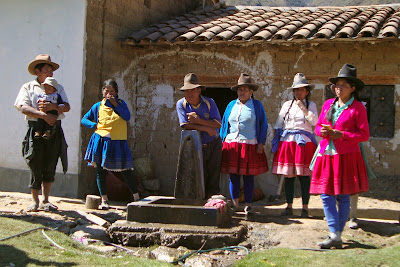
God used a backpacking trip through Peru in 1991 to draw their hearts toward the Quechua people, descendants of the Incas. These Indians live on high plateaus and in deep valleys of the Andes Mountains, impoverished and illiterate.

At that time, just four doctors served 40,000 people. The Johns knew immediately: this was where God wanted them to serve.

First they volunteered for five years at a well-established mission hospital in Ecuador. During that time Klaus and Tina founded the Diospi Suyana organization to alleviate the suffering of Peruvian Indians.

In Quechua, the words mean, “We trust in God.”

But they desired to do much more. “What if,” the couple dreamed, “we could establish a hospital for the Quechua people near Machu Picchu—not just a bare-bones clinic but a true hospital with everything necessary to provide excellent care?”

Just saying the words out loud highlighted the implausibility of their desire. How could they raise the millions of dollars necessary? And even if they could build such a facility, how would they keep it staffed and equipped?

But God propelled them forward.

In 2004 the Johns began seeking financial support for their vision, first in Germany and then in other countries. A trickle of donations at first grew to a steady flow. Several companies even committed to provide equipment and materials.

Also during this time, Klaus and Tina moved their family of five into a mud home in the village of Curahuasi, a village strategically located between three Peruvian cities.

By May 2005, the Johns were participating in a miracle: the ground-breaking for Diospi Suyana Hospital—a project that would cover eight-plus acres of land, and cost $100,000 each month to construct [1].

The couple was determined not to incur debt. God would either supply the needed funds or construction would be discontinued.

Supply he did—through more than 50,000 individual donors who’ve contributed to the hospital’s ministry [2].

As the complex took shape, fifteen miles of computer cable were set in the walls, as well as “countless miles of pipes for suction, compressed air, and oxygen” [3].  

The dedication of the facilities took place in August, 2007. By 2017, 300,000 Peruvian patients had received care at Diospi Suyana—patients who only pay 20% of the cost of their care—at most; the other 80% is paid by generous donors.

Each day begins with a worship service. Thousands of Peruvians have heard about Jesus and been told of his gift of eternal life. For those who accept that gift, one of the hospital pastors visits their home and connects them to a local church [4].

The ministry has expanded over the years to include dental and eye clinics, Kids’ Clubs, a school for six hundred children, and a radio station [5].

Many miraculous provisions have contributed to the flourishing of Diospi Suyana.

For example, in January 2006, while Klaus was in Germany on a speaking tour, he met with a good friend. Klaus mentioned they needed a civil engineer to oversee the hospital construction, but the person had to be willing to serve without pay.

“I know someone who might be interested,” declared the friend and he made a phone call, setting an appointment for later that day with the engineer Udo Klemenz.

Meanwhile, when the phone rang at the Klemenz’ home, Udo and his wife were in the midst of praying about their plans for the future.

At the meeting that afternoon, Klaus made his proposal. The couple gasped in surprise for this near-instantaneous answer to their prayer.

“Come to Peru for as long as you can stay,” Klaus invited.

Udo and his wife soon traveled to Curahausi—and stayed for eight years [6].

Klaus affirms often, “God has become visible in my life” [7]. (Emphasis added.)

Indeed, he has.


[1] https://cvm.swisshealthweb.ch/fileadmin/assets/CVM/2018/cvm.2018.00564/cvm-2018-00564.pdf

[2] https://cbn.com/news/news/hospital-built-faith-proof-me-god-real

[3] https://cvm.swisshealthweb.ch/fileadmin/assets/CVM/2018/cvm.2018.00564/cvm-2018-00564.pdf

[4] https://cbn.com/news/news/hospital-built-faith-proof-me-god-real

[5] https://www.diospi-suyana.de/diospi-suyana-2-2/?lang=en#

[6] https://cvm.swisshealthweb.ch/fileadmin/assets/CVM/2018/cvm.2018.00564/cvm-2018-00564.pdf

[7] https://www.churchtimes.co.uk/articles/2014/3-october/features/interviews/interview-klaus-dieter-john-founding-director-diospi-suyana-hospital

Photo credits: http://www.pixabay.com (2); http://www.canva.com; http://www.heartlight.org; http://www.travelingteacheronline.com, H. McElwee; http://www.pxhere.com.

TAKE NOTE! A newsletter launched this month that includes additional topics to what’s on the blog. Please sign up below and check out the first installment. Thank you!

Processing…
Success! You're on the list.

Read Full Post »

‘If I were you I’d buy a ticket for a boat going on the longest journey you can find and pray to know where to get off. If God doesn’t want you on that boat he’s perfectly able to stop you . . . or make the ship go anywhere in the world.’

Jackie Pullinger of Croydon, England nodded, sensing God’s affirmation to this advice from her pastor.

For months Jackie’s dream of becoming a missionary in Africa had been stymied. No mission society, school, or broadcasting company took interest in her, a twenty-two-year-old music teacher.

And yet the dream she’d held since age five remained as strong as ever—stronger, in fact, upon developing a close, personal relationship with Jesus while attending the Royal College of Music.

Jackie soon implemented her pastor’s advice and set sail from London in 1966 with no destination in mind and only ten pounds in her pocket. When she reached Hong Kong, Jackie sensed God telling her, this is the place.

Hong Kong, 1960s

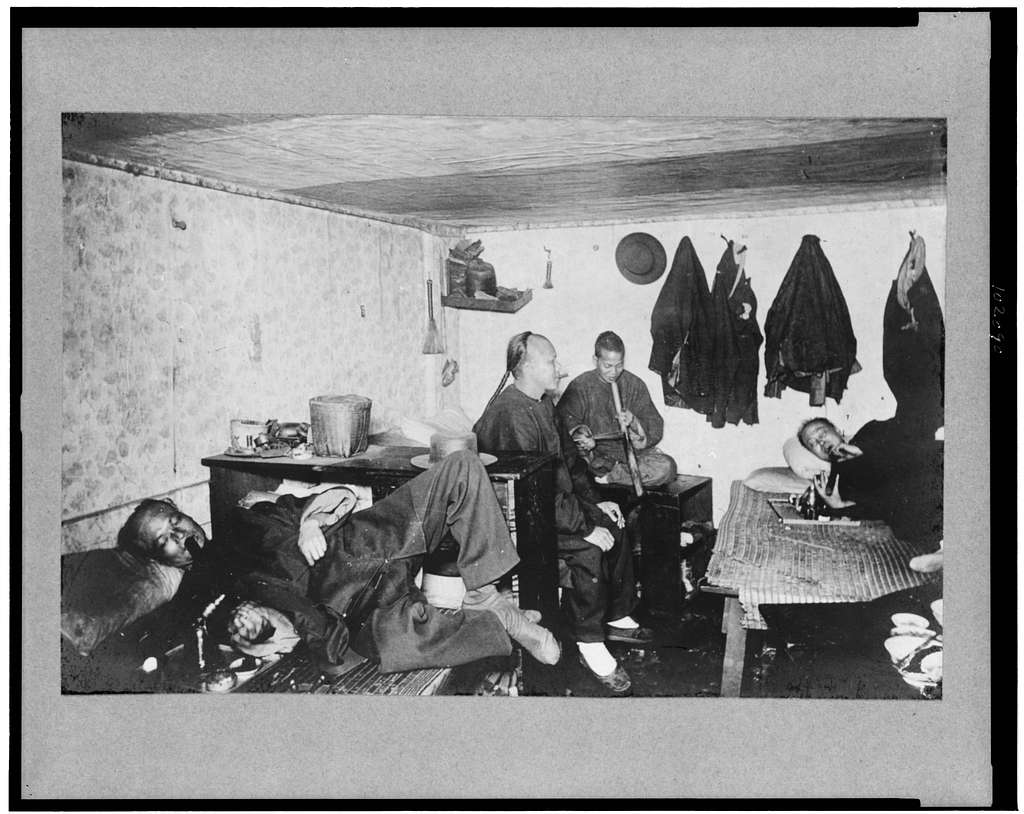
She began exploring the island and came upon the Walled City, a place of lawlessness and squalor, open sewers and rats, gangs, drug addicts, and prostitutes. Thirty-some thousand people on six acres.

No building codes enforced .

Years prior the area had been occupied by the Chinese imperial garrison. “It was omitted from the lease of 1898 in which China ceded Hong Kong to Britain. Neither government had taken responsibility for it” [1].  When the garrison disbanded the underclass moved in, unchecked by any police presence.

In spite of the filth and stench, Jackie felt happy there because in her mind’s eye she already saw the darkness lifting. She saw the kingdom of God.

No trash pick-up either.

To support herself, Jackie took a teaching position in a government school, but she also worked at a school in the Walled City, run by a missionary.

Jackie turned a few shabby rooms into a youth club where teenagers could play ping pong and darts. She began to build relationships with them, many of whom were already heroin or opium addicts.

Preaching about Jesus proved ineffective. But Jackie noticed people watching how she lived. So she focused on putting her faith in action.

Jackie shared her rice with an old woman, took a gang member to the hospital after a fight, waited in line overnight to register a young girl for school, went to court with a gang member who said he’d been framed, and more [2].

Many expressed appreciation for her kindness and generosity but no lives were changed—at first.

One night thugs ransacked the youth club. Benches, skateboards, and the games equipment were destroyed, the walls and floor smeared with sewage. But a gang leader who respected Jackie assigned guards to protect the youth club from future damage.

Another leader asked Jackie to help his gang members quit drugs. Sober members made better dealers, he explained.

“I’ll only help them to follow Jesus, reject narcotics, and not participate in organized crime,” she told him.

And yet the leader continued to support Jackie and even released from the gang those boys who became Christians [3].

One day while walking through the Walled City, Jackie spotted Christopher, a boy from her youth group. She asked him to carry her accordion.

As they walked, they talked. Christopher confessed he couldn’t become a Christian because he wasn’t good enough. Jackie made clear that wasn’t a prerequisite, and the boy became a Jesus-follower that day [4].

Others soon made the choice to become Christians, including one of the youth-club guards. But some of these new believers lived in opium dens, making their transition to sober-living especially difficult. 

One by one they came to live in Jackie’s home, where they received compassionate care and faith-filled prayer while processing through withdrawal. For many their transition was neither painful or traumatic [5].

Of course, Jackie’s apartment quickly became crowded. But through gifts from other Christians and government resources she was able to rent more apartments. It wasn’t long before dozens of such living quarters became hundreds and each quickly filled to capacity.

More workers joined in the work, including former addicts. They established additional homes for teenagers, women, and girls.

In 1981 Jackie founded the St. Stephen’s Society, to provide accountability for the growing ministry.

In 1985, the Hong Kong Government gave the society a complex of buildings divided into apartments. Hundreds more displaced persons—the poor, the elderly, and the infirm—were given places to live.

In the 1990s, the government offered another property to the St. Stephen’s Society. Buildings were erected to house two hundred men as they completed the five-phase withdrawal program, from detoxification to re-entering society as productive citizens.

The St. Stephen Society continues to function to this day, “rescuing hundreds of young people from a life of misery on the streets” [6]—not only in Hong Kong but in other countries as well.

Jackie, now eighty years old, continues to serve.


[1] https://mycharisma.com/charisma-archive/one-woman-vs-the-dragon/

[2] https://www.ststephenssociety.com/about-us

[3] https://thechurch.org.au/celebrating-jackie-pullinger-of-hong-kong/

[4] https://www.cmf.org.uk/resources/publications/content/?context=article&id=26751

[5] https://thechurch.org.au/celebrating-jackie-pullinger-of-hong-kong/

[6] https://blogs.georgefox.edu/dlgp/jackie-pullinger-loving-the-unlovely/

Photo credits: http://www.flickr.com (2); http://www.picryl.com; http://www.flickr.com; http://www.picryl.com; http://www.pickpik.com; http://www.rawpixel.com.
Read Full Post »

Twelve-year-old Henry bolted into the kitchen crying, “Look Ma!” and proudly held out his empty basket. An hour before it had been full of fresh produce, grown himself on the family farm in Sharpsburg, PA (near Pittsburgh).

Now his pocket was full—of change. Just as he’d hoped, townswomen had purchased every vegetable.

“Well done, Henry!” exclaimed his mother, ruffling his hair. “Your hard work paid off!”

It wasn’t long after that first sales excursion in 1856 that Henry required a wheelbarrow for his deliveries. By age fifteen, Henry was caring for three-plus acres of produce and required a wagon for transport. Not only did he sell to those nearby, but also to grocers in town.

The teenager became known for his quality produce, positive attitude, and honest business dealings, making his mother proud as he lived up to the Christian principles taught at home and church.

One day he approached his mother with a new possibility. “Could I use your recipe for horseradish and try to sell it along with my vegetables?”

She agreed the area’s German immigrants just might buy the popular sauce, saving them time and nuisance during the busy canning season.

Horseradish had to be grated, which often resulted in nicked knuckles. It also caused the eyes to sting and water—just like onions. As a result, many women of Sharpsburg were glad to forego the chore and buy Henry’s horseradish.

His entrepreneurial instincts led him to additional ways for growing his business. Henry chose white vinegar instead of brown and clear glass bottles instead of the traditional green, even though both were more expensive. The former resulted in a more appetizing product, the latter allowed his customers to see his top quality horseradish–with no fillers like some companies used.

Over the next few years Henry added pickles, sauerkraut, and vinegar to his product-line. He also expanded deliveries to Pittsburgh’s grocers, restaurants, and hotels.

Meanwhile Henry experimented with different seeds, taking careful notes to track results. He arranged for the design of attractive jars and labels to entice even more customers.

At age 24, Henry took on two partners and moved the company to Pittsburgh. They added fruit preserves, mustard, and catsup to the product-line, while expanding their market east and west via the new railroads.

Another important event that year: Henry married Sarah Young. They would have five children; one would die in infancy.

19th Century Pittsburgh

By 1872 the partners employed 150 people during harvesttime, producing 500 barrels of sauerkraut, 15,000 of pickles, and 50,000 of vinegar.

But when the economic Panic of 1873 occurred, Henry and his partners were forced to claim bankruptcy. Deep disappointment sunk him into depression.

Henry soon recovered, however, and determined to rebuild his company by doing what he’d always done—work hard and trust God [1].

With financing from two of his seven siblings and his mother, Henry set about reestablishing himself. Five years later he’d not only achieved success again, he’d repaid all his debts—even though that wasn’t required.

Henry continued adding new products, including apple butter, baked beans, and tomato soup. Always he sought new ways to market his wares, like free pickle pins with the company name, distributed at the Columbian Exposition in Chicago, 1893.

Columbian Exposition 1893

But out of reverence for God, he never allowed his newspaper advertisements to run on Sunday [2].

Henry applied Christian integrity to his treatment of employees, providing many more benefits than other factories including: free dental and health care onsite, lunchtime concerts and lectures, English lessons and assistance to obtain citizenship, and advancement of women to managerial positions.

Henry also “worked hard to encourage his employees to live the ‘righteous life’” [3].

During these years of company-development, Henry taught Sunday School and became a promoter of Sunday Schools not only in Pittsburgh but around the world.

He faithfully tithed his income his entire life beginning with 10%, but increasing over the years until Henry was giving away almost 100% of his income [4].

By 1896, Henry’s company produced over one hundred products. He put a new slogan on each bottle and jar: “57 Varieties,” thinking the number fifty-seven (based on Sarah’s and his favorite numbers) [5], was more memorable than one hundred.

Once again, Henry John Heinz had created a winning marketing strategy as “Heinz 57” became a familiar phrase all over the country.

Throughout his career, Henry kept experimenting to improve his products and production, provide eye-catching packaging, upgrade working conditions for his employees, and expand distribution and marketing.

Before his death in 1919, Heinz products were being produced and sold in Europe as well as all over America.

In his will, Heinz wrote:

“I desire to set forth at the very beginning of this will, as the most important item in it, a confession of my faith in Jesus Christ as my Savior.

John Henry Heinz


[1] (https://www.365christianmen.com/podcast/1146-henry-j-heinz-us-entrepreneur/

[2] https://positivelypittsburgh.com/heinz-legacy/#:~:text=Religious%20Roots&text=Heinz%20devoted%20time%20and%20energy,devoted%20that%20day%20to%20God

[3] https://profectusmag.com/american-original-hj-heinz/

[4] https://stories4homilies.blogspot.com/2016/12/tithing-colgate-kraft-and-heinz.html

[5] https://www.ai-bees.io/post/henry-john-heinz-founder-of-the-condiment-empire

[6] https://bibletruthpublishers.com/the-heinz-will/christian-treasury-volume-5/la155191

Other sources:

https://explorepahistory.com/hmarker.php?markerId=1-A-37

https://welcomechurch.co.uk/the-story-of-heinz-57-varieties

Photo credits: http://www.pickpik.com; http://www.picryl.com; http://www.flickr.com; http://www.rawpixel.com; jenikirbyhistory.getarchive.net; timelessmoon.getarchive.net; http://www.pickryl.com.

Read Full Post »

Ken looked up from his Bible into the faces of his children, gathered for their family devotions [1]. He’d been reading to them from a puzzling passage, and the circle of glassy eyes betrayed their lack of understanding.

Ken knew the problem; he’d dealt with it himself growing up in the 1920s. The King James Version of 1611, used by most Protestant churches at the time, was difficult for modern generations to comprehend—much less Ken’s children growing up in the 1940s and ‘50s.

He stopped reading and explained the meaning of the confusing verse.

“But Daddy,” said one of his daughters, “if that’s what it means, why doesn’t it say so” [2]?

Why not, indeed, thought Ken. That’s when he decided to rewrite certain Bible stories for his ten children.

Ken’s background provided a strong foundation for such a project. He’d grown up in the home of a pastor father and godly mother, and earned an advanced theology degree.

That training served him well, first as editor for HIS magazine, then at Good News Publishers, and finally as director of Moody Press in Chicago.

Ken’s children loved his stories, and when he shared them with colleagues at Moody, they urged him to publish. (He’d already published two children’s books.) The first collection of scripture-stories, The Bible in Pictures for Little Eyes (1956), was followed by several more.

Then came a new God-inspired epiphany. What if he rewrote scripture thought-for-thought instead of word-for-word, but still based on the original Hebrew or Greek? Could he make scripture—even the non-story parts—more understandable for his children?

Ken flipped open his Bible, and his eyes landed on 2 Timothy 2:4.

“No man that warreth entangleth himself with the affairs of this life; that he may please him who hath chosen him to be a soldier” (KJV).

After careful thought, Ken wrote: “As Christ’s soldier do not let yourself become tied up in worldly affairs, for then you cannot satisfy the one who has enlisted you in his army [3].”

That night he shared his rewrite with the family. They approved.

Thus began a multi-year commitment of evenings, weekends, and vacations, revising scripture for his family. Ken even worked during the 45-minute commute by train from his home (in Wheaton, Illinois) to Chicago.

Each evening he’d share the results of his efforts with the family.

A few years later another possibility occurred to Ken. Other families might also appreciate a scripture revision in modern-day English. By this time (1962), he’d completed the twenty-one epistles (letters) of the New Testament. He called the book Living Letters.

However, publisher after publisher rejected the manuscript. They doubted people would be interested in a modern version of the epistles so far removed from the familiar King James.

Ken and his wife Margaret decided to finance from their savings a printing of 2000 copies. He then rented half a booth at a Christian book convention and sold 800 copies.

The family helped process the orders at the dining room table. Boxes of books were stored under their beds.

Several months passed before the first orders arrived at their home. Ken dipped into their savings again and printed 5,000 copies. A few months later, 10,000 more.

In 1963 the Billy Graham Association contacted Ken. They wanted to offer Living Letters to anyone who requested a copy. They distributed six hundred thousand copies world-wide.

Considerable proceeds began to accumulate, but Ken and Margaret weren’t interested in upgrading their modest lifestyle. They set up a foundation in order to fund Christian mission projects worldwide [4].

Another prompting from God led Ken to leave Moody Press so he could write full-time and revise more books of the Bible into modern day language.

From 1964 to 1970 Ken added such volumes as The Living Prophecies (1964) and The Living Gospels (1966).  Each one included a different portion of the Bible.

By 1965, the dining room no longer sufficed for conducting the business of their company, Tyndale House Publishing [5]. Ken moved the operation to offices nearby. Another move became necessary in 1967 when even more space was required.

By 1972 Ken had completed the revision of the entire scriptures. The Living Bible was released, selling eight million copies by the end of that year.

In 1973, The Living Bible became the best-selling book in America, and Tyndale House Publishing soon became the well-known and highly-respected company it is today.

By the late 1980s Ken had been semi-retired for several years and his son Mark served as CEO. Tyndale House brought together ninety Bible scholars to work on The New Living Translation, which would be “faithful to the ancient texts and eminently readable” [6]. That volume was released in 1996 and has sold more than 50 million copies.

To this day Tyndale House carries on the passion and Living legacy of Kenneth N. Taylor (1917-2005), ministering to “the spiritual needs of people, primarily through literature consistent with biblical principles” [7].


[1] A time of Bible reading and prayer

[2] https://todayschristianliving.org/ken-taylor-making-scripture-clear/

[3] Ibid.

[4] Ibid.

[5] William Tyndale translated the Bible into English, and was burned at the stake in 1536 for doing so.

[6] https://www.tyndale.com/about-the-nlt

[7] https://www.tyndale.com/kenneth-n-taylor

Other sources:

https://www.zianet.com/maxey/ver4.htm

https://www.referenceforbusiness.com/history2/6/Tyndale-House-Publishers-Inc.html

Read Full Post »

David Bussau sat with three of his teenage friends in the dining hall of Sedgley Boys’ Home, an orphanage in New Zealand.

“How’d you guys like to work for me?” he asked.

David had lived in the orphanage himself until recently. Now he was out on his own, living at a boardinghouse. But David had prepared for this eventuality, saving money from odd jobs while living at Sedgley.

Currently he was running his own hot dog stand, and now he was ready to expand. With the help of his friends, David became proprietor of three hot dog stands, then two other food stands, followed by a bakery, and a pancake company. David improved each business and sold them for a substantial profit.

In 1965 at age 25, David married Carol Crowder, a girl from his church. Not long after they moved to Sydney, Australia.

Sydney, Australia 1960s

David found work as a construction foreman, and quickly learned the business. Before long he was part-owner of the company.

Over the next ten years, the Bussaus became parents to two daughters. His boss retired and David purchased his shares of the company. Soon he owned three construction companies, and reached the status of millionaire—before his thirty-fifth birthday.

David knew money wouldn’t satisfy. He wanted to live on enough and use his God-given wealth and talent as an entrepreneur to serve others. But how?

In 1974 a cyclone devastated Darwin, Australia. David and twenty volunteers traveled two thousand miles to help with reconstruction.

Of course, several weeks of work made little difference. So David made arrangements for his businesses in Sydney to carry on without him and moved his family to Darwin. In addition to supervising construction crews, David raised funds throughout Australia for the flattened city.

By 1976 Darwin was nearly rebuilt, and the Bussaus’ pastor in Sydney presented them a new opportunity in Bali, to rebuild a church destroyed by earthquake. Their answer: yes.

“This was my first real exercise in faith,” David said later. “Even when I’m out of my depth I like to take on a challenge. I jumped into it trusting and believing that God would redeem if I screwed up.” [1]

In the remote village of Blimbingsari, the Bussaus lived in a thatch-roofed home with no electricity, running water, or phone. But the community of one thousand Christians were willing to work hard to have a church again.

Water was the top priority, in order to make concrete for a sturdy structure. But bringing water to the village meant bypassing two Hindu villages. David and his crew built a dam and laid pipe, providing water to them first.

That project yielded another blessing. Now the villagers could irrigate their rice fields and harvest twice a year, not just once. 

While working toward church construction, David learned of the systemic debt plaguing the rice farmers. Landowners required sixty percent of the crop as rent; the remaining proceeds didn’t cover most families’ expenses. 

They often mortgaged their children to manage mounting debts, but it was rarely enough.

David created a solution: micro-financing. He began with his interpreter, Ketut, whose wife knew how to use a sewing machine.  

David lent them fifty dollars to purchase an old one. They sold the crafted items in surrounding villages, and as the business grew Ketut paid back the loan.

Even better, they made enough to buy a second machine and hire another worker. Before long Ketut and his family were ready to diversify. They opened an import/export business as well as a taxi service, employing more community members.

And so began the villagers’ escape from chronic debt into sustainable, successful businesses.

When the church was complete, village leaders asked the Bussaus to stay and help build a hotel. People could then be trained to work in the growing tourist industry.

David and Carol agreed. (Their two daughters loved living in Bali, making the decision even easier.)

To further develop his ability to provide micro-loans, David founded a non-profit organization called “Maha Bhoga Marga”— “The Way of Prosperity.” Over the decades he’s founded seventeen international ministries.

David also joined forces with a colleague to form Opportunity International (O.I.). As of 2021, it has served over 18 million clients in thirty countries. [2]

An O. I. savings and loans ready to open in Ghana, 2011

“O. I. creates a job in the developing world every thirty seconds, and they estimate that every permanent job created directly lifts six people out of poverty.” [3]

David explains their success: “Our original intent wasn’t to set up an international organization, it just grew. That’s the way God works. [When you] do what He puts in front of you, the more doors He opens up. The result is that God is glorified through it.” [4]

Now in his eighties, David still travels internationally, furthering the work God gave him to do: bringing people out of poverty one micro-loan at a time and glorifying God through it.


[1]  https://www.issuu.com/opportunity/docs/oia_agency_issue08

[2] https://opportunity.org/content/News/Publications/Annual%20Report/annual-report-2021/annual-report-2021.pdf

[3] https://www.hopechannel.com/read/david-bussau-creates-opportunity

[4]  https://www.issuu.com/opportunity/docs/oia_agency_issue08

Other sources:

https://christiantoday.com.au/news/cma-courageous-leadership-conference-melbourne-and-interview-with-micro-finance-pioneer-david-bussau.html

https://www.discoverwalks.com/blog/australia/top-10-sensational-facts-about-david-bussau/

https://opportunity.org/news/blog/2021/december/back-to-the-beginning-david-bussau

Photo credits: http://www.commons.wikimedia.org; http://www.rawpixel.com; http://www.flickr.com; http://www.commonswikimedia.org; http://www.rawpixel.com; http://www.commonswikimedia.org (2).; http://www.piqsels.com.

Read Full Post »

If you’d asked Robert’s mother Elizabeth about her teenage son, she may have replied, “He is a strong-willed, rebellious daredevil. If God doesn’t get ahold of him, he may not make it to twenty!”

No doubt Robert’s parents wondered if they’d made the right decision, when they allowed him to drop out of school at age fourteen and work in an iron foundry. But given his learning difficulties, on-the-job training seemed appropriate, to prepare Robert for his future.

Two years later in 1904, God answered the concerned parents’ prayers for their son. Robert decided hell was not an option he wanted to risk and at age sixteen invited Jesus into his life.

Later he would write, “No bolts of lightning hit me. No great flash of awareness. I just prayed to the Lord to save me, and then I was aware of another presence. No words were spoken. I received no messages. It was just that all of my bitterness was drained away, and I was filled with such a vast relief that I could not contain it all.”[1]

Robert moved from one uninspiring tradesmen job to another until he became an auto mechanic and discovered his passion—machinery. He opened his own garage with a business partner in 1911.

In April of 1917 the U.S. entered World War I. Robert volunteered for the war effort, working in a naval shipyard north of San Francisco. In August of that year he married Evelyn Peterson.

Upon returning home to Stockton, CA in 1918, Robert discovered his partner had sunk their business into debt. Robert carried $5000 of that liability.

He wondered, was God trying to transition him out of business? Should he become a missionary so he could work for God more directly? Robert sought guidance from his pastor and after praying together the clergyman remarked, “You know God needs businessmen too.”

Not long after, a rancher asked Robert to level a large parcel of land. The job paid well and Robert signed on. He satisfactorily completed the task in good time and actually enjoyed the work.

Through the 1920s earth-moving contracts kept coming Robert’s way. He bought land and built an engineering shop where he put his ingenuity and giftedness for engineering to work, designing machines that completed the task more efficiently. Most other companies still used mules with plows and dozens of men with shovels.

(Two of LeTourneau’s early machines)

But even as a top-notch, road-construction contractor, financial struggles still plagued Robert. Now and then he’d sell one of his earth-moving inventions to help make ends meet for his growing family. (He and Evelyn had five children, though tragically their first died during the Spanish influenza epidemic.)

In the early 1930s, Robert’s attorney suggested, “Why don’t you focus on manufacturing your machines? That might prove more profitable.”

Robert decided to try, even though the nation was suffering through the Great Depression. During his first year in 1932, he earned a profit of more than $52,000 and by 1935, well over two million.[2]

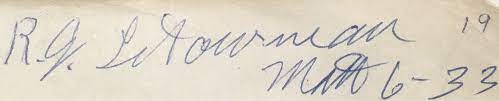
(Robert nearly always included reference to his life verse with each signature.)

It was then that he and Evelyn decided to live on 10% of Robert’s income and give 90% to Christian mission work, colleges, and institutions. Meanwhile Evelyn started Sunday Schools and youth camps. God blessed each of their endeavors.

Robert not only invented the earth mover, but also the bulldozer, the electric wheel, the tree crusher, the log picker, the Tournawheel (a two-wheel tractor), and more. Eventually he’d own 300 patents and construction plants on four continents. He’d also design the first off-shore oil rig.

(from the R.G. LeTourneau Museum and Archives, The Margaret Estes Library, LeTourneau University)

During World War II Robert’s company supplied 70% of the U.S. Army’s earth-moving equipment, making it possible for the Allies to quickly build roads, airports, and military bases.

After the war, Robert’s machinery helped construct the 48,000 miles of U.S. interstate highways.

(R.G. LeTourneau:  The Man, Machines, and Mission Collection
Evelyn LeTourneau Collection)

In 1946 he and Evelyn founded the LeTourneau Polytechnic Institute, a Christ-centered school especially for veterans who desired training in engineering. It has since become LeTourneau University.

Business and philanthropy weren’t Robert’s only pursuits. Though he’d always feared public speaking, Robert felt compelled to accept an invitation to share his story at a banquet in 1935. Soon he was speaking all over America and even overseas.  Robert would encourage others to honor God with their wallets and see what God would do.

“You will never know what you can accomplish

until you say a great big yes to the Lord.”

Robert Gilmour LeTourneau (1888-1969)

How has God blessed you as you’ve honored him with your wallet? Please share your story in the comment section below!


 Notes:

[1] https://www.wayoflife.org/reports/christian_inventor_rg_letourneau.html

[2] Ibid

Other sources:

 http://www.giantsforgod.com/rg-letourneau/

https://www.letu.edu/75/exhibit/panel-faith.html, and subsequent panels

https://www.oemoffhighway.com/trends/article/21366254/historical-construction-equipment-association-hcea-the-great-innovator-r-g-letourneau

https://www.peoriamagazines.com/ibi/2011/jan/rg-letourneau

Photo credits: http://www.flickr.com; http://www.picryl.com; http://www.canva.com; http://www.wikipedia.org; http://www.dailyverses.net; http://www.wikimedia.org; Margaret Estes Library, LeTourneau University (2); http://www.dailyverses.net.

Special thanks to Shelby Ware at the Margaret Estes Library, LeTourneau University, for arranging permission to use the two images of R. G. LeTourneau in this post.

Read Full Post »

Eliza strained forward as her legs churned beneath her, the underbrush tearing at her long skirts. The small boy in her aching arms whimpered, sensing a danger he couldn’t see.

“Hush, chile,” she gasped in a whisper. “Mama’s gone keep you safe.”

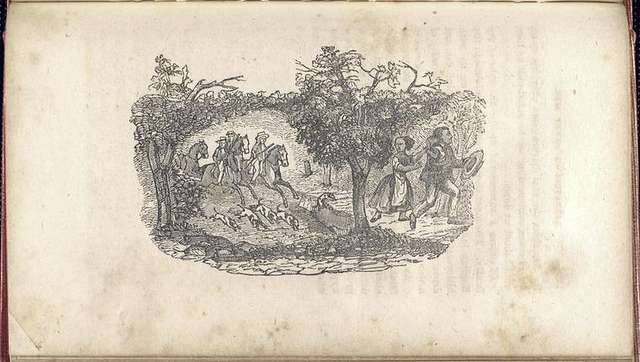
Eliza dared a quick glance behind her. She could see nothing of the slave catchers who’d found her hiding place, a house near the Kentucky side of the Ohio River.  She’d slipped out the back door and into the woods as they approached the front. But they would surely guess her run for freedom, and their long legs, unencumbered by skirts, would quickly bring them close.

Runaways like Eliza Harris

Eliza dared not slow her pace toward the northern side of the river, where she and her baby had a chance to be together. Though her master had been kind, he was planning to sell her son. Eliza could not let that happen; her two older children had already died.

Finally, Eliza could see glimmering flecks through the trees as morning light danced on the water. But this was not what she’d planned. Eliza had expected to walk across the mile-wide river on ice, given the winter season. Instead she found the ice broken up into mammoth chunks, drifting slowly on the current.

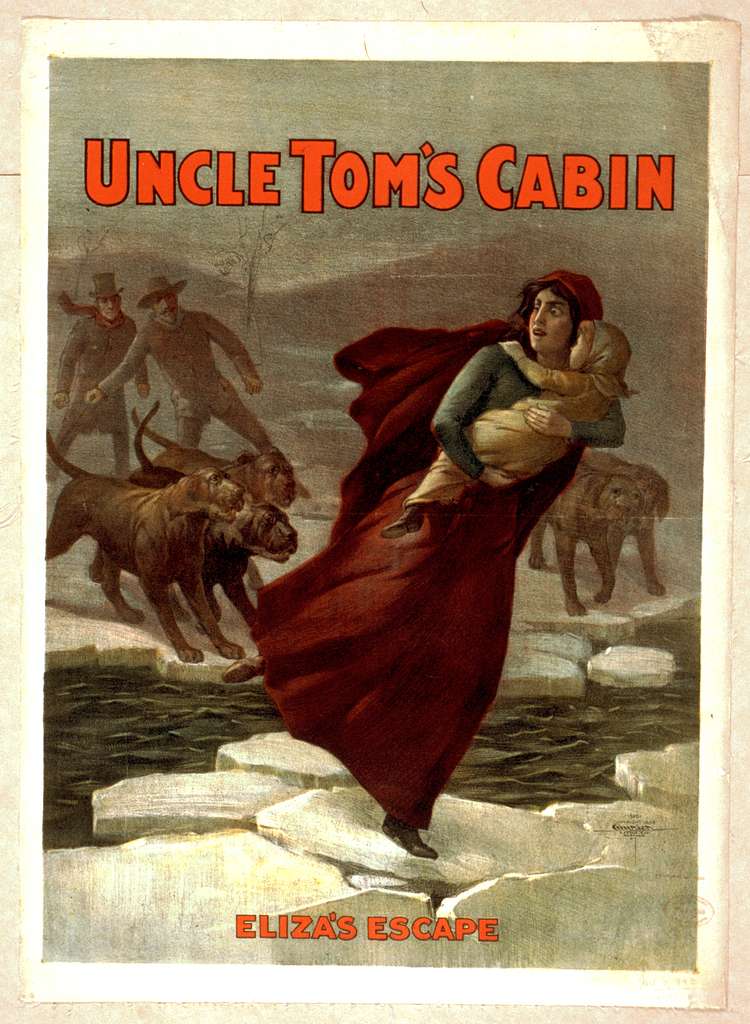
With a prayer on her lips, Eliza made the choice to cross anyway, jumping from ice cake to ice cake. Sometimes the cake on which she stood sunk beneath the surface of the water. Then Eliza would slide her baby onto the next cake and pull herself on with her hands. Soon her skirts were soaked and her hands numb with cold. But Eliza felt God upholding her; she was confident he’d keep them safe.

On the northern bank stood William Lacey, one of those who watched the river for escaping slaves in order to help them. Time and again he thought the river would take the woman and child, but she miraculously reached the bank, heaving for breath and weak from cold and exhaustion.
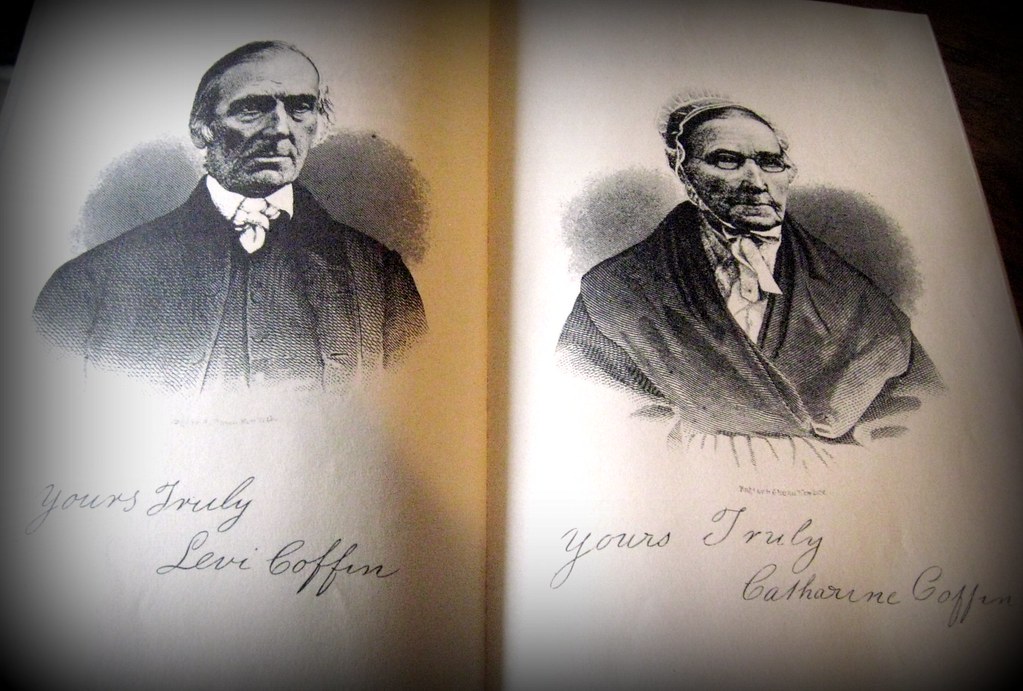
When she’d rested for a few moments, the man helped her to a house on the edge of town. There she received food and dry clothing before being taken to another home and then another, along the Underground Railroad. Finally she reached the home of Quakers, Levi and Catherine Coffin, in Newport, Indiana.[1]

Note the mention of Levi Coffin

By the time Eliza arrived on their doorstep in 1838, the Coffins had been helping escaped slaves for more than a decade. In fact, the following year they would build a house specifically designed for their work as station masters on the Underground Railroad.

A Federalist-style house, similar to the Coffins’ home

In the basement they constructed a spring-fed well, to conceal the enormous amount of water needed for their many guests. On the second floor, they built a secret room between bedroom walls, just four feet wide. Up to fourteen people could hide in the long, narrow room.

Eliza Harris was only one of more than a thousand slaves (some say 3,000) that stayed in the Coffin home on their way to Canada. Had the Coffins (or others) been caught helping runaway slaves, they would have owed a $1000 fine (which few could afford) and would have spent six months in jail (which meant no income for the family during that time). Slave hunters were known to issue death threats as well.

But the Coffins held strong convictions concerning slavery. In the 1870s Levi wrote in his memoirs, “I . . .  risked everything in the work—life, property, and reputation—and did not feel bound to respect human laws that came in direct contact with the law of God.”[2]

For the introduction of Coffin’s book, William Brisbane[3] wrote the following about Levi and two other abolitionists:

“In Christian love they bowed themselves before their Heavenly Father and prayed together for the oppressed race; with a faith that knew no wavering they worked in fraternal union for the enfranchisement of their despised colored brethren, and shared together the odium attached to the name of abolitionist, and finally they rejoiced together and gave thanks to God for the glorious results of those years of persevering effort.”[4]

Should we face such hatred and endangerment in our day, may we stand in the midst of it like Levi and Catherine Coffin—steadfast and unmovable in the power of God.

Addendum:

In 1854 the Coffins visited Canada and happened to encounter a number of former slaves they’d helped. Eliza Harris was one of them–settled in her own home, comfortable and contented.

Her story may sound familiar because Harriet Beecher Stowe, a friend of the Coffins, included the slave’s harrowing escape in her book, Uncle Tom’s Cabin.


[1] Now called Fountain City

[2] https://www.indianamuseum.org/historic-sites/levi-catharine-coffin-house/

[3] a doctor, minister, author, and South Carolina slaveholder who turned abolitionist and moved north where he freed his slaves

[4]https://docsouth.unc.edu/nc/coffin/coffin.html

Other sources:

http://www.womenhistoryblog.com

http://www.rialto.k12.ca.us/rhs/planetwhited/AP%20PDF%20Docs/Unit%206/COFFIN1.PDF

https://mrlinfo.org/famous-visitors/Eliza-Harris.htm

Art & photo credits: http://www.nypl.getarchive.net; http://www.wikimedia.org; http://www.flickr.com; http://www.wikimedia.org; http://www.flickr.com (2); http://www.slr-a.org.uk; http://www.wikimedia.org.

Read Full Post »

(From Morning by Morning, March 4.)

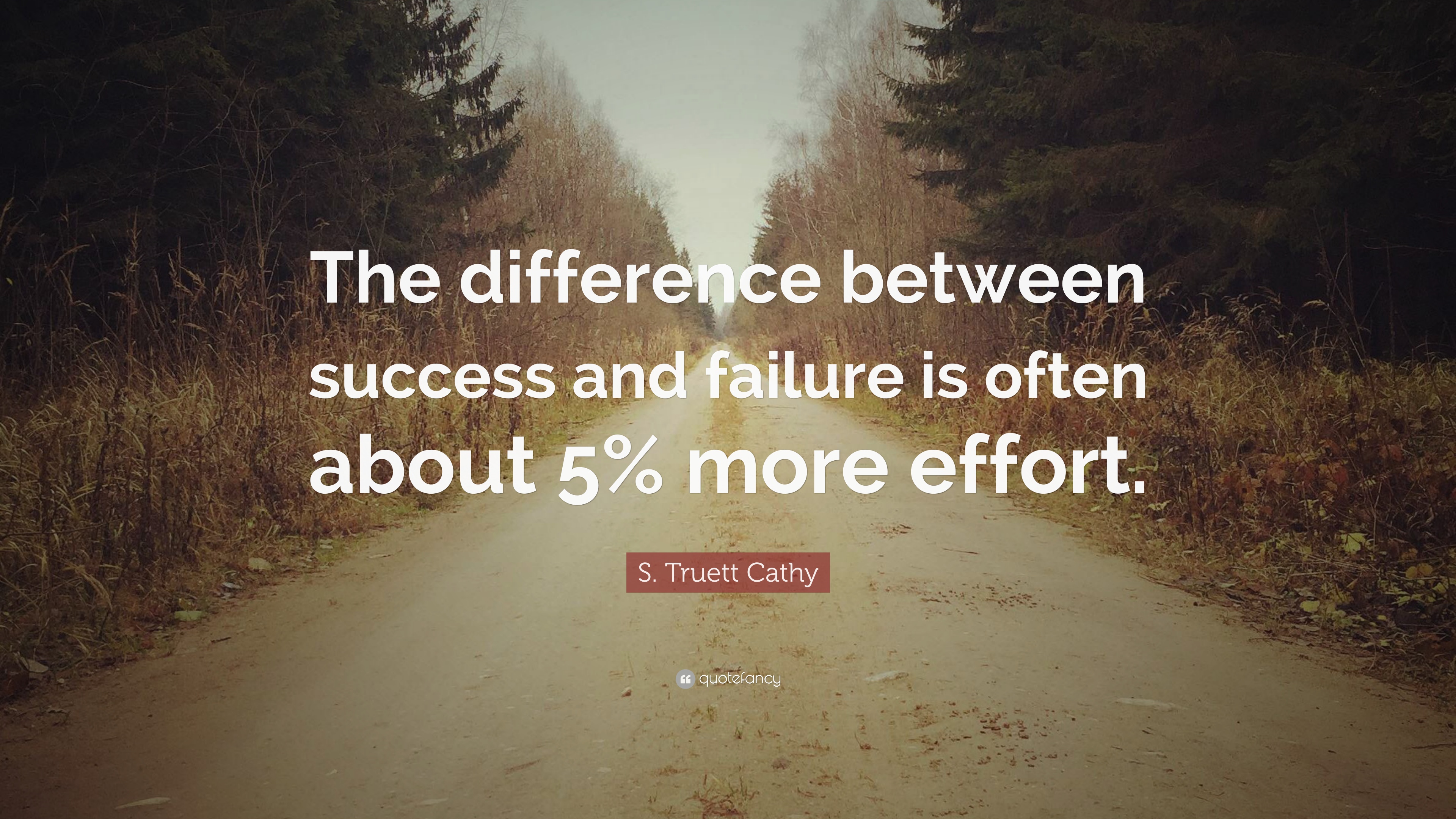
S. Truett Cathy (1921-2014) was just such a person, who grew up in poverty during the Great Depression to become a steadfast and unmovable masterwork of God.

At age eight he started his own business, inspired by a woman in his Atlanta, Georgia neighborhood. She sold cupcakes from her front yard.

M-m-m.  What could I sell to earn some money? Truett wondered. 

The answer: soft drinks. He purchased six bottles for a quarter and sold them for a nickel apiece. Just twenty six-packs, he figured, and I’ll have a whole dollar.

Truett quickly realized he could expand sales by enticing the door-to-door salesmen with cold drinks. He began to serve ice with the soda.

Soon the young entrepreneur had saved four dollars—enough to buy an old bicycle. Now he could make quicker profits by delivering newspapers.  But competition for customers was stiff with three well-established papers in Atlanta.

Truett had learned the value of customer satisfaction, however, so he made sure his papers landed on porches. On rainy days he put them inside the screen doors, and his customer list grew.

Truett delivered papers until high school graduation, after which he was drafted into the Army. Upon honorable discharge in 1945, Truett returned home to pursue his lifelong dream:  owning a business.

He decided to open a restaurant, knowing a bit about cooking for a crowd.  For years he’d helped his mother as she daily prepared meals not only for their family of nine but also for six boarders.

Truett and his younger brother Ben pooled their resources, took out a loan and bought a piece of land near a Ford assembly plant and Delta Airlines at the airport which provided a large customer base.

The tiny restaurant, aptly named the Dwarf Grill, included just ten counter stools and four tables.  The brothers served quick-to-fix burgers and steaks.

(The Dwarf Grill is still in operation, but in a new building with a revised name.)

They worked hard and the business thrived. But in 1949 tragedy struck. Ben, another brother, and two friends were killed.

Later Truett would remark, “I lost two brothers in an airplane crash, both of them leaving a wife and kids.  When I get to heaven, that’s probably the first question I’d like to ask: Why was it necessary?”[1]

The heartbreak did not erode Truett’s strong faith in God, which had been inspired by his devout mother and nurtured by Sunday School teacher and life-long mentor, Theo Abbey.

Then more trouble ensued.  In 1959 Truett was diagnosed with colon cancer. In an interview he explained that just prior to the successful surgery he experienced a new peace, knowing that whether he lived or died, he would be with God.[2] God granted another fifty-six years.

In 1960 the second restaurant burned to the ground, and then the original Dwarf Grill caught fire in 1965. But instead of becoming discouraged, Truett leaned on his God, growing stronger in faith and more determined than ever.

With only one restaurant to oversee, he focused his time on developing the menu. Truett remembered his mother’s impressive fried chicken, how she seasoned it the night before and put it in the ice box to marinate. 

He experimented with recipes, tried his efforts on regular customers and soon created a new menu item: the Chick-fil-A sandwich—a play on the word fillet, but also indicating the meat was grade A.

Customers loved the new sandwich, and in 1967, Truett opened the first Chick-fil-A restaurant. One successful opening followed another until, in the year 2000, the restaurant chain grossed one billion dollars in sales. By 2018, it surpassed $10 billion in sales.

(Double-click and enlarge this image to read about
Truett Cathy’s winning habits
based on Biblical principles.)

Today, the company generates more revenue per restaurant than any other fast-food chain, even though all locations are closed on Sundays. (Since his first day in the restaurant business, Truett set aside that day for his employees and himself “to rest and worship if they choose.”[3])

Truett’s commitment to put God first is expressed in the company’s statement of purpose: “To glorify God by being a faithful steward of all that is entrusted to us and to have a positive influence on all who come in contact with Chick-fil-A.”[4]

Truett also delighted to glorify God by spending his fortune to encourage others.

How do you identify someone who needs encouragement?

That person is breathing.

–Truett Cathy

Since 1973, Chick-fil-A has given more than $35 million in college scholarships to its employees. Truett also founded the WinShape Foundation, providing approximately $18 million dollars for the development of foster homes and summer camps.

His legacy of planting Christian ideals in the lives of others continues, even though Masterwork Samuel Truett Cathy now resides in heaven. (He is survived by his wife of sixty-six years, three children, eighteen grandchildren, and nineteen great-grandchildren.)


[1] https://www.quotetab.com/quote/by-s-truett-cathy/i-lost-two-brothers-in-an-airplane-crash-both-of-them-leaving-a-wife-and-kids-w

[2] https://www.11alive.com/article/news/thank-you-god-that-im-alive-in-book-chick-fil-a-founder-s-truett-cathy-shared-faith-affirming-brush-with-mortality/85-48c52862-7a53-4167-9e7a-1a37bd8d6185

[3] https://thechickenwire.chick-fil-a.com/inside-chick-fil-a/secret-menus-and-closed-on-sundays-chick-fil-a-fact-or-fiction

[4] https://billygraham.org/story/a-conversation-with-truett-cathy

Other Sources:

http://www.academicstar.us/UploadFile/Picture/2015-7/20157331854318.pdf

https://www.entrepreneur.com/article/311452

http://www.giantsforgod.com/s-truett-cathy/

https://www.thextraordinary.org/s-truett-cathy

Photo credits: http://www.pixhive.com; http://www.quotefancy.com; http://www.flickr.com; http://www.dailyverses.net; http://www.samiskelton.com; http://www.flickr.com; http://www.pxfuel.com.

Read Full Post »

(In honor of Women’s History Month)


Hannah More (1745-1833)


The odds were stacked against her.

Like all young women of eighteenth century Britain, Hannah More would have to choose between marriage and a select few occupations for females. Universities did not accept women, most professions were closed to them, they couldn’t serve in government or even vote.

Yet the case has been made that Hannah More wielded strong influence in important arenas of her time. How could that be? God paved the way.


First, he gave Hannah a quick mind and a schoolteacher father who taught his five daughters at home. As the girls grew into womanhood Mr. More helped two of the older sisters open a boarding school for girls in nearby Bristol. Hannah attended for a while, but at age eighteen, became one of the teachers.

In addition to the ability to teach, God gave Hannah a gift for writing. Even at an early age she was composing poems and essays. Later she began to write plays for her students—dramas that included life lessons.

In her early twenties, Hannah became engaged to neighboring landowner, William Turner. Three times the wedding date was set; three times he backed out. The third time Hannah broke the engagement. To assuage his guilt, William gave her a monthly stipend, enabling Hannah to move to London and focus on her writing.


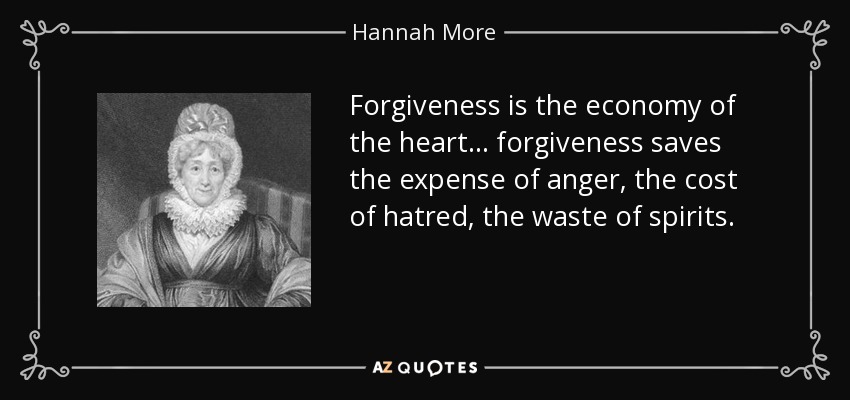
(www.azquotes.com/author/10363-Hannah_More)


God also provided opportunities for Hannah to meet people of influence. With her intelligence, wit, and charm, she was often invited to dinner parties and became a member of high society.

Meanwhile she made the acquaintance of John Newton, the slave-ship captain turned preacher who wrote Amazing Grace. They enjoyed a life-long friendship.


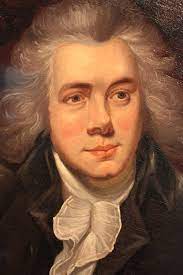
Newton was a member of the Clapham Sect, a group of passionate Christians, eager to release people from the oppression of poverty and slavery. One of the sect members served in Parliament, William Wilberforce. He, his wife Barbara, and Hannah also became friends for life.


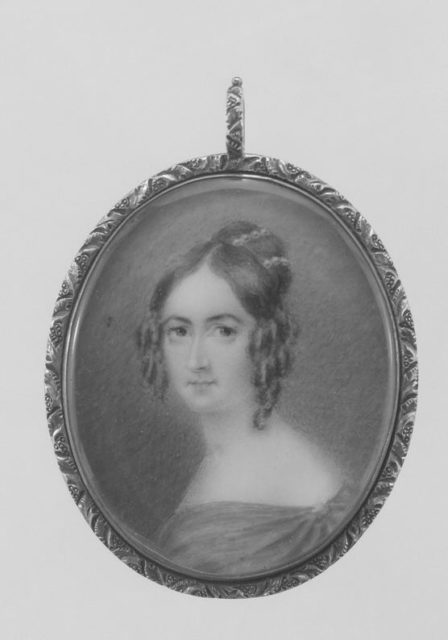
William and Barbara Wilberforce


Hannah already despised the slave trade and joined the Clapham community. Their strong commitment to Christ greatly influenced Hannah and the practice of her faith took on greater importance.

At the suggestion of Wilburforce, Hannah wrote a poem to raise awareness about the treatment of slaves. It was published in 1788. One passage described the capture of Africans:


The burning village, and the blazing town:

See the dire victim torn from social life,

See the sacred infant, hear the shrieking wife!

She, wretch forlorn! Is dragged by hostile hands,

To distant tyrants sold, in distant lands.


As a result of reading Hannah’s impassioned account, thousands of people signed petitions demanding an end to the slave trade. The next year, Wilburforce used her poem in a Parliamentary debate concerning slavery.

Hannah helped the cause in other ways also. She encouraged a sugar boycott, since slaves provided the workforce on the British plantations of the Caribbean.


She even used her influence at dinner parties. Among people dressed in finery and focused on pleasure, Hannah would engage in cheerful banter, then pull out a folded piece of paper from her reticule, a drawstring purse.

“Have you ever seen the likes of this?” she might ask while spreading a print flat on the dining table—a diagram of the cargo hold inside a slave ship with Africans packed tightly together. The startling image helped garner more support for the cause.


Even as she campaigned for the abolition of slavery, Hannah took on another endeavor: education for the poor. She and her younger sister Martha established Sunday Schools since many of their students worked Monday through Saturday. (Child labor wasn’t prohibited in Britain until 1880.) They taught the three R’s and Bible lessons.

Soon three hundred children attended. Then adults were included and job placement provided. Within ten years, the sisters had opened sixteen schools, three of which still functioned into the twentieth century. Hannah involved herself in these schools for thirty years.


(Hannah More Academy, built 1834; closed 1974)


And of course, Hannah continued to write. She produced numerous pamphlets, plays of Bible stories that missionaries used around the world, as well as Christian novels and nonfiction. Her books outsold Jane Austen’s.

At age eighty-eight Hannah died peacefully in her sleep, just weeks after Parliament abolished slavery. The battle had taken forty years.

Even after her death Hannah’s positive influence lived on. She left the proceeds of her books, 30,000 pounds, for distribution to the poor—the equivalent of three million dollars today.

Hannah wrote in Practical Piety (1811):


“We must, while we keep our hearts humble,

keep our aims high . . . As God is unlimited in goodness,

He should have our unlimited love.

The best we can offer is poor, but let us not withhold that best.”


No one can say Hannah More did not give her best. May we follow her example.


Sources:

  1. https://www.evangelicalmagazine.com/article/hannah-more/
  2. https://www.acton.org/pub/religion-liberty/volume-26-number-1/hannah-more-1745-%E2%80%93-1833
  3. https://www.str.org/w/hannah-more-guided-by-christian-convictions
  4. https://www.christianitytoday.com/ct/2015/march/hannah-more-powerhouse-in-petticoat.html
  5. https://religionnews.com/2014/11/05/hannah-karen-prior-evangelical/
  6. https://www.christianheadlines.com/columnists/breakpoint/the-power-of-a-poem-hannah-more-and-the-abolition-of-the-slave-trade.html.
  7. https://mylordkatie.wordpress.com/2012/02/22/hannah-more-a-heart-for-the-poor/
  8. https://www.citieschurch.com/journal/culture-shaping-faith
  9. http://christianwomenonline.net/2020/02/18/hannah-more-changing-the-world-with-a-pen/


Art & photo credits: http://www.picryl.com; http://www.heartlight.org; http://www.azquotes.com; http://www.wikimedia.org (2); http://www.wikipedia.org; http://www.wikimedia.org (3).


Read Full Post »

Older Posts »

Still Traveling

Impressions Becoming Expressions

Living Our Days

Gaining a heart of wisdom

He Said What?!

I'm Patty, and my husband and I are living with our adult son who has autism and epilepsy. I love sharing lessons learned from life around me, especially life with Aaron.

Meditations of my Heart

Impressions Becoming Expressions

Linda Stoll

Impressions Becoming Expressions

Debby Thompson

Impressions Becoming Expressions

Signora Sheila

Notes on Life, Faith & Italy

Colleen Scheid

Writing, Acting, Living in God's Love

Mitch Teemley

The Power of Story

Heidi Viars

Finding the Image of God