Feeds:
Posts
Comments

Archive for the ‘God’s Faithfulness’ Category

Many of us memorized 1 Peter 5:7 as children:
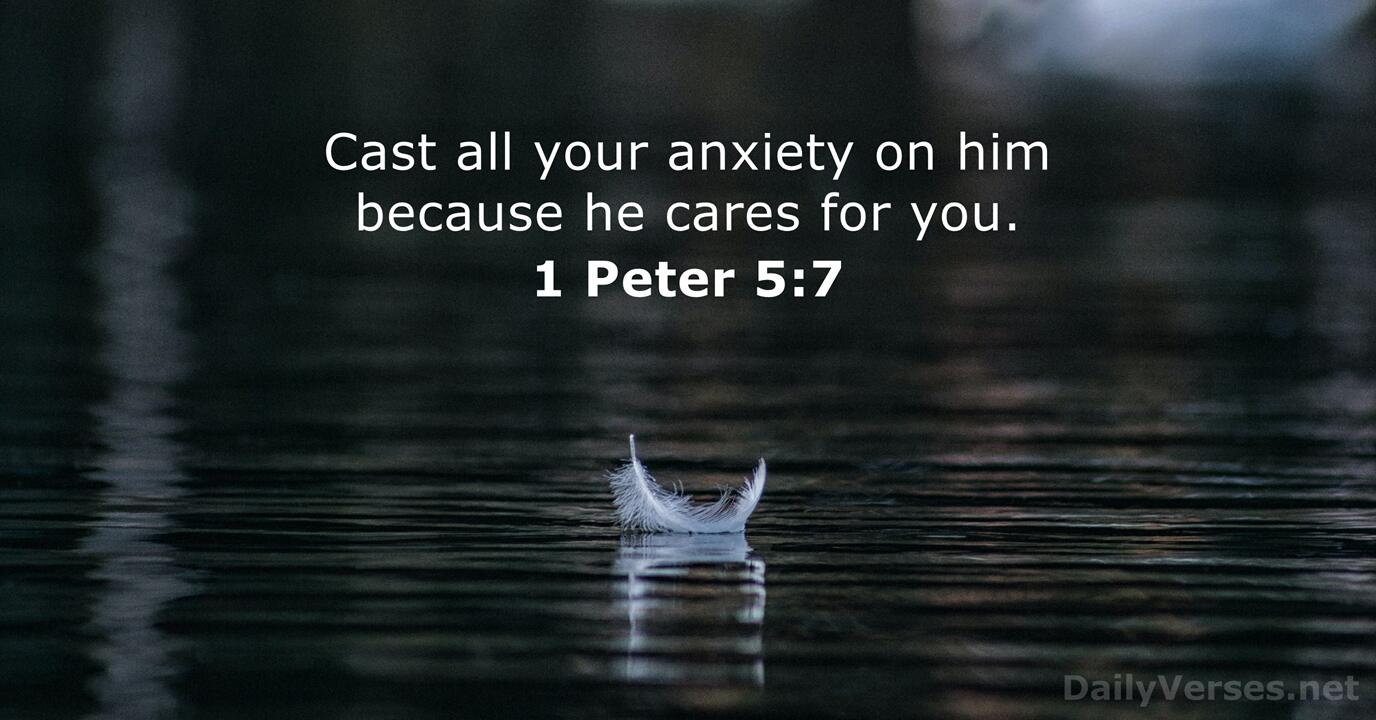
Did you ever wonder how we cast our anxiety?

After all, our concerns aren’t jammed into heavy backpacks we can physically heave onto God’s back. We’re talking in the abstract–about nagging problems, physical ailments, troubling situations.

And in spite of God’s capacity and willingness to be our Burden-Bearer (Psalm 68:19), we find anxiety and fear niggling among our thoughts just the same. It’s difficult to get rid of them.

We know gratitude and praise to God can be effective burden-lifters, but worries can linger on the periphery, waiting for the first opportunity to return. Is that a sign of failure?

Here’s what I’ve learned; maybe you have too.

First, ‘remember learning math facts in school?

Mastery required practice because that’s how God made our brains to work. We learn by making neural connections, called synapses. For most of us, it takes a good deal of repetition for synapse-connections to become hard-wired (1).

Second, it makes sense that the advanced skill of controlling our thinking is also going to require practice. It’s a sign of wisdom to keep turning our minds back to God–a hundred times a day if necessary.

Third, I also know this: God appreciates progress; he doesn’t withhold his delight in us until we’re perfect. 

Consider God’s message through the prophet Zechariah: 

So, when a concern wants front-and-center attention in our minds, let’s implement:

Strategy #1: Keep turning the mind to gratitude and praise.

Matthew Henry, the great Bible commentator of the 1600s had his wallet stolen one day. But instead of fretting about it, he wrote this in his journal:

“I thank Thee first because I was never robbed before; second because although they took my purse they did not take my life; third, because although they took my all, it was not much; and fourth because it was I who was robbed, and not I who robbed.”

Henry’s reasons for gratitude surely helped to shift the burden of anxiety from his own shoulders to the formidable shoulders of God. Just reading his entry lifts my spirit. 

Strategy #2: Affirm that God can turn burdens into blessings.  

God achieves purpose, even in our suffering. One purpose: to expand the joy in our lives (James 1:2).
For twenty-six years I taught elementary school. One difficult year, the problems and resulting tension intensified. And yet, as I got in the car each morning, I strongly sensed God’s presence with me, as if he sat in the passenger seat! 

His presence gave me joy–to the point of happy tears sometimes–while also offering reassurance and strength. Without the increased stress, I would not have experienced that singular blessedness.

Strategy #3:  Remember who God is.

For God to be our Burden-Bearer, we have to trust him, and trust grows as we remember:     

He’s our Father of compassion, our ever-present help in trouble, our King of power and glory, our loving and faithful God, our strong deliverer, and more (3). He can handle any load of trouble.

In fact, what seems to us a crushing burden is as inconsequential to him as a speck of dust on a balance scale (4).

*     *     *     *     *     *     * 

Lord, help me remember: You are the one with the answer to every question, the solution to every problem, and the wisdom for every decision (5). To worry is to forget Who’s in charge. May I joyfully rest in you.   
Notes:

  1. https://earlychildhood.qld.gov.au/early-years/early-learning-at-home/read-and-count/the-power-of-repetition
  2. Karol Ladd, Thrive, Don’t Simply Survive, 54-55.
  3. Psalm 103:13; 46:1;1 Chronicles 29:11; Psalm 57:10; 18:2.
  4. Based on a Charles Spurgeon quote from Morning by Morning, 8.
  5. Kay Arthur, His Imprint, My Expression, 36.

Image credits: dailyverses.net; http://www.flickr.com (Jimmie Quick); http://www.canva.com (2); http://www.heartlight.org.

Processing…
Success! You're on the list.

Read Full Post »


Maria (pronounced Ma-RYE-ah) Fearing and three friends stood at the ship’s rail, eager to see the coastline of their destination: Africa. For twelve days since leaving New York they’d waited not-so-patiently for this moment. Now it was almost upon them.

Maria remembered when missionary work in Africa first caught her interest. She’d been a teenage house slave and nanny for the youngest six children of the Winston family, on their plantation near Gainesville, Alabama. 

At bedtime, Mrs. Winston read Bible stories to her children as well as tales of missionaries like David Livingstone. How wonderful, thought Maria, to share about Jesus with people who’ve never heard of him before.

Slavery ended in 1865; Maria was twenty-seven. Becoming a missionary was still out of the question; she had no education. But Maria found employment in Gainesville as a live-in maid, grateful to God for the skills she’d learned in the Winston household. 

Five years later, Maria heard about a school founded by two former slaves and for former slaves, Talladega College, which included grades 1-12 as well as college courses.

Talledega College

Students could work on campus and pay their way. Maria traveled the 150 miles to Talladega by walking and catching rides.

She began her schooling with the youngest children. They teased at first—a grown woman with six-year-olds! But Maria played with them at recess and earned their affection. 

While at Talladega, Maria met Lucy Gantt and Lilian Thomas. Though much younger than Maria, the three women became close friends.

Setting her mind toward success, Maria made quick progress toward completing ninth grade. That qualified her to teach in a rural school for the children of former slaves.

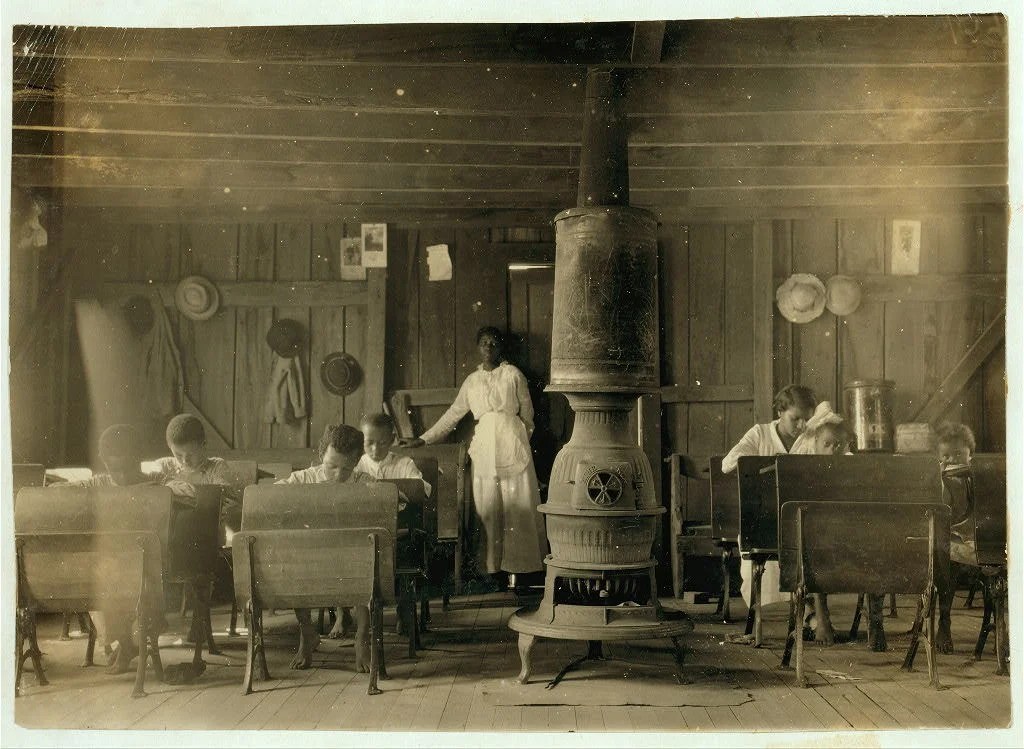
Perhaps her classrom looked similar to this one.

She soon achieved another goal, purchasing a small home. Sometime later Talladega invited Maria to return and serve as assistant matron. She accepted.

In 1894 William Shepherd came to the school to tell about his missionary work in the Congo (now Zaire).

Maria remembered Mrs. Winston’s stories and how she’d dreamed of becoming a missionary. When William invited others to join him, Maria volunteered.

However, her interview with the Presbyterian mission board did not go well. She was fifty-six years old, and though perfectly healthy, Maria appeared frail at just five feet tall and ninety pounds. 

“We’re very sorry, Miss Fearing, but we cannot support you,” they declared.

Maria didn’t acquiesce. She met with a church leader, asking him to vouch for her; friends also interceded on her behalf. With their recommendations, the board relented, if she’d pay her own way. 

Maria thanked God he’d inspired her to buy a home, which she happily sold, and with a $100 donation from Telladega women, arranged for the journey. 

Now it was June 1894, and she found herself standing next to her two friends from Talledega, Lucy and Lilian, who’d also volunteered. Lucy had since married the missionary William Shepherd, and together the foursome watched the coastline of Africa come into view. 

However, their journey was not over. They still faced the arduous trek to the mission station, over land and down rivers for 600 miles or so, and taking another six weeks. 

Finally they arrived at the Luebo Mission. Maria began to help the couple in charge however she could, while focused on learning the language. She became quite proficient in just one year’s time.

Also at the one-year mark, the mission board decided to pay her at half rate, then full salary after two years. 

Maria and Lilian cared for forty-four children who’d been orphaned or rescued from the slave trade. They called Maria Mama Wa Mputu, Mother from Far Away.

Perhaps the Luebo school looked similar to this one in Malawi, Africa, 1905.

She and Lillian taught the children household skills, preparing them for domestic employment when they left the mission. But they also taught reading, writing, arithmetic, and Bible knowledge.

All her life God had been preparing Maria for this position, beginning with training in the Winston home, her time as a nanny, and then a teacher. 

The school grew. Some of the new students were those Maria herself purchased out of the slave trade from her meager salary and with funds sent by friends from Talladega. By 1903, 203 students lived under their care—with the help of more teachers. 

Maria also contributed to the translation of the Bible, the catechism, and a number of hymns into the local dialect.

In 1915, at age 77, Maria traveled to America for minor surgery, but when she prepared to return to Africa, the mission board said no, she was too old. 

Maria must have been heartbroken, yet she continued to serve, establishing a Congolese art exhibit, sending the proceeds to the mission at Luebo, and teaching Sunday School until age 93.

After touching countless lives with the grace of Jesus, Maria Fearing died at age 99. 

In the year 2000, she was posthumously inducted into the Alabama Women’s Hall of Fame.

SOURCES:

Diana Lynn Severance, Her-Story, 342. 

https://ca.thegospelcoalition.org/columns/femmes-scriptura/meet-maria-fearing-african-american-missionary-to-congo/

https://encyclopediaofalabama.org/article/maria-fearing/

https://faithfullymagazine.com/maria-fearing-remember/https://placefortruth.org/maria-fearing-and-the-mission-to-the-congo/

Lorelei Siemens, “Maria Fearing: From Slavery to Missionary in Africa,” http://www.youtube.com, 2-26-25.

https://placefortruth.org/maria-fearing-and-the-mission-to-the-congo/

IMAGE CREDITS: http://www.picryl.com (3); http://www.flickr.com; http://www.picryl.com.

Processing…
Success! You're on the list.

Read Full Post »

Not long ago I meant to type into the search box, biblehub.com, a site I visit frequently for research. (If you’ve not visited there, it’s well worth exploring.) But this time, instead of hub I typed hug.

Bible hug.

After a slight snicker, I thought, Wait—scripture does offer hugs-of-sorts, in the form of encouragement, comfort, and assurance—providing occasions when I can almost feel God’s embrace.

Sometimes those hugs have come in preparation for what’s to come, sometimes in the midst of pain or trouble, and other times after the fact.

For example, a Bible hug in preparation for what was to come:

Steve and I were driving home after a visit to the next church (three hours away) where he’d been assigned to serve as pastor, beginning in six weeks. Melancholy enveloped me.

Three times in eleven years, the powers-that-be had chosen to move us, although neither we nor the current church had requested it. This was the hardest part of being a pastor’s family in our denomination.

Suddenly, on the Christian radio station we were listening to, the host read a scripture I’d surely heard before, but it took on fresh significance that day:

I clung to that promise over the next weeks of packing, taking care of the million-and-one details a move requires, and saying painful good-byes.

And look what God did at our new church:

He prospered us in new relationships, grew our faith (especially concerning our finances and those of the church), and blessed us as we watched him grow this community of believers—in number, spiritual maturity, and outreach—for thirteen years.

*       *       *

A Bible hug in the midst of pain: 

Spring semester my freshman year of college, I received news that a friend back home had died, the result of a car accident. She’d been in a coma for over a week.

It seemed impossible. So many people had been praying for Shelly. Why did God say “No?”

She was only eighteen, as smart as they come, and scheduled to go to Spain as a short-term missionary that coming summer. Shelly was also an accomplished pianist, and had just won second place in a talent competition.

Why didn’t God intervene for such an outstanding young woman? My faith was beginning to falter.

I shut myself in the dormitory broom closet and searched my Bible for an answer. It wasn’t long before I came across these verses:

Verse 36 in the New Living Translation says, “Everything comes from him . . . and is intended for his glory.” 

That includes the death of my young friend. My place is not to beg for answers that I likely wouldn’t understand or accept anyway. My place is to trust.

*       *       *

A Bible hug that provided closure:

Years ago Steve worked under the direction of a pastor whose words and actions could be downright unkind. We’ll call him George. 

The situation intensified when, behind the scenes and unbeknownst to us, George engineered a change of position for Steve—elsewhere in the state–while we were on vacation. I was pregnant at the time, due just one month prior to the move.

God taught me much during that time, including the wisdom of James 1:2-4:

The next few months provided many opportunities to practice perseverance as we endured continued difficulty with George.

We also developed self-control, not talking to people in the church about what he had done (except with a few mature confidantes), in order not to cause strife or division.

I learned that love is not a feeling, it’s an action. With much prayer, God gave me grace to be genial with George. He also helped me understand that much of his untoward behavior came from insecurity.

After the fact, I could count it all joy that we’d faced such trials. I’m a better person for the lessons learned in self-discipline, integrity, and perseverance.

Years later we had occasion to meet George again. God had obviously been at work in his life; he was a changed man.

*       *       *

Of course, these are just a few of the Bible hugs received from God over the years. Perhaps we’ll revisit this topic again in the future.

In the meantime, please share in the comment section below a Bible hug you’ve received. I’d love to read your stories; no doubt others would too!

Image credits: http://www.easy-peasy.ai; http://www.pexels.com (Leticia Alvares); http://www.dailyverses.net; http://www.canva.com; http://www.pickpik.com.

Processing…
Success! You're on the list.

Read Full Post »

I wonder if your inner voice ever speaks to you like this:

  • “Well, you stuck your foot in your mouth again. Why don’t you think before you speak?”
  • “There’s no way you’re going to finish that project on time.”
  • Go ahead! Tell her about that award you just won. She’ll be so impressed.”
  • “Why is he always so critical? I should give him a piece of my mind!”
  • “You have every right to be upset. How rude can a person be?”

At one time or other, similar thoughts have crept into my mind. If allowed to fester, my sense of well-being is compromised.

What I need from time to time is a pep talk from my positive voice to counter the negativity. Maybe you do too.

I can just hear that voice calling for my attention—“Hey Self! Listen Up!”—in preparation to take my thoughts in a new direction.

And what might that new direction include?

Listed below are common default reactions we want to avoid, followed by truths to counter them. For each I’ve included (what I hope is) an insightful quote, and a response from that inner voice residing in my head.

I wonder if these responses might resemble yours?

Anxiety

“Anxiety is rooted in a failure to trust God”—Unknown (1). 

Ouch. Did you hear that, Self? Let’s destroy those weeds of worry with affirmations of truth about God!

Psalm 36:5-6

Inadequacy

“Never mind your weakness; it is the very thing that qualifies you. Never mind your feelings of inadequacy; it is God’s work, not yours. Simply make yourself available, and let go of any need to impress others, or prove yourself worthy, or achieve ‘success.’ What matters is that God has chosen you and that God claims you as God’s own”—Brother David Vryhof.

Keep reminding yourself—It is God’s work, not yours. Just stay available, Self, in close connection with him.

Discouragement

“Every step toward Christ kills a doubt. Every thought, word, and deed for Him carries you away from discouragement”—Theodore L. Cuyler.

Okay, Self. Remember: Your King Jesus is Faithful and True, the great Shepherd of his sheep, the head over every authority and power, the Righteous One, and more. AND, this Lord of lords is at work for your benefit (2)!

Helplessness

“While it looks like things are out of control, behind the scenes there is a God who hasn’t surrendered his authority”—A. W. Tozer.

See Self? You aren’t helpless. God Almighty is on your side (3)!

Self-Pity

“Our troubles have always brought us blessings, and they always will. They are the black chariots of bright grace”—Charles Spurgeon.

Don’t dwell on the dark distressors, Self. Look for the beams of bright grace.

Perfectionism:

“A flawed rose still smells sweet”—Unknown.

So, Self: pour your energy into diffusing the fragrance of Christ (4)!

Pride:

“God abhors those people worst who adore themselves most”—William Seckler (5). 

That knowledge alone, Self, ought to help you nip prideful thoughts in the bud!

Wrong Motives:

“I know when I’m doing the right thing for the wrong reason, because that’s when I want credit for it. When I’m doing the right thing with the right heart, I’m content my Father knows and nobody else. That’s enough for me. Because He’s enough”—Denise J. Hughes (6).

Be most mindful of your Audience of One, Self, just as Big Daddy Weave sang about years ago (7).

Anger (Frustration, Resentment):

“Most often, you should leave your anger . . .at the feet of Jesus and allow him to act in your behalf” (8).

Wise advice, don’t you think, Self?

And there you have it: a positive pep talk of wisdom to counter nine undesirable emotions that vie for soul-space.

Now let’s get out there and seize the every day with positivity, purpose, trust, and expectation!

Notes:

  1. God’s Little Lessons on Life, no author given, 19.
  2. Revelation 19:11; Hebrews 13:20-21; Colossians 2:10; 1 John 2:1; Philippians 2:13; Romans 8:28
  3. Romans 8:31
  4. 2 Corinthians 2:14-15
  5. Proverbs 8:13
  6. Deeper Waters, 115.
  7. https://www.youtube.com/watch?v=eKS-c93bfbM&list=RDeKS-c93bfbM&start_radio=1
  8. The Women’s Study Bible, Thomas Nelson, 957.

Image credits: http://www.publicdomainpictures.net (Gerd Altmann); http://www.publicdomainpictures.net (George Hodan); http://www.heartlight.org; http://www.dailyverses.net (2); http://www.canva.com.

Processing…
Success! You're on the list.

Read Full Post »

A new soul. I like the sound of that, don’t you? In my imagination I see a freshening of my attitudes, improved motivations, and increased spiritual strength.

But where do I start in order to have a new soul?

No doubt, a new soul begins with repentance—expressing to God my sorrow for wrongdoing and availing myself of his help to change. Just as King David prayed, I can ask God to:

Notice that David asked God to create in him a pure heart. David didn’t promise to clean up his act on his own. Only God could make David’s heart new and pure. The same goes for me. All I can do is submit myself to his transforming power and follow his lead.

That pure heart David asked for is a clear conscience. And with the release from guilt came a rush of joy and the restoration of sweet peace with God. Doesn’t that sound wonderful?

“No one is happier than the one who has repented of wrong” (Max Lucado).

A new soul involves renewal of the mind.

romans12_2

Or, put another way:

“Don’t copy the behavior and customs of this world,

but let God transform you into a new person

by changing the way you think.

Then you will learn to know God’s will for you,

which is good and pleasing and perfect.”

–Romans 12:2, NLT (emphasis added)

Once the negative influences of sin have been removed, I need to fill my mind with excellent, praiseworthy contemplations.

Why waste my thoughts and allow them to wander on worthless topics or circle around pointless worries? Instead, I want to set my mind on the positive, especially on God himself.

A renewed mind is not problem-focused; it is Person-focused.

A new soul requires day-by-day rejuvenation.

“We do not lose heart.

Though outwardly we are wasting away,

yet inwardly we are being renewed day by day.”

–2 Corinthians 4:16 (emphasis added)

God has established certain laws by which our world is governed. Gravity is one example. The law of entropy is another. It states that all elements of the universe tend to disintegrate over time. Plants and animals die and decay, iron rusts, rock erodes.

Our souls tend to disintegrate over time, too, when left unattended:

  • Worry and fear wreak havoc
  • Self-centeredness creates an appetite for entertainment, possessions, and recognition—appetites that are never satiated
  • Foolishness reigns because wisdom is ignored
  • Rationalizations replace honest evaluations
  • Uncontrolled behaviors harm relationships

But when we avail ourselves of God’s influence day-by-day and step-by-step, the law of entropy has no effect on our souls.

The Amplified Version expands the meaning:

The steps of a [good and righteous] man

are directed and established by the Lord,

and He delights in his way [and blesses his path].

–Psalm 37:23 AMP

Consider the significance of these key words:

Steps – Even spiritual achievement rarely happens in an instant. God values slow and steady progress

Directed – He isn’t just interested in the details of our lives; he’s lovingly engineering them

Established – There is always design and strategy in God’s endeavors, even if we only occasionally perceive it

Delights – God is pleased with those who follow the path he has thoughtfully and wisely set

Blesses – God lovingly bestows such gifts as peace, joy, hope, and satisfaction in life

*     *     *     *     *     *     *     *     *     *

Holy Creator of new souls, as I stand on the brink of a new year, I do confess my failings to you. Purify my heart; show me how to refine my motivations behind right actions.

Thank you for your gentle nudges to turn my mind toward you, and your loving attention upon every step of my life. I praise you that continual contact with you results in a soul–a life–that is continually refreshed and made new!

Image credits:  www.canva.com; http://www.dailyverses.net; http://www.heartlight.org; http://www.canva.com (2).

(Revised and reblogged from 1-4-2016, while we enjoy one more day of out-of-town family.)

Processing…
Success! You're on the list.

Read Full Post »

This question popped into my head recently:

If we connected a scripture verse to one blessed event for each month of 2025, what might we include?

Here’s a portion of the Ruegg list:

JANUARY—

Upon leaving worship one Sunday, we were greeted by heavy snowfall. The predominately pure-white scene provided a reminder that “Great is our Lord and mighty in power . . . He spreads his snow like wool and scatters the frost like ashes” (Psalm 147:5a, 16 NIV).

MARCH—

Our twelve-year-old granddaughter and her parents faced the decision of which school she should attend for grades 7-12.

Then, they just happened to sit in church near a family whose son attends one of the schools on their list, and the subject just happened to come up during the meet-and-greet time.

The positive conversation helped make clear God’s choice, illustrating once again, he does indeed show us which path to take (Proverbs 3:6 NLT).

APRIL—

A memorable Easter feast at our son’s and D-I-L’s home. Family and friends contributed parts of the meal, served in courses. In between each we enjoyed readings, prayers, and song–dining and fellowshipping for four hours!

Perhaps we followed—in part—the example of the early church: “They devoted themselves to . . . fellowship, to the breaking of bread, and prayers” (Acts 2:42 CSB).

JUNE—

Our oldest granddaughter (17) participated in a week-long science program at the University of Cincinnati. She and our daughter stayed with us. S. loved the course; H. and I enjoyed quality mother/daughter time.

“Children are a heritage from the Lord, offspring a reward from him” (Psalm 127:3).

JULY—

What a delightful morning with the Hippos! (That’s the Toddler 2 class at church.) The best part: Elliott wanted to be held and Luca took my hand on the way back from the playground. “No doubt about it: children are a gift from the Lord” (Psalm 127:3 CEB)—even if they belong to others!

The joy on this woman’s face expresses mine

AUGUST—

The visit of old friends produced much reminiscing, laughter, and heart-to-heart conversation. “Sweet friendship refreshes the soul” (Proverbs 27:9 MSG).

SEPTEMBER—

A blog post this month lacked a good conclusion, and then the morning of posting an idea popped into my brain. I knew exactly where it came from. “Every good and perfect gift is from above” (James 1:17a), including ideas!

OCTOBER—

Times spent with our granddaughters provide some of our best blessings: sleepovers, movie nights, playing games, crafting, and more.

“Grandchildren are the pride and joy of old age” (Proverbs 17:6 ERV).

NOVEMBER—

Multiple errands one week allowed me to enjoy numerous stellar vistas of the fall foliage. Surely autumn is the time when “the forest sings for joy before the Lord” (1 Chronicles 16:33) most passionately!

And to sum up the whole year:

“How abundant are the good things God has stored up for those who fear him” (Psalm 34:19)! We give thanks to him with all our hearts (Psalm 9:1a).

[No doubt some of you recognized this post—it’s the Ruegg Report for 2025, inserted in our Christmas cards. Writing once and “publishing” twice helped streamline the pre-Christmas to-do list. I knew you’d understand!]

Image credits: http://www.openclipart.org; http://www.pickpik.com; http://www.freerangestock.com; http://www.pexels.com; Nancy Ruegg; http://www.commons.wikimedia.org.

Processing…
Success! You're on the list.

Read Full Post »

On this cloud-shrouded, Thanksgiving morning,

I pause in the candlelight to thank and praise You, O Lord–

for family and friends, food and clothing,

a cozy home and delightful blessings

we never even thought to ask for.

These are benevolences we see, touch, and hear.

One blessing we never thought to ask for: a trip to Israel in 1994, travel and lodging expenses paid for.

But I also want to thank you for those gifts

that only the senses of the heart can perceive—

blessings that include your eternal faithfulness,

as expansive and enduring as the skies,

and your loving devotion, as measureless as

the far reaches of the cosmos.

I thank you for your alert attentiveness,

keeping watch over me as I come and go,

for your abundant goodness which you store up

for those who fear you and take refuge in you,

for your wisdom that knows what to accomplish and when,

what to give and what to withhold.

I thank you for your compassionate mercy

that offers a fresh start each day,

your transforming grace that takes the sand of troubles

and creates pearls of lustrous steadfastness and stability.

I praise you for your strength that “turns my mush into might.”

When I’m weary in spirit, you prop me up and propel me forward.

 I thank you for your Word that instructs in the ways of abundant living,

guiding me along the right path as I internalize your truths.

I thank you for its encouragement when my spirit falters,

providing hope through the promises that cannot fail

and in the knowledge of who you are, our holy and perfect Father.

Your Word is “an anchor of truth in a sea of lies.”

“Praise and glory and wisdom and thanks and honor and power and strength be to you O God, for ever and ever. Amen” (Revelation 7:12)!

* * * * *

Now it’s your turn! What would you add to this gratitude list that specifically celebrates God? Add your praise in the comment section below!

Scriptures and other sources:

  • Verse 2: Psalm 36:5; 108:4
  • Verse 3: Psalm 121:8 NLT; 31:19; Proverbs 2:6
  • Verse 4: Lamentations 3:22-23; Romans 5:3-5; Anita Donihue, When I’m in His Presence, 52; Isaiah 40:29-31

Image credits: http://www.publicdomainpictures.net (Sheila Brown); http://www.commonswikipedia.org (Edmund Nigel Gail); http://www.canva.com; http://www.dailyverses.net (2); commonswikipedia.org (Marcus Bengtsson).

Processing…
Success! You're on the list.

Read Full Post »

(What follows are impressions from God one recent morning):

Yesterday, Nancy, you started singing that praise chorus from the ‘90s, “Lord, I Lift Your Name on High.” One line exclaims, “I’m so glad you’re in my life.” Take to heart the truth that I’m glad you’re in MY life too!

Each of my children is one-of-a kind, specially created with a unique set of traits, talents, and strengths. I already loved you, even before you were born, taking great care to plan out your days and write them in My book.

You’ve sometimes wondered what I was up to as those plans have unfolded—plans that involved challenge, trouble, and pain.

But as a parent yourself, you know that love must include discipline. I’ve used the difficulties you’ve faced in the development of your character and the growth of your spiritual maturity [1].

Keep in mind also that I designed you with the purpose of participation in my divine activity [2]. That activity sometimes includes adversity in order to provide the benefit of example and encouragement for others.

Once you get to heaven you’ll see how some of your most challenging experiences, most mundane moments, and most thankless efforts, have created impact under My orchestration. Be prepared; you’re going to be amazed! 

Remember too that all through the years I’ve tenderly led you along like a good shepherd, providing for you, guiding you, and blessing you with good things. Your “God Is Faithful” notebook contains forty years worth of proof [3].

I’ve also related to you as a devoted father, always regarding you with compassion and taking into consideration how weak you are. How well I know that you are mere dust [4]!

But every step of faith you take and every effort toward obedience you make bring me pleasure. I delight to see your progress as you grow more and more like Christ [5].

Never forget:

  • You are precious in My sight, like an expensive pearl [6]
  • You are highly valued as a treasured possession, proven by the price I paid for your redemption, the death of My Son in your place [7]
  • You are a vital part of My rich and glorious inheritance [8]

Daily I lavish My love upon you [9]. Stay alert to my blessings, and let gratitude do its work to magnify the delight of each gift. Then thankfulness will provide a continual flow of joy in your heart.

And remember, My steadfast love for you will never wane, My kindness to you will never end, My purpose for you will never expire [10].

Be mindful of these truths, Dear One, that prove I AM so very glad you’re in my life!


[2] James 1:2-4

[2] Ephesians 2:10

[3] Psalm 23; see the post “What’s an Ebenezer?” for a few examples from that notebook.

[4] Psalm 103:14

[5] 2 Corinthians 3:18; see also the post “God’s Pleasure in Progress.”

[6] Isaiah 43:4; Matthew 13:45-46

[7] Luke 12:6-7; Exodus 19:5; 1 John 4:9-11

[8] Ephesians 1:18 NLT

[9] 1 John 1:3a

[10] Jeremiah 31:3; Isaiah 54:10; Philippians 1:6

Images credits: http://www.canva.com; http://www.pexels.com; http://www.canva.com; Nancy Ruegg; http://www.heartlight.org; http://www.canva.com; http://www.freerangestock.com

Processing…
Success! You're on the list.

Read Full Post »

In 1937, the Imperial State Crown of England was created for the coronation of King George VI. It is inarguably one of the most beautiful in the world.

The number of jewels staggers the imagination. Among them: eleven emeralds, seventeen sapphires, 269 pearls, and 2868 diamonds [1].

Front and center, just above the ermine band, sits the largest diamond—the “Star of Africa II, weighing 317.4 carats. (“Star of Africa I,” which is even larger, sits atop the British royal scepter.)

Puritan preacher and author, Thomas Watson (1620-1686), named one of God’s attributes as the most sparkling jewel of God’s crown. But before I reveal his answer, which of God’s quality traits would you consider his “attribute of attributes?”

  1. Love
  2. Holiness
  3. Power
  4. Infinitude

Watson chose B, perhaps because of the word’s meaning: separate and set apart. God is completely removed from every other creature, given his omnipotence, omniscience, and omnipresence. In addition, he is perfect in purity, goodness, faithfulness, and so much more.

In heaven the seraphim (fiery angels!) continually celebrate God’s holiness. The prophet Isaiah heard them saying:

The Apostle John, during his vision of heaven, heard a similar chant [2].

We can’t help but notice the repetition of holy three times, and if you’re like me, that makes us curious. Why three times?

First, “holy” in triplicate may seek to honor each Person of the Trinity: Father, Son, and Spirit.

Second, repetition indicates emphasis.

The ancient Hebrew language included no punctuation, no bold print, no way to indicate greater importance. When writers wanted to highlight something, they’d repeat it.

Other examples would include:

  • In Genesis chapter one “God saw that it was good” is repeated six times.
  • 1 Kings 9:26-10:29 includes the word gold fifteen times to emphasize King Solomon’s wealth.
  • Psalm 130:6 offers heartfelt longing: “I wait for the Lord more than the watchmen wait for the morning, more than watchmen wait for the morning.”
  • Psalm 136 includes “His love endures forever” twenty-six times.
  • In Ezekiel 21:27, the prophet related God’s soon-coming judgment on Jerusalem—“A ruin! A ruin! I will make it a ruin!”

But nowhere in scripture do we see a triple-repetition of an attribute for anyone but God and only for this one attribute [3]. God’s holiness is superlative; he is infinitely holy. And that holiness impacts everything else about him.

His love is holy love. His power is holy power. His justice is holy justice. All his attributes are characterized by purity and splendor beyond those of anyone else.

Gaze upon the crowning jewel of God’s holiness and be overcome with awe and reverence, as well as “a sense of our incredible, desperate need for a fresh infusion of who He is”—because he’s instructed us to be holy too [4].

“Oh, I can’t do that,” someone will say. “Even at my age I still do and say things I shouldn’t, and then leave undone the things I should do. Being holy is impossible!”

Here’s what that person doesn’t understand:

“What God’s truth demands; His grace will provide.” “Faithful is he that calls, who also will do it” [5].

The more we expand our awareness of God’s holiness, the more honor and respect we’ll long to give him through obedience—obedience that he rewards with blessing.

Just how do we expand that awareness? Through Bible study that instructs, prayer that empowers, worship that inspires, and practicing his presence that encourages.

*     *     *     *     *     *     *     *     *     *

Holy God, who is like you? You are majestic in holiness beyond my comprehension; you are awesome in glory that takes my breath away. Every moment you are continually working wonders. There is no one holy like you! There is no one besides you!

I praise you, Father, for working your holiness into my spirit, enabling me to reflect your holy love, your holy goodness, your holy compassion to those around me. Empower me this day, I pray. AMEN.

(Exodus 15:11; 1 Samuel 2:2; Philippians 2:13)


[1] https://www.rct.uk/collection/31701/the-imperial-state-crown

[2] Revelation 4:8

[3] James MacArthur, Gripped by the Greatness of God, 28.

[4] MacArthur, 31.

[5] Francis Frangipane, Holiness, Truth, and the Presence of God, 23; 1 Thessalonians 5:24

Images: http://www.picryl.com; http://www.flickr.com; http://www.canva.com; http://www.rawpixel.com; http://www.heartlight.org; http://www.dailyverses.net; http://www.canva.com.

Processing…
Success! You're on the list.

Read Full Post »

Since Charlie Kirk’s tragic death last week, perhaps you’ve heard people ask, “Why didn’t God stop Tyler Robinson?” Or, ”Why is so much violence occurring in our country? Why does God allow such suffering [1]?”

Perhaps you’ve been wondering yourself.

But even if we knew the answers to all of our why questions, we’d still want to ask God: Couldn’t you have accomplished your purpose some other way?

Better than seeking answers (that likely won’t satisfy), we’d settle our spirits more effectively if we sought perspective, built our hope and faith with God’s promises, and encouraged our hearts with praise.  

See Job’s example, Job 1:20

Perspective

I appreciate this wisdom from Eugene Peterson:

Evil must be faced, he says, raising the question, how? The Bible tells us: with prayer, with goodness, and with soft (not incensed or arrogant) responses to anger [3].

Peterson also asserts God uses evil for good. What possible good could God accomplish from Charlie Kirk’s assassination?

Just since last Wednesday, there are more than one million new subscribers to Charlie’s organization, Turning Point USA, and more than 54,000 new requests for Turning Point chapters at high schools, colleges, and universities across the country.

I pray that as participants hear about Charlie’s faith, his passion for the institutions of marriage and family, as well as his irrefutable logic in support of biblical values, they too will accept Christ into their lives, to experience the God-enhanced life he offers [4].

Promise

Charles Spurgeon would have us understand:

What might those stars of promise include?

  • Psalm 9:9-10 “The Lord is a refuge for the oppressed, a stronghold in times of trouble. Those who know your name trust in you, for you, Lord, have never forsaken those who seek you.”
  • Romans 8:31 “If God is for us, who can be against us?”
  • Romans 16:20 “The God of peace will soon crush Satan under your feet.”

We can also be encouraged by such scripture-based affirmations as:

  • “Underneath are the everlasting arms, full of sustaining comfort and strength” [5].
  • “I know nothing which can so comfort the soul, so calm the swelling billows of grief and sorrow, so speak peace to the winds of trial, as a devout musing upon the subject of the Godhead” [6].
  • “The devil may land a punch or two. He may even win a few rounds, but he never wins the fight” [7].

Praise

Even though it’s counterintuitive to praise God when we’re distressed, it’s a powerful way to lift our spirits [8].

Perhaps we could begin . . .

I praise you, Lord, for drawing especially near to those who are hurting. You DO make your presence known in palpable ways. And to sense your presence is to experience inexplicable peace and comfort. I pray this for Charlie Kirk’s family and friends.

I praise you also for your Word that ministers consolation and strength. May we all avail ourselves with renewed appetite for your truth.

Psalm 34:18; 139:7-10; John 16:33;

Lamentations 3:32-33; Psalm 119:49-50;

Proverbs 15:14

P.S. Continue your praise, guided by the free resource offered below, as part of our newsletter.


[1] Two worthwhile books that consider such questions: The Problem of Pain by C. S. Lewis and Os Guinness’ book, Last Call for Liberty.

[2] Excerpts from pp. 55-57 of Run with the Horses.

[3] Luke 6:27-28; Proverbs 15:1

[4] John 10:10

[5] Oswald Chambers, My Utmost for His Highest, 145; Deuteronomy 33:27

[6] Charles Spurgeon, from a sermon, “The Immutability of God”; Isaiah 26:3

[7] Max Lucado, Grace for the Moment, 91; 1 John 3:8

[8] Isaiah 61:1-3

Image credits: http://www.picryl.com; http://www.canva.com; http://www.heartlight.org; http://www.canva.com (2); http://www.pexels.com.

Processing…
Success! You're on the list.

Read Full Post »

Older Posts »

When the House is Quiet

Impressions Becoming Expressions

Mitch Teemley

The Power of Story

Still Traveling

Impressions Becoming Expressions

Living Our Days

Gaining a heart of wisdom

He Said What?!

I'm Patty, and my husband and I are living with our adult son who has autism and epilepsy. I love sharing lessons learned from life around me, especially life with Aaron.

Meditations of my Heart

Impressions Becoming Expressions

Linda Stoll

Impressions Becoming Expressions

Signora Sheila

Where faith meets la dolce vita

Heidi Viars

Finding the Image of God