Feeds:
Posts
Comments

Archive for the ‘God’s Provision’ Category

The Annunciation by Philippe de Champaigne, 1644

‘Remember what the angel Gabriel said to Mary when he first appeared to her?

“Greetings, you who are highly favored! The Lord is with you. Do not be afraid, you have found favor with God” [1].

He then made an incredible announcement. Mary would give birth to the Messiah [2].

Did her mind jump to Isaiah’s prophecy about a young woman who would conceive and give birth to Immanuel?

Surely many Jewish girls knew the passage. And each must have wondered, Might I grow up to be the mother of the King of all?

God favored Mary with the singular role of mother to the Righteous One. Perhaps his choice was based on Mary’s virtue, but scripture gives no indication of that.

Luke did mention that Zacharias and Elizabeth, the parents of John the Baptist, “were righteous in the sight of God, observing all the Lord’s commands and decrees blamelessly” [3].

But no such commendation is given for Mary. It may be God wanted us to understand: he can use anyone. His empowerment doesn’t depend on social standing, intelligence, accomplishments, or even moral superiority.

Our part is willingness and faith, which Mary did demonstrate when she professed: ‘’I am the Lord’s servant. May your word to me be fulfilled” [4]. Mary acquiesced to God’s plan, his choice for her.  

If you’re like me, you’ve wondered about the favor bestowed upon Mary. To us the word conjures up kindness and generosity.

But Mary faced:

  • rejection and cruelty as a pregnant and unmarried, young teen [5]
  • the probable annulment of her engagement to Joseph
  • a grueling trip to Bethlehem, nine months pregnant
  • delivering her first child in a stable-cave
  • another difficult journey to Egypt to protect Jesus from Herod’s slaughter
  • the hurtful disapproval of many for her firstborn, including his own half-siblings
  • watching her son die in agony [6]

How could Gabriel call Mary favored?

We’re looking in the wrong direction. God’s favor, his best for us, does not guarantee an easy path through life and an abundance of material blessings. That kind of favor would only spoil us.

God would have us look in the direction of more satisfying favor: his spiritual blessings [7].

That’s what Mary did, evidenced by her Magnificat, a prayer preserved for us in Luke 1:46-55, where she praised God for his mindfulness of her, his might that had accomplished great things for her, his mercy extended to those who fear God, and more.

In the NIV Study Bible, nineteen cross-references from this passage cite verses from seven books of the Old Testament. Mary knew scripture.

It’s unlikely she thought God’s favor would bring fame and fortune. Mary would have known that God’s best more often includes:

  • empowerment to carry out his assignments
  • instruction in the ways we should choose
  • help in times of trouble
  • strength to endure hardship and grief
  • compassion and comfort to quell distress
  • satisfaction in taking part in God’s wonderful plans [8]

And as God’s wonderful plan of redemption for all people began to unfold, his favor began to flow upon Mary.

He dispelled her fears, gave her courage to tell Joseph the unsettling news, inspired Mary to visit her wise cousin Elizabeth for encouragement, filled her with endurance for the journey to Bethlehem, and strength for the birth of her first child in less-than-ideal circumstances.

Of course, Mary isn’t the only one who’s experienced the favor of the Lord. God’s best is available to everyone who allows God to choose what’s best.

God would have us know:

By his favor he forms our characters and fits us for satisfying service. He charts our course, imparts strength to accomplish his plan, supplies all that is necessary, and ultimately crowns our efforts [9].

Just as he did for Mary.


[1] Luke 1:26-30 NIV, emphasis added

[2] Luke 1:31-33

[3] Luke 1:6

[4] Luke 1:38

[5] This was surely Mary’s experience, given the social norms of the day.

[6] Matthew 1:18-19; Luke 2:1-5; 6-7; Matthew 2:13-15; Mark 3:20; John 19:26-27

[7] Ephesians 1:3

[8] Psalm 138:8 ESV; 25:12; 46:1; 73:26; 86:15; Isaiah 66:13a; Psalm 128:1

[9] Based on Herbert Lockyer quote, Seasons of the Lord, 202.

Image credits: http://www.picryl.com; http://www.canva.com; http://www.freebibleimages.org (4); http://www.stockvault.net.

Processing…
Success! You're on the list.

Read Full Post »

I trust you’ve received your flu and Covid shots for 2025/2026. Viruses are already making their rounds in our area; maybe where you live too.

There’s another booster you may wish to add to the list, a very powerful one that impacts body, mind, emotions, and spirit: a gratitude booster.

Most of us know the research, that great benefit results from simply expressing gratitude: improved sleep, mood, and immunity as well as a decrease in depression, anxiety, chronic pain and risk of disease [1].

But some of us need a little boost now and then, to jump start gratitude. And what better time to make that our focus than during the season of Thanksgiving?

Such boosters would include:

Actively choosing to see what God has provided [2]

‘We just have to turn up our joy detectors, notice, and give credit to the God who provided [every blessing, big and small]” [3].

Try listing the eight adjectives in Philippians 4:8 and then name something God has provided for you that fits each adjective. For example:

  • True: The daily delights God bestows, like morning sunbeams, apparent when I’m attentive
  • Noble: The young neighbor who shoveled our walk
  • Right: A car mechanic who treated us more than fairly
  • Pure: A perfect fall day of cool temps and sunshine, enjoyed with a compelling book
  • Lovely: a grandchild sitting on my lap
  • Admirable: The warm hospitality offered frequently by our nearby son and daughter-in-law
  • Excellent: The music and preaching at our church
  • Praiseworthy: a golden peach sunset followed by a glowing harvest moon

Turn the contemplations into praise for even more benefit.

Thinking on God’s Character Traits

“Our ability to be thankful and content in all things is directly related to our understanding of God’s character” [4].

One website out of many that list God’s attributes:

https://www.blueletterbible.or/faq/attributes.cfm

Here you’ll find not only a list but relevant scriptures, and a brief explanation highlighting the wonder of each trait.

Replacing Negativity with Positivity

As soon as we’re aware our thoughts have turned gloomy, we can flip the switch to positivity. There are many things to be grateful for no matter what, including:

  • I’m a Jesus follower, on my way to heaven (John 3:16)
  • I’m a child of the King—the King of the universe (1 John 3:1)!
  • He always supplies what I need (Philippians 4:19)
  • God can redeem any situation and make me triumphant in any circumstance [5] (Romans 8:31-39)
  • His presence with me always provides guidance, comfort, and more (Psalm 23:3-4)
  • His love for me never wavers (Jeremiah 31:3)
  • His goodness to me will never end (Psalm 23:6)

And as we express gratitude for these realities and many others, “confidence in God replaces complaint, which leads to rejoicing” [6].

Another way to augment positivity is to linger on pleasant memories, God’s promises, and how he’s already fulfilled them. God has equipped our brains with neuroplasticity, giving us the capability of changing how our minds function.

“When we linger on happy experiences or positive truths, these thoughts become encoded. Neural connections strengthen. The brain undergoes actual physical change” [7].

No wonder God inspired the Apostle Paul to write: “Be transformed by the renewing of your mind.” (Romans 12:2).

Now Imagine adding gratitude in the mix—gratitude for each memory, each promise, each fulfillment. The transformation is sure to be augmented. 

*         *          *

St. Augustine wrote:

Doesn’t that sound like a happy way to live? These gratitude boosters will surely help each of us become that Alleluia—just in time for Thanksgiving.


[1] https://www.mayoclinichealthsystem.org/hometown-health/speaking-of-health/can-expressing-gratitude-improve-health

[2] Melissa Krueger, The Envy of Eve, 134.

[3] Deanna Chadwell, contributor to Soul Bare, 82.

[4] Krueger, 49.

[5] Margaret Feinberg, Wonderstruck 148.

[6] Feinberg, 153.

[7] Jennifer Dukes Lee, The Happiness Dare, 199.

Image credits: http://www.commons.wikipedia.org; http://www.pexels.com (Joni Lorraine); http://www.wallpaperflare.com; http://www.pickpik.com (3); http://www.publicdomainpictures.net.

Processing…
Success! You're on the list.

Read Full Post »

“Hey James–I like your hat,” declared Henry Clifford as he sauntered up to the smaller boy on the playground.

James’ heart began to pound.

I need a hat,” Henry continued, and the bully reached for it.

James dodged and began to run. Unfortunately, the direction away from Henry took him toward the street. James didn’t see the bread truck coming; parked cars blocked his vision. Neither did the driver see the boy.

James crashed into the vehicle with his head, denting his forehead like an eggshell hit with a spoon.

The surgeon warned James’ parents before attempting to remove bone fragments. “Prepare yourselves; there’s a strong possibility of brain damage.”  

But the boy surprised everyone, sustaining no loss of function.

James endured three weeks in the hospital, followed by six months of recuperation at home.

He was fitted with an aluminum plate to wear over the wound, held in place with an elastic band. The doctor told him his head would remain dented, and he’d need to wear the protective head-gear for the rest of his life.

Of course, sports were out of the question, and as James grew up in the village of Twyning, England, he became increasingly withdrawn. He spent his leisure hours reading and writing stories.

James had always loved books; his mother taught him how to read before he started school. He especially enjoyed Agatha Christie. The year of the accident, 1933, James read all nine mysteries she’d written thus far. He was seven years old.

At age eleven, James balked at his parents’ continued protectiveness. Granted, he couldn’t play sports, but couldn’t he at least ride a bicycle? All the other boys his age had them. And why wear the protective plate (which generated plenty of teasing) if he couldn’t do anything anyway?

James was sure his arguments would win his parents over. The morning of his birthday he expected to come downstairs to shiny chrome spokes and gleaming Whizzer Maroon fenders.

Instead, sitting atop the dining room table was a second-hand typewriter. James’ mother stood in the kitchen doorway, a pained expression on her face.

“Please understand, son. If you injured yourself again, it could be  even more serious. We just can’t take that chance.”

James’ father helped him heft the machine to his room where curiosity soon got the better of him. He began to type one of his stories[1]. And . . .

“It proved to be his best present and the most treasured possession of his boyhood”[2].

At age fifteen James refused to wear the protective head-gear any longer. If he was injured again, so be it.

James excelled in school and won a scholarship to Oxford University.

One evening he attended a church service nearby. Though James had read C. S. Lewis’ Mere Christianity and The Screwtape Letters, James realized he didn’t know Jesus. At the speaker’s invitation, he went forward to ask Christ into his life.

After graduation James taught at a college in London, but after two years, felt the need of further education and returned to Oxford.

James earned his master’s degree and was ordained deacon in the Church of England. He also wrote his first published article for the Evangelical Quarterly.

In 1954 James earned his doctorate from Oxford and married Kit Mullett, a nurse he’d met two years before. They would subsequently adopt three children.

Over the next twenty-five years James served in academic positions at three colleges, including Oxford, and as superintendent of an evangelical research center.

Always he was writing–publishing essays, articles, pamphlets, and dozens of books.

In the 1960s an editor asked James to write articles for Evangelical Magazine. He wrote 720 of them over the next five years. Some of those articles became his most popular book, published in 1973, with more than a million and half copies sold.

James and Kit relocated to Vancouver, Canada in 1979, for James to teach at Regent College. The next year James became senior editor of the magazine, Christianity Today while still maintaining his position at Regent.

Regent College today. Photo by Ken McAllister

Regent College today. Photo by Ken McAllister.

In 1997, Crossway Books invited James to serve as general editor of The English Standard Bible, published in 2001. He felt this was the most important work of his life.

Upon James’ death in 2020, “readers of Christianity Today identified him as second only to C. S. Lewis among the most influential theological writers of the twentieth century”[3]. No doubt many of them had read that best seller, Knowing God.

And the influence they spoke of surely began to take root with that typewriter James hadn’t wanted.

But look what God did for J. I. (James Innell) Packer. Look what God did through him.

https://www.azquotes.com/author/17128-J_I_Packer


[1] This story based on fact. Our pastor shared a brief version last Sunday; curiosity led me to learn more. See https://www.thegospelcoalition.org/blogs/justin-taylor/j-i-packers-11th-birthday-the-tale-of-the-bicycle-and-the-typewriter/

[2] Alister McGrath, J. I. Packer: A Biography, 6.

[3] https://www.samstorms.org/enjoying-god-blog/post/the-life-of-j-i-packer–1926-2020-

Additional source: https://www.thegospelcoalition.org/blogs/justin-taylor/j-i-packer-1926-2020/

Image credits: http://www.wallpaperflare.com; http://www.flickr.com (3); http://www.wallpaper.com; http://www.commons.wikimedia.org; http://www.azquotes.com.

Processing…
Success! You're on the list.

Read Full Post »

‘Won’t be long and we’ll either be the asker or receiver of the question, “What would you like for Christmas?”

Here’s one answer you likely won’t hear: “Give me some tests and challenges, please!”

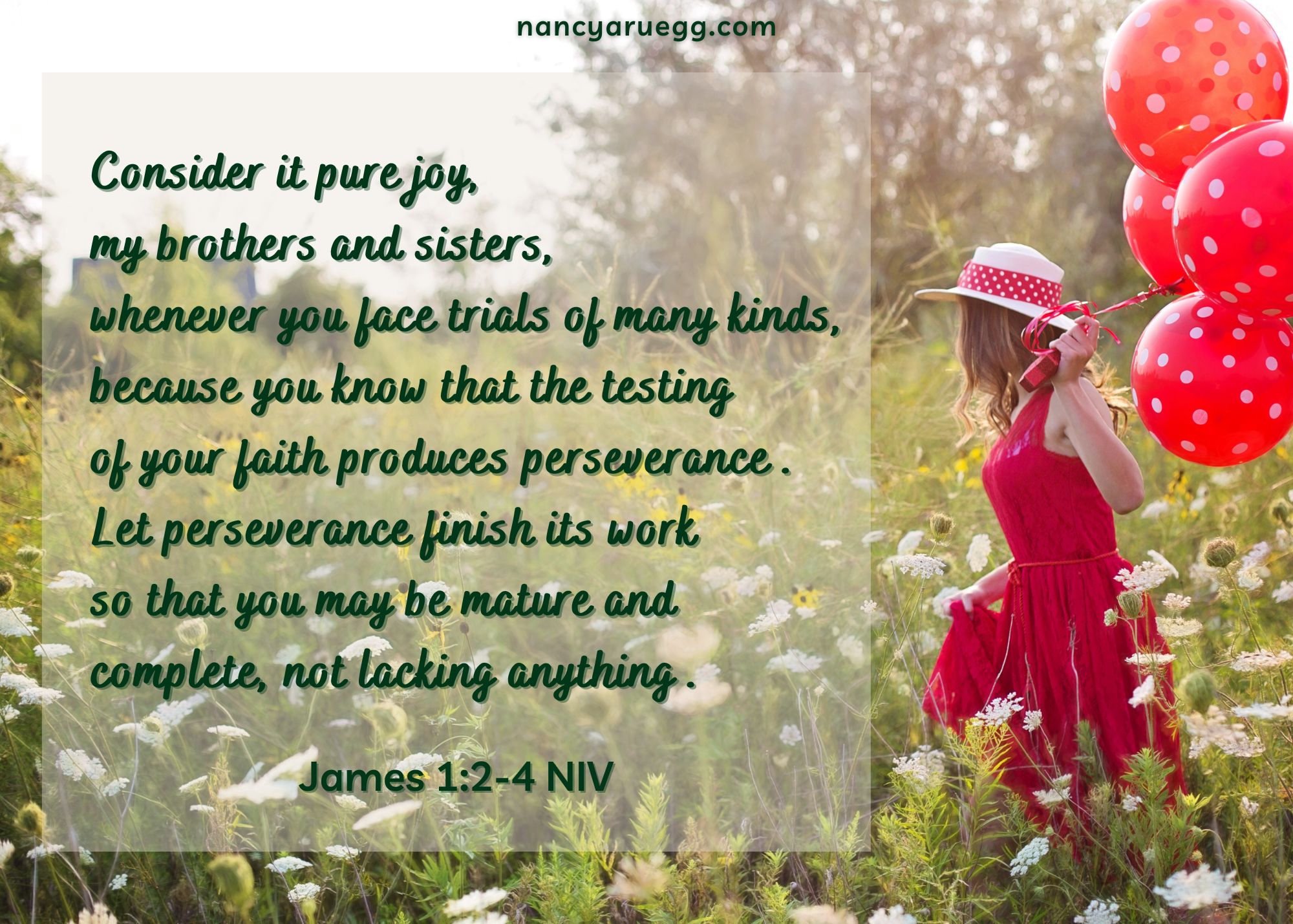
And yet, in the Bible we find this encouragement written by James, the half-brother of Jesus:

What could he possibly have meant? How can tests and challenges be considered gifts?

And then we might remember the saying, “What doesn’t kill you makes you stronger.”

James does mention strength that comes from perseverance, contributing to maturity and spiritual competency (v. 3). But difficult circumstances produce even more, including these ten aspects of the gift of trials:

GREATER GODLINESS

Pressure will make us into the kind of people God wants us to be—more responsive to him, more like him [1]. (And isn’t that who we want to be also?)

HEIGHTENED AWARENESS OF GOD’S PRESENCE

In the darkness of adversity, we’re able to see more clearly the radiance of his face. It happens as we spend time with him, and he ministers to us [2].

INCREASED SPIRITUAL POWER

God creates more friction when he desires to create more power in our lives [3].

Think of Joseph’s trials before becoming prime minister of Egypt, or David’s troubles while on the run from King Saul, or Jonah’s suffering in the belly of the great fish before preaching in Nineveh.

STRENGTHENED CONFIDENCE

Trouble strengthens our confidence that with God, we can endure whatever difficulties the future may hold [4].

A CLEARED PATHWAY

Some storms come, not to disrupt our lives, but to clear our path [5].

For example, a young couple we know put an offer on a house they really liked, but the sale fell through. Highly disappointing, of course, but that cleared the path for a better-suited home at a better price.

And during the season of waiting, they learned lessons in faith and perseverance.

ENHANCED EMPATHY

The pressure we endure helps us understand the challenges faced by others, equipping us to empathize and help [6].

ETERNAL INFLUENCE

God will make our sacrifice of suffering count for all eternity [7]. The person who serenely trusts God to bring good out of their pain demonstrates the power of faith and draws others to Christ.

SWEET DISCOVERIES

“It is often through the most difficult trials that God brings the sweetest discoveries of himself” [8].

During a particularly trying season, I sensed God next to me in the car every day while driving to the school where I taught. His sweet presence was so palpable I sometimes had to blink away tears.  

A SIGN OF VALUE

Trials indicate we’re precious to God. Otherwise, why would he spend so much time and energy perfecting us [9]?

ENHANCED JOY

Paul wisely advised we think on those things that are excellent and praiseworthy [10], turning our minds from what hurts to what helps—gratitude. To do so magnifies our joy, even during troublesome times.

These bits are from my gratitude journal:

  • An hour-plus of fun with the toddlers at church. Who can think about troubles when playing with little ones?
  • Six different species of birds, frolicking in the backyard trees–a veritable circus to enjoy.
  • The prayer of a friend that warmed the heart and lifted the spirit
  • The treasure of family, whose love and support are especially meaningful during stressful times
  • The good medicine of laughter. I texted our younger son that his third niece had taken her first steps. “I don’t understand what the big deal is,” he wrote back. “I’ve been doing that for years!”

And there you have it. Ten facets of the sheer gift that tests and challenges bring into our lives—all wrapped in God’s unfailing love.

The question is, will we receive it?


[1] Selwyn Hughes, Every Day Light, 142; Romans 12:1; 2 Corinthians 3:18

[2] Sarah Young, Jesus Calling, 361; Psalm 89:15-17a

[3] Based on an A.B. Simpson quote.

[4]Sarah Young, Jesus Always, 152; Philippians 4:13 AMP

[5] Unknown.

[6] A.B. Simpson, quoted in Streams in the Desert, 197; Philippians 1:6 AMP

[7] F. Elaine Olsen, Beyond the Scars, 163.

[8] L. B. Cowman, Streams in the Desert, Jim Reimann, ed., 143.

[9] L. B. Cowman, 77.

[10] Philippians 4:8

Image credits: http://www.canva.com (4); http://www.stockcake.com.

Processing…
Success! You're on the list.

Read Full Post »

Joy Ridderhof pulled the blankets around her head to warm her shivering body, knowing she’d soon be throwing them off as sweat soaked her nightgown.

Joy had succumbed to malaria before, but this episode wouldn’t subside. As a result, she’d had to leave the people she’d grown to love in Honduras and return home to Los Angeles. The year: 1937.

Her doctors weren’t sure why she didn’t improve. Added to her discomfort was their discouragement: “You mustn’t go back to Honduras, Joy.”

A mountain village of Honduras , 2008

The thirty-four-year-old had served as a missionary in a remote, mountain village for five years. In spite of hardship, illness, and even threats on her life, she’d loved her time there, and many Hondurans had come to know Christ.

Now it appeared that challenging yet satisfying life-chapter was over. Joy faced the possibility of being an invalid the rest of her life—or at least a semi-invalid.

One day as Joy lay in bed, a wonderful idea occurred to her. The gramophones many villages owned could be put to good use if she made records of stories and songs about Jesus. As far as she knew, no such records existed in Spanish.

But how could she implement such a plan? Joy began to pray and asked others to join her.

Slowly, her health improved. And then, she happened to be introduced to a missionary returned from Central America who’d built a recording studio in his home. She shared her idea, and he became enthused about such a project.

Joy wrote the scripts and arranged for singers and their accompaniment. She herself read the stories.

The first record was produced on December 31, 1938. Joy sent them to various locations in Central America. Now people who couldn’t read would hear about Christ in their own language.

But each record cost fifty cents to produce and Joy had no income. The Great Depression meant resources were tight everywhere. Joy prayed for God’s provision. She believed what the great missionary Hudson Taylor had said [1]:

And supply God did.

In May 1939, Joy established Spanish Gospel Recordings.

Missionaries in Mexico heard about Joy’s work and asked for records in another language. Of course, finding native speakers in L. A. for an indigenous Mexican-Indian language would be nearly impossible.

So Joy and her college friend Ann Sherwood left for Mexico and Central America in 1944, a trip made possible by a doctor who loaned them a car and provided gas ration coupons.

Once they arrived in Mexico, a man invited them to use his new recording studio. The women spent ten months producing records in thirty-five languages, then returned to the States, satisfied their task was complete.

But God had more in store.

Missionaries to the Navajo Indians in Arizona asked for recordings; Joy found native speakers to translate and record scripts for them [2].

Next came a call from Alaska. The two women drove from L.A. to Alaska, equipped with one of the first tape recorders produced in America. While there, someone mentioned that such records would be helpful in the Philippines.

“Oh no!” Joy laughed. “Now we’ve got to go to there!”

Joy and Ann spent one year in the Philippine Islands, producing records in ninety-two languages [3].

By 1955, the two women and others had travelled around the world. Records were being sent to more than one hundred countries [4], prepared on top-of-the-line recorders that God supplied.

He also provided workers who lived in various countries. By 1980 about 3,500 languages had been recorded [5]. Millions of records had been produced.

Of course, not all remote villages owned a record player. So Joy’s organization developed and supplied a number of different players over the decades.

The simplest was a cardboard sleeve that also housed the record for shipping. When opened up, a needle fastened to one edge played the record when placed on the stubby spindle attached to one side. The record could be turned by a pencil or stick stuck into a hole on the edge of the label.   

Hand-wound box-players were later issued, then cassette players, followed by hand-wound mp3 players. Today, the internet and apps allow people all over the world to hear about Jesus and his gift of salvation.

In an interview recorded in 1974 [6], Joy Ridderhof (1903-1984) passionately affirmed:

“We have a God that’s alive, who answers prayer, takes care of us, gives us joy in the work, and provides great results from our work.

“Many thousands have heard about Jesus; little churches have sprung up in different places. He has met our needs and proven himself faithful [7]!”

Today, the Global Recordings Network includes forty offices worldwide, and has produced recordings in more than 6,500 languages [8].  

Joy Ridderhof


[1] https://www.globalrecordingsusa.org/wp-content/uploads/2024/03/Magazine-viewing-version-1.pdf

[2] https://fromthevault.wheaton.edu/2024/03/04/too-impractical-to-be-a-missionary-remembering-missions-pioneer-joy-ridderhof/

[3]  https://www.youtube.com/watch?v=TsLfY9bOkxo

[4] https://fromthevault.wheaton.edu.

[5] www.globalrecordings.org

[6] (and [7])  https://www.youtube.com/watch?v=TsLfY9bOkxo

[8] https://www.globalrecordingsusa.org/about/overview/

Image credits: http://www.canva.com; http://www.flickr.com; commons.wikimedia.org; http://www.picryl.com; http://www.canva.com; http://www.commons.wikimedia.org (2).

Processing…
Success! You're on the list.

Read Full Post »

Most tourists to Rome will visit St. Peter’s Basilica and find their way to the Chapel of the Pietá. There resides the striking statue carved by Michelangelo when he was only twenty-four years old.

For the viewer, the subject matter evokes sad commiseration with the grieving mother, and yet the artistry of the statue manifests incomparable beauty in Mary’s tranquil expression, the luxurious folds of her robe, and the peaceful repose of Jesus’ face.

Perhaps Michelangelo wished to convey Mary’s relief that the anguish of her Son was over. Jesus’ expression might indicate his satisfaction in perfectly executing the Father’s mission.  

The Pietá gives evidence: beauty may be its most captivating when viewed in juxtaposition against suffering. And Michelangelo superbly represented the two entities in this one statue.

Yet there is One who surpasses even the great Renaissance sculptor in the compelling intertwining of beauty and suffering: our heavenly Father. His medium? The lives of his children.

He can make all things beautiful—even suffering.

Perhaps you’ve known people who’ve endured much—physically, mentally, and/or emotionally. And among them are those who’ve manifested the beauty of strong faith.

We’ve seen heavenly joy in their eyes, even amidst the tears.

We’ve heard the winsome affirmations of God’s palpable, sustaining presence and even of God’s blessings during their season of trouble.

We’ve witnessed their striking maturity in the way they react to their circumstances.

 These saints have embraced the truth that:

How do people find the wherewithal to radiate such loveliness of spirit even as they suffer?

Beauty-in-Suffering Begins with Trust

Of course, it begins with strong trust in God—in his sovereignty over all things, his grace to uphold, and in his power to accomplish purpose through hardship. Such people can say:

–Dr. Charles Stanley, Advancing through Adversity, 78.

Can you also see the beauty of joy on the face of such a witness? How do we grow a strong trust like that?

Beauty-in-Suffering Grows with Intimacy

The formula for growing intimacy with God is quite simple: Prayer + the Word + Time [1].

The closer we walk with God, the less room there is for any other thing to come between us, including trouble, hardship, or pain. In addition, we begin to reflect the glory of his beautiful character [2]!

Beauty-in-Suffering Impacts Others

The question is, will the impact be characterized by the ugliness of complaining, negativity, and self-pity? Or will it be the beauty of vibrant faith, contagious joy, and a settled peace?

Meet Anik, a young African father who was suffering through illness and finding it difficult to provide for his family. Nearby another household also dealt with hardship, and yet their quick smiles and frequent laughter indicated a happiness Anik craved.

He could hear them worship God and pray. They even prayed for him! Anik finally asked them about this God they praised. They told him about Christ, and the family shared their Bible with him.

Upon reading the stories about Jesus, Anik prayed to receive him into his life. So did his family, and they found their hearts transformed.

Their circumstances didn’t change immediately, but they did [3].

May the beauty-in-suffering illustrated by the Pietá and reflected in those like Anik’s neighbor, be evidenced in us also.

*     *     *     *     *     *     *     *     *     *

We praise you, O God, for gifting us with extra measures of your peace and presence—even joy—when difficulty invades our lives. Only you can bring beauty out of suffering! Help us to lean upon you in ever-deepening faith, to carry us through until the final day of triumph. 

(Psalm 34:18; Philippians 4:5-7; Romans 5:3-5;

2 Corinthians 2:14)


[1] Joanna Weaver, Having a Mary Heart in a Martha World, 77.

[2] 2 Corinthians 3:18

[3] www.wycliffe.org/blog/posts/the-light-of-hope-scripture-passages-for-hard-times-.

Image credits: http://www.flickr.com; http://www.canva.com (2); http://www.en.wikipedia.org; http://www.heartlight.org.

Processing…
Success! You're on the list.

Read Full Post »

One delightful (and relatively easy) way to remember biblical concepts, celebrate God, and include our God-given creative side is to compose an acronym. (Perhaps you remember the process from elementary school?)

Start with a word, phrase, or even a short sentence. Write or type it vertically. Use each letter to begin another word, clause, or phrase (composed horizonatally).

For example, the letters P.R.A.Y. can remind us to:

And as we experiment with various words that fit our desired outcome, we’re planting concepts deeper into our consciousness where we’re more likely to remember them.

Of course, we want to make sure those concepts reflect biblical truth. I like to include a correlating scripture reference with each line. The research benefits my spirit also.

Recently in my reading I came across a familiar phrase to describe God, “beyond comprehension,” and decided to tackle an acronym that explores the question: In what ways does he surpass understanding?

Below you’ll find a celebration of the transcendence of God, reminding us just how glorious he is.

He is:

BEYOND COMPREHENSION!   

B  eautiful in his perfections (Psalm 27:4)

E  arnest in attending to our needs (Psalm 23:1-6)

Y  earning for relationship with us (Isaiah 30:18)

O  mnipotent over the universe (Psalm 103:19)

N  ourishing our souls with trustworthy truth (Psalm 19:7; Matthew 4:4)

D  eclaring his glory through all that he has made (Psalm 19:1)

C  ompletely loving of all, with no exceptions (John 3:16)

O  mniscient of all things (Job 37:16)

M  indful of each of us, every moment (Psalm 139:7-12, 17-18)

P  atiently waiting for us to respond to him (2 Peter 3:9)

R  ighteous in all his ways (Psalm 145:17)

E  xceedingly merciful (1 Peter 1:3)

H  oly in splendor and glory (Psalm 96:7-9)

E  ternally faithful to his people (Psalm 100:5)

N  urturing of his children (Isaiah 40:11)

S  upremely inventive as Creator of all things (John 1:3)

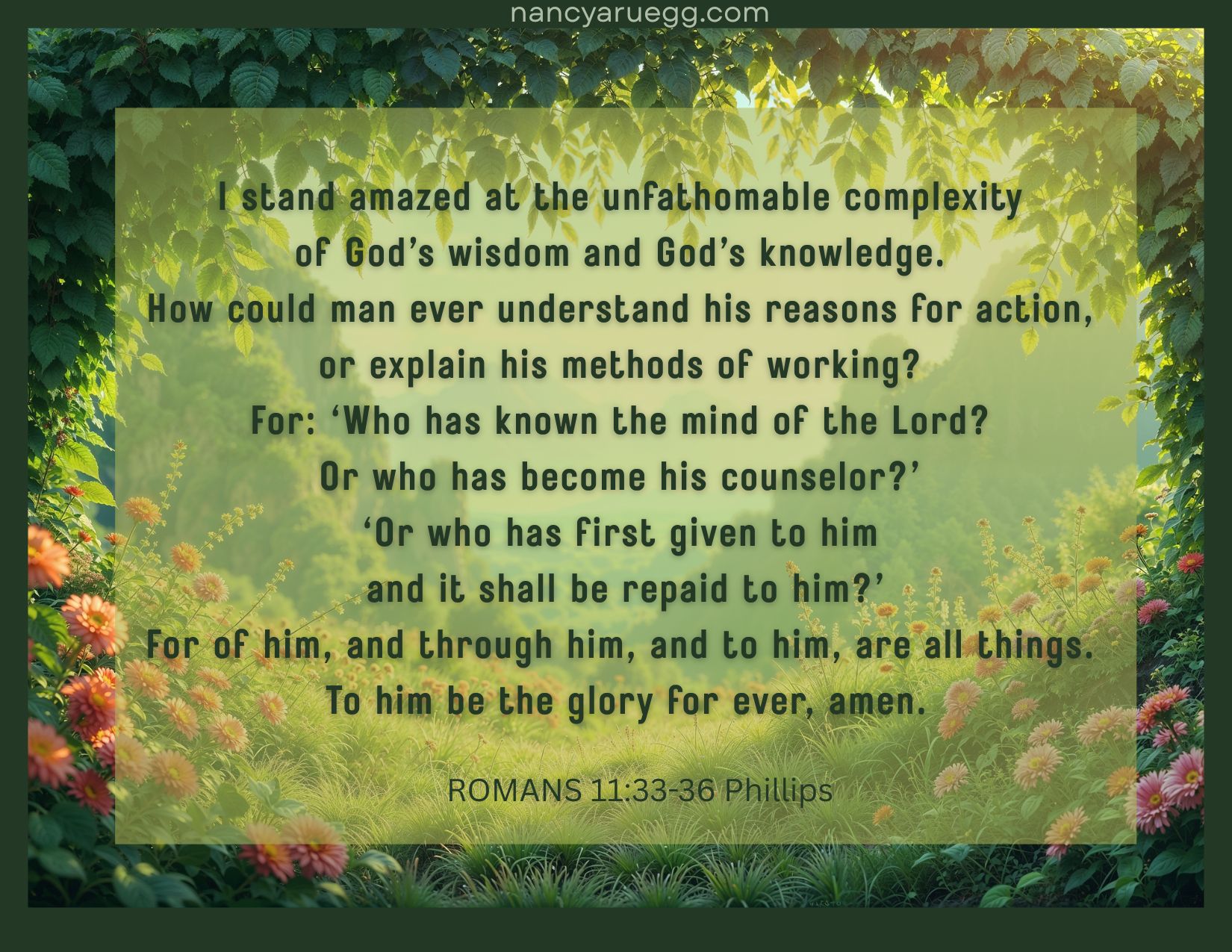
I  nfallibly wise (Romans 11:33)

O  mnipresent in every place (Psalm 139:7-10)

N  ear to all who call on him (Psalm 145:18)

We’d do well to remember:

“There is no perfect life, no perfect job, no perfect childhood, no perfect marriage, and no set of people who always do what you expect them do.

“What we do have is a perfect God who is able to lead us through this imperfect life with unfailing strength, impeccable wisdom, and infinite love [1].”

“May we see him as he is, the God of eternal excellence. May we stand in awe of Him [2].”

And . . .  


[1] Unknown

[2] Linda Dillow, Satisfy the Thirsty Soul, 31.

Image credits: http://www.pexels.com; http://www.canva.com; heartlight.org; http://www.canva.com.

Processing…
Success! You're on the list.

Read Full Post »

The decision had been narrowed down to two schools for our granddaughter Emma*, a rising seventh-grader. Which would be the best choice for next year–Willow Hills or Sheridan? She’d taken the tests and been accepted by both; each offered its own set of benefits.

Our son Derek and daughter-in-law Heidi received input from others, but their comments only added to the list of pros and cons. No definitive answer came to light.

Emma spent a school day shadowing another student at Sheridan. “It was OK,” she reported afterward. “The teachers were nice.” But nothing she’d seen or experienced had convinced her, “This is the place I want to be!”

All through this process Derek, Heidi and Emma (as well as little sister Madison) had been praying God would make clear the best choice.  The deadline was nearing and the uncertainty felt like a heavy weight upon their minds and hearts.

No doubt you’ve faced similar decisions. It’s not a comfortable place to be.

So why does God allow such distress? Why don’t the answers to our prayers become evident immediately?

There are a number of reasons. Among them:

Uncertainty reveals the frailty of self-reliance.

We can’t see the big picture, and to be honest, very little in our lives is under our full control. Times of uncertainty press us into a place of trusting God [1].

We do well to affirm he’s our devoted heavenly Father. We can trust that what he’s lovingly planned is exactly what we’d choose for ourselves if we could see the entire storyline [2].

So our son and his family (Nana and Papa too!) waited and prayed. All we could do was trust our faithful God to reveal his good and wise plan in his good time.

Uncertainty provides a platform for God to display his grace, wisdom, and power.

These attributes and more become apparent as the answer unfolds and we see his lovingkindness in the plan he’s designed, the wisdom behind it, and the power he’s wielded to make events play out just so.

In the meantime, we must realize the uncertainty we face is only apparent uncertainty. Our future and our provision are certain to God. We’d also do well to remember that “uncertain seasons are often some of the most powerful moments we experience with God” [3]

Uncertainty allows us to experience God in fresh ways as we:

  • Sense his presence more profoundly during difficulty. Pat Chen calls it liquid love [4] — perfect imagery for the warm and comforting presence of our Heavenly Father.
  • See his unfailing love on display, even as we struggle—through the kindness of others, the beauty of creation, an encouraging scripture, and more.
  • Recognize his lavish goodness in the eventual, right-on-time provision.

The Sunday after the two acceptance letters arrived for Emma, our family just happened to sit in church in front of a couple with a son who attends Willow Hills.

Both the parents and he shared enthusiastically about the school. They also knew students at Sheridan and expressed concerns that our son and daughter-in-law hadn’t heard before.

The young man, several years older than Emma, spoke directly to her, giving her reasons why he’s loved Willow Hills.

Several days after that encounter, Emma and her dad visited Willow Hills for a tour. “Impressive!” he declared. “I like it!” she affirmed.

And so, just as we’d all prayed, God made the decision clear, and the weight lifted.

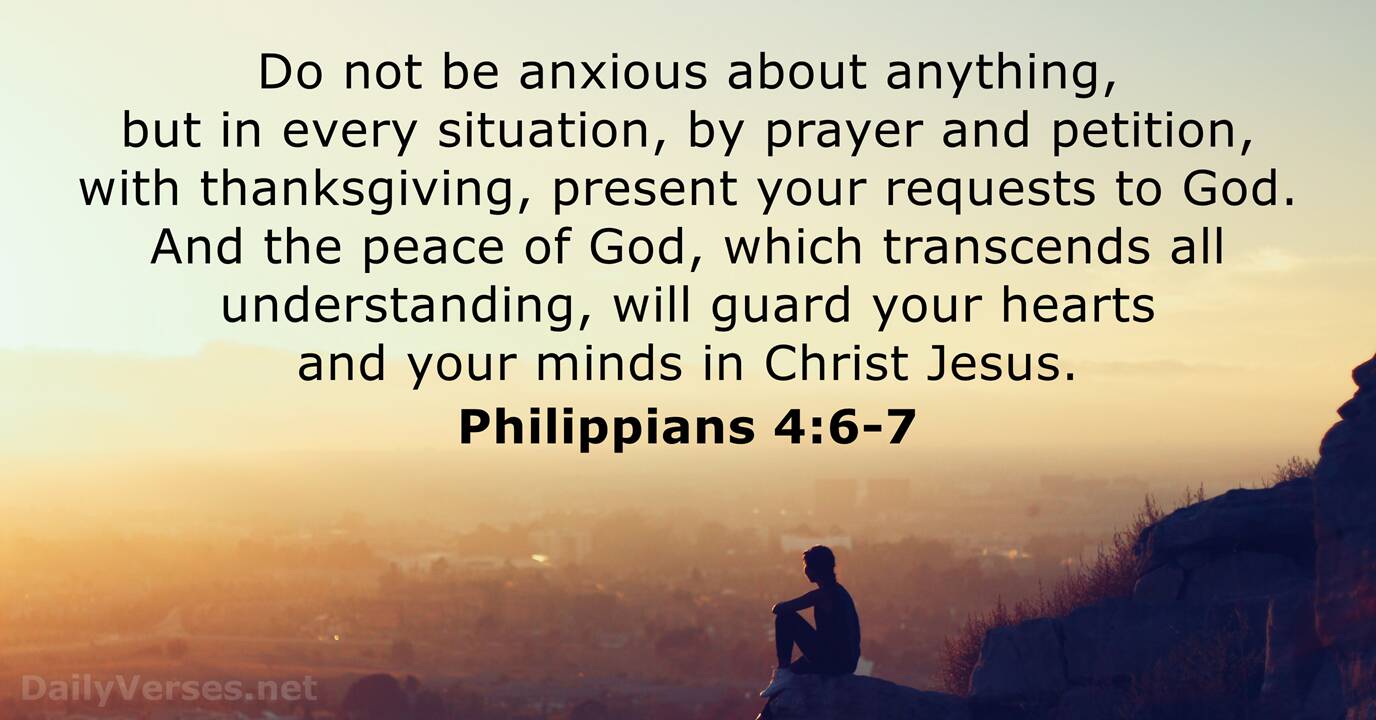
When have you faced a season of uncertainty? What helped you to triumph over the doubts and questions? Please share in the comment section below!

*All names changed, including the schools.


[1] https://serenityinsuffering.com/4-ways-to-trust-god-in-uncertainty/

[2] Katilyn Bouchillon, contributor to Take Heart, 210.

[3] Jon Bloom, Not by Sight, 57.

[4] Intimacy with the Beloved, 81-82.

Image credits: http://www.pexels.com; http://www.dailyverses.net; http://www.heartlight.org; http://www.canva.com (3).

Processing…
Success! You're on the list.

Read Full Post »

Brady Miller, a young and single first-year employee at Reed Investments, smiled as he read the email from his boss Justin. The memo reminded him of the personal day he hadn’t used yet.

Stipulations required he not add the day to vacation time or a weekend, but otherwise, any mid-week day was allowed, pending approval from Justin.

Brady immediately began planning for his Perfect Day the next Thursday: wearing sweats all day, binge-watching The Mandalorian, eating toaster-waffles for breakfast, broccoli cheddar soup and a ham on rye for lunch, nachos for snacking, and a pepperoni pizza for dinner—oh, and a big bowl of mint chocolate chip ice cream for dessert.

He’d also enjoy the solitude—no one to play host for, no one talking during the episodes, and no one to clean up after. Absolute bliss.

But late the next Thursday evening, Brady noticed he felt rather blah, maybe even a bit depressed and de-energized. Wasn’t his Perfect Day supposed to make him happy and content? What happened?

Brady wasn’t aware that researchers have actually studied what contributes to a good day. And all the indulgences he’d allowed himself did not make the list.

Here’s what did:

  • Eat nourishing food
  • Exercise 150 minutes per week
  • Include meaningful activity that also brings pleasure
  • Spend time with family and/or friends
  • Practice mindfulness
  • Limit recreational screen time
  • Show kindness toward others
  • Encourage others
  • Express gratitude

Brady incorporated none of these activities into his day off. No wonder satisfaction alluded him.

Perhaps you also noticed: all these elements contributing to a good day are included in biblical instruction. God wants us to enjoy good days!

For example, scripture directs us to:

Take proper care of our bodies which are temples of the Holy Spirit (1 Corinthians 6:19-20).

Get a good night’s sleep (Psalm 127:2).

Choose meaningful activities, especially those that benefit others. Blessing for the giver is built in (Acts 20:35c).

Spend time with family and/or friends, providing uplift, encouragement, and support (Ecclesiastes 4:9-12).

For me, “the greatest by far is the possession” of family who double as friends.

Practice mindfulness, taking note of what is excellent and praiseworthy, protecting against discouragement and anxiety (Philippians 4:8).

What better way to occupy the mind than to look for evidence of God around us?

Be compassionate, kind, and encouraging (Colossians 3:12; Ephesians 4:29).

And, I would add, that touch includes the one demonstrating kindness.

Express gratitude (1 Thessalonians 5:16-18).

It makes me smile to see secular research backing up what scripture has taught all along.

However, one important activity for a good day is not mentioned in the research:  quiet time with God— studying his Word and conversing with him in prayer (Psalm 119:15-16).

Then again, to do so does incorporate four of the elements researchers identified: meaningful activity that also brings pleasure, time with a Friend, mindfulness, and gratitude.

Is it possible to accomplish all of these activities every day? YES! Some might take only a moment: a kind deed or a word of gratitude. Some can be combined, as illustrated above.

You can start small and choose just one activity to start reducing the blahs and increasing the good. Go ahead—choose one.

Now, let’s get out there and MAKE IT A GOOD DAY!

Sources:

Image credits: http://www.frreerangestock.com (Matt Moloney); http://www.stockcake.com; http://www.freerangestock.com (FOCA Stock); http://www.canva.com (4); http://www.flickr.com.

Processing…
Success! You're on the list.

Read Full Post »

We’ve all known people who push themselves hard all day long until they fall into bed at night. Their lists and schedules make sure they use every minute to the fullest.

And though efficiency experts might be impressed by their productivity, it’s likely these ultra Type-A folks are harming themselves—physically, mentally, and spiritually.

The truth is, “Renewal and restoration are not luxuries, they are essentials. Being alone and resting for a while is not selfish; it is Christlike.” Even Jesus took time away to be with his Father [1].

Also important to understand: Rest is an attitude of the heart amidst the responsibilities of the day.  It’s not “some holy feeling that comes upon us in church. It is a state of calm rising from a heart deeply and firmly established in God” [2].

The restful life begins in trusting God, and he’s given us plenty of good reasons to do so:

 OUR GOD PERFORMS RIGHTEOUS DEEDS AND MIGHTY ACTS (Psalm 71:16-18)

OUR GOD HELPS IN NUMEROUS WAYS (Psalm 27:9)

He supplies our needs, guides our decisions, strengthens our spirits, and more.

In addition, his power is at work to help us “understand his love, live a life worthy of our calling, bear fruit in every good work, endure with patience, live a life of thanksgiving, escape the corruption caused by evil desires and overflow with hope” [3].

In other words, he helps us experience the God-enhanced life that truly satisfies our souls.

OUR GOD PROTECTS HIS PEOPLE (Psalm 3:8 CEV)

It’s not his way to protect us from all pain and trouble. Instead, he grants us stamina and strength of spirit to endure, growing us into maturity.

OUR GOD LAVISHES US WITH HIS LOVE (Psalm 86:13)

His compassionate care is expressed as “His wisdom is our direction, His knowledge, our instruction, His power, our protection, His justice, our surety, His love, our comfort, and His mercy, our solace. He holds back nothing from us” [4].

OUR GOD BESTOWS BLESSINGS, BENEFITS, AND GOODNESS (Psalm 103:1, 5)

OUR GOD FULFILLS HIS PROMISES (Psalm 145:13b)

But how can we be sure of that?

“The permanence of God’s character guarantees the fulfillment of his promises” [5].

OUR GOD ANSWERS WHEN WE CALL (Psalm 86:7)

To rest in spite of a “No” or “Wait” answer surely gives indication how well we trust.

These seven assurances of God’s influence in our lives certainly offer wonderful encouragement. But they won’t contribute to spiritual rest unless we “grasp them by faith, plead them by prayer, expect them by hope, and receive them by gratitude” [6].

*     *     *     *     *     *     *     *     *     *

O Lord, I bow before you in wonder that you, the God of the universe, with your infinite power and glory, would provide all these blessings and benefits for me.

Thank you for your gracious benevolence. Help me to REST in these truths, knowing that you have everything under control and you will see me through until I’m home with you.


[1] Chuck Swindoll, The Quest for Character, 49; Luke 6:12.

[2] Henry Drummond, quoted in Streams in the Desert, Jim Reiman, ed., 232.

[3] Melissa Krueger, The Envy of Eve, 104.

[4] Charles Spurgeon, Morning by Morning, 141.

[5] A. W. Pink, http://www.gracequotes.org.

Image credits: http://www.stackcake.com; http://www.canva.com (5).

Processing…
Success! You're on the list.

Read Full Post »

Older Posts »

Still Traveling

Impressions Becoming Expressions

Living Our Days

Gaining a heart of wisdom

He Said What?!

I'm Patty, and my husband and I are living with our adult son who has autism and epilepsy. I love sharing lessons learned from life around me, especially life with Aaron.

Meditations of my Heart

Impressions Becoming Expressions

Linda Stoll

Impressions Becoming Expressions

Debby Thompson

Impressions Becoming Expressions

Signora Sheila

Notes on Life, Faith & Italy

Colleen Scheid

Writing, Acting, Living in God's Love

Mitch Teemley

The Power of Story

Heidi Viars

Finding the Image of God