Feeds:
Posts
Comments

Archive for the ‘God’s Will’ Category

The Annunciation by Philippe de Champaigne, 1644

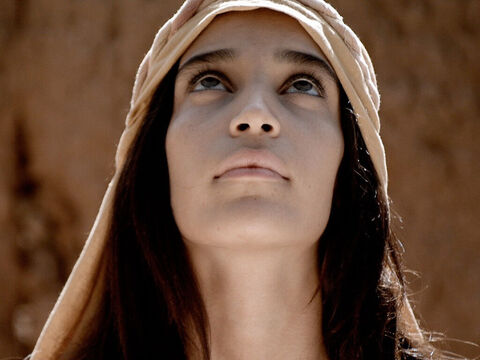
‘Remember what the angel Gabriel said to Mary when he first appeared to her?

“Greetings, you who are highly favored! The Lord is with you. Do not be afraid, you have found favor with God” [1].
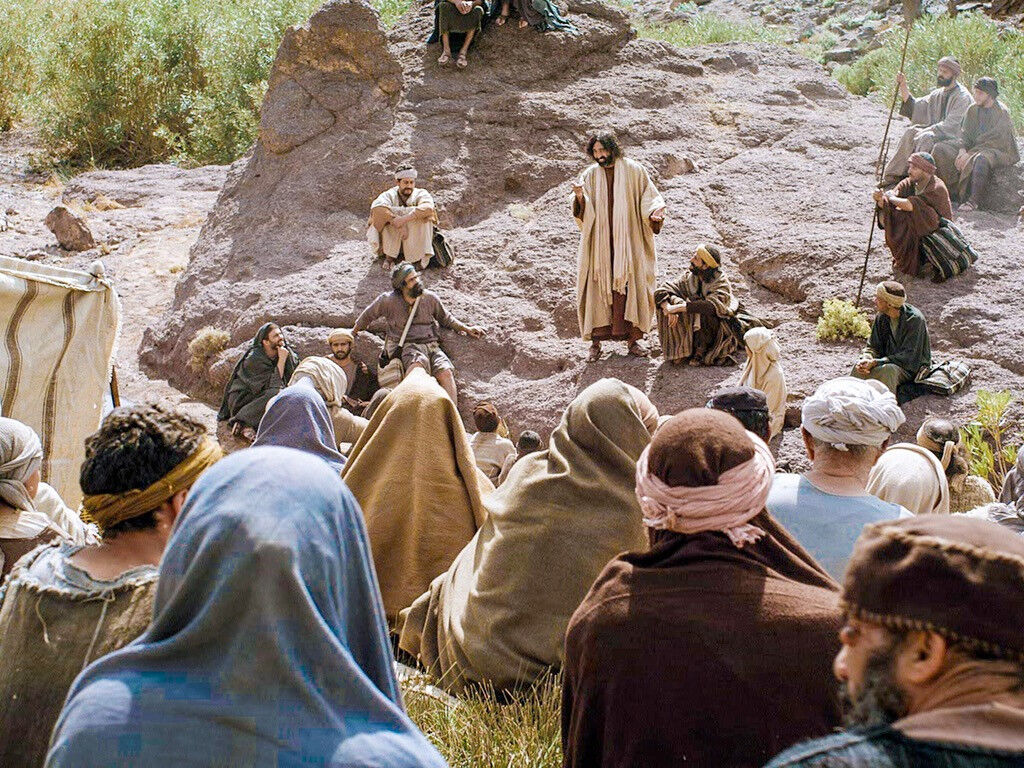
He then made an incredible announcement. Mary would give birth to the Messiah [2].

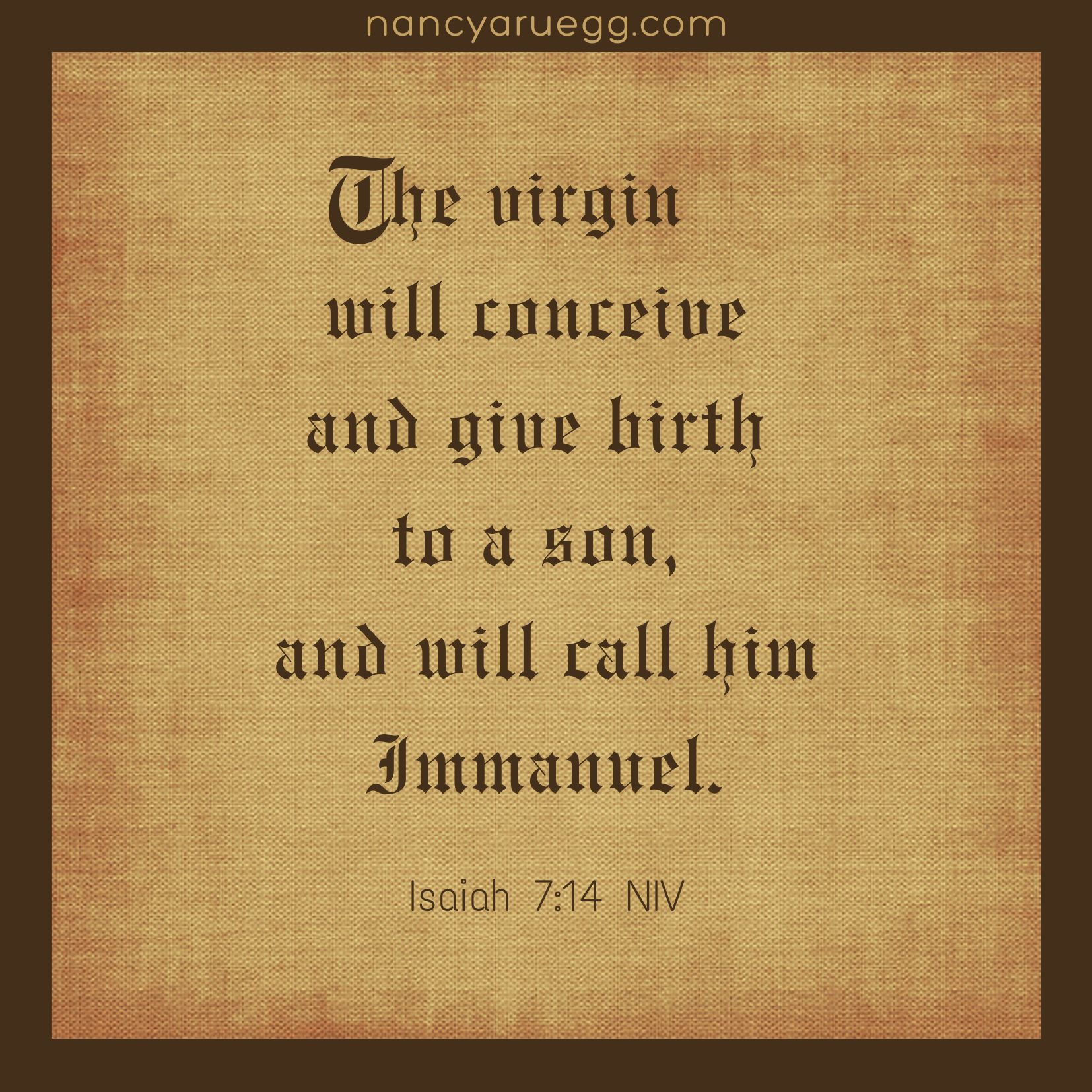
Did her mind jump to Isaiah’s prophecy about a young woman who would conceive and give birth to Immanuel?

Surely many Jewish girls knew the passage. And each must have wondered, Might I grow up to be the mother of the King of all?

God favored Mary with the singular role of mother to the Righteous One. Perhaps his choice was based on Mary’s virtue, but scripture gives no indication of that.

Luke did mention that Zacharias and Elizabeth, the parents of John the Baptist, “were righteous in the sight of God, observing all the Lord’s commands and decrees blamelessly” [3].

But no such commendation is given for Mary. It may be God wanted us to understand: he can use anyone. His empowerment doesn’t depend on social standing, intelligence, accomplishments, or even moral superiority.

Our part is willingness and faith, which Mary did demonstrate when she professed: ‘’I am the Lord’s servant. May your word to me be fulfilled” [4]. Mary acquiesced to God’s plan, his choice for her.  

If you’re like me, you’ve wondered about the favor bestowed upon Mary. To us the word conjures up kindness and generosity.

But Mary faced:

  • rejection and cruelty as a pregnant and unmarried, young teen [5]
  • the probable annulment of her engagement to Joseph
  • a grueling trip to Bethlehem, nine months pregnant
  • delivering her first child in a stable-cave
  • another difficult journey to Egypt to protect Jesus from Herod’s slaughter
  • the hurtful disapproval of many for her firstborn, including his own half-siblings
  • watching her son die in agony [6]

How could Gabriel call Mary favored?

We’re looking in the wrong direction. God’s favor, his best for us, does not guarantee an easy path through life and an abundance of material blessings. That kind of favor would only spoil us.

God would have us look in the direction of more satisfying favor: his spiritual blessings [7].

That’s what Mary did, evidenced by her Magnificat, a prayer preserved for us in Luke 1:46-55, where she praised God for his mindfulness of her, his might that had accomplished great things for her, his mercy extended to those who fear God, and more.

In the NIV Study Bible, nineteen cross-references from this passage cite verses from seven books of the Old Testament. Mary knew scripture.

It’s unlikely she thought God’s favor would bring fame and fortune. Mary would have known that God’s best more often includes:

  • empowerment to carry out his assignments
  • instruction in the ways we should choose
  • help in times of trouble
  • strength to endure hardship and grief
  • compassion and comfort to quell distress
  • satisfaction in taking part in God’s wonderful plans [8]

And as God’s wonderful plan of redemption for all people began to unfold, his favor began to flow upon Mary.

He dispelled her fears, gave her courage to tell Joseph the unsettling news, inspired Mary to visit her wise cousin Elizabeth for encouragement, filled her with endurance for the journey to Bethlehem, and strength for the birth of her first child in less-than-ideal circumstances.

Of course, Mary isn’t the only one who’s experienced the favor of the Lord. God’s best is available to everyone who allows God to choose what’s best.

God would have us know:

By his favor he forms our characters and fits us for satisfying service. He charts our course, imparts strength to accomplish his plan, supplies all that is necessary, and ultimately crowns our efforts [9].

Just as he did for Mary.


[1] Luke 1:26-30 NIV, emphasis added

[2] Luke 1:31-33

[3] Luke 1:6

[4] Luke 1:38

[5] This was surely Mary’s experience, given the social norms of the day.

[6] Matthew 1:18-19; Luke 2:1-5; 6-7; Matthew 2:13-15; Mark 3:20; John 19:26-27

[7] Ephesians 1:3

[8] Psalm 138:8 ESV; 25:12; 46:1; 73:26; 86:15; Isaiah 66:13a; Psalm 128:1

[9] Based on Herbert Lockyer quote, Seasons of the Lord, 202.

Image credits: http://www.picryl.com; http://www.canva.com; http://www.freebibleimages.org (4); http://www.stockvault.net.

Processing…
Success! You're on the list.

Read Full Post »

In 1937, the Imperial State Crown of England was created for the coronation of King George VI. It is inarguably one of the most beautiful in the world.

The number of jewels staggers the imagination. Among them: eleven emeralds, seventeen sapphires, 269 pearls, and 2868 diamonds [1].

Front and center, just above the ermine band, sits the largest diamond—the “Star of Africa II, weighing 317.4 carats. (“Star of Africa I,” which is even larger, sits atop the British royal scepter.)

Puritan preacher and author, Thomas Watson (1620-1686), named one of God’s attributes as the most sparkling jewel of God’s crown. But before I reveal his answer, which of God’s quality traits would you consider his “attribute of attributes?”

  1. Love
  2. Holiness
  3. Power
  4. Infinitude

Watson chose B, perhaps because of the word’s meaning: separate and set apart. God is completely removed from every other creature, given his omnipotence, omniscience, and omnipresence. In addition, he is perfect in purity, goodness, faithfulness, and so much more.

In heaven the seraphim (fiery angels!) continually celebrate God’s holiness. The prophet Isaiah heard them saying:

The Apostle John, during his vision of heaven, heard a similar chant [2].

We can’t help but notice the repetition of holy three times, and if you’re like me, that makes us curious. Why three times?

First, “holy” in triplicate may seek to honor each Person of the Trinity: Father, Son, and Spirit.

Second, repetition indicates emphasis.

The ancient Hebrew language included no punctuation, no bold print, no way to indicate greater importance. When writers wanted to highlight something, they’d repeat it.

Other examples would include:

  • In Genesis chapter one “God saw that it was good” is repeated six times.
  • 1 Kings 9:26-10:29 includes the word gold fifteen times to emphasize King Solomon’s wealth.
  • Psalm 130:6 offers heartfelt longing: “I wait for the Lord more than the watchmen wait for the morning, more than watchmen wait for the morning.”
  • Psalm 136 includes “His love endures forever” twenty-six times.
  • In Ezekiel 21:27, the prophet related God’s soon-coming judgment on Jerusalem—“A ruin! A ruin! I will make it a ruin!”

But nowhere in scripture do we see a triple-repetition of an attribute for anyone but God and only for this one attribute [3]. God’s holiness is superlative; he is infinitely holy. And that holiness impacts everything else about him.

His love is holy love. His power is holy power. His justice is holy justice. All his attributes are characterized by purity and splendor beyond those of anyone else.

Gaze upon the crowning jewel of God’s holiness and be overcome with awe and reverence, as well as “a sense of our incredible, desperate need for a fresh infusion of who He is”—because he’s instructed us to be holy too [4].

“Oh, I can’t do that,” someone will say. “Even at my age I still do and say things I shouldn’t, and then leave undone the things I should do. Being holy is impossible!”

Here’s what that person doesn’t understand:

“What God’s truth demands; His grace will provide.” “Faithful is he that calls, who also will do it” [5].

The more we expand our awareness of God’s holiness, the more honor and respect we’ll long to give him through obedience—obedience that he rewards with blessing.

Just how do we expand that awareness? Through Bible study that instructs, prayer that empowers, worship that inspires, and practicing his presence that encourages.

*     *     *     *     *     *     *     *     *     *

Holy God, who is like you? You are majestic in holiness beyond my comprehension; you are awesome in glory that takes my breath away. Every moment you are continually working wonders. There is no one holy like you! There is no one besides you!

I praise you, Father, for working your holiness into my spirit, enabling me to reflect your holy love, your holy goodness, your holy compassion to those around me. Empower me this day, I pray. AMEN.

(Exodus 15:11; 1 Samuel 2:2; Philippians 2:13)


[1] https://www.rct.uk/collection/31701/the-imperial-state-crown

[2] Revelation 4:8

[3] James MacArthur, Gripped by the Greatness of God, 28.

[4] MacArthur, 31.

[5] Francis Frangipane, Holiness, Truth, and the Presence of God, 23; 1 Thessalonians 5:24

Images: http://www.picryl.com; http://www.flickr.com; http://www.canva.com; http://www.rawpixel.com; http://www.heartlight.org; http://www.dailyverses.net; http://www.canva.com.

Processing…
Success! You're on the list.

Read Full Post »

(A personal, prayer-response:)

How I love this passage, Lord, with its comfort and reassurance!

Paul reminds me here that You, O God, are all-wise and all-knowing; You know what’s best for each of us.

You cause all things to work together for our benefit, for those who love You (Romans 8:28).

Sometimes though, I have to admit, certain events confound and frustrate me. My finite mind cannot understand what good you could possibly bring out of:

  • Severe financial setbacks for a godly family
  • A rejection letter from a mission board for an eager candidate
  • An announcement of divorce between a respected couple in the church
  • A cancer diagnosis for a young mother
  • The death of a child

But those of us who trust in You know that we can count on Your wisdom and knowledge in all things, and the absolute dependability of Your character—Your benevolent goodness, Your perfect righteousness, Your deep compassion, Your unfailing faithfulness and infinite love (to name a few)—even in the face of struggle and tragedy.

Remind me, Father, that “making room for mystery in my worldview”(1) is an important element of spiritual maturity.

And to demonstrate that mature trust, I can follow Job’s example. His first response to catastrophe was worship (Job 1:20).

And as I worship, I can praise and thank You, not only for those blessings I see but also for those I can’t.

Help me Father to rest in the knowledge that:

  • Out of Your infinite wisdom, You select the best possible conclusion of events, and You adopt the best possible means for accomplishing that conclusion (2).
  • You are the Most High God, Lord of heaven and earth. You are subject to no one and influenced by no one; neither can anyone thwart or hinder Your plans (3).
  • Even my mistakes could never obstruct Your will.
  • You, on the other hand make no mistakes. Your choices for me are always right, because they come from Your perfect mind and heart. You always know exactly what you’re doing.
  • “Everything from You and for You” (v. 36) often includes mundane tasks, tedious routine, and lack of recognition. But I can count on the fact that, “in the midst of what seems terribly ordinary, You—in your wisdom and power–are doing something extraordinary” (4).
  • Everything serves Your purpose (5). You direct everything toward the conclusion you ordained for it.

May I be joyfully submissive to Your plans for me, in light of these marvelous truths!

Notes:

  1. Sarah Young, Jesus Always, 65. 
  2. Based on a J. L. Dagg quote, www.gracequotes.com.
  3.  Based on an A. W. Pink quote, www.gracequotes.com.
  4. Alice Mathews, A Woman God Can Use, 77.
  5. A quote my dad copied into one of his Bibles, source unknown.

Image credits: http://www.canva.com

Processing…
Success! You're on the list.

Read Full Post »

The decision had been narrowed down to two schools for our granddaughter Emma*, a rising seventh-grader. Which would be the best choice for next year–Willow Hills or Sheridan? She’d taken the tests and been accepted by both; each offered its own set of benefits.

Our son Derek and daughter-in-law Heidi received input from others, but their comments only added to the list of pros and cons. No definitive answer came to light.

Emma spent a school day shadowing another student at Sheridan. “It was OK,” she reported afterward. “The teachers were nice.” But nothing she’d seen or experienced had convinced her, “This is the place I want to be!”

All through this process Derek, Heidi and Emma (as well as little sister Madison) had been praying God would make clear the best choice.  The deadline was nearing and the uncertainty felt like a heavy weight upon their minds and hearts.

No doubt you’ve faced similar decisions. It’s not a comfortable place to be.

So why does God allow such distress? Why don’t the answers to our prayers become evident immediately?

There are a number of reasons. Among them:

Uncertainty reveals the frailty of self-reliance.

We can’t see the big picture, and to be honest, very little in our lives is under our full control. Times of uncertainty press us into a place of trusting God [1].

We do well to affirm he’s our devoted heavenly Father. We can trust that what he’s lovingly planned is exactly what we’d choose for ourselves if we could see the entire storyline [2].

So our son and his family (Nana and Papa too!) waited and prayed. All we could do was trust our faithful God to reveal his good and wise plan in his good time.

Uncertainty provides a platform for God to display his grace, wisdom, and power.

These attributes and more become apparent as the answer unfolds and we see his lovingkindness in the plan he’s designed, the wisdom behind it, and the power he’s wielded to make events play out just so.

In the meantime, we must realize the uncertainty we face is only apparent uncertainty. Our future and our provision are certain to God. We’d also do well to remember that “uncertain seasons are often some of the most powerful moments we experience with God” [3]

Uncertainty allows us to experience God in fresh ways as we:

  • Sense his presence more profoundly during difficulty. Pat Chen calls it liquid love [4] — perfect imagery for the warm and comforting presence of our Heavenly Father.
  • See his unfailing love on display, even as we struggle—through the kindness of others, the beauty of creation, an encouraging scripture, and more.
  • Recognize his lavish goodness in the eventual, right-on-time provision.

The Sunday after the two acceptance letters arrived for Emma, our family just happened to sit in church in front of a couple with a son who attends Willow Hills.

Both the parents and he shared enthusiastically about the school. They also knew students at Sheridan and expressed concerns that our son and daughter-in-law hadn’t heard before.

The young man, several years older than Emma, spoke directly to her, giving her reasons why he’s loved Willow Hills.

Several days after that encounter, Emma and her dad visited Willow Hills for a tour. “Impressive!” he declared. “I like it!” she affirmed.

And so, just as we’d all prayed, God made the decision clear, and the weight lifted.

When have you faced a season of uncertainty? What helped you to triumph over the doubts and questions? Please share in the comment section below!

*All names changed, including the schools.


[1] https://serenityinsuffering.com/4-ways-to-trust-god-in-uncertainty/

[2] Katilyn Bouchillon, contributor to Take Heart, 210.

[3] Jon Bloom, Not by Sight, 57.

[4] Intimacy with the Beloved, 81-82.

Image credits: http://www.pexels.com; http://www.dailyverses.net; http://www.heartlight.org; http://www.canva.com (3).

Processing…
Success! You're on the list.

Read Full Post »

No Christmas season would be complete without the reading of the second chapter of Luke—the account of Mary and Joseph traveling to Bethlehem, presiding over the birth of Jesus in a stable or cave, and receiving shepherd-guests.

Toward the end of the account, as those shepherds were spreading the word of Jesus’ birth, Luke wrote, “Mary treasured up all these things and pondered them in her heart” (v. 19).

Indeed. She had much to process:

  • Her baby was the Messiah, the Promised One, who would save his people from their sin. I wonder if she studied him, looking for signs that he was different from other infants.
  • This was the Prince of Peace cradled in her arms. Yet he had been born to a common village girl in very primitive conditions.  Did that seem strange to her?
  • The shepherds had learned of his birth when angels visited them, just as the angel, Gabriel, had visited Mary and then Joseph.  Gabriel had also visited Zechariah, the father of John the Baptist. Four angel visitations in a matter of months. Never had that happened before.

I find myself pondering, too—pondering Mary herself–this dear, young girl who carried a tremendous burden for a long time.

Dear means beloved and valued. Mary is certainly that for numerous reasons.

  • She embraced Gabriel’s announcement with great faith. “May it be to me as you have said,” (Luke 1:38). She put herself in the care of God in spite of incomprehensible circumstances.
  • Her prayer, the Magnificat (Luke 1:46-55), gives indication of a heart fully committed to God.
  • She endured much: shame for her pregnancy, a long, uncomfortable journey to Bethlehem, and crude circumstances for the birth of her Son.

Mary was young—perhaps between thirteen and fifteen years of age. That was the typical age for a girl to be married in Bible times.

Yet, young as Mary was, Gabriel praised her for being “endued with grace” (v. 28, AMP). In addition, Mary demonstrated stamina, maturity, and gentleness beyond her years.

No doubt God graced her with these traits. But I have to believe Mary also had freedom of choice, as we all do, to embrace God’s way for her.

What I ponder most, however, is the fact Mary carried a tremendous burden, given to her by an elderly man, Simeon, eight days after Jesus was born.

You undoubtedly remember the story. Joseph and Mary took Jesus to the temple at Jerusalem to be circumcised.

There they met the righteous and devout Simeon who had been waiting decades for the Messiah. The Holy Spirit had revealed to him he would not die until he had seen the Lord Christ.

Immediately upon seeing the Child, Simeon knew this was the One.

He praised God for keeping his promise, blessed Mary and Joseph, and then spoke particularly to Mary, saying Jesus would cause some to rise and some to fall, he would be spoken against, the thoughts of many hearts would be revealed, and a sword will pierce your own soul too (Luke 2:21-35).

Those last words must have caused Mary’s eyes to grow wide and her heart to skip a beat. Wasn’t the worst behind her? Surely Mary wanted to ask Simeon, “What do you mean?” Scripture gives us no indication that she did so.

For thirty-three years those last words of Simeon must have echoed in Mary’s mind again and again. How does a person live with such long-term foreboding? Perhaps her mind turned back to the night of Gabriel’s visitation.

Perhaps, for thirty-three years, Mary repeated what she had told the archangel: “I am the Lord’s servant. May it be to me as you have said” (1:38).

Mary may very well have developed the calm assurance that even when God’s ways are baffling, we can rest assured he is orchestrating events to accomplish far more than we could ever imagine (Ephesians 3:20). She’d been witness to such orchestration in Bethlehem.

Mary knew that even our personal hardships can fulfill purposes that extend far beyond ourselves.

That’s a lesson for all of us to embrace with calm assurance.

(Revised and reblogged from December 15, 2014, while we enjoy a blessed week with family!)

Photo credit: http://www.stocksnap.io.

Processing…
Success! You're on the list.

Read Full Post »

Pretend you’re on an ocean liner headed from New York City to England.   You and several thousand other passengers enjoy your days at sea, free to choose from dozens of activities—games, shopping, shows, sports, crafts, and more.

You can eat anytime you like, sleep whenever you feel drowsy, make friends among the other passengers or remain solitary. In other words, you make many choices during the voyage, but all the while the ship is headed towards its predetermined destination.

A.W. Tozer gave us this ocean-voyage illustration in his classic, The Knowledge of the Holy, to help us understand God’s sovereignty:

  • Our all-powerful God wields total authority in the universe, just as the shipping authorities exercise sovereignty over the course of a ship.
  • We’ve been given much freedom within the confines of God’s sovereignty to move about and make choices.

Now some folks take issue with God’s control. They want to direct the course of their life-ships.  I for one find great comfort in the numerous, reassuring scriptures about God’s sovereignty.

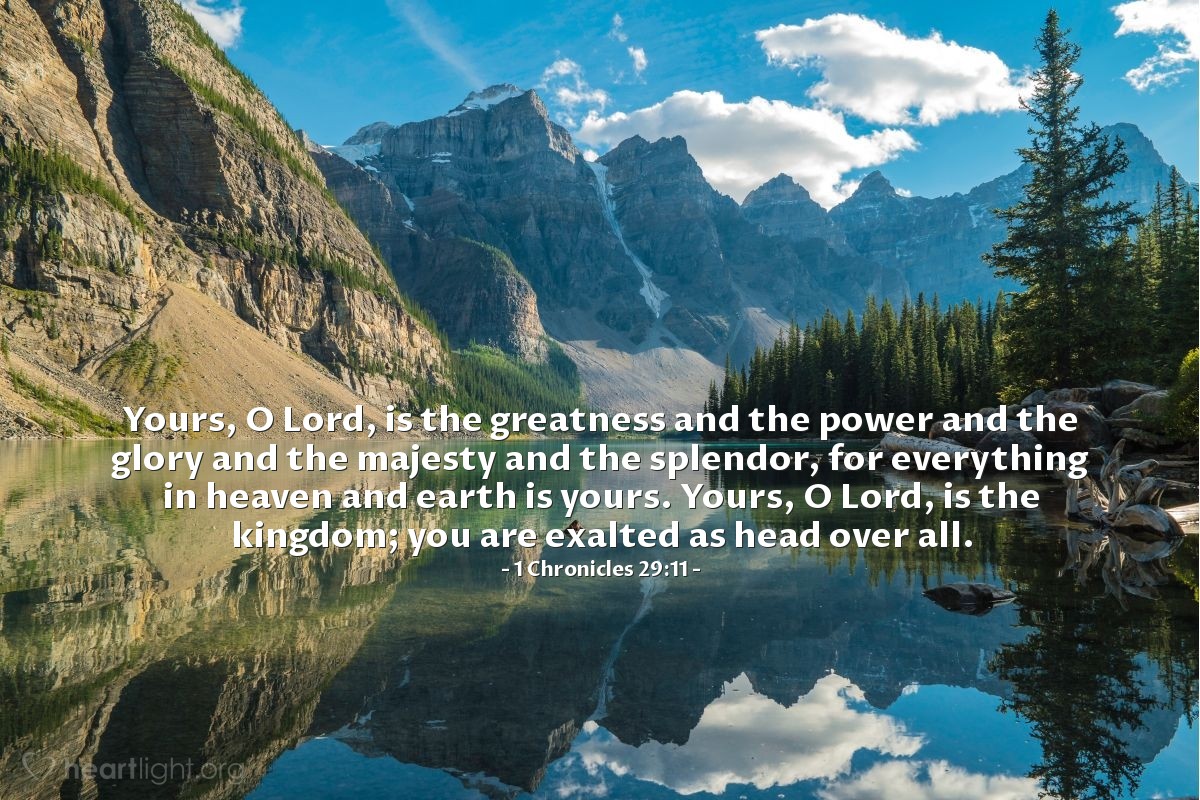
For example, everything in heaven and earth belongs to Him. He is the glorious head over all, the ruler of all things (1 Chronicles 29:11-12). That includes us–those who know Jesus and belong to the family of God.

As our Heavenly Father, he provides for our needs, guides us through decisions, bestows many blessings, and more. What encouraging truth! The Almighty God of the universe is in charge of our lives as we submit to him. We don’t have to navigate alone.

The key, however, is submission. God is a gentleman and will not force himself upon us. He’s chosen to limit his sovereignty, to allow humans free choice.

Another reassuring truth: God is totally competent. We’ve all known inept leaders who couldn’t fulfill their responsibilities.

But our Ruler is supremely capable. Nothing is too hard for him (Jeremiah 32:17).  As we focus on his complete sufficiency, our worries shrink in significance.

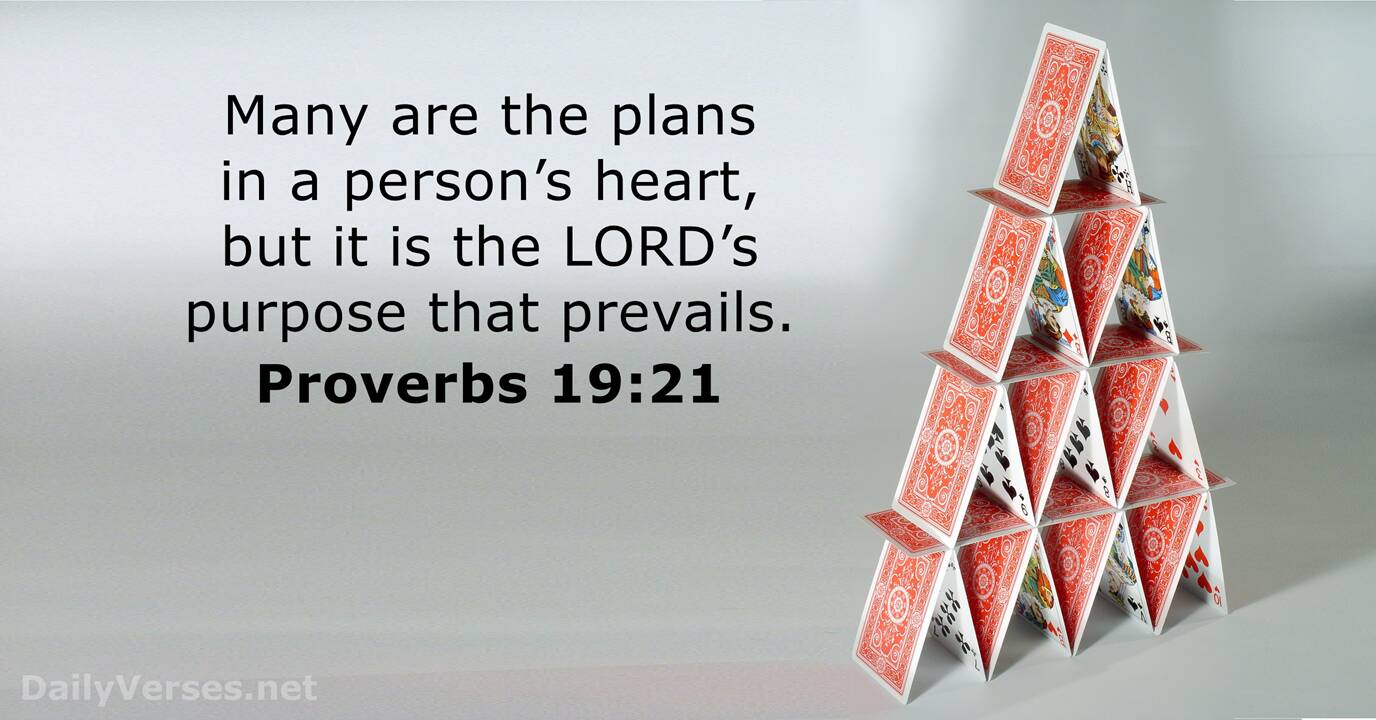
In addition, no plan of God’s can be thwarted (Job 42:2).   What God says, happens.

His sovereign plan is efficient and goal-oriented. He works out everything in conformity with the purpose of his perfect plan (Isaiah 25:1).

God’s sovereignty is also employed with infinite wisdom (Job 12:13).  No foolish decisions come from God’s throne!

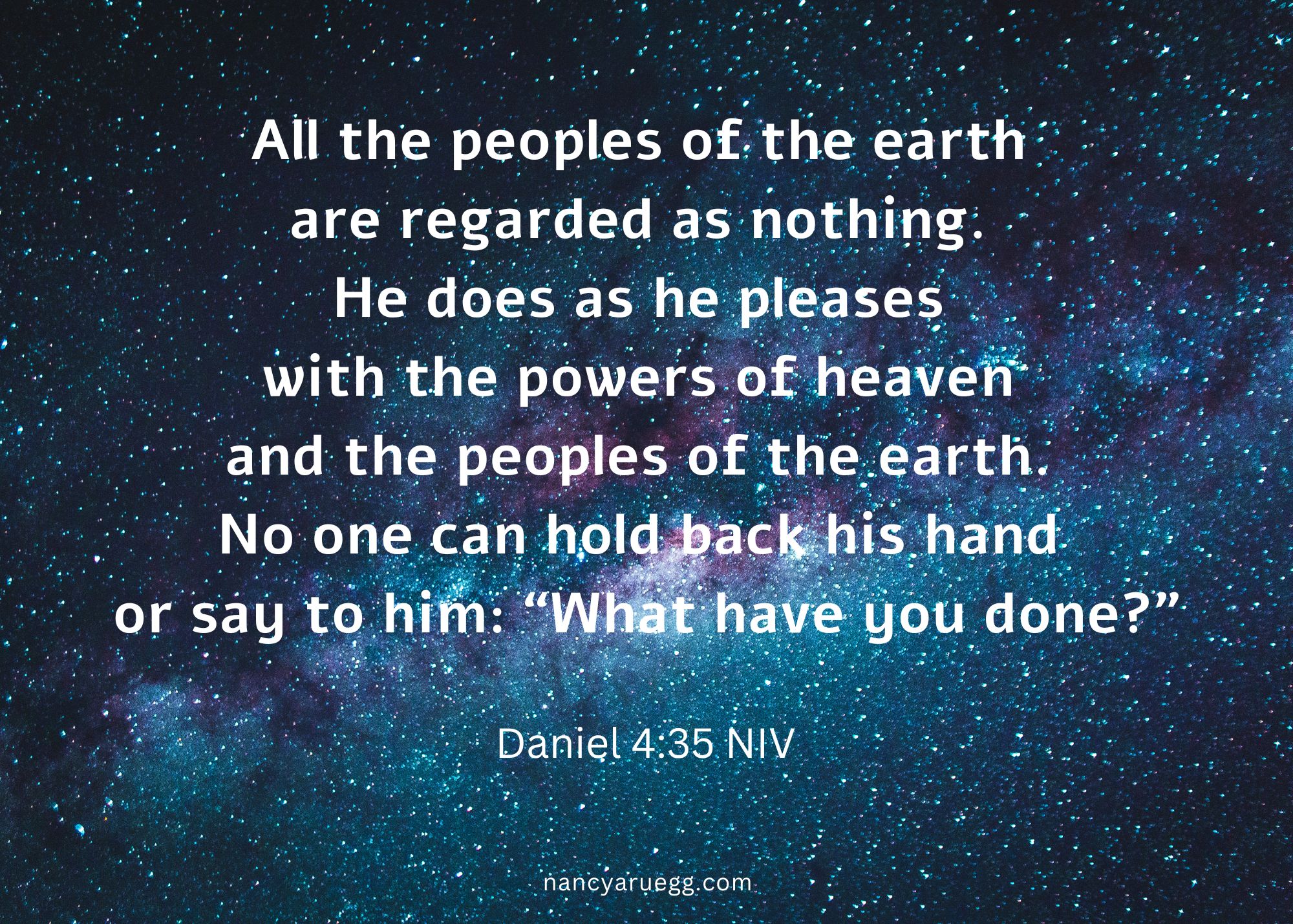
And contrary to appearances, he does maintain over-arching rule on humankind (Daniel 4:35).

Consider how circumstances must have seemed to the people of Judah as the barbaric Babylonians destroyed Jerusalem in 586 B. C., murdered all the nobles, and took thousands of Jewish captives to Babylon.

That wasn’t an isolated case of oppression either. Good people have suffered at the hands of the wicked for eons, and it breaks our hearts. It breaks God’s heart too (Isaiah 63:10). 

Our question of why God allows bad things to happen to good people doesn’t always get answered. We’re not privy to everything God knows or all the reasons behind his decisions (Romans 11:33-36).

What we do know is this: evil never wins in the end. Every evil empire of history that rose in prominence and power eventually fell in ruin. Our sovereign God knows what he’s doing.

And he will have the last word.

So when the squeaky wheels of worry, doubt, or fear begin to spin in your head, and you wonder, Who’s in Charge Here?, apply the oil of gladness, delighting in who God is—your all-powerful, all-knowing, all-wise, and yes, in-control God!

Take joy in the knowledge that “if God is for us, who can be against us” (Romans 8:31)?

And rest in thIs affirmation: “from him and through him and to him are all things” (Romans 11:36, emphasis added).

*     *     *     *     *     *     *     *     *     *

Sovereign Lord of the universe, I bow in worshipful wonder of your magnificence. Your greatness shatters all boundaries! I stand in awe of your vast power and infinite wisdom, always at work in the world.

But for those times when I cannot understand your plan or your ways, help me stand in the truth of who you are.

(Revised and reblogged from February 26, 2015, while we enjoy the company of out-of-town family.)

Photo credits: http://www.commons.wikimedia.org; http://www.heartlight.org (2); http://www.dailyverses.net; http://www.canva.com; http://www.dailyverses.net.

Read Full Post »


In his Sermon on the Mount, Jesus included eight statements called beatitudes (Matthew 5:3-10). Each one highlighted a virtue that results in the highest kind of happiness: sweet contentment not based on circumstances but on joyful faith in God and his provision for all we need.

In addition to the beatitudes of Matthew 5, the Bible offers dozens of blessing-statements—each one an encouraging slice of truth about God and his ways for us. They just aren’t constructed in typical beatitude style.

For example, consider Psalm 37:4:


Written as a beatitude:


Blessed are those who delight in God

for they shall receive the desires of their hearts.


Of course, the desires of our hearts often reflect child-sized plans, while God may have designed a “hugely dimensional destiny” that will surprise everyone.[1]

Kara’s* story illustrates. She fully expected to attend university and then enter the world of business. But even with a straight-A average, no scholarship materialized, and her parents earned too much money to qualify for sufficient financial aid.

Unless she took out a large student loan, Kara’s only option was community college. Highly disappointed—embarrassed even—she applied. Meanwhile a letter happened to arrive from that local college, describing a new course of study in TV production.


Kara had just completed a high school course in multimedia programming and loved it, so she applied for this new program and was accepted. Better yet, God provided full tuition as she earned that degree. And best of all, he molded Kara’s desire to coincide with the delightful and satisfying plan he’d designed for her.

Now years later, Kara and her husband make their living in the entertainment industry. No doubt the two of them marvel how God brought them together to work in a medium they love.

Kara is a miracle.

Romans 5:3-4 offers another beatitude truth:


As a beatitude it might read like this:


Blessed are those who embrace their challenges,

for they shall be changed for the better.


Anne wanted to support her husband’s dream of a free counseling service in their community and began making pretzels to sell at the local farmer’s market.

Through long effort and a number of failures, Anne was able to grow the business into hundreds of franchises across the country. You’ve probably eaten one of Auntie Anne’s Soft Pretzels at a mall or airport.


Anne’s personal life also included struggles, failures, and even the death of one of her children. Yet she says, “I am now thrilled to live this life, feeling that each day is one to be enjoyed. God’s grace and forgiveness are what got me through it all.”[2]

Anne is a miracle.

Our third new beatitude is based on Mark 10:27b:


Beatitude style?


Blessed are those who care less about their limitations

and care more how limitless God is.


The bio on the backs of Jennifer Rothschild’s books informs the reader she is a wife, mother, and recording artist. Jennifer also travels the country as a speaker, and cofounded WomensMinistry.NET.

What the bio does not reveal is that Jennifer has been blind since age fifteen. In her book, Lessons I Learned in the Dark, she wrote: “God often wraps difficult gifts with His grace—and then uses them to display His glory.”[3] Jennifer’s productive and joyful life perfectly illustrates that statement.

Jennifer is a miracle.

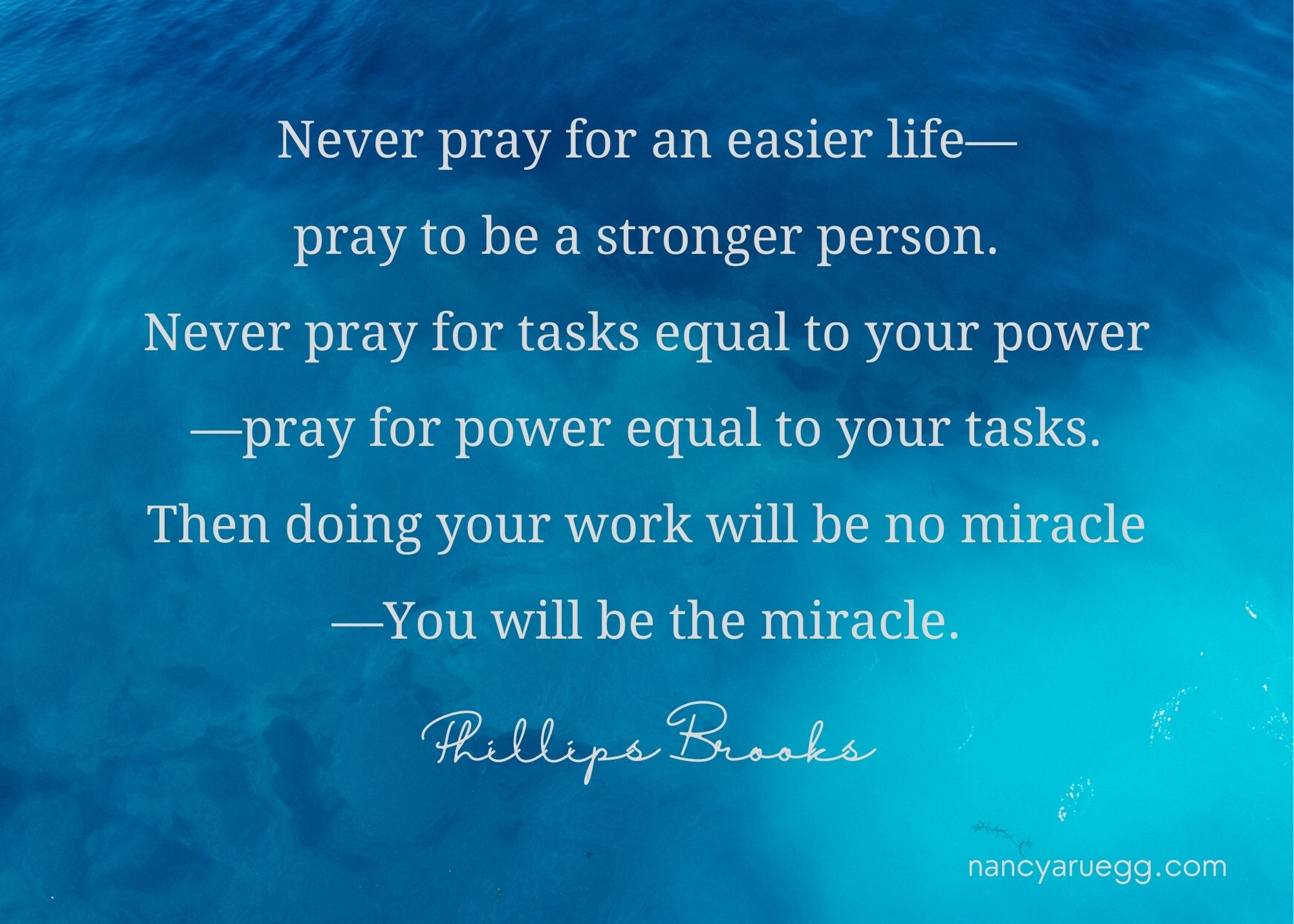
All three women exemplify what Rev. Phillips Brooks (1835-1893) wrote long ago:


Kara, Ann, Jennifer, and countless other believers demonstrate: When we embrace God’s be-attitudes, we not only experience the highest kind of happiness; we become miracles.


*Name changed.


Notes:

[1] Eugene Peterson, Under the Unpredictable Plant, pp. 160-161.

[2] Karol Ladd, Thrive, Don’t Simply Survive, pp. 147-148.

[3]  Jennifer Rothschild, Lessons I Learned in the Dark, p. 84.


Art & photo credits:  http://www.freebibleimages.org; http://www.heartlight.org; http://www.flickr.com; http://www.stocksnap.io; http://www.flickr.com; http://www.canva.com (2).


Read Full Post »

One Sunday morning years ago our Bible study teacher, Andy, gave each of us a pencil and a piece of paper with a large grid—4 squares across, 4 squares down. One square at a time but out of order, he guided us to draw various sized curves in various positions.


Sometimes he instructed us to revisit a square and add more detail.


The bits and pieces made no sense—just haphazard strokes accomplishing nothing–until the last few curves remained, and Andy told us to rotate our papers bottom side up.


Each of us was constructing a very recognizable Mickey Mouse.

And you can probably guess Andy’s objective:

God does indeed know what he’s doing, even when events seem random to us. Sometimes he reveals the reasons for nonsensical curves in our lives, as purposeful outcomes finally sharpen into focus.

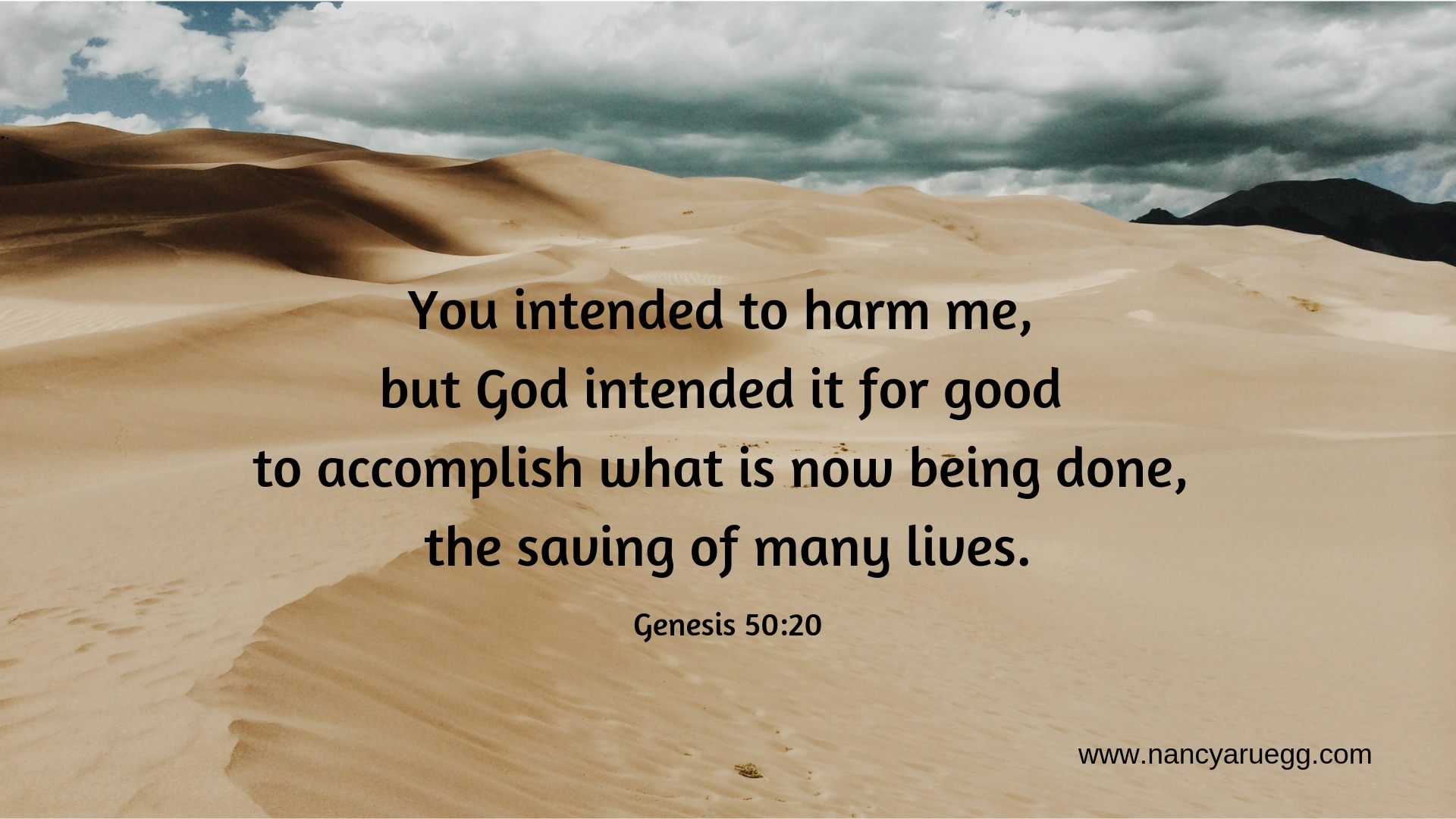
Such was the case with Joseph in the Bible. The violent curves of his life story finally made sense when he became prime minister of Egypt.

To his brothers who had terribly mistreated him he said,


Quite often, however, God chooses to withhold explanation.

I have to wonder if he’s waiting until all his children are gathered together in heaven and then he’ll reveal the complete, awe-inspiring panorama of intricately wrought events, involving billions of lives over eons of time.

Andy Andrews, in his delightful children’s book, The Boy Who Changed the World, offers a glimpse of this panorama, as he tells the story of a farm manager named Moses and his wife Susan who raised an orphaned boy. Together they shared their love of plants with the child. That boy was George Washington Carver.


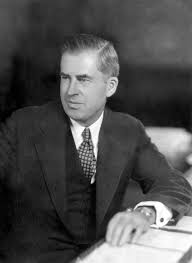
In addition to his many scientific achievements, George provided an important influence for a young boy named Henry, teaching him all about plants. Henry Wallace grew up to become the U.S. secretary of agriculture and then vice president of the United States.


Henry hired a young biochemist named Norman and instructed him to develop a high-yielding, disease-resisting wheat. Norman spent twenty years in laboratory and field research to achieve the objective. He also developed superior corn and rice.


More than two billion lives have been saved because of Norman Borlaug–and Henry Wallace who impacted Norman, and George Washington Carver who influenced Henry, and Moses Carver who inspired George.


Who else but God could have directed such events, connecting one life with another to create such epic results?

We, too, have the exciting privilege to participate with God.  There are grand possibilities in every encounter–to impact our corners of the world as Jesus’ agents, speaking on his behalf, acting in his name, and drawing people to him.

And at those times when the effort doesn’t seem to accomplish much, we can remember:

  1. 1. “God does some of his best work when we don’t think he’s doing a thing” (Priscilla Shirer, The Kingdom Woman Devotional, emphasis added), and
  2. 2.  God’s work in us and through us isn’t over until we’ve completed the last curve.

*     *     *     *     *     *     *     *     *     *

Father, I want to be a person who seizes the day under your instruction, who chooses to honor you in word and action. I want to be a participant in what you’re accomplishing, not just an observer. May I be faithful to follow your lead, knowing that in the end the results will be gloriously worth it.


(Art & photo credits:  Nancy Ruegg (4); http://www.canva.com; http://www.flickr.com; http://www.wikimedia.com (2); http://www.sunraybook.com)


Read Full Post »


o-M2QbOH


Have you heard or read such statements as these?

  • Dream big! With God you can go as far as you can think or imagine.
  • Faith may not make things easy; but it does make them possible.
  • When God makes a promise he also makes a provision.

All three statements are valid IF the promises we’ve embraced coincide with God’s plan. If not, God may not be making that dream come true, or turning the unimaginable into possible, or making provision for a particular fulfillment.

That means the perfect wife or husband may not show up, the perfect job may not open up, the perfect family may not be delivered up, and the perfect ministry opportunity (in our view) may not match up with those making the choices.

What do we do when our dreams seem to be fading away like vapor?


maxresdefault


We need to remember:


  1. God is not limited to our timeframe.


We know that, right?  Sometimes God requires a waiting period before making our dreams reality. The dream will be fulfilled—but in his time.  Scripture is full of examples of those who had to wait; we’ve considered them before:  Abraham, Jacob, Joseph, David—to name a few.

Eventually their dreams came true.  Abraham became a father, Jacob was blessed with twelve sons, Joseph  became prime minister of Egypt, and David, the king of Israel.

However, we’d be wise to hold onto our dreams with a light grip, as these same four patriarchs demonstrate:

  • Abraham saw the birth of only one son of promise, not exactly the nation God foretold.
  • The full extent of blessing promised to Jacob was not fulfilled until the birth of Jesus.
  • David dreamed of erecting a temple for God, and though he collected an impressive store of materials, the privilege of building went to his son, Solomon.


SolomonTempleCropped2


Perhaps, like these Bible heroes, God has chosen to fulfill our dreams after we’re gone.

I have to decide: Will I balk at such a reality or embrace it?


  1. Maybe my heart is set on the wrong dream—even though it seems right and worthwhile.

God may desire that I set aside my Plan A and take hold of his Plan B. Oh, but that sounds like settling, doesn’t it? Not at all. God’s plan is never second best. It’s always better (Hebrews 11:39-40)!

Also important to understand: God may have chosen me to be a foundation-builder—part of the preparation process. Someone else will be the presentation. John the Baptist is a perfect example, as he prepared the way for Jesus.


john-baptist


Foundation builders serve as mentors, planners, and seed planters. Again, will I balk at such a reality or embrace it?


  1. We can be “certain of what we do not see” (Hebrews 11:1).

That includes this truth: When we do not see one promise (or more) being fulfilled, we can be certain other promises are. God is loving and good. Always. He will demonstrate his grace and compassion–no matter what.

Part of God’s goodness prompts him to foster within us: a) a deeper relationship with him (Jeremiah 33:3); b) greater obedience to his all-wise ways (Hebrews 12:7-11, 14), and c) greater spiritual strength (2 Corinthians 12:7-10). Once we begin to realize the benefit of these blessings, other desires will fade in importance.

(Note to self: When my appreciation for spiritual blessings overrides my celebration of material and circumstantial blessings, I’ll know that the maturity James talked about is taking root.)


James-1-4-Let-Patience-Have-Its-Perfect-Work-brown-copy


*     *     *     *     *     *     *     *     *     *


I praise you, oh God, for your omnipotent ability to supply, guide, sustain, change, correct, and improve–in your time, for your good purpose. Help me to rely upon your love and wisdom to choose what’s best for me, and your power to live in godly ways for your glory. That is the way to a fulfilling, satisfying life!


(Art & photo credits:  www.twitter.com; http://www.youtube.com; http://www.saltlakebiblecollege.org; http://www.pinterest.com; http://www.knowing-jesus.com.)


Read Full Post »


Joseph_and_the_Amazing_Technicolor_Dreamcoat_(3640665731)


We’ve all heard the story of Joseph (or seen the musical, Joseph and the Amazing Technicolor Dream Coat). You’ll remember he’s the one who endured years of slavery and prison before his dreams (of bowing wheat sheaves and stars paying homage) came true.

We also know about Moses, an adopted prince in Pharaoh’s household who ended up in the wilderness herding sheep.  Forty years later God called him to lead the Hebrews out of Egypt.

And we’re familiar with Paul who spent years traveling from place to place and, yes, suffering all kinds of trials—beatings, imprisonment, dangers, shipwrecks—all for the privilege of serving God, introducing people to Jesus and establishing churches.

These Biblical stories and others teach us to never give up, because we never know when God will show up to turn a prisoner into a prime minister, a shepherd into a great leader, or a Pharisee tentmaker into a world evangelist.

Then there’s Jeremiah. His is a different kind of story altogether. He was called by God to warn the inhabitants of Judah that destruction would come if they did not return to God and follow his ways. It was not a one-time message. Over a period of forty years Jeremiah spoke many times of coming doom.


4ef160f6525a2c685725524e6193fbd9


Almost no one listened. (A brief revival took place under King Josiah, but when he died, the people returned to their complacency and evil ways.)

We love the stories of Joseph, Moses, Paul, and others, whose perseverance was rewarded with success. But what about Jeremiah?

He, too, persevered through trials–poverty and deprivation, imprisonment and ill-treatment, rejection and ridicule. For what? According to the evidence (minimal results for his efforts), Jeremiah was a wretched failure. Yet he had obeyed God faithfully, endured patiently, and preached courageously.

Perhaps visible evidence is not the best way to quantify success.

Instead, the true measure of success involves our characters, not our acquisitions (Joshua 1:8).


eac79fb6c5313818bb8b68fb51b50b24


The true measure of success may include the tenacity to get up every day and face the same tasks as yesterday, to persistently make choices that further God’s objectives for each of us, and to remain steadfast even when discouraged (1 Corinthians 15:58).

Last, a true measure of success is how our choices honor God (1 Kings 2:3). Jeremiah may not have turned thousands back to Yahweh, but that was not due to his lack of effort or disobedience to God. Jeremiah doggedly preached to the people of Judah—month after month, year after year.

So the true measure of success includes: 1) pursuing godly character, 2) persevering toward God-given purpose, and 3) making choices that honor him.


Zac-Poonen-Quote-Mans-Greatest-Honor1


Today, such successful people might look like:

  • The parent who has put his career on hold to invest time in his young children.
  • the business owner who drives a twelve-year old car so he can give generously to ministries.
  • The college student slowly working her way through school, anxious to return to her inner city neighborhood and teach school

For those of us looking for that kind of success, Jeremiah is our hero.

He lived out these precepts :

  • Do our prayerful best and leave the results with God.
  • Press on–day by day, month by month, year by year if necessary. Allow such perseverance to build our trust in God and strengthen our character.
  • Persist until God tells us to stop. (How do we know we’ve reached that moment? Peace, not uncertainty, will fill our spirits.)

We may not understand what God is doing, but we know him. And he is holy love and perfect wisdom.*


Pilgrims-Rock-gods-wisdom-is-faultless-application-of-his-perfect-knowledge-300w


*Oswald Chambers, My Utmost for His Highest, p. 129.


(Art & photo credits:  www.commons.wikimedia.org; http://www.pinterest.com (2); http://www.christianquotes.info; http://www.pilgrimsrock.com.)


Read Full Post »

Older Posts »

Still Traveling

Impressions Becoming Expressions

Living Our Days

Gaining a heart of wisdom

He Said What?!

I'm Patty, and my husband and I are living with our adult son who has autism and epilepsy. I love sharing lessons learned from life around me, especially life with Aaron.

Meditations of my Heart

Impressions Becoming Expressions

Linda Stoll

Impressions Becoming Expressions

Debby Thompson

Impressions Becoming Expressions

Signora Sheila

Notes on Life, Faith & Italy

Colleen Scheid

Writing, Acting, Living in God's Love

Mitch Teemley

The Power of Story

Heidi Viars

Finding the Image of God