Feeds:
Posts
Comments

Archive for the ‘Heroes of the Faith’ Category


SONY DSC


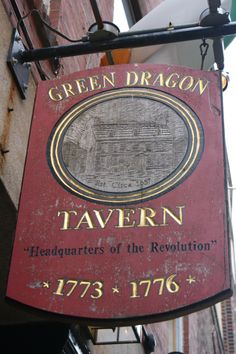
Sam leaned in close toward the center of the table, in order to be heard over the rowdy group nearby. In spite of the noise, the Green Dragon Tavern was a perfect place for Sam and his comrades to meet. No one paid much attention to them or their topic of conversation: resisting British tyranny.

“What we need,” Sam announced firmly but quietly, “are committees of correspondence in every town of Massachusetts, ready to pass on communication quickly from one to another, keep each other informed, and coordinate our efforts—in spite of the Brits’ nosy presence.”

Others at the table nodded in agreement. Almost all Bostonians longed for the removal of British soldiers, encamped in their harbor town since 1768. The men at table with Sam weren’t surprised by his idea for subterfuge. For eight years he had been writing newspaper articles in criticism of Britain’s oppressive policies and harsh taxation of the colonists.

Now it was 1772.  Samuel Adams and many others felt the colonies had endured enough. It was time for action. He began to organize Committees of Correspondence in Massachusetts, and soon more than 300 developed throughout the colonies.

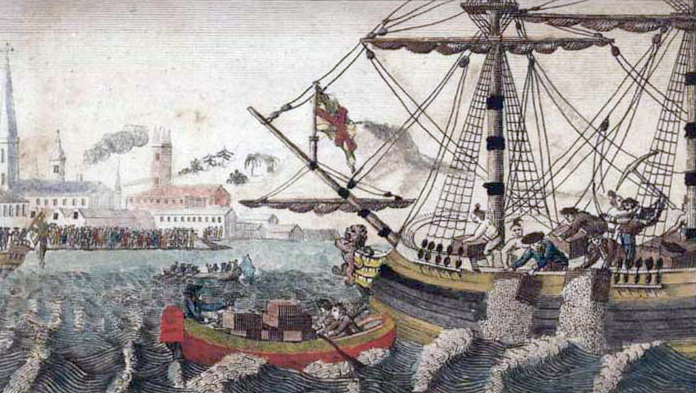
Sam also helped organize protests and boycotts. The most famous was the Boston Tea Party of 1773. He led fifty-some patriots to dump tea into the harbor, thus avoiding the high import duties, and sending Britain a clear message.


boston_tea_party_w


In 1774, Samuel Adams represented Massachusetts in the First Continental Congress. Their objective: to determine how best to deal with their grievances against Britain. The delegates readily agreed their first course of action should be prayer, but a disagreement ensued. Which clergyman from which denomination should be invited?

Samuel Adams told the congress he was “no bigot and could hear a prayer from any gentleman of piety and virtue, who was at the same time a friend of his country (1).” He nominated an Episcopalian clergyman, Mr. Duche. Sam did not know him, but the minister had been highly recommended. The motion passed.

From communicator to leader to unifier, Samuel Adams distinguished himself as a worthy patriot for the history books. But his character out shown his considerable abilities.


56049891-ab


Sam’s distinguishing traits included:

  • Courage.  He continually spoke out against the British crown. At least once, Sam narrowly escaped capture. In 1776, Adams (and fifty-five others) signed the Declaration of Independence. They knew it could likely be their death warrants. For some, it was.
  • “Incorruptible Integrity” (as described by one biographer (2).  For the eight years Sam served in the Continental Congress, he was known for his stamina, realism, and commitment, working tirelessly on numerous committees.
  • Wisdom.  Adams knew that devotion to God would strengthen the new nation (Proverbs 14:34). “Communities are dealt with in this world by the wise and just Ruler of the Universe,” Sam wrote in 1776. “He rewards or punishes them according to their general character (3).”

Samuel Adams was indeed a man of strong Christian faith, evidenced frequently in his writings:

“The name of the Lord (says the Scripture) is a strong tower; thither the righteous flee and are safe (Proverbs 18:10). Let us secure His favor and He will lead us through the journey of this life and at length receive us to a better (4).


094065741afa4d8fdd221ceea03aa7ae


Following the signing of the Declaration, Sam said, “We have this day restored the Sovereign to Whom all men ought to be obedient. He reigns in heaven and from the rising to the setting of the sun, let His kingdom come (5).

In his last will and testament Sam wrote: “I…[rely] on the merits of Jesus Christ for a pardon of all my sins (6).”

He was also a visionary, speaking wisdom for the generations to come. His statements ring true today, especially as we approach our presidential election:

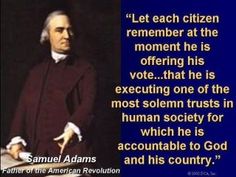
“Let each citizen remember at the moment he is offering his vote that…he is executing one of the most solemn trusts in human society for which he is accountable to God and his country” (7).


dd1671214dbdfc717a69b97f485feba5


“He who is void of virtuous attachments in private life is, or very soon will be, void of all regard of his country…The public cannot be too curious concerning the characters of public men” (8).

“Those who are to have a share in making as well as in judging and executing the laws should be men of singular wisdom and integrity” (9).

Samuel Adams:  Born 294 years ago tomorrow, on September 27, 1722–a man who lived what he believed.

Lord, help me to do the same.  And may I remember:

The privilege to vote is a solemn trust for which I am accountable to God.


Notes:

  1. http://www.renewamerica.com, “Continental Congress:  America Founded on Prayer,” Brian Fischer, May 2, 2007.
  2. http://www.belcherfoundation, “Samuel Adams.”
  3. From a letter to John Scollay, April 30, 1776.
  4. http://www.usa.church.
  5. http://www.faithofourfathers.net
  6. Founders’ Bible, ed. Brad Cummings & Lance Wubbels, p. 1732.
  7. From an article in the Boston Gazette, April 2, 1781.
  8. From The Writings of Samuel Adams, ed. Harry A. Cushing, 1907.
  9. From the Boston Gazette article, April 2, 1781.

Sources:

  1. http://www.belcherfoundation.org
  2. http://www.christianitytoday.com
  3. Founders’ Bible, Shiloh Road Publishers
  4. http://www.history.com
  5. http://www.notablebiographies.com

Art & photo credits:  www.pinterest.com; http://www.wikipedia.org; http://www.history.com; http://www.pinterest (2).


Read Full Post »

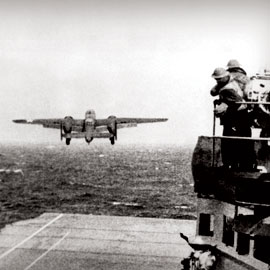
Staff Sgt. Jacob DeShazer, a member of the famed Doolittle Raiders, was the bombardier of Crew No.16, the last of the 16 B-25 Mitchell bombers to launch from the USS Hornet April 18, 1942, on the famous bombing run over Tokyo. Sergeant DeShazer, 95, died March 15. (U.S. Air Force photo)

Jake DeShazer sat on a narrow bench facing the back wall of his cell, a position he was forced to keep hour after hour, day after day, as his imprisonment dragged on.

The year was 1945. DeShazer had been a prisoner of war in Japan for forty long months, enduring suffocating heat in summer, bitter cold in winter, solitary confinement, near-starvation, cruel treatment, and torture.

As he sat, perhaps Jake thought of his comrades among the eighty flyers of Dolittle’s Raiders, the bombing run over Japan that helped turn the tide of the war in favor of the Allies in 1942.

DeShazerTakeOffFinal_md

But DeShazer’s plane was among those shot down, its crew members captured. How many of the original eighty had survived? Jake had no way of knowing, except for the few in his own cell block.

During those long, solitary hours, perhaps Jake reviewed the encouragements from scripture he had learned and the verses he’d memorized when–for three short weeks–he was allowed to have a Bible. What a change had taken place in his heart.

Prior to his captivity, Jake had no interest in Christianity. But the cruel treatment from his captors month after month nearly drove him crazy. Hatred consumed him. He remembered that Christianity supposedly changed hatred into brotherly love. Was that really possible?

He had begged for that Bible, but it was a long time coming. When the emperor of Japan told prison guards to treat their captives better, DeShazer’s request was finally honored. And as a result of studying the scriptures, he put his faith in Jesus. Bitter hatred for the Japanese transformed into loving pity.

As Jake’s thoughts focused on his captors, he may have prayed again the words from scripture that first melted his heart: “Father, forgive them, for they know not what they do” (Luke 23:34). Perhaps DeShazer reaffirmed what God’s Spirit had revealed to him earlier: His captors knew nothing of a Savior.  Without Jesus it was only natural for them to be cruel.

And so, as he lifted up loved ones and fellow soldiers, as he expressed his longing for the war to end, Jake also prayed for his captors to know Christ.

Finally, on August 10, 1945  the emperor of Japan surrendered to the Allied forces, following the atomic bombings of Hiroshima and Nagasaki.

The horror was finally over; DeShazer and thousands of other soldiers returned home to pick up the pieces of their lives.

Jake chose to pursue a degree at Seattle Pacific University, which he accomplished in three years. By December of 1948, he and his wife, Florence, along with their first baby, were headed for the mission field, to—of all places—Japan.

Every time DeShazer met someone in his new home country and told his story, almost always the person would ask, “Why did you come back here?” And he would introduce them to Jesus.

DeShazer-with-kids-1952

(DeShazer with Japanese children, 1952)

It is estimated that some 30,000 people accepted Christ into their lives—just in the first year of Jake’s ministry in Japan. Among them, a number of former prison guards who had held Jake and his comrades captive.

Another surprising convert: Mitsuo Fuchida, the pilot who led the attack on Pearl Harbor. He “happened” to read a pamphlet Jake had written, “I Was A Prisoner of Japan.” Fuchida began to study the Bible, became a Christian, and served as a missionary himself in Asia. He and Jake eventually met and became friends.

fuchida

(DeShazer and Fuchida)

For nearly thirty years the DeShazers served God in Japan, helping to found sixteen churches throughout the country.

Someone has said:

e29eb6e78638f02633d911339071451d

(“Forgiveness does not change the past,

but it does change the future.”)

DeShazer’s story proves just how mind-boggling and miraculous that future can be.

*     *     *     *     *     *     *     *     *     *

Thank you, Father, for DeShazer’s story, proving it is possible to love our enemies, bless those who curse us, do good to those who hate us, and pray for those who persecute us (Matthew 5:44). By comparison to DeShazer’s horrific experiences, my hurts and resentments are embarrassingly puny. Yet I still need your Spirit to transform them into compassion and love. As a starting point, may I never lose sight of the totally underserved forgiveness you have lavished upon me.

You can access more of Jacob DeShazer’s story at:

(Art & photo credits:  www.verterantributes.org; http://www.worldevangelism.net; http://www.spu.edu; http://www.jacobdeshazer.com; http://www.pinterest.com.)

Read Full Post »


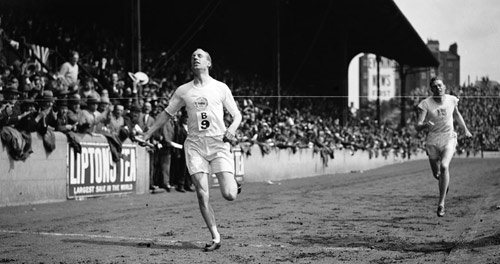
eric-liddell-olympic-gold-race1924sm


Logic said his chances were slim to win the 400-meter race at the 1924 Olympics. After all:

  • Four hundred meters is a long sprint; he was a short sprinter.
  • Two other competitors in the race had achieved world records in this event.
  • He had been assigned the least desirable lane.

But when the starting gun fired, Eric Liddell quickly took the lead and pounded around the track at a steady pace—his head thrown back, arms pumping at his sides. Against the odds, Eric crossed the finish line first to win the gold medal. In fact, he set a new world record.

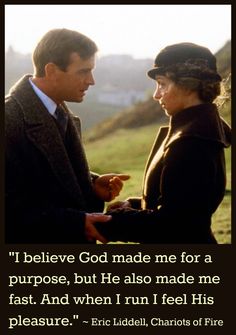
In the film, Chariots of Fire (1981), about Eric’s rise to Olympic gold, his character says, “God made me fast, and when I run, I feel his pleasure.” The scriptwriter was actually responsible for those words, but the attitude behind them surely reflected the strong faith-experience of the real Liddell.


7389e2d4ae23eb33a47c9e1613719144


No doubt about it: Eric was gifted by God to run. And when he used that gift, Eric felt confident God was pleased, because he was fulfilling one of the purposes for which God had created him.

But those famous words from the film beg the question:

How can a person know when the invisible God experiences pleasure?

Scripture is the obvious place to begin our search for answers. In fact, the first book of the Bible—the first chapter no less—gives us indication. Seven times as God was creating the universe he “saw that it was good.” God takes pleasure in what he has made.

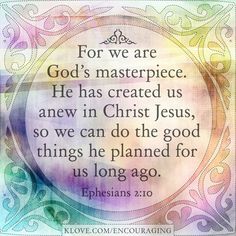
His pleasure is especially evident in the creation of humanity. He knit each of us together—not just bones, muscle, and organs—but personality traits, modes of intelligence, talents, interests, and more. Each of us is an incredible feat of engineering, a breath-taking masterpiece (Psalm 139:13, Ephesians 2:10). With so many variables at his disposal, God creates each person with precise uniqueness for distinct purposes.


62b6c2c98fa94a691f9286f6cd398949


God also plans out each of our lives: the places where we’ll live, the people we’ll meet, the events we’ll experience (Psalm 139:16).


“God formed us for his pleasure…

and meant us to see him and live with him

and draw our life from his smile.”

A. W. Tozer

(The Pursuit of God, p. 32, emphasis added)


In Psalm 147, we’re told, “The Lord delights in those who fear* him, who put their hope in his unfailing love” (v. 11).

What might that delight or pleasure feel like to us?

Perhaps a warm contentment in the spirit—the way we feel when someone we respect smiles upon us with approval. Perhaps deep confidence as we live by his wisdom.

With God, such sublime moments are not necessarily random events.   We can be assured to experience God’s pleasure as we:

  • Take joy in his presence (Psalm 16:11) through worship—anytime, anywhere.
  • Radiate his joy to others. There is blessing in being a blessing.
  • Make right choices – especially the tough ones.

Eric Liddell surely sensed God’s pleasure as deep confidence when he made the tough choice not to run in his best event, the 100-meter, in the 1924 Olympics. The race was scheduled on a Sunday, and Eric took seriously God’s commandment to keep the Sabbath set apart for worship and rest.


quote-circumstances-may-appear-to-wreck-our-lives-and-god-s-plans-but-god-is-not-helpless-eric-liddell-58-33-94


When does God experience pleasure from our lives?

Consider Eric Liddell’s statement in the film, only let’s personalize it based on the way God has created each of us. Prayerfully fill in these blanks:


“God made me ____________. When I __________, I feel his pleasure.


One of my statements might read: “God made me a grandmother. When I play a rousing game of tag or hide ‘n’ seek with Elena and Sophie, I feel God’s pleasure.”

I’d love to hear your responses. Please share in the comment section below!

Meanwhile…

My mind cannot fathom the incredible privilege you have given us, Lord God. Thank you for ordaining the reciprocal process of pleasure between us: we enjoy bringing you delight, and you allow us to feel your pleasure. My mind cannot fathom it: I bring delight to the King of glory! I rejoice in you and praise you with all my heart.


———————————–


* “Fear of God” in the ancient Hebrew refers to awe, respect, and reverence for him.


Sources of information about Eric Liddell:


(Art & photo credits:  www.swordofthespirit.net; http://www.pinterest.com (2); http://www.azquotes.com.)


Read Full Post »


7a2ec1fb4dc7fb0a135a84db27d506cf

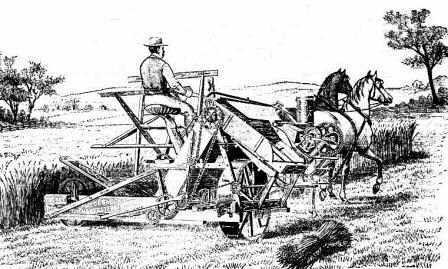
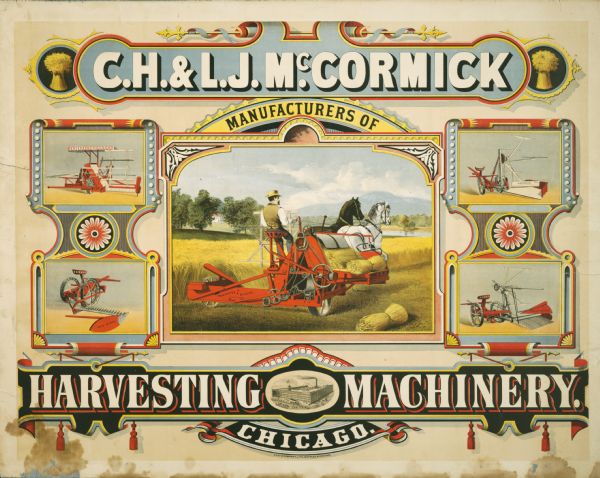
Cy lined up his machine at one edge of the wheat field. He gave Henry, their most reliable workhorse, a few reassuring pats on the shoulder, and a rub to his nose.

“This is it, old boy,” he whispered. “I think we’ve got a winner this time. Are you ready?”

Henry nodded his head as if he understood. But Cy knew the horse was just anxious to head down the rows, hopeful there’d be a carrot or two at the end.

With a doff of his hat to his watching father, Cy got behind the machine, and called, “Walk!”

Henry pulled forward and the machine followed alongside, exactly as Cy had designed it, so Henry’s hooves would not trample the wheat–just one of the problems Cy had solved as he worked on his invention.

Actually, it wasn’t solely his. Cy’s father, Robert, had worked for sixteen years developing a machine to ease the slow, back-breaking work of cutting wheat with a scythe or sickle. Also important to a wheat farmer: a quick harvest.  Too often they suffered the debilitating disappointment of a crop ruined by rain because harvest couldn’t always be achieved fast enough.


b6842d527e640684fbc89c59bbb7cee8


Solutions to several problems had evaded Robert. Twenty-one year old Cy asked if he could give the reaper a try.

Cy worked out several improvements: 1) a paddle wheel to press the wheat against the cutting blade, 2) a toothed blade that moved back and forth. 2) a comb-like affair that held the stalks in place for cutting, and 3) a divider situated ahead of the reaper, to separate the grain to be cut from the grain left standing.

Now, just six weeks after receiving permission to take over the project, Cy was ready to test his newest version.

As reliable old Henry plodded down the first row, the machine whirred among the grain, neatly slicing the stalks near the ground. In no time Cy and his reaper had reached the end of the field. The wheat was neatly cut, none had been trampled or left behind, and the blades had not jammed.


mccormick-reaper-jpeg


Cyrus McCormick had just changed the way the world farmed. For centuries, no more than an acre or two of wheat could be harvested in a day. Cy’s invention reaped a dozen or more.

On June 21, 1834 (one hundred eight-two years ago tomorrow), Cyrus McCormick took out a patent for the horse-drawn reaper.

By 1847, he and his brother, Leander, were moving from Virginia to Chicago to build a factory for reaper production. Waterways and railways made the small city of 40,000 a new hub for transportation. It was also on the edge of the Great American prairie, where pioneers were turning grasslands into farms.


9999005047-l


Four years later, Cyrus would be honored by the French Academy of Sciences for “having done more for agriculture than any other living man” (1).

He was also amassing a great fortune.

Perhaps you remember parts of Cy’s story from history class. But few history students (I would guess) know that Cyrus McCormick was a Christian—a man who didn’t just listen to God’s Word, but lived it (James 1:22).


831319be81ff7b4afe56ed0ec59a8ef6


For example:

Cyrus’ business practices followed the Golden Rule, making it possible for struggling farmers to buy a reaper. He was the first American businessman to offer: 1) an installment plan for purchase, 2) a set price—no haggling necessary (a common practice at the time), 3) a trial period, and 4) a written warranty for his product.


McCormick portrait


Jesus said, “Freely have you received, freely give” (Matthew 10:8). For Cyrus that meant supporting ministries. McCormick’s legacy included:

  • Large contributions to the salaries of two missionaries, John R. Mott and Sherwood Eddy. (At the time American mission work abroad was growing rapidly.)
  • $10,000 to Dwight L. Moody to help start the Chicago YMCA.
  • Another $100,000 to Moody to start his Bible Institute.
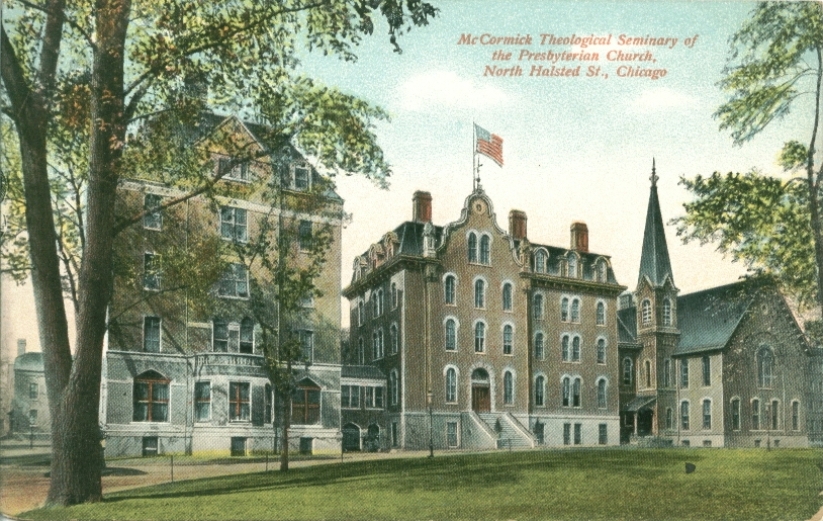
  • Yet another $100,000 to Northwestern Theological Seminary, later renamed McCormick Theological Seminary.

All three of these institutions are still functioning, still impacting people all these years later.

mccormick theo sem of presbyterian ch

*     *     *     *     *     *     *     *     *     *


Thank you, Father, for such heroes as Cyrus. H. McCormick, whose legacy continues in the lives of many, including the graduates of Moody Bible Institute and McCormick Theological Seminary. No doubt his influence is also at work around the globe, through the ripple effect of John R. Mott’s and Sherwood Eddy’s work. Only You know how many other ministries and individuals McCormick impacted.


Lord, keep me mindful that “the greatest use of my life is to spend it for something that will outlast it” (2). That something would be your kingdom, and Cyrus H. McCormick is a prime example.  


Notes:

  1. lemelson.mit.edu.
  2. William James


Sources:  www.cbn.org; http://www.intheworkplace.com; http://www.worldencyclopedia.org; http://www.christianhistoryinstitute.org.


Art & photo credits:  www.pinterest.com (2); http://www.american-historama.org; http://www.wisconsinhistory.org; http://www.pinterest.com; http://www.chicagotribute.org; http://www.chicagopc.info.


Read Full Post »


“The whole meaning of history is in the proof that

there have lived people before the present time

whom it is important to meet” (1).


I greatly enjoy meeting the heroes of history and hope you do, too.

One such hero, a founding father of America, is remembered more for his words than his deeds–words such as:


“Give me liberty or give me death.”


His name: Patrick Henry, born May 29, 1736. (His birthday is this Sunday.)


Imacon Color Scanner


But what brought Patrick Henry to that pivotal moment in history and that immortal statement? What influence did he carry afterwards?

A bit of exploration revealed the following:

Patrick Henry’s education and faith began at home, under the guidance of his college-educated father and his namesake-uncle, an Episcopal minister. Uncle Patrick’s teaching, example, and encouragement helped instill in young Patrick the Christian virtues that would impact his entire life.

As Henry grew into manhood, he transitioned from business to law to government. He was elected to the Virginia House of Burgesses in 1765.

Soon after, Great Britain established the Stamp Act, which required almost everything printed in the American colonies to be inscribed on specially stamped paper, available only from agents of the British crown–with the payment of a hefty tax.

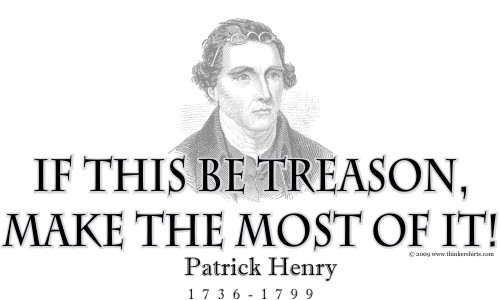
Henry spoke eloquently against the Stamp Act: “If this be treason, make the most of it,” he challenged. The Virginia Stamp Act Resolutions passed, and those with pro-British leanings did consider the action treasonous.


sku-gt184


In 1774, Patrick Henry was elected to the First Continental Congress. Delegates met to determine a course of action for the colonies, in response to Great Britain’s offenses: taxation without representation, searches and seizures without probable cause, confiscation of firearms, and more.

On March 23, 1775, Henry rallied the Second Virginia Convention, calling them to arms against advancing British troops. England was already at war against the colonies, he reasoned. Then Henry concluded with those famous, rousing words:


2015-06-03-d50a1173_large


(“Is life so dear, or peace so sweet

as to be purchased at the price of chains and slavery?

Forbid it, Almighty God!

I know not what course others may take;

but as for me, give me liberty, or give me death!”)


No doubt such eloquent and impassioned words held the delegates spellbound. But more astounding still? Henry had not prepared a speech for that day; he held no notes in his hands.

Another surprise for most of us: Henry spoke of God throughout that speech, and quoted from the Bible.  In one short paragraph, he used eight scriptural phrases.


patrick_henry5


Other examples include:

  • “Gentlemen may cry, Peace, Peace—but there is no peace (Jeremiah 6:14). The war is actually begun! 
  • “The battle, sir, is not to the strong alone” (Eccl. 9:11). 
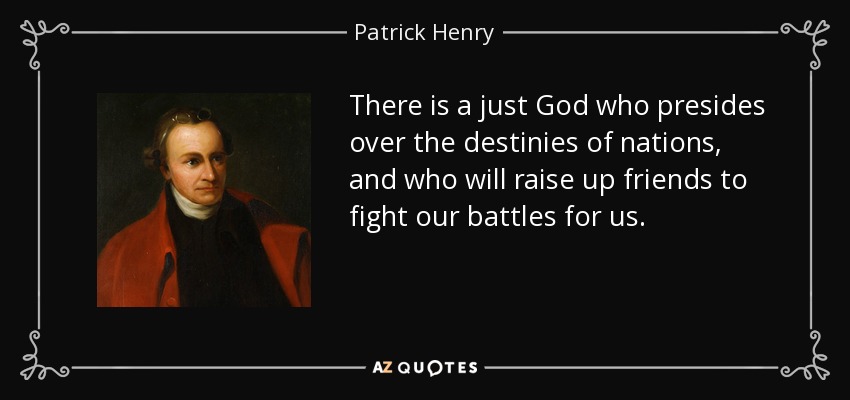
  • “There is a just God who presides over the destinies of nations, and who will raise up friends to fight our battles for us” (2 Chron. 32:8).


quote-there-is-a-just-god-who-presides-over-the-destinies-of-nations-and-who-will-raise-up-patrick-henry-53-32-60


Remember, his speech was delivered with no notes. These verses and many more were imprinted in Henry’s memory.

On many occasions during the war that ensued, he encouraged the beleaguered soldiers to pray for divine intervention, reminding them that:


“…the same God whose power divided the Red Sea for the deliverance of Israel,

still reigns in all of his glory, unchanged and unchangeable…” (3).


The American Revolution officially began April 19, 1775 at the Battle of Lexington and dragged on for  eight long years.  At first, Henry served in the military, as commander-in-chief of the Virginia militia.  But in 1776, Henry shifted his attention from the military to governmental aspects of the war and the development of a new nation.

In fact, governmental affairs were to be his main focus from that time forward. Henry served five terms as governor of Virginia and as a representative in the state legislature.

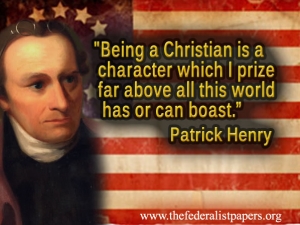
Yet it was not his accomplishments that he prized most.


thumbs_ph-beingachristian

(“Being a Christian…is a character which I prize

far above all this world has or can boast” (4).


After Henry’s death, this note was found, containing truth just as appropriate for today as in 1799:


“Whether this [the American Revolution] will prove a blessing or a curse

will depend upon the use our people make of the blessings

which a gracious God hath bestowed on us.

If they are wise, they will be great and happy.

If they are of a contrary character, they will be miserable.

Righteousness alone can exalt them as a nation [Proverbs 14:34].

Reader! – whoever thou art, remember this! –

and in thy sphere practice virtue thyself and encourage it in others.

–P. Henry” (5).


Patrick Henry certainly practiced Christian virtue himself, and is still encouraging it—in those who will listen.


Notes:

(1) Eugene Rosenstock Huessy, Speech and Reality, Argo Books, 1970, p. 167.

(2) The Founders’ Bible, p. 1734

3) http://www.christianhistorysociety.com

(4) www.faithofourfathers.net

(5) The Founders’ Bible, p. 957


Sources:

www.christianhistorysociety.com

www.faithofourfathers.net

The Founders’ Bible, Shiloh Road Publishers, 2012

www.patrickhenrycenter.com

www.wallbuilders.com


Art credits:  www.wikitree.com; http://www.thinkershirts.com; http://www.patriotpost.us; ce-wiki.wikispaces.com; http://www.azquotes.com http://www.thefederalistpapers.org.)
Read Full Post »

His record sounds like a tall tale.

He traveled 250,000 miles (that’s ten times around the globe at the equator) by horseback or on foot. All told, he preached 40,000 sermons. And by the end of his life, his followers included scores of people on both sides of the Atlantic Ocean:

  • 71, 668 British members
  • 294 preachers in Britain
  • 43,265 American members
  • 198 preachers in America
  • 19 missionaries

But that’s not all. This giant of Christianity also wrote dozens of books.

This is no tall tale; it’s the life of John Wesley (1703-1791).


220px-Jwesleysitting

(John Wesley)

Even into old age, John Wesley proclaimed the good news about Jesus and his gift of eternal life.

At age 83, he was still writing books, but very disappointed that after fifteen hours at his desk, his eyes would start to hurt.

At age 86, Wesley could still preach a rousing sermon, but sadly (to him) he only had stamina for two per day, not three as had been his standard for many years.

It also frustrated Wesley that he needed more rest as he aged. No longer did he wake up ready to seize the day at 4:00 a.m. In his latter years he had to sleep until 5:30.

The evidence seems clear: John Wesley lived every day of his life with purpose and passion—even into old age.

And undoubtedly he received great satisfaction and fulfillment from his choice to remain active and useful.

Like some men and women today, Wesley carried on into his golden years what he had been doing for decades. (I recently heard on the news about a one hundred-year old woman who is still teaching school. Like John Wesley though, she’s curtailed her schedule!)

Others of us explore new paths during our retirement years. Laura Ingalls Wilder didn’t begin her best-selling “Little House on the Prairie” series until age 64. The last book, These Happy Golden Years, she completed at age 76.


Laura_Ingalls_Wilder

(Laura Ingalls Wilder)


Wesley’s and Wilder’s examples (and those of countless others) prove:  It is possible to accomplish worthwhile endeavors even as we age.

If you’re young, you can look forward to new possibilities of successful, purposeful living for decades to come.

If you’re older as I am, we still can enjoy successful, purposeful living.

But for all of us, maintaining an attitude of faith and remaining involved with others is most important because:

Our influence on those around us offers opportunity for the most significant contribution.


*     *     *     *     *     *     *     *     *     *


Thank You, Father, that each chapter of my life has included purpose and blessing. Keep me mindful that my purpose includes living a legacy of influence. May love, faith, and integrity be the guiding principles for all my remaining days!      

Read Full Post »

“The whole meaning of history is in the proof that there have lived people before the present time whom it is important to meet” (Eugene Rosenstock Huessey, Speech and Reality, p. 167).

The forefathers of our nation are among them…


John_Hancock_1770-crop


(January 23, 1737-October 8, 1793)


For John Hancock, it was the last straw.

The Stamp Act of 1765 was bad enough, requiring printed materials in America to carry a special stamp, and the obligatory fees sent to England. In the 160-year history of the colonies, Americans had only paid taxes to their colonial governments.

And although the Stamp Act had been repealed, it was replaced with a more detrimental decree: The Declaratory Act of 1766, which proclaimed Britain’s absolute authority over the American colonies.

Then came the Townshend Revenue Acts of 1767, taxing the colonists further.

No wonder they took up the cry, “No taxation without representation.”

Now it was 1768. Customs officials had just confiscated John Hancock’s sloop, Liberty, in the Boston Harbor. They claimed it was being used to transport contraband goods.

And that was the last straw. Hancock had reached the end of his tolerance for sovereign British rule. He and politician, Samuel Adams began orchestrating demonstrations and rallies. They also spread the ideal of liberty to other locales.

Meanwhile, British reinforcements were sent to Boston—an occupation that would last eight years.


t25-Ft-c1770s-Lawson-ASKB-Lawson-ASKB


In 1770, British soldiers shot into an unarmed crowd, killing five Bostonians and wounding others. The horrific event became known as the Boston Massacre.

For a number of years, that day, March 5, was memorialized in the city. Hancock was asked to speak in 1774. In his speech he said:

“Let us humbly commit our righteous cause to the great Lord of the Universe (Psalm 37:5), who loveth righteousness and hateth iniquity (Hebrews 1:9)…Let us joyfully leave our concerns in the hands of Him Who raiseth up and pulleth down the empires and kingdoms of the world as He pleases (Daniel 2:21).”

Then he quoted Habakkuk 3:17-18, reminding Bostonians that no matter what happened as the conflict continued, or how desperate circumstances might become, “yet we will rejoice in the Lord” (1).

So many scriptures brought together in one brief paragraph give indication of the strong Christian faith John Hancock embraced.

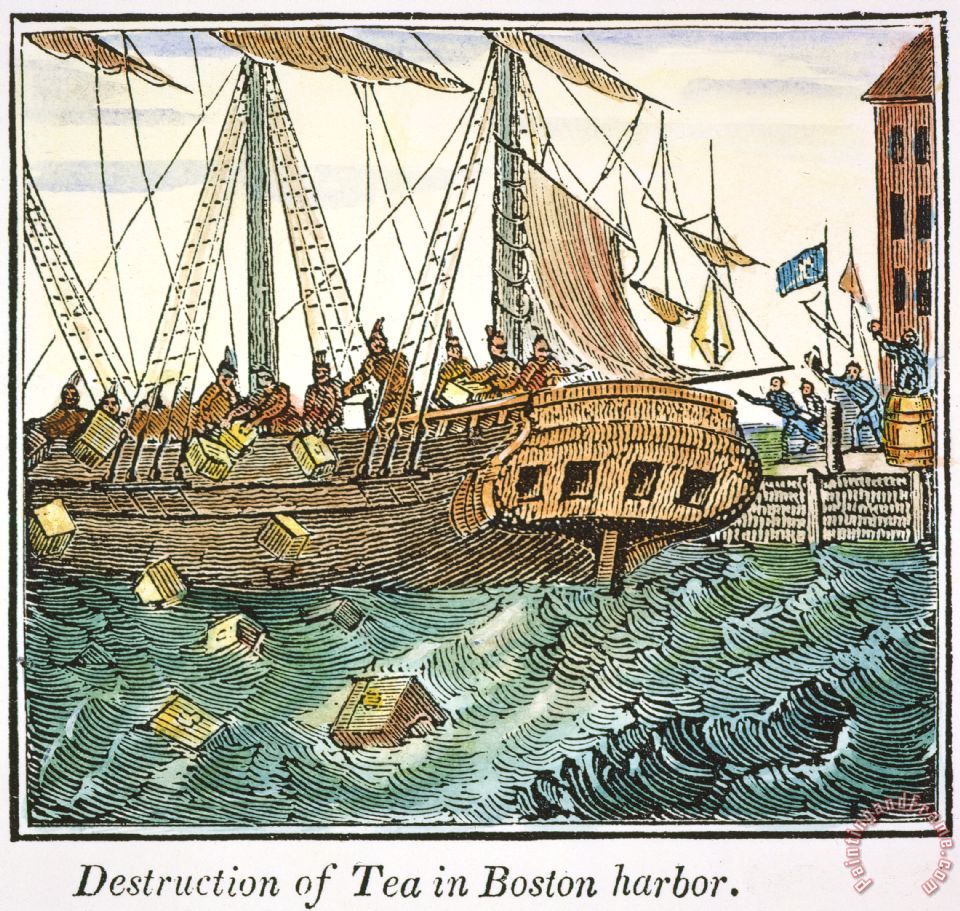
Also in the early 1770s, Hancock, Adams, and several dozen others “hosted” the Boston Tea Party. They dumped 342 chests of tea into the harbor rather than pay import duties to Britain.


The Boston Tea Party, 1773 Painting; The Boston Tea Party, 1773 Art Print for sale


In 1774, Hancock and Adams were elected to the Provincial Congress at Concord, Massachusetts. John was elected president and presided over the Committee of Safety. He and others organized the minutemen, colonial militia who could be ready in a minute to oppose the British.

April 19, 1775, seven hundred British soldiers were sent to Concord to confiscate military supplies and capture Hancock and Adams. Thanks to the warning of Paul Revere, the two men were able to escape.

At nearby Lexington, British soldiers and minutemen engaged in a skirmish, and the Revolutionary War began with the “shot heard round the world.”

Just four days before, John Hancock had written:

“All confidence must be withheld from the means we use; and reposed only on that GOD who rules in the armies of heaven, and without whose blessing, the best human counsels are but foolishness—and all created power vanity (2)”.

Hancock knew that all their efforts toward freedom were in vain if God was not on their side.

That summer he represented Massachusetts at the Continental Congress held in Philadelphia, to discuss ways of restoring harmony with Britain, yet establish rights and liberties for the colonists. Independence wasn’t on the table – yet.


continental-congress-hero-H


But 1776 brought Thomas Paine’s famous pamphlet, “Common Sense.” American patriotism grew strong, and Congress passed a resolution calling on “the aid of God in the moral cause for independence.” They encouraged fasting and prayer throughout the colonies, and “through the merits and mediation of Jesus Christ, obtain his pardon and forgiveness” (3).

That’s how deep and wide the Christian faith permeated American society.

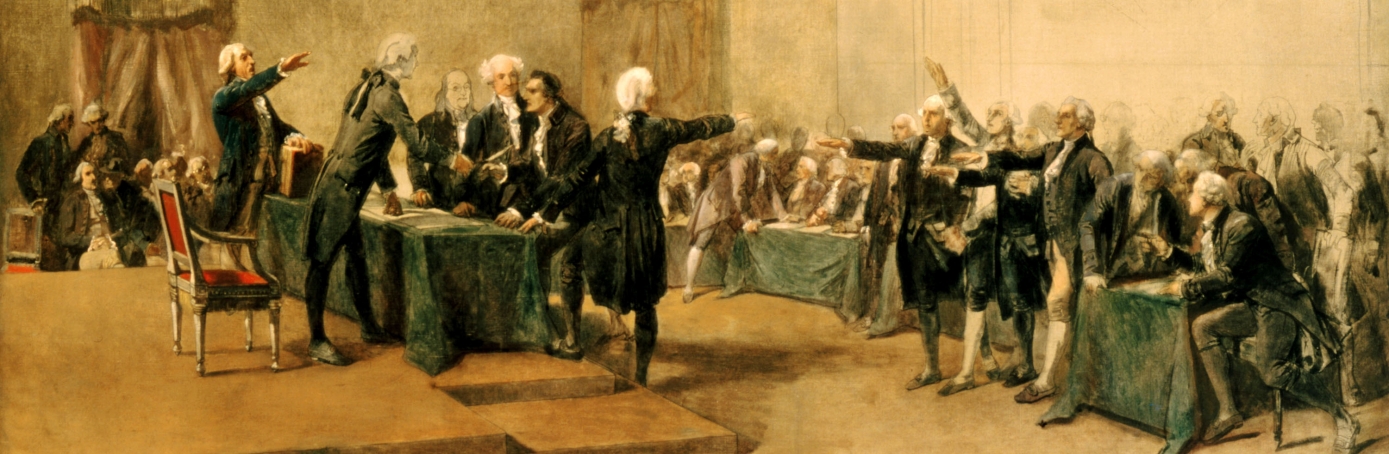
Of course, the most important resolution of the Continental Congress, under Hancock’s presidency, was the Declaration of Independence, severing all ties to Britain. And, as most U.S. history students know, he was the first to sign in his distinctive script.


John-Hancock-dreamstime1


For almost two and a half years, Hancock tirelessly presided over the Congress, as the war escalated, and the delegates hammered out the first constitution, the Articles of Confederation.

At least four times they had to flee for their lives to other colonies in order to continue their work. In addition, long debates and political rifts took their toll on the delegates, including John Hancock. He also suffered from gout.

When Congress had completed the Articles, Hancock resigned the presidency, but continued public service in Massachusetts, assisting in the formation of the state constitution (4). He and other delegates included this requirement:

“Any person chosen governor, lieutenant governor, counselor, senator, or representative…shall…make and subscribe the following declaration: ‘I, ______________, do declare that I believe the Christian religion and have a firm persuasion of its truth” (5).

I wonder what our institutions of government would look like today if that affirmation were still required.

John Hancock, first governor of Massachusetts, became one of the first to sign that statement of faith. He served eleven years before his death in 1793, at age fifty-five.

Revisionists want to remove from the historical record any mention of God, Jesus, Christianity, and the Bible. But Hancock and many other founding fathers knew: “Without God’s blessing, the best human counsels are but foolishness.”

We had better know that, too.


Citations and Notes:

  1. The Founders’ Bible, p. 1374
  2. faithofourfathers.net
  3. johnhancock.org
  4. The only constitution in the world still in use today and older than the U. S. Constitution
  5. The Founders’ Bible, p. 2097

Sources:

  1. acheritagegroup.org
  2. biography.com
  3. The Founders’ Bible
  4. faithofourfathers.net
  5. johnhancock.org
  6. ushistory.org

Art & photo credits:  www.wikipedia.org; http://www.allthingsliberty.com; http://www.paintingandframe.com; http://www.history.com; http://www.plannersweb.com.

Read Full Post »

eaab14ad79f81660b93f3032488a12eddc3a7b6e

Granville Sharp

(b. November 10, 1735)

Never had thirty-year old Granville Sharp seen such injuries: large swellings about the neck and head, gaping wounds, and a face hideously swollen, streaked with trails of dried blood.

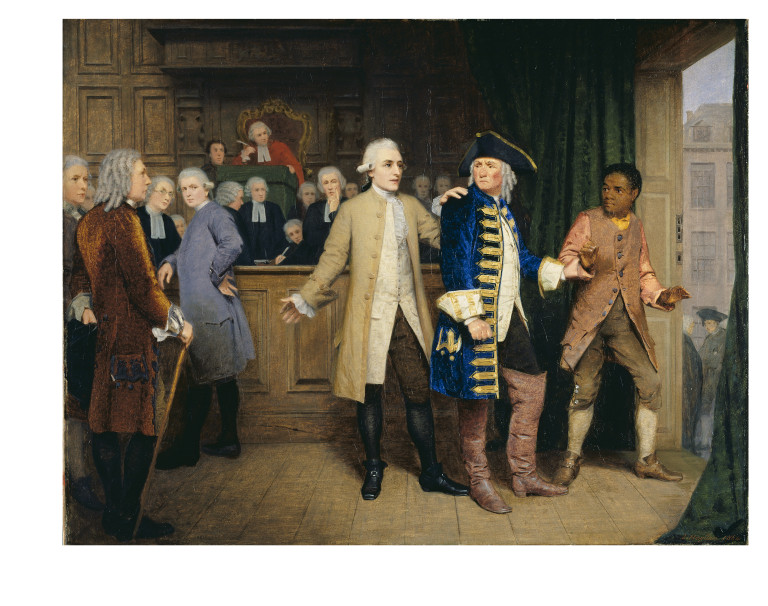
The victim: Jonathan Strong, a young slave who’d been pistol-whipped by his master and left to die on the streets of London, 1765. Somehow Jonathan made his way to the house of Granville’s brother, William, a doctor. And there he sat, waiting in line outside William’s office, when Granville stopped by the house.

quote-the-boy-seemed-ready-to-die-he-almost-lost-the-use-of-his-legs-and-feet-and-to-compleat-his-granville-sharp-266227

The encounter would change Granville’s life forever.

His heart went out to the slave; they became acquainted. Jonathan’s story horrified Granville. To make matters worse, when Jonathan recovered, the master demanded he be returned. Granville determined to help Jonathan, even though he’d “never opened a law-book except the Bible in [his] life” (1).

Those defending the slave owner were evidently intimidated by the case Granville put forth. After a two-year legal battle, they never brought Jonathan’s case to trial.

7149324-Granville_Sharp_1769_Liverpool

Sharp helped other slaves win their cases against tyrant owners, becoming more and more involved in the abolition of slavery. One case in particular, that of James Somerset, helped to set an important precedent in England.

Somerset had escaped his master, been recaptured, and was about to be shipped to a Jamaican plantation when Granville and others became involved.  They helped the slave win his freedom, arguing that “no master ever was allowed here (in England) to take a slave by force to be sold abroad because he deserted his service…therefore the man must be discharged” (2).

2006BB2012

Granville remained active in the abolition movement his entire life. He wrote frequent letters to many leaders in America and Britain, influencing their thinking about slavery and earning their respect. Among them: Dr. Benjamin Rush (signer of the Declaration), John Jay (first Chief Justice of the U.S. Supreme Court), Benjamin Franklin, and John Adams in America; John Wesley, William Wilberforce, the Archbishop of Canterbury in England; and General Lafayette of France.

But that was only one of his passionate pursuits. Another concern was the illegal treatment of the colonists in America. He published books and pamphlets to help their cause, catching the attention of Ben Franklin during one of his visits to England.

Granville gave Mr. Franklin 250 copies of his pamphlet about people’s natural rights as supported by the British constitution. Franklin sent them to America where several presses reprinted the booklet.

Sharp’s pamphlet influenced Thomas Jefferson as he drafted the Declaration of Independence, evidenced by at least several similarities in both documents.

In 1775, when war broke out in the colonies Granville was employed in the ordnance office (handling all matters concerning weaponry). He wanted nothing to do with the war, so he wrote to his employer: “I cannot return to my ordnance duty whilst a bloody war is carried on, unjustly as I conceive, against my fellow-subjects” (3).

Granville’s brothers agreed to support him, enabling him to pursue his studies, causes, and writing. In fact, beginning with his first book in 1765, Sharp published a new work, sometimes more than one, almost annually for the rest of his life (5).

sharp-title-page-Cropped-543x465

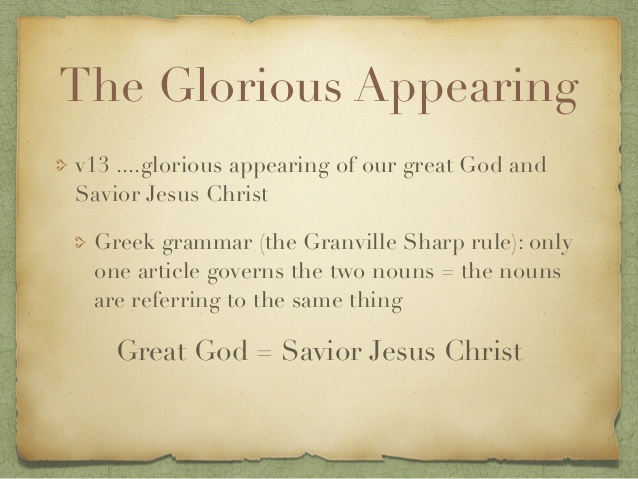
One of those books (with a thirty-six word title!) is now known as “Sharp’s rule” (1777). With his self-taught knowledge of ancient Greek, Granville demonstrated how eight passages of the New Testament had been mistranslated by some Bible scholars, leaving the reader to surmise that God the Father and God the Son were separate Beings. Sharp presented a thorough explanation that God the Father, Son, and Holy Spirit are One, according to the original Greek texts (4).

our-hope-the-appearing-of-jesus-christ-16-638

Yet Granville accomplished still more. In the mid-1780s, Sharp teamed with a Mr. Smeathman to establish a colony for freed English slaves on the west coast of Africa. (Many of them were homeless, subsisting on the streets of London with no hope of improving their lives.) But Smeathman died shortly after he and Granville established their partnership. Sharp continued the work nevertheless.
In April of 1787, the dream for that African colony became a reality with the founding of Sierra Leone. The colonists named the first settlement, Granvilletown.

220px-Province_of_Freedom

Sharp accomplished even more, as he served on a number of boards and societies, in support of mission efforts and philanthropic concerns.

Yet he did not see the fulfillment of his greatest dream—the abolition of slavery. The battle he began with the case of Jonathan Strong in 1765 finally ended in 1833, when slavery was completely abolished in the British Empire.

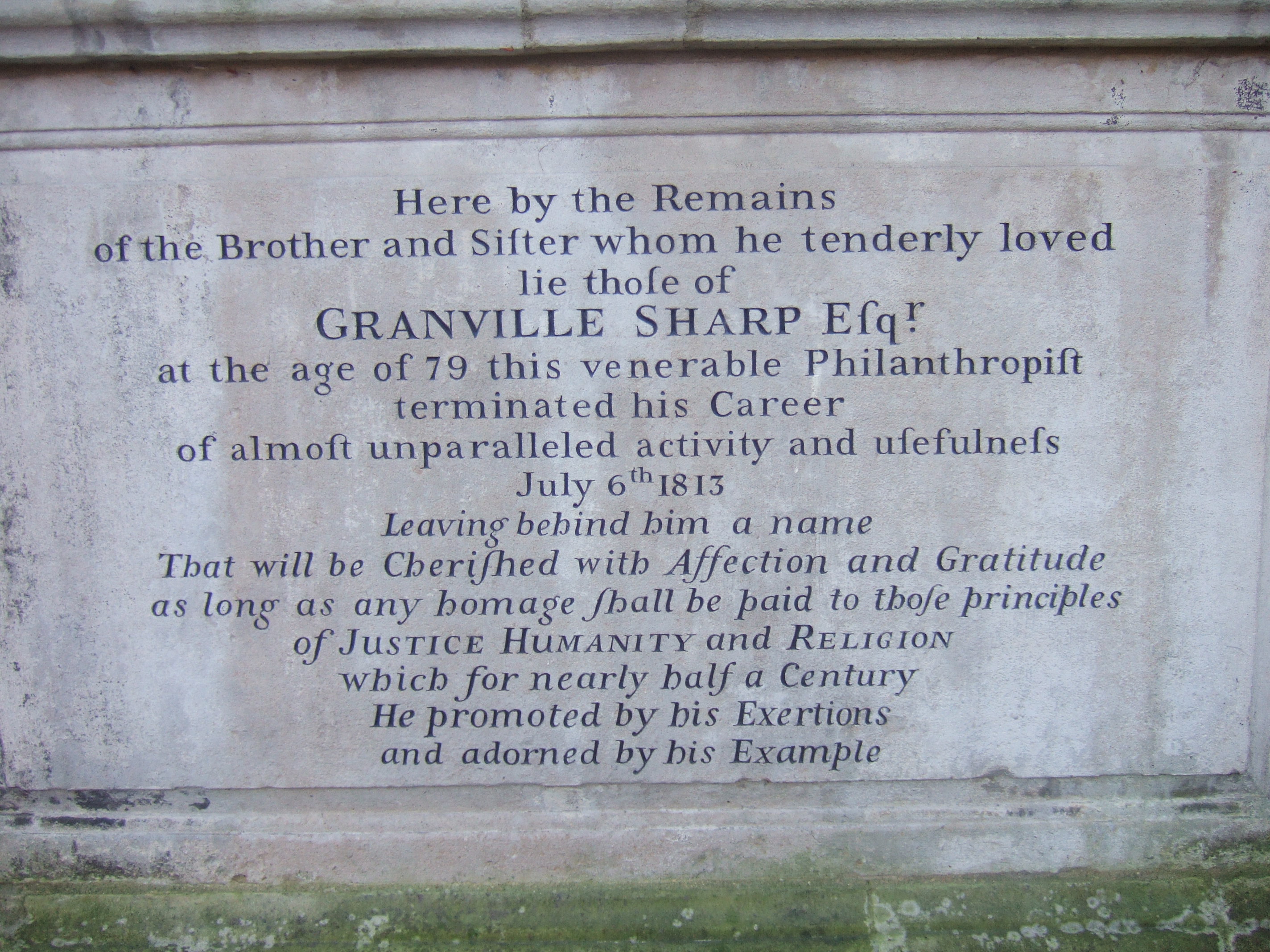
Sharp died in 1813.

Granville_Sharp's_tomb_inscription

His chief biographer, Prince Hoare, said that as he began to study Sharp he intended to “draw a veil over peculiarities of Mr. Sharp’s character,” out of respect for the dead. But when he finished his careful and comprehensive research, he realized Sharp’s “character to be of that high and dignified nature, to leave no necessity for such a precaution…I see nothing to veil.” (6).

Like many other forgotten heroes, Granville Sharp is among that great cloud of witnesses who fixed their eyes on Jesus and ran the race marked out for them (Hebrews 12:1-2a).

May his example and that of others–their faith, integrity, perseverance, and passion–push us along in the race marked for us.

______________________________

  1. history.ac.uk
  2. national.archives.gov.uk
  3. Dr. Daniel Wallace, www.bible.org
  4. christianity.com
  5. brycchancarey.com
  6. Dr. Daniel Wallace, http://www.bible.org

(Art & photo credits:  www.bbc.co.uk; izquotes.com; http://www.virtualtourist.com; http://www.collections.vam.ac.uk; http://www.wikipedia.org; http://www.liverpoolmuseums.org.uk; http://www.slideshare.net; http://www.en.wikipedia.org; )

Read Full Post »

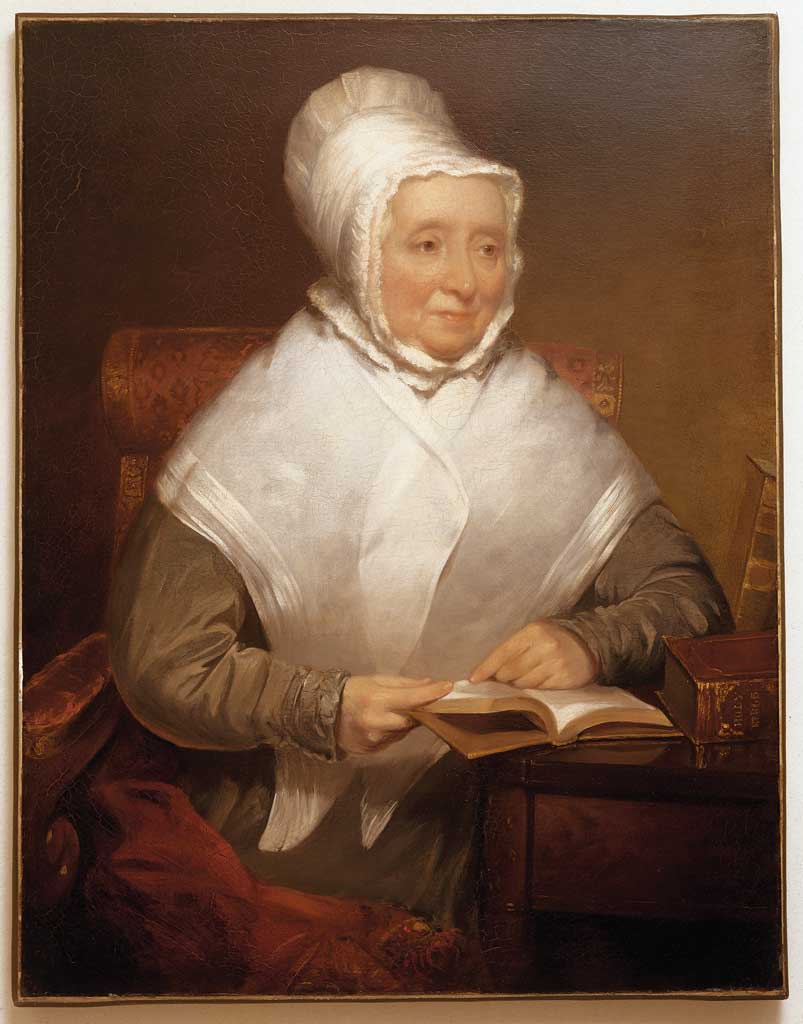
taste_041_hannah_adams_harding

Hannah Adams

(born October 2, 1755)


“Hannah!” Silence. “Han-nah?” Still silence. “HAN-NAH A-DAMS!” her father bellowed.

Hannah finally came scurrying into the keeping room, her long skirts swishing. “I’m sorry, Father.   I was reading one of your books out on the porch and didn’t hear you.” The proof was in her hand, her thumb tucked between the pages.

He should have known. Hannah always seemed to have her nose in a book when chores were done, and easily tuned out the world while reading.  He himself was an avid reader with a large personal collection of books. How could he fault her for a strong desire to learn?

“Yes…well…I’ve something…rather disappointing to share with the family,” he faltered, “and there’s no time like the present, as they say.”

With that introduction, Mr. Adams sat his family down to share dismal, embarrassing news: his business of selling books and English goods had failed; his inherited fortune was gone.

Hannah was only seventeen, but willingly did her part to help support the family. She taught school, tutored, as well as crafted and sold bobbin lace. However, what spare moments Hannah found she continued to devour her father’s books. And with her outstanding memory, she retained much of what she read. Hannah also began to write.

Mr. Adams generated income by taking in Harvard divinity students as boarders and tutoring them. One student gave Hannah a book about the world’s religions. As she read about the Christian denominations, Hannah (a Congregationalist) became more and more disturbed.

This author isn’t offering subjective facts; he’s inserting his own negative opinions about each one–except his own denomination, she thought. I could construct a better volume than this—an unbiased one. And the proceeds could further help the family.

Hannah began her new reference work in 1778. Her intent was “to avoid giving the least preference of one denomination above another and to present the arguments and sentiments of each sect in believers’ own words, according to the group’s general collective sense” (1).

The result: The Alphabetical Compend of the Various Sects Which Have Appeared from the Beginning of the Christian Era to the Present Day. It was published in 1784 and sold well. But Hannah did not benefit; the agent absconded with most of the proceeds from the first edition.

Six years of diligent, painstaking work appeared wasted.

A Bostonian minister, James Freeman, helped Hannah gather a number of subscribers for the second edition (1791). It was even more profitable than the first, and finally Hannah enjoyed a small income from her efforts. As the years passed, she produced two more editions (1801, 1817). Hannah Adams was now the first woman of America to become a professional writer.

In 1799, her Summary History of New-England was published, followed by The Truth and Excellence of the Christian Religion Exhibited in 1804.

In between, Hannah lobbied Congress for the first copyright law (as a result of her first publishing experience, perhaps?). She sent a petition dated July 27, 1789. The law went into effect the following spring.

Several prominent intellectuals in Boston greatly respected Hannah’s work, and became her patrons. They even established an annuity for her. In 1810, she left her home in Medfield, Massachusetts and moved to Boston, where she soon joined company with literary friends “in whose conversation I enjoyed the feast of reason and the flow of soul,” she wrote. (A gifted wordsmith, indeed.)

One of those friends, Joseph Buckminster, allowed her access to his private library. There she researched two works: A History of the Jews (1812), and Letters on the Gospels (1824). In all, Hannah wrote nine books, and became one of the most famous women in America at the time.

People remarked that Hannah was a frail, timid, and modest woman. The latter trait was referenced in an article based on her memoirs, published in The Ladies Magazine after her death (1831):

“She must have had much more to tell of the history of her mind, its struggles, and trials, and triumphs, and the effect of all these in forming her character. But her humble opinion of herself induced her to attach less importance to trifling details than her readers would have done” (2).

Hannah also demonstrated:

  • loyalty–especially to her family,
  • inner strength in the time of trial and disappointment,
  • perseverance and patience, as she conducted careful research to produce each volume of history.

You may wonder if Hannah was related to John Adams, our second president, or his son, John Quincy Adams, the fourth president. She was their distant cousin. In fact, Hannah once visited John Adams’ home, staying for two weeks. She spent most of her time–(Care to guess?)– in the library.

It’s no wonder that, in her girlhood dreams of heaven she said, “[My] first idea..was of a place where we should find our thirst for knowledge fully gratified.”  Indeed, one of the joys of heaven will surely be just that.

Hannah Adams is a woman I look forward to meeting in heaven. And I know just where I’ll find her.*

Notes:

  1.  www.womenhistoryblog.com
  2. http://www.questia.com

Other sources:  www.christianity.com; www.bostonathenaeum.org; www.womenshistory.about.com; www.librarycompeny.org; www.brittanica.com.

Portrait:  www.bostonathenaeum.org

*in the celestial library!


Read Full Post »

(In honor of the beginning of another school year)

Have you ever tackled a long-term project that lasted five or ten years? How about twenty years?

And as part of that undertaking, did you learn twenty-eight languages?

Few if any of us could answer yes to those questions. But at least one person of history could: Noah Webster (1758-1843).

MTIwNjA4NjM0MDA4MDc3ODM2

Webster was a student at Yale during the Revolution. But he left school twice to fight in battle. Upon graduation he became an attorney and a schoolteacher. It was the latter position that prompted him to write textbooks for many disciplines, including: spelling, grammar, history, geography, government, agriculture, economics, meteorology, medicine, zoology, and morality. (Whew!) He earned the title, “Schoolmaster of America”, as a result of advancing education in the fledgling country.

And then, of course, there is his iconic dictionary, the project that took twenty years to complete. As part of his research for that volume, he learned the twenty-eight languages mentioned above, including Anglo-Saxon and Sanskrit. Webster also traveled to England and France in order to access ancient works in their libraries that were not available in America.

Once completed, Webster’s American Dictionary of the English Language contained 70,000 words. Not only were the etymology, pronunciations, and definitions included for every word, he added a sample sentence of how each word should be properly used.   Many of his examples came from the Bible.

100260

Webster also dedicated the work to God: “To that great and benevolent Being…who has sustained me…and given me strength and resolution.”

As if all those textbooks and a meticulously researched dictionary weren’t enough for one lifetime, Noah tackled yet another project, a modern-language Bible. This volume he was able to complete in just five years, taking advantage of all he had learned about words while developing the dictionary.

webster-bible-large

Why did Webster feel another translation of the Bible was warranted? He explained in the preface to his Common Version of the Holy Bible (1833):


“The Bible is the chief moral cause of all that is good and the best

corrector of all that is evil in human society—the best book for

regulating the temporal concerns of men and the only book that

can serve as an infallible guide to future felicity [happiness].”


No doubt there are many who would refute those remarks by saying, “That’s just one man’s opinion.”

But when, for example, the Ten Commandments and the Golden Rule are applied, who can argue that society does not benefit?

Noah Webster also credited Christian principles for the civil liberties enjoyed in the world:

“Almost all the civil liberty now enjoyed in the world owes its

origin to the principles of the Christian religion…the religion

which has introduced civil liberty is the religion of Christ and

His apostles, which enjoins humility, piety, and benevolence;

which acknowledges in every person a brother, or a sister, and

a citizen with equal rights. This is genuine Christianity, and to

this we owe our free constitutions of government.”

(from Webster’s History of the United States, 1832)


Again, can it be argued that a religion which encourages humility, piety, benevolence, fairness and equality is bad for society?

It is for these reasons Webster believed that a Christian education was beneficial:

Any system of education…which limits instruction to the arts

and sciences and rejects the aids of religion in forming the

characters of citizens, is essentially defective. In my view, the

Christian religion is the most important and one of the first

things in which all children under a free government ought

to be instructed.”

(from a letter to David McClure, October 25, 1836)


Webster also gave this advice to civic students which is appropriate for every citizen:

When you become entitled to exercise the right of voting for

pubic officers, let it be impressed on your mind that God

commands you to choose for rulers just men who will rule in

the fear of God (Exodus 18:21).

6b1a5bea871620ef2ae6b214ce090c98 

If the citizens neglect their duty and place unprincipled men

in office, the government will soon be corrupted; laws will be

made not for the public good so much as for selfish or local

purposes; corrupt or incompetent men will be appointed to

execute the laws; the public revenues will be squandered on

unworthy men; the rights of the citizens will be violated or

disregarded. 

(from The History of the United States, “Advice to the Young”)

 As we begin the countdown to Election Day, 2016, I find Noah Webster’s advice to be just as applicable today as it was then.

(Art & photo credits:  www.biography.com; http://www.wikipedia.org; http://www.baumanrarebook.com; http://www.buzzquotes.com.)

Read Full Post »

« Newer Posts - Older Posts »

When the House is Quiet

Impressions Becoming Expressions

Mitch Teemley

The Power of Story

Still Traveling

Impressions Becoming Expressions

Living Our Days

Gaining a heart of wisdom

He Said What?!

I'm Patty, and my husband and I are living with our adult son who has autism and epilepsy. I love sharing lessons learned from life around me, especially life with Aaron.

Meditations of my Heart

Impressions Becoming Expressions

Linda Stoll

Impressions Becoming Expressions

Signora Sheila

Notes on Life, Faith & Italy

Heidi Viars

Finding the Image of God