Feeds:
Posts
Comments

Archive for the ‘Service’ Category

Ken looked up from his Bible into the faces of his children, gathered for their family devotions [1]. He’d been reading to them from a puzzling passage, and the circle of glassy eyes betrayed their lack of understanding.

Ken knew the problem; he’d dealt with it himself growing up in the 1920s. The King James Version of 1611, used by most Protestant churches at the time, was difficult for modern generations to comprehend—much less Ken’s children growing up in the 1940s and ‘50s.

He stopped reading and explained the meaning of the confusing verse.

“But Daddy,” said one of his daughters, “if that’s what it means, why doesn’t it say so” [2]?

Why not, indeed, thought Ken. That’s when he decided to rewrite certain Bible stories for his ten children.

Ken’s background provided a strong foundation for such a project. He’d grown up in the home of a pastor father and godly mother, and earned an advanced theology degree.

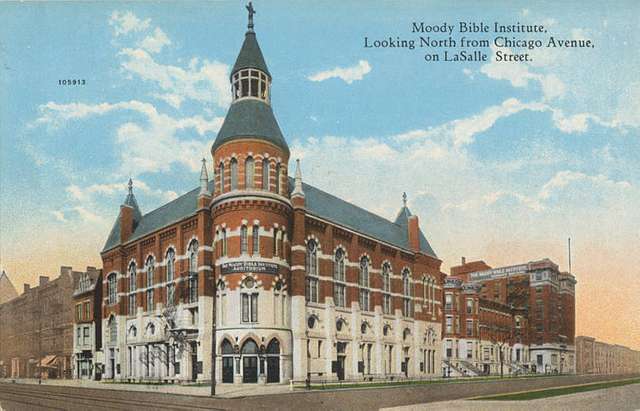
That training served him well, first as editor for HIS magazine, then at Good News Publishers, and finally as director of Moody Press in Chicago.

Ken’s children loved his stories, and when he shared them with colleagues at Moody, they urged him to publish. (He’d already published two children’s books.) The first collection of scripture-stories, The Bible in Pictures for Little Eyes (1956), was followed by several more.

Then came a new God-inspired epiphany. What if he rewrote scripture thought-for-thought instead of word-for-word, but still based on the original Hebrew or Greek? Could he make scripture—even the non-story parts—more understandable for his children?

Ken flipped open his Bible, and his eyes landed on 2 Timothy 2:4.

“No man that warreth entangleth himself with the affairs of this life; that he may please him who hath chosen him to be a soldier” (KJV).

After careful thought, Ken wrote: “As Christ’s soldier do not let yourself become tied up in worldly affairs, for then you cannot satisfy the one who has enlisted you in his army [3].”

That night he shared his rewrite with the family. They approved.

Thus began a multi-year commitment of evenings, weekends, and vacations, revising scripture for his family. Ken even worked during the 45-minute commute by train from his home (in Wheaton, Illinois) to Chicago.

Each evening he’d share the results of his efforts with the family.

A few years later another possibility occurred to Ken. Other families might also appreciate a scripture revision in modern-day English. By this time (1962), he’d completed the twenty-one epistles (letters) of the New Testament. He called the book Living Letters.

However, publisher after publisher rejected the manuscript. They doubted people would be interested in a modern version of the epistles so far removed from the familiar King James.

Ken and his wife Margaret decided to finance from their savings a printing of 2000 copies. He then rented half a booth at a Christian book convention and sold 800 copies.

The family helped process the orders at the dining room table. Boxes of books were stored under their beds.

Several months passed before the first orders arrived at their home. Ken dipped into their savings again and printed 5,000 copies. A few months later, 10,000 more.

In 1963 the Billy Graham Association contacted Ken. They wanted to offer Living Letters to anyone who requested a copy. They distributed six hundred thousand copies world-wide.

Considerable proceeds began to accumulate, but Ken and Margaret weren’t interested in upgrading their modest lifestyle. They set up a foundation in order to fund Christian mission projects worldwide [4].

Another prompting from God led Ken to leave Moody Press so he could write full-time and revise more books of the Bible into modern day language.

From 1964 to 1970 Ken added such volumes as The Living Prophecies (1964) and The Living Gospels (1966).  Each one included a different portion of the Bible.

By 1965, the dining room no longer sufficed for conducting the business of their company, Tyndale House Publishing [5]. Ken moved the operation to offices nearby. Another move became necessary in 1967 when even more space was required.

By 1972 Ken had completed the revision of the entire scriptures. The Living Bible was released, selling eight million copies by the end of that year.

In 1973, The Living Bible became the best-selling book in America, and Tyndale House Publishing soon became the well-known and highly-respected company it is today.

By the late 1980s Ken had been semi-retired for several years and his son Mark served as CEO. Tyndale House brought together ninety Bible scholars to work on The New Living Translation, which would be “faithful to the ancient texts and eminently readable” [6]. That volume was released in 1996 and has sold more than 50 million copies.

To this day Tyndale House carries on the passion and Living legacy of Kenneth N. Taylor (1917-2005), ministering to “the spiritual needs of people, primarily through literature consistent with biblical principles” [7].


[1] A time of Bible reading and prayer

[2] https://todayschristianliving.org/ken-taylor-making-scripture-clear/

[3] Ibid.

[4] Ibid.

[5] William Tyndale translated the Bible into English, and was burned at the stake in 1536 for doing so.

[6] https://www.tyndale.com/about-the-nlt

[7] https://www.tyndale.com/kenneth-n-taylor

Other sources:

https://www.zianet.com/maxey/ver4.htm

https://www.referenceforbusiness.com/history2/6/Tyndale-House-Publishers-Inc.html

Read Full Post »

Looking ahead at the calendar for 2024, I found more than a few wild-and-crazy celebrations in store for those who care to participate. Just in January alone, we can look forward to:

  • National Cream Puff Day—January 2 (Who thought this was a good idea right after the holidays when so many will be embarking on diets?)
  • World Logic Day—January 14 (If only we could fix in one day the irrational and absurd thinking that seems to be increasing these days.)
  • National Popcorn Day—January 19 (This one I can get behind!)
  • National Blonde Brownie Day—January 22 (If you prefer cream cheese brownies, your day is coming February 10.)
  • National Backwards Day—January 31 (Seems like we’d benefit more from honoring evidence of going forward—toward integrity, responsibility, and maturity.)

Didn’t I tell you they were wild-and-crazy observances?

To be honest, we Christians are encouraged to celebrate some wild-and-crazy things—things that make no sense at first glance, like:

Weakness

Too many of us assume we have to be supremely talented and gifted in order to be used by God. But the opposite is true.

God most often chooses ordinary people who’ve emptied themselves of prideful ambition and self-centered motives. They are the ones whom God can fill with himself, who become the ideal showcases for his greatness and glory [1].

Turns out, when we recognize just how weak we are—with our inadequacies, missteps, and fears—we’re actually in the best position to manifest the power of God.

Now that’s worth celebrating!

Meekness

The Hebrew word for meekness suggests “being molded.” The meek are God-molded; they’ve submitted to him and are patterning their lives after him [2]. The meek delight in leaving everything in God’s capable hands.

That may sound unappealing to some, but little do they know: the meek get the most out of life.

For example:

  • They view life with joyful gratitude, not disgruntled entitlement
  • They appreciate their resources—not for the prestige they offer but for their usefulness
  • They don’t harbor envy or jealousy, but genuinely enter into the joys of others

And note what God promises to the meek in Psalm 37:11 (above): an abundance of peace. Isn’t that a happy reality to celebrate?

Servanthood

Not many of this world are interested in the role of servant. But God’s kingdom works very differently:

Every day is a new opportunity to discover what eternal business might be lurking in the ordinary business of being human [3].

Bruce Wilkerson

Yes, there is eternal business in serving others as we:

  • prepare meal after meal that keeps the family fed, but also nourishes their hearts with comfort and delight
  • perform small deeds of kindness—because they’re woven into the larger expanse of God’s far-reaching grace
  • work for the benefit of others and the glory to God—whether anyone notices or not

There is honor in such serving.

Trouble

Now I’ve gone too far, some will say. Celebrating difficulty seems downright sadistic. But consider:

We can take delight in what God will do through the trial.

First, God delights in transforming the black-carbon pressures of our lives into diamonds of radiant beauty, as he chips away at the rough places of our character and the distractions in our lives, allowing the Light of Christ to shine with greater clarity.  Such an undertaking rarely happens overnight; it’s a process that takes time [4].

Second, think of those you’ve known or learned about who did shine with the radiant Light of Christ. They undoubtedly faced trouble, yet persevered and triumphed in the end. We too can experience fulfillment as the Light of Christ shines through us to impact others.

Third, while we’re in the midst of the trial, God often brings the sweetest discoveries of himself [5].

These realities also warrant celebration.

The question remains, how will we celebrate?  Perhaps with an ancient song:


[1] Nancy Leigh DeMoss Wolgemuth, Biblical Womanhood in the Home, 67.

[2] Ralph Sockman, The Higher Happiness, 65.

[3] A Life God Rewards, 114, emphasis added.

[4] Joanna Weaver, Having a Mary Heart in a Martha World, 199.

[5] L. B. Cowman, Jim Reimann (ed.), Streams in the Desert, 143.

Art & photo credits: http://www.pixexid.com; http://www.dailyverses.net; http://www.pixexid.com; http://www.depositphotos.com; http://www.canva.com; http://www.commons.wikimedia.org.

Read Full Post »

David Bussau sat with three of his teenage friends in the dining hall of Sedgley Boys’ Home, an orphanage in New Zealand.

“How’d you guys like to work for me?” he asked.

David had lived in the orphanage himself until recently. Now he was out on his own, living at a boardinghouse. But David had prepared for this eventuality, saving money from odd jobs while living at Sedgley.

Currently he was running his own hot dog stand, and now he was ready to expand. With the help of his friends, David became proprietor of three hot dog stands, then two other food stands, followed by a bakery, and a pancake company. David improved each business and sold them for a substantial profit.

In 1965 at age 25, David married Carol Crowder, a girl from his church. Not long after they moved to Sydney, Australia.

Sydney, Australia 1960s

David found work as a construction foreman, and quickly learned the business. Before long he was part-owner of the company.

Over the next ten years, the Bussaus became parents to two daughters. His boss retired and David purchased his shares of the company. Soon he owned three construction companies, and reached the status of millionaire—before his thirty-fifth birthday.

David knew money wouldn’t satisfy. He wanted to live on enough and use his God-given wealth and talent as an entrepreneur to serve others. But how?

In 1974 a cyclone devastated Darwin, Australia. David and twenty volunteers traveled two thousand miles to help with reconstruction.

Of course, several weeks of work made little difference. So David made arrangements for his businesses in Sydney to carry on without him and moved his family to Darwin. In addition to supervising construction crews, David raised funds throughout Australia for the flattened city.

By 1976 Darwin was nearly rebuilt, and the Bussaus’ pastor in Sydney presented them a new opportunity in Bali, to rebuild a church destroyed by earthquake. Their answer: yes.

“This was my first real exercise in faith,” David said later. “Even when I’m out of my depth I like to take on a challenge. I jumped into it trusting and believing that God would redeem if I screwed up.” [1]

In the remote village of Blimbingsari, the Bussaus lived in a thatch-roofed home with no electricity, running water, or phone. But the community of one thousand Christians were willing to work hard to have a church again.

Water was the top priority, in order to make concrete for a sturdy structure. But bringing water to the village meant bypassing two Hindu villages. David and his crew built a dam and laid pipe, providing water to them first.

That project yielded another blessing. Now the villagers could irrigate their rice fields and harvest twice a year, not just once. 

While working toward church construction, David learned of the systemic debt plaguing the rice farmers. Landowners required sixty percent of the crop as rent; the remaining proceeds didn’t cover most families’ expenses. 

They often mortgaged their children to manage mounting debts, but it was rarely enough.

David created a solution: micro-financing. He began with his interpreter, Ketut, whose wife knew how to use a sewing machine.  

David lent them fifty dollars to purchase an old one. They sold the crafted items in surrounding villages, and as the business grew Ketut paid back the loan.

Even better, they made enough to buy a second machine and hire another worker. Before long Ketut and his family were ready to diversify. They opened an import/export business as well as a taxi service, employing more community members.

And so began the villagers’ escape from chronic debt into sustainable, successful businesses.

When the church was complete, village leaders asked the Bussaus to stay and help build a hotel. People could then be trained to work in the growing tourist industry.

David and Carol agreed. (Their two daughters loved living in Bali, making the decision even easier.)

To further develop his ability to provide micro-loans, David founded a non-profit organization called “Maha Bhoga Marga”— “The Way of Prosperity.” Over the decades he’s founded seventeen international ministries.

David also joined forces with a colleague to form Opportunity International (O.I.). As of 2021, it has served over 18 million clients in thirty countries. [2]

An O. I. savings and loans ready to open in Ghana, 2011

“O. I. creates a job in the developing world every thirty seconds, and they estimate that every permanent job created directly lifts six people out of poverty.” [3]

David explains their success: “Our original intent wasn’t to set up an international organization, it just grew. That’s the way God works. [When you] do what He puts in front of you, the more doors He opens up. The result is that God is glorified through it.” [4]

Now in his eighties, David still travels internationally, furthering the work God gave him to do: bringing people out of poverty one micro-loan at a time and glorifying God through it.


[1]  https://www.issuu.com/opportunity/docs/oia_agency_issue08

[2] https://opportunity.org/content/News/Publications/Annual%20Report/annual-report-2021/annual-report-2021.pdf

[3] https://www.hopechannel.com/read/david-bussau-creates-opportunity

[4]  https://www.issuu.com/opportunity/docs/oia_agency_issue08

Other sources:

https://christiantoday.com.au/news/cma-courageous-leadership-conference-melbourne-and-interview-with-micro-finance-pioneer-david-bussau.html

https://www.discoverwalks.com/blog/australia/top-10-sensational-facts-about-david-bussau/

https://opportunity.org/news/blog/2021/december/back-to-the-beginning-david-bussau

Photo credits: http://www.commons.wikimedia.org; http://www.rawpixel.com; http://www.flickr.com; http://www.commonswikimedia.org; http://www.rawpixel.com; http://www.commonswikimedia.org (2).; http://www.piqsels.com.

Read Full Post »

Ida Scudder, a senior at Northfield Seminary in Massachusetts, envisioned a future for herself in a small American town that included a charming home with a loving husband, fun times with good friends, adventure, and eventually several children.

Such a dream was the antithesis of her upbringing in Vallore, India—with its crowds, poverty, famine, and disease. Having lived in the States now for several years, Ida had no desire to return.

Her parents served as medical missionaries in Vallore, and her paternal grandparents before them. Ida wanted no part of that kind of life.

But when Mrs. Scudder became seriously ill in 1894, Ida felt compelled to return home to care for her mother and help run the clinic. Following graduation that year, she set sail, praying she’d arrive before the unthinkable occurred. Ida’s prayers were answered [1].

One evening during her visit, a Hindu man knocked at the door, desperate for Ida to come help his wife.

“She’s been struggling for hours to deliver our baby,” he cried. “Now she is growing weak. I’m afraid for her!”

“Let me get my father,” Ida suggested. “He’s the doctor.”

“Oh no,” the man replied. “It is against our beliefs for another man to see my wife. You must attend to her.”

Ida explained she could not help; she knew nothing about childbirth. And the grief-stricken man turned away.

Later that same night a Moslem came to the door with the same request. He too refused help for the same reason. And not long after, the scenario repeated itself a third time with another Hindu.

When Ida finally went to bed, no visions of idyllic living in America filled her mind. Instead she prayed, and a new dream began to form. God meant for her to become a doctor and help the suffering women of India. Even more startling: Ida found herself eager to follow his plan.   

In the morning, she learned that all three mothers and their infants had died. It broke her heart and solidified her resolve.

When Ida returned to the States, she was one of the first women to attend Cornell Medical College. And no sooner had she graduated in 1899, than Ida was on her way back to India, bolstered by a $10,000 grant from a Manhattan banker, in honor of his wife, Mary Taber Schell.

At first Ida treated women in a small medical office set up in her parents’ home. But patients often waited too long to see her, so she decided to go to them.

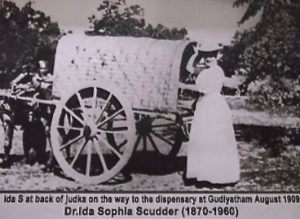
An ox-pulled cart full of medical supplies became her clinic. And as she tended the sick and injured, Ida spoke of Jesus and asked patients if they’d like to know more about the Great Physician.

In 1902, Ida was able to open the Mary Taber Schell Hospital in Vellore. But with only forty beds, the medical needs in the region far exceeded what Ida could provide.

She set about establishing a school for young women to train as nurses. Critics warned no one would come since the education of girls wasn’t part of Indian culture. But come they did—151 students that first year—and they performed well.

Funding from various denominations in the U.S. and Britain allowed for expansion of the hospital. By 1906, 40,000 patients were being treated annually.

Ida’s next venture, in 1918, was to establish a medical school to train women doctors. Naysayers claimed women would not be able to pass the final exams, but all fourteen of the first class succeeded.

More qualified staff meant more space needed for them to work. A second hospital was built in Vallore in 1923.

Expansion continued in 1928 with an endeavor even Ida could not have envisioned:  the construction of the Vellore Christian Medical College and Hospital, spread over 200 acres. Gandhi himself came to see Ida and the monumental project underway.

Ida seated on left.

Also during this time, Ida traveled back and forth to America to raise funds. Her passion for the work inspired people to give, and she raised millions of dollars.

Back in India, Ida spent less time with patients and more time preparing for the opening of the new college, “negotiating between various missionary agencies, and dealing with a turbulent Indian political scene as fierce demands for independence were growing”[2].

Today the Vallore Medical College and Hospital treat over 8,000 patients a day and are well known for excellence in the fields of research, patient care, and disease prevention. Chaplains pray with the patients, and Bible classes are offered in nine different languages [3].

The main building of Vallore Medical College and Hospital

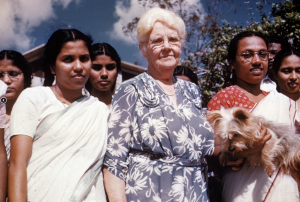
Dr. Scudder and students

Ida Scudder (1870-1960) was once asked how she was able to accomplish so much. Her answer explains how to fulfill God’s individualized plan for each of us:

“I took only one step at a time; the step God showed me” [4].


[1] Mrs. Sophia Scudder passed to heaven in 1925.

[2] https://canonjjohn.com/2022/11/12/heroes-of-the-faith-ida-scudder/

[3]  https://scudder.org/family-history/ ; https://www.christianity.com/church/church-history/church-history-for-kids/ida-scudder-reluctant-missionary-11635053.html  

[4] https://www.youtube.com/watch?v=tJIHIJpmVTs

Other Sources:

  1. https://scudder.org/about/history/india-medical-missions/ida-scudder-story/

3. “A Life of Consecrated Purpose: The Ministry of Dr. Ida Scudder” by Dr. Rebekah Naylor at http://www.imb.org.

Photo credits: All photos of Dr. Ida Scudder courtesy of The Scudder Association Foundation at http://www.scudder.org. The Indian city street scene, http://www.picryl.com.

Read Full Post »

“I’m sorry, but we cannot treat those who cannot pay,” the doctor explained.

Katie Davis blinked in shock. How could a physician turn away an injured child, even if she was an orphan? Then again, this was Uganda, not Brentwood, Tennessee where she grew up. Fifty percent of the population here lived in poverty, and the under-resourced hospital couldn’t handle all the overwhelming needs.

People waiting in Ugandan hospital

But Katie, a kindergarten teacher, couldn’t accept the doctor’s pronouncement. This child was a student in her school, living in a shack down the street. She was the oldest of three and caretaker of the younger two; their parents had died of AIDS.

The orphanage was already full to capacity; Katie feared for the girls’ future. That very day she managed to secure custody papers, and single Katie became a mother of three—at age nineteen.[1]

What will Mom and Dad say about THIS? she must have thought.

They’d already been hesitant about Katie’s first three-week trip to Uganda, to work at a Christian orphanage her senior year of high school, 2006. Almost as soon as she arrived, Katie fell in love with the staff and students.

Upon returning to the States, Katie couldn’t wait to get back to Uganda after graduation, to take the kindergarten position offered her. The Davises had agreed, with the understanding she’d begin college the following year.

Katie returned home as promised, but her heart remained in Uganda. After one semester, her parents acquiesced and Katie flew back to the people and country she loved.

Uganda–a small land-locked country of East Africa

It was January 2008 when Katie’s adopted daughters moved into her small living quarters, but God soon provided a house to rent.

Over the next eighteen months, more orphans were brought to Katie—girls who’d been abandoned, abused, or whose parents had died of AIDS. One baby was given to Katie by an HIV-positive mother, just twelve years old herself. Child-by-child, Katie’s family grew to thirteen.

Of course, her teacher-salary couldn’t cover all the expenses. But Katie had already researched how to start a nonprofit organization, to aid Uganda’s children. Amazima International Ministries was established in 2008, based in Katie’s hometown of Brentwood.[2]

Soon 150 children were receiving assistance that included school supplies, basic medical care, and two hot meals a day—things their families couldn’t afford.

Two years passed. Katie’s life brimmed with all the responsibilities that thirteen children entail. In addition, numerous houseguests came and went—people in dire circumstances needing temporary lodging.

As with any household, disagreements and frustrations flared. But the word Katie chose to describe the atmosphere was elation—for the laughter, singing, happy noise and gratitude that filled her home.[3]

Then tragedy unfolded. A dear friend and mother of five, died. And the biological mother of one of Katie’s adoptees returned to claim her daughter—a mother unfit for parenting—but Katie had to let the child go. Grief beyond words gripped her heart as she turned to her Heavenly Father for solace. 

Early in 2014, twenty-something Benji Majors arrived in Uganda on a mission trip. He soon recognized the need for young men to be mentored. So Benji decided to stay and come alongside those wanting to become God’s men of integrity.

When Benji asked Katie out–twice, she said no both times, not sure if marriage was part of God’s plan. Besides, what man would commit himself to a woman with thirteen children? Better not to get involved, she thought. 

But Katie found herself attracted to Benji’s passionate heart for God and for people. She finally invited him for coffee—the first of many dates.

The following year Benji proposed over a picnic. When Katie said yes, her thirteen daughters jumped out of the bushes and tossed flowers at the couple. Benji had included them as part of the plan. He and Katie were married in late 2015.

The couple still lives in Uganda, running Amazima Ministries. They provide education for hundreds of children in their own Amazima School, food and health services for thousands of families, as well as job opportunities.

Who could have imagined such a far-reaching outcome when young Katie left for Uganda?

GOD could.

P.S. Ben and Katie no longer parent 13 children; the number has grown to 15 with their two biological sons.


[1] Though Ugandan law specifies an adoptive parent must be at least twenty-one, a judge can override the law in the best interest of the child(ren).

[2] Amazima means “truth” in Lugandan.

[3] https://youngadults.lifeway.com/2012/01/no-ordinary-life-katie-davis-story-of-serving-children-in-uganda/ 

Sources:

https://amazima.org/about/ . Visit here for numerous photos and information about Amazima Ministries.

https://www.christianpost.com/news/katie-davis-majors-young-adoptive-mother-of-13-ugandans-where-is-god-in-suffering-interview.html

https://justbetweenus.org/magazine/exclusive-interviews/extraordinary-love/

https://myhero.com/katie-davis-a-serving-heart-2

https://toptwentyfiveinterviews.transistor.fm/episodes/7-daring-to-hope-part-1-katie-davis-majors

Photo credits: http://www.commons.wikimedia.org (Toshihiro Horii); http://www.wikimedia.org; http://www.flickr.com; sni.no/Skole_og_utdanning_i_Uganda (Richard Lord); http://www.publicdomainpictures.com (Michael Spisak).

Read Full Post »

The Ruegg crew–1980

Years ago when my husband Steve was two-and-a-half years into his first pastorate and our three children were ages five and under, I found myself over-committed.

Sundays, of course, included Sunday School, church, and an evening service. Mondays we hosted a small group in our home that grew to about 30 (which, in my mind, required a clean house plus fresh iced tea and coffee). Thursday evening was choir practice.

From a handful of members to a loft-full; I’m 5th from the left

Every other week, I facilitated a Moms’ support group/Bible study. Also on the to-do list: leading Children’s Church each Sunday for a year, and participating in numerous other activities that happened on a less frequent schedule.

Do you see any issues here?! I didn’t.

All this activity felt important for the growth and community-building of our church that had been dying before we arrived. As a result, I was always on the go between the responsibilities there and at home. Sometimes I resented it (which can be one of the symptoms of striving too hard).  

But the bustle felt gratifying too. In seeking to please the people around me, I was feeding my own neediness for validation. Pride and self-satisfaction lurked in the corners of my soul—wrong reasons for the striving. In addition, I was discovering those attitudes are never satiated.

What’s a Type-A person–who wants to do what’s right–supposed to do?

The following questions can help us evaluate our choices of activity, how many we choose, as well as analyze the motivations behind them:  

Am I propelled most days by determination or devotion?

The determined person rarely reads her Bible or prays except on the run. Her calendar is impressively full of good-deed commitments for others, but contentment is illusive.

This woman may know that a quiet time spent with God refreshes and transforms the spirit, but she can’t seem to make it happen.

Do I find myself pressing on (to the point of exhaustion), while rarely pressing in to be strengthened?

Pressing in includes connecting with God throughout the day, especially in the thick of stress, frustration, or anxiety.  One means is to recite scripture verses that bring our focus back to our all-powerful, all-wise God. [1]

Such verses include:

  • “God is our refuge and strength, a very present help in trouble” (Psalm 46:1).
  • “Call on me in the day of trouble; I will deliver you, and you will honor me” (Psalm 50:15).
  • “The Lord is good to those whose hope is in him, to the one who seeks him” (Lamentations 3:25).

God is ever-ready to help—with the choices before us, when to say yes and when to say no, as well as the right motivations behind those choices.

Does people-pleasing supersede God-pleasing in my life?

Author Shauna Niequist speaks for some of us when she asks: “Why am I doing this? What is it in me that keeps things moving so breakneck fast, . . . that sacrifices my own health and happiness so that people who aren’t me will think I’m doing a good job, in some vague, moving-target kind of way?”[2]

I too find my service for others frequently tinged with people-pleasing. Does that mean I should forego such activity until I can purify my intentions?

No, wrote author and pastor, Tim Keller: “If you wait until your motives are pure and unselfish before you do something, you will wait forever.”[3]

BUT! Our heavenly Father offers this glorious hope:

Because we are covered by Jesus’ righteousness, even our imperfect efforts to please God are acceptable. And as we grow in dependence upon Christ, he’ll purify our hearts more and more.[4]

*     *     *     *     *     *     *     *     *     *

Father, I know it’s downright foolish of me to strive so hard, especially for all the wrong reasons. I want to be free from people-pleasing, self-gratification of the ego, and pride. Forgive me for giving room to such attitudes in my mind.

Help me to be an eager and compliant participant as you work within me to create a pure heart and make my attitudes new.

In the powerful name of Jesus, AMEN.

(Proverbs 4:23; Psalm 51:10; Romans 12:2)


[1] Psalm 72:12 ESV

[2] Present over Perfect, 58.

[3] The Reason for God: Belief in an Age of Skepticism

[4] Isaiah 61:10; Titus 2:11-14

Photo credits: Nancy Ruegg (2); http://www.dailyverses.net; http://www.pixabay.com (TheDigitalArtist); http://www.heartlight.org; http://www.dailyverses.net.

Read Full Post »

“Forgive me, Mr. Ruskin, but I cannot give myself to painting the way you desire and continue to keep God at the center of my life.” Lilias Trotter looked imploringly into her tutor’s eyes.

After three years of instruction from John Ruskin, the well-known artist, author, and art critic, twenty-five-year-old Lilias had prayerfully made the difficult choice. She would forego the opportunity to become “the greatest living painter in England” (as Ruskin predicted she would be) [1], and devote more time to her mission work.

(Self-portrait of John Ruskin)

“Ah, my dear Lilias, he sighed. “I was afraid our efforts would come to this. Goodness knows how many times I’ve complained that you needed to spend more time with your brushes and less time with the women of ill-repute around Victoria Station. However, I do admire your dedication, and regretfully wish you well.”

From this crossroads, a new path began to open before Lilias Trotter.

For a while she continued her work with women at the lowest rung of society, bringing them to the newly-established YWCA for training in various employable skills and introducing them to Jesus.

But in 1887 Lilias found her heart drawn to Algeria, after hearing a plea for more missionaries to the region. She applied to the North African Mission board but was denied because of her frail health.

(Algiers, Algeria circa 1880)

Undeterred, Lilias and two friends chose to go on their own. A generous endowment from her wealthy father (upon his death in 1865) provided the financial support necessary.

The three women settled in the French Quarter of Algiers and immediately began learning the Arabic language and Muslim culture. Because of the male-dominated society, they chose to engage women and children.

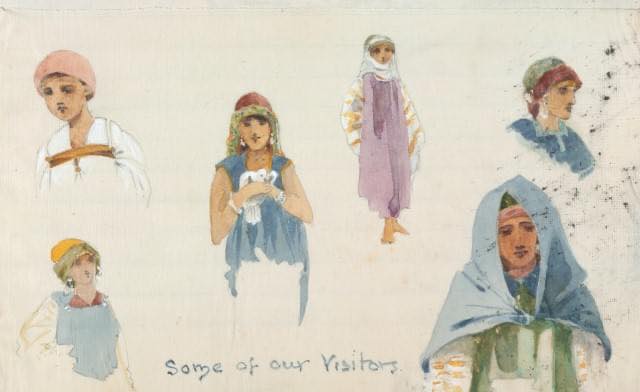
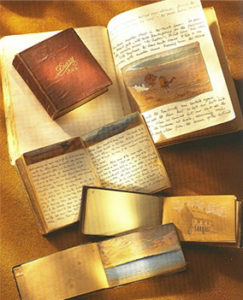
(watercolor sketches from Lilias’ journals)

Lilias put her artistic abilities to work creating leaflets. The charming illustrations drew attention to the spiritual truths she wrote. Her inspiration came from the hours she spent in Bible study, meditation, and prayer.

But inroads into Algerian society didn’t come easily. Nearly everyone was suspicious of them. They were women after all, European and Christian. Opposition came from the French authorities as well as Muslim leaders. Lilias wrote in one of her journals that she and her friends felt like they were knocking their heads against stone walls [2].

In addition, the Muslim women were difficult to reach since they were seldom allowed in public. But after several years one woman accepted Jesus into her life. Sometime later another woman and then another expressed their faith, until they could count their little band of believers on two hands.

Lilias also traveled into Morocco on the west and Tunisia on the west, into the far regions of the Sahara Desert where no European woman had been before. There too she sought out the isolated Arab women as well as the Sufi mystics who resided in the desert.

Lilias shared her pamphlets and booklets that included depictions of Arab life, always praying that her writings and drawings would help these Muslims understand who Jesus is and why he came.

Of course, persecution came to those who chose Jesus. Two of the new Arab Christians were slowly poisoned to death, others were drugged, and still more were punished in additional ways.

After twenty years of struggle, the missionaries still had little to show for their effort. And yet Lilias wrote:

I am full of hope that when God delays in fulfilling our little thoughts, it is to leave Himself room to work out His great ones. And, more and more as time goes on, I feel that the longer He waits the more we can expect, . . . and the greater will be the band of those who will come forth free from their prison walls. When one gets hold of that vision, one can throw back in the devil’s face his taunts over the seemingly wasted years that lie behind us.

Lilias Trotter

Perhaps even more productive than her conversations with people was the impact of her writings. Lilias’ appealing parables, “creatively illustrated in Eastern style” were widely circulated [3].

She felt confident that the Arabs would more seriously consider written material in the privacy of their homes, than in public conversation where opposition was likely. With her knowledge of the culture, language, and arguments of challengers, she was perfectly-suited for the task of producing these materials.

Lilias returned to Europe a number of times because of her health, each time in dire need of rest as well as relief from Africa’s oppressive heat. But Lilias often used these trips to garner interest and support for the organization she founded: the Algerian Mission Band.

A number of people responded, joining Lilias in her work. However she never asked for financial backing. “God’s wealth is boundless,” she said [4].

For forty years Lilias Trotter lived out her passion for the Algerian people. Before her death in 1928, she’d established twelve mission stations. And instead of three workers, a team of thirty had joined them, bringing the joy-filled, abundant life of Christ to the Muslims of Algeria [5].


Notes:

[1] https://ililiastrotter.wordpress.com/about/

[2] https://ishshahsstory.com/2016/08/10/celebrating-lilias-trotter-of-algeria/

[3] https://www.imb.org/2019/06/12/missionaries-you-should-know-lilias-trotter/

[4] https://thiseternalmoment.com/the-life-and-legacy-of-lilias-trotter/

[5] https://pioneers.org/2021/03/15/the-legacy-of-lilias-trotter

Other sources:

https://www.christiantoday.com/article/lilias.trotter.talented.artist.dedicated.missionary/139139.htm

https://liliastrotter.com/about/

Photos of Lilias Trotter and her paintings as well as John Ruskin’s self-portrait, courtesy of Lilias Trotter Legacy at http://www.liliastrotter.com and their Facebook page. Street scene of Algiers: http://www.commons.wikimedia.org.

Read Full Post »

“This is your last chance!” shouted the leader of Columbian guerillas. “Join us, convince the Motilone to join us, and you will live. Otherwise, you are a dead man.”

The surrounding group of rebels aimed their guns at American missionary Bruce Olson. He fully expected to see Jesus in the next moment.

Of course, this was not the first time Bruce faced death during his twenty-seven years with the fierce Motilone tribe.

No sooner had he arrived in 1961, than Bruce was surrounded by tribal warriors who shot him in the leg with an arrow and took him captive. The guides who had led him to their village fled.

Bruce was just nineteen years old and had received no backing from any mission organization, because of his age and lack of training. But he’d seen a picture of the remote Columbian tribe and felt drawn to share with them about Jesus.

His own life had been wonderfully transformed by Christ, and Bruce desired that for others—especially for this people-group who knew nothing about Jesus.

(The Motilone live in northeastern Colombia and western Venezuela.)

Some would say, “Bruce must have misunderstood God’s plan. Otherwise, why would he experience calamity the minute he arrived?”

But look what God did.

First, the Motilone chief forbade the warriors to kill Bruce. Later he and his men would admit there was no reason to spare him; they just did.

The next day the chief’s son, Bobarishora, brought worms for Bruce to eat, which thankfully tasted like liquified bacon and eggs. In spite of the language barrier, Bruce and Bobarishora began to build a friendship.

The leg wound became infected. Bruce escaped and returned to civilization for treatment. But upon regaining strength, the young missionary went back to the tribe—only to contract dysentery and have to seek medical help again. He almost died in the effort.

For his third attempt to settle with the Motilone, Bruce brought medical supplies. The witch doctor took great interest in their healing powers and learned from Bruce how to use them. With Bobarishora and the witch doctor as allies, Bruce began to achieve acceptance in the tribe.

Over the next four years he learned the Motilone language and set about translating the New Testament into their language, putting to use his knowledge of Hebrew, Greek, and Latin.

Bobarishora, or “Bobby,” became the first to accept Jesus into his life. At a festival not long after, Bobby sang about the jungle trail of life, a metaphor familiar to the Motilone. Bobby explained he’d seen the footprints of God.

“There are many trails in the jungles,” he said. “But there is one trail that goes to the horizon.” (Bobby was referring to heaven.)  “Christ came to walk that trail so we can walk in his footsteps.”[1]

It wasn’t long before many tribespeople had become Jesus-followers. They began sending their own missionaries to neighboring tribes to tell them about Christ.

The Motilone wanted to learn how to read and write, so Bruce started a school. He also set up a medical clinic, and led the effort to grow cacao, to help support the tribe.

(Cutting a cacao pod from the tree.)

Over time the proceeds helped finance 48 schools, more than 20 health clinics, 12 farming cooperatives, and numerous scholarships for Motilone students to attend high school and university.[2]

Then came the day in 1988 when 15 Communist guerillas kidnapped Bruce with the plan of forcing his cooperation, and convincing the Motilone to do so also. Bruce spent several months chained to a palm tree and became very ill. Somehow he survived.

One of the leaders asked Bruce to teach them how to read and write. They brought a book to Bruce, not knowing it was a New Testament. Bruce used it to teach the men to read, and many became Jesus followers.

Bruce’s health continued to deteriorate. The guerillas decided to give him a blood transfusion.

“I will give him some of my blood,” one rebel announced.

The next day he told Bruce that when he was a young child, the Motilone had given food to his widowed mother for three years, never asking for anything in return. “You saved my life,” he said, “Now, I save your life.”[3]

Months passed. No amount of mistreatment had convinced Bruce to help their cause.

One day a group stood him against a tree, announced his execution, and aimed their guns at him. But when they fired, Bruce remained unharmed. They’d shot blanks at him, expecting this final test to break him.

Sometime later one of the leaders told Bruce that capturing him had been a mistake. He hoped that Bruce could forgive them.

He promised the rebels would leave the Motilone alone, and Bruce could continue his work. After nine months of captivity, they released him.

As a result of Bruce’s long devotion to the tribe, more than 400 Motilone have graduated from high school, and over 30 from university, trained as physicians, accountants, translators, forest rangers, agriculturalists, and more. Still others have received technical training.

All have returned to their jungle communities to share their expertise within the tribe.

As of 2018, more than 70% of the Motilone tribe are following in Christ’s footsteps to the horizon.[4]

As for Bruce Olson, now 80, you’ll find him still working with the people of 18 different tribes and languages of the jungles.[5]


 Notes:

[1] https://missionexus.org/an-interview-with-bruce-olson/

[2] https://www.tms-global.org/story-details/bruchko

[3] Ibid

[4] Ibid

[5] https://www.godreports.com/2021/02/legendary-american-missionary-ate-maggots-wore-a-flea-collar-to-survive/ 

Additional Sources:

https://www.bruceolson.com/en/index.html

https://www.theopedia.com/bruce-olson

Photo credits: http://www.picryl.com; http://www.pxhere.com; http://www.flickr.com; http://www.commons.wikipedia.org (2).

Read Full Post »

Eliza strained forward as her legs churned beneath her, the underbrush tearing at her long skirts. The small boy in her aching arms whimpered, sensing a danger he couldn’t see.

“Hush, chile,” she gasped in a whisper. “Mama’s gone keep you safe.”

Eliza dared a quick glance behind her. She could see nothing of the slave catchers who’d found her hiding place, a house near the Kentucky side of the Ohio River.  She’d slipped out the back door and into the woods as they approached the front. But they would surely guess her run for freedom, and their long legs, unencumbered by skirts, would quickly bring them close.

Runaways like Eliza Harris

Eliza dared not slow her pace toward the northern side of the river, where she and her baby had a chance to be together. Though her master had been kind, he was planning to sell her son. Eliza could not let that happen; her two older children had already died.

Finally, Eliza could see glimmering flecks through the trees as morning light danced on the water. But this was not what she’d planned. Eliza had expected to walk across the mile-wide river on ice, given the winter season. Instead she found the ice broken up into mammoth chunks, drifting slowly on the current.

With a prayer on her lips, Eliza made the choice to cross anyway, jumping from ice cake to ice cake. Sometimes the cake on which she stood sunk beneath the surface of the water. Then Eliza would slide her baby onto the next cake and pull herself on with her hands. Soon her skirts were soaked and her hands numb with cold. But Eliza felt God upholding her; she was confident he’d keep them safe.

On the northern bank stood William Lacey, one of those who watched the river for escaping slaves in order to help them. Time and again he thought the river would take the woman and child, but she miraculously reached the bank, heaving for breath and weak from cold and exhaustion.

When she’d rested for a few moments, the man helped her to a house on the edge of town. There she received food and dry clothing before being taken to another home and then another, along the Underground Railroad. Finally she reached the home of Quakers, Levi and Catherine Coffin, in Newport, Indiana.[1]

Note the mention of Levi Coffin

By the time Eliza arrived on their doorstep in 1838, the Coffins had been helping escaped slaves for more than a decade. In fact, the following year they would build a house specifically designed for their work as station masters on the Underground Railroad.

A Federalist-style house, similar to the Coffins’ home

In the basement they constructed a spring-fed well, to conceal the enormous amount of water needed for their many guests. On the second floor, they built a secret room between bedroom walls, just four feet wide. Up to fourteen people could hide in the long, narrow room.

Eliza Harris was only one of more than a thousand slaves (some say 3,000) that stayed in the Coffin home on their way to Canada. Had the Coffins (or others) been caught helping runaway slaves, they would have owed a $1000 fine (which few could afford) and would have spent six months in jail (which meant no income for the family during that time). Slave hunters were known to issue death threats as well.

But the Coffins held strong convictions concerning slavery. In the 1870s Levi wrote in his memoirs, “I . . .  risked everything in the work—life, property, and reputation—and did not feel bound to respect human laws that came in direct contact with the law of God.”[2]

For the introduction of Coffin’s book, William Brisbane[3] wrote the following about Levi and two other abolitionists:

“In Christian love they bowed themselves before their Heavenly Father and prayed together for the oppressed race; with a faith that knew no wavering they worked in fraternal union for the enfranchisement of their despised colored brethren, and shared together the odium attached to the name of abolitionist, and finally they rejoiced together and gave thanks to God for the glorious results of those years of persevering effort.”[4]

Should we face such hatred and endangerment in our day, may we stand in the midst of it like Levi and Catherine Coffin—steadfast and unmovable in the power of God.

Addendum:

In 1854 the Coffins visited Canada and happened to encounter a number of former slaves they’d helped. Eliza Harris was one of them–settled in her own home, comfortable and contented.

Her story may sound familiar because Harriet Beecher Stowe, a friend of the Coffins, included the slave’s harrowing escape in her book, Uncle Tom’s Cabin.


[1] Now called Fountain City

[2] https://www.indianamuseum.org/historic-sites/levi-catharine-coffin-house/

[3] a doctor, minister, author, and South Carolina slaveholder who turned abolitionist and moved north where he freed his slaves

[4]https://docsouth.unc.edu/nc/coffin/coffin.html

Other sources:

http://www.womenhistoryblog.com

http://www.rialto.k12.ca.us/rhs/planetwhited/AP%20PDF%20Docs/Unit%206/COFFIN1.PDF

https://mrlinfo.org/famous-visitors/Eliza-Harris.htm

Art & photo credits: http://www.nypl.getarchive.net; http://www.wikimedia.org; http://www.flickr.com; http://www.wikimedia.org; http://www.flickr.com (2); http://www.slr-a.org.uk; http://www.wikimedia.org.

Read Full Post »

Betsy gasped at the revolting scene before her. Yes, she’d been warned by Stephen Grellet, a family friend, but even his graphic descriptions could not have prepared her for this.

In a space meant for sixty women, three hundred women and children[1] swarmed over every square foot, some barely clothed. Screaming and shouting assaulted the ears.

But the worst offense was the stench of unwashed bodies, vomit, human waste and more which saturated the meager straw on the floor. Small barred windows offered little fresh air for relief.

The place: Newgate Prison in London England. The time: 1813.

Newgate prison. Credit: Wellcome Library, London.

In that first moment inside Newgate, Betsy knew that “God wanted her to minister hope to these women who were being treated like animals and had lost their desire to live.”[2]

The jailers told Betsy and her companion, sister-in-law Anna Bruxton, not to enter the cells, that the women were bound to attack her.

But Betsy insisted, and they marveled when her quiet presence actually calmed the women. Betsy read the Bible and then prayed for the prisoners. Many dropped to their knees.

After that first visit, Betsy began to dream of better ways to deal with prisoners—especially those guilty of nothing more than stealing apples to feed their starving children. She wondered, Instead of severe punishment as the only purpose of confinement, what if rehabilitation was provided?  

Betsy went to work immediately.  She organized her Quaker friends (a group which quickly expanded) who made clothing for the inmates and their children.

Betsy recruited volunteers to visit the prisoners, read the Bible and tell them about Jesus, then pray with them, just as she did. No doubt many chose to believe in Jesus as a result.

Mrs. Fry reading the Bible to prisoners.

Betsy arranged for clean straw to be brought in regularly. A prison school was established, paving the way for children and mothers alike to escape destitution. Betsy also convinced prison authorities to hire a matron and female monitors for the women.

It’s no wonder people began to call her the Angel of Newgate. But financial backing proved difficult. None of the male-dominated organizations were interested. Nevertheless, Betsy was able to raise support through friends.

As she worked, Betsy prayed:

“Lord, may I be directed what to do and what to leave undone, and then may I humbly trust that a blessing will be with me in my various engagements—enable me, O Lord, to feel tenderly and charitably toward all my beloved fellow mortals.”[3]

News of Betsy’s reforms began to spread. In 1818 Betsy was invited to speak before a House of Commons committee concerning prison conditions. She was the first woman ever brought before such a body as a witness.

Her experience as a Quaker minister helped Betsy deliver a clear and powerful speech. And members of Parliament responded affirmatively. But when she spoke against capital punishment, any action toward prison reform stagnated.

Disappointed but not discouraged, Betsy continued her efforts toward further reforms. At the time many prisoners were shipped to Australia. Women were chained, then transported to the docks in open carts. Crowds gathered to mock and throw all kinds of filth at them.

Betsy initiated change by offering to escort each convoy and keep order if prison officials used covered carriages. They agreed.

She also supplied each woman with a bag of useful items including materials for a patchwork quilt, giving them something to do on the long voyage. Better yet, when the women arrived they could sell the finished quilts.

Inside the hull of the Edwin Fox, the last surviving convict ship. Just 157 feet long, she transported at least 180 prisoners each voyage.

Also in 1818, an American emissary John Randolph visited England to see Betsy’s work firsthand. He wrote, “I have witnessed there miraculous effects of true Christianity upon the most depraved of human beings. Bad women, sir, who are worse, if possible, than the devil himself: and yet the wretched outcasts have been tamed and subdued by the Christian eloquence of Mrs. Fry.”[4]   

Five years later sympathies in Parliament had changed and the Gaols Act of 1823 was passed. It included many of Betsy’s recommendations from three years before.

The new reforms didn’t apply to local jails or debtors’ prisons. Betsy and her brother Joseph traveled the British Isles to gather evidence of the conditions and then presented additional reform legislation.

And yet Betsy accomplished still more. “She established night shelters for the homeless, libraries for coast guards, societies to help the poor, and the Institution for Nursing Sisters to modernize British nursing. She also influenced Florence Nightingale’s training program.”[5]

For more than thirty years Elizabeth Fry championed these causes in the name of Christ. And to think, one year before that first visit at Newgate, she wrote in her diary, “I fear that my life is slipping away to little purpose.”[6]

But of course God would never let that happen to someone who trusts in him.

Addendum: Elizabeth Gurney (1780-1845), married Joseph Fry in 1800; they had eleven children.


Notes:

[1] The youngsters had no one else to care for them

[2] https://setapartgirl.com/story-elizabeth-fry/

[3] From Great Women of the Christian Faith by Edith Deen, quoted at https://setapartgirl.com/story-elizabeth-fry/

[4] https://christianhistoryinstitute.org/magazine/article/to-act-in-the-spirit-not-of-judgment-but-of-mercy

[5] https://christianhistoryinstitute.org/magazine/article/to-act-in-the-spirit-not-of-judgment-but-of-mercy

[6] (https://christiansforsocialaction.org/resource/heroes-of-the-faith-elizabeth-fry/ ).

Sources:

https://christianfocus.org/elizabethfry

https://christianhistoryinstitute.org/magazine/article/to-act-in-the-spirit-not-of-judgment-but-of-mercy

https://christiansforsocialaction.og/elizabethfry

https://setapartgirl.com/elizabethfry

https://encrustedwords.ca/elizabethfry

Art & photo credits: http://www.wikimedia.com; http://www.lookandlearn.com; http://www.wikimedia.com; http://www.lookandlearn.com; http://www.wikimedia.com; http://www.picryl.com; http://www.dailyverses.net.

Read Full Post »

« Newer Posts - Older Posts »

Still Traveling

Impressions Becoming Expressions

Living Our Days

Gaining a heart of wisdom

He Said What?!

I'm Patty, and my husband and I are living with our adult son who has autism and epilepsy. I love sharing lessons learned from life around me, especially life with Aaron.

Meditations of my Heart

Impressions Becoming Expressions

Linda Stoll

Impressions Becoming Expressions

Debby Thompson

Impressions Becoming Expressions

Signora Sheila

Notes on Life, Faith & Italy

Colleen Scheid

Writing, Acting, Living in God's Love

Mitch Teemley

The Power of Story

Heidi Viars

Finding the Image of God