Feeds:
Posts
Comments

Oops!

In one of his picture books, Barney Saltzberg asks all young artists: What can be done when your paper tears, a corner gets bent, or paint drips on your project? Throw it away and start over?

No, Saltzberg has better ideas, and through the pages of his book demonstrates his creative mastery of the mishap. A tear in paper, for example, can become the snaggly smile of an alligator. A bent corner can be turned into the head of a penguin, and paint drips into wheels on vehicles.

Saltzberg titled his masterpiece, Beautiful Oops!


What perfect imagery his book presents for the beautiful life Jesus creates out of each of us!

Without Jesus we make ourselves victims of mishaps and mistakes, motivated by the desires for self-gratification, power, and notoriety (to name a few). The results can include: gluttony, alcohol and drug abuse, sexual promiscuity, physical and emotional abuse, cheating, and slander (to name a few again).

But with Jesus, even those mishaps and mistakes can be transformed into something beautiful:


“Anyone united with the Messiah

gets a fresh start, is created new.

The old life is gone; a new life burgeons!”

–2 Corinthians 5:17, MSG


And what a life it is!

Those of us who ask Jesus into our lives get to enjoy incredible benefits such as:

  • A new perspective. No longer are we scrabbling for the next gratification, promotion, or thrill. Our eyes are opened to the delight of blessing others.


  • A new source of power. Dependence on ourselves is exhausting and worrisome. What a relief to rely on Someone all-wise and strong, Someone who even knows what will happen in the future.


  • A new certainty. No more lying awake at night with unanswerable questions pounding in our heads—questions like, “Is there life after death? How can a person know whether there’s a heaven and hell? If there is, how can I be sure to experience the former and not the latter?”  One step toward Jesus settles those questions. The believer knows his eternal destiny in heaven is secure.*


  • A new plan of action. No more striving after things that don’t satisfy. Life takes on new meaning, purpose, and fulfillment when God is integral to our lives.


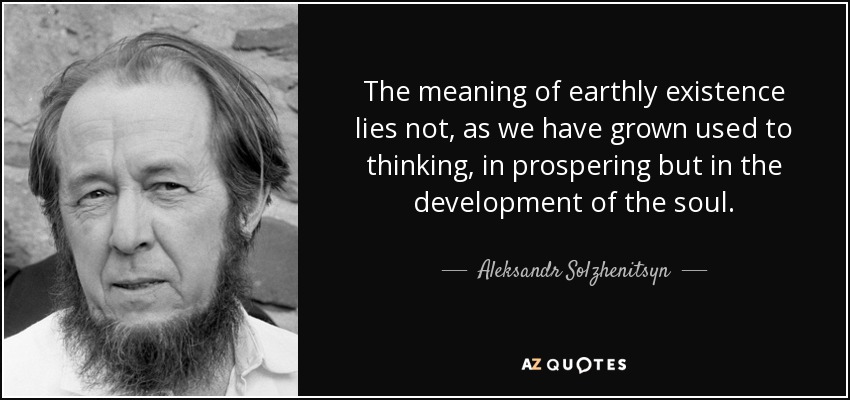
(“The meaning of earthly existence lies not,

as we have grown used to thinking, in prospering

but in the development of the soul.”

Aleksandr Solzhenitsyn)


  • New delights, such as: 1) anticipation and hope for the future, 2) awareness of God’s presence, 3) augmented relationships, and 4) understanding of and pleasure in Bible reading.


The person who doesn’t know Jesus may read this list and doubt its validity. Perhaps they don’t sense the need (yet) for these things or they question Jesus’ ability to provide them.

But like all the Oops in Barney Saltzberg’s book, we don’t really know the difference the Master can make until we turn the page.


______________________________


Have you turned the page to new life with the Master? If so, what aspect of your new life would you add to the list above? Share your experience in the comment section below!


*  Why would we believe what Jesus claimed in the Bible, that he’s the One to trust for the gift of eternal life in heaven? Whole books have been written to answer that question, to prove that the historical record of Jesus is accurate and his claims are absolutely true. One I highly recommend is The Case for Christ (Zondervan, 1998) by former legal editor of the Chicago Tribune, Lee Strobel.

Mr. Strobel was an atheist when he embarked on a thorough investigation of the evidence for a historic Jesus and his claims. When he had finished, Mr. Strobel had this to say: “The great irony was this: it would require much more faith for me to maintain my atheism than to trust in Jesus of Nazareth” (p. 265)! Mr. Strobel was convinced by the overwhelming evidence and chose to become a Christian.


(Art & photo credits:  www.pinterest.com (2); http://www.flickr.com; http://www.pinterest.com (2); http://www.azquotes.com; http://www.pinterest.com.)


While waiting for the coffee to brew Monday morning, I peeked out the kitchen curtains. To the east, a glowing red band rimmed the horizon. Slightly to the west, a clear, dark sky provided backdrop for a gleaming crescent moon.


Thank you, Father, I prayed, for prompting me to look out the window just now. Your handiwork never ceases to thrill me.

I wondered what further delights God might present as the day progressed? I decided to begin a list, just for the fun of seeing how many moments I could record. The glowing horizon and bright crescent moon became #1.

#2.  A completed workout.   Thank you, Lord, for helping me eat a live frog–yet again!  (Yes, that’s a perfectly logical prayer for those who know what Mark Twain said: “Eat a live frog first thing in the morning and nothing worse will happen to you the rest of the day.” For me, exercising is about as distasteful as eating a live frog!)

Moments later, as a bowl of oatmeal spun slow circles inside the microwave, I chose to window-gaze again. This time a squirrel caught my attention as he scampered along a treetop branch, then leapt across a wide chasm to the next tree.


How do squirrels jump like that without falling? Such astounding abilities you’ve given some of your creatures, Lord.  

#3 became:   A gravity-defying squirrel.

#4.   Oatmeal—with cinnamon, berries, walnuts, and milk. Thank you, Father, for the endless combinations of ingredients we can put together to make our taste buds happy! 

#5.   Coffee.  The most exquisite flavor to start the morning.


I was on a roll now as the praiseworthy moments continued:

#6.   A dropped contact found.

#7.   Sunshine pouring through the windows.

#8.   The drive to our son’s house along the edge of Mount Airy Forest. Spring is in evidence: bright green undergrowth portends the imminent leafing of trees.


#9.   Clear, rain-washed air–fresh and crisp. Just breathing is a supreme pleasure.

#10. Holding four-year old Elena’s soft little hand as we climb the stairs together.

#11.  Snuggling two-month old Maarit on my shoulder while taking her on another slow, bouncy tour of the living/dining, and kitchen area. Her bright eyes seem to study every object, any sign of movement, every play of light.

#12.  Reveling in Maarit’s smiles, each one a delightful surprise.

#13.  Making her laugh for the first time.

#14.  Watching Elena complete a 48-piece puzzle, with very little help.

#15.  Catching one of Maarit’s smiles on camera–well, almost.


#16.  Listening to a symphony of birds upon arrival home, as I walked from car to house.

#17.  Soaking up the warmth of sunshine on the deck while reading my Bible and journaling a bit.

#18.  Enjoying a refreshing salad, all the more delicious because Steve made it.


#19.  Receiving blessing and challenge while reading posts from bloggers I follow.  (See the list in the right column!)

#20. Resting with a pleasurable book.


    *    *     *     *     *     *     *     *     *     *

It may not be practical to record such moments every day, but I can see great benefit from keeping a list now and then.

It’s grateful eyes that get to see God’s goodness and glory everywhere–all day long.


(“It is good to praise the Lord…

…to proclaim your love in the morning

and your faithfulness at night…

…For you make me glad by your deeds, O Lord,

I sing for joy at the works of your hands.”

–Psalm 92:1-2, 4)


What commonplace moment brings you uncommon joy? Please share in the comment section below!


(Art & photo credits:  www.pixabay.com; http://www.flickr.com; http://www.farm7.staticflickr.com; http://www.flickr.com; http://www.wikimediacommons; Nancy Ruegg; http://www.flickr.com; http://www.pinterest.com.)


“I think everybody should get rich and famous and do everything they ever dreamed of,” said the wealthy, well-known actor.

Of course, I thought. He’s loving the high life—for now—and maybe feels guilty that 97% of humanity will never live the dream he’s privileged to enjoy.

But what he said next shocked me.

They should do everything they ever dreamed of so they can see that’s not the answer.”

Who made that startling statement? A man just about everybody in America recognizes on sight: Jim Carrey.

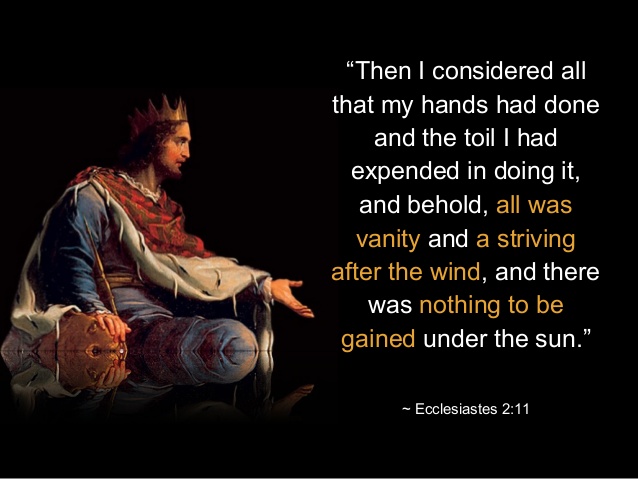
I wonder if Jim knew how close he came to echoing the words of King Solomon?


(“When I surveyed all that my hands had done

and what I had toiled to achieve,

everything was meaningless, a chasing after the wind;

nothing was gained under the sun”–Ecclesiastes 2:11 NIV.)


From ancient times to today, man has strived to find happiness by obtaining the next desired possession, experiencing the next enticing adventure, or pursuing the next enthralling relationship—even though any success is short-lived.

When will we learn?

Contentment results when we:

Want what we have.


(“The things you take for granted someone else is praying for.”

— Anonymous)


When our children were eight, eleven, and thirteen, my pastor-husband was appointed to a church in an area of South Florida known for its golf courses, beaches, and wealth.

That last characteristic was most challenging for our children. Many of their classmates arrived at school in expensive cars. They wore clothing with exclusive labels, owned all the latest gadgets, and traveled to exotic locations.

Though Eric, Heather, and Jeremy could see that consumerism did not guarantee happiness, they still struggled with the inequity.

The younger two, Jeremy and Heather, were thirteen and sixteen when they joined a crew of teens and sponsors for a one-week trip to the Dominican Republic.  Their responsibilities included painting at an orphanage and interacting with the children.

The next summer they repeated the trip. And as a result of witnessing true poverty, their outlook on life was dramatically transformed.


(Heather is the blonde on the left, in case you weren’t sure!)


Months later, Heather and I were riding together in our van and stopped at a red light. We weren’t even talking about those weeks spent at the orphanage. But a decked out sports car pulled up next to us and after a pause, Heather wistfully said, “The cost of that car would feed so many people in the Dominican.”

Such a dramatic shift of perspective had occurred in her heart.  Jeremy’s too.

However, over time contentment easily fades. We must:

Find the positives of each day.

I’ve started a new section in my quiet time notebook:  “A Celebration of Small Things.”  Maybe you’d like to join me?  Each evening I’m recording at least one thing that gives me a sense of contentment. The first entry on Monday was daffodils.


You see, last week a bitter cold snap here in Ohio ruined much of the early spring flora. Even the hardy daffodils lay bowed over to the ground.

However, they were not defeated! When the temperature rose above freezing again, most of their floral stems stood tall once more. Fluted cups remained open and delicately ruffled; petals fanned outward with only a slight curl at the tips.

I’m so very grateful a soupçon of spring has survived.


(“Sweet are the thoughts that savor of content.

The quiet mind is richer than a crown.”

– Robert Greene, English author, 1558-1592)


I’m discovering Robert Greene was right. Sweet thoughts do produce the treasure of a quiet mind.


*     *     *     *     *     *     *     *     *     *


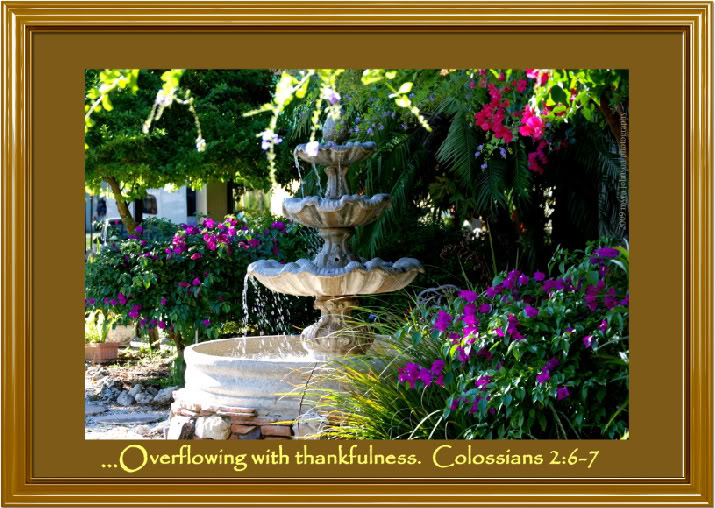
What a delight, Father, to give you thanks and praise for your abundant gifts—the beautiful, the pleasant, the heart-warming, the humorous. Every day is filled with blessing because of your love, compassion, and faithfulness.  My heart overflows with gratitude as I contemplate your goodness!


(Psalm 9:1-2, 103:8; Colossians 2:6-7)


What small thing causes your heart to overflow with thankfulness?  Share your choice in the comment section below!


(Art & photo credits:  www.flickr.com; http://www.slideshare.net; http://www.truevined.com; Nancy Ruegg (2); http://www.oldquotes.com; Myra Johnson at http://www.picturemythoughts.com.)


In the Image of God

Imagine God on the sixth day of creation, surveying the work he’s accomplished.

Craggy mountain peaks reach upward toward cerulean skies.


Undulating oceans teem with thousands of different kinds of fish and sea creatures—from protozoa to humpback whales.


Flat lands and rolling hills, some covered with grass, others with trees, also abound with life—from pixie cups that can only hold one drop of water…


…to elephants that can drink 80 gallons per day.

“And God saw that it was good” (Genesis 1:25).

But he wasn’t finished yet. God created one more being capable of deep thought, complex interaction, and an array of emotions. He called the creature “man” (vs. 26-27).


And the Lord Most High endowed man with abilities similar to his own. For example:

  • God is creative; people have the ability to produce new works and ideas.
  • God is linguistic; people can communicate with words.
  • God is logical; people are capable of reason.
  • God is interpersonal; people have the capacity to develop relationships.
  • God is wise; people can develop wisdom.
  • God is gracious and compassionate; people are capable of responding to one another with patience, kindness, and encouragement.


Just like our Father, each of us is (to some degree) capable of all these abilities. We can creatively solve problems, retell events, weigh the pros and cons of a decision, make friends, choose wisely from the grocery store shelves, offer a compliment.

But evidence would indicate God chose to endow each of us further, with a particular intelligence in which to excel. Our own family includes:

  • Two creatives—an artist and a graphic designer
  • Two linguistics—both pastors
  • One logistic—a tech support manager
  • Three interpersonal types—a teacher, school psychologist, and psychiatric/family doctor


Each person also has secondary and even tertiary strengths, in various combinations.

Yet God didn’t stop there. In his image he made us spiritual beings as well. Within each person is an invisible, eternal soul, a place where we can experience his presence (Ephesians 3:16-19). And he gave us a conscience to know right from wrong—not to spoil our enjoyment of life but to enhance it (Psalm 128:1-2).


As wondrous as all these gifts are—individually designed strengths, eternal souls, and the compass of a conscience–God chose to bequeath us with one more extraordinary privilege. He made us to be reflections of his glory (2 Corinthians 3:18).

God chose not to confine his grandeur to the throne room of heaven. He allows us to make his radiant image visible in the world, as we reflect his multi-faceted goodness. No other creature was given such honor.

King David experienced the wonder. He marveled that God made us just a little lower than the angels and—get this—crowned us with glory and honor (Psalm 8:5).


Think of it: The God of all glory who deserves all honor desires to share his magnificence in the world through us.

Just this week, I glimpsed the image of God as:

  • Steve thoughtfully brought me a cup of fresh coffee—as he often does.
  • Trelene kindly gave us a book she thought we’d enjoy.
  • Micki shared her wisdom.
  • Cheri offered a word of encouragement.
  • Four-year old Elena gifted us with a sample of her artwork—accompanied by hugs.


In such ways, God’s loving kindness, wisdom, inspiration, creativity, and affection are made visible. How dark our world would be without the sparkling splendor of God’s perfections reflected through his people.

So take note:

You are irreplaceable.

No one has your particular set of gifts, strengths and traits.

God designed you specifically

to achieve pre-designed purpose (Ephesians 2:10)—

just the way you are,

in the glorious image of God.

_________________________


What God-given attributes do you see among your family members? Where have you glimpsed the glorious image of God this week?


(Art & photo credits:  www.commons.wikimedia.org; http://www.en.wikipedia.org; http://www.mnn.com (Leonard Turner); http://www.mybible.com; http://www.pinterest.com; http://www.freestockphotos.biz.; http://www.pinterest.com; http://www.believers4ever.com; Nancy Ruegg.)


Sweet Friendship


Soul refreshment in progress at the Ruegg house this week.  A dear friend is visiting us from Florida.  I’ll be back next week with a new post!


(Photo credit:  www.pinterest.com


soft-toys-1450960_960_720


Fifteen minutes had passed since three-year old Elena had been tucked in for her afternoon nap, but she was still conversing with her buddies—the half-dozen or so stuffed animals she sleeps with.

I left my book to go settle her down.

“Elena, it’s time to be quiet and rest,” I reminded while re-tucking the blankets around her.  “You can talk to your buddies when you wake up.”

“But I can’t rest,” she replied, her wide, innocent eyes locked with mine. “They keep talking and talking so I can’t go to sleep.”

Don’t you love the vivid imaginations of young children?

Why does that ability diminish over time? What happens to that creative nook of the mind as we grow older?

In reality, the ability to imagine has its purpose even into adulthood, and into the serious realm of faith. According to theologian and author, Leslie Weatherhead (1893-1976):


“Faith is imagination grown up.”


M-m-m. He makes an astute observation. Faith is greatly enhanced by engaging the imagination. For example:


We can use our imaginations to better understand God.

The Bible includes a variety of metaphors that help us know him. As we apply our imaginations, what might we see?

  • God, our Shepherd (Isaiah 40:10), rubbing his hand lovingly over the heads of his sheep one by one, or resting his cheek against the neck of a lamb while cradling her in his arms. How caring and affectionate he is.


isaiah-40-11


  • God, our Father (Psalm 103:13-14), with attentive ears and tender eyes upon a child who’s pouring out her heart of pain. Note the furrow in his brow because one of his precious children is hurting. How compassionate he is.


0e3863e9d3b76cc537505e5306b26f30


  • God, our Shield (Psalm 3:3)—strong in body, alert in mind, passionate in spirit, never distracted, never weary, and always attentive. How determined he is to protect us.


psalm3_3b


We can use our imaginations to add insight to Bible reading.

For example, imagine you are the innkeeper in the story of the Good Samaritan (Luke 10:25-36). The kind traveler explains the situation and announces he will personally care for the injured Jewish man.  Surely you respond with a slight jerk of surprise. That’s just not done! you think. Too much bad blood between Jews and Samaritans. Why does he care so much?


rembrandt_harmensz-_van_rijn_033

(The Good Samaritan by Rembrandt)


As we imagine such details, we discover more insight: The demonstration of sacrificial love like the Good Samaritan may compel observers to ask important questions.


We can use our imaginations to see more in the natural world.

The great theologian, Jonathan Edwards, used his imagination to see scripture themes in nature.

  • Butterflies provided images of the burial and resurrection of Jesus.
  • Spider webs illustrated the devious ways of Satan to entrap us.
  • Sunrises demonstrated the brilliance of God’s grace.


sunrise-views-976567_960_720


With a bit of effort we could add to Edwards’ list:

  • The unending treasures of God’s creation speak of his eternal glory
  • A light summer breeze brings to mind the wind of the Spirit–gentle and grace-filled–wafting from person to person through a kind word, a small favor, a listening ear.
  • When leaves sway back and forth like church bells, the trees are clapping their hands (Isaiah 55:12). I’ll bet God hears their praise too.


2202-closeup-of-green-tree-leaves-pv


I’m thinking, faith is not only enhanced by the imagination; faith requires the imagination in order to accept a spiritual dimension beyond our five senses, an invisible but all-powerful God who exists as Spirit, and his Son who resides in us and with us (2 Corinthians 13:5; Matthew 28:20).


7a3aed94e697a66be98f982a9a7004c6


Oh say, can you see?


How has your imagination impacted your faith?  Please share your experience in the comment section below!


(Art & photo credits:  www.pixabay.com; http://www.dailylifeverse.com; http://www.pinterest.com; http://www.heartlight.org; http://www.commons.wikimedia.org; http://www.pixabay.com; http://www.freestockphotos.biz.; http://www.pinterest.com.)

You Are

(A personal psalm)

16622147504_f20425acd7_b

God of the boundless universe,

Your oceans roil and churn across wide expanses of the earth

To depths greater than the height of Mt. Everest.

Your sun explodes with firestorms,

Spewing plumes of flame thousands of miles upward.

A mere handful of 100 billion stars form the Milky Way–

Just one of your millions of galaxies.

YOU ARE a God of awesome, infinite power.

4202fe4d4e0210955ad46d2cbb7660fb


God of perfect wisdom,

You know all truth and comprehend all things.

You possess the ability to always choose the best.

Your wisdom is righteous, impartial, and sincere–

Not just a function of your all-knowing, precise mind–

But guided by a heart of purity, understanding, and compassion.

Your wisdom is always active, never-failing, and full of mercy.

YOU ARE the all-wise God–far beyond human comprehension.

james3-17


God of mercy and compassion,

Your persistent love pursues us, longing to bring us home.

Your selfless love engulfs us, bestowing forgiveness and grace.

Your generous love endows us, lavishing immeasurable treasure.

Your changeless love is not based on our performance.

Your attentive love does not leave us to struggle alone.

“Your perfect love perseveres until it perfects.”*

YOU ARE a God of incredibly active love.

heaven-2327_640


God of glorious resplendence,

You illuminate our way through life,

Dispelling the darkness of fear.

You send forth your enlightenment and truth to guide,

Diffusing the fog of uncertainty.

You provide the radiance of your presence,

Instilling a sense of well-being and peace within our spirits.

YOU ARE a God of transforming light.

god39s_light_-_gates_of_heaven_-_panoramio


God of bountiful blessing,

Every good and perfect gift comes from you—

From cloudless skies to life-giving rain,

From hearth-fires in winter to fireflies in summer,

From treasured memories of yesterday to anticipated hopes for tomorrow.

From rousing sunrise to restful sunset,

Each day overflows with abundant pleasures.

YOU ARE a God of extravagant goodness.

sunset-1815991_960_720


YOU ARE a God transcendent above all imaginings or hope!


Sources of inspiration included:

  • Stanza #2—James 3:17; Job 28:12-13.
  • Stanza # 3—Luke 15:11-27; Romans 8:38-39; Deuteronomy 31:8; *Philip Yancey, Grace Notes, Zondervan, 2009, p. 242.
  • Stanza #4—Psalm 89:15; 27:1; 76:4; 43:3.
  • Stanza #5—James 1:17; Psalm 31:19.

Art & photo credits:  www.flickr.com; http://www.pinterest.com; http://www.dailybibleme.com; http://www.dayofgrace.me; http://www.wikimedia.com; pixabay.com.

Unfulfilled Promises


If there were a Museum of Faith, and artifacts from earliest times still existed, the heroes of Hebrews 11:4-12 would surely be represented. On display we might find:


karkom28


  • Rocks from Abel’s altar, where God proclaimed him a righteous man.
  • Enoch’s walking stick, left behind when he strolled with God one day and ended up in heaven.
  • Part of Noah’s ark, which he spent at least 100 years building before God’s promise of rain (and protection for Noah’s family) was fulfilled.
  • Abraham’s tent, in which he lived while traveling to a place God had chosen, though Abraham did not know where he was going.
  • Isaac’s swaddling clothes, reminders of his miraculous birth to elderly parents, twenty-five years after God first promised his arrival.


5342049b17344f98a670368940ccf65f


Then we come to verse 13.


“All these people were still living by faith when they died.

They did not receive the things promised;

they only saw them and welcomed them from a distance,

admitting that they were foreigners and strangers on earth”

(NIV, italics added).


What was the writer of Hebrews referring to? What things did these heroes of faith not receive that God had promised?

They did not see fulfillment of the most important promises: the arrival of Jesus the Messiah, his glorious resurrection, and all the blessings and privileges he provides. (All the way back in the Garden of Eden, God foretold that One would come to defeat Satan—Genesis 3:15).


d5403b23462e67a55b6d9cb07d5ce2ed


If the great heroes of faith listed in Hebrews did not receive things promised, I’d be wise to prepare myself for the same.

What should I do when promises are not being fulfilled? Below are five possibilities:


  1. Consider that the roadblock might be me.

Many promises come with conditions. If I’m not willing to comply, how can I expect the promise to be fulfilled? Philippians 4:6-7 offers a good example. If I want to receive God’s promise of peace, I need to be praying with a grateful heart.


6f3811fa954a70d8d239d541e668d22b


  1. Consider that the time is not right.

More than a few biblical heroes endured long waits for their promises to come to pass: Abraham for his son, Joseph for his position of leadership, the Israelites for their promised land, David for his kingship, and devout Jews like Simeon and Anna for their Messiah—to name a few.

I must remember that God is always at work carrying out his plan (Isaiah 46:11b). My work is to trust, pray, and wait.


75f5172812b8d04acc07a537b1bbaf7b


  1. While trusting, praying, and waiting for one promise, I can celebrate those already kept.

 Dozens of promises have been fulfilled in my life already. At the appropriate time God has provided:

  • Wisdom for difficult decisions (James 1:5)
  • Peace in the midst of challenging circumstances (Philippians 4:6-7)
  • Provision in miraculous ways (Philippians 4:19)
  • Purpose (Ephesians 2:10)
  • Strength to push through weariness (1 Peter 4:10-11)
  • Help in all sorts of situations (Isaiah 41:13)


07cdc853fc1d8309ca313bd4ee17badc


Praise for what God has already done is a powerful weapon against discouragement.

  1. God’s ways aren’t my ways.

If God has not fulfilled a particular promise, he has good reason. What I desire may not be for my ultimate good or for the good of others.

Surely Paul had to wonder sometimes why God allowed him to be imprisoned in Rome for two years. Perhaps he recited from the psalms:


psalm_91-14-15_picture


“’Because he loves me,’ says the Lord, ‘I will rescue him;

I will protect him, for he acknowledges my name…

…I will deliver him and honor him.”’

–Psalm 91:14-15 NIV


Paul had every right to claim this promise. His love for Jesus was passionate, and he acknowledged his Savior’s name everywhere he went. But God did not rescue Paul. No angel came to deliver Paul, as had happened to Peter.

As a result, we are beneficiaries of Paul’s letters, containing priceless teaching from the heart of God: Ephesians, Philippians, Colossians, and Philemon–all written from his prison cell in Rome.


  1. Fulfillment may come after I’m gone.

Abraham, Isaac and Jacob did not see their descendants become as numerous as the stars (Genesis 15:5).  But the promise was kept centuries later, because there is no stopping the perfectly wise, precisely timed will of God.


romans-11-36


“From him and through him and for him are all things”

(including the fulfillment or unfulfillment of his promises).

“To him be the glory forever!”

–Romans 11:36 NIV (parenthetical comment added)


What helps you cope with unfulfilled promises from God?  Please share in the comment section below.


(Art & photo credits:  www.biblewalks.com; http://www.pinterest (5); http://www.thefellowshipsite.org; http://www.dailyverses.net.)


Lost and Found

Cookie Ingredients Bake Cookies Christmas Time Bake


Lena was baking Christmas cookies when she realized her wedding ring was missing.

The family searched everywhere. No ring. Lena, of course, was heartsick. She had designed the ring herself—a band of white gold with seven small diamonds.

Years later when they renovated the kitchen and took up the old floor tile, the family again searched carefully. Still no ring.

One morning Lena was harvesting carrots from her garden when she pulled up a surprise. The carrot in her hand wore her wedding ring.

Lena surmised the ring had fallen into a pile of vegetable peelings in the kitchen sink and become part of their compost heap—sixteen years previously.


carrot-3-600x377


_________________________


Petunia, an American Staffordshire terrier, somehow escaped her family’s Virginia farm in 2003. In spite of a vigilant search, they were not able to find their pet.

Imagine the family’s surprise, eight years later, to receive a phone call that their dog had been located. The woman who found Petunia took her to a vet who scanned her microchip and discovered the address of Petunia’s family. However, getting her home was a bit complicated. Petunia had wandered 3,000 miles—all the way to California.


petunia

(Petunia)


_________________________


fseprd510283

(A scenic spot in Mark Twain National Forest)


In early May of 2009, three-year old Joshua Childers decided to take a hike in Mark Twain National Forest, not far from his home in southeastern Missouri. He was wearing sneakers, a T-shirt, and a pull-up diaper. It wasn’t long before Joshua was lost.

Joshua’s family notified authorities and for 52 heart-in-the-throat hours dozens of searchers combed through the underbrush, worried every moment the toddler would succumb to exposure in the wet and chilly weather, fall over a cliff or into a creek, or be attacked by mountain lion, bear, or snake. There were so many dangers to which a three-year old would be susceptible. And, of course, he had no food or water.


195px-agkistrodon_contortrix_contortrix_cdc-a

(Southern Copperhead, one of five poisonous species in Missouri.)


After two days, searchers were beginning to lose hope of finding the boy alive. Finally one of the volunteers spotted Joshua huddled in a hollow near a creek bed. He wasn’t moving. The volunteer feared the worst but called out to the boy. Joshua sat up and grinned.


_________________________


Such stories receive much attention on social media, some even make it to the national news. Everybody loves a lost-and-found story. We find them satisfying, uplifting, and even resonating deep within our souls.

Why is that?

First, the impact of such stories is magnified by the importance of the lost items. If Lena’s ring had been costume jewelry, if Petunia had been a plastic toy dog or Joshua had been a doll, we would hardly react.

Second, we marvel at the odds. A ring found on a carrot? A dog found 3,000 miles away from home? A toddler found unharmed in a damp and chilly forest after 52 hours? The feel-good endorphins kick in when we hear such news.

Jesus told his own lost-and-found stories: the lost sheep, the lost coin, and the lost son.


charles-joseph_lecointe_-_lenfant_prodigue_gardant_les_pourceaux

(The Prodigal Son by Charles Joseph Lecointe)


The sheep was lost because he foolishly left the watchful care of the shepherd and went his own way. The coin was lost through no fault of its own. And the prodigal son willfully lost his way in life through self-centered pursuits.

Each story illustrates: It doesn’t matter to God how we got lost; every one of us is important to him. He longs to restore us to the place where we belong: in his care and keeping.

And that brings us to the third reason we like lost-and-found stories.

We were programmed to be found, and to experience a happy ending—at home in heaven—where we’ll find secure safety, joy beyond imagination, and everlasting peace.


c72411b781944f7feaca5f0c36f3e331

(“Our hearts were made for you, O Lord,

and they are restless until they rest in you”

–St. Augustine.)


That’s why Jesus came—to find each of us and restore us to our Heavenly Father, because we were lost (Luke 19:10). And just like Lena who polished her soil-encrusted wedding band until it shone, Jesus makes us new, shining like stars (Philippians 2:15).


*     *     *     *     *     *     *     *     *     *


I praise you, O God, that my soul has found rest in you. You are my rock of stability and fortress of protection; You are my salvation from all that would destroy me (Psalm 62:1-2).

“And should I wander off like a lost sheep—seek me! I’ll recognize the sound of your voice” (Psalm 119:176, MSG).


(Art & photo credits:  www.maxpixel.freegreatpicture.com; http://www.littlethings.com; http://www.motleydogs.com; http://www.fs.usda.gov; http://www.wikipedia.org; http://www.wikimediacommons.org; http://www.pinterest.com.


h63568

(In honor of Black History Month)

In the predawn hours of May 13, 1862, Robert Smalls’ experienced hands gripped the ship’s wheel of the Planter, though his heart was pounding. Ahead were five checkpoints along the Charleston River, and then the open sea. Within a few hours he and the fifteen others onboard would be free from slavery.

Or, failing to succeed, they would be sinking the ship, jumping overboard and perishing together. They had already decided: being captured was not an option.

Smalls prayed aloud, for the benefit of his crew and passengers: “Lord, we entrust ourselves into thy hands. Like thou didst for the Israelites in Egypt, please stand over us to our promised land of freedom” (1).

The first checkpoint came into view, its lanterns gleaming gold against the dark night. Even though the sentries would not be able to see him clearly, Smalls had taken the precaution of wearing the captain’s coat and straw hat. He even assumed his captain’s posture. And when Smalls gave the correct whistle signal, they allowed him to pass without question.

Robert whispered another prayer, this time of gratitude and praise. He marveled how God had engineered events to bring him to this moment:

  • At age twelve, Smalls’ master, Mr. McKee of Beaufort, South Carolina, had rented him to an employer in Charleston. Smalls had worked in the city ever since, as waiter, lamplighter, and then wharf hand.
  • Currently he was employed as wheel hand aboard the Confederate supply ship, Planter, under command of Captain Ripley. His circumstances had allowed him to learn how to sail and how to make the correct whistle signals at checkpoints.
  • The captain and white crew members frequently spent their nights in Charleston, not on the ship. This night was one of them.

charleston_s-c-_-_street_scene_-_nara_-_525179

(Charleston street scene by Matthew Brady)

  • Smalls enjoyed good rapport with the other ship-hand slaves of the Planter. Without them, this daring getaway would have been impossible.
  • The opportunity for escape presented itself when a pre-dawn mission was scheduled for May 13. Smalls’ 3:30 a.m. departure, although earlier than actually scheduled, did not alert the harbor guards.
  • Smalls had time to notify his wife and children that he would pick them up at a prearranged wharf nearby, prior to the first checkpoint.

A small pinpoint of pale light appeared ahead. Checkpoint Two. Again, the Planter slid by without incident as Smalls signaled to those on shore. Three, four, and five also allowed them to pass.

By sunrise they were sailing into safe Union waters. Upon sighting the first vessel of the Union blockade, Smalls took down the Confederate flag and hoisted a white sheet—just in time before Onward sailors began to fire at the Confederate vessel.

His plan had worked; the little band onboard had escaped to freedom. No doubt their shouts of celebration included, “Thank you, Jesus!”

Smalls surprised the captain of Onward with his knowledge of Rebel fortifications and their locations. Also of value: a book of secret flag signals used by the Confederates, and a full cargo of armaments.

It wasn’t long before Smalls had joined the war effort for the Union, helping to enlist Black men to fight. Nearly 5,000 former slaves fought courageously for the North.

For his part, Smalls became the Union Navy captain for the CSS Planter, the ship he had sailed to freedom. He also captained the ironclad, USS Keokuk.

uss_keokuk_h59546

(The USS Keokuk)

Smalls led Union ships into waters the Confederacy had protected with mines—mines that Small had helped to plant while enslaved in Charleston. Soldiers deactivated the mines, opening those passageways to Union vessels.

Smalls courageously conducted seventeen missions in and around Charleston, which included assisting in the destruction of railroad bridges in the harbor area.

After the war, Smalls and his family returned to Beaufort, South Carolina. He was awarded the rank of Major General of the South Carolina Militia during Reconstruction, and turned his attention to business, education, and finally, politics.  He opened a general store and started a newspaper. He helped establish the first school built for African-American children in Beaufort County.

robert_smalls_-_brady-handy

From 1869 to 1889 Smalls served in both houses of the South Carolina Legislature, and five terms in the U.S. Congress. Referring to his political service, one commentator said, “His record was brilliant, consistent, and indeed he led in all the most prominent measures” (2).

One story in particular highlights Smalls’ Christ-like attitude that impacted his entire life:

robert_smalls_house_beaufort_south_carolina

(The McKee/Smalls House in Beaufort, SC)

He eventually acquired enough wealth to purchase the house in Beaufort where he and his mother had been slaves of the McKee family. Sometime after Smalls and his family moved in, Mrs. McKee came to the door. By this time she was elderly and perhaps suffering from dementia. She thought the house still belonged to her.

The natural inclination would have been to send her away or have her delivered to her current home. But that was not Robert Smalls’ way. He invited Mrs. McKee inside, gave back to the woman her old bedroom, and then served her.

Robert Smalls died in 1915 at age 76, and was buried with great honors.

In 2001 a Logistics Support Vessel was launched with his name, the Major General Robert Smalls. It was the first ship named for an African-American.  A worthy honoree, indeed.

Notes:

(1) Boone, Bishop Wellington, Black Self-Genocide, p. 165.

(2) http://www.docsouth.umc.edu/neh/simmon/simmons.html

Sources:  Black Self-Genocide by Bishop Wellington Boone, APPTE Publishing, 2016; http://www.biography.com/people/robert-smalls; http://www.cbn.com/CBNnews/138685.aspx; http://www.historynet.com/robertsmalls; http://www.robertsmalls.com.

Art & photo credits:  www.ibiblio.org; http://www.wikimedia.org (4)

When the House is Quiet

Impressions Becoming Expressions

Mitch Teemley

The Power of Story

Still Traveling

Impressions Becoming Expressions

Living Our Days

Gaining a heart of wisdom

He Said What?!

I'm Patty, and my husband and I are living with our adult son who has autism and epilepsy. I love sharing lessons learned from life around me, especially life with Aaron.

Meditations of my Heart

Impressions Becoming Expressions

Linda Stoll

Impressions Becoming Expressions

Signora Sheila

Notes on Life, Faith & Italy

Heidi Viars

Finding the Image of God