Feeds:
Posts
Comments

Posts Tagged ‘Joy to the World’

As his father prayed, little Isaac peeked through his fingers to see what was causing a rustling sound. His eyes spied a mouse crawling up a bell-rope, and Isaac giggled.

After family prayers, Father wanted to know what had possessed his son to be so disrespectful.

“I saw a mouse running up the bell-rope, and it came to my mind:

There was a mouse for want of stairs,

‘Ran up a rope to say his prayers.”

Father was not amused and reached for the rod. Isaac fell to his knees and begged:

“Father, Father, pity take,

And I will no more verses make [1]!”

Neither the little poet Isaac Watts (1674-1748) nor his father could have known where the boy’s penchant for rhymes would take him.

As a late teen, Isaac complained often to his father about the tiresome, chanted hymns of the church. How was a person supposed to sing them with joy as the Bible-psalms often urged, when the music droned in a minor key?

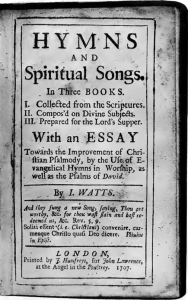
From a 1600’s hymnal

Mr. Watts finally suggested he turn complaining into composing and create better melodies and lyrics. Isaac did, and over the next fifty-plus years more than six hundred of his hymns were published.

Some people found fault with Isaac’s contemporary worship songs. But at least several prominent leaders supported him, including Samuel Johnson, Cotton Mather, and John Wesley [2].

Isaac Watts

Probably the best known of Watts’ hymns is “Joy to the World,” although Watts never set it to music. Decades later Lowell Mason felt inspired to do so and upon publication in 1848, the song soon became a beloved Christmas carol.

Some insist this hymn has no place in the carol-category, because Watts included no elements of the Christmas story in the lyrics.

But as Alyssa Poblete points out: This song celebrates what Christ came to do. And along with looking back at the grace accomplished in the past, we also look forward to the grace accomplished for our future, to the ultimate joy to be revealed [3].

That enlightenment helps explain that puzzling first line, “Joy to the world, the Lord is come” (emphasis added). I’ve often wondered why Watts didn’t choose “has come.”

Ms. Poblete gives us indication. God’s grace (explained in part by the acronym, God’s Riches at Christ’s Expense) is active in all of time—past, present, and future.

Our Messiah’s birth was long-promised for centuries. His coming ushered in a new kingdom of Light. Those who believe in Jesus gain release from the kingdom of darkness, and one day that evil kingdom will be utterly destroyed [4].

In addition:

Christ’s coming is an ever-present and ongoing engagement in the world.

–Darrow L. Miller [5]

The Lord didn’t just come. He is here! And we can sing with dazzling Christmas joy because:

  • One day the whole earth will receive her King. Therefore, let heaven and nature sing (v. 1) [6]
  • The Savior reigns forever and ever (v. 2) [7]
  • Sins and sorrows will be no more, when Christ returns (v. 3) [8]
  • He comes to make his blessings flow (v. 3) [9]
  • He rules the world with truth and grace (v. 4) [10]
  • The glories of his righteousness and the wonders of his love are on display everywhere (v. 4) [11]

These musicians capture well the dazzling joy of knowing our Savior reigns!

For the reasons listed above and more, Watts invites: “Let every heart prepare him room” (v. 1), and “Let men [all humanity] their songs employ” (v. 1)!

May we be just such people who sing with intention, from a place of authenticity [12].

In fact, take a moment right now if you can, and worship, celebrate, and sing with dazzling Christmas joy!

[1] Betty Dunn, https://www.powerofchange.org/blog/2011/12/16/isaac-watts-joy-to-the-world.html

[2] Erin Tabor, https://www.zmiinternational.org/daily-dose-of-encouragement/joy-to-the-world-the-lord-is-come  

[3] https://www.thegospelcoalition.org/article/joy-to-the-world-a classic-christmas-hymn-reconsidered/

[4] Isaiah 7:14 and 9:6; Colossians 1:14; Revelation 20:7-20.

[5] https://disciplenations.org/wp-content/uploads/202004/Music-that-Writes-Culture-Reflections-on-Joy-to-the-World.pdf

[6] Romans 8:19-23; Revelation 22:20; Psalm 96:1-4

[7] Revelation 11:15

[8] Revelation 21:4

[9] Psalm 5:12; 34:10b; 2 Peter 1:3

[10] John 1:14; Colossians 1:16-17

[11] Psalm 33:4; 145:17 31:21

[12]  https://passioncitychurch.com/article/joy-to-the-world/

Art & photo credits: http://www.justanotherclaypotblogspot.com 9/10/2008; http://www.boudewijnhuijgens.getarchive.net; http://www.jenikirbyhistory.getarchive.net; http://www.canva.com (2); youtube.com; http://www.pxhere.com and canva.com.

Processing…
Success! You're on the list.

Read Full Post »

b1bb02ee04f63726069baa4376903dc6


Isaac closed his eyes for a moment and pondered the scripture he had just read:


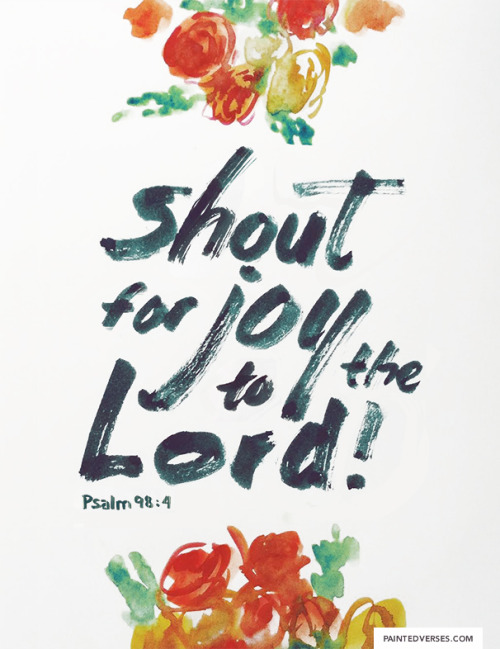
“Make a joyful noise unto the Lord,

all the earth:

Make a loud noise,

And rejoice, and sing praise.”

–Psalm 98:4 KJV


A poem began to take shape in his mind, and he picked up his quill to write.

Poetry came as naturally to Isaac Watts as regular conversation to others. Ever since he was a boy he’d taken great pleasure in rhyme and rhythm.

He also appreciated a heart-stirring tune, which is why, as a young man, he found the chanted church music of the day uninspiring and ponderous. At the urging of his father (also a nonconformist), young Isaac set out to write new hymns. In fact, he may have been among the first composers of contemporary Christian music—contemporary for the late 1600s, that is.

As could be expected, his first songs were rejected by some as unworthy for congregational singing. They even called Isaac a heretic because his lyrics were not direct quotes from scripture.  Despite the critics, however, his first volume of Hymns and Spiritual Songs was published in 1707.


page-of-watts-first-hymnal


Even today, some of his hymn-titles are familiar, including: “When I Survey the Wondrous Cross,” “We’re Marching to Zion,” and “At the Cross.” In all, Isaac Watts wrote more than six hundred hymns.

In 1716 Isaac was hired as an assistant to the minister of Mark Lane Independent Chapel in London, and less than three years later, became the minister. He worked tirelessly and creatively; the congregation grew.


220px-isaac_watts_from_npg


It was one day during that same year of 1719 Isaac chose to meditate on Psalm 98 and was particularly inspired by verse four (quoted above).

Perhaps Isaac pondered the “joyful noise” all the earth would make—if fields, hills, rocks, and plains joined mankind in praise of the Lord, the King. And the words began to flow:


DCF 1.0


“Joy to the world! The Lord is come!

Let earth receive her King:

Let every heart prepare Him room.

And heaven and nature sing.

Joy to the earth! The Savior reigns!

Let men their songs employ;

While fields and floods, rocks, hills and plains

Repeat the sounding joy.


The four-stanza poem was published in 1719—without benefit of tune.

More than one hundred years later in Boston, Massachusetts, Christian composer, Lowell Mason, was inspired to write an upbeat melody he titled, “Antioch.”


220px-lowell_mason


This tune needs to be sung, he thought. But finding lyrics with the correct rhythm and a suitable theme proved difficult. Not until three years later, in 1839, did Mason come across the perfect lyrics in Isaac Watt’s Modern Psalmist: “Joy to the World.”

Sing through the hymn and you’ll find no mention of Jesus’ birth—nothing about Mary, Joseph or Bethlehem, nothing about angels, shepherds, or wise men. So how did it become a traditional Christmas carol?

Perhaps pastors and music ministers began choosing the song because it celebrated the impact of Jesus’ birth—the advent of his Spirit to all who believe, and the final advent when Jesus will return to earth and begin his reign as King of kings.

When we sing this well-loved carol, we’re celebrating:

  • The past. “The Lord is come” (stanza one). Two thousand years ago Almighty God became flesh and lived among humanity, to win our hearts and transform our lives.


gerard_van_honthorst_001


  • The present. “The Savior reigns” within those of us who make room for him, filling our spirits with the joy of his presence (stanza two).


559c33b1b26c70d5d1dd68b5268fddae


  • The future. The day is coming when sin and sorrow will cease, God’s blessings will flow forever (stanza three), and he will “rule the world with truth and grace” (stanza four).


2650583dcc06214dc0bf560e8e0635c5


The “wonders of his love” (also from stanza four) include all these truths and more.


So…


tumblr_n50r3bpger1r7w67qo1_500


“Shout your praises to God, everybody!

Let loose and sing!”

–Psalm 98:4, MSG


JOY TO THE WORLD!


(Art & photo credits:  www.pinterest; http://www.yourworshiptools.com; http://www.wikipedia.org; http://www.pinterest; http://www.wikipedia.org (2); http://www.pinterest.com (2); http://www.tumbr.com.)


Read Full Post »

Still Traveling

Impressions Becoming Expressions

Living Our Days

Gaining a heart of wisdom

He Said What?!

I'm Patty, and my husband and I are living with our adult son who has autism and epilepsy. I love sharing lessons learned from life around me, especially life with Aaron.

Meditations of my Heart

Impressions Becoming Expressions

Linda Stoll

Impressions Becoming Expressions

Debby Thompson

Impressions Becoming Expressions

Signora Sheila

Notes on Life, Faith & Italy

Colleen Scheid

Writing, Acting, Living in God's Love

Mitch Teemley

The Power of Story

Heidi Viars

Finding the Image of God