Feeds:
Posts
Comments

Posts Tagged ‘Trust’

(An addendum to one of the stories in last week’s post:)

“John just called,” Steve informed me.  “He and his wife Peg will be in town on business this weekend, and want to visit the church on Sunday. What would you think of inviting them for dinner afterwards?”

‘Let me check with Mom—‘see if she can help,” I responded. “It would be nice to get acquainted with them ahead of our move.”

John served as chairman of the staff-parish relations committee for the new church Steve had been appointed to. In seven weeks we’d be moving from west coast to east coast in Florida, as determined a couple of months previously by those in charge. 

The visit in late-April was arranged and dinner planned. My dear mother helped with preparations, since we were already stretched quite thin with Steve’s church responsibilities, mine as an elementary teacher, our three kids, and packing already underway.

As some of you know, we lived in parsonages during Steve’s ministry. Until 2010 or so, these clergy-homes were also supposed to be furnished.

At the time of this move we lived in a lovely middle-class home that fit the current guidelines for parsonages.

This house (over 2000 square feet), included four bedrooms, and even a study. It leant itself well to holding meetings in the living room while the children could be in a separate family room.

Three years previously the church had purchased the house and some new furniture. This is the home that John and Peg saw, as we enjoyed getting acquainted with them.

John would tell us later he was struck by the contrast between our current home and the one we’d be moving into—with approximately 1200 square feet of living space and long-outdated furniture. 

Storage would be another problem, given the insufficient kitchen cabinets, small closets, the detached garage (where bugs and critters could create havoc), no attic, and of course no basement in Florida.

John knew the time had come to provide their pastor a home similar to what other professionals with three-year advanced degrees own, that met the scripture-directive of “double honor for those preaching and teaching” (1 Timothy 5:17).

But John had to wait for the committee to meet and funding to be appropriated.

Soon after John’s and Peg’s visit, Steve and I traveled across-state to tour their church and parsonage. That’s when we realized some of the challenges to come—in the deficient housing provided and in the church situation.

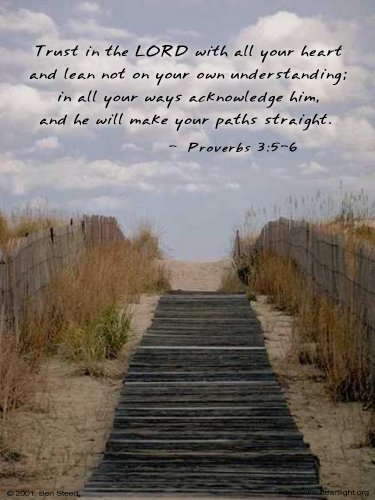
On the way home, we heard Jeremiah 29:11 quoted on the radio:  

Days later, a devotional suggested repeating “all the promises from God’s Word you can remember.” I determined to write in my journal as many as I could find that fit our circumstances. including:

I knew God would enable the five of us to thrive in the small house, or he’d provide another home. But I struggled with “what-ifs.”

Meanwhile, John rallied the staff-parish committee; they voted “yes” for a new parsonage. A week later, the administrative board passed a resolution to purchase a four-bedroom house and allocate funds for some new furniture.

Still to come: a church-wide vote, with the district superintendent presiding.

Of course, a few hiccups occurred. After one disappointment, I wrote: “We still have our promises from our never-failing God. . . I put my trust in You, Lord, by an act of my will, not by what I see happening! 

“You know our needs, you know what’s best for this church. Guide us into Your plan in Your timing, and give us wisdom and grace to accept whatever You have for us. We do want what you want!”

And I copied more scripture-promises.

In mid-June, the move into the small house went smoothly.

A week later the church-wide conference voted by a wide margin to relocate their parsonage. 

Mid-July our daughter and I flew to Austin, Texas to meet my newborn nephew. Steve called one evening to say a suitable house had been found, similar to our previous home but a bit smaller at 1800 square feet. The kids would love the pool. 

I trusted Steve’s appraisal, and agreed the church should make an offer.

As our children started school, we were settling into our new home—just two blocks down the street.
Image credits: http://www.dailyverses.net; http://www.canva.com (3).

Processing…
Success! You're on the list.

Read Full Post »

The place:  Spindletop, Texas.

A group of five investors formed the Gladys City Oil Company.  Sulphur springs in the area gave them great hope that black gold lay beneath the surface, especially since gas seepages in the area would ignite if lit.

Soon the area was dotted with holes–holes that produced nothing.  Two investors pulled out.

A geologist was brought in.  More investors were convinced to take the risk.

Nine long, unproductive years went by, and  still no oil. That’s 3,285 days of discouragement, disappointment, and exhausting labor.  Yet those men would not give up.

Finally, on January 10, 1901, their long-held dreams were realized.  At the depth of 1,139 feet, the company struck oil.  And it wasn’t just a gurgling flow.  The discovery at Spindletop gave new meaning to the term, “gusher.”  The oil shot over one hundred feet into the air, spewing enough to fill 100,000 barrels a day.  It took nine days to get the well under control.  No oil field in the world, up to that time, had been so productive.

Lucas_gusher

I wonder what those men said to each other each morning, over those 3,000-plus days of working, learning, waiting, and wondering?  Surely their conversations included some positive uplift, or they would have quit.  Perhaps they made such comments as:

  • “If we don’t find oil, at least we can say we gave the effort everything we’ve got.  If we quit before all possibilities are tried?   That‘s failure.”
  • “All the signs indicate there is oil.  We cant quit!
  • “Today might be the day!”

Just as oil is sometimes discovered by accident, so God’s blessings fall into our laps as glorious surprises. Other times,  God chooses to postpone a blessing while we dig our way through learning, working, waiting, and wondering–like the oil men of Spindletop, Texas.

How do we press on when circumstances look bleak, when common sense tells us to quit?

1.  Pray!  The key to knowing when to persevere and when to change direction is to spend time with God. Ask him to make clear what the next step is.  Most likely he will not reveal the whole plan at once.  He rarely works that way, because it eliminates the faith factor.  Our moment-by-moment trust in him is too crucial to the abundant living he desires for us.

2.  Believe!  Dozens of promises in scripture probably apply to your situation and mine. We can recite those promises–not as demands (“God, you said this, so I’m expecting you to do it.”) but as faith-builders. (“God, you said this, and I know with you all things are possible.”)

3.  Fight!  Fight against discouragement with plenty of encouragement.  God is very creative in the ways he brings hope to our spirits.  We must keep watching and listening!

A friend or even a stranger can speak uplifting words that resonate in our hearts.  Sometimes it’s as if God is speaking directly. One sign for me, that someone is speaking for God?  Goosebumps!  I can almost feel his light touch on my arm and his voice saying, “Pay attention to this, Nancy.”

Our God is a well of unending supply.  Whatever we need in this life, including wisdom, direction, and perseverance toward a goal, he will provide.  In fact, he will do whatever it takes for his praying, believing, fighting children to discover the oil of gladness, instead of mourning (over failure), a garment of praise instead of a spirit of despair.

That’s one way our loving, supportive Heavenly Father displays his splendor (Isaiah 61:3).

Steven Curtis Chapman Quote: “Out of these ashes beauty will rise.”

[https://quotefancy.com/quote/1129946/Steven-Curtis-Chapman-Out-of-these-ashes-beauty-will-rise]

(Revised and reblogged from February 13, 2014.)

Photo credits:  www.en.wikipedia.org; http://www.heartlight.org; http://www.quotefancy.com.

Read Full Post »

iStock_000013894567XSmall-300x199


“What traits should you look for when determining if someone is trustworthy?” asked the subtitle of a magazine article.

That question piqued my interest, and I read further.

According to the researcher, integrity is a crucial component, but there’s another trait that’s equally important: competence. The author gave the following scenario as an example: His best friend, Charlie, had proven himself completely reliable, but he wouldn’t want that friend performing an operation on him.  Charlie is not a surgeon.

So a trustworthy person is not only honest and fair, he is also competent for what you need him to do.

Those of us who know God have just such a friend.  Think of all we know from scripture about the character of our virtuous, competent God.  He is:

  • just, faithful, and upright (Deuteronomy 32:4).
  • righteous (Psalm 119:142) and holy (Leviticus 19:2).
  • wise (Daniel 2:20) and good (Psalm 106:1).
  • truthful (Psalm 31:5).

An  enlightened understanding of our trustworthy God should calm our fears and doubts, right?

But perhaps you’re like me—struggling a bit from time to time, asking questions like:

  • Lord, I know you have a plan, but when are you going to reveal it to me?
  • Why hasn’t Bill been healed? We’ve prayed so hard and for so long!
  • Dealing with Meredith day after day is sapping my strength, God.  When will the frustration end?

According to Philip Yancey, faith boils down to the matter of trust in the relationship. Do I have confidence in God or not? If I do stand on a bedrock of trust, the worst of circumstances will not destroy the relationship (Grace Notes, p. 198).

Vintage country


So how can I develop that strong bedrock of trust? Saturating myself in scriptures about the character of God, such as those listed above, is a good place to start. Another worthy study-pursuit: the promises of God, because…

…“God is not a man, that he should lie, nor a son of man that he should change his mind. Does he speak and then not act? Does he promise and not fulfill” (Numbers 23:19)?  No, of course not.

To truly impact my trust quotient, a change of habit is necessary–a habit such as: T-squared. Any time I find doubt or fear creeping at the edges of my thoughts, I want to Turn, Trust, and Thank. T x 3 includes:

  1. Turn away from thinking about the what-ifs, the negative, the hurtful.
  1. Express trust in God through song, prayer, and scripture. “Doubts are dismantled by declarations,” says my good blogger-friend, Jody Collins.*
  1. Thank God for his attributes that he’s bringing to bear on any negative situation.  Thank him also for every scripture-promise that applies.

I think I’ll try it right now.

*     *     *     *     *     *     *     *     *     *

psalm287-nlt1


Oh, Father, I praise you that you are strong, and protect like a shield.   My heart leaps for joy knowing you care for me and will help me. I praise you for surrounding me with your love, because I trust in you. All my life you have proved yourself trustworthy; why would I want to stop trusting you now? Oh, how I praise you that, as I keep my mind steadfast upon you, you will fill me with your peace. You are my trustworthy Rock—reliable and unchanging.      

(Psalm 28:7; 32:10b; 71:5-6; Isaiah 26:3-4)

 *Visit Jody’s blog at http://www.threewaylight.blogspot.com.


(Photo credits:  www.pixgood.com., http://www.katherinepasour.net., http://www.tyndalerewards.com.)

Read Full Post »