Feeds:
Posts
Comments

Archive for the ‘Bible Study’ Category

Jacob half-walked, half-jogged mile after mile toward Paddan Aram, to escape his furious brother, Esau. (You can read about the circumstances of Esau’s anger in Genesis 27-28.)

Finally, at sunset, Jacob had to stop and rest. In a grassy meadow surrounded by trees, he spotted a low, flat rock, perfect for a pillow. He folded his sash into a smooth bundle, to add a bit of softness under his head, then wrapped himself in his outer robe, and promptly fell asleep.

That may be the impression we’ve acquired from such art work as this:

jacob

The truth is, the area where Jacob rested that first night as a runaway, was far from pleasant. The landscape was scrubby, rocky, and desolate, which surely accentuated how very alone he was.

I doubt that Jacob rested comfortably or fell asleep quickly.   For all he knew, Esau was in hot pursuit. And though Jacob was headed to the ancestral home of his mother, it’s doubtful he’d ever met any of those relatives. What would they be like? How would he be treated? Between the uncomfortable “bed,” and the worrying and wondering, who could rest?

But Jacob had covered many miles that day. Exhaustion finally took over, and he slept—soundly enough to dream.

You know the story.  Jacob was witness to a glorious sight: angels of God, ascending and descending on a stairway that reached all the way to heaven.

At the top of the stairway stood God Almighty himself, proclaiming glorious promises to Jacob:

  • The land on which he lay would one day be his.
  • His descendants would be as numerous as the dust on the earth.
  • All the peoples of the earth would be blessed through Jacob and his offspring.
  • God would be with him to watch over him wherever he went.

Jacob awoke, astonished by his dream. Perhaps he was a bit disoriented by the darkness and desolation, when just a moment before he was surrounded by ethereal light, gazing at angels on a glowing staircase, and listening to the voice of God.

“The Lord is in this place!” he breathed.

Jacob took the stone pillow and stood it up on end as a pillar-reminder of the momentous occasion. And he renamed the location, Bethel, which means house of God (Genesis 28:10-19).

Jacob_set_up_stone_C-175

We may not be runaways like Jacob, forced to sleep in a wilderness. But we’ve all faced rough, rock-strewn places in life when:

  • Marriage is more disappointment than delight
  • The growing pains of our children become our pain too
  • Friends prove unfriendly
  • Circumstances turn our lives upside down
  • The day-to-day routine is unpleasant and boring

Amidst the desolation and darkness we forget:

God.  Is.  With.  Us.

And that is huge.

51RKiHO4XNL

“God’s presence with us is his greatest present to us” (Joanie Yoder).

The problem is, we’re often unaware just as Jacob was.

But we do have numerous assurances of God’s presence with us throughout scripture, and indications of what a sublime treasure that is:

  • Hundreds of promises in the Bible. (Jacob received only five that night at Bethel!)
  • All of God’s incredible attributes at work in and around us: his power, wisdom, loving kindness, and much more
  • His guidance, provision, protection, and empowerment–whether we currently see the evidence or not
  • His blessings, even in the desolate places of life

May we awaken to full awareness and the full meaning of his presence, because:

bestofallgodiswithus-wesley1

(Art credits:  www.keyway.ca; http://www.bibleencyclopedia.com; http://www.amazon.com; http://www.izquotes.com.)
Read Full Post »


From the backseat of my grandparents’ car, I strained to catch my first glimpse of the Smokey Mountains. The day before the three of us had left home in Aurora, Illinois and were on our way to Conyers, Georgia to visit friends of theirs.


hqdefault

(We traveled in style, in Grandpa’s 1950-something turquoise Studebaker.)


What an adventure for a six-year old.  Up until that time, I’d only visited one other state, neighboring Indiana.

Grandma had told me that mountains were like hills, only much, much taller. And instead of being a single mound (like the rise we sledded on in the wintertime), they were lined up one after another.

My imagination could hardly conjure a picture of such a phenomenon.

That second day of our trip, as we rounded the top of yet another hill in Tennessee, my straining paid off. Far in the distance we caught sight of mountain tops. Each rise thereafter afforded another spectacular view, always a bit closer to the peaks, and even more mesmerizing than the last. My breaths came in startled gasps. Never had I seen such magnificence…


smoky-mountains-in-the


Smokies-cades-cove


…until, at age fifteen, when I traveled to Colorado for a week at Young Life’s Frontier Ranch. The soaring, steep cliffs of the Rockies dwarfed the more rounded Smokies.


nevers12


Ah, but then came the semester-long, short-term missionary adventure in Quito, Ecuador, a city nestled in the Andes Mountains at 10,000 feet. Thirty miles to the south, Cotopaxi towers over the city, at 19,000 feet above sea level.  Again, my breath was taken away.


Quito volcanico141121g


“Mountains are earth’s undying monuments,” said Nathaniel Hawthorne.

Indeed, they do stand tribute to their Maker, ancient testimonials to God’s awe-inspiring, creative power.

They also provide a meaningful metaphor, because certain adjectives we use to describe mountains, also describe Him:


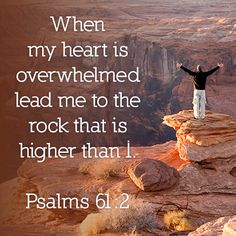
  • High

d10a87c019aedde4d2cd45602f98714f

(“Lead me to the rock that is higher than I.” — Psalm 61:2)

  • Firm

“God’s solid foundation

stands firm.”

–2 Timothy 2:19a

  • Strong


edee1af2af37a19a86f447ab0f87af17

(“O LORD God of Heaven’s Armies!

Where is there anyone as mighty as you, O LORD?

You are entirely faithful.” –Psalm 89:8, NLT)

  • Immoveable

“I the Lord do not change.”

–Malachi 3:6a

  • Eternal


43e033b5445c40029b82903ba9f3031d

(“The eternal God is your refuge.” — Deuteronomy 33:27a)


One of the psalmists, perhaps King Hezekiah, wrote:

“As the mountains surround Jerusalem,

so the Lord surrounds his people

both now and forevermore.”

–Psalm 125:2

(Emphasis added)


Imagine yourself surrounded by high, strong and secure mountains.

Are they likely to crumble? No. Neither will your Almighty God fall to pieces, succumbing to the pressure of insurmountable problems.  It can’t happen!

Do mountains change with every passing breeze? No.  Neither can your Lord be shaken.

Are you easily accessible when surrounded by mountains? No. You are protected. Mountains can even act as barriers against stormy weather. Similarly God shelters you from the full brunt of the storms of life.

And what is your view from this protected valley? Your eyes are drawn upward toward peaks and sky, indicative of the appropriate response when we’re facing difficulty:


Glacier_park1


Look up to the Maker of mountains

and Provider of refuge.

His righteousness is like the mighty mountains.

He surrounds us with his favor and loving kindness,

encircles us in his everlasting arms of love,

and guards us by his providence on all sides.

Hallelujah!

(Psalm 36:6; Psalm 32:10; Deuteronomy 33:27; Psalm 32:7).

(Art & photo credits:  www.youtube.com; http://www.tripadvisor.com; http://www.gatlinburg.com; http://www.mountainlake.com; http://www.cotopaxinoticias.com; http://www.pinterest.com (3), http://www.wikipedia.org.)

Read Full Post »

psalm-90-12-230-130

“Teach us to number our days,

that we may present to you

a heart of wisdom”

–Psalm 90:12 (NAS)


I did the math and numbered my days: over 24,000 so far. That means I’m well past the half-way point of the average earthly life. And such a sobering thought would surely weigh heavy on my mind, if I did not have heaven to look forward to.

But I’m certain Moses (the author of Psalm 90, above) wasn’t asking God for a multiplication lesson.

Perhaps in learning how to number his days Moses wanted to: 

  • make each day count by accomplishing worthwhile tasks, or
  • live mindfully so steady growth and learning took place, or
  • dedicate himself to the well-being of others, or
  • look for God throughout each day, worshiping and praising, or
  • revel in the positive instead of grovel in the negative.

Perhaps Moses was thinking of all those things.

According to two commentators, Numbering our days means:  1) living in such a way that each day has value, and 2) living intentionally in ways that bring glory to God and blessing to others.

Then notice what Moses indicates will happen when we live with those supreme purposes:

We’ll be able to present to God a heart of wisdom—a heart with “the ability to see life from God’s perspective, and then to know the best course of action to take” (p. 1055, Living Application Bible). 

That seems to me a lovely gift to present to my Heavenly Father—accepting his perspective and acting upon it.


Charles-Spurgeon-Quote-Wisdom


But learning to number our days and grow in wisdom are such abstract processes. It’s difficult to determine progress. So how might we know that we’re learning and growing? These ten questions may help; they’re based on the Book of Wisdom, Proverbs. Try answering in the context of the last ten—maybe even twenty—years:

  1. Am I more aware of God’s daily gifts and more grateful to him for these blessings (15:13)?
  2. Do my thoughts frequently turn to God during the day? Am I continually turning to him for guidance? (2:1-6)
  3. Do I express trust in God more often than worry about circumstances (3:5-6)?
  4. Am I pursuing biblical instruction (8:33-34a)?
  5. Do I take great pleasure in building up others (10:11)?
  6. Am I able to think before I speak (10:19b)?
  7. Do I give people the benefit of the doubt (19:11)?
  8. Am I becoming more patient and kind–especially toward challenging people (25:21-22)?
  9. Do I thoughtfully consider the advice of those who are knowledgeable and wise (19:20)?
  10. Am I able to do what’s right even when there’s no one around to notice (10:9)?


a0ea4e208506c36a35ddbfffcd0cd872


Scripture tells us that when Abraham died, he was “satisfied with life” (Genesis 25:8, NAS).  Surely satisfaction with life includes the development of a heart of wisdom, which Abraham demonstrated by his life of faith–in spite of challenges, disappointments, and uncertainties.

But the pinnacle of satisfaction must have been presenting that heart of wisdom to God Almighty on the day he entered heaven’s gates.

My prayer is that I’ll be able to do the same.

You, too?

“What we weave in time

is what we’ll wear in eternity.”

– Mart DeHaan


(Photo and art credits:  www.faithgateway.com; http://www.quotesgram.com; http://www.pinterest.com.)

Read Full Post »

5c1cdef89b871e8095f70ce44bf2c898

(“Thanks be to God for his indescribable gift!”

–2 Corinthians 9:15 NIV)

Consider.

Jesus, our Savior, is:

  • Incomparable – without equal or rival (Psalm 86:8)


85d81ac7ab8a0b3947d92604f1091b4f


  • Incomprehensible – beyond understanding or knowing; unfathomable (Romans 11:33)


Romans_11-33


  • Indescribable – exceeding description (Jeremiah 10:6-7)


image10

  • Indisputable — incontestable (Isaiah 40:13-14)


blogger-image-1447150886


  • Inestimable – of incalculable value (Psalm 145:3)


fbf41a5427ef67c257c65dc01af288ff


  • Inexhaustible – incapable of being used up or consumed or becoming tired (Revelation 1:8; Psalm 121:3)


d9d9e4567f79b10eb2ca1ee33f55e92d


  • Infallible – cannot fail or even make a mistake (Psalm 145:17)


f65a18471e84ba787378cce22761e36d


  • Invariable – never-changing (Hebrews 13:8)


1ac798f9a8c3556236c4b2b9561ce3e6


  • Invisible – John 1:18


98e17694c4978f1297c069388e500041


And those nine descriptors only begin to define Jesus. No matter how many fancy, multi-syllable words we might collect, the attributes of God’s Son are beyond full comprehension.  And he is God’s gift to us.

*     *     *     *     *     *     *     *     *     *

Oh, Jesus, how we thank you for giving up the splendor of heaven and the glory of your deity, to take on human form and become our Savior. How incomprehensible that you could love such pitiful creatures as mankind. Nevertheless you came so that we, too, could become God’s sons and daughters. Even more incredible, many of the descriptors above will be true of us—on that day when you appear again, and  We.  Shall.  Be.  Like.  You. 

(Philippians 2:6-7; John 3:16; Romans 8:29; 1 John 2:2)

(Art & photo credits:  www.pinterest.com; http://www.kingjamesbibleonline.org; http://www.thelovelyscribe.com; http://www.tgreatiam.blogspot.com; http://www.pinterest (5).


Read Full Post »

Hagar_Abraham


All alone she sat–a runaway–heart pounding with fear.

This was not the way she imagined events would unfold. Just weeks before opportunity had blossomed with possibilities–a life of security, provision, and honor seemed assured . But those dreams dissolved in a moment.

If only I’d kept my mouth shut, she thought. What a fool to think I could get away with those snide remarks. But my mind was consumed with the unfairness of it all, and I was so jealous—jealous that she would hold the place of honor, not me. To her I was nothing more than a vessel.

Fresh anger quieted her fear for a moment, as Hagar replayed the events that led her to sit by a spring in the desert, beside the road to Shur.

When Sarai, her mistress, had first suggested she become a substitute wife to Abram, Hagar foresaw a better life for herself. Surely the mother of the master’s son would hold a secure position in the household. She would be well provided for and respected by everyone.

But then the full meaning of “substitute wife” became clear. Hagar realized the child within her would not be her own but Sarai’s. Hagar began to express her frustration and jealousy toward Sarai in spiteful, unkind ways. She couldn’t seem to help herself.

Finally, Sarai hit her and Hagar ran.

Now what? Returning to Egypt seemed the only option. Her desperate hope was to find a home in need of a servant girl—even if she was pregnant.

Hagar shaded her eyes and peered down the road, willing a caravan to come along. If she attempted to cross the desert alone, it would mean certain death.

Instead of a caravan, however, a man approached. Little small talk ensued; he gave her an instruction (“Return to your mistress and do as she says.”); and he gave her a promise (“You will have a son, and descendants too numerous to count”).

It wasn’t until the stranger left that Hagar realized she had been visited by the angel of the Lord, and she named the place, Beer Lahai Roi, “Well of the Living One who sees me” (Genesis 16:1-14).

ElRoiGod2

Imagine. A servant girl in a foreign country, completely alone and pregnant. She herself had compounded her troubles. Yet God sought her out, to instruct and encourage her.

The Good Shepherd has always sought–and always will seek after–his lost sheep.

And then, with eyes of love, grace, and mercy, the Lord saw Hagar–

  • understanding every facet of her predicament, her motives and reactions
  • caring passionately about what would happen to her
  • mercifully forgiving her missteps and regretful behavior (Notice he didn’t say a word of reproach about her actions!)
  • giving instruction for what to do next
  • graciously providing for her needs
  • offering hope for her future

And still today, our God is the Living One who sees us with the same love, grace, and mercy.

quotpsalm-quot-by-cathywillett-redbubble-1414417436g8n4k

*     *     *     *     *     *     *     *     *     *

I praise you, Heavenly Father, that your eyes are upon the righteous—not because of any godly deeds we might accomplish, but because you see us through the righteousness of Jesus. And, oh how I thank you that you don’t just see us, you are watching over us. In these troubling, fear-inducing times, we turn our eyes upon you, our sovereign God, our refuge.

(Psalm 34:15; 2 Corinthians 5:21; Proverbs 15:3; Psalm 141:8)


(Photo & art credits:  www.christian-resources-today.com; http://www.assets.faithgateway.com; http://www.prayerpins.org.)


Read Full Post »

what-can-separate-us

“I am convinced that neither death nor life,

neither angels nor demons,

neither the present nor the future,

nor any powers,

neither height nor depth,

nor anything else in all creation,

will be able to separate us from the love of God

that is in Christ Jesus our Lord.”

–Romans 8:38-39

Consider the author of these lofty, poetic words: Paul—a man who endured beatings, stonings, shipwrecks, danger, sleepless nights, extreme hunger and thirst, and exposure to the elements (1).

Yet in spite of all these hardships, Paul never thought, Maybe God doesn’t love me anymore.  No, he was convinced otherwise.  And he wanted to assure his readers, including us today, that nothing can come between the believer and his/her God:

            “Neither death nor life…”

Every moment of our lives God is watching over us, working out his plans that will achieve the highest good. Sometimes that includes suffering, for reasons we don’t always understand.

But consider: the greatest tragedy of history, the cruel torture and death of God’s perfect Son on a cross, brought about the most glorious consequence–the eternal salvation of all who believe (2).

image.axd

And when we die? God will still be watching over us (3). Visit a dying Christian and you will be the one encouraged by their God-given peace, joy, and expectation.

“Neither angels nor demons…” 

Long ago, the rabbis believed some angels were grudgingly hostile to men, not wanting to share God with earthly creatures. Perhaps Paul was saying, “Even jealous angels can do nothing to separate us from God’s love” (William Barclay).

As for demons, they were defeated when Jesus died on the cross (4). Granted, they may prowl around and cause mischief, but they are powerless to sever us from God’s love. Their teeth were removed at Calvary!

colossians2_15

“Neither the present nor the future…”

 Sometimes we worry about the future. Will we be able to handle potential calamities down the road? Or, perhaps it’s the present that’s unbearable, and we wonder if better days will ever dawn.

But our omniscient God has never been surprised by any turn of events. What he says here (through Paul) is a guaranteed promise: nothing present or future—no circumstance–can separate us from his loving presence.

“Nor any powers…” 

All powers of the universe—whether physical or spiritual—are subject to God, because he alone is the Omnipotent One. No one supersedes him.

“Neither height nor depth…”

 Many in Paul’s day believed that the star a person was born under controlled that person’s destiny. Height referred to a star’s zenith; depth to the star’s lowest point in the sky. Paul may have been assuring his readers that the stars have no power over our lives.

By contrast, our Star of David, Jesus, is like the North Star. He never waxes and wanes; he never changes. And his love is present everywhere (5).

22b369c3e20ff6b9ced0597f35085cfb

            “Nor anything else in all creation…”  

No circumstance, no place, no person can remove us from God’s love. “God never loses his loving grip on his children” (Keith Krell, www.bible.org).

And so Paul covered every eventuality that might separate us from the love of God and assured us: It. Can’t. Happen. Surely, if Paul was convinced, after all he suffered, shouldn’t we be convinced as well?

*     *     *     *     *     *     *     *    *     *

Day after day, Father, you express your love to us: forgiving our sins, transforming our spirits, defending us from spiritual enemies, showering us with blessings. We praise you for the warm embrace of your love—a love that spans all time and space, overcomes all pain and suffering, and defeats every foe! “Because your love is better than life, [our] lips will glorify you” (6).

(1) 2 Corinthians 11:25-27

(2) John 3:16

(3) Psalm 23:4

(4) Colossians 2:15

(5) Psalm 139:7-10

(6) Psalm 63:3

Photo credit:  www.doughusen.com; http://www.klove.com; http://www.verseoftheday.com; http://www.pinterest.com.

Read Full Post »

john15-1

(“I am the true vine, and my Father is the vinedresser.” — John 15:1)

With that metaphor, Jesus began teaching his followers about living like branches and abiding in him, the vine.

No doubt the disciples readily pictured a vineyard and the vinedresser tending to his work. They would have been familiar with the tasks he performed to assure a maximum yield.

But today, most of us live far removed from the sources of our food and drink. We have little knowledge of what ranchers, farmers, or vinedressers do to assure a high quality product.

We’re left wondering as we read this verse, How is God like a vinedresser?

Here is what I discovered:

His/her main duties include caring for the vines, pest management, irrigation, pruning, and harvest.

granmonte-vineyard

Caring for the Vines

 Grapevines produce fruit for thirty to fifty years. Therefore the vinedresser comes to know each vine like a shepherd knows each sheep. He understands the special care each one requires and how to provide the best growing conditions, depending on the type of grape, the amount and direction of sunlight, the soil conditions, and more.

When branches grow long enough, the vinedresser lifts them up from the ground and gives them support so they can grow upward toward the sun. This practice also helps protect the vine from disease.

Vinedressers remove individual leaves to increase the amount of sunlight on the grapes and air circulation around the clusters, which improves the color and flavor of the crop. The vinedresser must know which leaves to remove, depending on the angle of the sun. Just the right number must be chosen also. If too many leaves are removed, the vine won’t be able to absorb enough sunlight for photosynthesis. If not enough are removed, the crop will fail to achieve optimum quality.

Pest Management

Weeds must be removed by hand or with a hoe. Contemporary vinedressers might be tempted to use a Weed-Eater, but it could easily damage the trunks of the vines. Insects and diseases must also be eradicated.

Irrigation 

Though grapevines can survive dry conditions, parched vines will not produce much fruit. Some experts recommend watering deeply and thoroughly so roots receive plenty of moisture.

 Pruning

Grapevines produce some branches that are barren and worthless. These must be pruned radically. In fact, “vines never produce to full capacity without drastic pruning” (William Barclay).

Harvest

The vinedresser knows the exact moment to harvest.  The grapes are plump, juicy, and rich in color. The skins are slightly transparent; the flavor a balance between sweet and tart.

6351f7348ecdc436db1fb43b7b900e5f


 Given even this scant information, we begin to appreciate God’s role of Vinedresser in our lives:

  • He knows each of us just as an attentive vinedresser knows his vines (Psalm 139:1-5).
  • He tends to us with vigilant, individualized care, providing circumstances, relationships and events that will create the best growing conditions for our souls (Titus 2:11-14).
  • He lifts us up, encouraging our development toward the Son (James 4:10).
  • As we submit to our Vinedresser, he eradicates the disease of sin (Psalm 103:3).
  • He provides streams of living water so we need not fear a year of drought. We can continually bear the fruit of the Spirit and good deeds (Jeremiah 17:8).
  • Like any wise vinedresser, he prunes with discipline, cutting away bad habits, erroneous beliefs, harmful influences, poor attitudes, pride, selfishness and more. He helps us become spiritually healthy as well as productive influences in the world (Hebrews 12:5-11).

And when we’ve reached maturity, our transparency allows the sweet, rich nature of Jesus to radiate from within us.

*     *     *     *     *   *     *     *     *     *

Thank you, Heavenly Vinedressser, for your careful attention and protection. I marvel that you created me for abundance—abundant pleasure in you, abundant fruitfulness for you. Help me to abide in you, Jesus, the Vine, and respond in obedience and trust, so that I might live for your glory–the glory of my splendorous Vinedresser.

(Photo credits:  www.carolinasnalc.org; http://www.tripadvisor.com; http://www.pinterest.com.)

Read Full Post »

(Steve and I are enjoying time with family this week.  I’ll return soon with  new posts.  Meanwhile, I’ll reblog previous ones.  Hopefully you’ll find them meaningful again, or perhaps for the first time.  The following post was first published November 14, 2013.)

(“The Lord make his face shine upon you and be gracious to you;  the Lord turn his face toward you and give you peace.”– Numbers 6:25-26)

Lovely, poetic words.  But what do those phrases about God’s  face mean?  Even if God’s face did shine upon me, or turn toward me, how would I know?  I’ve never seen God; no one has (1 John 4:12).

A little research turned up this explanation:   God’s face represents his character.

Read those verses from Numbers again.  But this time replace the word face with the word character.  The meaning becomes clearer.

The Lord make his character shine upon you

And be gracious to you;

The Lord turn his character toward you

And give you peace.

How many of God’s character traits can you name?  David named seven in a psalm of thanksgiving found in 1 Chronicles 16:8-34.  God is:

  • Powerful (v. 9)
  • Strong (v. 11)
  • Trustworthy (v. 15)
  • Majestic (v. 27)
  • Holy (v. 29)
  • Good (v. 34)
  • Loving (v. 34)

This brief list is just the beginning of descriptors we could name about God.  He is infinite; his attributes are infinite!

All of those character traits and more are shining upon our lives, as he cares for us, lives in us,and participates with us every moment of our lives.

  • His power works miracles.
  • His strength carries us through difficult times.
  • He can be trusted to always do what is best.
  • His supreme majesty speaks of his authority over the universe.
  • He is righteous and holy in all he does.
  • Out of his goodness he provides countless blessings.
  • And all of this is graciously given, not out of a sense of duty because he made us, but because he loves us.

God’s face shining upon us represents God’s radiance.

 If we insist on following our own way, as Israel did, he may choose to hide his face from us (Isaiah 1:15).

But.

“When a king’s face brightens, it means life; his favor is like a rain cloud in spring” (Proverbs 16:15).

When the King of the universe shines his favor upon us, what more could we want?  Life for us is not mere existence.  It is a rich, full life–rich with blessings, and full of satisfaction, peace, and joy!

*     *     *     *     *     *     *     *     *     *

Thank you, Almighty God, for manifesting your character in my life.  I have seen you work miracles and give strength to the weak.  I have watched as you engineered circumstances to accomplish your plan. (And it always turned out to be a hundred times better than anything I could dream up!)

 I marvel at your power and majesty on display in creation.  I have recorded hundreds of blessings you’ve provided for our family.  Your radiance shines brilliantly all around me. 

 And now, as a thank you gift back to you, dear Father, may my life reflect your radiance to others—with ever-increasing glory (2 Corinthians 3:18). 

*     *     *     *     *     *     *     *     *     *

How has God shone his face upon you?  Please share in the Comments below!

(art credit:  www.christianwordart.com)

Read Full Post »

When you say the name, Jesus, do images from his life flash to mind?  Images such as:


hqdefault

  • His healing hand gently touching a hideous leper, the lesions disappearing, fingers and toes miraculously being restored?  Do you see the love and joy on Jesus’ face as he watches the healed one, his eyes darting between arms and legs, elbows and knees, rejoicing that every inch of his skin glows with health (Matthew 11:5)?
  • Jesus standing in the bow of a lurching boat with arms raised, sleeves flapping in the whipping wind of a squall?  Do you hear his authoritative voice above the mayhem shouting, “Be still!”  Do you feel the boat stop pitching and rolling as the fearsome waves settle into calm ripples (Luke 8:22-25)?
  • Do you see Jesus leaning in, listening intently to the Samaritan woman at the well, eyes focused only on her, indicating genuine interest and tender compassion?  Do you sense his pleasure as she becomes a passionate believer (John 4:4-30)?
  • Do you breathe in the aroma of fresh bread and dried fish that permeated the hillside where 5,000 men (plus women and children) ate lunch one day, supplied by one boy’s meager fare–likely two small barley loaves and five sardines (Luke 9:10-17)?
  • Do you see Jesus reclining with his disciples at the Last Supper?  Do you hear the reverent tone of the ceremonial words?  Do you see the astonished expressions on the disciples’ faces, as Jesus changed the well-known ritual to speak of his body, his blood, and a betrayer among them?

Do you recognize the rich symbolism of his sacrifice-to-come in the elements of the meal?  1)  The unleavened matzah bread with its grill marks, reminding us of the stripes he bore on his back (Matthew 27:26).  2) The breaking of that bread, representing Jesus’ body broken for us (Matthew 26:26-28).   3) The lamb, symbolizing Jesus as the Lamb of God, sacrificed for our sakes that we might have eternal life (Romans 3:23-24).  4)  The third cup of wine during the Passover meal, called the cup of redemption, representing Jesus’ blood.**

Without our Jesus of gentleness, power, compassion, and sacrifice, we’d be reduced to lives of futility and fear.  Without our Jesus, we’d have no hope and promise of heaven’s ecstasy.

Every moment of his earthly life proved his perfection, his singular purpose, his love.

He is the sum total of all delights.

His name is:

music with which the bells of heaven sing;

a song in a word;

an ocean for comprehension,

although a drop of brevity;

a matchless oratorio in two syllables,

a gathering up of the hallelujahs of eternity

in five letters”

— Charles Spurgeon

    *     *     *     *     *     *     *     *     *

Precious Jesus, we praise you that the same attributes you demonstrated in Galilee and Judea so long ago are still at work among us today.  You are our faithful Rock, a Friend who never fails, a Shepherd who always attends.  May your name continually be on our lips!

**Jesus referred to his blood as the seal of a new covenant, a new promise.  By his death, the debt was paid–the one we owed because of our sin (Luke 22:20; Romans 3:23-25a).

(Photo credit:  http://www.youtube.com.)

Read Full Post »

The story of Cinderella always was my favorite fairy tale. The rags-to-riches, wrong-to-right, happily-ever-after story never grew old.

1437fdd92c98d193d310d64889316185


And that ball gown! How the illustrators of the various editions must have enjoyed creating the glory and splendor of that dress!

Rarely, if ever, are we common damsels provided opportunity to wear such grand finery. And I doubt many guys out there in the blogosphere have donned gold-braided jackets spangled with brightly colored medals. Such ostentation is almost exclusively reserved for royalty.

Ah! But whether we’re CEOs of the home front (stay-at-home parents) or CEOs of corporations, plumbers or painters, teachers or taxi drivers, we are priests of the Lord King of the universe.   And that designation makes us a royal priesthood:


81cbdeaa64193e714bde42f962d32d8a


(“You are a chosen people, a royal priesthood,

a holy nation, a people belonging to God,

that you may declare the praises of him

who called you out of darkness

into his wonderful light.”

–1 Peter 2:9)

Because we are his royal priesthood, God has provided a glorious new wardrobe for each of us, including:

  • Rich garments of salvation, replacing the sin-stained rags of our self-centeredness (1).
  • A robe of righteousness, radiant with the perfections of Jesus (2).
  • A belt of truth, studded with gems from God’s Word that inspire, instruct, encourage, and comfort (3).
  • Garments of praise, because he continually manifests his glorious attributes and showers us with blessings (4).
  • Ornaments of strength and joy (5).
  • A crown of beauty, as we allow the Holy Spirit to renew our minds and turn our thoughts to the positive (6).
  • Beautiful shoes of peace, equipping us to tread gently and share the peace of Jesus with others (7).

Note: None of this is earned, like the medals on Prince Charming’s uniform. Every radiant item has been magnanimously bestowed by our King.

Why would that be, we wonder. Is his purpose simply to display his generosity?

Surely that’s part of the answer. But the last half of 1 Peter 2:9 (above) reveals more: Now that we’re dressed in his garments of radiant splendor, we are commissioned to proclaim his excellency everywhere we go.


Two-women-talking-in-a-cafe-300x199


Sometimes we proclaim with words (Mark 16:15), as simple as “God is so good,” while sharing a story with a coworker.

Sometimes we proclaim with loving action (John 13:34-35), serving as a channel of blessing between God and others. That extra-generous tip to a waitress, for example, may pay eternal dividends  especially if she saw us praying before we ate, and we engaged her in friendly, upbeat conversation (about her).

Sometimes we proclaim with our attitudes—simply reflecting the radiance of Jesus’ peace and joy on our faces (2 Corinthians 3:18)—especially in difficult circumstances. Someone may very well ask, “I don’t know how you do it,” giving you opportunity to proclaim God’s excellencies and the blessings of living in his wonderful light—just as that verse in First Peter suggests.


sun-beams-through-forest-300x199


If our new wardrobe is on full display, people will notice.


“Let us put on the vestments of holiness

and minister before the Lord all day long.”

–Charles Spurgeon

Photo credits:  www.pinterest.com (2), http://www.icould.com; http://www.kingdomcalling.com.)

___________________________________________________________________

  1. Zechariah 3:4; Isaiah 61:10
  2. Isaiah 61:10
  3. Ephesians 6:14; 2 Timothy 3:16
  4. Isaiah 61:3
  5. Isaiah 49:18
  6. Isaiah 61:3; Romans 8:5; Philippians 4:8
  7. Isaiah 52:7; Ephesians 6:15; John 14:27


Read Full Post »

« Newer Posts - Older Posts »

When the House is Quiet

Impressions Becoming Expressions

Mitch Teemley

The Power of Story

Still Traveling

Impressions Becoming Expressions

Living Our Days

Gaining a heart of wisdom

He Said What?!

I'm Patty, and my husband and I are living with our adult son who has autism and epilepsy. I love sharing lessons learned from life around me, especially life with Aaron.

Meditations of my Heart

Impressions Becoming Expressions

Linda Stoll

Impressions Becoming Expressions

Signora Sheila

Notes on Life, Faith & Italy

Heidi Viars

Finding the Image of God