Feeds:
Posts
Comments

Archive for the ‘Godly Character’ Category

Last week, on April 22nd, I read the devotion, “Listen to Me Continually,” by Sarah Young (Jesus Calling, Integrity Publishers, 2004).

Did you happen to read it, too?


writing-fountain-pen-400


As you may know, Sarah determined a number of years ago to listen to God with pen in hand and write down whatever she believed he was saying to her. Those meditative moments became this book.

God’s messages through Sarah often speak timely challenges to me.  Last Thursday was no exception.

First, a bit of background.

As I write this, my to-do list is a bit long, even though I’m retired. (To those who are still employed or still have children at home under your charge, that sounds ridiculous, I know. But let me tell you, retirement does not change how busy you are, just what you are busy doing.)

Not only is that list of tasks long, but I have a strong desire to do a thorough job on each item. After all,


if-a-jobs-worth-doing-its-worth-doing-well-quote-1

(“If a task is worth doing, it is worth doing well.”)


Except that goal can easily lead to perfectionism, which I do have to fight against.

So here is what Sarah sensed Jesus telling her for April 22nd:

When Jesus died, he set us free. That includes freedom from compulsive planning.

And that’s exactly what I have been doing: figuring out when I could accomplish certain jobs, deciding whether a few tasks could be postponed, wondering if I’d be able to accomplish everything–on time.

Jesus continued; Sarah wrote more:

When we’re distracted by a whirlwind of thoughts, we cannot hear his voice.

 

bored-baby2


Oh, Lord, that is so true. Sometimes my thoughts are a stress-inducing jumble of “Stay on task! Don’t waste a minute! Don’t forget that! Do this first!” No wonder I feel overwhelmed.

Then Jesus and Sarah hit me between the eyes:

“A mind preoccupied with planning pays homage to the idol of control.”

Oh, my. I never thought of planning as a possible idol, something excessively adored.

But there is truth in that idea. I do prefer to be in control, to feel competent in handling my responsibilities, to know that everything will be accomplished efficiently and in a timely manner.

That sounds an awful lot like pride, doesn’t it.

I don’t think the problem lies in the planning, as if it’s a sin to make a to-do list.

The sin is in the attitude.  I need to ask myself:   Is my planning an effort toward making an impression? Rooting for compliments? Looking for a pat on the back?  I have to be honest.  Sometimes, yes.

Jesus reminded me (through Sarah) that my attention needs to be on him, not on the best ways to complete a task list. I need to listen to him, not the voices telling me to hurry to do this; scurry to do that.

And what will be the result? Stress will melt away, and I’ll enjoy the peaceful, God-enhanced, abundant life he’s promised.  I’ll be more useful to him and compliant to his will instead of mine.

That sounds much more satisfying and enjoyable, doesn’t it.

*     *     *     *     *     *     *     *     *     *

Heavenly Father, I am so sorry that I’ve allowed a preoccupation with planning to become an idol. Help me to hold very loosely the plans I make, in order to embrace the interruptions and changes ordained by you. Teach me also to release control of the to-do list to you.  Amen.

Photo credits:  www.imgbuddy.com; http://www.picturequotes.com; http://www.eastbabtlife.com.)

 

Read Full Post »


 Antiques-Roadshow


“Do you have any idea how much your painting is worth?” asks the antiques dealer.

“No, not really,” the owner answers.

“At auction, this portrait would probably bring…(a bit of a pause)…$5,000 or more.

The owner gasps. “And to think I only paid $25.00 at a garage sale!”

Scenes such as this are quite frequent on the popular TV program, Antiques Roadshow.  It’s astonishing how valuable some common-looking items turn out to be.  But I can’t help feeling a bit sad for the previous owners, who had no idea the worth of their possessions.

There are some folks who see little worth in the teachings of Jesus.  To their way of thinking, his world view and expectations seemed upside down and backwards.

For example, in the Sermon on the Mount, Jesus highlighted attributes that the world does not value, yet God considers of great worth.  Meekness would be a prime example.

Part of the problem lies in a common misunderstanding of the attribute. People think a meek person as weak-willed, passive, and too nice for her own good.

Such thinking is far from the truth.

1747489843_2066ef0122

Meekness includes:

  • Surrender to God
  • Trust and confidence in His ways and provision
  • Gentleness and humility with others
  • More concern for the interests of others than one’s own
  • Self-control, self-sacrifice, faith, patience, and forbearance
  • A gentle and soothing disposition

A weak-willed, passive person cannot demonstrate such traits.   Meekness requires strength of character; it is power under control.

 031311wildhorses_x

Imagine wild stallions running free across rolling hills.   Manes and tails undulate and flow in the wind, muscles strain beneath gleaming coats, hooves pound a rapid rhythm. Indeed, stallions in motion are a majestic sight. They exude power. But that power is useless to man unless it is harnessed and trained.

 9dcc98fa20ec776ed6380e492675c065

That’s the picture of meekness–strength under control. Strength to do the right thing at the right time. It’s not a human personality trait; it’s a super-human God trait. And the more we know his Son and abide in him, the more we’ll demonstrate meekness.

What might that look like, day-to-day? First, there would be no:

  • Mean-spirited sarcasm and rudeness
  • Arrogant behavior
  • Concern for prestige
  • Over-sensitivity or defensiveness


b5e664098ee28d482f1e253676a356e8


Instead, the beauty of meekness includes:

  • Quiet trusting in God to supply
  • Adherence to the Golden Rule
  • Love in action—caring, giving, helping
  • Gracious understanding and forgiveness

The world would be a different place if meekness were a more prevalent trait.

Some of you may recall the old tune, “Let There Be Peace on Earth.” Do you remember the next line? “And let it begin with me.”

Surely the same could be said for meekness. We can each be an example. As opportunities arise that require meekness, we can allow the Holy Spirit to fill us with his power, much as we fill our lungs with air. In fact, we can use that physical act of taking a deep breath as a reminder of “the breath of God” within us, providing everything we need for meekness: trust in God, self-control, compassion, kindness, and patience.

Meekness is so important to God, he included specific promises in scripture for those who demonstrate this trait:

c7f50f37de05f692e131e54ac399b328

  • “I hear the desires of the meek. I strengthen their hearts” (Psalm 10:17, RSV).
  • “The meek shall…be satisfied” (Psalm 22:26, ERV).
  • “The meek will he guide in justice; And the meek will he teach his way” (Psalm 25:9, ASV).
  • “The meek will…enjoy great peace” (Psalm 37:11).
  • “The Lord lifts up the meek” (Psalm 147:6a).
  • “The meek shall obtain fresh joy in the Lord (Isaiah 29:19a, RSV).

Strength, satisfaction, guidance, peace, uplift, and fresh joy. Valuable blessings, don’t you think?

Let’s seize the day in meekness. Let’s partake in the adventure of living our lives upside down and backwards, Jesus’ way!

We will NOT be disappointed in the results.

(Art & photo credits:  www.dealtrackersf.com; http://www.flickr.com; http://www.pinterest.com; http://www.kansas.com; http://www.pinterest.com;


Read Full Post »

tired_treadmill_workout_exercise_run


Nearly every morning I make myself exercise. I hate it.  All that huffing and puffing, and muscles crying out, “Stop! You’re hurting me!” Add to that the boredom factor.

What I do like are the results. My body feels strong. I can still hop up the stairs, lift our toddler granddaughter with relative ease, and get up from a squat without leverage.

I like the increased energy, and the elevated metabolism, too.

But one benefit I never considered until recently: improved balance.

When our muscles are strong, our bodies have an easier time maintaining balance. That means we can reduce the possibility of sprains, injured joints and back, or broken bones.

Three factors contribute to good balance: Stability, strength, and flexibility.

However, it’s not just our bodies that require those three factors. Our spirits need those same characteristics:

  • Stability to handle disappointment and frustration,
  • Strength to endure loss and pain,
  • Flexibility to manage unpleasant surprises.

But how do we create balance in the abstract world of our spirits?

Just as there are many exercises to improve physical balance, there are numerous strategies that contribute to spiritual balance. For example:

  1. Stability can be enhanced by spending time with stable people. Get in the middle of a Christian support group, and allow them to hold you up with their prayer, concern, encouragement, and counsel. Look for members who demonstrate spiritual maturity and follow their example. 

Stability also grows as we spend time in God’s Word. Just as daily physical exercise is important to the body, so is daily reading and contemplation of the Bible. God’s truths and promises, His encouragement and direction, all contribute to our steadfastness of faith.

  1. Strength can be developed through praise and gratitude. Look for the positive things in your life, and you’ll find yourself experiencing joy.  Joy fosters strength (Nehemiah 8:10).

Another strategy for building spiritual strength is to affirm God’s character.   He is sovereign, all-knowing, and all-powerful. Our Heavenly Father is trustworthy, good and loving. We can stand firm with such a God at our side and in the strength of his mighty power (Ephesians 6:10).

  1. Flexibility is needed when circumstances don’t meet our expectations. We have a choice when life takes a sudden turn down an unexpected pathway: 1) Fuss, fume, and balk or 2) Go with the flow and see where the pathway leads.

Kaye Arthur suggests: “Change the D of Disappointment to an H, and you have His Appointment.”* Such an attitude can relax the tension in our spirits, and prepare us to be flexible, to embrace the unknown.

Several years ago, I heard about an elderly resident of a senior citizen facility.  She was being transferred from the assisted-living apartments to the full-care center.

As the nurse wheeled her through the corridors, the senior saint said, “I just know I’m going to love it.”

The nurse exclaimed, “But Mrs. __________, how do you know? You’ve never seen the full-care section.”

The woman’s profound answer: “I’ve already decided I’m going to love it.”

Such an example of:

Stability—maintaining her emotional equilibrium in spite of circumstances.

Strength—determining ahead of time to look for the positive.

Flexibility—going with the flow to see where the pathway might lead.

Surely, such an attitude reflects trust in a gracious and powerful God, knowledge and application of God’s Word, and a positive attitude of contentment (Philippians 4:11).

If the spiritual stability, strength, and flexibility demonstrated by that elderly woman were transferred into physical traits, she’d be able to balance on one toe.  With her eyes closed.

I want to be like that woman in my spirit.

*     *     *     *     *     *     *     *     *     *

What strategies help you maintain spiritual balance?  Please add your experience and insight to the conversation below!


*His Imprint, My Expression, by Kay Arthur, p. 96.

Photo credit:  www.sparkpeople.com.


Read Full Post »


6a00e54f0d380188340133f2ef50d4970b 

One of the delights of grand-parenting is recapturing the joys of childhood. In the name of entertaining the little ones, we get to return to such fun activities as drawing with crayons, molding Play-Doh, and building with blocks.

Little eyes watch in wonder as we sketch a flower, create a clay nest of eggs, or fashion a tall tower. It doesn’t take much to wow the little tykes.

Just the other day I demonstrated for our toddler granddaughter the first rule of constructing block skyscrapers: A solid, level foundation is a must. Without that strong base, the tower will lean and fall.

For centuries, the success of constructing real buildings depended on one foundation stone in particular: the chief cornerstone. Without the sophisticated tools of today, stone masons had to be certain that first stone was level and its corners squared accurately. The rest of construction conformed to that one stone. If the cornerstone was faulty in any way, the building would lean and fall.

The chief cornerstone also carried the weight of the structure. If laid properly, the weight of the building was evenly distributed and the structure remained sound.

Scripture tells us that Jesus is our cornerstone. God said,

“See, I lay a stone in Zion, a tested stone, a precious cornerstone for a sure foundation; the one who trusts will never be dismayed” (Isaiah 28:16).

Oh, my. So much good news in one short verse!

The “stone in Zion” is Jesus, our Rock (1 Corinthians 10:4), who has been tested for two thousand years. Billions of believers over the centuries have found him to be a trustworthy Savior, Shepherd, Friend, Prince of Peace, Teacher, and more.

Jesus is our precious cornerstone—highly valuable to us who believe in him. Think of the excellency of his character and his perfect, holy life. Think of his position. God exalted him to the highest place and gave him the name that is above every other name in the universe (Philippians 2:9). Think of the myriad ways he blesses, guides, comforts, and strengthens us, his followers.

He is also our sure foundation—strong and reliable. In his divine power he gives us everything we need for life. We can depend on his great and precious promises (1 Peter 1:5).

Those who trust in him will never be dismayed; their lives will not topple and fall into ruin. However, commitment to obedience is crucial. If I’m not following his blueprint for life, as provided in the Bible, I’m not demonstrating trust.  (Still working on that!)

Also important to understand: God’s architectural plan does not end with the placement of the chief cornerstone, his Son, in our individual lives. Each of us who believe in Jesus are like a stone or brick in the building of the Church universal.

The truth is, individual bricks by themselves are practically useless. They must be mortared together to realize their full potential. As Christians, we, too, must come together as the Church to realize our full destiny.

We become more significant, not less, as we gather to pray, encourage one another to lead godly lives, work together, and share with others the good news about Jesus.

We also become stronger, able to withstand storms and hardships because the stress from such forces is distributed over numerous bricks. We carry one another’s burdens.

Even better, we have a strong, sure foundation in Jesus. He is more than sufficient to carry the weight of our cares. On him rests the Spirit of power, which he dispenses on our behalf (Isaiah 11:2; Philippians 4:13).

*     *     *     *     *     *    *     *     *     *

Thank you, Father, for the wonderful, rock-solid saints you have brought into my life over the years, shining examples of living stones, spiritually well-hewn, and set apart for your service. I’m thinking of family members, pastors, Sunday School teachers, youth leaders, Bible study teachers, mentors, authors, friends. Countless saints have helped, encouraged, and challenged me to become a living stone for you also.

And oh, Lord Jesus, how I praise you for the sure foundation you provide in my life. When a storm of worry begins to stir, you offer reassurance of your power and strength. When I’m ready to topple from a multitude of cares, you uphold me. When fear wants to consume me, you soothe me with your Word. Over and over, with calm stability, you have steadied me. You are my foundational Rock.

(1 Peter 1:5; Isaiah 28:16; Matthew 6:25-26; 1 Peter 5:7; Isaiah 26:3; Psalm 18:31)

Photo credit:  www.amberdusik.com.

Read Full Post »

DSCN3147


No Christmas season would be complete without the reading of the second chapter of Luke—the account of Mary and Joseph traveling to Bethlehem, presiding over the birth of Jesus in a stable or cave, and receiving shepherd-guests.

Toward the end of the account, as those shepherds were spreading the word of Jesus’ birth, Luke wrote, “Mary treasured up all these things and pondered them in her heart” (v. 19).

Indeed. She had much to process:

  • Her baby was the Messiah, the Promised One, who would save his people from their sin. I wonder if she studied him, looking for signs that he was different from other infants.
  • This was the Prince of Peace cradled in her arms. Yet he had been born to a common village girl in very primitive conditions.  Did that seem strange to her?
  • The shepherds had learned of his birth when angels visited them, just as the angel, Gabriel, had visited Mary and then Joseph.  Gabriel had also visited Zechariah, the father of John the Baptist. Four angel visitations in a matter of months. Never had that happened before.

I find myself pondering, too—pondering Mary herself–this dear, young girl who carried a tremendous burden for a long time.

Dear means beloved and valued. Mary is certainly that for numerous reasons.

  • She embraced Gabriel’s announcement with great faith. “May it be to me as you have said,” (Luke 1:38). She put herself in the care of God in spite of incomprehensible circumstances.
  • Her prayer, the Magnificat (Luke 1:46-55), gives indication of a heart fully committed to God.
  • She endured much: shame for her pregnancy, a long, uncomfortable journey to Bethlehem, and crude circumstances for the birth of her Son.

Mary was young—perhaps between thirteen and fifteen years of age. That was the typical age for a girl to be married in Bible times.

Yet, young as Mary was, Gabriel praised her for being “endued with grace” (v. 28, AMP). In addition, Mary demonstrated stamina, maturity, and gentleness beyond her years, in dire circumstances. No doubt God graced her with these traits. But I have to believe Mary also had freedom of choice, as we all do, to embrace God’s way for her.

But what I ponder most about Mary is the fact she carried a tremendous burden, given to her by an elderly man, Simeon, eight days after Jesus was born.

You undoubtedly remember the story. Joseph and Mary took Jesus to the temple at Jerusalem to be circumcised. There they met the righteous and devout Simeon who had been waiting decades for the Messiah. The Holy Spirit had revealed to him he would not die until he had seen the Lord Christ.

Immediately upon seeing the child, Simeon knew this was the One. He praised God for keeping his promise, blessed Mary and Joseph, and then spoke particularly to Mary, saying Jesus would cause some to rise and some to fall, and the thoughts of many hearts would be revealed.

Simeon’s last words must have caused Mary’s eyes to grow wide and her heart to skip a beat: “And a sword will pierce your own soul too” (Luke 2:21-35).

What?! Wasn’t the worst behind her? Surely Mary wanted to ask Simeon, “What do you mean?” Scripture gives us no indication that she did so. Perhaps Simeon walked away, leaving the stunned couple to stand speechless there in the temple court.

For thirty-three years those last words of Simeon must have echoed in Mary’s mind again and again. How does a person live with such long-term foreboding? Perhaps her mind turned back to the night of Gabriel’s visitation. Perhaps, for thirty-three years, Mary repeated what she had told the archangel: “I am the Lord’s servant. May it be to me as you have said” (1:38).

Mary may very well have developed the calm assurance that even when God’s ways are baffling, we can rest assured he is orchestrating events to accomplish far more than we could ever imagine (Ephesians 3:20). She had been witness to such orchestration in Bethlehem.

Mary knew that even our personal hardships can fulfill purposes that extend far beyond ourselves.

That’s a lesson for all of us to embrace with calm assurance.


(Art credit:  www.seekerville.blogspot.com.)

Read Full Post »


Mayflower_compact


They had been at sea for sixty-six days, enduring overcrowded conditions. Storms had caused damage to their ship and sea sickness plagued them all– passengers and crew alike. Meager provisions and no heat on chilly autumn days caused further discomfort.

So on November 9, 1620, when they finally saw the coastline of North America in the distance, the Pilgrims and others aboard the Mayflower must have cheered enthusiastically. Soon they could abandon the cramped, cold, and fetid ship and begin new lives in a new world.

But. All had not been peaceful and congenial among the passengers during the crossing. And when it became apparent the storms had blown them too far off course to land in the Virginia Colony as planned, relations deteriorated further.

Not all of the travelers were Pilgrims. Also aboard were merchants, craftsmen, skilled workers, and indentured servants. The Pilgrims called them “strangers.”

No sooner had the decision been made to anchor off Cape Cod, than an argument ensued. Several of the “strangers” pointed out that, since they were not going to be under the jurisdiction of the Virginia Company, they would “use their own libertie” and do as they pleased. “None had the power to command them, they said.” (Quoted words are from William Bradford’s records. He served as historian for the Pilgrims.)

To avoid anarchy, five men gathered in the cabin of the ship to create a basis for law and order. The result of their efforts: the Mayflower Compact.

The first words of the document give strong indication of the Pilgrims’ hearts.

In the name of God, Amen.

“Everything they did started with God” (The Founders’ Bible, p. 187).

Next, the Pilgrims stated their purpose for coming to America.

We, whose names are underwritten,…by the grace of God,…having undertaken for the glory of God, and advancement of the Christian faith, and honor of our King and country…

Several phrases indicate the Pilgrims’ desires for their new colony:

  • “For the glory of God” would be a guide for all manner of decisions.
  • “Advancement of the Christian faith” would encourage them to remain strong in Christian faith among themselves and to introduce others to Jesus.
  • “Honor of our King and country” indicates their loyalty to native England and its monarch, in spite of his untoward actions that caused their flight to America in the first place.

…[We] do solemnly and mutually in the presence God and of one another, covenant and combine ourselves together into a civil body politic…

The Mayflower Compact expressed their commitment to live together in a civil manner, in the sight of God.

[We] will enact…such just and equal laws, ordinances, acts, constitutions, and offices, from time to time, as shall be thought most meet and convenient for the general good of the colony, unto which we promise all due submission and obedience.” 

Note:  there is no mention of a leader who would oversee the colony. The Pilgrims created a democratic, representative form of government, in covenant with one another, rather than by a monarchy or dictatorship.

It was the first document of its kind in the history of the world.

But the Mayflower Compact would only be as good as the commitment of Pilgrims and Strangers alike to abide by its guidelines.

Would the mutinous Strangers sign?

John Carver, church deacon and one of the organizers of the voyage, was the first to affix his signature. Other Pilgrims followed.

One book says there was a long pause. Then Captain Myles Standish stepped forward to sign. Standish had been hired by the Pilgrims to be their military captain; he was with them, but not one of them.

Soon other Strangers followed Standish’s example.  In total, forty-one signatures appeared on the document. One freeman, two hired men and seven servants declined.

At long last, Pilgrims, Strangers, and crew were able to disembark. And what did they choose to do first?

Pray.

According to Bradford, they “blessed the God of heaven, who had brought them over the fast and furious ocean..and a sea of troubles before.” Then he quoted scripture:

“Let them therefore praise the Lord, because He is good and His mercies endure forever.” (Psalm 106:1).


*     *     *     *     *     *     *     *     *     *


We, too, praise you, Lord, for your goodness and mercy upon America all these years.  As we celebrate Thanksgiving on Thursday, may we remember the solemn history behind this occasion.  Thank you for the supreme example and sacrifice of our Pilgrim forefathers–strong in faith, commitment, and perseverance.  May we follow their example, not only because you are faithful to the faithful (2 Samuel 22:26), but out of appreciation for what you, our loving God, have already done.


(Sources:  By These Words by Paul M. Angle; The Founders’ Bible; The Intellectual Devotional:  American History by David S. Kidder & Noah D. Oppenheim; The Rebirth of America;  http://www.learningtogive.org; http://www.humanities360.com; http://www.crf-usa.org; http://www.americanhistory.about.com; http://www.tparents.org; http://www.mrkash.com; http://www.mayflowerhistory.com; http://www.plimoth.org.)


Art credit:  www.washingtonmayflower.org.  


Read Full Post »

“Who has known the mind of the Lord?” Paul asked (1 Corinthians 2:16).

That’s an easy question to answer: Nobody! His intellect and wisdom are far beyond our human ability to comprehend.

After all…

God has worked out the complexities of every living cell–with perfect precision.


yeast-front

(X-ray microscopy combine to picture interior of living cell)


He has engineered a staggering number of specialized plants and creatures, carefully interrelated in a web of reliance upon one another.


wshedcrosscut2


He has created the unfathomable reaches of the universe filled with countless heavenly bodies of immeasurable proportions.


hs-2007-41-a-small_web

(Spiral Galaxy M74)


Such intellect and wisdom to accomplish these feats is incredible.

Yet, at the end of that same verse above, Paul makes a statement even more astounding. In fact, at first glance it seems ludicrous.


Unknown

 “We have the mind of Christ.”


What? How is that possible? His knowledge and wisdom are infinite; ours is markedly limited.

But Paul makes clear:  we have the mind of Christ because he lives within us (Galatians 2:20).


Galatians-21


Not that we can know everything and respond with pure wisdom in all situations. Our perfection is a process that won’t be completed until Jesus returns (Philippians 1:6).

But my heart beats a little bit faster to realize that, each day and for all my tomorrows, I might think more like Jesus, understand more like Jesus, and react more like Jesus.

One particular action will encourage progress: spending time with him, especially in his Word.


Young woman reading bible


Here’s an analogy, though far from perfect. Steve and I have been married a very long time—forty-four years.  At this point, we can finish each other’s sentences, supply missing information or words in a conversation, and sometimes even know what the other is thinking.

It’s as if we’ve acquired a bit of the other person’s mind. And it’s happened bit by bit, over time.

So I repeat: We will have the mind of Christ as we spend time with him day by day– especially in his Word.

And how will we know that his way of thinking is becoming our way of thinking? After all, there’s no measuring stick for spiritual growth.


tapemeasure


Oswald Chambers, in My Utmost for His Highest, posed an excellent question that can help us determine our progress:

“Are other people beginning to see God in my life more and more (p. 78)?” Because a person with the mind of Christ will demonstrate Christ-like behavior.

Perhaps we could take an occasional inventory, based on the fruit of the Spirit (Galatians 5:22-23). The attributes listed in these two verses characterize a person with the mind of Christ–someone who is loving, joyful, peace-filled, patient, kind, good, and so on.  We could ask ourselves, how have I demonstrated these attributes this week?

And what will be the result of cultivating the mind of Christ? “The mind controlled by the Spirit is life and peace” (Romans 8:6).


Romans8_6


Life that is characterized by vitality and purpose.

Peace that includes inner-contentment, freedom from guilt, and security for eternity.

That sounds awfully good to me.

*     *     *     *     *     *     *     *     *     *

Heavenly Father, we praise you for taking us into the high places of blessing in Jesus. That includes this gift: the mind of Christ. And day by day you are transforming us into his likeness, with ever-increasing glory. May I seize this day and its opportunities to think like you, understand like you, and react like you.  

(Ephesians 1:3; 2 Corinthians 3:18)


Art and photo credits:  www.lbl.gov; http://www.chesapeakebay.net; http://www.hubblesite.org; http://www.crosspointenwa.com; http://www.pinterest.com; http://www.changingthefaceof christianity.com; http://www.footsoldier4christ.com; http://www.motivationalquotes.com.


Read Full Post »

mri-scanner


My brother had to get an MRI last week. The technician warned him the machine was very loud—similar to a large motorcycle.

“I like motorcycles!” John told her.

Nevertheless she gave him earplugs, to block the noise as much as possible, and a set of headphones, through which he could listen to the music of his choice.

Earplugs and headphones. That’s what I need to drown out the devil’s loud voice.   Sometimes he can be incredibly persistent with his irritating chatter in my spiritual ears, saying things like:

  • “You are past your prime. Why bother trying to accomplish anything?”
  • “Look how blessed your neighbor is. You must have upset God in some way or you’d be blessed like that, too.”
  • “Can you believe how insensitive Ms. __________ is? How can she be so hurtful and not even realize it?

Wouldn’t it be nice if God handed out earplugs and headphones for our spiritual ears?

Maybe God wants us to develop some worthy habits in the process of manufacturing our own auditory devices.

And how might we do that?

Earplugs could be fashioned out of gratitude. We can occupy our minds with continual rejoicing in the blessings of this moment. Then we won’t be able to hear the devil’s negative and critical comments.

Let’s see…I wonder if I could name a blessing for each of the five senses, for what I am experiencing right now?

  • Thank you, Lord, for books and the gift of sight that allows me to read and enjoy them, as well as learn from them.
  • Thank you for soft breezes that create a cheerful rustling of fall leaves.
  • Thank you, Father, for the cozy warmth of my fleece jacket.
  • Thank you for the nutty goodness of hazelnut coffee,
  • And thank you, Lord, for the homey aroma of vanilla, coming from a nearby candle.


candleflame


Oh! That was fun, and I didn’t have one negative thought during the exercise. No wonder Paul told us to rejoice always.

Alright–earplugs are in place. Now it’s time for the headphones—something worthwhile to pay attention to, that drowns out the noise of negativity and criticism.

And what could be more worthwhile than scripture, where God offers reassurance, encouragement, and strength? The psalms are a perfect place to begin:

  • “Blessed is the man who makes the Lord his trust” (Psalm 40:4).
  • “I will sing of your strength, in the morning I will sing of your love; for you are my fortress, my refuge in times of trouble” (Psalm 59:16).
  • “Your ways, O God, are holy. What god is so great as our God? You are the God who performs miracles; you display your power among the peoples” (Psalm 77:13-14).

And one of my favorites:


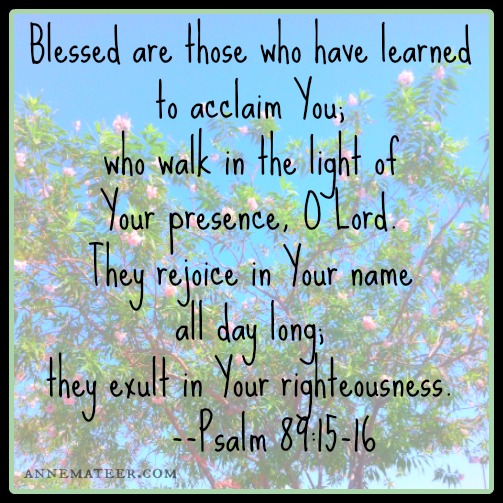
Ps.89.15.16


(“Blessed are those who have learned to acclaim you, who walk in the light of your presence, O Lord. They rejoice in your name all day long; they exult in your righteousness. For you are their glory and strength” (Psalm 89:15-17).)

Notice: We are blessed when we acclaim God. Disparaging ourselves or others, bemoaning our circumstances—even just in our thought life—is counter-productive.  It is worship that transforms our minds and spirits.

So let’s insert those earplugs and pop on those headphones! The difference will be remarkable.


(Photo and art credits:  www.cancerresearchuk.org; http://www.cozyhearthcandles.com; annemateer.com.)


Read Full Post »

DSC_7445-X3 (My mom & dad with their great-granddaughter, Sophie, 2011)


“What we leave behind

is not what is engraved in stone monuments,

but what is woven into the lives of others.”

— Pericles (495-429, B.C.  Greek statesman, orator, and general of Athens)

I love that word, woven. It speaks eloquently of the way my mother, Geraldine Claire  (November 5, 1928-October 9, 2014), influenced my life. Woven into the fabric of my being are memories of Mom’s words and example that still have impact to this day.

Many of those memories involve Mom and Dad because they were such an inseparable team. They even wallpapered together.

Now marriage experts will tell you that completing home improvement projects with your spouse can be detrimental to your relationship. But that was not the case for Mom and Dad. Amidst the measuring, pasting, and hanging, my brother, John, and I saw cooperation and patience in action.

Once the wallpaper was hung in the three homes of our growing-up years, Mom was ready to entertain. Hospitality was definitely one of her gifts. In fact, the last dining room table Mother and Dad purchased could seat fourteen people.

Mom became adept at organizing large gatherings by writing lists, doing everything she could ahead of time, even labeling the serving ware so each item on the menu would have an appropriate bowl or plate. Little did I know then how often I’d be following her routine and recipes, as Steve and I began to entertain.

Mom’s legacy included wise advice. One time I was heartsick over a low report card grade in math—my most challenging subject. She quickly gave me perspective for the tragedy, saying, “Just remember: this grade will not matter in ten years.”  And, of course, she was right.

Countless times over the years as disappointments and difficulties have occurred, I’ve heard Mother’s voice reminding me to consider events with a ten-year perspective.

But that doesn’t mean she accepted excuses. Instead, Mom fostered independence and personal responsibility .

I’m remembering the Sunday School Christmas program from second grade. My part was to recite six verses from Luke, chapter two, about the angel visitation to the shepherds. “This is too much to memorize,” I complained.

Mother replied calmly, “Well, just tell Mr. Faircloth that you can’t manage it, and he’ll ask someone else.”

Mom did not take control of the situation; she left it up to me to decide what course of action to take. Wise mother, indeed.

But perhaps the most astounding aspect of her legacy is the way she exhibited all features of the fruit of the Spirit, listed in Galatians 5:22-23.

For example:

LOVE — Mom lavished love on family, friends, and stranger alike. She could strike up a conversation with anyone, and was always ready with a warm hug.

JOY — Mother was a woman of gladness. She laughed easily and often.

PEACE — Mom and Dad created a peaceful, secure home for John and me.

PATIENCE — She exercised great patience, especially when dealing with my fluctuating moods of early adolescence.

KINDNESS — Mother demonstrated kindness in many ways.  I remember one house where the old wallpaper was in process of removal when Mom and Dad took in a missionary who needed a place to stay.  We have home movies of  that missionary, Miss Hunt, standing in front of  the glue-encrusted plaster.  Another time when a different missionary family stayed with us, Mom did all their laundry while they attended to other affairs.

GOODNESS — Mother’s goodness was also expressed in numerous ways.  In my mind’s eye, I can still see Mom at her desk at Scripture Press, where she was executive secretary to the Vice President of Editorial.  (The visualization is easy to conjure; I sat directly across from Mom, most of my seven summers as an editorial assistant.)  Frequently people stopped by her desk to share a need and ask for advice.  We used to tease her about being the psychologist of Scripture Press!   

FAITHFULNESS — Mother’s faithfulnesss to God never wavered for the seventy-five earthly years she knew Jesus as her Savior and Lord.

GENTLENESS — While John and I were growing up, Mom could be plenty firm with us.  Yet, when we were sick, hurt or experiencing trouble, she readily soothed us with comfort and hugs.

SELF-CONTROL — I have to admit:  I provided Mom and Dad with plenty of parenting challenges.  And though Mom did become angry sometimes, she never lost her temper with me.

For these reasons and so many more, John and I “arise and call her blessed” (Proverbs 31:28).  Mother did indeed weave godly integrity, wisdom, and faith into our lives.

Read Full Post »

autumn5

“The land is lit with autumn blaze.”

–Helen Hunt Jackson (1830-1885)

I’ve been anticipating these few weeks of October ever since we moved back to the Midwest in June—the gilding on tree-covered hillsides, the crimson coats on sumac trees, and, of course, the swaths of gold and vermilion among the maples.

The trees appear dressed for a grand party!

Indeed, autumn was the season I missed most during our forty years in Florida.

So Friday afternoon I sat on our second-story deck, to observe more closely the magnificent display in our back yard. You see, a shallow woods stands sentry between the houses on our street and the houses behind us. Among the tree-fellows, chestnut, elm, oak, and others stretch their colorful arms heavenward.

But already the trees are beginning to lose their leaves.

Elm leaves somersault while they plummet, flashing sparks of sunlight from their luminous topsides.

Oak leaves drift downward, gracefully zigzagging side to side.

But whether they tumble or drift, the leaves of all deciduous trees will eventually fall, having fulfilled their purpose: photosynthesizing light, absorbing carbon dioxide and releasing oxygen.

As human beings, we, too, have purpose to our existence: to live for the praise of God’s glory (Ephesians 1:11).  What an honor is ours, to inspire others to give praise to the King of the universe.

And how might we do that?

  1. Reflect God’s character, like the elm leaves flashing in the sunlight. Wherever we are, whatever we’re doing, we can shine as lights (Matthew 5:14)–offering assistance or a listening ear, being a positive voice and example, exercising self-control and patience.
  1. Give praise to God at every opportunity. As tree leaves fall, the lacey branches are exposed, all reaching upward toward the sunlight. Our hearts should be raised toward the Light of Life, the Son of God.

df352dd4289de9df98adedcc47361a1a

(“My lips will glorify you.  I will praise you as long as I live,  and in your name I will lift up my hands” — Psalm 63:3-4)

We can:

  • Praise him in the morning for the opportunities of the day ahead.
  • Praise him in the afternoon for the blessings and accomplishments already enjoyed.
  • Praise him in the evening for his guidance and care throughout the day, his strength for the challenges, and the blessing of rest yet to come.
  1. Be content (Philippians 4:11).  God has blessed us with every spiritual blessing in Christ (Ephesians 1:3).  Begin to name those blessings and note how your heart begins to swell with elation–blessings like:
  • relief of forgiveness
  • liberation from guilt
  • assurance of hope
  • confidence of access to his presence
  • certainty of eternal life.

(How long might the list grow if we continued?)

Just as autumn blazes around us, may our hearts blaze to live for the praise of God’s glory!

(Photo credits:  www.galleryhip.com; http://www.media-cache-akO.pinimg.com.)

Read Full Post »

« Newer Posts - Older Posts »

When the House is Quiet

Impressions Becoming Expressions

Mitch Teemley

The Power of Story

Still Traveling

Impressions Becoming Expressions

Living Our Days

Gaining a heart of wisdom

He Said What?!

I'm Patty, and my husband and I are living with our adult son who has autism and epilepsy. I love sharing lessons learned from life around me, especially life with Aaron.

Meditations of my Heart

Impressions Becoming Expressions

Linda Stoll

Impressions Becoming Expressions

Signora Sheila

Notes on Life, Faith & Italy

Heidi Viars

Finding the Image of God