Feeds:
Posts
Comments

Archive for the ‘Godly Character’ Category

eaab14ad79f81660b93f3032488a12eddc3a7b6e

Granville Sharp

(b. November 10, 1735)

Never had thirty-year old Granville Sharp seen such injuries: large swellings about the neck and head, gaping wounds, and a face hideously swollen, streaked with trails of dried blood.

The victim: Jonathan Strong, a young slave who’d been pistol-whipped by his master and left to die on the streets of London, 1765. Somehow Jonathan made his way to the house of Granville’s brother, William, a doctor. And there he sat, waiting in line outside William’s office, when Granville stopped by the house.

quote-the-boy-seemed-ready-to-die-he-almost-lost-the-use-of-his-legs-and-feet-and-to-compleat-his-granville-sharp-266227

The encounter would change Granville’s life forever.

His heart went out to the slave; they became acquainted. Jonathan’s story horrified Granville. To make matters worse, when Jonathan recovered, the master demanded he be returned. Granville determined to help Jonathan, even though he’d “never opened a law-book except the Bible in [his] life” (1).

Those defending the slave owner were evidently intimidated by the case Granville put forth. After a two-year legal battle, they never brought Jonathan’s case to trial.

7149324-Granville_Sharp_1769_Liverpool

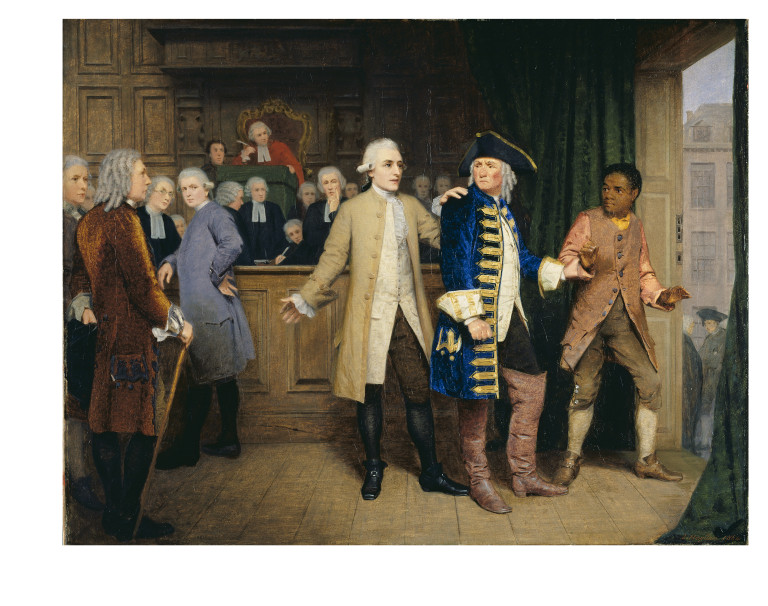
Sharp helped other slaves win their cases against tyrant owners, becoming more and more involved in the abolition of slavery. One case in particular, that of James Somerset, helped to set an important precedent in England.

Somerset had escaped his master, been recaptured, and was about to be shipped to a Jamaican plantation when Granville and others became involved.  They helped the slave win his freedom, arguing that “no master ever was allowed here (in England) to take a slave by force to be sold abroad because he deserted his service…therefore the man must be discharged” (2).
2006BB2012

Granville remained active in the abolition movement his entire life. He wrote frequent letters to many leaders in America and Britain, influencing their thinking about slavery and earning their respect. Among them: Dr. Benjamin Rush (signer of the Declaration), John Jay (first Chief Justice of the U.S. Supreme Court), Benjamin Franklin, and John Adams in America; John Wesley, William Wilberforce, the Archbishop of Canterbury in England; and General Lafayette of France.

But that was only one of his passionate pursuits. Another concern was the illegal treatment of the colonists in America. He published books and pamphlets to help their cause, catching the attention of Ben Franklin during one of his visits to England.

Granville gave Mr. Franklin 250 copies of his pamphlet about people’s natural rights as supported by the British constitution. Franklin sent them to America where several presses reprinted the booklet.

Sharp’s pamphlet influenced Thomas Jefferson as he drafted the Declaration of Independence, evidenced by at least several similarities in both documents.

In 1775, when war broke out in the colonies Granville was employed in the ordnance office (handling all matters concerning weaponry). He wanted nothing to do with the war, so he wrote to his employer: “I cannot return to my ordnance duty whilst a bloody war is carried on, unjustly as I conceive, against my fellow-subjects” (3).

Granville’s brothers agreed to support him, enabling him to pursue his studies, causes, and writing. In fact, beginning with his first book in 1765, Sharp published a new work, sometimes more than one, almost annually for the rest of his life (5).

sharp-title-page-Cropped-543x465

One of those books (with a thirty-six word title!) is now known as “Sharp’s rule” (1777). With his self-taught knowledge of ancient Greek, Granville demonstrated how eight passages of the New Testament had been mistranslated by some Bible scholars, leaving the reader to surmise that God the Father and God the Son were separate Beings. Sharp presented a thorough explanation that God the Father, Son, and Holy Spirit are One, according to the original Greek texts (4).

our-hope-the-appearing-of-jesus-christ-16-638

Yet Granville accomplished still more. In the mid-1780s, Sharp teamed with a Mr. Smeathman to establish a colony for freed English slaves on the west coast of Africa. (Many of them were homeless, subsisting on the streets of London with no hope of improving their lives.) But Smeathman died shortly after he and Granville established their partnership. Sharp continued the work nevertheless.

In April of 1787, the dream for that African colony became a reality with the founding of Sierra Leone. The colonists named the first settlement, Granvilletown.

220px-Province_of_Freedom

Sharp accomplished even more, as he served on a number of boards and societies, in support of mission efforts and philanthropic concerns.

Yet he did not see the fulfillment of his greatest dream—the abolition of slavery. The battle he began with the case of Jonathan Strong in 1765 finally ended in 1833, when slavery was completely abolished in the British Empire.

Sharp died in 1813.

Granville_Sharp's_tomb_inscription

His chief biographer, Prince Hoare, said that as he began to study Sharp he intended to “draw a veil over peculiarities of Mr. Sharp’s character,” out of respect for the dead. But when he finished his careful and comprehensive research, he realized Sharp’s “character to be of that high and dignified nature, to leave no necessity for such a precaution…I see nothing to veil.” (6).

Like many other forgotten heroes, Granville Sharp is among that great cloud of witnesses who fixed their eyes on Jesus and ran the race marked out for them (Hebrews 12:1-2a).

May his example and that of others–their faith, integrity, perseverance, and passion–push us along in the race marked for us.

______________________________

  1. history.ac.uk
  2. national.archives.gov.uk
  3. Dr. Daniel Wallace, www.bible.org
  4. christianity.com
  5. brycchancarey.com
  6. Dr. Daniel Wallace, http://www.bible.org

(Art & photo credits:  www.bbc.co.uk; izquotes.com; http://www.virtualtourist.com; http://www.collections.vam.ac.uk; http://www.wikipedia.org; http://www.liverpoolmuseums.org.uk; http://www.slideshare.net; http://www.en.wikipedia.org; )


Read Full Post »

12-27-11iStock_000018316152

Years ago I read a story that still comes to mind now and then.

As I recall, an older church member–a woman of very high standards which she vocalized frequently–came to visit a young mother of the church unannounced.

The impromptu hostess—we’ll call her Beth—invited Mrs. Perfect into her home, grateful that she’d straightened up a bit after her two older children left for school. The two younger ones were playing quietly with new Legos (How fortunate was that?), allowing the two women to chat.

kitchen-after-counter-1

As they sat at the kitchen table, Beth considered the room from her guest’s perspective: table cleared, dishes done, counters not too cluttered or spotted. Whew.

Then she saw it: an orange peel on the floor—not a fresh strip from breakfast; more likely from last week. How did I miss that? Beth thought. One thing for sure: Mrs. Perfect wouldn’t miss it. It was in plain view from where she sat too.

Suddenly Beth experienced an epiphany. What difference did it make to her if this poor, old woman noticed the orange peel? Mrs. Perfect, however, would leave with a spring in her step because she would never allow such filth to remain undetected on her floor.

And Beth smiled to herself as the other woman prattled on about the upcoming bazaar.   I hope that orange peel makes her day. And Beth truly meant it.

God brings that story to my mind because I have to fight against perfectionism too.

Obsessive man laying on grass, perfection

And the reasons? So others will be pleased with me, appreciate me, and admire my efforts. Notice: me, me, my.

Clearly perfectionism is a close relative of self-centeredness.  Oh, Lord, forgive me.

I pray God steers me away from such counter-productive expectations of myself. Instead I want to strive for excellence.

Yes, there is a difference between perfection and excellence.

Perfectionists have the tendency to:

  • Set unreasonably high standards
  • Experience satisfaction only when those high standards are met
  • Become depressed over failures and disappointments
  • Be controlled by fear of failure and therefore procrastinate
  • Worry about disapproval when mistakes are made

On the other hand, those striving for excellence are likely to:

  • Set standards that are high but reachable
  • Enjoy the process as well as the outcome
  • Recover quickly from failures and disappointments
  • Keep fear under control with positive truth
  • View mistakes as opportunities for growth

c398dcb781f29c5f0c3e1946d50a4422

For the Christian, excellence should be our loving response to God with the desire to please him.

And what might those responses look like, as we strive for excellence?

  • Ask God to reveal his expectations. Then invite him to work toward meeting his standard:  maturity (James 1:4).
  • Take pleasure in signs of spiritual growth, as we manifest the fruit of the Spirit more and more each day (Philippians 1:9-11).
  • Turn to him for encouragement and strength when failures and disappointments come (Psalm 18:25-33).
  • Keep fear under control with appropriate scriptures and uplifting devotionals (Psalm 118:5-8).
  • View mistakes as opportunities to grow in maturity and in our relationship with God (Proverbs 24:16).

6f8af2878da632fd3fcbfe0e23c9a750

By the way, when the Bible tells us to be perfect (as in Matthew 5:48), the words mature and complete are helpful synonyms to interpose. Perfection is not within our abilities to achieve (Romans 3:23). We know it and God knows it.

Here’s what we can do:

“Strive toward holiness, yet relax in grace.”

–Philip Yancey


Isn’t that a wonderfully balanced goal?

Let’s remember: “Christ has set us free to live a free life. So take your stand! Never again let anyone [including ourselves] put a harness of slavery [to perfectionism] on you.” – Galatians 5:1 (MSG)*

*Words in brackets added.

Photo credits:  www.deeprootsathome.com; http://www.femhack.com; http://www.worshipmatters.com; http://www.pinterest.com (2).

What are your thoughts about perfectionism and Christian excellence?  Share your comments below!

Read Full Post »

3571053_orig

(Remember Susan Boyle?)


Makeovers. What a remarkable change-of-appearance can be achieved with a becoming hairstyle (and maybe color-enhancement!), deftly applied make-up, and well-fitted clothing.  Add the benefit of plastic surgery and a person hardly resembles her former self.

But the transformation of someone’s face and body doesn’t begin to compare to the transformation of someone’s spirit.


tumblr_m8s31eBVQU1qbwmglo1_1280


Anyone who belongs to Christ has become a new person.

The old life is gone; a new life has begun!

–2 Corinthians 5:17 (NLT) 


Notice: We’re not just improved and beautified. Jesus remakes each of us into a brand new person.

And what might that newness include? Here’s a partial list:


  • New purpose


357191882884919061_1401068073

(“Whatever you do, do it all for the glory of God.”

–1 Corinthians 10:31b)


Those who follow this directive discover an interesting phenomenon: honoring God brings satisfaction and fulfillment to us. (By the way, God is not on some ego trip, demanding us to give him all the glory. He desires his splendor and benevolence to be evident everywhere, so others might be drawn to him.)


  • New attitude resulting in new character


 e2


(“Put on your new nature and be renewed

As you learn to know your Creator and become like him.”

–Colossians 3:10)


The more we know of God and appreciate all his benefits, the more we want to please him by following his example. That new attitude impacts every aspect of our lives.


  • New perspective


Psalm-23-6

(“Surely goodness and love will follow me all the days of my life.”

–Psalm 23:6)


Just knowing God has our best interest at heart is enough to renew energy and hope.


  • New power to face what comes


d7d8bc8fd004fe850361444ecf5acb49

(“[He] is able to do immeasurably more than all we ask or imagine,

according to his power that is at work within us.”

–Ephesians 3:20)


Think of it: the same power that controls the universe is at work within us. Tell me again why we revert to worrying?!


  • New emotions, such as peace and joy


coffee-cupverses7-28-638

(“The kingdom of God is not a matter of eating and drinking,

but of righteousness, peace, and joy in the Holy Spirit.”

–Romans 14:17)


We do not need to live at the mercy of our circumstances. With God as our constant companion, we can experience peace and joy in spite of what happens. The Bible is full of examples of people who lived that way: Joseph, Daniel, Peter, and Paul readily come to mind.


  • New confidence

Proverbs 3.26 

(“The Lord will be your confidence.”

–Proverbs 3:26a)


God is not only with us, he is our Protector, Provider, and Guide.  As we become increasingly aware of his faithfulness, our trust grows. Trust = confidence.


  • New opportunities and blessings


ef03f9e29f19624eaa836b41accd6d80

(“The faithful love of the LORD never ends!

His mercies never cease. Great is his faithfulness;

his mercies begin afresh each morning.”

–Lamentations 3:22-23 (NLT)


Experience tells us that when we say “yes” to Jesus, God does not bestow the full measure of all of these wonderful new things instantaneously. God told Isaiah: “Behold I am doing a new thing” (Isaiah 43:19).  That hints at process. We’re made new, but growing into that newness.


843ae42db665b78c33102645c1850579


Think of buying a coat in the fall that’s a little too big for your child. She owns the coat, but it doesn’t quite fit yet.  Within a matter of weeks however, the sleeves hit the wrist not the fingertips, and the shoulder seams sit properly–no sagging down the arms.

Might it be that when we invite Jesus in our lives, our spirits are made new, but we don’t quite fit into them yet? Then, as we cooperate with Holy Spirit and his fruit grows within us (Galatians 5:22-23), we steadily become more Christ-like, day by day.

*     *     *     *     *     *     *     *     *     *

Oh, Father, I don’t want to cling to aspects of the old me—things like worry, perfectionism, selfishness, and pride. I want to embrace everything new that YOU bring to my life, to become my true self—the one you designed me to be.**


**Based on idea from Jesus Calling by Sarah Young, Thomas Nelson, p. 381.

Photo credits:  www.joblogging.weebly.com; http://www.ilovemybible.tumblr.com; http://www.pinterest.com; http://www.dayofgrace.me; http://www.faithgateway.com; http://www.pinterest.com; http://www.slideshare.net; http://www.plus.google.com; pinterest.com (2).

Share your thoughts in the comment section below.  I’d love to hear from you!

Read Full Post »

(In honor of the beginning of another school year)

Have you ever tackled a long-term project that lasted five or ten years? How about twenty years?

And as part of that undertaking, did you learn twenty-eight languages?

Few if any of us could answer yes to those questions. But at least one person of history could: Noah Webster (1758-1843).

MTIwNjA4NjM0MDA4MDc3ODM2

Webster was a student at Yale during the Revolution. But he left school twice to fight in battle. Upon graduation he became an attorney and a schoolteacher. It was the latter position that prompted him to write textbooks for many disciplines, including: spelling, grammar, history, geography, government, agriculture, economics, meteorology, medicine, zoology, and morality. (Whew!) He earned the title, “Schoolmaster of America”, as a result of advancing education in the fledgling country.

And then, of course, there is his iconic dictionary, the project that took twenty years to complete. As part of his research for that volume, he learned the twenty-eight languages mentioned above, including Anglo-Saxon and Sanskrit. Webster also traveled to England and France in order to access ancient works in their libraries that were not available in America.

Once completed, Webster’s American Dictionary of the English Language contained 70,000 words. Not only were the etymology, pronunciations, and definitions included for every word, he added a sample sentence of how each word should be properly used.   Many of his examples came from the Bible.

100260

Webster also dedicated the work to God: “To that great and benevolent Being…who has sustained me…and given me strength and resolution.”

As if all those textbooks and a meticulously researched dictionary weren’t enough for one lifetime, Noah tackled yet another project, a modern-language Bible. This volume he was able to complete in just five years, taking advantage of all he had learned about words while developing the dictionary.

webster-bible-large

Why did Webster feel another translation of the Bible was warranted? He explained in the preface to his Common Version of the Holy Bible (1833):


“The Bible is the chief moral cause of all that is good and the best

corrector of all that is evil in human society—the best book for

regulating the temporal concerns of men and the only book that

can serve as an infallible guide to future felicity [happiness].”


No doubt there are many who would refute those remarks by saying, “That’s just one man’s opinion.”

But when, for example, the Ten Commandments and the Golden Rule are applied, who can argue that society does not benefit?

Noah Webster also credited Christian principles for the civil liberties enjoyed in the world:

“Almost all the civil liberty now enjoyed in the world owes its

origin to the principles of the Christian religion…the religion

which has introduced civil liberty is the religion of Christ and

His apostles, which enjoins humility, piety, and benevolence;

which acknowledges in every person a brother, or a sister, and

a citizen with equal rights. This is genuine Christianity, and to

this we owe our free constitutions of government.”

(from Webster’s History of the United States, 1832)


Again, can it be argued that a religion which encourages humility, piety, benevolence, fairness and equality is bad for society?

It is for these reasons Webster believed that a Christian education was beneficial:

Any system of education…which limits instruction to the arts

and sciences and rejects the aids of religion in forming the

characters of citizens, is essentially defective. In my view, the

Christian religion is the most important and one of the first

things in which all children under a free government ought

to be instructed.”

(from a letter to David McClure, October 25, 1836)


Webster also gave this advice to civic students which is appropriate for every citizen:

When you become entitled to exercise the right of voting for

pubic officers, let it be impressed on your mind that God

commands you to choose for rulers just men who will rule in

the fear of God (Exodus 18:21).

6b1a5bea871620ef2ae6b214ce090c98 

If the citizens neglect their duty and place unprincipled men

in office, the government will soon be corrupted; laws will be

made not for the public good so much as for selfish or local

purposes; corrupt or incompetent men will be appointed to

execute the laws; the public revenues will be squandered on

unworthy men; the rights of the citizens will be violated or

disregarded. 

(from The History of the United States, “Advice to the Young”)

 As we begin the countdown to Election Day, 2016, I find Noah Webster’s advice to be just as applicable today as it was then.

(Art & photo credits:  www.biography.com; http://www.wikipedia.org; http://www.baumanrarebook.com; http://www.buzzquotes.com.)

Read Full Post »

happy-friendship-day-syquotable

“A friend is someone who

reaches for your hand,

but touches your heart.”

–Kathleen Grove

Yesterday was Friendship Day, an annual observance on the first Sunday of August.  It’s a day that doesn’t get much press, even though most folks would agree that good friends are one of life’s greatest gifts.

Steve and I have been blessed over the years with many good friends whose company we greatly enjoy. We’ve shared experiences and meals, laughter and tears. We’ve celebrated each other’s joys and supported one another through challenges.

These folks have touched our hearts by exemplifying God-enhanced friendship that’s rooted in a commitment to him first of all, and scripture-principles like the following.

Kindness (1 Thessalonians 5:15)

G. and A. are two of the most thoughtful, giving people you’ll ever meet. Just one small example of their thoughtfulness: when they accompanied the youth of our church to glean corn for an inner city ministry, they’d always stop at our house on the way home to drop off a dozen ears or so.

Honor (Romans 12:10)

We were new in town when C.S. befriended me. For our first get-together, she planned a Girls’ Day Out, taking me for a walk in a forest preserve and then treating me to lunch.

Concern (1 Corinthians 12:25)

One winter Steve and I were both sidelined by illness at the same time. B.H. made us a divine chicken soup. Seriously—the angels of heaven would be hard-pressed to improve on her recipe!

Help (1 Corinthians 12:26)

M.K. was one of few who knew about a difficult situation in my life. She suggested we do a Bible study together—just the two of us. Her prayerful support was invaluable.

Encouragement (Romans 15:2)

All of you who read this blog and leave your comments create such uplift for my spirit. Thank you!

Prayer (Ephesians 6:18)

N.S. has faithfully prayed for us for years. She provided faithful support during Steve’s forty years of ministry, and no doubt continues to pray for us still.

Faithfulness (Proverbs 18:24)

Some friends come and go for a season. Some friendships last a very long time. M. and L. belong in the latter category—faithful friends for over thirty years. Along with their loyalty, they’ve expressed all the traits mentioned above and below as well.

We’ve also been blessed with three children who have become friends as they’ve reached adulthood. Traits of Christian friendship are evident in their lives, too.

Cooperation (1 Corinthians 3:9)

The summer before his senior year of high school, our younger son, Jeremy, and I taught Vacation Bible School together. One of the other teachers commented on how well we worked as a team. That was to Jeremy’s credit—his willingness to be collaborative, not combative (like some teens that age).

Support (Galatians 6:2)

Our daughter, Heather, joined me in Austin, TX when my mother suffered a stroke. Her sweet presence was a comfort, her help, priceless.

Goodness (Ephesians 4:32)

Our older son, Eric, oversaw the renovations to our current home while Steve completed his last year of ministry 900+ miles away. No one could have paid more attention to detail.

Commitment (1 Corinthians 13:7-8)

My best friend is Steve, who has loved, cared, helped, and given for forty-five years. Through his consistent, ongoing determination, he has made our home a place of joy and contentment.

These dear friends and many more have indeed touched my heart, day by day, year after year.

“I awoke this morning with

devout thanksgiving for my friends,

the old and the new.

Shall I not call God the Beautiful,

who daily showeth Himself so to me

with His gifts?”

–Ralph Waldo Emerson

Surely you, too, treasure friends who demonstrate certain admirable traits. Tell us about them in the comments below!

(Photo credit:  www.sayquotable.com.)

Read Full Post »

89211a5ee0ee45323b75c828d833bbb6


In one scene of What’s Up Doc? (an old screwball comedy from 1972, starring Barbra Streisand and Ryan O’Neal), a hotel concierge wants the gruff house detective to stop a particular woman from leaving the hotel.

“And how am I supposed to do that?” inquires the detective with much sarcasm.

“Use your charm,” replies the concierge.

So when the woman enters the lobby and heads for the doors, the detective…

…trips the unsuspecting victim, causing her to sprawl in a most unladylike fashion on the floor.

Charming indeed.

I dare say some folks are just about as clueless as that detective when it comes to such an illusive quality as charm. Just what is it that makes a person charming?

One important quality, for sure, is respect.

And it happens to be a biblical concept:

“Show proper respect to everyone.”

(1 Peter 2:17)

M-m-m. Everyone. Not just the people at church on a Sunday morning, or at the meeting with the boss on Monday—but with family, and those with whom we have little in common, and even those we don’t particularly like.

But how do we demonstrate such over-arching respect?

Here are ten possibilities. (And while you’re reading, consider:  Which of these strategies, when administered to you, have made you feel especially respected?)

  1. Politeness – even at home. Be on the alert for rudeness, sarcasm, and inconsiderate comments or behavior. Even family members deserve to be treated politely. Make home a haven of kindness.
  1. Tact.  Perhaps your mother was like mine, offering the frequent reminder, “THINK before you speak.” It was wise advice.

think_T

  1. Gratitude.  Never let an opportunity pass by to say “thank you” for the least of favors or the smallest of gifts. Try to be a person who notices.
  1. Thoughtfulness — demonstrates that you value the other person. Let the Golden Rule be your guide.
  1. Compliments — especially in the hearing of others. Plant a lot of positive input into the people around you, and make their souls blossom.

56f7958a5053fef8b1e517686af11ee8

  1. Focused Listening—with eyes as well as ears. Even if you can recite his last sentence word for word, but your eyes were on the door, on the kids, or on a screen (as in TV, computer, iPhone, etc.) he will assume you’re not interested.
  1. Reliability.  Keep promises and commitments; be on time for appointments or engagements. Consideration of these matters indicates you truly care about the other person.

Respect also requires that we avoid certain behaviors:

  1. Avoid comparisons to others. Suggesting that Jake be more like Zeke is deflating and demoralizing, not helpful.
  1. Avoid criticism unless absolutely necessary. Share judgments carefully, sandwiched between positive and affirming comments. NEVER criticize in front of others.

It-is-usually-best-to__quotes-by-Author-Unknown-72

  1. Avoid making corrections, especially in the company of others. Does it really matter if an event happened on Tuesday, not Wednesday, or that the car was a Ford and not a Chevy? Interrupting with unimportant corrections borders on rudeness. Yes, it does.

I’ve heard some people say, “If So-and-So wants respect, she needs to earn it.”

In my younger years, I made similar remarks, too. I wish I’d known better.

The truth of the matter is:

“The way we treat others is more about who we are,

not who they are.”

(Source unknown)

Perhaps the above list can be our guide.

So! Did you agree wholeheartedly with one or more of these evidences of respect–because you’ve been treated that way, and felt valued as a result? Tell us about it in the comment section below!

(Art & photo credits:  www.pinterest.com; http://www.wpclipart.com; http://www.pinterest.com; http://www.quotescover.som.)


Read Full Post »

4294b8e0861224468e7e42b56456b714


My first teaching job was in a small community southwest of Lexington, Kentucky. Although the school included first through sixth grades, there were only five teachers. Second grade was divided, some students included in first, the rest with third. I was assigned the first/second split.

The first morning of school went by quickly as we read stories, played a few learning games, and completed a class chart of favorite summer activities. Soon it was time to march to the cafeteria for lunch.

The children lined up to receive their plates of food, and then were instructed to pick up napkins, utensils, cartons of milk, and straws – all without benefit of trays. Little hands struggled to hold so many items–much less carry them all without accident. (And why were the first and second graders seated farthest from the serving line? I never had the nerve to ask.)

lunch

So began my habit of standing at the end of the counter, wrapping utensils and a straw in a napkin, then perching a milk carton on an empty corner of the plate as the students passed by.

One second grader, Ricky, was much too manly to use a straw. Each day he would proclaim, “I don’t need no straw.”

Each day I would patiently correct him: “I don’t need a straw.” Ricky would repeat it again after me.  It almost became a joke between us, as the exchange occurred day after day, month after month.

One noontime in March, while focused on wrapping the next set of flatware, I heard Ricky’s voice proudly proclaim, “I DON’T NEED A STRAW!”

My eyes popped, Ricky’s twinkled, and his broad smile indicated his pleasure in remembering–all by himself–how to correctly form his request.

A quick hug, a few pats on the back, and an “I-am-so-PROUD-of-you!” let him know how I felt.

It never occurred to me to say, “Well, it’s about time, Bud! You DO realize we’ve repeated this little ceremony over one hundred times, don’t you?”

No. This was a moment to celebrate! Our perseverance had paid off. And perhaps this one little grammatical victory would prompt Ricky to conquer the next. I was thrilled.

Do you suppose that’s how God feels when our “practice makes perfect?”

When:

1313

  • Our quiet time with him finally becomes a near-daily habit?
  • We remember to express gratitude and praise to him throughout the day?
  • We’re able to think before we speak more consistently?
  • We forgo some purchase for pleasure in order to supply someone else with necessities?
  • We put aside our agenda to do a favor for someone else?

Yes, I believe God is thrilled with our steps of progress, just as I was with Ricky’s effort. If God withheld his pleasure until we reached perfection, we’d never experience even one good thing (Psalm 84:11). He’d always be in discipline-mode.

But Isaiah tells us: “The Lord longs to be gracious to you; he rises to show you compassion” (30:18).

David reminds us that out of his grace and compassion he guides our steps and takes delight when we follow his way (Psalm 37:23).

Another psalmist proclaimed that the Lord delights in those who fear him, who put their hope in his unfailing love (147:11).   No mention of delight reserved only for those who are perfect.

Ah, but what about Jesus’ statement in Matthew 5:48:   “Be perfect as your Heavenly Father is perfect?”

Yes, that is the standard, but God does not disapprove of us because we have not achieved that goal.   He knows perfection this side of heaven is impossible. What he does approve of is effort—to press on like Paul to “receive the heavenly prize for which God through Christ Jesus, is calling us” (Philippians 3:12-14).

When we stumble, we keep going. When we fall, we get up and try again.

But listen closely.  You’ll hear God celebrating our progress (Zephaniah 3:17).

Zephaniah-317-

*    *     *     *     *   *     *     *     *     *

We praise you, Heavenly Father, for being a gracious, compassionate God,

who is slow to become angry and always abounding in loving-kindness.

Even as we strive to be more like you,

we can rest in the knowledge that you will not condemn us

when we stumble and fall.

Thank you for your readiness to forgive and your everlasting love.  

Thank you for continually drawing us closer to you and your perfection. 

(Psalm 103:1-2, Romans 8:1; 1 John 1:9; Jeremiah 31:3).

Photo credits:  www.pinterest.com; http://www.grist.org; http://www.neabscobaptist.org; http://www.untilsheflies.com.)


Read Full Post »

il_570xN.485491692_idn6

“Mom, what’s that lovely perfume you’re wearing?” I exclaimed while greeting my mother-in-law with a hug.

“It’s called White Linen,” she responded. “I like it because it’s crisp and clean and not too heavy.”

The scent stayed with me, but I didn’t mind. Not only did the perfume have a pleasing aroma, but it belonged to one of the sweetest, most generous women I’ve ever known.

The apostle Paul taught that we should leave a pleasant scent wherever we go. But he wasn’t talking about perfume or cologne. He meant that our very lives ought to emit the fragrance of Christ:

“Through us, [God] brings knowledge of Christ.

Everywhere we go, people breathe in the exquisite fragrance.

Because of Christ, we give off a sweet scent rising to God,

which is recognized by those on the way of salvation—

an aroma redolent with life.”

(2 Corinthians 2:14-15, The Message)

 I’ve been privileged to enjoy the exquisite fragrance of a number of saints over the years:

  • My grandmother, who loved and served Jesus with a passion. She demonstrated kindness and thoughtfulness, and never raised her voice. (At least not that I heard!)
  • My parents, who lovingly guided me, and demonstrated what a Christian marriage should be:  two people committed to the best interest of the other.
  • A youth pastor who showed personal interest in each kid, and whose prayers were so heartfelt, we knew this guy was up-close-and-personal with God.
  • A professor and his wife at the seminary Steve attended, who took us under their wings and lovingly mentored us with great wisdom.
  • A mother of three who led the first women’s Bible study I attended.  She provided strong teaching, but better yet, an example of what it means to be a godly woman of excellence.
  • An older couple who listened, supported, and encouraged us as Steve began his pastoral career.
  • A younger couple who came alongside us in ministry over thirty years ago and are still caring friends to this day.
  • A choir director who taught by example what a calm and gentle spirit (2 Peter 3:4) looks like.
  • Countless friends and acquaintances over the years who have loved on us and prayed for us.

Some of these wonderful people have already departed for heaven. Yet their beautiful fragrance lingers in my life to this day—a memorable blend of selflessness, generosity, and grace.

And I wonder, Where would I be without their enduring examples providing strength and guidance?

To be honest, I would surely have ruined my life with poor choices, spurred by emotional immaturity, and spiritual depravity. But God provided all these saints and more, that I might acquire even a faint aroma of Christ. 

And now I plead with myself, YOU serve Jesus by being a sweet fragrance for others, redolent with the life of Christ. YOU be the listener, encourager, and grace-giver. YOU provide the example of Christian maturity. 

*     *     *     *     *   *     *    *     *     *

Oh, Father, I thank you for the countless people you have brought into my life, whose positive impact provided wisdom, direction, and inspiration. Guide me, I pray, to live just as fragrantly, spreading your love, grace, and joy wherever I go.

Whose exquisite aroma lingers in your life?  Tell us about him/her in the comments below.

(Photo credit:  www.etsy.com.)

Read Full Post »

Chocolate Chip Cookies

Chocolate Chip Cookies

There’s nothing quite like a fresh batch of chocolate chip cookies. The best recipes (and a decent oven!) create a buttery crunch on the outside and a chewy, chocolate-and-walnut infused center.

Of course, every ingredient of the recipe is necessary—not just the chips and nuts. You have to include the flour, butter, eggs, and more. Leave one out, and the results will be hugely disappointing.

Take vanilla extract, for example. A batch of chocolate chip cookies is quite bland without that one teaspoon of flavoring. But have you ever tasted vanilla extract all by itself?  Whew!  It is shockingly strong and bitter.

Now try this idea on for size: Our lives are a bit like chocolate chips cookies!

(Stay with me–the simile will be clear in a moment!)

Just as it takes a variety of ingredients to make delectable cookies, it takes a variety of people and circumstances to make our lives into “the aroma of Christ” (2 Corinthians 2:15).

Some ingredients, like chips and walnuts, can be enjoyed all on their own. Similarly, God’s recipe for each of us also includes blessings, provided solely for our pleasure—all on their own.

But then there’s that vanilla. So awful by itself; so transforming when combined with the rest of the ingredients.

I see that vanilla as representative of the distasteful and bitter experiences God allows in our lives. Without them, we’d end up as bland and good-for-nothing as vanilla-less chocolate chip cookies.

Every person, every situation God allows into our lives has the potential to make us like Jesus. Even the bitter ones. No, especially the bitter ones. It’s those uncomfortable, challenging relationships and situations that transform us the most. For example:

  • Would Joseph have been as prepared to be second-in-command under Pharaoh—without being sold into slavery or thrown into prison? Probably not. He learned invaluable lessons about organization and leadership while overseeing Potiphar’s household. Those skills only increased while Joseph was incarcerated and given responsibility for all that was done in the prison.
  • Would David the shepherd boy have become the greatest king of Israel? Undoubtedly, his perseverance and faith grew strong as he struggled through fifteen years of waiting—and hiding in caves from Saul.
  • Would Paul’s ministry have been as effective to the persecuted Christians of the first century, if he himself had not been exposed to great suffering?

It’s true. Just a teaspoon of trouble can create great benefit. Trials offer us opportunities for:

  • Growing spiritually and emotionally
  • Ministering to others with understanding and empathy
  • Developing a closer relationship with God
  • Preparing for a God-ordained change-of-direction in life
  • Praising, as God engineers circumstances beyond our dreams

However.

We must be willing participants.

Perhaps our prayer could be based on Ephesians 3:20, a verse often quoted to give us hope for blessing. But this scripture also offers great hope for the good accomplished through difficulty:

“All glory to God,

who is able,

through his mighty power

at work within us,

to accomplish infinitely more

than we might ask or think.”

Just as a bit of acrid vanilla works wonders in the cookie dough,…

God uses the bitter moments to work wonders in our lives.

*     *     *     *     *     *     *     *     *     *

Heavenly Father, I praise you for your infinite wisdom. You know exactly what to allow into my life to achieve your ultimate purpose. I thank you for the blessings but also for the trials. May I be a willing participant, like Joseph, David, and Paul. And may I become strong and resilient as they were—for your honor and glory. Amen.

(Photo credit:  www.thehealthyfoodblog.wordpress.com.)

Read Full Post »

Game-Logo-Fatty-iOS-Android

  “Hi there, Fatty!” he called out. AGAIN. For several weeks this had been his standard greeting.

My husband’s boss evidently thought Fatty was a cute nickname for a very pregnant Mama—me. On the outside I smiled; on the inside I seethed:

This man is the most insensitive lout I have ever known. How can he think such a comment is appropriate? I am sick and tired of his teasing. Add to that his lack of tact, the lies he’s told us, his sneakiness behind the scenes and just general annoyance, it’s a wonder I don’t hit him in the head!

I wish my negativity had ended there. That little tirade is bad enough. But all too often during that trying period years ago, my thoughts went round and round in a cesspool of bitterness and anger.

Then our Bible study group began a study of First John. Chapter two, verses nine through eleven shouted off the page:

“Anyone who claims to be in the light

but hates his brother

is still in the darkness.

Whoever loves his brother

lives in the light

and there is nothing in him

to make him stumble.

But whoever hates his brother

is in the darkness

and walks around in the darkness;

he does not know where he is going

because the darkness has blinded him.”

(1 John 2:9-11)

ecc1c21b0a843ea739550ef999ed591f

 Guilt washed over me.

Oh, Lord, help me to love Jim*. I don’t want to live in this dark cesspool anymore. I know it’s wrong, but every time he says or does something irritating, my mind and spirit get all churned up again. You’ve probably noticed I’ve even been daydreaming about telling him off. How can I ever learn to love a man like Jim?

Part of my problem was a profound misunderstanding of what love is. I thought it was warm and fuzzy feelings toward another person. And try as I might, or as much as I prayed, no tender affection welled up inside me for Jim. It wasn’t until years later I learned:

love-is-action

Love is not a feeling; it’s an action.

When another Bible teacher brought these facts to my attention, I immediately thought of Jim. Had I treated Jim in loving ways, even though there were no warm and fuzzy feelings in sight? For the most part, yes. I was able to smile, be civil,  even wrap my arm around his back when he gave me a hug. I never did tell him off.

Over the years Steve and I have dealt with more challenging folks. No surprise there. Planet Earth is still our home.   I wish I could say their annoyances have rarely wormed their way under my skin, and I kept myself out of the cesspool of negativity. Alas, no.

But the good work God began in me when Jim came into our lives, he has been carrying out ever since (Philippians 1:6). God has taught me, and continues to teach that:

  1. I cannot control the actions of another; it is my reactions I need to control.   I must set aside anger, resentment, and rehashing.   I need to forgive, whether the other person asks for it or not.

 Forgiveness isn’t about letting the other person off the hook.

It’s about keeping the hooks of bitterness from getting into you.

–Unknown

  1. Sometimes, forgiveness is an act of the will, not an act of the heart. When we find ourselves circling the edge of the cesspool, we can make a willful turnabout to focus on God instead.

The key to forgiving others

is to quit focusing on what others have done to you

and start focusing on what God has done for you.

–Unknown

  1. To foster a forgiving heart: pray for the offender.

“I do not believe you can hate a man

for whom you habitually pray.

–Charles Spurgeon

 And just how do we pray for people like Jim?

  • Pray for understanding. There may be psychological or spiritual problems at the root of a person’s offenses. The person may be oblivious to the harm he is causing.
  • Ask for God’s blessing upon this difficult person.
  • Pray for opportunities that allow us to show him God’s love. And,
  • Remember what God has done for us. I, for one, have offended God numerous times. Yet he has never stopped demonstrating his love for me. How small of me to focus on Jim’s shortcomings and faults, while ignoring my own.

Forgiveness is not easy. It stretches to the limit our capacity to love. But by the power of the Holy Spirit, we can take the necessary steps that will lead us there, because:

 2-peter_1819

“His divine power has given us

everything we need for a godly life…”

(2 Peter 1:3)

…including love and forgiveness.

*(The name has been changed.)


(Photo & art credits:  www.invisioncommunity.co.uk; http://www.pinterest.com; http://www.reaganramm.com; http://www.schenphoto.wordpress.com)                

Read Full Post »

« Newer Posts - Older Posts »

When the House is Quiet

Impressions Becoming Expressions

Mitch Teemley

The Power of Story

Still Traveling

Impressions Becoming Expressions

Living Our Days

Gaining a heart of wisdom

He Said What?!

I'm Patty, and my husband and I are living with our adult son who has autism and epilepsy. I love sharing lessons learned from life around me, especially life with Aaron.

Meditations of my Heart

Impressions Becoming Expressions

Linda Stoll

Impressions Becoming Expressions

Signora Sheila

Notes on Life, Faith & Italy

Heidi Viars

Finding the Image of God