Feeds:
Posts
Comments

Archive for the ‘Heroes of the Faith’ Category

ucm284632


Research scientists rely on their five senses to collect and analyze data.

Some scientists argue that because we can’t see, touch, or hear God (out loud, in the hearing of others), he cannot exist.

So how can we embrace faith in our invisible God, and be sure of what we hope for, and certain of what we do not see (Hebrews 11:1)?

First, the Christian faith is based on a huge body of proof. Our beginning point of discovery: God’s Word. And why should we believe the Bible? Because its reliability has been proven again and again by:

  • Hundreds of archaeological discoveries. One small example: Remember the Pool of Bethesda where Jesus healed a lame man (John 5:1-8)? According to John, the pool had five porticos, or colonnaded walkways. No such place was found until 1956, because it was buried–forty feet below ground level. But, sure enough, there are five porticos (1).

Also worth noting: Not one artifact has been found to disprove a fact or claim of the Bible (2).


1422113545_7ada8fbca9_z


  • Thousands of manuscript fragments discovered, from ancient copies of the scriptures. The Dead Sea scrolls are one incredible example. Complete copies or portions of ALL books in the Hebrew Bible, our Old Testament, are included in these scrolls.  The book of Esther is the only omission (3).

viewer-Isaiah


  • Scientific and medical discoveries that have corroborated scriptural truth. Again, one example of many: In the late 1960s, deep sea exploration discovered numerous springs of fresh water pouring out of the ocean floor. Job (38:16) spoke of the “springs of the sea” eons ago (4).


Job 38-16


Hundreds of prophecies fulfilled with pinpoint accuracy.  The Old Testament contains hundreds of prophecies. Of those, more than four dozen are about Jesus. Every one of them that refers to his earthly life was fulfilled.  

Those are just a few categories of proof.

But we can also place our confidence in God because of experience.  The Bible and two thousand years-plus of church history include countless stories of believers in God who faced hardships to be sure, but lived adventurous, fulfilling, and miraculous lives of faith.

To experience the same, we have to step out in faith, like:


gen-12-1-ww-wall-9x


  • Abraham, who left his home country at God’s command, with no idea of where he was going (Genesis 12:1).
  • Moses, who confronted Pharoah and ordered the powerful ruler to release God’s people from slavery (Exodus 5:1-5).
  • David, who stepped out onto a battlefield to fight a giant—alone (1 Samuel 17).
  • King Jehoshophat, who led Judah into battle against a vast army (2 Chronicles 20).
  • The centurion who asked Jesus to heal his beloved servant—from a distance. Jesus fulfilled his request and commended the officer for his great faith (Luke 7:1-10).

We have to step out like these more recent heroes, too:


4225983_orig

  • George Muller (1805-1898), who could hardly provide for his own family, yet with great faith and not much else, founded five orphanages in Bristol, England, where ten thousand children were cared for.
  • Florence Young (1856-1940), a missionary to the Kanakas of the Solomon Islands. She and others helped the Kanaka believers minister to villages that practiced cannibalism. Thousands of people became Christians.
  • C. T. Studd (1860-1931), missionary to China, India, and then Africa. He inherited 25 million dollars ( in today’s economy) and gave it all away.
  • Betty Greene (1920-1997), who combined her passion for flying with her faith in God and helped to found Mission Aviation Fellowship.
  • Brother Andrew (1928- ), who smuggled Bibles into communist countries during the Cold War.

How were these biblical and historical heroes able to accomplish such feats? Was it because of courage and perseverance? No doubt, but the foundation underneath those traits was their faith in God.

They believed what they could not see. They were sure of God’s love and care. They were certain their final destiny was secure.  Therefore, they confidently moved forward step by step as God opened the way. That is faith.


il_570xN.189993668


*     *     *     *     *     *     *     *     *     *

Lord, I have said it many times: Whatever you want for my life is OK with me! Forgive me for wavering and fretting that perhaps your will might cause hardship. Shame on me! Help me to rest in you, Father. Since your love is steadfast and everlasting, and you have only my best interest at heart, I can confidently put my faith in you. Help me to be watchful and stand firm, a woman of strength, courage, and love.

(Psalm 116:7; Jeremiah 31:3; 1 Corinthians 16:13)

Notes:

  1. bible-history.com
  2. Grant Jeffrey, The Signature of God, p. 71.
  3. deadseascrollsfoundation.com
  4. Institute of Creation Research (icr.org)

(Photo and art credits:  www.fda.gov; http://www.flickr.com; dss.collections.imj.org.il; http://www.newheartnewspirit.com; http://www.alittleperspective.com; http://www.georgemuller.org; http://www.etsy.com.)

Read Full Post »

“You have made man a little lower than the heavenly beings…

You made him ruler over the works of your hands…

All the beasts of the field, the birds of the air, and…

All that swim the paths of the seas” (Psalm 8:5-8, italics added).


4553514-More-Underwater-Fish-1


“Paths of the seas.” What might that refer to?  That question crisscrossed Matthew Maury’s mind frequently.

Maury had always loved the sea, prompting him to join the U.S. Navy at age 19, in 1825.

Life at Sea

The second ship on which he served, the Vincennes, included a library. Matthew was eager to learn and spent his spare time studying navigation. Sometimes he chalked out problems in spherical geometry on cannon balls. When the Vincennes circumnavigated the world, Matthew received practical experience in the subject.

Upon returning to the States, Matthew took an examination in navigation and passed. He was then appointed acting sailing master on the Falmouth. Along with the ship’s commander, he was responsible for navigating the course, steerage, and sail trim.

Next Matthew determined to learn about winds and currents. He discovered that no one had charted such information for the treacherous Cape Horn off the southern tip of South America. He kept meticulous records during the voyage and wrote about his findings in a paper, published by the American Journal of Sciences and the Arts.

In 1834, Matthew married Ann Herdon, and they settled in Fredericksberg, Virginia.

Maury’s life was certainly following a positive trajectory. And no doubt, as a strong Christian believer since boyhood, he saw each new opportunity as a blessing from God.

Plan B

But in 1839, Matthew was injured in a stagecoach accident.  The final result:   permanent lameness.  Never again would Maury be able to work aboard a naval vessel.  His career came to an abrupt end, and Maury fell into despair.

Surely he must have wondered, What am I to do, Lord? The sea is all I know.

But Maury did not allow his despair to debilitate him. He used his convalescence to continue studying navigation, meteorology, winds, and currents.

Was God behind that compulsion? Perhaps so. In 1841, Maury was offered a position as manager of the U.S. Naval Observatory and the depot for charts and instruments. This position was perfect for him, requiring the exact knowledge and abilities he had acquired.


4 arthur


In 1852-1853, Maury brought together ten major maritime powers of the world. In unanimous agreement, they began to compile unified records benefiting all mankind. For the next thirty-five years, more than a million ships’ logs were sent annually to the observatory. From those records were developed wind and current charts for the globe.

Pathfinder of the Seas

Meanwhile, Maury sought for the meaning of that mysterious phrase in Psalm 8:8, “the paths of the seas.”

As he studied those ships’ logs being sent to the observatory, he compiled charts of ocean-wind and sea currents. He set adrift weighted bottles that would float slightly below the surface of the water, where they would not be impacted by wind.

Instructions inside each bottle informed the person who found it to return the bottle, with the location and date of its discovery. From his charts and experiments, Maury was able to determine the “paths of the seas,” including the Gulf Stream.

Pathfinder of the Wind

Maury also proved the truth of Ecclesiastes 1:6:

“Blowing toward the south, then turning toward the north, the wind continues swirling along; and on its circular courses the wind returns.”

Further study and experiments indicated that the wind did indeed move in circular patterns. Today we call them jet streams. Maury’s investigations led to a better understanding of weather, and predictions became more reliable.

Plan C

But despair entered Maury’s life again when the United States declared civil war. As a citizen of Virginia, he felt obligated to side with the South, giving up the position in Washington at his beloved observatory. Jefferson Davis, President of the South, sent Maury to England as an ambassador for the Confederate States.

After the war Matthew spent three years exiled in England. Many honors were conferred on him during that time, but his heart was still in the U.S.

Did he wonder once again what God might be planning? Perhaps he prayed, “Lord, if it be your will, arrange circumstances so that we may return to America.”

In 1868, the U.S. offered general amnesty to ex-patriots and Matthew sailed back to the States. He accepted a position at Virginia Military Institute as professor of meteorology, a position he held to the day he died, February 1, 1873.


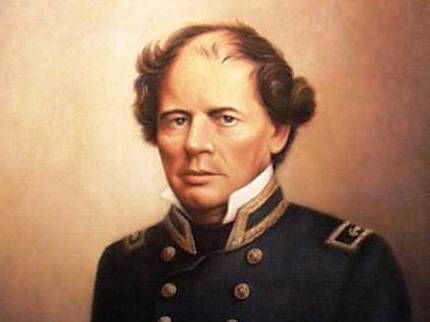
maury2187


Matthew Fontaine Maury, a self-taught navigator of the seas, astronomer, meteorologist, author, and educator, always sought to prove:

“The Bible is true and science is true,

and therefore each, if truly read,

but proves the truth of the other.”

–Matthew Maury


And though he may not have set out to do so, Maury also proved:

“I know the plans I have for you, plans to prosper you and not to harm you, plans to give you hope and a future” (Jeremiah 29:11).

With the advantage of hindsight, we can readily see this promise grandly fulfilled in Maury’s life. Yes, he suffered pain and hardship. All saints of God do (Romans 8:17).

But! God brought Maury through every challenge and used him in mighty ways—ways that impact our world to this day.

*     *     *     *     *     *     *     *     *     *

Lord, I am deeply grateful you are the one who plans each of our lives. What comfort to know that an all-seeing, all-wise God is orchestrating not only the main events of life, but every single day. I pray for your grace, in order to be accepting of disappointments, knowing that you will bring good out of every situation. In fact, you may very well be preparing something important. I want to trust you without hesitation.

(Psalm 139:16; Romans 8:28; Ephesians 2:10)


Sources:  The Founders’ Bible, https://answersingenesis.org; http://www.cbn.com; http://www.creation.com.)

Photo and art credits:  www.travelblog.org; http://www.firstladies.org.)

Read Full Post »

Jesus-Praying-Last-Supper-570x377


Whether I heard it or read it, I don’t remember. But the words caught me by surprise, and I jotted them down:

“What was uppermost in Jesus’ mind as Good Friday approached?

“Joy.”

Do you find that surprising, too?

Yet at least three times on the eve of his crucifixion Jesus spoke about joy (John 15:11; 16:22, 24; 17:13)–a most unusual topic and completely unnatural.  Who thinks about joy when they know that catastrophe is about to strike?

Jesus, that’s who.

Within the next twenty-four hours he would face excruciating pain, total abandonment by his Father, and the most horrific death ever devised.

But his concern was for his disciples, not himself.  Jesus wanted them to remember the important principles of love, obedience, and joy–an empowering joy that no one could take away from them.

Perhaps you remember the scene. Jesus and his disciples had just finished their last Passover supper together. After the meal, he taught his final lesson.

The first mention of joy came near the end of his teaching about the vine and the branches:

“I have told you this

so that my joy may be in you

and that your joy may be complete”

(John 15:11).

The word, “this,” refers to the ways Jesus had just mentioned that will contribute to joy:

1.  Live close to him and produce much good in and through your life (vs.4-8).

2.  Live in obedience to Jesus and experience the warmth, peace, and care of His love (vs. 9-10).

 Note that Jesus wanted his joy to be in the hearts of his disciples. What characterized his joy, compared to that of others?

  1. Strong awareness of the Father’s love for him, and his own love for the Father (vs. 9-10).
  1. Absolute surrender and self-sacrifice of himself to his Father, and the joy of doing what his father had sent him to do. Even during his great travail in the Garden of Gethsemane, his one desire was to do his Father’s will (Luke 22:42).

Jesus’ joy coexisted with the profound sorrow of his impending suffering, because he was already well-acquainted with the satisfaction and fulfillment of obedience.

  1. The understanding that joy deferred to the future is anticipatory joy in the present. “For the joy set before him he endured the cross” (Hebrews 12:2).

And finally, Jesus told his disciples that he desired complete joy for them. What does complete joy look like? It is:

  • Not so much an emotion as it is a conviction (Keith Krell, “Moment by Moment,” http://www.bible.org).
  • Inner contentment, resulting from continually cultivating an intimate relationship with Jesus.
  • Constant, not dependent on circumstances.
  • Enduring, day after day. Indestructible.
  • Perfect—the perfect, joy-filled fulfillment of the destiny for which God created you, even when a portion of that destiny is suffering.

I’m thinking of the martyrs–Stephen, Polycarp, Ignatius of Antioch, William Tyndale, John Wycliffe and countless others who demonstrated complete joy even as they died in anguish.

Polycarp, disciple of the Apostle John and Bishop of Smyrna for many years, refused to revile Jesus. For that he was burned at the stake.

But before the flames rose up, Polycarp prayed:

“O Lord God Almighty, Father of thy blessed and beloved Son, Jesus Christ, through whom we have been given knowledge of thyself…I bless thee for granting me this day and hour, that I may be numbered amongst the martyrs, to share the cup of thine Anointed and to rise again unto life everlasting…”

Such devotion, courage, and supernatural strength are impossible to fathom apart from the enablement of the Holy Spirit.

Can you hear the grace in Polycarp’s voice as he blessed God for the privilege of dying a martyr?

That is complete joy, only experienced by those who trust in Jesus implicitly.

Complete joy that Jesus purchased for us at Calvary.

*     *     *     *     *     *     *     *     *

We marvel, Heavenly Father, in the extreme paradox that is the cross. Out of the evil unleashed upon your Son comes your holy, righteous goodness–upon us. Out of the horror of the crucifixion that Jesus endured comes inexpressible and glorious joy, to those who put their faith in him–not a temporary feeling of elation, but deep, abiding, abundant joy. 

All praise to you, our loving, gracious God!       

(Acts 3:13-16, 1 Peter 1:8, John 6:47, John 10:10)


(Photo credit:  www.rejesus.co.uk.)


Read Full Post »

(In honor of Black History Month)


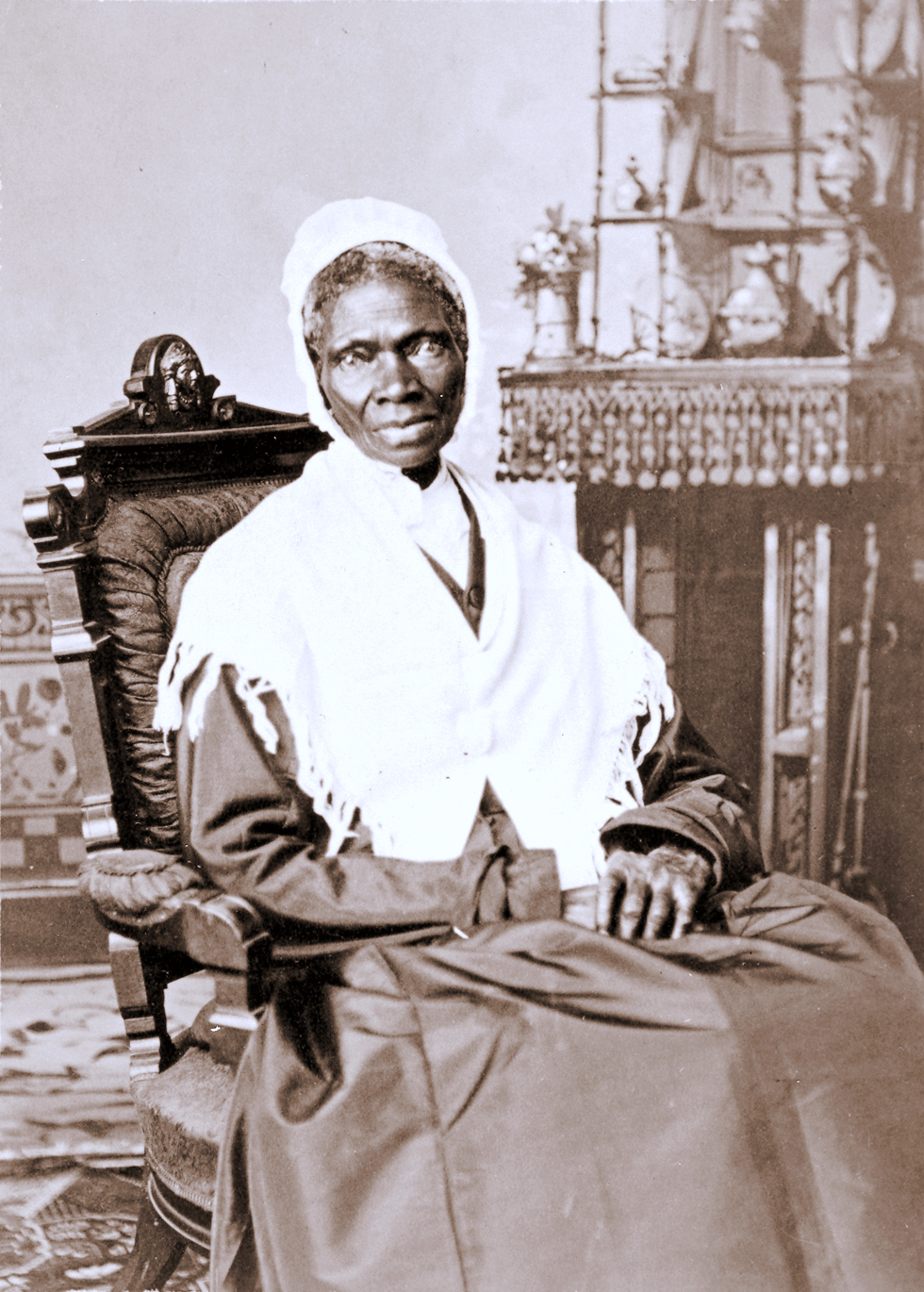
Isabella, the daughter of James and Elizabeth Baumfree, was born a slave in New York state about 1797. No one knows the exact date, because birth records weren’t kept for “property.”

Did her parents know the name means, “consecrated to God?” Even if they chose the name for its meaning, those parents could not have dreamed of the future awaiting their Baby Belle.

Her early years were difficult.  Belle was sold five times, several times to cruel masters.

At age eighteen or so, Belle fell in love with Robert, a young slave from a nearby farm. The couple had a daughter. But Belle’s master, John Dumont, forbade her to see Robert again. According to the law, all children of the union would belong to Robert’s master, not Dumont.

Two years later, Dumont forced Belle to marry an older slave. They had three children: Peter, Elizabeth, and Sophia.

In 1826, Belle escaped the Dumont farm with Baby Sophia. In a vision, God showed her a particular home to go to. That home belonged to a Quaker family, the Wageners, who took in the young woman and her baby. They even paid Belle’s price to Dumont and made her a free woman. Belle became a housekeeper, then a maid.

Shortly after her escape from slavery, Belle learned that her five-year old son, Peter, had been illegally sold in Alabama. She took the matter to court and won her case. Peter was returned to New York. That was the first time a black woman challenged a white man in a U.S. court. It was also the first time of many that Belle’s resolve and courage were put on display.

Several years later Belle was falsely accused of poisoning her former employer. In 1835 she took that case to court and won again.

Someone must have encouraged Belle to tell her story of being a slave and becoming a free woman. But she had never learned to read or write, so a friend wrote as Belle dictated. A Northern Slave was published in 1850.

In her book, Belle explained that several years after she was freed, God revealed himself to her, “with all the suddenness of a flash of lightning, showing her, in the twinkling of an eye, that he was all over, that he pervaded the universe, and that there was no place where God was not.”

The book sold many copies and Belle became well-known. She was asked to speak at a women’s rights convention in Massachusetts. Before long, Belle was traveling with abolitionist, George Thompson, speaking against slavery and for human rights.

In 1851, Belle gave a speech at another women’s conference, this time in Ohio. She spoke convincingly (and extemporaneously) about women being every bit as capable as a man:

“I have plowed and reaped and husked and chopped and mowed, and can any man do more than that?”

And, no doubt with a twinkle in her eye, she added:

“As for intellect, all I can say is, if a woman have a pint, and a man a quart — why can’t she have her little pint full? You need not be afraid to give us our rights for fear we will take too much, for we can’t take more than our pint’ll hold. The poor men seems to be all in confusion, and don’t know what to do. Why children, if you have woman’s rights, give it to her and you will feel better. You will have your own rights, and they won’t be so much trouble.”

She concluded by asking: “And how came Jesus into the world? Through God who created him and the woman who bore him. Man, where was your part?”

It’s not surprising that some were displeased with Belle’s speeches. One time she was told that the building where she was to preach would be burned down if she dared to speak. “Then I will speak to the ashes,” she replied.

Belle was also physically assaulted. One brutal attack caused permanent injury, and she had to walk with a cane for the rest of her life.

In 1863, Harriet Beecher Stowe wrote an article about Belle for the Atlantic Monthly:

“I do not recollect ever to have been conversant with anyone who had more of that silent and subtle power which we call personal presence…She seemed perfectly self-possessed and at her ease. An audience was what she wanted—it mattered not whether high or low, learned or ignorant. She had things to say, and was ready to say them at all times, and to anyone.”

Imagine. A slave woman who never had the opportunity to go to school, never learned to read or write. Yet the power of her spoken word helped bring the end of slavery and pave the way for women to be granted the right to vote.

Belle proved:

“There is no difficulty that cannot be defeated.

There is no victory that cannot be achieved,

if you believe in the power of God!”

— Anonymous

Of course, by the time she achieved notoriety, Belle was known by another name.

You see, Belle had asked God for a new name several decades before the Civil War. Again, it was the result of a vision. She said God chose her new first name based on the fact she would travel. Then Belle asked God for a second name, “’cause everybody has two names.” And the Lord granted her request. Her second name proclaimed what Belle always declared from her podium.

Perhaps you remember Sojourner Truth.


Sojourner_truth_c1870

(Photo from http://www.wikipedia.org.)


Sources:  www.biography.com; http://www.sojournertruth.org; http://www.; http://www.blackpast.org; http://www.americanswhotellthetruth.org; http://www.christianitytoday.com.)

Read Full Post »


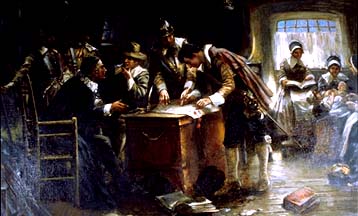
Mayflower_compact


They had been at sea for sixty-six days, enduring overcrowded conditions. Storms had caused damage to their ship and sea sickness plagued them all– passengers and crew alike. Meager provisions and no heat on chilly autumn days caused further discomfort.

So on November 9, 1620, when they finally saw the coastline of North America in the distance, the Pilgrims and others aboard the Mayflower must have cheered enthusiastically. Soon they could abandon the cramped, cold, and fetid ship and begin new lives in a new world.

But. All had not been peaceful and congenial among the passengers during the crossing. And when it became apparent the storms had blown them too far off course to land in the Virginia Colony as planned, relations deteriorated further.

Not all of the travelers were Pilgrims. Also aboard were merchants, craftsmen, skilled workers, and indentured servants. The Pilgrims called them “strangers.”

No sooner had the decision been made to anchor off Cape Cod, than an argument ensued. Several of the “strangers” pointed out that, since they were not going to be under the jurisdiction of the Virginia Company, they would “use their own libertie” and do as they pleased. “None had the power to command them, they said.” (Quoted words are from William Bradford’s records. He served as historian for the Pilgrims.)

To avoid anarchy, five men gathered in the cabin of the ship to create a basis for law and order. The result of their efforts: the Mayflower Compact.

The first words of the document give strong indication of the Pilgrims’ hearts.

In the name of God, Amen.

“Everything they did started with God” (The Founders’ Bible, p. 187).

Next, the Pilgrims stated their purpose for coming to America.

We, whose names are underwritten,…by the grace of God,…having undertaken for the glory of God, and advancement of the Christian faith, and honor of our King and country…

Several phrases indicate the Pilgrims’ desires for their new colony:

  • “For the glory of God” would be a guide for all manner of decisions.
  • “Advancement of the Christian faith” would encourage them to remain strong in Christian faith among themselves and to introduce others to Jesus.
  • “Honor of our King and country” indicates their loyalty to native England and its monarch, in spite of his untoward actions that caused their flight to America in the first place.

…[We] do solemnly and mutually in the presence God and of one another, covenant and combine ourselves together into a civil body politic…

The Mayflower Compact expressed their commitment to live together in a civil manner, in the sight of God.

[We] will enact…such just and equal laws, ordinances, acts, constitutions, and offices, from time to time, as shall be thought most meet and convenient for the general good of the colony, unto which we promise all due submission and obedience.” 

Note:  there is no mention of a leader who would oversee the colony. The Pilgrims created a democratic, representative form of government, in covenant with one another, rather than by a monarchy or dictatorship.

It was the first document of its kind in the history of the world.

But the Mayflower Compact would only be as good as the commitment of Pilgrims and Strangers alike to abide by its guidelines.

Would the mutinous Strangers sign?

John Carver, church deacon and one of the organizers of the voyage, was the first to affix his signature. Other Pilgrims followed.

One book says there was a long pause. Then Captain Myles Standish stepped forward to sign. Standish had been hired by the Pilgrims to be their military captain; he was with them, but not one of them.

Soon other Strangers followed Standish’s example.  In total, forty-one signatures appeared on the document. One freeman, two hired men and seven servants declined.

At long last, Pilgrims, Strangers, and crew were able to disembark. And what did they choose to do first?

Pray.

According to Bradford, they “blessed the God of heaven, who had brought them over the fast and furious ocean..and a sea of troubles before.” Then he quoted scripture:

“Let them therefore praise the Lord, because He is good and His mercies endure forever.” (Psalm 106:1).


*     *     *     *     *     *     *     *     *     *


We, too, praise you, Lord, for your goodness and mercy upon America all these years.  As we celebrate Thanksgiving on Thursday, may we remember the solemn history behind this occasion.  Thank you for the supreme example and sacrifice of our Pilgrim forefathers–strong in faith, commitment, and perseverance.  May we follow their example, not only because you are faithful to the faithful (2 Samuel 22:26), but out of appreciation for what you, our loving God, have already done.


(Sources:  By These Words by Paul M. Angle; The Founders’ Bible; The Intellectual Devotional:  American History by David S. Kidder & Noah D. Oppenheim; The Rebirth of America;  http://www.learningtogive.org; http://www.humanities360.com; http://www.crf-usa.org; http://www.americanhistory.about.com; http://www.tparents.org; http://www.mrkash.com; http://www.mayflowerhistory.com; http://www.plimoth.org.)


Art credit:  www.washingtonmayflower.org.  


Read Full Post »

DSC_7445-X3 (My mom & dad with their great-granddaughter, Sophie, 2011)


“What we leave behind

is not what is engraved in stone monuments,

but what is woven into the lives of others.”

— Pericles (495-429, B.C.  Greek statesman, orator, and general of Athens)

I love that word, woven. It speaks eloquently of the way my mother, Geraldine Claire  (November 5, 1928-October 9, 2014), influenced my life. Woven into the fabric of my being are memories of Mom’s words and example that still have impact to this day.

Many of those memories involve Mom and Dad because they were such an inseparable team. They even wallpapered together.

Now marriage experts will tell you that completing home improvement projects with your spouse can be detrimental to your relationship. But that was not the case for Mom and Dad. Amidst the measuring, pasting, and hanging, my brother, John, and I saw cooperation and patience in action.

Once the wallpaper was hung in the three homes of our growing-up years, Mom was ready to entertain. Hospitality was definitely one of her gifts. In fact, the last dining room table Mother and Dad purchased could seat fourteen people.

Mom became adept at organizing large gatherings by writing lists, doing everything she could ahead of time, even labeling the serving ware so each item on the menu would have an appropriate bowl or plate. Little did I know then how often I’d be following her routine and recipes, as Steve and I began to entertain.

Mom’s legacy included wise advice. One time I was heartsick over a low report card grade in math—my most challenging subject. She quickly gave me perspective for the tragedy, saying, “Just remember: this grade will not matter in ten years.”  And, of course, she was right.

Countless times over the years as disappointments and difficulties have occurred, I’ve heard Mother’s voice reminding me to consider events with a ten-year perspective.

But that doesn’t mean she accepted excuses. Instead, Mom fostered independence and personal responsibility .

I’m remembering the Sunday School Christmas program from second grade. My part was to recite six verses from Luke, chapter two, about the angel visitation to the shepherds. “This is too much to memorize,” I complained.

Mother replied calmly, “Well, just tell Mr. Faircloth that you can’t manage it, and he’ll ask someone else.”

Mom did not take control of the situation; she left it up to me to decide what course of action to take. Wise mother, indeed.

But perhaps the most astounding aspect of her legacy is the way she exhibited all features of the fruit of the Spirit, listed in Galatians 5:22-23.

For example:

LOVE — Mom lavished love on family, friends, and stranger alike. She could strike up a conversation with anyone, and was always ready with a warm hug.

JOY — Mother was a woman of gladness. She laughed easily and often.

PEACE — Mom and Dad created a peaceful, secure home for John and me.

PATIENCE — She exercised great patience, especially when dealing with my fluctuating moods of early adolescence.

KINDNESS — Mother demonstrated kindness in many ways.  I remember one house where the old wallpaper was in process of removal when Mom and Dad took in a missionary who needed a place to stay.  We have home movies of  that missionary, Miss Hunt, standing in front of  the glue-encrusted plaster.  Another time when a different missionary family stayed with us, Mom did all their laundry while they attended to other affairs.

GOODNESS — Mother’s goodness was also expressed in numerous ways.  In my mind’s eye, I can still see Mom at her desk at Scripture Press, where she was executive secretary to the Vice President of Editorial.  (The visualization is easy to conjure; I sat directly across from Mom, most of my seven summers as an editorial assistant.)  Frequently people stopped by her desk to share a need and ask for advice.  We used to tease her about being the psychologist of Scripture Press!   

FAITHFULNESS — Mother’s faithfulnesss to God never wavered for the seventy-five earthly years she knew Jesus as her Savior and Lord.

GENTLENESS — While John and I were growing up, Mom could be plenty firm with us.  Yet, when we were sick, hurt or experiencing trouble, she readily soothed us with comfort and hugs.

SELF-CONTROL — I have to admit:  I provided Mom and Dad with plenty of parenting challenges.  And though Mom did become angry sometimes, she never lost her temper with me.

For these reasons and so many more, John and I “arise and call her blessed” (Proverbs 31:28).  Mother did indeed weave godly integrity, wisdom, and faith into our lives.

Read Full Post »

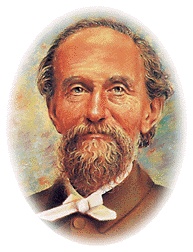
His name keeps popping up in books and blog posts: Andrew Murray.

His words are thought-provoking:

  • “Never try to arouse faith from within. You cannot stir up faith from the depths of your heart. Leave your heart, and look into the face of Christ.”
  • “Abiding fully means praying much.”
  • “Just as water ever seeks and fills the lowest place, so the moment God finds you abased and empty, His glory and power flow in.”

So who was this deeply thoughtful man, Andrew Murray(1828-1917)? Did his conversion experience turn him around 180 degrees like Paul’s? Did he face great danger like David or Daniel? Did he impact throngs of people with his preaching like Jonah or John the Baptist?


andrew_murray-gif


No. According to the Christian Classics Ethereal Library (www.ccel.org), Andrew grew up in a Christian home. No spectacular transformation from unbeliever to saint.

His father was a Scottish Presbyterian minister who served in the Dutch Reformed Church of South Africa. Andrew became a pastor himself and served several pastorates, also in South Africa.

Andrew helped found two schools, made several evangelistic tours of South Africa, and received an honorary doctorate for his contributions to world missions. Today he is best known for his devotional writings, found in the 240 publications to his credit.

Not a shabby list of accomplishments, but Andrew faced no giants or lions. There are no cliff-hanger stories to tell about him. He simply served God faithfully where he was.

No doubt there are some who would skim-read such a biography, yawn, and seek more exciting stories–Adoniram Judson’s or David Livingstone’s.

Andrew Murray may have written some thoughtful books and essays, but let’s face it. His life-story borders on ho-hum ordinary.

But wait. The Bible and annals of history are overflowing with the stories of ordinary people such as:

  • Jethro, a shepherd. Yet his wisdom greatly assisted his son-in-law–Moses (Exodus 18:1-27).
  • Mordecai, a captive. However, he was in the right place at the right time to hear of a plot against the Jews (the book of Esther).
  • Lydia, a dealer in fine purple cloth and dye. She just happened to provide housing for Paul and Silas, and became the first convert—in all of Europe (Acts 16).

No doubt these people considered themselves just ordinary folk. But God used them in astonishing ways.

The truth is, there is no such thing as an ordinary person in God’s kingdom.

So, guess who’s talking when that voice in your head whispers, “You are a nobody. You aren’t accomplishing anything worthwhile in your life.”

It’s not God!

He placed within each of us wondrous, unique gifts. Would God do that if we were worthless?

Second, he placed us within a circle of influence that includes family, neighbors, friends, church acquaintances, business contacts, and more. (And let’s not forget the ripple effect.)

Third, God provides opportunities within that circle for us to use our gifts, be a blessing to others, and  bring him praise.

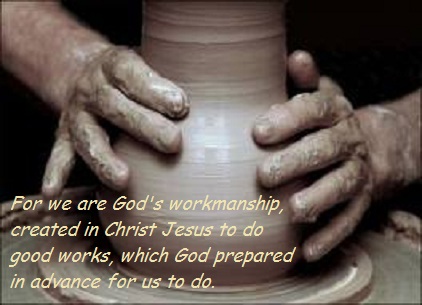
So whether God ordains you or me to be a leader or follower, a platform personality or a behind-the-scenes helper, a larger-than-life Paul, or a lesser-known Andrew Murray, we each have a unique niche to fill—especially designed by God himself.


potter


For we are God’s workmanship, 

(Think of it—we are the handiwork of the Master Designer!)

Created in Christ Jesus to do good works, 

(Works that will bring glory to God and supreme satisfaction to our hearts.)

which God prepared in advance for us to do (Ephesians 2:10).”

(Availing ourselves to what he’s prepared results in supremely worthwhile accomplishment.)

*     *     *     *     *     *     *     *     *     *


Thank you, Father, for gifting each of us with unique abilities to fulfill your specially designed plans. Thank you that in your kingdom there is no such thing as ho-hum ordinary, because you, the Master of the universe only create masterpieces! May our joy be centered in faithfully completing the works you have prepared for each of us.


Art and photo credits:  www.newparadigmthinkers.wordpress.com; http://www.dayofgrace.me.)       


Read Full Post »

Washington_Constitutional_Convention_1787


On September 17, 1787, George Washington took up a quill and signed the Constitution of the United States of America. He was the first of thirty-three convention delegates to endorse the document that day.


Most Americans probably don’t realize that this Wednesday is the anniversary of that important event.  Chances are they do not realize how close we came, the summer of 1787, to dissolving into small factions and losing our identity as the United States of America.

I certainly wouldn’t have been aware, except I read Catherine Drinker Bowen’s book, Miracle of Philadelphia over the summer.  Our constitution does indeed qualify as a miracle of creativity, wisdom, compromise, and forward thinking–all wrapped up into one.

The young delegates (average age, 43) had begun their deliberations at the end of May. As the summer heated up (many days were oppressively hot), so did the discussions. Their task seemed impossible: create a strong national government that could support and stabilize the states, yet limit that government in order to honor states’ rights.

For almost four exhausting, uncomfortable months the men debated issue after issue, including: 1) slavery, 2) representation in the legislature, 3) whether the executive branch should be a committee or one man, and 4) whether a bill of rights should be included.

It was the dispute over representation that really caused tempers to flare. Some delegates were concerned that large states would lord it over small states in a legislature of equal representation.   Other delegates thought proportional representation based on population was the fairest method.

The two opposing sides hurled arguments back and forth with no compromise in sight. According to Georgia delegate, William Few, “It was an awful and critical moment. If the Convention had then adjourned, the dissolution of the union of the states seemed inevitable.”

What kept them from adjourning? Perhaps it was the strong appeal of an elder statesman in attendance, encouraging the delegates to press on–with God’s help.  Following is an excerpt. (Note the twelve phrases and references borrowed from Scripture):

In this situation of this assembly, groping, as it were, in the dark to find political truth, and scarce able to distinguish it when presented, how has it happened that we have not once thought of humbly applying to the Father of Lights to illuminate our understandings?

In the beginning of the contest with Britain when we were sensible of danger, we had daily prayers for the Divine Protection. Our prayers were heard and were graciously answered. All of us who were engaged in the struggle must have observed frequent instances of a superintending Providence in our favor…

…And have we now forgotten that powerful Friend? Or do we imagine we no longer need His assistance? I have lived a long time; and the longer I live the more convincing proofs I see that God governs the affairs of men.

And if a sparrow cannot fall to the ground without His notice, is it probable that an empire can rise without His aid?

We have been assured in the Sacred Writings that except the Lord build the House, they labor in vain that build it. I firmly believe this; and I also believe that without His concurring aid, we shall succeed in this political building no better than the builders of Babel…and we ourselves shall become a reproach and a byword down to future ages (from The Papers of James Madison, 1840).

Those words came from a delegate known for his wisdom and political savvy, one of the most highly respected men in America: Benjamin Franklin.

Another delegate, Mr. Randolph of Virginia, proposed that “thenceforward prayers be used in ye convention every morning” (according to James Madison’s notes).

The Great Debate continued, arguments still broke out, Alexander Hamilton wrote that the crisis was alarming and he “almost despaired.” But the delegates did indeed press on. On July 16, the final compromise was voted upon and passed. The Senate would have two members from each state; the House of Representatives would be based on population, one member for every 40,000 residents.

Slowly but surely, over four months of grueling deliberation, these young visionaries hammered out a new form of government comprised of three branches: executive, legislative, and judicial. They strove for careful balance of power between those three branches, as well as between the federal government and the states.

The Constitution of the United States of America is the oldest written constitution in the world. It has stood the test of time, as a result of the collective genius of the delegates. They persevered to create a flexible document that could adapt to change as the decades passed.

And undoubtedly Benjamin Franklin has been proven right:

Without [God’s] concurring aid, we shall succeed in this political building no better than the builders of Babel…and we ourselves shall become a reproach and a byword down to future ages.

On the contrary, with God’s aid providing that collective genius, those resolute patriots created the foundation for the greatest nation on earth.


(For those interested in the scriptures Mr. Franklin alluded to in his speech, they include:  Job 12:25; James 1:17; James 1:5; Luke 12:6; Psalm 75:7; Daniel 4:17; Psalm 127:1; Genesis 11:1-9; Deuteronomy 28:37; 1 Kings 9:7; 2 Chronicles 7:20; Psalm 44:14).


Art credit:  wwwlwikipedia.com.   Sources:  The Founders’ Bible, Shiloh Road Publishers, 2012; Miracle at Philadelphia by Catherine Drinker Bowen, Little, Brown and Company, 1986; The Story of America, Reader’s Digest Association, 1975).


Read Full Post »

borfarb


“Katherine, I’m terribly sorry, but there’s nothing else to do. We have no money to hire a nursemaid for you children, and now that your mother is gone…”  His voice trailed off.

Is that what Hans von Bora told his five-year old daughter?  No record has been left.  We do know that, in 1504, after the death of her mother, Katherine was sent to a convent in Nimbschen, Germany. At age nine, she was transferred to Convent Marienthron, where she took her vows and became a nun. Katherine was just sixteen years old.

Katherine’s duties gave her opportunity to learn management and care of a large estate, since the convent owned much property. Proceeds covered the expenses for the forty-four nuns and forty servants.  They also made a profit.

About this time a tract was secretly passed among the young nuns titled, “The Monastic Life, and the Marriage of Priests, Nuns and Monks.” Monks, nuns, and clergy should be free to marry, it said. Marriage should be kept; it is monasteries that should be given up.

As this message spread it was not just monasteries that began to empty but convents also. Twelve nuns from Marienthron chose to escape on Easter evening, in April of 1523.  Among them was Katherine. Three of the young women were returned to their families, the other nine secretly delivered by wagon under cover of night to a nearby town. It happened to be the home of the monk who wrote the tract, and he took personal responsibility to see that the nine nuns were well taken care of.

Husbands were found for some of the women; others were given positions in households. Katherine was in the latter group. One suitor, a university student, did court Katherine that summer. A deep friendship grew between them, but when he returned to school, Katherine never heard from him again. Perhaps his parents did not approve of a marriage between their son and a former nun.

Was Katherine’s heart broken after this first experience of love?  Did she wonder why God would allow such a painful turn of events?  Again, no record exists.  We can only surmise that Katherine felt great disappointment as would any young woman in such circumstances.

Several other suitors came forward, but Katherine was content to stay and work in the home of the Lucas Cranach family.

Meanwhile, the monk who wrote the tract about marriage had left the monastery. He was considering taking a bride himself. Katherine let it be known that she was interested, as affection for the caring man had developed during the two years she had known him.

On June 15, 1525, the couple announced their engagement before five witnesses.   Immediately following was the wedding!

An abandoned Augustinian cloister was given to the couple for their home. Katherine became mistress of this virtual estate.  (The first floor alone contained forty rooms with cells above.)

Eventually every room was occupied, not just by their own six children, but by widows, students, and orphans that the couple took in. In fact, Katherine and her husband adopted four orphaned children from their relatives.

Can you imagine caring for so many people—without such appliances as stove, refrigerator, washer, or dryer?

But God had prepared Katherine to manage the estate.  Remember her duties at Marienthron Convent?  Katherine  was on the go from daybreak to night, overseeing the multitude of household responsibilities, the animals, a large garden, the brewery, and large parcels of land she purchased in order to grow grain for the animals.

That’s not all. Katherine ministered to the needs in her community, giving care to the sick and counsel to the hurting.

She made it possible for her husband to travel, preach, and teach, knowing that all would be well taken care of at home.

Day after day, for twenty years, Katherine served others in and around her home.   How ironic that one of the few quotes of Katherine von Bora which has survived the centuries should be:

“I’ve read enough [of the Bible]. I’ve heard enough. I know enough. Would to God I lived it.”

According to the historical record, Katherine most certainly lived by the truth of God’s Word. Who can deny her courage, perseverance, love of others, and servant’s heart?  She stands as a worthy example for us to follow.

Katherine’s husband grew to appreciate her greatly and love her deeply. He called her “Kittie, My Rib” and  “The Morning Star of Wittenberg.”

Does the name of their hometown sound familiar? Wittenberg was the home of Martin Luther.

The husband of Katherine von Bora was none other than Martin Luther himself.


(Sources:  www.the-highway.com, http://www.rpmministries.org, http://www.helios.augustana.edu, http://www.lutheranhistory.org, http://www.thegospelcoalition.org, http://www.haventoday.org.  Art credit:  www.lutherin.de.)

Read Full Post »

???????????????????????????????????????????????????????????????????????????????????????????????


The days are getting shorter; schools will be in session within a couple of weeks. It must be August.

And with the end of summer comes a tinge of sadness. The days of swimming, boating, and patio parties will soon be over for another year. We wish summer could last a bit longer.

What we need is a holiday in August, even if we invent it for ourselves. Something to lift our spirits.

Perhaps we could celebrate the birthday of Francis Scott Key, born August 1, 1779. (That would place our new holiday neatly centered between Independence Day and Labor Day.)


Francis-Scott Key


Mr. Key would be a worthy man to honor, too, and not just because he penned The Star Spangled Banner.

Francis Scott Key was a man of faith.

From 1818 until his death in 1843, he served as vice-president of the American Bible Society. Mr. Key was also involved in the American Sunday School Union, instrumental in planting thousands of Sunday Schools in settlements throughout the Midwest.

Though only an amateur poet, he penned at least ten hymns in addition to our national anthem. Included below are the first-stanza lyrics of Lord, with Glowing Heart I’d Praise Thee.  I think you’ll find these words  as heart-stirring as The Star-Spangled Banner: 


Lord, with glowing heart I’d praise Thee,

For the bliss Thy love bestows,

For the pardoning grace that saves me,

And the peace that from it flows:

Help, O God, my weak endeavor;

This dull soul to rapture raise:

Thou must light the flame, or never

Can my love be warmed to praise.


Francis Scott Key was a man of courage.

If you’re like me, you remember bits and pieces of the circumstances that inspired Mr. Key to write our national anthem. Sometime during the War of 1812, he was on a boat in a harbor, anxiously watching to see if the fort onshore would survive an onslaught from the British Navy. By the dawn’s early light he caught a glimpse of the American flag still flying over the ramparts, and the first lines of The Star Spangled Banner were born in his mind.

But what was Sir Francis doing in a harbor full of British ships attacking an American fort?

First, it’s important to understand the British had just completed a successful campaign against Washington, D.C., burning many buildings including the White House. Hundreds had fled for their lives, including President Madison.

After Washington, the victorious enemy approached Baltimore, the third largest city in America.  Mr. Key and John Stuart Skinner (an American Prisoner Exchange Agent) had been sent to the British, to negotiate the release of prisoners.  One of those prisoners was Dr. William Beanes. Dr Beanes had been captured in Washington, and was being held aboard ship in Baltimore Harbor.

Why was Mr. Key sent as a negotiator? Perhaps because, as a lawyer, he was gifted at persuasion.

But what guarantee might Francis Key and John Skinner have that they themselves would not be taken prisoners? Surely there was none. Promises can easily be broken, especially during war.

Yet the two men did board an enemy ship and talk the British into releasing Dr. Beanes. However, the battle against Fort McHenry was about to begin. The three Americans were not allowed to return to shore, but were transferred to a small boat behind the British fleet. They had no choice but to anxiously watch the bombardment of Fort McHenry, located on Baltimore Harbor. Would the Americans be forced to surrender?


francis-scott-key-1779-1843-american-lawyer-and-poet-witnessing-the-bombardment-of-fort-mchenry-september-13-14-1814-wood-engraving-american-1885-granger


Into the night the ferocious battle continued. Sixteen British war ships lobbed cannon fire and rockets into the fort from a safe distance out in the harbor. Meanwhile, American gunfire was useless. The ships were out of range.

But the dawn’s early light revealed that the American flag still waved. The fort had remained secure in spite of the onslaught. Mr. Key grabbed an envelope. On the back he wrote out the first phrases of the poem, “The Defense of Fort McHenry.”  Later he added to the poem, creating four stanzas. Soon it was set to a British(!) tune, Anacreon in Heaven, and retitled, The Star-Spangled Banner.

Though the song celebrated that particular victory at Fort McHenry, Mr. Key expressed his faith in God and hope for America in the last stanza:


Oh, thus be it ever when freemen shall stand

Between their loved homes and war’s desolation;

Blest with vict’ry and peace, may the Heav’n rescued land

Praise the Pow’r that hath made and preserved us a nation!

Then conquer we must, when our cause it is just;

And this be our motto: “In God is our trust.”


Did you notice that last line? Mr. Key created our nation’s motto as well as our national anthem.

He’s worthy of a holiday, don’t you think?


(Resources:  www.wallbuilders.com, http://www.christianity.com, http://www.middletownbiblechurch.org, http://www.usflag.org, and http://www.poemhunter.com.

Photo & art credits:  www.scholarshipexperts.com, http://www.oldfloridabookstore.blogspot.com, http://www.fineartamerica.com.)


Read Full Post »

« Newer Posts - Older Posts »

When the House is Quiet

Impressions Becoming Expressions

Mitch Teemley

The Power of Story

Still Traveling

Impressions Becoming Expressions

Living Our Days

Gaining a heart of wisdom

He Said What?!

I'm Patty, and my husband and I are living with our adult son who has autism and epilepsy. I love sharing lessons learned from life around me, especially life with Aaron.

Meditations of my Heart

Impressions Becoming Expressions

Linda Stoll

Impressions Becoming Expressions

Signora Sheila

Notes on Life, Faith & Italy

Heidi Viars

Finding the Image of God