Feeds:
Posts
Comments

Archive for the ‘Heroes of the Faith’ Category

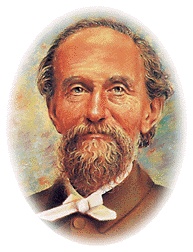
His name keeps popping up in books and blog posts: Andrew Murray.

His words are thought-provoking:

  • “Never try to arouse faith from within. You cannot stir up faith from the depths of your heart. Leave your heart, and look into the face of Christ.”
  • “Abiding fully means praying much.”
  • “Just as water ever seeks and fills the lowest place, so the moment God finds you abased and empty, His glory and power flow in.”

So who was this deeply thoughtful man, Andrew Murray(1828-1917)? Did his conversion experience turn him around 180 degrees like Paul’s? Did he face great danger like David or Daniel? Did he impact throngs of people with his preaching like Jonah or John the Baptist?


andrew_murray-gif


No. According to the Christian Classics Ethereal Library (www.ccel.org), Andrew grew up in a Christian home. No spectacular transformation from unbeliever to saint.

His father was a Scottish Presbyterian minister who served in the Dutch Reformed Church of South Africa. Andrew became a pastor himself and served several pastorates, also in South Africa.

Andrew helped found two schools, made several evangelistic tours of South Africa, and received an honorary doctorate for his contributions to world missions. Today he is best known for his devotional writings, found in the 240 publications to his credit.

Not a shabby list of accomplishments, but Andrew faced no giants or lions. There are no cliff-hanger stories to tell about him. He simply served God faithfully where he was.

No doubt there are some who would skim-read such a biography, yawn, and seek more exciting stories–Adoniram Judson’s or David Livingstone’s.

Andrew Murray may have written some thoughtful books and essays, but let’s face it. His life-story borders on ho-hum ordinary.

But wait. The Bible and annals of history are overflowing with the stories of ordinary people such as:

  • Jethro, a shepherd. Yet his wisdom greatly assisted his son-in-law–Moses (Exodus 18:1-27).
  • Mordecai, a captive. However, he was in the right place at the right time to hear of a plot against the Jews (the book of Esther).
  • Lydia, a dealer in fine purple cloth and dye. She just happened to provide housing for Paul and Silas, and became the first convert—in all of Europe (Acts 16).

No doubt these people considered themselves just ordinary folk. But God used them in astonishing ways.

The truth is, there is no such thing as an ordinary person in God’s kingdom.

So, guess who’s talking when that voice in your head whispers, “You are a nobody. You aren’t accomplishing anything worthwhile in your life.”

It’s not God!

He placed within each of us wondrous, unique gifts. Would God do that if we were worthless?

Second, he placed us within a circle of influence that includes family, neighbors, friends, church acquaintances, business contacts, and more. (And let’s not forget the ripple effect.)

Third, God provides opportunities within that circle for us to use our gifts, be a blessing to others, and  bring him praise.

So whether God ordains you or me to be a leader or follower, a platform personality or a behind-the-scenes helper, a larger-than-life Paul, or a lesser-known Andrew Murray, we each have a unique niche to fill—especially designed by God himself.


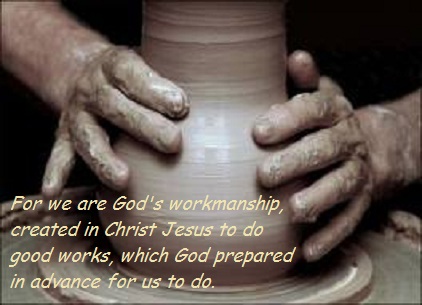
potter


For we are God’s workmanship, 

(Think of it—we are the handiwork of the Master Designer!)

Created in Christ Jesus to do good works, 

(Works that will bring glory to God and supreme satisfaction to our hearts.)

which God prepared in advance for us to do (Ephesians 2:10).”

(Availing ourselves to what he’s prepared results in supremely worthwhile accomplishment.)

*     *     *     *     *     *     *     *     *     *


Thank you, Father, for gifting each of us with unique abilities to fulfill your specially designed plans. Thank you that in your kingdom there is no such thing as ho-hum ordinary, because you, the Master of the universe only create masterpieces! May our joy be centered in faithfully completing the works you have prepared for each of us.


Art and photo credits:  www.newparadigmthinkers.wordpress.com; http://www.dayofgrace.me.)       


Read Full Post »

Washington_Constitutional_Convention_1787


On September 17, 1787, George Washington took up a quill and signed the Constitution of the United States of America. He was the first of thirty-three convention delegates to endorse the document that day.


Most Americans probably don’t realize that this Wednesday is the anniversary of that important event.  Chances are they do not realize how close we came, the summer of 1787, to dissolving into small factions and losing our identity as the United States of America.

I certainly wouldn’t have been aware, except I read Catherine Drinker Bowen’s book, Miracle of Philadelphia over the summer.  Our constitution does indeed qualify as a miracle of creativity, wisdom, compromise, and forward thinking–all wrapped up into one.

The young delegates (average age, 43) had begun their deliberations at the end of May. As the summer heated up (many days were oppressively hot), so did the discussions. Their task seemed impossible: create a strong national government that could support and stabilize the states, yet limit that government in order to honor states’ rights.

For almost four exhausting, uncomfortable months the men debated issue after issue, including: 1) slavery, 2) representation in the legislature, 3) whether the executive branch should be a committee or one man, and 4) whether a bill of rights should be included.

It was the dispute over representation that really caused tempers to flare. Some delegates were concerned that large states would lord it over small states in a legislature of equal representation.   Other delegates thought proportional representation based on population was the fairest method.

The two opposing sides hurled arguments back and forth with no compromise in sight. According to Georgia delegate, William Few, “It was an awful and critical moment. If the Convention had then adjourned, the dissolution of the union of the states seemed inevitable.”

What kept them from adjourning? Perhaps it was the strong appeal of an elder statesman in attendance, encouraging the delegates to press on–with God’s help.  Following is an excerpt. (Note the twelve phrases and references borrowed from Scripture):

In this situation of this assembly, groping, as it were, in the dark to find political truth, and scarce able to distinguish it when presented, how has it happened that we have not once thought of humbly applying to the Father of Lights to illuminate our understandings?

In the beginning of the contest with Britain when we were sensible of danger, we had daily prayers for the Divine Protection. Our prayers were heard and were graciously answered. All of us who were engaged in the struggle must have observed frequent instances of a superintending Providence in our favor…

…And have we now forgotten that powerful Friend? Or do we imagine we no longer need His assistance? I have lived a long time; and the longer I live the more convincing proofs I see that God governs the affairs of men.

And if a sparrow cannot fall to the ground without His notice, is it probable that an empire can rise without His aid?

We have been assured in the Sacred Writings that except the Lord build the House, they labor in vain that build it. I firmly believe this; and I also believe that without His concurring aid, we shall succeed in this political building no better than the builders of Babel…and we ourselves shall become a reproach and a byword down to future ages (from The Papers of James Madison, 1840).

Those words came from a delegate known for his wisdom and political savvy, one of the most highly respected men in America: Benjamin Franklin.

Another delegate, Mr. Randolph of Virginia, proposed that “thenceforward prayers be used in ye convention every morning” (according to James Madison’s notes).

The Great Debate continued, arguments still broke out, Alexander Hamilton wrote that the crisis was alarming and he “almost despaired.” But the delegates did indeed press on. On July 16, the final compromise was voted upon and passed. The Senate would have two members from each state; the House of Representatives would be based on population, one member for every 40,000 residents.

Slowly but surely, over four months of grueling deliberation, these young visionaries hammered out a new form of government comprised of three branches: executive, legislative, and judicial. They strove for careful balance of power between those three branches, as well as between the federal government and the states.

The Constitution of the United States of America is the oldest written constitution in the world. It has stood the test of time, as a result of the collective genius of the delegates. They persevered to create a flexible document that could adapt to change as the decades passed.

And undoubtedly Benjamin Franklin has been proven right:

Without [God’s] concurring aid, we shall succeed in this political building no better than the builders of Babel…and we ourselves shall become a reproach and a byword down to future ages.

On the contrary, with God’s aid providing that collective genius, those resolute patriots created the foundation for the greatest nation on earth.


(For those interested in the scriptures Mr. Franklin alluded to in his speech, they include:  Job 12:25; James 1:17; James 1:5; Luke 12:6; Psalm 75:7; Daniel 4:17; Psalm 127:1; Genesis 11:1-9; Deuteronomy 28:37; 1 Kings 9:7; 2 Chronicles 7:20; Psalm 44:14).


Art credit:  wwwlwikipedia.com.   Sources:  The Founders’ Bible, Shiloh Road Publishers, 2012; Miracle at Philadelphia by Catherine Drinker Bowen, Little, Brown and Company, 1986; The Story of America, Reader’s Digest Association, 1975).


Read Full Post »

borfarb


“Katherine, I’m terribly sorry, but there’s nothing else to do. We have no money to hire a nursemaid for you children, and now that your mother is gone…”  His voice trailed off.

Is that what Hans von Bora told his five-year old daughter?  No record has been left.  We do know that, in 1504, after the death of her mother, Katherine was sent to a convent in Nimbschen, Germany. At age nine, she was transferred to Convent Marienthron, where she took her vows and became a nun. Katherine was just sixteen years old.

Katherine’s duties gave her opportunity to learn management and care of a large estate, since the convent owned much property. Proceeds covered the expenses for the forty-four nuns and forty servants.  They also made a profit.

About this time a tract was secretly passed among the young nuns titled, “The Monastic Life, and the Marriage of Priests, Nuns and Monks.” Monks, nuns, and clergy should be free to marry, it said. Marriage should be kept; it is monasteries that should be given up.

As this message spread it was not just monasteries that began to empty but convents also. Twelve nuns from Marienthron chose to escape on Easter evening, in April of 1523.  Among them was Katherine. Three of the young women were returned to their families, the other nine secretly delivered by wagon under cover of night to a nearby town. It happened to be the home of the monk who wrote the tract, and he took personal responsibility to see that the nine nuns were well taken care of.

Husbands were found for some of the women; others were given positions in households. Katherine was in the latter group. One suitor, a university student, did court Katherine that summer. A deep friendship grew between them, but when he returned to school, Katherine never heard from him again. Perhaps his parents did not approve of a marriage between their son and a former nun.

Was Katherine’s heart broken after this first experience of love?  Did she wonder why God would allow such a painful turn of events?  Again, no record exists.  We can only surmise that Katherine felt great disappointment as would any young woman in such circumstances.

Several other suitors came forward, but Katherine was content to stay and work in the home of the Lucas Cranach family.

Meanwhile, the monk who wrote the tract about marriage had left the monastery. He was considering taking a bride himself. Katherine let it be known that she was interested, as affection for the caring man had developed during the two years she had known him.

On June 15, 1525, the couple announced their engagement before five witnesses.   Immediately following was the wedding!

An abandoned Augustinian cloister was given to the couple for their home. Katherine became mistress of this virtual estate.  (The first floor alone contained forty rooms with cells above.)

Eventually every room was occupied, not just by their own six children, but by widows, students, and orphans that the couple took in. In fact, Katherine and her husband adopted four orphaned children from their relatives.

Can you imagine caring for so many people—without such appliances as stove, refrigerator, washer, or dryer?

But God had prepared Katherine to manage the estate.  Remember her duties at Marienthron Convent?  Katherine  was on the go from daybreak to night, overseeing the multitude of household responsibilities, the animals, a large garden, the brewery, and large parcels of land she purchased in order to grow grain for the animals.

That’s not all. Katherine ministered to the needs in her community, giving care to the sick and counsel to the hurting.

She made it possible for her husband to travel, preach, and teach, knowing that all would be well taken care of at home.

Day after day, for twenty years, Katherine served others in and around her home.   How ironic that one of the few quotes of Katherine von Bora which has survived the centuries should be:

“I’ve read enough [of the Bible]. I’ve heard enough. I know enough. Would to God I lived it.”

According to the historical record, Katherine most certainly lived by the truth of God’s Word. Who can deny her courage, perseverance, love of others, and servant’s heart?  She stands as a worthy example for us to follow.

Katherine’s husband grew to appreciate her greatly and love her deeply. He called her “Kittie, My Rib” and  “The Morning Star of Wittenberg.”

Does the name of their hometown sound familiar? Wittenberg was the home of Martin Luther.

The husband of Katherine von Bora was none other than Martin Luther himself.


(Sources:  www.the-highway.com, http://www.rpmministries.org, http://www.helios.augustana.edu, http://www.lutheranhistory.org, http://www.thegospelcoalition.org, http://www.haventoday.org.  Art credit:  www.lutherin.de.)

Read Full Post »

???????????????????????????????????????????????????????????????????????????????????????????????


The days are getting shorter; schools will be in session within a couple of weeks. It must be August.

And with the end of summer comes a tinge of sadness. The days of swimming, boating, and patio parties will soon be over for another year. We wish summer could last a bit longer.

What we need is a holiday in August, even if we invent it for ourselves. Something to lift our spirits.

Perhaps we could celebrate the birthday of Francis Scott Key, born August 1, 1779. (That would place our new holiday neatly centered between Independence Day and Labor Day.)


Francis-Scott Key


Mr. Key would be a worthy man to honor, too, and not just because he penned The Star Spangled Banner.

Francis Scott Key was a man of faith.

From 1818 until his death in 1843, he served as vice-president of the American Bible Society. Mr. Key was also involved in the American Sunday School Union, instrumental in planting thousands of Sunday Schools in settlements throughout the Midwest.

Though only an amateur poet, he penned at least ten hymns in addition to our national anthem. Included below are the first-stanza lyrics of Lord, with Glowing Heart I’d Praise Thee.  I think you’ll find these words  as heart-stirring as The Star-Spangled Banner: 


Lord, with glowing heart I’d praise Thee,

For the bliss Thy love bestows,

For the pardoning grace that saves me,

And the peace that from it flows:

Help, O God, my weak endeavor;

This dull soul to rapture raise:

Thou must light the flame, or never

Can my love be warmed to praise.


Francis Scott Key was a man of courage.

If you’re like me, you remember bits and pieces of the circumstances that inspired Mr. Key to write our national anthem. Sometime during the War of 1812, he was on a boat in a harbor, anxiously watching to see if the fort onshore would survive an onslaught from the British Navy. By the dawn’s early light he caught a glimpse of the American flag still flying over the ramparts, and the first lines of The Star Spangled Banner were born in his mind.

But what was Sir Francis doing in a harbor full of British ships attacking an American fort?

First, it’s important to understand the British had just completed a successful campaign against Washington, D.C., burning many buildings including the White House. Hundreds had fled for their lives, including President Madison.

After Washington, the victorious enemy approached Baltimore, the third largest city in America.  Mr. Key and John Stuart Skinner (an American Prisoner Exchange Agent) had been sent to the British, to negotiate the release of prisoners.  One of those prisoners was Dr. William Beanes. Dr Beanes had been captured in Washington, and was being held aboard ship in Baltimore Harbor.

Why was Mr. Key sent as a negotiator? Perhaps because, as a lawyer, he was gifted at persuasion.

But what guarantee might Francis Key and John Skinner have that they themselves would not be taken prisoners? Surely there was none. Promises can easily be broken, especially during war.

Yet the two men did board an enemy ship and talk the British into releasing Dr. Beanes. However, the battle against Fort McHenry was about to begin. The three Americans were not allowed to return to shore, but were transferred to a small boat behind the British fleet. They had no choice but to anxiously watch the bombardment of Fort McHenry, located on Baltimore Harbor. Would the Americans be forced to surrender?


francis-scott-key-1779-1843-american-lawyer-and-poet-witnessing-the-bombardment-of-fort-mchenry-september-13-14-1814-wood-engraving-american-1885-granger


Into the night the ferocious battle continued. Sixteen British war ships lobbed cannon fire and rockets into the fort from a safe distance out in the harbor. Meanwhile, American gunfire was useless. The ships were out of range.

But the dawn’s early light revealed that the American flag still waved. The fort had remained secure in spite of the onslaught. Mr. Key grabbed an envelope. On the back he wrote out the first phrases of the poem, “The Defense of Fort McHenry.”  Later he added to the poem, creating four stanzas. Soon it was set to a British(!) tune, Anacreon in Heaven, and retitled, The Star-Spangled Banner.

Though the song celebrated that particular victory at Fort McHenry, Mr. Key expressed his faith in God and hope for America in the last stanza:


Oh, thus be it ever when freemen shall stand

Between their loved homes and war’s desolation;

Blest with vict’ry and peace, may the Heav’n rescued land

Praise the Pow’r that hath made and preserved us a nation!

Then conquer we must, when our cause it is just;

And this be our motto: “In God is our trust.”


Did you notice that last line? Mr. Key created our nation’s motto as well as our national anthem.

He’s worthy of a holiday, don’t you think?


(Resources:  www.wallbuilders.com, http://www.christianity.com, http://www.middletownbiblechurch.org, http://www.usflag.org, and http://www.poemhunter.com.

Photo & art credits:  www.scholarshipexperts.com, http://www.oldfloridabookstore.blogspot.com, http://www.fineartamerica.com.)


Read Full Post »

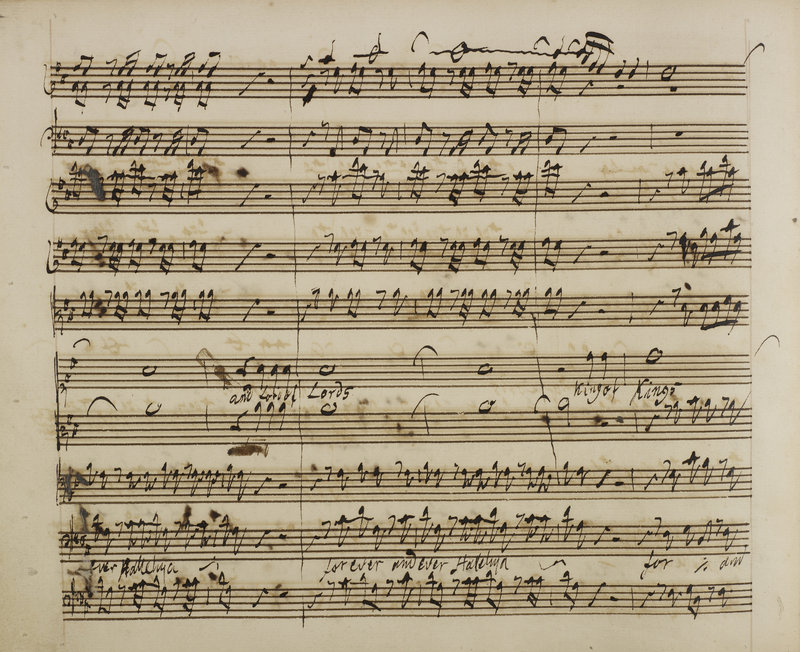
009276


The musical notes appeared on the score as fast as he could draw them.

Melodies and harmonies not only filled his mind, they resonated in his soul. In fact, they consumed him. He ate little and barely slept. For twenty-four days he wrote.  And wrote.  And wrote.

The music maestro? George Frederic Handel (1685-1751).


CGHandel


The composition? Messiah.

Imagine the magnitude of composing such a lengthy piece in such a short time. My personal copy of the vocal score is 252 pages. That would mean Handel produced more than ten pages per day—not just a line of melody, but often four-part harmonies for twenty choral numbers AND orchestration for the entire piece. No doubt most of us would struggle to copy that much music, much less create it.

One of Handel’s biographer’s, Sir Newman Flower wrote, “Considering the immensity of the work and the short time involved, it will remain, perhaps forever, the greatest feat in the history of music composition.”

The idea for the oratorio actually originated with Handel’s friend, Charles Jennens. He was a librettist, a writer of operatic text. He and Handel had collaborated on three previous works.

Jennens wrote to Handel in 1741 that he wanted to create an anthology of scripture on the life of the Messiah. His idea was to tell the story of Christ, strictly through passages of scripture set to music. Jennen’s text included seventy-two verses.

Handel immediately became enthused about the idea. Perhaps he saw the potential for such a piece during an era when illiteracy was widespread and Bibles much too expensive for most people to own. This composition would teach the scriptures through music.

So he created the concept of oratorio: a musical composition for voices and instruments, narrating a sacred story without dramatic action or costumes.

Handel told Jennens it would probably take a year to compose all the music for so much text. But he finished in less than four weeks, never leaving the house during that time.

I can only imagine Handel’s euphoria as he sensed God’s inspiration of the glorious melodies and ingenious harmonies.

Upon completing the “Hallelujah” chorus, he turned to his servant with tears in his eyes. “I did think I did see all Heaven before me, and the great God Himself,” he cried.

Sometime during those twenty-four days, a friend visited Handel and found him sobbing with intense emotion. Handel could not put into words the depth of his spiritual experience as he composed. Later he borrowed words from Paul (2 Corinthians 12:2), in an effort to recount the indescribable:


quote-whether-i-was-in-my-body-or-out-of-my-body-i-know-not-god-knows-it-george-frideric-handel-234765

(“Whether I was in the body or out of my body when I wrote it I know not.”)

According to music scholar, Richard Luckett, the number of errors in Handel’s draft is remarkably small for a document of its length. Might that be another indication of divine inspiration?

Surely Handel realized that the music had not come from his creative abilities alone. At the end of his manuscript is the inscription: SDG—Soli Deo Gloria, which means “to God alone the glory.”

Because we often associate Messiah with Christmas, we may think the first performance occurred during Advent. But Handel intended the oratorio to be an Easter offering. The debut occurred on April 13, 1742—two hundred seventy-two years ago this Sunday. Handel conducted the performance himself.

A reviewer of that first concert wrote, “The sublime, the grand, and the tender, adapted to the most elevated, majestic and moving words, conspired to transport and charm the ravished heart and ear.”

That assessment has remained accurate through the decades, even till now.

For many years I sang in choirs that performed Messiah without knowing the story behind the oratorio.  Now, more than ever, I add my voice to Handel’s and millions across the years who proclaim, “Soli Deo Gloria–to God alone the glory,” for this magnificent piece of music.

I hope you feel the same.


(Sources:  www.beliefnet.com; http://www.thinkinaction.org; http://www.christians.com; http://www.christianity.com; http://www.patheos.com.)


(Photo & art credits:  www.prints.bl.uk; http://www.baroquemusic.org; http://www.izquotes.com.)


Read Full Post »

Supposedly, these housewife tips were circulated in the late 1800s:

“Have dinner ready, prepare yourself, be fresh-looking, clear away the clutter, prepare the children, minimize all noise, be happy to see him, listen to him (remember his topics of conversation are more important than yours), make him comfortable, take off his shoes, be a little gay.”

If that was the prevailing attitude, we might smugly comment, “That advice had to be written by a man.  As if the woman of the house hasn’t put in a long day already, cleaning, cooking, laundering, ironing, taking care of the children, and more.  Now she gets to wait on her husband?  Ridiculous!”

If exposed to enough old nonsense, such as the above, we’re likely to miss true gems.  We see an old picture, a copyright date from decades ago, and we think the article or book will be as worthwhile as those housewife tips.  But that’s not necessarily the case.

For example, allow me to introduce you to Desiderius Erasmus, born around 1467 in Holland.

Erasmus was a teacher, theologian, and author, critical of the Catholic church and its abuses of the time.  One belief held by the church hierarchy:  Scripture is much too complicated for the common man to understand.  Only priests should have access to the Bible, and they are the only ones qualified to interpret for the masses.

Erasmus wrote:  “I disagree very much with those who are unwilling that the Holy Scripture…be read by the uneducated, as if Christ taught such intricate doctrines that they could scarcely be understood by very few theologians.”

Such writings helped prepare the way for Martin Luther and the Protestant Reformation.

The common sense of Erasmus becomes obvious in more quotes such as these.

  • “If you keep thinking about what you want to do or what you hope will happen, you won’t do it and it won’t happen.”
  • “Prevention is better than cure.”
  • “A nail is driven out by another nail; habit is overcome by habit.”

Good advice, even if it is five hundred years old.

Throughout the centuries, women, too, have acquired wisdom to share. Unfortunately, most was never published.  In the male-dominated world of past generations, women were not offered that privilege.

One exception is Julian of Norwich, born 1342.  She actually prayed for a serious illness to help her understand the sufferings of Jesus.  At age thirty, the illness came, accompanied by sixteen visions.  She spent the rest of her life meditating on her visions and writing about them.  Her book was the first written in English by a woman.  Here are several of her truth gems:

  • “The greatest honor we can give Almighty God is to live gladly because of the knowledge of his love.”

Sounds like an addendum to Paul’s instruction to rejoice always (Philippians 4:4).  I appreciate the sweet motivation she offers for finding joy in each day.

  • “Truth sees God, and wisdom contemplates God, and from these two comes a third, a holy and wonderful delight in God, who is love.”

Oh, yes.  The more we know of God, the more we direct our thoughts to Him, the more we enjoy Him!

  • “Of all the things our minds can think about God, it is thinking upon his goodness that pleases him most and brings the most profit to our souls.”

Again, such astute observations.  Even if formulated six hundred years ago.

*     *     *     *     *     *     *     *     *      *

Thank you, Father, for preserving a wealth of evidence, confirming your presence and inspiration throughout the ages.  Thank you for the testimony of thousands of the saints from ages past. Their perseverance and faith continue to inspire us centuries later.  May we not be among those who ignore the wisdom you have already revealed. 


(Photo credit: http://www.jenikirbyhistory.getarchive.net.)

Read Full Post »

Portrait_of_George_Washington

Many of our founding fathers were men of Christian faith.  The record of their background, correspondence, and character attests to that fact.  Consider:

  • Twenty-four of the fifty-six men who signed the Declaration of Independence attended seminary or Bible school.
  • Hundreds of letters of these men speak of God and their faith in Him.
  • Honor and integrity were important attributes which characterized their lives.  Most of them sacrificed much for the cause of American liberty.  “With firm reliance on the protection of the divine Providence*, we mutually pledge to each other our Lives, our Fortunes, and our Sacred Honor,” they declared.

George Washington was no exception. With great integrity,  courage, faith, wisdom, and humility, he was instrumental in bringing America through perilous times.  We should know his legacy well, and follow his example.  Can you imagine an America where men and women would display…

 …The Integrity of George Washington

Washington was the only president unanimously chosen by the electoral college, an indication of the trust the American people invested in the general.  Frequently throughout his life, he demonstrated strong reliance on God.  Remember the portrait of him, kneeling in prayer at Valley Forge?    And decades after his death, pastors were still preaching sermons that honored his exemplary life.

…The Courage of George Washington

Washington’s accomplishments can be rivaled by few.  At age 23 he was commissioned colonel at the outset of the French and Indian War (1754).  His courage was legendary.  In one battle he directed the troops while riding up and down the front lines on his horse, seemingly not to care he was an easy target.  After that battle (which the British and American forces won), George wrote home that his safety was the result of “the miraculous care of Providence*.”

…The Faith of George Washington

Washington recognized that God had been strongly involved in the colonies’ battle for liberty.

“The hand of Providence* has been so conspicuous in all this that he must be worse than an infidel that lacks faith and more than wicked, that has not gratitude enough to acknowledge his obligations.”

His first act upon being sworn in as President?  He prayed, reminding his listeners at the inauguration that it is Almighty God who presides over the universe.  Washington also closed his inaugural address with prayer.

As he signed official government documents, he often concluded with the closing, “In the year of our Lord Christ.”

…The Wisdom of George Washington

In an address given in 1796, George wisely stated:  “Of all the dispositions and habits which lead to political prosperity, religion and morality are indispensable supports.”

(Might the economic and political decline now happening in America be the result of those supports–religion and morality–being slowly but surely removed?)

…The Humility of George Washington

In spite of a long list of outstanding accomplishments over a lifetime of sacrificial service to his country, Washington said:  “I have only been an instrument in the hands of Providence*.”

What chance did the weak, floundering colonies have to become a strong, prosperous nation?  Small, indeed.  But God used men of Christian character such as Washington to achieve the impossible.

What chance does our nation have today, to recapture our strength and prosperity?  Small, indeed.  But, God can use men and women of Christian character, just as he did George Washington–those willing to follow God’s lead and live sacrificially, to achieve the impossible. Because “nothing is impossible with God (Luke 1:37) .”

*     *     *     *     *     *     *     *     *     *

*Providence was a word used frequently in early America, to indicate God’s active care and protection.  Noah Webster, in his first dictionary (1828), noted that Divine providence is often understood as God Himself.  The word appeared over 100 times in the Geneva Bible, the translation of choice among many early Americans.  Now the word is translated with synonyms for care, such as “tender mercies,” “loving kindness,” and “protection.”

Because the word, providence, no longer appears in our Bibles, some have concluded that those forefathers who used the term were Deists who believed in an impersonal God.  But many outspoken Christians of the day used the term, including Rev. Dr. John Witherspoon (minister and signer of the Declaration), John Quincy Adams (officer of the American Bible Society, active patriot, and sixth president of the United States), John Jay (president of the American Bible Society and first chief justice of the Supreme Court), and Dr. Benjamin Rush (founder of the Sunday School in America and signer of the Declaration).  All of these men and others, whose allegiance to Christ is verifiable in their writings, also  included many references to Providence in their works.

(Sources:  The Founders’ Bible, http://www.wallbuilders.com, http://www.ochristian.com)

(Art Credit:  www.en.widipedia.org)

Read Full Post »

Have you ever noticed that, except for the first line, the familiar Thanksgiving hymn, “We Gather Together” is not about God’s blessing?

We sing such statements as:

  • The wicked oppressing now cease from distressing
  • So from the beginning the fight we were winning
  • Let Thy congregation escape tribulation

Don’t those seem strange concepts to emphasize on a day set aside for thanks?

The truth is:   although Thanksgiving is about gratitude, it is also a celebration of religious freedom.  That was surely on the minds of the Pilgrims back in 1621.

Freedom to worship God, and to read the Bible for themselves, were among the chief reasons the small band of believers left England for Holland in 1609.  Then, as circumstances became difficult there as well, they courageously set out for America to establish their own colony (albeit with a charter from the king of England, which granted them permission to inhabit the Virginia Colony).

The Pilgrims had faced the threat of imprisonment and death in Holland as well as England.  In addition, the trip to America included such hazards as shipwreck, illness, and accident.

Yet troubles only mounted upon reaching the New World.  The Mayflower landed too far north–at Cape Cod—not in Virginia as planned.  A late launch and a sixty-six day voyage on stormy seas (instead of the planned three weeks) meant they arrived in late fall.  Shelters were not completed until February.   Then there were Indians to worry about.

Yet they were willing to face all these challenges in order to establish a colony “for the Glory of God and Advancement of the Christian Faith” (from the Mayflower Compact).

The third line of the hymn  speaks of one joy they embraced:  “The wicked oppressing” (King James of England and his bishops) “now cease from distressing.” God had removed the Pilgrims far out of the king’s reach.  No longer could he persecute them.

The first verse ends with:  “Sing praises to His name.” There is no historical record that the Pilgrims sang at their first Thanksgiving celebration in 1621.  But music was typical at their gatherings, so perhaps they did participate in a psalm or two.  After all, the feasting lasted three days!

Undoubtedly the Pilgrims would have offered their prayerful thanks– even though half their number had died the previous winter, and the first harvest had been quite meager.  (The ninety Native Americans who attended that celebration actually brought most of the food.)

The second verse of the hymn begins:  “Beside us to guide us, our God with us joining.”

God certainly chose an interesting way to guide the Pilgrims and join with them in surviving the harsh conditions of New England.  Remember Squanto?  He’s the one who showed the Pilgrims how to fertilize the soil with fish.  Without that first crop of decent corn, the Pilgrims never would have survived.

Even more amazing?  Squanto just happened to speak English!

The third verse of “We Gather Together” begins:  “We all do extol Thee, Thou Leader triumphant.”  The Pilgrims honored God as Lord.  They recognized that from him all blessings flow.  And the hymn concludes:  “Thy name be ever praised; O Lord, make us free.”

In actuality, this hymn was not written as a direct tribute to the Pilgrims’ experience.   It dates back to Holland, in the late 1500s, written in celebration of a Dutch victory over the Spanish at the Battle of Turnhout (1597).

Under the rule of Spain’s King Philip II, Dutch Protestants had been forbidden to gather for worship.   Perhaps the Pilgrims heard the song while living in Holland.  But the words we sing today were translated into English by Theodore Baker, in 1894.

Even so, the words remind us that the Pilgrims suffered much and risked everything to found a colony where they could gather together in freedom—to proclaim:

“All glory be Thine!”

May we, too, extol our Leader triumphant, as we sing this hymn through the coming week.

(Sources:  The Founders’ Bible, www.plimoth.org, History News Network at http://www.hnn.org )

Read Full Post »

Boris Nicholayevich Kornfeld, political prisoner of the former Soviet Union.

Incarcerated in the late 1940s at Ekibastuz, a forced labor camp, in Siberia.

A doctor.

Because of his medical training, the camp authorities put him to work in the hospital.

Dr. Kornfeld was Jewish, but a Christian prisoner attracted his attention.  The man evinced a quietness of spirit, in spite of the horrors, deprivation, and hopelessness of their situation.  Often the doctor would hear this fellow prisoner reciting the Lord’s Prayer.

One day, a guard was brought into the surgery.  An artery had been cut during a knifing incident.  As Dr. Kornfeld began to repair the artery, he thought, I could make the sutures in such a way that this horrid man would slowly bleed to death later.  The authorities would ever know.

But no sooner did the idea cross his mind than Dr. Kornfeld’s stomach turned at the cruelty of his own thoughts.  Words from the Lord’s Prayer came to his mind, and he spoke them silently in his heart:  Forgive us our sins as we forgive those who sin against us.

Day by day, Dr. Kornfeld sensed change occurring in his spirit.  He wanted to speak to the Christian prisoner about his experience in the surgery, to discuss what was happening within himself, but the fellow had been transferred to another gulag.  The doctor told no one about his growing faith in Jesus.

As he was being transformed on the inside, Dr. Kornfeld’s character began to change.  He started saying “No” to some of the sordid practices of the prison camp. Once he reported on an orderly who had stolen food from a dying patient.  Such misdeeds were actually quite common.  After all, why waste food on someone who was going to die anyway?

But telling the authorities what was going on put Dr. Kornfeld in danger.  No one was going to appreciate his sense of fairness and kindness.  Every prisoner lived for himself, doing whatever was necessary to survive.

One evening, Dr. Kornfeld examined a patient named Alex, who had undergone surgery for cancer.  He felt compelled to describe to Alex his journey toward faith in Christ.  The words came in a flood.  For at least several hours, Kornfeld spoke to the young cancer patient.

The next morning, Dr. Kornfeld was dead.  Someone had beaten him in the head with a mallet.

Alex thought long and hard about the doctor’s story and his life-changing faith.  He, too, decided to become a Christian.  Miraculously, Alex survived the gulag and wrote about his experiences there.  The book was smuggled to the West and published.

More books followed, all revealing the cruel and disastrous results of the Soviet system under the leadership of Stalin.  (At least sixty-five million Russian citizens were murdered in the gulags.)

That prisoner-become-author was Alexander Solzhenitsyn, who won the Nobel Prize for Literature in 1970.  One Day in the Life of Ivan Denisovich (published in November 1962) and The Gulag Archipelago (December 1963) were two of his most famous works.  Many credit his writings as the beginning of the end of the Soviet Union.

Photo of Aleksandr Solzhenitsyn in 1953, right...

Photo of Aleksandr Solzhenitsyn in 1953, right after his release from the special Gulag camp at Ekibastuz (Photo credit: Wikipedia)

But certainly Dr. Boris Kornfeld also deserves credit.  His influence was an important catalyst.  And what about the nameless Christian who introduced Dr. Kornfeld to Jesus?

He also was used by God in a chain of events to achieve great impact upon the world.

But no one knew, including himself.  He very likely died in the gulags.

Oh, but consider his home-going to heaven.  Think of Jesus, wrapping his arm around the shoulders of this saint, saying “Well done, my devoted one.  Have I got a story for you!  Come and let me share what you have been a part of!”

We must not allow fear or anonymity to dissuade or discourage.  God may use any one of us to change the world, but he may very well wait to reveal our impact until he can tell us all about it — face to face!

*     *     *     *     *     *     *     *     *     *

Heavenly Father, may I never miss an opportunity to be a part of your grand, over-arching plan.  May the legacy of Dr. Kornfeld, Alexander Solzhenitsyn, and millions of nameless martyrs compel me to be courageous and passionate for you.  I have nothing important to lose and everything worthwhile to gain.

Read Full Post »

Remember those black and white portraits in our history textbooks–those figures posed stiffly with expressionless faces?   They looked more like statues than real people.  In fact, they appeared downright bored, didn’t they?

Take A.B. Simpson here.

Albert Benjamin Simpson

Albert Benjamin Simpson (Photo credit: Wikipedia)

He looks the part of a serious preacher, which he was.  Reverend Simpson was also a theologian and prolific author.  He wrote 101 books, numerous hymns, periodicals, articles, and even complete curriculums.

Oh.  And he founded a denomination.  A rather impressive list of accomplishments.  No wasting time for Albert.

But A.B. did much more than sit in a book-lined office with stacks of research everywhere.  While pastoring a prestigious church in New York City, God laid a special call upon his heart–to establish a church specifically for the immigrants pouring into the city.  A.B. felt burdened for the poor, homeless, sick and displaced.

Yet his dream did not stop there.  Albert wondered how he could reach people overseas who did not yet know Jesus.  And one thing began to lead to another.  He gathered like-minded people together that led to Sunday afternoon meetings, which became revivals along the East Coast.  And The Christian and Missionary Alliance denomination was born.

From the soul of such an impassioned, focused, persevering man came these warm-hearted words:

Let us but feel that

He has His heart set upon us,

that He is watching us from those heavens

with tender interest,

that He is following us day by day

as a mother follows her babe

in his first attempt to walk alone,

that He has set His love upon us,

and in spite of ourselves

is working out for us

His higher will and blessing,

as far as we will let Him –

and then nothing can discourage us.

–A. B. Simpson (1843-1919)

Knowing that A.B. gave his life in selfless service, I find his words all the more meaningful.  Surely he felt God’s heart set upon him and following close during his many endeavors, that his Heavenly Father was working things out–in spite of himself.  Not just minimal sustenance, but for God’s higher will and blessing.

I like that.  Those words “higher will and blessing” hold hope and excitement for what’s to come for each of us, as God’s plan unfolds indefinitely until we meet him face to face.

I’m with A.B;  I want nothing to hold me back.  No doubt you feel the same.

*     *     *     *     *     *     *     *     *     *

Thank you, Heavenly Father, for introducing me to A.B. Simpson today.  I love this quote that highlights your compassionate love, your desire to use us, and even bless us.  May I be mindful of your watchfulness, and then nothing can discourage me.  


Read Full Post »

« Newer Posts - Older Posts »