Feeds:
Posts
Comments

Archive for the ‘Maturity’ Category

‘Won’t be long and we’ll either be the asker or receiver of the question, “What would you like for Christmas?”

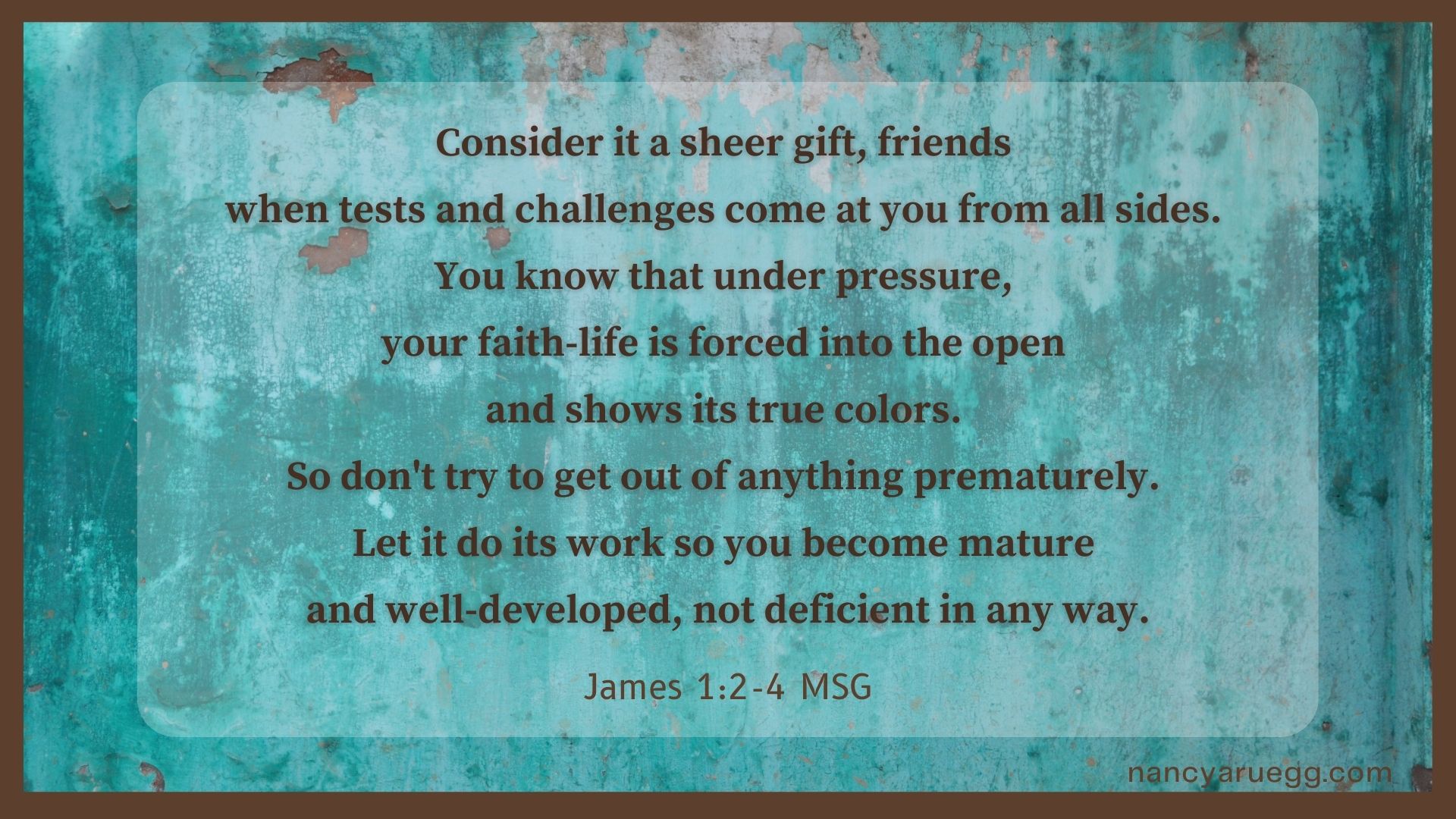
Here’s one answer you likely won’t hear: “Give me some tests and challenges, please!”

And yet, in the Bible we find this encouragement written by James, the half-brother of Jesus:

What could he possibly have meant? How can tests and challenges be considered gifts?

And then we might remember the saying, “What doesn’t kill you makes you stronger.”

James does mention strength that comes from perseverance, contributing to maturity and spiritual competency (v. 3). But difficult circumstances produce even more, including these ten aspects of the gift of trials:

GREATER GODLINESS

Pressure will make us into the kind of people God wants us to be—more responsive to him, more like him [1]. (And isn’t that who we want to be also?)

HEIGHTENED AWARENESS OF GOD’S PRESENCE

In the darkness of adversity, we’re able to see more clearly the radiance of his face. It happens as we spend time with him, and he ministers to us [2].

INCREASED SPIRITUAL POWER

God creates more friction when he desires to create more power in our lives [3].

Think of Joseph’s trials before becoming prime minister of Egypt, or David’s troubles while on the run from King Saul, or Jonah’s suffering in the belly of the great fish before preaching in Nineveh.

STRENGTHENED CONFIDENCE

Trouble strengthens our confidence that with God, we can endure whatever difficulties the future may hold [4].

A CLEARED PATHWAY

Some storms come, not to disrupt our lives, but to clear our path [5].

For example, a young couple we know put an offer on a house they really liked, but the sale fell through. Highly disappointing, of course, but that cleared the path for a better-suited home at a better price.

And during the season of waiting, they learned lessons in faith and perseverance.

ENHANCED EMPATHY

The pressure we endure helps us understand the challenges faced by others, equipping us to empathize and help [6].

ETERNAL INFLUENCE

God will make our sacrifice of suffering count for all eternity [7]. The person who serenely trusts God to bring good out of their pain demonstrates the power of faith and draws others to Christ.

SWEET DISCOVERIES

“It is often through the most difficult trials that God brings the sweetest discoveries of himself” [8].

During a particularly trying season, I sensed God next to me in the car every day while driving to the school where I taught. His sweet presence was so palpable I sometimes had to blink away tears.  

A SIGN OF VALUE

Trials indicate we’re precious to God. Otherwise, why would he spend so much time and energy perfecting us [9]?

ENHANCED JOY

Paul wisely advised we think on those things that are excellent and praiseworthy [10], turning our minds from what hurts to what helps—gratitude. To do so magnifies our joy, even during troublesome times.

These bits are from my gratitude journal:

  • An hour-plus of fun with the toddlers at church. Who can think about troubles when playing with little ones?
  • Six different species of birds, frolicking in the backyard trees–a veritable circus to enjoy.
  • The prayer of a friend that warmed the heart and lifted the spirit
  • The treasure of family, whose love and support are especially meaningful during stressful times
  • The good medicine of laughter. I texted our younger son that his third niece had taken her first steps. “I don’t understand what the big deal is,” he wrote back. “I’ve been doing that for years!”

And there you have it. Ten facets of the sheer gift that tests and challenges bring into our lives—all wrapped in God’s unfailing love.

The question is, will we receive it?


[1] Selwyn Hughes, Every Day Light, 142; Romans 12:1; 2 Corinthians 3:18

[2] Sarah Young, Jesus Calling, 361; Psalm 89:15-17a

[3] Based on an A.B. Simpson quote.

[4]Sarah Young, Jesus Always, 152; Philippians 4:13 AMP

[5] Unknown.

[6] A.B. Simpson, quoted in Streams in the Desert, 197; Philippians 1:6 AMP

[7] F. Elaine Olsen, Beyond the Scars, 163.

[8] L. B. Cowman, Streams in the Desert, Jim Reimann, ed., 143.

[9] L. B. Cowman, 77.

[10] Philippians 4:8

Image credits: http://www.canva.com (4); http://www.stockcake.com.

Processing…
Success! You're on the list.

Read Full Post »

Remember the Sesame Street game, “One of These Things Is Not Like the Others?”

See if you can find the misfit in this list of especially nutritious superfoods. One of these things is not like the others! Berries, cruciferous vegetables, cucumber, fish, leafy greens, legumes, nuts, olive oil, tomatoes, whole grains, and yogurt [1].

Did you choose cucumber? You win! Go eat some broccoli as a special winner’s treat!

And know this: prioritizing these foods on our plates leads to beneficial outcomes, including more energy, lower blood pressure and cholesterol, plus less risk of diabetes, depression, cognitive decline and even some cancers.

It’s no secret: our souls also need to be fed well. Choose the best options and experience such outcomes as these: lower anxiety, less depression, more contentment in life, and improved ability to handle life’s challenges with confidence and hope [2].

In addition, the well-fed soul tends to be resilient, able to navigate the ups and downs of everyday life [3].

So what are the best options for feeding our souls? There are a number of them, but for today, we’ll concentrate on just five.

No doubt they’re familiar to you. But I’d encourage you to at least skim-read below for an A-HA moment or two. I found worthwhile insights among the following; perhaps you will too.

BIBLE STUDY

The Center for Bible Engagement conducted extensive research to determine what happens when people engage with scripture at least four times per week. They found that people involved in Bible study are:

  • more pro-active in their faith (improving their quality of life as a result)
  • less likely to deal with bitterness, unforgiveness, discouragement, and more
  • more likely to resist temptations such as excess drinking, lashing out in anger, gossiping, or lying [4]

There’s much joy to be experienced in Bible study as well.

Theologian Jonathan Edwards (1703-1758) wrote that the Bible communicated “such refreshing food,” that “almost every sentence seemed to be full of wonders” [5].

I couldn’t agree more and know many of you would also.

PRAYER

And what might those changes include?

  • Less anxiety and more peace (Philippians 4:6-7)
  • Improved attitude as trust replaces doubt and hope replaces despair (Isaiah 40:31)
  • More understanding of God’s will (Colossians 1:9)
  • Greater endurance (Colossians 1:9-11)
  • Fine-tuned perspective as we allow God to reorient our thinking (Romans 12:2)

PRAISE AND WORSHIP

“Praise . . . is one great means of promoting the growth of the spiritual life. It helps to remove our burdens, to excite our hope, and to increase our faith.

“It is a healthful and invigorating exercise which quickens the pulse of the believer and prepares him for fresh enterprises in his Master’s service” (Charles Spurgeon) [6].

Here’s a praise-appetizer to whet your taste for glorifying God:

GRATITUDE

Gratitude is not just for those times when blessings abound.

“What was the prayer Daniel prayed right before being thrown in the lions’ den . . . ? Thanksgiving. What was Jonah’s prayer right before he was finally delivered onto dry land? Thanksgiving. How are we instructed to pray in Philippians 4:6 when we feel anxious? With thanksgiving. And what is the outcome . . . ? Peace” [7].

And that’s just one of many glorious benefits of gratitude—even when circumstances don’t seem to call for it. You can augment the positive impact by keeping a gratitude journal [8].

COMMUNITY

If we’re going to grow spiritually, we need the encouragement, prayer, and insight of other Jesus followers. Character and wisdom do not develop in a vacuum; interaction with others is an important factor [9].

All of these things—Bible study, prayer, praise and worship, gratitude, and community—are alike, in that they lead to the exceptionally satisfying life Christ offers [10].

Bon appétit!


[1] https://www.health.harvard.edu/blog/10-superfoods-to-boost-a-healthy-diet-2018082914463

[2] https://www.focusonthefamily.com/get-help-how-practicing-spiritual-disciplines-can-positively-impact-your-mental-health/

[3] https://www.healthline.com/health/emotionalhealth

[4] https://www.centerforbibleengagement.org/post/bible-engagement-a-key-to-spiritual-growth

[5] www.gracequotes.org

[6] Morning by Morning, 306.

[7] Lysa Terkhuerst, Embraced, 257.

[8] See https://nancyaruegg.com/2020/11/19/one-single-strategy-for-an-exceptional-life/

[9] Kenneth T. Aiken, Proverbs (from the Daily Study Bible Series), 170.

[10] John 10:10; Colossians 1:9-10; 1 Thessalonians 5:17; Psalm 34:1-3; Proverbs 27:17

Image credits: http://www.freerangestock.com; http://www.stockcake.com; http://www.canva.com; http://www.rawpixel.com; http://www.pickpik.com; http://www.stockvault.net.

Processing…
Success! You're on the list.

Read Full Post »

(A personal, prayer-response:)

How I love this passage, Lord, with its comfort and reassurance!

Paul reminds me here that You, O God, are all-wise and all-knowing; You know what’s best for each of us.

You cause all things to work together for our benefit, for those who love You (Romans 8:28).

Sometimes though, I have to admit, certain events confound and frustrate me. My finite mind cannot understand what good you could possibly bring out of:

  • Severe financial setbacks for a godly family
  • A rejection letter from a mission board for an eager candidate
  • An announcement of divorce between a respected couple in the church
  • A cancer diagnosis for a young mother
  • The death of a child

But those of us who trust in You know that we can count on Your wisdom and knowledge in all things, and the absolute dependability of Your character—Your benevolent goodness, Your perfect righteousness, Your deep compassion, Your unfailing faithfulness and infinite love (to name a few)—even in the face of struggle and tragedy.

Remind me, Father, that “making room for mystery in my worldview”(1) is an important element of spiritual maturity.

And to demonstrate that mature trust, I can follow Job’s example. His first response to catastrophe was worship (Job 1:20).

And as I worship, I can praise and thank You, not only for those blessings I see but also for those I can’t.

Help me Father to rest in the knowledge that:

  • Out of Your infinite wisdom, You select the best possible conclusion of events, and You adopt the best possible means for accomplishing that conclusion (2).
  • You are the Most High God, Lord of heaven and earth. You are subject to no one and influenced by no one; neither can anyone thwart or hinder Your plans (3).
  • Even my mistakes could never obstruct Your will.
  • You, on the other hand make no mistakes. Your choices for me are always right, because they come from Your perfect mind and heart. You always know exactly what you’re doing.
  • “Everything from You and for You” (v. 36) often includes mundane tasks, tedious routine, and lack of recognition. But I can count on the fact that, “in the midst of what seems terribly ordinary, You—in your wisdom and power–are doing something extraordinary” (4).
  • Everything serves Your purpose (5). You direct everything toward the conclusion you ordained for it.

May I be joyfully submissive to Your plans for me, in light of these marvelous truths!

Notes:

  1. Sarah Young, Jesus Always, 65. 
  2. Based on a J. L. Dagg quote, www.gracequotes.com.
  3.  Based on an A. W. Pink quote, www.gracequotes.com.
  4. Alice Mathews, A Woman God Can Use, 77.
  5. A quote my dad copied into one of his Bibles, source unknown.

Image credits: http://www.canva.com

Processing…
Success! You're on the list.

Read Full Post »

Most tourists to Rome will visit St. Peter’s Basilica and find their way to the Chapel of the Pietá. There resides the striking statue carved by Michelangelo when he was only twenty-four years old.

For the viewer, the subject matter evokes sad commiseration with the grieving mother, and yet the artistry of the statue manifests incomparable beauty in Mary’s tranquil expression, the luxurious folds of her robe, and the peaceful repose of Jesus’ face.

Perhaps Michelangelo wished to convey Mary’s relief that the anguish of her Son was over. Jesus’ expression might indicate his satisfaction in perfectly executing the Father’s mission.  

The Pietá gives evidence: beauty may be its most captivating when viewed in juxtaposition against suffering. And Michelangelo superbly represented the two entities in this one statue.

Yet there is One who surpasses even the great Renaissance sculptor in the compelling intertwining of beauty and suffering: our heavenly Father. His medium? The lives of his children.

He can make all things beautiful—even suffering.

Perhaps you’ve known people who’ve endured much—physically, mentally, and/or emotionally. And among them are those who’ve manifested the beauty of strong faith.

We’ve seen heavenly joy in their eyes, even amidst the tears.

We’ve heard the winsome affirmations of God’s palpable, sustaining presence and even of God’s blessings during their season of trouble.

We’ve witnessed their striking maturity in the way they react to their circumstances.

 These saints have embraced the truth that:

How do people find the wherewithal to radiate such loveliness of spirit even as they suffer?

Beauty-in-Suffering Begins with Trust

Of course, it begins with strong trust in God—in his sovereignty over all things, his grace to uphold, and in his power to accomplish purpose through hardship. Such people can say:

–Dr. Charles Stanley, Advancing through Adversity, 78.

Can you also see the beauty of joy on the face of such a witness? How do we grow a strong trust like that?

Beauty-in-Suffering Grows with Intimacy

The formula for growing intimacy with God is quite simple: Prayer + the Word + Time [1].

The closer we walk with God, the less room there is for any other thing to come between us, including trouble, hardship, or pain. In addition, we begin to reflect the glory of his beautiful character [2]!

Beauty-in-Suffering Impacts Others

The question is, will the impact be characterized by the ugliness of complaining, negativity, and self-pity? Or will it be the beauty of vibrant faith, contagious joy, and a settled peace?

Meet Anik, a young African father who was suffering through illness and finding it difficult to provide for his family. Nearby another household also dealt with hardship, and yet their quick smiles and frequent laughter indicated a happiness Anik craved.

He could hear them worship God and pray. They even prayed for him! Anik finally asked them about this God they praised. They told him about Christ, and the family shared their Bible with him.

Upon reading the stories about Jesus, Anik prayed to receive him into his life. So did his family, and they found their hearts transformed.

Their circumstances didn’t change immediately, but they did [3].

May the beauty-in-suffering illustrated by the Pietá and reflected in those like Anik’s neighbor, be evidenced in us also.

*     *     *     *     *     *     *     *     *     *

We praise you, O God, for gifting us with extra measures of your peace and presence—even joy—when difficulty invades our lives. Only you can bring beauty out of suffering! Help us to lean upon you in ever-deepening faith, to carry us through until the final day of triumph. 

(Psalm 34:18; Philippians 4:5-7; Romans 5:3-5;

2 Corinthians 2:14)


[1] Joanna Weaver, Having a Mary Heart in a Martha World, 77.

[2] 2 Corinthians 3:18

[3] www.wycliffe.org/blog/posts/the-light-of-hope-scripture-passages-for-hard-times-.

Image credits: http://www.flickr.com; http://www.canva.com (2); http://www.en.wikipedia.org; http://www.heartlight.org.

Processing…
Success! You're on the list.

Read Full Post »

No Christmas season would be complete without the reading of the second chapter of Luke—the account of Mary and Joseph traveling to Bethlehem, presiding over the birth of Jesus in a stable or cave, and receiving shepherd-guests.

Toward the end of the account, as those shepherds were spreading the word of Jesus’ birth, Luke wrote, “Mary treasured up all these things and pondered them in her heart” (v. 19).

Indeed. She had much to process:

  • Her baby was the Messiah, the Promised One, who would save his people from their sin. I wonder if she studied him, looking for signs that he was different from other infants.
  • This was the Prince of Peace cradled in her arms. Yet he had been born to a common village girl in very primitive conditions.  Did that seem strange to her?
  • The shepherds had learned of his birth when angels visited them, just as the angel, Gabriel, had visited Mary and then Joseph.  Gabriel had also visited Zechariah, the father of John the Baptist. Four angel visitations in a matter of months. Never had that happened before.

I find myself pondering, too—pondering Mary herself–this dear, young girl who carried a tremendous burden for a long time.

Dear means beloved and valued. Mary is certainly that for numerous reasons.

  • She embraced Gabriel’s announcement with great faith. “May it be to me as you have said,” (Luke 1:38). She put herself in the care of God in spite of incomprehensible circumstances.
  • Her prayer, the Magnificat (Luke 1:46-55), gives indication of a heart fully committed to God.
  • She endured much: shame for her pregnancy, a long, uncomfortable journey to Bethlehem, and crude circumstances for the birth of her Son.

Mary was young—perhaps between thirteen and fifteen years of age. That was the typical age for a girl to be married in Bible times.

Yet, young as Mary was, Gabriel praised her for being “endued with grace” (v. 28, AMP). In addition, Mary demonstrated stamina, maturity, and gentleness beyond her years.

No doubt God graced her with these traits. But I have to believe Mary also had freedom of choice, as we all do, to embrace God’s way for her.

What I ponder most, however, is the fact Mary carried a tremendous burden, given to her by an elderly man, Simeon, eight days after Jesus was born.

You undoubtedly remember the story. Joseph and Mary took Jesus to the temple at Jerusalem to be circumcised.

There they met the righteous and devout Simeon who had been waiting decades for the Messiah. The Holy Spirit had revealed to him he would not die until he had seen the Lord Christ.

Immediately upon seeing the Child, Simeon knew this was the One.

He praised God for keeping his promise, blessed Mary and Joseph, and then spoke particularly to Mary, saying Jesus would cause some to rise and some to fall, he would be spoken against, the thoughts of many hearts would be revealed, and a sword will pierce your own soul too (Luke 2:21-35).

Those last words must have caused Mary’s eyes to grow wide and her heart to skip a beat. Wasn’t the worst behind her? Surely Mary wanted to ask Simeon, “What do you mean?” Scripture gives us no indication that she did so.

For thirty-three years those last words of Simeon must have echoed in Mary’s mind again and again. How does a person live with such long-term foreboding? Perhaps her mind turned back to the night of Gabriel’s visitation.

Perhaps, for thirty-three years, Mary repeated what she had told the archangel: “I am the Lord’s servant. May it be to me as you have said” (1:38).

Mary may very well have developed the calm assurance that even when God’s ways are baffling, we can rest assured he is orchestrating events to accomplish far more than we could ever imagine (Ephesians 3:20). She’d been witness to such orchestration in Bethlehem.

Mary knew that even our personal hardships can fulfill purposes that extend far beyond ourselves.

That’s a lesson for all of us to embrace with calm assurance.

(Revised and reblogged from December 15, 2014, while we enjoy a blessed week with family!)

Photo credit: http://www.stocksnap.io.

Processing…
Success! You're on the list.

Read Full Post »

Looking ahead at the calendar for 2024, I found more than a few wild-and-crazy celebrations in store for those who care to participate. Just in January alone, we can look forward to:

  • National Cream Puff Day—January 2 (Who thought this was a good idea right after the holidays when so many will be embarking on diets?)
  • World Logic Day—January 14 (If only we could fix in one day the irrational and absurd thinking that seems to be increasing these days.)
  • National Popcorn Day—January 19 (This one I can get behind!)
  • National Blonde Brownie Day—January 22 (If you prefer cream cheese brownies, your day is coming February 10.)
  • National Backwards Day—January 31 (Seems like we’d benefit more from honoring evidence of going forward—toward integrity, responsibility, and maturity.)

Didn’t I tell you they were wild-and-crazy observances?

To be honest, we Christians are encouraged to celebrate some wild-and-crazy things—things that make no sense at first glance, like:

Weakness

Too many of us assume we have to be supremely talented and gifted in order to be used by God. But the opposite is true.

God most often chooses ordinary people who’ve emptied themselves of prideful ambition and self-centered motives. They are the ones whom God can fill with himself, who become the ideal showcases for his greatness and glory [1].

Turns out, when we recognize just how weak we are—with our inadequacies, missteps, and fears—we’re actually in the best position to manifest the power of God.

Now that’s worth celebrating!

Meekness

The Hebrew word for meekness suggests “being molded.” The meek are God-molded; they’ve submitted to him and are patterning their lives after him [2]. The meek delight in leaving everything in God’s capable hands.

That may sound unappealing to some, but little do they know: the meek get the most out of life.

For example:

  • They view life with joyful gratitude, not disgruntled entitlement
  • They appreciate their resources—not for the prestige they offer but for their usefulness
  • They don’t harbor envy or jealousy, but genuinely enter into the joys of others

And note what God promises to the meek in Psalm 37:11 (above): an abundance of peace. Isn’t that a happy reality to celebrate?

Servanthood

Not many of this world are interested in the role of servant. But God’s kingdom works very differently:

Every day is a new opportunity to discover what eternal business might be lurking in the ordinary business of being human [3].

Bruce Wilkerson

Yes, there is eternal business in serving others as we:

  • prepare meal after meal that keeps the family fed, but also nourishes their hearts with comfort and delight
  • perform small deeds of kindness—because they’re woven into the larger expanse of God’s far-reaching grace
  • work for the benefit of others and the glory to God—whether anyone notices or not

There is honor in such serving.

Trouble

Now I’ve gone too far, some will say. Celebrating difficulty seems downright sadistic. But consider:

We can take delight in what God will do through the trial.

First, God delights in transforming the black-carbon pressures of our lives into diamonds of radiant beauty, as he chips away at the rough places of our character and the distractions in our lives, allowing the Light of Christ to shine with greater clarity.  Such an undertaking rarely happens overnight; it’s a process that takes time [4].

Second, think of those you’ve known or learned about who did shine with the radiant Light of Christ. They undoubtedly faced trouble, yet persevered and triumphed in the end. We too can experience fulfillment as the Light of Christ shines through us to impact others.

Third, while we’re in the midst of the trial, God often brings the sweetest discoveries of himself [5].

These realities also warrant celebration.

The question remains, how will we celebrate?  Perhaps with an ancient song:


[1] Nancy Leigh DeMoss Wolgemuth, Biblical Womanhood in the Home, 67.

[2] Ralph Sockman, The Higher Happiness, 65.

[3] A Life God Rewards, 114, emphasis added.

[4] Joanna Weaver, Having a Mary Heart in a Martha World, 199.

[5] L. B. Cowman, Jim Reimann (ed.), Streams in the Desert, 143.

Art & photo credits: http://www.pixexid.com; http://www.dailyverses.net; http://www.pixexid.com; http://www.depositphotos.com; http://www.canva.com; http://www.commons.wikimedia.org.

Read Full Post »

Perhaps you too watched the episode of Antiques Roadshow when an appraiser analyzed a Kintsugi bowl.

This ancient Japanese art form involves mending broken pieces of pottery with gold or silver. The glimmering veins resurrect the ruins to create a beautiful work of art.

Such a transformation offers imagery for what happens when we allow the golden work of Christ to mend our brokenness from failures, sins, and shortcomings. As a result, each of us becomes a masterpiece [1].

But what about Jesus’ instruction, “Be perfect as my Heavenly Father perfect”[2] and all the itemized directives for Christian conduct in the New Testament—all 1,500 of them, give or take?

I can’t possibly measure up to such a standard, so what’s a cracked pot like me supposed to do? Is the pure gold of Christ’s work (on my behalf at his crucifixion, and in my life now) enough to make me acceptable to God, considering my faults and failures?

We’d do well to remind ourselves often: just as family members love one another in spite of shortcomings and wrongdoing, our Heavenly Father does the same.

Note the above verse doesn’t say the Lord has compassion only on those nearing perfection.

Then what did Jesus mean when he instructed us to be perfect?

The Amplified Version offers clarity for that key word:

“You, therefore, will be perfect [growing into spiritual maturity both in mind and character, actively integrating godly values into your daily life], as your heavenly Father is perfect.”

Matthew 5:48 AMP

‘You see? Jesus isn’t requiring angelic perfection; he’s directing us toward full spiritual maturity.

Jesus would also direct us away from unrealistic expectations.

Some think that unless we’re . . .

  • spending long hours in Bible study and prayer
  • attending every pertinent service and event at church
  • serving those around us
  • extending hospitality in our homes
  • discipling and mentoring others
  • sharing with everyone in need . . .

. . . we’re not doing enough for God.

So when is enough enough?

I’m reminded of the time I sat in the pediatrician’s office with one of our children when a young mom from our church, Nicole*, walked in with her infant son. Sagging shoulders and dark eye-circles gave evidence to the truth about parenting a newborn: it’s exhausting.

But this Mama was dealing with even more: another son, age three (whom Daddy was babysitting at that moment), and a full-time job. She worked nights as a nurse, and her husband worked days so they could avoid childcare costs.

Somehow Nicole was surviving on naps here and there, and a few hours of sleep before her shift, once her husband got home.

During our conversation, Nicole confessed it had become nearly impossible to spend quiet time with God in Bible study and prayer, and she felt terribly guilty.

In that moment God brought to mind an image of my loving, earthly father. If I were in Nicole’s situation and said to him, “Dad, I’d come see you in a minute, but with things the way they are right now . . .”

I knew what he’d do. Dad would interrupt and say, “Don’t worry–I understand! I know you love me, and you know I love you. When your schedule lightens up, then we’ll get together for an extended visit. For now, I’m delighted in these quick phone calls.”

I told Nicole, I think our heavenly Father would respond in the same way. (Remember Psalm 103:13 above?) Her heart was in the right place; she longed to spend quiet hours with God.

But in her current situation, it was perfectly fine to postpone such a plan until that debilitating season ended. Our God of grace understood; there was no cause for guilt.

Our God of grace would have us let go of perfectionism and unrealistic expectations.

He’d have us delight in the golden work Christ has done and continues to perform in our lives [3].

And though we do press on to live by God’s wise ways, he would have us embrace the beauty of imperfect perfection [4].

Like a Kintsugi masterpiece.  

*Not her real name


[1] 2 Corinthians 3:5; Ephesians 2:10 ISV

[2] Matthew 5:48

[3] 1 Peter 1:3-5; Philippians 1:6

[4] Philippians 3:12-14; Lamentations 3:22-23

Photo credits: http://www.commons.wikimedia.org; http://www.heartlight.org; http://www.pexels.com/Tima Miroshnichenko; www. rawpixel.com; http://www.pexels.com/Alexander Dummer; http://www.pxhere.com/Forrest Cavale; http://www.commons.wikimedia.org./Ruthann Hurwitz.

Read Full Post »

I remember the moment; I don’t remember when it took place . . . perhaps in young adulthood, during my quiet time. A Bible verse caught my attention–John 17:21–causing my eyes to widen and fill with tears.

First, a bit of context. That chapter includes Jesus’ prayer after the Last Supper and mere hours before the crucifixion. He asked his Father to sustain him, to manifest God’s power through his death, resurrection, and ascension, and in so doing, prove that Jesus was the Son of God (vs. 1-5).[1] 

Second he prayed for his disciples—for their protection, joy, spiritual growth, and unity (vs. 6-18).

And then (wonder of wonders!) Jesus prayed for you and me, his future followers!

“I pray also for those who will believe in me,” he said (v. 20, emphasis added).

I read on with eager expectation. What did he ask God to do on our behalf? Strength to endure? Guidance for wise choices? Kind and generous hearts?

Those are worthwhile prayers, but it would seem Jesus left those for us to request.

Instead, he prayed for one over-arching blessing to characterize his believers: unity.

“I pray that they may all be one, Father!

May they be in us, just as you are in me and I am in you.”

John 17:21a GNT

Among all the things we need as his followers, why would Jesus pray for unity? We’ll get to that in a moment.

First, we need to understand he wasn’t praying for uniformity, expecting his followers to agree on every issue. The apostle Paul and his co-missionary Barnabas disagreed over their young companion Mark (Acts 15:37-39), and godly men throughout church history have taken different sides of various issues: Martin Luther with Huldrych Zwingli, John Wesley with George Whitefield, and John Stott with Martyn Lloyd-Jones—to name a few.

It’s doubtful Jesus expected his followers to grow into one big denomination. What he did desire was a spirit of love and an attitude of grace to bind us together, equipping us to overlook differences of preference and tradition. He’d have us focus on what we have in common.

At the Christian university I attended, all students were required to take the course, Philosophy and Christian Thought. One of our textbooks (a very thick one!) was titled, The Protestant Faith. And though the differences between denominations were certainly laid out, I was struck by how much doctrine and theology we share in common—much more than what divides us.

That’s what we need to concentrate on: the foundational truths like those we recite in the Apostles’ Creed, and our purpose of introducing others to Christ as well as taking delight in obeying him and growing more like him.

Even more important? A covering of love—love that admits wrong, forgives grievances, allows for differences of opinion on nonessentials, and doesn’t dishonor others but seeks the best for them.

Last but foremost: we must continually look to Jesus through prayer and worship, privately and publicly.

Perhaps you remember A. W. Tozer’s illustration. If one hundred pianos are all tuned to the same fork, they’re automatically in tune with each other. Similarly, if one hundred worshipers look to Christ, they’re going to be much more in tune with one another than if they focus on other matters, worthwhile as they might be. That would include unity itself.[2]

And now to answer that question, why would unity be so important to Jesus? His reason is revealed at the end of John 17:21.

“May they be one, so that the world will believe that you sent me.”

John 17:21b GNT

The world is plagued by ugly divisiveness, hatred, and vitriol.

Jesus desired his followers to be characterized by the beauty of unity as we strive to love like him—overlooking slights, sidestepping fights, and giving up our rights.[3]

When people witness such beauty, there will be those who desire it for themselves and come to faith in Christ.

*     *     *     *     *     *     *     *     *     *

O Father, point out those areas where my preferences and opinions interfere with my love for your people. Help me put aside differences and focus on areas of commonality. May I play an active part in the beauty of unity within my circle of influence, drawing others to you.   


[1] Barnes Notes on the Bible, www.biblehub.com.

[2] A. W. Tozer, The Pursuit of God, 90.

[3] Patsy Clairmont, Boundless Love, 236.

Art & photo credits: http://www.commons.wikimedi.org; http://www.flickr.com (Long Thien); http://www.commons.wikimedia.org (Peter Swain); http://www.commons.wikimedia.org; http://www.rawpixel.com.

Read Full Post »

Most everyone knows her name and a bit about her work. But few know of the discouragement and self-doubt she faced, the depression during her early twenties that led to suicidal thoughts, the criticism she endured, her ruined health, and collapses from overwork.

Yet Florence Nightingale, Mother of Modern Nursing, persevered through it all.

Coloured lithograph by H. M. Bonham-Carter, 1854.

Even as she suffered, Florence wrote, “It is such a blessing to have been called, however unworthy, to be the handmaid of the Lord” [1].

We marvel at her determination and strength, yet such endurance is available to us too. God has provided numerous ways for us to endure all circumstances.

Especially in this time of turmoil and uncertainty in our world, we’d do well to build up a nest egg of intentional faith deposits—deposits that include:

STANDING firm on the Bible

Psalm 119 in particular celebrates the benefits of immersion in God’s Word. A short-list would include: delight (v. 16), counsel (v. 24), understanding (v. 32), hope (v. 49), comfort (v. 52), wisdom (v. 99), truth (v. 160), and peace (v. 165).

Who couldn’t use more of these qualities in their lives?

TIME with God

Turn your mind to worship throughout the day, and in the process of being worshiped . . . God will communicate his presence [2]. Awareness of his presence then leads to strength, and strength leads to quietness of spirit.

TRUST in God’s character

Those of us who’ve known God for awhile can attest to his unfathomable grace, unwavering faithfulness, never-ending compassion, supreme goodness, infinite wisdom, over-arching power, and perfect love.

Meditating on his attributes also replenishes our spiritual strength.

.   

APPROPRIATION of what God has provided

Think of the value of such God-given gifts as forgiveness, prayer, the presence of the Holy Spirit within us, and contentment.

Why would I ever say, “No thank you, God!” to such glorious gifts?

DETERMINATION to stay in the fight

You might remember that composer Ludwig van Beethoven became deaf, beginning in his twenties. Yet he declared, “I will take life by the throat” [3].

May we exercise such determination and embrace our life in Christ with the same tenacity, no matter the circumstances. Strain contributes to strength.

AWARENESS of the evidence

How has God provided for you? Protected you? Guided you?

Contemplate the examples and you’ll find yourself echoing the psalmist: “You make me glad by your deeds, O Lord; I sing for joy at the works of your hands” [4].

And joy in the Lord also fosters strength [5].

ENJOYMENT of God’s blessings

To keep the joy flowing, remember his magnanimous blessings—those gifts beyond necessity and surprises beyond dreams.

More joy; more strength.

FELLOWSHIP with God’s people

Praise God for family and friends whose winsome ways make our lives a little lighter, whose compassion makes our troubles easier to carry, and whose love and encouragement enable us to press on.

They infuse strength when ours begins to wane.

SINGLE-MINDEDNESS on the goal

With the Apostle Paul we can focus on one thing: forget what is behind and do our best to reach toward what is ahead, “which is God’s call through Christ Jesus to the life above” [6].

All of these deposits . . .

S  tanding firm

T  ime with God

E  njoyment of God’s blessings

A  ppropriation of what God has provided

D  etermination to stay in the fight

F  ellowship with God’s people

A  wareness of the evidence

S  ingle-mindedness

T  rust in God’s character . . .

. . . will contribute to the kind of STEADFASTNESS that propelled such people of faith as Florence Nightingale and Ludwig van Beethoven through the adversities they faced.

And do you remember what happens when perseverance finishes its work in our lives?

We become mature, complete, and lacking in nothing [7].

Ready for anything.


[1] https://www.christiantoday.com/article/god-has-spoken-to-me-and-called-me-to-serve-12-inspiring-florence-nightingale-quotes-to-mark-her-birthday/108984.htm

[2] C. S. Lewis, quoted by Linda Dillow in Satisfy the Thirsty Soul, 17.

[3] https://bible.org/illustration/life-throat  

[4] Psalm 92:4

[5] Nehemiah 8:10

[6] Philippians 3:13-14 GNT

[7] James 1:4 HCSB

Art & photo credits: http://www.wikimedia.org; http://www.dailyverses.net; http://www.wkikimedia.org; http://www.canva.com; http://www.piqsels.com.

Read Full Post »

The psalmists of old seemed to have a favorite metaphor for God: Rock. You’ll find the imagery used twenty-nine times.  Sometimes the writers included reasons why this was a meaningful comparison for them; sometimes they included synonyms:

  • “The Lord is my rock, my fortress” (18:2)
  • “My God is my rock, in whom I take refuge, my shield . . . my  stronghold” (also 18:2)
  • “Lead me to the rock that is higher than I” (61:2)
  • “God alone is the mighty rock that keeps me safe” (62:2 CEV)
  • “Be to me a rock of habitation to which I may continually come” (71:3 NASB)

David seemed especially fond of this metaphor, perhaps because he spent months hiding from King Saul in the rocky terrain of the Judean wilderness. Psalm 57 was written specifically when he escaped into a cave. It may have been the characteristics of the rock walls surrounding him that brought to mind descriptors of God—solid, strong, protective, and unchanging.

Perhaps a cave such as this hid David and his men.
Might such a formation as this have provided the inspiration behind
“Be the rock that is higher than I” (Psalm 61:2)?

Later when he became king, David composed Psalm 18, probably after the numerous battle victories summarized in 2 Samuel 8.  Four times in that psalm he extolled God as his Rock.

In the New Testament we find Jesus’ parable about a foolish man building his house on sand, and a wise man building his house on rock. The point is clear: God is a reliable foundation-Rock on which to build our lives.  He provides:

  • solid, trustworthy wisdom for decisions 
  • strength and power for life’s challenges
  • protection from our arch enemy, Satan
  • unchanging reliability, faithfulness, and love—to name a few unfailing attributes
“Anyone who listens to my teaching and follows it is wise,
like a person who builds a house on solid rock” Matthew 7:24.
(House in Meteora, Greece.)

One of my favorite examples of Bible imagery is found in Philippians 2:15.  To understand the context though, we have to start reading at verse fourteen:

Do everything without grumbling or arguing,

so that you may become blameless and pure,

children of God without fault in a warped and crooked generation.

Then you will shine among them like stars in the sky

as you hold firmly to the word of life.

–Philippians 2:14-15 NIV

Isn’t that a glorious statement in the fourth line above?  We can shine into the darkness of the world like stars as we allow the Spirit to foster purity within us!

Ngc 3603 Nebula Cluster Of Stars

Now why would letter-writer Paul choose stars to make his point? Perhaps their beauty reminded him: with kindness, patience, joy, and more we can bring beauty to the world around us–a world darkened by selfishness, greed, and hatred.

Paul would also have known about using stars for navigation.  As far back as 3000 B.C. ancient Minoans were using constellations to navigate the Mediterranean Sea (1).  Perhaps Paul connected the starlight to God’s wisdom shining in mature believers, enabling them to provide guidance to those around them.

But now, centuries later, we know more about stars than Paul did and further comparisons can be drawn:

Stars shine by burning hydrogen into helium in their cores.  We shine as the Holy Spirit burns away the dross in our lives—those unbecoming traits like pride, negativity, and ingratitude. That’s when we can become radiant.

One prominent star in the evening sky of Fall and Winter is Deneb in the constellation Cygnus (the Swan), which is 19 quadrillion miles from earth.  The gleam we see left Deneb about 1500 light years ago in 521 A.D (2). The gleam of our lives can also achieve far-reaching effect as one life touches another which touches another, and then another . . . ad infinitum.

Stars not only create beauty but fulfill function.  They manufacture and distribute into the universe such elements as carbon, nitrogen, and oxygen (3). As we shine like stars in our circles of influence, we too fulfill function, manufacturing and distributing such elements as goodness, encouragement, and helpfulness.

From earth and sky come these two insightful examples of biblical imagery:  rock and stars.

Do you see the connection between the two? As you plant yourself on the firm Rock of Almighty God and shine for him like a star . . .

. . . YOU are a Rock star!

Notes:

  1. https://nationalgeographic.org/encyclopedia/navigation/
  2. https://earthsky.org/space/ten-things-you-may-not-know-about-stars/
  3. https://science.nasa.gov/astrophysics/focus-areas/how-do-stars-from-and-evolve

Photo credits: http://www.hippopx.com; http://www.canva.com; http://www.wikimedia.org (2); http://www.pixfuel.com; http://www.maxpixel.net; http://www.heartlight.org; http://www.maxpixel.net.

Read Full Post »

Older Posts »

Still Traveling

Impressions Becoming Expressions

Living Our Days

Gaining a heart of wisdom

He Said What?!

I'm Patty, and my husband and I are living with our adult son who has autism and epilepsy. I love sharing lessons learned from life around me, especially life with Aaron.

Meditations of my Heart

Impressions Becoming Expressions

Linda Stoll

Impressions Becoming Expressions

Debby Thompson

Impressions Becoming Expressions

Signora Sheila

Notes on Life, Faith & Italy

Colleen Scheid

Writing, Acting, Living in God's Love

Mitch Teemley

The Power of Story

Heidi Viars

Finding the Image of God