Feeds:
Posts
Comments

Archive for the ‘Perseverance’ Category

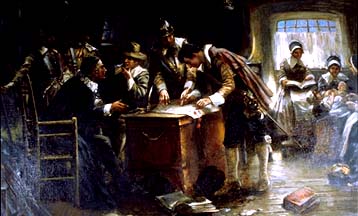
Washington_Constitutional_Convention_1787


On September 17, 1787, George Washington took up a quill and signed the Constitution of the United States of America. He was the first of thirty-three convention delegates to endorse the document that day.


Most Americans probably don’t realize that this Wednesday is the anniversary of that important event.  Chances are they do not realize how close we came, the summer of 1787, to dissolving into small factions and losing our identity as the United States of America.

I certainly wouldn’t have been aware, except I read Catherine Drinker Bowen’s book, Miracle of Philadelphia over the summer.  Our constitution does indeed qualify as a miracle of creativity, wisdom, compromise, and forward thinking–all wrapped up into one.

The young delegates (average age, 43) had begun their deliberations at the end of May. As the summer heated up (many days were oppressively hot), so did the discussions. Their task seemed impossible: create a strong national government that could support and stabilize the states, yet limit that government in order to honor states’ rights.

For almost four exhausting, uncomfortable months the men debated issue after issue, including: 1) slavery, 2) representation in the legislature, 3) whether the executive branch should be a committee or one man, and 4) whether a bill of rights should be included.

It was the dispute over representation that really caused tempers to flare. Some delegates were concerned that large states would lord it over small states in a legislature of equal representation.   Other delegates thought proportional representation based on population was the fairest method.

The two opposing sides hurled arguments back and forth with no compromise in sight. According to Georgia delegate, William Few, “It was an awful and critical moment. If the Convention had then adjourned, the dissolution of the union of the states seemed inevitable.”

What kept them from adjourning? Perhaps it was the strong appeal of an elder statesman in attendance, encouraging the delegates to press on–with God’s help.  Following is an excerpt. (Note the twelve phrases and references borrowed from Scripture):

In this situation of this assembly, groping, as it were, in the dark to find political truth, and scarce able to distinguish it when presented, how has it happened that we have not once thought of humbly applying to the Father of Lights to illuminate our understandings?

In the beginning of the contest with Britain when we were sensible of danger, we had daily prayers for the Divine Protection. Our prayers were heard and were graciously answered. All of us who were engaged in the struggle must have observed frequent instances of a superintending Providence in our favor…

…And have we now forgotten that powerful Friend? Or do we imagine we no longer need His assistance? I have lived a long time; and the longer I live the more convincing proofs I see that God governs the affairs of men.

And if a sparrow cannot fall to the ground without His notice, is it probable that an empire can rise without His aid?

We have been assured in the Sacred Writings that except the Lord build the House, they labor in vain that build it. I firmly believe this; and I also believe that without His concurring aid, we shall succeed in this political building no better than the builders of Babel…and we ourselves shall become a reproach and a byword down to future ages (from The Papers of James Madison, 1840).

Those words came from a delegate known for his wisdom and political savvy, one of the most highly respected men in America: Benjamin Franklin.

Another delegate, Mr. Randolph of Virginia, proposed that “thenceforward prayers be used in ye convention every morning” (according to James Madison’s notes).

The Great Debate continued, arguments still broke out, Alexander Hamilton wrote that the crisis was alarming and he “almost despaired.” But the delegates did indeed press on. On July 16, the final compromise was voted upon and passed. The Senate would have two members from each state; the House of Representatives would be based on population, one member for every 40,000 residents.

Slowly but surely, over four months of grueling deliberation, these young visionaries hammered out a new form of government comprised of three branches: executive, legislative, and judicial. They strove for careful balance of power between those three branches, as well as between the federal government and the states.

The Constitution of the United States of America is the oldest written constitution in the world. It has stood the test of time, as a result of the collective genius of the delegates. They persevered to create a flexible document that could adapt to change as the decades passed.

And undoubtedly Benjamin Franklin has been proven right:

Without [God’s] concurring aid, we shall succeed in this political building no better than the builders of Babel…and we ourselves shall become a reproach and a byword down to future ages.

On the contrary, with God’s aid providing that collective genius, those resolute patriots created the foundation for the greatest nation on earth.


(For those interested in the scriptures Mr. Franklin alluded to in his speech, they include:  Job 12:25; James 1:17; James 1:5; Luke 12:6; Psalm 75:7; Daniel 4:17; Psalm 127:1; Genesis 11:1-9; Deuteronomy 28:37; 1 Kings 9:7; 2 Chronicles 7:20; Psalm 44:14).


Art credit:  wwwlwikipedia.com.   Sources:  The Founders’ Bible, Shiloh Road Publishers, 2012; Miracle at Philadelphia by Catherine Drinker Bowen, Little, Brown and Company, 1986; The Story of America, Reader’s Digest Association, 1975).


Read Full Post »

borfarb


“Katherine, I’m terribly sorry, but there’s nothing else to do. We have no money to hire a nursemaid for you children, and now that your mother is gone…”  His voice trailed off.

Is that what Hans von Bora told his five-year old daughter?  No record has been left.  We do know that, in 1504, after the death of her mother, Katherine was sent to a convent in Nimbschen, Germany. At age nine, she was transferred to Convent Marienthron, where she took her vows and became a nun. Katherine was just sixteen years old.

Katherine’s duties gave her opportunity to learn management and care of a large estate, since the convent owned much property. Proceeds covered the expenses for the forty-four nuns and forty servants.  They also made a profit.

About this time a tract was secretly passed among the young nuns titled, “The Monastic Life, and the Marriage of Priests, Nuns and Monks.” Monks, nuns, and clergy should be free to marry, it said. Marriage should be kept; it is monasteries that should be given up.

As this message spread it was not just monasteries that began to empty but convents also. Twelve nuns from Marienthron chose to escape on Easter evening, in April of 1523.  Among them was Katherine. Three of the young women were returned to their families, the other nine secretly delivered by wagon under cover of night to a nearby town. It happened to be the home of the monk who wrote the tract, and he took personal responsibility to see that the nine nuns were well taken care of.

Husbands were found for some of the women; others were given positions in households. Katherine was in the latter group. One suitor, a university student, did court Katherine that summer. A deep friendship grew between them, but when he returned to school, Katherine never heard from him again. Perhaps his parents did not approve of a marriage between their son and a former nun.

Was Katherine’s heart broken after this first experience of love?  Did she wonder why God would allow such a painful turn of events?  Again, no record exists.  We can only surmise that Katherine felt great disappointment as would any young woman in such circumstances.

Several other suitors came forward, but Katherine was content to stay and work in the home of the Lucas Cranach family.

Meanwhile, the monk who wrote the tract about marriage had left the monastery. He was considering taking a bride himself. Katherine let it be known that she was interested, as affection for the caring man had developed during the two years she had known him.

On June 15, 1525, the couple announced their engagement before five witnesses.   Immediately following was the wedding!

An abandoned Augustinian cloister was given to the couple for their home. Katherine became mistress of this virtual estate.  (The first floor alone contained forty rooms with cells above.)

Eventually every room was occupied, not just by their own six children, but by widows, students, and orphans that the couple took in. In fact, Katherine and her husband adopted four orphaned children from their relatives.

Can you imagine caring for so many people—without such appliances as stove, refrigerator, washer, or dryer?

But God had prepared Katherine to manage the estate.  Remember her duties at Marienthron Convent?  Katherine  was on the go from daybreak to night, overseeing the multitude of household responsibilities, the animals, a large garden, the brewery, and large parcels of land she purchased in order to grow grain for the animals.

That’s not all. Katherine ministered to the needs in her community, giving care to the sick and counsel to the hurting.

She made it possible for her husband to travel, preach, and teach, knowing that all would be well taken care of at home.

Day after day, for twenty years, Katherine served others in and around her home.   How ironic that one of the few quotes of Katherine von Bora which has survived the centuries should be:

“I’ve read enough [of the Bible]. I’ve heard enough. I know enough. Would to God I lived it.”

According to the historical record, Katherine most certainly lived by the truth of God’s Word. Who can deny her courage, perseverance, love of others, and servant’s heart?  She stands as a worthy example for us to follow.

Katherine’s husband grew to appreciate her greatly and love her deeply. He called her “Kittie, My Rib” and  “The Morning Star of Wittenberg.”

Does the name of their hometown sound familiar? Wittenberg was the home of Martin Luther.

The husband of Katherine von Bora was none other than Martin Luther himself.


(Sources:  www.the-highway.com, http://www.rpmministries.org, http://www.helios.augustana.edu, http://www.lutheranhistory.org, http://www.thegospelcoalition.org, http://www.haventoday.org.  Art credit:  www.lutherin.de.)

Read Full Post »

White_Oak-15_acorns


Elena, almost eighteen months old, loves to collect acorns. A grand oak tree on the church property across the street from her home provides perfect hunting grounds. She trundles along the edge of the sidewalk, her eyes on the grassy edge. Now and then she bends over, chooses a prime specimen, and clutches it tightly to her chest.

Yesterday was a banner day for acorns. Way too many shiny nuts with perfect caps. Her little hands couldn’t carry them all. I was given the honor of transporting a few of her treasures home. And this opportunity became the starting point for a train of thoughts.

You’ve no doubt noticed this yourself:  acorns do not appear capable of producing oak trees.  They’re too small and too hard.  How can the seeds inside even escape those tough shells?   Yet given the right soil, the right climate, and plenty of time, the miracle of growth occurs.  White oak trees can reach the height of 150 feet, growing twelve to fourteen inches per year.  Acorns do not appear until the twentieth year.  In the end, the majestic giant provides hundreds of benefits (www.arborday.org and http://www.ehow.com).


white_oak_5036-320


Now a few tall plants, like bamboo, grow very quickly. But not tall, strong trees.  I wonder why?

We humans are also slow-growing–in body and spirit. And I wonder about that, too.  Why didn’t God make us more like bamboo, able to reach maturity quickly? Instead, we progress through a protracted, sometimes painful learning process to become “mature, lacking in nothing” (James 1:4).

Perhaps God willed our development to happen slowly so we have many opportunities to follow his chosen path and fulfill the potential he’s especially prepared for each of us. A false step in the wrong direction can be corrected, just as a crooked tree can be straightened if attended to promptly.


 HardMaple1


Yes, there are those who choose not to mature, not to participate with God.

But we know that God is good, that what he does is good. I want him to train and teach me (Psalm 119:68). My guess is you feel the same.

Day by day, choice by choice, we can progress along the spectrum from self-centered to selfless, from impatient to patient, from lesser to greater.  But we have to realize: it happens slowly over time.

Here’s another possibility, even better than just accepting slow progress.  Let’s embrace it.

You see, our culture tends to look at time as a thief who steals away our youth, worth, mental acuity, and energy.

But what if we view time as a gift–a gift of countless opportunities provided day by day, choice by choice–to grow into the mature and gracious people God ordained? Instead of regretting the passage of time we can celebrate:

  • Our progress to become rooted and built up in Jesus, strengthened in our faith (Colossians 2:6).
  • The growing ability to bear fruit (the fruit of the Spirit, exemplary living, glorifying God to others)–even into old age (Psalm 92:14).
  • Becoming “oaks of righteousness, a planting of the Lord, for the display of his splendor” (Isaiah 61:3).

Oh, I like that last verse especially, don’t you?

And it can happen through  slow and steady perseverance, with God as our guide.


(Photo credits:  www.bio.brandeis.edu; http://www.treetopics.com; http://www.awesometools.com.)


Read Full Post »

(As most of you know, Steve is retiring from the pastorate, after serving forty years in Florida. Very shortly we move to the Midwest, to be close to our sons and their families. If our daughter and her family would just move east from Washington State, life would be near-perfect!

No doubt you’re also aware that packing and unpacking are time-consuming tasks, so I’m putting the blog on hold for a few weeks. But please continue to visit! I’ll re-blog some previous posts, and hopefully you’ll find them meaningful again, or perhaps for the first time.

The following post was first published 5-16-13.)
220px-E-W-Wilcox

“With every deed you are sowing a seed, though the harvest you may not see”

(Ella Wheeler Wilcox, author and poet, 1850-1919).

Observation #1:

We never know when a small deed may plant a seed of faith or encouragement. We never know when that seed will reap a bountiful harvest in the life of someone else.

Live attentively to the fact that every deed is a seed. The people around us are watching and listening. Perhaps you’re familiar with the story of a church elder who once led a worship service for two. It happened over 150 years ago in England. A blizzard on Saturday night made it impossible for villagers to get to the church—including the pastor.


Oakwood_Park,_London_N14_-_snow_storm_-_geograph.org.uk_-_1146589


The elder almost sent home the two individuals who had come, an older man and a young boy. But something (Someone?) compelled him to speak. Later he confessed his words came out rather jumbled and brusque.

But. The elder planted a seed that immediately took root. The young boy accepted Jesus as his Savior that day. His name? Charles Spurgeon—preacher and author extraordinaire, whom God used mightily. People are still impacted by his writings to this day. (For an example of Dr. Spurgeon’s God-given genius, see the post, “Not Length But Strength,” from May 9, 1913).


Observation #2:

Our responsibility is the planting of “deed seeds”; the harvest is up to God.

The same principle that works in the physical realm works in the spiritual realm: A farmer may plant, fertilize, and water, but the germination of each seed is a miracle only God can bring about. Don’t become tightly focused on results.

The elder who led Charles to the Lord that snowy, wintry day, had no idea the boy would grow up to have such a profound effect on the world. The gentleman may not have lived long enough to see the results of his deed that morning. But we know, and we marvel.


Observation #3:

The true harvest is not measurable in physical terms, and it’s hidden from view in the spiritual realm.

Only now and then does God give us a glimpse of what our small deeds are accomplishing. Perhaps God planned it that way so pride and self-gratification do not taint the glory of the harvest.

Imagine the joy that elder continues to experience every time a saint comes through the gates of heaven–fourth and fifth generation Christians, who have been influenced by Charles Spurgeon, whose ancestors accepted Jesus because of him. In addition, thousands  have been influenced and encouraged by the preacher’s writings.

And it all began with that faithful elder.

You see, the positive influence of a man or woman of God never dies.


4 T


Such a possibility should translate into enthusiastic motivation for planting seeds wherever we go.


(Art and photo credits:  www.wikimedia.org and http://www.wikipedia.org.)

Read Full Post »

(As most of you know, Steve will soon be retiring from the pastorate, after serving forty years in Florida. Mid-June we move to the Midwest, to be close to our sons and their families. If our daughter and her family would just move east from Washington State, life would be near-perfect!

No doubt you’re also aware that packing and unpacking are time-consuming tasks, so I’m putting the blog on hold for a few weeks. But please continue to visit! I’ll re-blog some previous posts, and hopefully you’ll find them meaningful again, or perhaps for the first time.

The following post was first published 11-7-13.)


tears


Before my friend, Elizabeth, said a word, I knew something was wrong. The slump of her shoulders, the wrinkled brow, the tears welling up in her eyes–they spoke loud and clear.

“You know how Michael and I would like to have a little brother or sister for Ashley,” my friend said, dabbing her eyes with Kleenex. “Well, it’s become more than just a desire for me. I so desperately want another child.” Her voice became tight. “The waiting and uncertainty are becoming unbearable.”

We stood together, in the emptying sanctuary after church, arms entwined. And I prayed for Elizabeth and Michael.

Psalm 113:9, a verse which had ministered to me years before, came to mind. I included the promise in my prayer: “God, you’ve promised ‘to settle the barren woman in her home as a happy mother of children.’ We are claiming that promise today for Michael and Elizabeth. Even now we look forward to the day when they are holding a precious, new baby in their arms.”

Note the verse says children, not child.

The prayer came out of my mouth with certainty and brazen expectation, not in keeping with my cautious personality at all. I have to admit, the thought crossed my mind, What if God intends for Elizabeth and Michael to have just one child? You’ve gone way out on a limb with that prayer!

But I voiced no disclaimers. I let the prayer stand on its foundation of conviction–conviction that didn’t come from my spirit as much as from the Holy Spirit.

For the weeks that followed, I continued to pray that God would bless this couple with another child.

Weeks later, Elizabeth approached me once again. Before she said a word, I knew what she was going to say. Her outspread arms, wide grin, and sparkling eyes spoke loud and clear.

“I’m pregnant!” she cried.

We hugged each other tight and noisily exclaimed our jubilation.

Would I have been as excited had I not been praying for this family? Delighted, yes. But jump-up-and-down ecstatic? Probably not.

My joy was greatly expanded because I had invested myself in the outcome—with the effort of prayer.

Yes, there are many reasons to pray, including these benefits:

Our wills are aligned to God’s will (Psalm 37:4).
Strength of character is developed through the discipline of perseverance (Luke 11:5-8).
We have the opportunity to bring glory to God (John 14:13).
Prayer is a means of fighting against evil (Ephesians 6:10-18, especially verse 18).

But the wonder of prayer, for me, is the privilege God gives us to be part of the process, as he engineers circumstances to accomplish his will.

Every time God moves in situations for which we’ve prayed, he is giving us a precious gift: the gift of participation with him–in a miracle.

Maybe two.

Michael and Elizabeth had twin girls!


il_340x270.446306088_4ipl


*      *      *      *      *      *      *      *      *      *

Heavenly Father, thank you for the splendid privilege of participating with you in the healing, protection, provision, and guidance with which you bless others. May I never get tired of bringing my requests to you, knowing that the joyful conclusion will be worth every moment spent in prayer!

(Photo credit:  www.saveourschoolsnz.files.wordpress.com; http://www.etsy.com.)

Read Full Post »

 frazzled-career-woman


Ever had a pending appointment you didn’t want to keep? A person you didn’t want to encounter? A task you didn’t want to complete?

Some days are filled with unpleasantries. And if I’m not careful, it’s an easy slide down into a gloomy funk.

How does that happen?

My thoughts provide the slippery slope…

What a lousy day this is going to be. I sure hope So-and-So is in a good mood for that meeting this afternoon. Last time he was as irritable as Oscar the Grouch. And while I’m looking forward to that (Ha-Ha!), look at this impossible to-do list. Talk about crazy. And then there’s our double-date tonight with that new couple from church. I am in no mood to be sociable. All I want to do is go home, put on my sweats, and park on the couch!

 Can you identify my problem here? I’m focusing on the negative. The solution is obvious: turn my thoughts to the positive.

But some days that is next to impossible. It’s as if the problems and challenges are shouting giants, jumping up and down, with arms waving no less. They block any view of the positive.

Making the effort to think about praiseworthy things works for a while, but those negative thoughts often return, unbidden and oh, so unwanted. To make matters worse, I feel guilty for allowing those giants access to my mind and spirit.

Why can’t I get rid of them once and for all?

Maybe I’m not supposed to. Maybe God wants me to become more watchful, to learn perseverance, and to practice proactive behaviors, like gratitude and praise.

But one strategy for fighting the giants is particularly important: Get out my sword.

I’m talking about the Sword of the Spirit, which is the word of God (Ephesians 6:17).

Scripture is full of wisdom and encouragement for doing battle, like Psalm 73.

Asaph writes about his challenge: arrogant and wicked people (v. 3) who scoff and speak malice (v. 8).

“What is going on here?” he writes. “Is God out to lunch? Nobody’s tending the store. The wicked get by with everything; they have it made…When I tried to figure it out, all I got was a splitting headache” (vs. 11-14, The Message).

Sounds like the giants of negativity had been pestering Asaph, too.

But at the end of the psalm, Asaph affirms what he knows about God and his ways:


“You [God] hold me by my right hand.

You guide me with your counsel,

And afterward you will take me into glory.

Whom have I in heaven but you?

And earth has nothing I desire besides you.

My flesh and my heart may fail,

But God is the strength of my heart

And my portion forever.”

(Psalm 73:23-26)


I need to meditate on Asaph’s affirmations and make them my own:

  1. My loving Heavenly Father holds me by the hand, offering protection and security.
  1. He guides me with wisdom, especially through his Word, infusing me with comfort and strength.
  1. God gives me perspective for my earthly troubles as I look forward to blissful eternity with him.
  1. He is all I need.


Thank you, Asaph. I’m going to memorize those verses so they’re ready to draw like a sword—on a moment’s notice!


(photo credit:  www.ideas.tome.com.)


Read Full Post »

DSC05030b

When Steve and I moved from South Florida to north of Tampa, we were delighted to see the abundance of live oak trees. Each one reaches wide with graceful, curving branches that outline intriguing free-form shapes.

Live oaks can grow to be eighty feet tall and just as broad over a life-span of hundreds of years.  The key to their longevity is their root system, which reaches down into the soil about four feet, and extends laterally to ninety feet. Such depth and width offers strong support for the tree.

Of course, roots also provide water and nutrients. A mature oak can take in more than fifty gallons of water per day, much of which evaporates and keeps the tree cool.

Such facts give me greater understanding and appreciation for Jeremiah 17:7-8.

“Blessed is the man who trusts in the Lord,

whose confidence is in him.

He will be like a tree planted by the water

that sends out its roots by the stream.

It does not fear when heat comes;

its leaves are always green.

It has no worries in a year of drought

and never fails to bear fruit.”

Doesn’t that sound satisfying and peaceful? Yet too often I’ve been more like a tumbleweed in the desert—dry, flitting here and there, and anything but peaceful.

Tumbleweed

How do I turn my tumbleweed self into a mature, flourishing tree?

The secret is in the roots. Oak tree roots grow wide and deep; tumbleweeds have none.

I have to send out my roots into the soil of God’s Word. That’s where the nutrients of strength, wisdom, and encouragement will come from. The deeper and wider my knowledge, the more empowered I’ll be to withstand the buffeting challenges of life.

The soil also represents God’s love (Ephesians 3:17-18). I must learn about my loving Heavenly Father and spend time with him in order to know him. As intimacy develops, trust grows.

And when roots grow deep into God’s Word and his love, when we practice his presence, we can remain strong when life turns up the heat…

  • When our kids make foolish choices
  • When the boss’s high expectations ratchet up a few more notches
  • When the paycheck will not stretch another penny
  • When a disagreement becomes an impasse
  • When a decision must be made and the pros and cons swim endlessly in our heads

We express our trust by affirming what we know about God. And we affirm our confidence in him by reviewing his promises–not once a day in a quick morning prayer, but moment by moment.

Roots are continually absorbing water and nutrients. We must do the same by praising and thanking God all day long. Even our concerns can be expressed with praise and gratitude:

“Father, I lift up _______ to you as he looks for another job. We are trusting you to provide, knowing that those who seek you lack no good thing (Psalm 34:10). Our hope is in you because no one who hopes in you is put to shame (25:3). I thank you that he is looking to you, God, and seeking your path. You are a good and upright God; you will instruct ______ in the way you have chosen for him (Proverbs 3:5-6).  Hallelujah!”

As our roots grow deep, our spirits can reach high and strong like live oak branches — in adoration and praise for our trustworthy God.

I am DONE with tumbleweed living!  How about you?

(Photo credits:  www.nativetreesociety.org; http://www.sonoragardensinc.com)

Read Full Post »

$T2eC16Z,!ykE9s7t)22nBQ0lKpDuG!~~60_35

(Success is not final, failure is not fatal; it is the courage to continue that counts.” — Winston Churchill)


The annals of history are filled with failures.  Consider:

Example #1: A.’s parents may have felt like failures when their son did not speak until age four and did not read until he was seven. Later they faced the embarrassment of his expulsion from school.

But surely his parents must have breathed a sigh of relief when A. was finally admitted to a university–only to be discouraged again when a professor called him a lazy dog! Who was this disappointing failure of a son? Albert Einstein.

Example #2: As a young man, W. worked for a newspaper, but not for long. His editor told him he lacked imagination and had no good ideas. In the coming years he started a number of short-lived enterprises that ended in bankruptcy. The name of this business failure? Walt Disney.

Example#3: M. was set up for failure. Jealous competitors convinced an employer to assign him a difficult, time-consuming project, outside M.’s area of expertise. It was a sure-fire plan to keep him busy, ruin his reputation, and be rid of him.

The employer? Pope Junius II. The person set up for failure? Michelangelo. The project was the ceiling of the Sistine Chapel.

Michelangelo had no experience with fresco painting. In addition to tackling a new medium, he had to paint upside down on a curved surface. It took him four years to complete the project.

But. Giorgio Vasari (1511-1574), painter, writer, and historian said, “The whole world came running when the vault was revealed, and the sight of it was enough to reduce them to stunned silence.”  I’ll bet his competitors were among them!

As I seek to put myself in the place of each of these individuals, I sense their disappointment, embarrassment, and frustration. Failure is painful! It damages our dignity and destroys our morale.

Simply put, failure feels bad…

…but that’s good!

Defeats push us to refocus and redirect. And with God’s help, those two steps can bring us to peace in spite of failure, and hope for a future of contentment.  Our relationship with God is deepened; our character is strengthened.

Care to join me in a closer look at those two verbs, refocus and redirect?

Refocus by turning our attention upward—not backward. Dwelling on the disappointments of the past is counterproductive.

As soon as we realize negativity has moved in, we must refocus our thoughts on gratitude for God’s gifts and praise for his attributes. (If my past experience is any indication, we may have to do this frequently. The enemy does not give up easily!)

But when we fill our hearts and minds with faith-statements, peace, encouragement and hope have a chance to flourish.

Redirect  our energy. God gives us our marching orders in Psalm 37. Again, note the verbs.

Trust in the Lord and do goodDelight yourself in the Lord…Commit your way to the Lord…Be still before the Lord and wait patiently for him…Do not fret—it leads only to evil (Psalm 37:3-8).

And all the while we can remind ourselves, God specializes in providing…

  • Strength for the weary and power for the weak
  • Light in place of darkness
  • New ways out of a wasteland
  • Comfort for the afflicted
  • Gladness and joy after sorrow and sighing
  • Beauty out of ashes

(Isaiah 40:28-29; 42:16; 43:19; 49:13; 51:11; 61:3)


Thank God he also provides what Winston Churchill (at the beginning of the post) says counts the most:   the courage to continue.


(Photo and quote credit:  www.ebay.co.uk.com.)


Read Full Post »

let_the_glory_out_tshirts-rf982b89d7b1846dbb186d467bd317390_8naah_324

Defeat may serve as well as victory

To shake the soul and let the glory out.

When the great oak is straining in the wind

The boughs drink in new beauty and the trunk

Sends down a deeper root on the windward side.

Only the soul that knows the mighty grief

Can know the mighty rapture.  Sorrows come

To stretch out spaces in the heart of joy.

–Edwin Markham (1852-1940)

Mr. Markham–educator, author, and poet– gives us much to contemplate in just eight lines, beginning with the first seven words:

“Defeat may serve as well as victory.”

No, thank you, my spirit says.  Defeat is humiliating, uncomfortable, and depressing.

Mr. Markham inspires a different perspective and a note-to-self:  God may very well bring defeats into my life “to shake my soul and let the glory out.”

Reminds me of Jonah, the reluctant prophet who tried to run from God.  The Lord told him to go east to Nineveh, an important city of Assyria.  Instead he headed west, boarding a ship for Tarshish.

But a fierce storm churned the seas into a boil.  In desperation to appease the gods, the sailors hurled Jonah overboard.  Surely in those tense moments of near-drowning and then being swallowed by a great fish, Jonah felt crushing defeat.  His life was over; it was just a matter of seconds.

Yet he didn’t die.  Hour after hour in the utter blackness of the fish’s belly, he remained alive.

No doubt he felt shaken in his soul, and in his distress, he called to the Lord (2:1ff).

God heard his prayer and commanded the fish to vomit Jonah onto dry land.

Jonah_shore

 Then the Lord repeated Jonah’s marching orders: “Go to the great city of Nineveh and proclaim to it the message I give you” (3:1).

This time Jonah obeyed, and the glory came forth.   Jonah preached and the people repented. God had compassion upon the citizens of Nineveh, and did not bring destruction upon them.

What appeared to be a mortal defeat for Jonah turned into a glorious revival for a wicked city.

Read Mr. Markham’s poem again and you’ll discover more benefits of defeat, as outcomes of:

  • Straining in the wind.  Pressing on during adversity results in perseverance and strength of character.
  • Drinking in new beauty.  During times of distress we’re more aware of God’s glorious attributes at work in our spirits–attributes such as empowerment, faithfulness, peace, and grace.
  • Sending down deep roots.  Defeat often brings us to new depths of surrender and submission.  It also brings us to new depths of God’s love (Ephesians 3:17).
  • Experiencing grief.  Only those that know a mighty grief can know the mighty rapture.  Like diamonds against dark velvet, joy needs a backdrop of sadness in order to be appreciated fully.
  • Experiencing sorrow.  Sorrows create space for joy.  Joy is never so sweet and overwhelming as after sorrow.

God knows what he’s doing, and he doesn’t waste time or effort.  False starts and fruitless endeavors just don’t happen with our perfect Heavenly Father.

Therefore, when defeat comes into my life or yours, we can rest assured he is accomplishing his good purpose for us.

There will be victory in defeat.

Guaranteed.


(photo and art credits:  www.zazzle.co.nz.com; http://www.searchforbibletruths.blogspot.com.)


Read Full Post »

“I even wash aluminum foil so I can use it again–if it’s not too messy,” joked a friend.  “My son makes fun of me, but that’s what my mother did, and I just picked up the habit.  Seems so wasteful to throw away a perfectly good piece of foil, just because it has a bit of goop on it.”

We were discussing the frugal habits passed down to us from our parents. They were children during the Great Depression, and learned to conserve, reuse, and make do.  Now, eighty years later, the effects of that difficult time are still impacting many of us today.

Might the same effect occur in the spiritual realm?  Might our spiritual habits not only impact those around us, but even generations to come?

Legacy-Postcard

An anonymous psalmist alluded to our long-reaching influence:  “Blessed is the man who fears the Lord, who finds great delight in his commands.  His children will be mighty in the land; the generation of the upright will be blessed…his righteousness endures forever” (Psalm 112:1-3).

James Moffatt (1870-1944), theologian and professor, also spoke poetically of our ongoing influence:  “Death is never the last word in the life of a…man. When a man leaves this world, be he righteous or unrighteous, he leaves something in the world. He may leave something that will grow and spread like a cancer or a poison, or he may leave something like the fragrance of perfume or a blossom of beauty that permeates the atmosphere with blessing.”

42-21217958

Who has left “something like the fragrance of perfume or a blossom of beauty” in your life?  I am surrounded by the examples of:

  • my grandparents’ perseverance
  • my father’s wisdom
  • my mother’s resiliency
  • a favorite teacher’s sense of humor
  • a choir director’s positive attitude

To name a few.

When I was a small child, our family’s pastor called each of us girls “Little Miss Sunshine.”  I found myself trying to live up to the name.  Now, decades later, I still feel the influence of his affirmation.

As a teenager I benefited greatly from the examples of various youth sponsors.  One married couple in particular took me under their wings and mentored me.  Their example of integrity, service, and caring, lived out in a loving home, remain with me to this day.

And so many more!  We really are composites of the countless influences we’ve absorbed.

Now, it’s our turn to pass on a worthwhile legacy.  We mustn’t give in to the notion that Generations X and Y will always find us irrelevant.  One day they’ll realize older persons have the benefit of experience, and experience gives rise to wisdom.  And whether we are present on that day or not, our example will be.

Most of what they absorb will not be the words we have spoken.  They will remember our actions.  Kids watch and learn–sometimes intentionally, but most of the time not.

learning-by-observing

We are the ones who need to be intentional, living out a legacy of character and faith, to be a perfume of blessing.  If we do, the fragrance of our Christian maturity will permeate the atmosphere for years to come.

We can also be encouragers.  Others will remember positive affirmations.  At least one Little Miss Sunshine can attest to that.

*     *     *     *     *     *     *     *     *     *

Please leave a comment below.  I’d love to hear from you!

(Photo credits:  www.jeaninemurk.com ; http://www.telegraph.co.uk ; http://www.inspiredwednesdays.blogspot.)


Read Full Post »

« Newer Posts - Older Posts »

When the House is Quiet

Impressions Becoming Expressions

Mitch Teemley

The Power of Story

Still Traveling

Impressions Becoming Expressions

Living Our Days

Gaining a heart of wisdom

He Said What?!

I'm Patty, and my husband and I are living with our adult son who has autism and epilepsy. I love sharing lessons learned from life around me, especially life with Aaron.

Meditations of my Heart

Impressions Becoming Expressions

Linda Stoll

Impressions Becoming Expressions

Signora Sheila

Notes on Life, Faith & Italy

Heidi Viars

Finding the Image of God