Feeds:
Posts
Comments

Archive for the ‘Wisdom’ Category

Supposedly, these housewife tips were circulated in the late 1800s:

“Have dinner ready, prepare yourself, be fresh-looking, clear away the clutter, prepare the children, minimize all noise, be happy to see him, listen to him (remember his topics of conversation are more important than yours), make him comfortable, take off his shoes, be a little gay.”

If that was the prevailing attitude, we might smugly comment, “That advice had to be written by a man.  As if the woman of the house hasn’t put in a long day already, cleaning, cooking, laundering, ironing, taking care of the children, and more.  Now she gets to wait on her husband?  Ridiculous!”

If exposed to enough old nonsense, such as the above, we’re likely to miss true gems.  We see an old picture, a copyright date from decades ago, and we think the article or book will be as worthwhile as those housewife tips.  But that’s not necessarily the case.

For example, allow me to introduce you to Desiderius Erasmus, born around 1467 in Holland.

Erasmus was a teacher, theologian, and author, critical of the Catholic church and its abuses of the time.  One belief held by the church hierarchy:  Scripture is much too complicated for the common man to understand.  Only priests should have access to the Bible, and they are the only ones qualified to interpret for the masses.

Erasmus wrote:  “I disagree very much with those who are unwilling that the Holy Scripture…be read by the uneducated, as if Christ taught such intricate doctrines that they could scarcely be understood by very few theologians.”

Such writings helped prepare the way for Martin Luther and the Protestant Reformation.

The common sense of Erasmus becomes obvious in more quotes such as these.

  • “If you keep thinking about what you want to do or what you hope will happen, you won’t do it and it won’t happen.”
  • “Prevention is better than cure.”
  • “A nail is driven out by another nail; habit is overcome by habit.”

Good advice, even if it is five hundred years old.

Throughout the centuries, women, too, have acquired wisdom to share. Unfortunately, most was never published.  In the male-dominated world of past generations, women were not offered that privilege.

One exception is Julian of Norwich, born 1342.  She actually prayed for a serious illness to help her understand the sufferings of Jesus.  At age thirty, the illness came, accompanied by sixteen visions.  She spent the rest of her life meditating on her visions and writing about them.  Her book was the first written in English by a woman.  Here are several of her truth gems:

  • “The greatest honor we can give Almighty God is to live gladly because of the knowledge of his love.”

Sounds like an addendum to Paul’s instruction to rejoice always (Philippians 4:4).  I appreciate the sweet motivation she offers for finding joy in each day.

  • “Truth sees God, and wisdom contemplates God, and from these two comes a third, a holy and wonderful delight in God, who is love.”

Oh, yes.  The more we know of God, the more we direct our thoughts to Him, the more we enjoy Him!

  • “Of all the things our minds can think about God, it is thinking upon his goodness that pleases him most and brings the most profit to our souls.”

Again, such astute observations.  Even if formulated six hundred years ago.

*     *     *     *     *     *     *     *     *      *

Thank you, Father, for preserving a wealth of evidence, confirming your presence and inspiration throughout the ages.  Thank you for the testimony of thousands of the saints from ages past. Their perseverance and faith continue to inspire us centuries later.  May we not be among those who ignore the wisdom you have already revealed. 


(Photo credit: http://www.jenikirbyhistory.getarchive.net.)

Read Full Post »

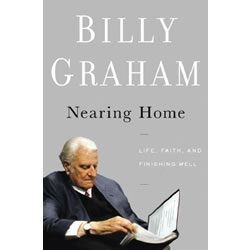
Book-NearingHome-BillyGraham-Sep2011


Those words, “Life, Faith, and Finishing Well,” are actually the subtitle of Nearing Home (2011), by Billy Graham.

Most Americans recognize that name immediately.  In fact, people around the world know of the famous preacher.  For nearly fifty years, he held mass meetings in numerous large cities, and introduced millions to Jesus.  His radio program, television broadcasts, and writings have further expanded his renown.

After such a long, fruitful ministry, Dr. Graham has earned the right to tell us how to live well during our remaining days.

He includes practical advice, to answer such questions as:  When should I retire? What should I keep in mind as I plan for the golden years?  What legal issues should I settle so my children won’t have to?

Dr. Graham also inspires us with his wisdom:

  • ” Look for the Lord’s purpose in every circumstance and in every face or voice you encounter daily, for the time He has given you is not without purpose” (p. 38).
  • “Whatever you do, keep your mind and your body occupied; don’t give laziness or boredom a chance to take root in your soul” (p. 47).
  • “God designs transitions and provides the grace to embrace what follows” (p. 165).

M-m-m.  Such advice would be helpful for the high school graduate heading off to college or the workplace, just as much as the senior citizen!

Billy also offers up much encouragement.  He names numerous senior citizens of the Bible and draws attention to the work God gave them to do.

The record of some we know well:

  • Abraham was 100 when Isaac was born, and the foundation for the Israelite nation was finally established.
  • Moses was 80 when he led the Israelites out of Egypt.
  • Daniel was still serving as prime minister of the Medo-Persian empire, at age 80.

Others are not so familiar:

  •  Barzillai,  age 80, helped to save the life of King David and his men (2 Samuel 17:28-29).
  • Jeremiah remained faithful to his prophet-calling, probably into his nineties
  • Haggai wrote his book of prophecy at age 70.

These men had probably slowed down a bit, compared to their energetic youth.  (Moses is the only exception.  Deuteronomy 34:7 tells us that, when he died at age 120, “his strength was not gone.”)  All of us, sooner or later, experience that life-shift from speed to sputter!

But slowing down is not the same as stopping.  “Retirement should not put us on a shelf,” says Dr. Graham (p. 28).  One option:  lift up others who are carrying heavy loads.  We can pray, encourage, and offer help as we’re able.

What else contributes to aging gracefully?  Age gratefully.   Follow Paul’s instruction, Philippians 4:8:

“You’ll do best by filling your minds and meditating on things true, noble, reputable, authentic, compelling, gracious–the best, not the worst; the beautiful, not the ugly; things to praise not things to curse” (The Message).

Again, just as applicable to a teenager as an octogenarian–and all of us in between.

Because no matter how old each of us might be, our foundations of faith can always use reinforcing.

(photo credit: http://www.homecomingmagazine.com.)

Read Full Post »

Portrait_of_George_Washington

Many of our founding fathers were men of Christian faith.  The record of their background, correspondence, and character attests to that fact.  Consider:

  • Twenty-four of the fifty-six men who signed the Declaration of Independence attended seminary or Bible school.
  • Hundreds of letters of these men speak of God and their faith in Him.
  • Honor and integrity were important attributes which characterized their lives.  Most of them sacrificed much for the cause of American liberty.  “With firm reliance on the protection of the divine Providence*, we mutually pledge to each other our Lives, our Fortunes, and our Sacred Honor,” they declared.

George Washington was no exception. With great integrity,  courage, faith, wisdom, and humility, he was instrumental in bringing America through perilous times.  We should know his legacy well, and follow his example.  Can you imagine an America where men and women would display…

 …The Integrity of George Washington

Washington was the only president unanimously chosen by the electoral college, an indication of the trust the American people invested in the general.  Frequently throughout his life, he demonstrated strong reliance on God.  Remember the portrait of him, kneeling in prayer at Valley Forge?    And decades after his death, pastors were still preaching sermons that honored his exemplary life.

…The Courage of George Washington

Washington’s accomplishments can be rivaled by few.  At age 23 he was commissioned colonel at the outset of the French and Indian War (1754).  His courage was legendary.  In one battle he directed the troops while riding up and down the front lines on his horse, seemingly not to care he was an easy target.  After that battle (which the British and American forces won), George wrote home that his safety was the result of “the miraculous care of Providence*.”

…The Faith of George Washington

Washington recognized that God had been strongly involved in the colonies’ battle for liberty.

“The hand of Providence* has been so conspicuous in all this that he must be worse than an infidel that lacks faith and more than wicked, that has not gratitude enough to acknowledge his obligations.”

His first act upon being sworn in as President?  He prayed, reminding his listeners at the inauguration that it is Almighty God who presides over the universe.  Washington also closed his inaugural address with prayer.

As he signed official government documents, he often concluded with the closing, “In the year of our Lord Christ.”

…The Wisdom of George Washington

In an address given in 1796, George wisely stated:  “Of all the dispositions and habits which lead to political prosperity, religion and morality are indispensable supports.”

(Might the economic and political decline now happening in America be the result of those supports–religion and morality–being slowly but surely removed?)

…The Humility of George Washington

In spite of a long list of outstanding accomplishments over a lifetime of sacrificial service to his country, Washington said:  “I have only been an instrument in the hands of Providence*.”

What chance did the weak, floundering colonies have to become a strong, prosperous nation?  Small, indeed.  But God used men of Christian character such as Washington to achieve the impossible.

What chance does our nation have today, to recapture our strength and prosperity?  Small, indeed.  But, God can use men and women of Christian character, just as he did George Washington–those willing to follow God’s lead and live sacrificially, to achieve the impossible. Because “nothing is impossible with God (Luke 1:37) .”

*     *     *     *     *     *     *     *     *     *

*Providence was a word used frequently in early America, to indicate God’s active care and protection.  Noah Webster, in his first dictionary (1828), noted that Divine providence is often understood as God Himself.  The word appeared over 100 times in the Geneva Bible, the translation of choice among many early Americans.  Now the word is translated with synonyms for care, such as “tender mercies,” “loving kindness,” and “protection.”

Because the word, providence, no longer appears in our Bibles, some have concluded that those forefathers who used the term were Deists who believed in an impersonal God.  But many outspoken Christians of the day used the term, including Rev. Dr. John Witherspoon (minister and signer of the Declaration), John Quincy Adams (officer of the American Bible Society, active patriot, and sixth president of the United States), John Jay (president of the American Bible Society and first chief justice of the Supreme Court), and Dr. Benjamin Rush (founder of the Sunday School in America and signer of the Declaration).  All of these men and others, whose allegiance to Christ is verifiable in their writings, also  included many references to Providence in their works.

(Sources:  The Founders’ Bible, http://www.wallbuilders.com, http://www.ochristian.com)

(Art Credit:  www.en.widipedia.org)

Read Full Post »

Last fall I read there were more than 150 million blogs on the internet, with approximately 175,000 new ones being launched daily.  At that rate, cyberspace now includes over 213 million blogs!

After much shopping, I have found twelve devotional blogs which I follow regularly.  I’ll introduce six today and six on Thursday–in no particular order.  After reading these sample bits, you might want to visit these blogs yourself, and discover fresh insight from…

IMG_1727…Jennifer Dukes Lee (www.jenniferdukeslee.com), wife of an Iowa farmer, mother of two daughters, professor of journalism, and author of a new book being released in early 2014.  Recently she wrote about “How to Talk Back to Fear:”

“I believe that bravery looks a lot like…believing.  And I believe that there’s really no such thing as failure, because there’s nothing unredeem-able in the hands of Christ.”

Smart woman, that Jennifer.

…Holley Gerth (www.holleygerth.com), life coach and author, tackled the topic, “When You’re Worried What People Think.”

First, Holley quoted 1 Corinthians 4:3 (MSG):  “It matters very little to me what you think of me, even less where I rank in popular opinion…Comparisons in these matters are pointless.”

Holley says.  “When I care very little what other people think of me then I’ve suddenly got room to care a lot about other people.”

Quite insightful, don’t you agree?

Unshakable Hope…Unshakable Hope (www.unshakablehope.wordpress.com), written by Bill, married more than twenty-five years, father of two daughters, diagnosed in 1996 with ALS, or Lou Gehrig’s Disease.  Bill has very little mobility, yet his spirit is more vibrant than ever.

On February 21, 2013, Bill wrote about Shadrach, Meshach, and Abednego (Daniel 3).  They were about to be thrown into King Nebucadnezzar’s furnace and boldly proclaimed, “The God we serve is able to save us…, and he will rescue us from your hand, O king.  But even if he does not…we will not serve your gods or worship the image of gold you have set up (vs. 17-18).

Bill says, “For me, this is more than a great example of strong faith.  I believe this is a pattern of faith that all Christians should emulate regardless of challenges we might be facing.  We can proclaim that, ‘Our God whom we serve is able to deliver us from [insert your trial here].  BUT EVEN IF HE DOES NOT…we are not going to serve…doubt, fear, worry, hopelessness or anything else that destroys faith, hope, joy and peace.’

Strong words from a man of deep strength.

…Morning Story & Dilbert (http://www.morningstoryanddilbert.wordpress.com).  Kenny gleans thought-provoking posts from many sources and serves them up with a Dilbert cartoon — something for the mind and heart; something for the funny bone!

Recently Kenny included an anecdote about Abraham Lincoln, highlighting the president’s humility.  Although Lincoln was wise, responsible, and persevering, surely humility was one of the supreme qualities that contributed to his strong leadership.

Here’s the story Kenny shared:

“After the Battle of Gettysburg, General Robert E. Lee and his Confederate forces were withdrawing to Virginia, and Lincoln felt that they were vulnerable. Eager to get the agony of the war over with, President Lincoln sent word to General Meade to attack.

“With his message, Lincoln also sent a personal note. ‘The order I enclose is not on record,’ said the note. ‘If you succeed, you need not publish it. Then, if you succeed, you will have all the credit of the movement. If not, I’ll take the responsibility.’”

Taking responsibility for failure, but giving others the credit for success.  Now that’s humility.

…Jean Wise of “Healthy Spirituality” (www.healthyspirituality.org), is a former nurse, but now focuses her time on writing My Photoand speaking.

On September 24, 2013, she shared the story of second-string quarterback, Kenny Guiton, of the Ohio State Buckeyes.  Opportunities to get in the game have been few for this senior, but Kenny is always prepared.  Then, on a recent Saturday, he not only had a chance to play, Kenny scored a record six touchdowns!

In contemplating Kenny’s story, Jean said, “My job is to be faithful. To enter each day relying on God’s love and guidance.  To show up every morning with an open mind and heart.  To say to our heavenly coach, ‘Here I am, Lord.  What position do you need me to play today?’  To be ready when He calls me off the bench.  To wait and let God form me as He wills till His time is right.’”

Jean’s prayer resonates with my heart, too.

Diana Trautwein…Diana Trautwein‘s musings at “Just Wondering” (www.dianatrautwein,com).  She’s the mother of three, grandmother of 8, and a graduate of seminary in mid-life.  Currently Diana serves as a spiritual director.  Her post on October 11, 2013 was titled, “Giving Permission to Say No.”  Her words of wisdom include:

“Saying ‘yes’ is central to a full, rich challenging life.  We need to say yes to lots of different things over the course of our [life] journey.”

But!  “Try as we might, we cannot do everything.  (Because God already has.)  We cannot save the world.  (There is only one Savior.)  And we must not work ourselves to death.  (We are meant to enjoy God, and glorify God, not assume responsibilities we were never designed to bear.)”

See what I mean?  Wise woman.

Please return on Thursday to meet six more outstanding bloggers!

Read Full Post »

“Take up one idea.  Make that one idea your life — think of it, dream of it, live on that idea.  Let the brain, muscles, nerves, every part of your body, be full of that idea, and just leave every other idea alone.  This is the way to success” — Swami Vivekananda (1863-1902).

Ever have a boss who seemed guided by this philosophy? He may not be familiar with the person who wrote these words (Swami was a Hindu monk.), but the same principles influence his decisions.


This kind of boss expects employees to work long hours to achieve his personal goals.  Ideas from others are not well accepted, because he is, after all, the expert.  He’s read all the books on management theory, marketing strategies, and profit maximization.  Suggestions are superfluous.

But, there is a new form of executive leadership garnering attention.  September’s issue of Sky Magazine ran an article, “The Enlightened Leader,” that highlights this innovative leadership model.   Workshops, webinars, even courses are available for training.

Included in the curriculum are these four topics:  1) Character , 2) Purpose, 3) Integrity, and 4) Values.

How ironic that business experts are returning to such ancient principles–Biblical principles.  For example:

1) A person of character is trustworthy, respectful, responsible, fair, and caring.  Someone with character pursues righteousness and love; then he finds life, prosperity, and honor (Proverbs 21:21).

2) A person of worthwhile purpose is not focused on the bottom line of the financial spreadsheet.  He/she takes to heart Paul’s advice:  “Don’t push your way to the front; don’t sweet-talk your way to the top.  Put yourself aside, and help others get ahead.  Don’t be obsessed with getting your own advantage.  Forget yourselves long enough to lend a helping hand” (Philippians 2:3-4, The Message).

3) A person of integrity walks securely (Proverbs 10:9).  He’s not wishy-washy, making decisions based on what’s expedient for the moment.  “The integrity of the upright guides them” (Proverbs 11:3) to be wise and caring.

4) A person with moral values lives by an ethical code of behavior, summed up by Jesus in the Golden Rule.  “In everything, do to others what you would have them do to you” (Matthew 7:12).

It’s tempting to respond with a smug comment like, “It’s about time the experts came around to God’s way of handling business!”  Except…

…I still have character traits that need refinement.

…I do not live up to God’s purpose for me each day.

…Integrity still needs further development in my life.

…My choices do not always reflect my values.

It doesn’t matter if I am a leader of a large organization or a leader in my home.    I am called to have a positive effect within my circle of influence (Matthew 6:13-16).  And that circle is surprisingly wide when I include extended family, friends, neighbors, business associates, church acquaintances, etc.  In fact…

“…Sociologists say that even introverted people will influence an average of 10,000 people in their lifetime” (The Maxwell Leadership Bible by Dr. John C. Maxwell, p. x).

So what’s the first step toward success?

Perhaps commitment—commitment to God as a willing student in his course of leadership.  Commitment to prayer throughout the day, as choices present themselves.  And commitment to persevere toward wisdom, because:

“Blessed is the man who listens to me [wisdom], watching daily at my doors…For whoever find me finds life and receives favor from the Lord” (Proverbs 8:34-35).

*     *     *     *     *     *     *     *     *     *

Thank You, Father, for the absolute truth of your word.  New ideas come and go, but your wisdom that leads us to success never fails.  Forgive me for the times I have ignored your word.  I want to be a woman of godly character, fulfilling your purpose with integrity, and reflecting your values.  That’s the kind of success that will provide lasting satisfaction and fulfillment in my soul.  Thank you for continuing to work on me.  Amen. 

(photo & art credits:  www.signsforyourlife.com, http://www.averyemployment.com, macondesigns.wordpress.com, http://www.signsforyourlife.com, calcuttaherald.wordpress.com.)

Read Full Post »

Kind words do not cost much. Yet they accomplish much. ~  Blaise Pascal

“Kind words do not cost much.  Yet they accomplish much.”

*     *     *     *     *     *

“Do you wish people to think well of you?  Don’t speak well of yourself.”

*     *     *     *     *     *

The power of a man’s virtue should not be measured by his special efforts,

but by his ordinary doing.”

*     *     *     *     *     *

Do the above quotes remind you of Proverbs in the Bible?  They do have a similar tone, and certainly impart wisdom.  But they were not penned by King Solomon.  Credit goes to Blaise Pascal (1623-1662).

Portrait of Pascal

His name probably sounds familiar.  Chances are, you studied him in school, either in math class or science, maybe both.

Pascal’s first noteworthy accomplishment?  He formulated  a basic theorem of projective geometry, called Pascal’s theorem– at age sixteen!

He invented a calculating device, to help his father, who was a tax collector–when he was only nineteen.

A Pascaline, an early calculator.

(A Pascaline, Pascal’s early calculator)

Another set of experiments produced his famous law of hydraulics.  He contributed important study on the vacuum, on the weight and density of air, and the arithmetic triangle.

Pascal also developed the theory of probability, which is still used today.

And he invented the syringe, the hydraulic lift, as well as the first mechanical computer.  A computer language is named after him.

Such broad giftedness wrapped up in one young man!  But Pascal was actually embarrassed by all his talents.

Even as he was studying mathematics and conducting scientific experiments, Pascal was also exploring spiritual matters.  He and his sister joined a group of Catholics in France, called Jansenists, who believed that salvation was a gift of God’s grace, and could not be earned through good works.

Pascal said, “There is a God-shaped vacuum in the heart of every man which cannot be filled by any created thing, but only by God, the Creator, made known through Jesus Christ.”

In 1654, Pascal was thrown from a carriage when the horses bolted.  The horses died, but Pascal was unhurt.  He felt convinced God had saved him, and he began thinking seriously about what God might want him to do.

That night Pascal had a vision of the crucifixion and experienced a profound renewal in his spirit.  From that point forward, scientific work was of secondary importance in his life.

At that time, Pascal wrote:  “Certainty!  Joy!  Peace!  I forget the world and everything but God!…I submit myself absolutely to Jesus Christ my Redeemer.”

Pascal recorded  this and other statements about his mystical experience on a piece of parchment, then sewed the document into his coat.  There it remained hidden until it was discovered after he died.  Pascal was only thirty-nine years old.

(Pascal’s “Night of Fire” parchment)

Also discovered after his death:  twenty-seven bundles of notes for a major work defending the Christian faith.  These notes were published posthumously and titled Pensees, or Thoughts.  It became a classic of Christian thinking.

 Pascal’s truth-gems include:

“The supreme function of reason is to show man that some things are beyond reason.”

“Happiness is neither without us nor within us.  It is in God, both without us and within us.”

“If our condition were truly happy, we would not seek diversion from it in order to make ourselves happy.”

“People almost invariably arrive at their beliefs not on the basis of proof but on the basis of what they find attractive.”

Perhaps his most famous statement in the Pensees is a short essay titled “The Wager.”  Here are a few excerpts:

“Either God exists, or He does not.  Which will you gamble on?  If God exists, you win everything.  If He does not exist, you lose nothing.  Do not hesitate, then:  gamble on His existence!”

In other words:

Thank You, Father, for wise men and women such as Blaise Pascal, who express themselves in such rare and beautiful ways.  Their words stretch our intellects and stir our hearts. 

Yet Your greatest joy would be for their words to touch our lives so that tomorrow we are nearer Your best for us–words such as that quote about virtue not being measured by special efforts but by ordinary doing.  Help me to remember that it is in the ordinary that I can reflect You most brilliantly.

 (References:  Eerdman’s Christian Classics;  www.christianitytoday.com ; www.ccel.org; www.answersingenesis.org. ; http://www.brainyquote.com ; http://www.goodreads.com ) 

Photo and graphics credits: http://www.smallactsofkindness.wordpress.com ; http://www.wikipedia.com ; http://www.famousquotesabout.com; http://www.conflicted collegechristians.wordpress.com.


Read Full Post »


“These are the days when the Christian is expected

to praise every creed except his own.” 

—  G. K. Chesterton


Indeed.  Christians are often labeled narrow-minded, because we uphold what the Bible teaches:  that faith in Jesus is the only way to heaven.  We are fair game for pundits to disparage and comedians to ridicule.

This fellow, Chesterton, is right on.  Christians are expected to be kind to others; others are not always kind toward us.

A person might think Chesterton is a current commentator on American culture, but he was born in London in 1874, and died in 1936.

Do you know him?

G. K. did not start out to become a writer, much less a defender of the Christian faith.  He set out to become an artist.  But his first job upon leaving art school was to read manuscripts for a publisher.

In his spare time, he tried his own hand (and mind) at writing.  Several essays were published in magazines, and it wasn’t long before two newspapers began publishing his column.

Over a period of thirty years in journalism, G. K. wrote 4000 essays.  Dale Ahlquist, President of the American Chesterton Society, points out the immensity of that number: you would have to write an essay every day for eleven years to reach that total.


Mr. Ahlquist adds to the marvel of this feat by reminding us: every one of Chesterton’s essays was an example of fine journalism—often witty and thought-provoking at the same time.  For example:

“When we were children we were grateful to those who filled our stockings at Christmastime.  Why are we not grateful to God for filling our stockings with legs?” 

But unlike many journalists, G. K.’s writing talent swept across numerous genres.  During his lifetime, he wrote hundreds of books, both fiction and nonfiction, two anthologies of poetry, five plays, and over 200 short stories.

It’s no wonder he’s credited with being one of the most prolific authors of his time.


While his career as a writer was burgeoning, Chesterton married Frances Blogg.  She was an important influence, helping to turn him from his agnostic beliefs to embrace Christianity.  His writings often reflected his faith.  For example:

“Christianity has not been tried and found wanting; it has been found difficult and left untried” (from What’s Wrong with the World).

“There are those who hate Christianity and call their hatred an all-embracing love for all religions.” – (from Illustrated London News, 1/13/06)

“…the curtness of the Ten Commandments is an evidence, not of the gloom and narrowness of a religion, but, on the  contrary, of its liberality and humanity. It is shorter to state the things  forbidden than the things permitted: precisely because most things are permitted, and only a few things are forbidden.” – (from Illustrated London News, 1-3-20)

Even after his death, Chesterton’s influence lived on.  One of his books, The Everlasting Man (1925) was instrumental in leading C. S. Lewis from agnosticism to Christianity.

An evangelical Protestant scholar has said, “There has not been a more articulate champion of classic Christianity, virtue, and decency.”

Here are a few more examples of G.K.’s thoughtful writing:

“One sees great things from the valley; only small things from the peak.”

“I would maintain that thanks are the highest form of thought, and that gratitude is happiness doubled by wonder.”

 “If I can put one touch of rosy sunset into the life of any man or woman, I shall feel that I have worked with God.”

 Words of wisdom?  I think so.  And if…


 …“he who walks with the wise grows wise” (Proverbs 13:20a), then we have certainly benefited from spending a few moments with G. K. Chesterton.


(Photo credits:  www.saltandlighttv.org , www.catholicnewsagency.com , www.lifesitenews.com , www.biblegodquotes.com)


Read Full Post »

Steve and I received a calendar for Christmas with a quote for each day. Sometimes the choice is quite meaningful, such as:

Babe Ruth, full-length portrait, standing, fac...

“Never let the fear of striking out get in your way” – Babe Ruth.

We can actually find similar truth in scripture.

“Be strong and courageous. Do not be terrified; do not be discouraged, for the Lord your God will be with you wherever you go” (Joshua 1:9).

Sometimes, as I turn the calendar page to a new day, I have to wonder what the selection committee was thinking. See if you agree.

Sample #1:

“Do not fear mistakes. There are none.” (I won’t name the person who said that!)

Forgive me, but that makes no sense. Am I missing something? If so, please set me straight.

But here’s what makes sense to me:

Winston Churchill, Prime Minister of the Unite...

“All men make mistakes, but only wise men learn from their mistakes” — Winston Churchill.

Wise men also admit mistakes and correct them. When we don’t, we heap another mistake on top of the first: pride.  Ouch!

When we do admit and correct, we develop humility and maturity. And God values those traits (James 4:6, 1:4)

Sample #2:

“Every day is a journey, and the journey itself is home.”

Here’s what makes sense to me:

Although there is joy in the journey, it is not home. Our final home is heaven. I do not want to become enamored with the journey and lose sight of my home.

With Paul, I want to “press on toward the goal to win the prize for which God has called me heavenward in Christ Jesus” (Philippians 3:14).

Heaven

(Photo credit: irunandshoot)

Sample #3:

“Take care of your body. It’s the only place you have to live.”

Problem is, no matter how well we take care of ourselves, these bodies have expiration dates. But praise God our earthly bodies are not the only place to live!

In fact, for those of us who know Jesus, “to die is gain” (Philippians 1:21). We’ll have new, spiritual bodies fit for heaven — strong and vibrant, with no expiration date.  Can you imagine?

Paul said, “I desire to depart and be with Christ, which is better by far” (v. 23).

Oh, yes.

Quadruple combination opened to the Book of Is...

Thank you, Father, for your Word that speaks reliable wisdom and truth—truth that guides, teaches, and protects. But I need your help to live by its truths. Remind me that only fools despise your wisdom (Proverbs 1:7).

Read Full Post »

A spoon containing breakfast cereal flakes, pa...

(Photo credit: Wikipedia)


Have you seen this cereal commercial?

Several women decry the frustration of nutrition and diet research which contradicts itself. Examples:

  • Carbohydrates are good; carbohydrates are bad.
  • Eliminate as much fat from your diet as possible; a little bit of fat is good for you.
  • To lose weight, eat no more than 1500 calories a day. To lose weight, eat no more than 1200 calories a day.

And then the ladies say something like, “You know what? I’m not listening to expert advice anymore. I’m going to listen to me. I know better nutrition when I see it.”

I want to ask them: “And how do you know what’s good? How did you find out? What makes you wiser than the experts? Sure, they make mistakes. But haven’t you made a few yourselves?”

I’ve seen the same attitude in discussions of spiritual matters.

“Well, I believe…”

“In my opinion…”

“I just know that…”

 Oh? Sometimes we forget that there is a standard for truth—the Bible. In the long run, it doesn’t really matter what we believe or think. What matters is what God’s Word says. If our thoughts and beliefs do not coincide with the Bible, we’re on the wrong track.

Bible Study 1

Bible Study 1 (Photo credit: DrGBB)


 “The Lord gives wisdom, and from his mouth come knowledge and understanding” (Proverbs 2:6). In other words, God is the only source of true wisdom. We humans cannot manufacture it on our own.

 God pointedly warns us about thinking of ourselves as experts of wisdom. “Do not be wise in your own eyes,” he says (3:7a). “The way of a fool seems right to him, but a wise man listens to advice” (12:15).

EXPERT

EXPERT (Photo credit: Pete Prodoehl)

I, for one, would not set myself up as an expert, like the women in the commercial. I don’t always know what’s good for me. I’m not that smart!

Instead, my measuring tool is God’s Word.  That’s where I turn to verify if my line of thinking is straight. There is only one Mastermind, the One who created me. And unlike human experts, he is completely trustworthy.*

It would behoove me to know what he thinks before I spout off my own opinions.


English: Eric H. Cline excavating at Megiddo

English: Eric H. Cline excavating at Megiddo (Photo credit: Wikipedia)

* The Bible is also trustworthy, proven time and again to be accurate, by the ancient manuscripts, archaeology, prophecy, and other proofs. You may wish to read Biblical Archaeology: A Very Short Introduction by Eric H. Cline and The Evidence of Prophecy edited by Robert C. Newman for a deeper study of these fascinating topics.

Read Full Post »

« Newer Posts