Feeds:
Posts
Comments

Archive for the ‘Worship’ Category

Cover of "The Guernsey Literary and Potat...

Cover via Amazon

The title grabbed my attention:  The Guernsey Literary and Potato Peel Pie Society (by Mary Ann Shaffer and Annie Barrows).   And it turned out to be an excellent read, especially since I particularly enjoy historical fiction.

But this post is not a book review.  It’s about a statement one of the characters makes.

First, a bit of background.  A group of folk who lived on the island of Guernsey, in the late 1940s, were greatly anticipating the arrival of a writer.  This writer  was going to tell their story of what happened during the German occupation of World War II.

Upon her arrival, one of the village residents, Juliet, says, “How beautiful of you to come” (p. 26).

Note she did not say, “How wonderful of you to come.”  She said, beautiful.

I love the use of an unexpected word that catches me by surprise and makes me think.

As I read Juliet’s statement, I thought it made a perfect gratitude prayer to Jesus, especially at Christmastime.

How beautiful of you to come—how lovely, graceful, goodly, splendorous, and magnificent.

Oh, yes, Lord Jesus.

 How beautiful of you to come, leaving the resplendent perfection of heaven behind, and:

  • Making yourself nothing,
  • Taking the very nature of a servant,
  • Becoming obedient to death (Philippians 2:7-8).

How beautiful of you to come, with glorious qualities that delight our hearts—qualities such as:

  • Love, expressed with forgiveness, patience, and benevolence (1 Corinthians 13:4-5).
  • Perfect sinlessness, giving us a worthy example to follow (Hebrews 4:15).
  • Truth, in which we can trust (John 14:6).
  • Peace that defies explanation (Philippians 4:6-7).

How beautiful of you to come, to:

  • Turn my darkness into light (2 Samuel 22:29b).
  • Be the source of my salvation (Hebrews 5:9).
  • Be with me always (Matthew 28:20).
  • Provide blessing after blessing (John 1:16).

How beautiful of you to come. 

And as we welcome you into our hearts, Lord Jesus, you make us new (2 Corinthians 5:17).

You make us beautiful!  We can:

  • Shine like stars (Philippians 2:15).
  • Be the aroma of Christ to others (2 Corinthians 2:14-15).
  • Reflect your image (Romans 8:29) of holiness, moral purity, and love.

Oh, how beautiful of you to come!
Read Full Post »

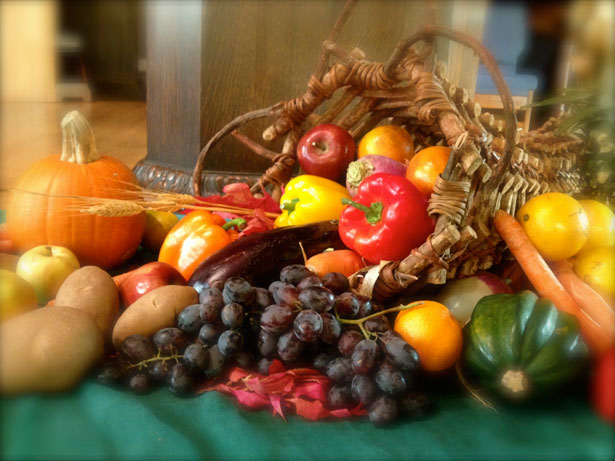
Cornucopia Free Stock Photo - Public Domain Pictures

The First Course:

“I would maintain that thanks are the highest form of thought, and that gratitude is happiness doubled by wonder.”

(G. K. Chesterton — 1874-1936. Columnist and author extraordinaire;  called the best writer of the twentieth century.)

The Second Course:

“The unthankful heart…discovers no mercies; but let the thankful heart sweep through the day and, as the magnet finds the iron, so it will find, in every hour, some heavenly blessings!”

(Henry Ward Beecher — 1813-1887.   Congregationalist minister, known for his support of the abolition of slavery.)

The Third Course:

“Thanksgiving gives effect to prayer, and frees from anxious carefulness by making all God’s dealings matter for praise, not merely for resignation, much less murmuring. Peace is the companion of thanksgiving.”

(Author Unknown – Quoted in Jamieson, Fausset and Brown Commentary on the Whole Bible, Philippians 4:6.)

May wonders and mercies surround you this Thanksgiving Day, bringing you peace and happiness!

(photo credit:  www.publicdomainpictures.net, George GrimmHowell)

Read Full Post »

I don’t know what’s better:

That first sip of coffee in the morning, or the first moment on the pillow at night!

The anticipation of an exciting event, or the lingering memories after.

Ice cream in the summertime, or thick, hot soup in winter.

Gazing at a wide vista of mountains and trees, or studying a tiny flower up close.

Snuggled up by the fire, or walking through crisp, autumn leaves.

Dark chocolate or white popcorn!

A new book with a tantalizing title, or an old, prized volume, underlined and dog-eared.

The raucous noise of a festive party, or the delicious quiet afterward.

The uplift of a clear, cloudless day, or the coziness of a cloud canopy.

Looking forward to wonders yet to be discovered, or looking back on wonders already known.

Oh, yes, Lord.  “You have made everything beautiful in its time” (Ecclesiastes 3:11).

*     *     *     *     *     *     *     *     *     *

Thank you, Father, for continually blessing your people—not just corporately but individually.  You even bestow custom-blessings, specifically designed for the pleasure of one!  And thank You that, as I draw near to you with a grateful heart, your presence fills me with awe and joy.

*     *     *     *     *     *     *     *     *     *

What blessings are you hard-pressed to choose between this Thanksgiving?  Share your thoughts in the Comments below!

(photo credits:  www.3dwaltz.com/babies-pictures-6.html, http://www.popsdigital.com,  www.levenger.com, http://www.footage.shutterstock.com.)   

Read Full Post »

Have you ever noticed that, except for the first line, the familiar Thanksgiving hymn, “We Gather Together” is not about God’s blessing?

We sing such statements as:

  • The wicked oppressing now cease from distressing
  • So from the beginning the fight we were winning
  • Let Thy congregation escape tribulation

Don’t those seem strange concepts to emphasize on a day set aside for thanks?

The truth is:   although Thanksgiving is about gratitude, it is also a celebration of religious freedom.  That was surely on the minds of the Pilgrims back in 1621.

Freedom to worship God, and to read the Bible for themselves, were among the chief reasons the small band of believers left England for Holland in 1609.  Then, as circumstances became difficult there as well, they courageously set out for America to establish their own colony (albeit with a charter from the king of England, which granted them permission to inhabit the Virginia Colony).

The Pilgrims had faced the threat of imprisonment and death in Holland as well as England.  In addition, the trip to America included such hazards as shipwreck, illness, and accident.

Yet troubles only mounted upon reaching the New World.  The Mayflower landed too far north–at Cape Cod—not in Virginia as planned.  A late launch and a sixty-six day voyage on stormy seas (instead of the planned three weeks) meant they arrived in late fall.  Shelters were not completed until February.   Then there were Indians to worry about.

Yet they were willing to face all these challenges in order to establish a colony “for the Glory of God and Advancement of the Christian Faith” (from the Mayflower Compact).

The third line of the hymn  speaks of one joy they embraced:  “The wicked oppressing” (King James of England and his bishops) “now cease from distressing.” God had removed the Pilgrims far out of the king’s reach.  No longer could he persecute them.

The first verse ends with:  “Sing praises to His name.” There is no historical record that the Pilgrims sang at their first Thanksgiving celebration in 1621.  But music was typical at their gatherings, so perhaps they did participate in a psalm or two.  After all, the feasting lasted three days!

Undoubtedly the Pilgrims would have offered their prayerful thanks– even though half their number had died the previous winter, and the first harvest had been quite meager.  (The ninety Native Americans who attended that celebration actually brought most of the food.)

The second verse of the hymn begins:  “Beside us to guide us, our God with us joining.”

God certainly chose an interesting way to guide the Pilgrims and join with them in surviving the harsh conditions of New England.  Remember Squanto?  He’s the one who showed the Pilgrims how to fertilize the soil with fish.  Without that first crop of decent corn, the Pilgrims never would have survived.

Even more amazing?  Squanto just happened to speak English!

The third verse of “We Gather Together” begins:  “We all do extol Thee, Thou Leader triumphant.”  The Pilgrims honored God as Lord.  They recognized that from him all blessings flow.  And the hymn concludes:  “Thy name be ever praised; O Lord, make us free.”

In actuality, this hymn was not written as a direct tribute to the Pilgrims’ experience.   It dates back to Holland, in the late 1500s, written in celebration of a Dutch victory over the Spanish at the Battle of Turnhout (1597).

Under the rule of Spain’s King Philip II, Dutch Protestants had been forbidden to gather for worship.   Perhaps the Pilgrims heard the song while living in Holland.  But the words we sing today were translated into English by Theodore Baker, in 1894.

Even so, the words remind us that the Pilgrims suffered much and risked everything to found a colony where they could gather together in freedom—to proclaim:

“All glory be Thine!”

May we, too, extol our Leader triumphant, as we sing this hymn through the coming week.

(Sources:  The Founders’ Bible, www.plimoth.org, History News Network at http://www.hnn.org )

Read Full Post »


As I set the dish washing soap down on the counter, a small cluster of bubbles burst from the open top.  Playfully they danced upward in front of the window.  And I didn’t just smile; I giggled.

Memories associated with bubbles floated through my mind as I watched those drifting bubbles—memories of our children, and now our granddaughter–gleefully capturing bubbles that family members provided for their popping pleasure.  As they grew older, the children took on the challenge of slow and steady blowing, to make the biggest bubbles possible.


But it’s just a pocket of air surrounded by a film of soap.  Why is it that a bubble grabs our attention?

First, no one can refute their beauty:

  • Bubbles reflect light and sparkle with iridescence.
  • Bubbles refract light into brilliant pastel hues.  Ever-changing ribbons of color pirouette over the surface in rainbow swirls.
  • Bubbles gracefully glide across space, undulating on the air currents.

Each of these aspects can also draw attention to another form of beauty: the beauty of the Lord.


(“One thing I ask of the Lord,

this is what I seek: …

to gaze upon the beauty of the Lord.”

–Psalm 27:4)


But what does the beauty of bubbles (of all things) have to do with God?

Bubbles remind me that:

1)  God is light (1 John 1:5).  Ezekiel saw him “as if full of fire…Brilliant light surrounds him” (Ezekiel 1:27).  “The Lord is my light” is also a symbolic statement, referring to his truth and goodness.

2)  The refraction of light into glorious colors is reminiscent of the first rainbow (Genesis 9:15-17).  God told Noah that never again would he send a flood to destroy all life on earth.  The rainbow was a sign of this promise.  To this day, a rainbow—even a rainbow on a bubble—is a reminder that God keeps his promises.


3) The grace with which bubbles move brings to mind the grace of God.  He, too, moves in gentle ways within our spirits, like a loving shepherd tenderly gathering the lambs to his heart (Isaiah 40:11).

Perhaps God’s whole intention for creating bubbles (and many other phenomenon in nature) was to grab our attention and turn our thoughts to him.

So the next time bubbles escape from the bottle of the dish soap, you may wish to send up a prayer of praise, as they merrily bob through the air:


You are resplendent with light, O God (Psalm 76:4)!

You are faithful to all your promises (Psalm 145:13c)!

You are compassionate and gracious, slow to anger,

abounding in love and faithfulness (Exodus 34:6)!


But why wait for serendipity bubbles?  Take some of that dish soap and create your own!


Revel in the sparkling light, the whirling rainbows, the graceful dance…


…and worship!


(photo credits:  www.flickr.com; http://www.pixabay.com;  www.dailyverses.net; wikimedia.com; http://www.pixabay.com.)

Read Full Post »

“Mail’s here early today!” called Lorna, as she entered the kitchen.

Oh, that was good news.  Living far from home in Quito, Ecuador made letters a very precious commodity.

“Terrific!” I responded, and dashed upstairs to get my keys.

Lorna and her husband, Elbert, served as missionaries with HCJB.  I was a short-termer, living with them for the four months of my assignment as a preschool and kindergarten teacher.

English: Radio HCJB Deutsch: Radio HCJB

The compound was only a brief walk from the house.  Once there, it was just a matter of unlocking the gate, heading down the main walkway a short distance, up a few steps, and into the post office alcove where all of our mailboxes were located.

I jogged the whole way there and back, excited to read my mail.  But no sooner did I return home than my head started to pound, nausea engulfed me, and all I wanted to do was lie down.  Never mind those coveted letters!

My problem was not a sudden onset of the flu, but mild hypoxia–oxygen deprivation. Quito is located 10,000 feet above sea level in the Andes Mountains.

My experience proves, as well as those of countless others:  we humans require oxygen—lots of it.

Even folks who live near sea level can suffer from lack of oxygen, because they’ve become accustomed to shallow breathing.  Their bodies never receive enough oxygenated air, causing them to feel short of breath and anxious.

On the other hand, research has proven that deep breathing helps us manage stress and anxiety, lower blood pressure and heart rate, and even spark brain growth.  By not taking slow, deep breaths now and again, we deprive ourselves of these benefits.

M-m-m.  Reminds me of Ecclesiastes 2:10-11, where King Solomon lamented the results of shallow living:  chasing after wealth, accomplishments, and pleasure.  In the end, nothing gave him lasting satisfaction and fulfillment.

Shallow living brings on symptoms in the spirit, similar to oxygen deprivation in the mind and body: heartache, fatigue with life, nausea from repetitive, meaningless activity, and shortness of temper.

In contrast to Solomon’s lament in Ecclesiastes is Paul’s praise to God for the power and strength of deep living:

“Oh, the utter extravagance of his work in us who trust him—endless energy, boundless strength” (Ephesians 1:19, The Message)!

Deep living happens when we breathe in God’s strength with a prayer, his wisdom and encouragement with a scripture, his joy with a song.

Deep living happens when we practice his presence as automatically as we breathe.

And how do we do that, “practice his presence?”

It’s just a matter of  pausing frequently throughout each day, to turn our attention to God.

I might say such things as:

  • Thank You, Lord, for this new day.  Work through me to accomplish your purpose.
  • I  love you, Heavenly Father.  Thank you for filling my heart with peace and joy every time I turn my attention to you.
  • Thank you for your power at work in me as I complete this task.
  • The wonders of your creation–graceful tree branches dancing in the breeze, lyrical songs of the mockingbirds, delicious aromas of pine and orange blossoms–They make my heart sing with praise!
  • Oh, Lord, I shouldn’t have spoken to Mary like that.  Forgive me, I pray.  Help me to think before I speak.  And yes, I will apologize to her.

Refreshing.  Energizing. Purifying.  Like a deep breath of oxygen.

Shallow breathing causes a lesser quality of life.  So does shallow living.

Deep breathing fosters strength of mind and body.  Deep living does that and more.

Deep living radically transforms the spirit.

Let’s breathe/live deep!

*     *     *     *     *     *     *     *     *     *

What deep living habits help you practice the presence of God?

(photo credits:  www.wikipedia.com , http://www.picstopin.com , http://www.vineyardcs.org )

Read Full Post »

“You are a shield around me, O Lord;

You bestow glory on me and lift up my head.

To the Lord I cry aloud,

And he answers me from his holy hill.

Selah

(Psalm 3:3-4, NIV).

Seventy-one times in psalms we find that word, selah.

And no one can say definitively what it means, because the Hebrew root word is uncertain.  One humorist suggested it was a word spoken by David when a string broke on his harp!

Here’s a review of what more serious Bible scholars have proposed.

One possibility:  selah is related to calah which means “to hang” or “to measure or weigh in the balances.”

Or,  selah may come from three Hebrew words, s_lah (to praise) and s_lal, (to lift up), or salah (to pause).

Selah may have been a musical direction, for a pause in the vocal music and an interlude of instruments only.

I personally like how the Amplified version translates Selah: “pause and calmly think about that.”  An instrumental interlude would certainly lend itself to meditation on what was just sung, to weigh in the balance of the intellect the value of the statement, to give praise for its certain truth.

For a bit of practice, I skimmed through the psalms looking for the word, Selah, and quickly discovered places where pausing and calmly thinking about a passage could have heart-changing results:

Feeling alone and powerless against difficulty?  Pause and calmly think about Psalm 24:10.

“Who is he, this King of glory?  The Lord Almighty—he is the King of glory.  Selah.”

I’m reminded that nothing is too hard for our splendorous God.  He is all-powerful and all-wise.

Feeling worried?  Pause and calmly think about Psalm 32:7.

“You are my hiding place; you will protect me from trouble and surround me with songs of deliverance.  Selah.”

The hiding place of God’s presence is in the spiritual realm, where he makes his sweet peace and gentle comfort available.  Troubles may come, but they cannot destroy me.  My soul is secure for eternity because Jesus has delivered me from the consequences of my sin.  And  one day I will live with him forever!

Feeling frightened?  Pause and calmly think about Psalm 46:1-3.

“God is our refuge and strength, an ever-present help in trouble.  Therefore we will not fear, though the earth give way and the mountains fall into the heart of the sea, though its waters roar and foam and the mountains quake with their surging.  Selah.

Whatever calamity I might have to face, God will supply the necessary strength.  Again, God is my refuge—a personal retreat.  I can go to him for peace and comfort   He is always present, as close as a whispered prayer, not just ready to help, but eager.

Feeling useless?  Pause and calmly think about Psalm 57:2-3.

“I cry out to God Most High, to God, who fulfills his purpose for me.  He sends from heaven and saves me, rebuking those who hotly pursue me; God sends his love and his faithfulness.  Selah.”

God doesn’t waste his time making useless beings.  Every one of us has purpose, and as I cry out to him and make myself available to him, he has promised to fulfill that purpose.  He will also put passion and joy into my heart for his plan.  He “is too gracious to ask [me] to do something [I] hate” (Max Lucado, Just Like Jesus).

And so, a Selah interlude, I find, affirms, uplifts, and strengthens.

It can also be a moment of worship as I turn my thoughts into praise.

*     *     *     *     *     *     *     *     *     *

Heavenly Father, thank you for giving us the capacity to think deeply, to meditate and discover.  Truly, Selah interludes provide for the renewal of my mind and the transformation of my state of being.  Help me to remember to pause and calmly think about your Word—often!

(Photo credits:  www.flickr.com , http://www.marthaspong.com , http://www.ministrylift.ca )

Read Full Post »

Our granddaughter, Elena, is now seven months old, and already her personality is evident.

For example, when she awakens in the morning, Elena plays contentedly in her crib for ten minutes or so.  She chews on her pacifier from every angle, rolls around,  practices her pike position, and plays with a snuggle toy or the zipper on her sleep sack.  Elena may also struggle to crawl or even pull herself up into a standing position, in spite of the confines of the sleep sack.  Eventually she lets the household know that crib-playtime is over and she’d like to be rescued.

The rescuer receives rich reward–a big 1000-watt smile, a few squeals of pleasure, and panting excitement at what the new day might hold.

And though she enjoys songs and stories, Johnny Jump-Up and toys, her favorite activity has to be dancing with her daddy.  Eric, our son, has created a playlist specifically for this activity, many tunes from Disney musicals.

Daddy Daughter Dance

I recently had the pleasure of watching Eric and Elena  perform this ritual.  Eric tucks her firmly in one arm, while holding her hand out with the other.  True ballroom style.  And though they may begin with a gentle waltz, Eric soon takes off with gentle jogging and polka steps.  He adds his voice to Angela Lansbury’s and David Tomslinson’s.

But the other morning, my pleasure in watching them dance turned to uproarious laughter, as Eric mimicked a few of the chimney sweeps’ moves from Mary Poppins.  Knees rising high with each step, and dips in between, he marched across the dining room.  Then with broad, high kicks he pranced in the other direction.  Elena bobbed in his arms, beaming and squealing.

And I thought, O, Lord, this is such supreme pleasure–to watch a daddy and his daughter do a silly dance, reveling in the music, the movement, and each other.  Do you, Father, take joy in watching us, your children, delighting in all the pleasures you’ve given?  Surely so. Otherwise, why would you have provided spectacular colors, intricate patterns, and incredible variety in creation?  Why would serendipity  blessings suddenly drop into our laps? Yes, we need to keep pleasure in its proper place, and not let the pursuit of it consume us.  But I glory in those delights you have ordained.  And I worship you for your gracious love, motivating you to make us laugh and smile.  Thank you, God.    

Read Full Post »

Can you remember back to your childhood Sunday School days?  Did you ever make crowns of yellow construction paper, symbolizing the crowns we’d someday wear in heaven?

In my class, we were encouraged to add colorful cut-out jewels, to represent all the good deeds we would do for Jesus.  The idea was he would reward us for our obedience.  And didn’t we all want beautiful, sparkling crowns to wear when we got to heaven?

My teachers may be commended for encouraging us to make wise choices.  But I’m not sure where the scripture supports jewel awards for righteous behavior. Was it inferred from Isaiah 61:10b?  “As a bridegroom adorns his head like a priest and as a bride adorns herself with her jewels.”

You probably remember:  the bridegroom is an image used several times in scripture to represent Jesus (Matthew 9:15), and the bride represents God’s people (Revelation 19:6-8).  But that still doesn’t explain decisively what the jewels are.

On the other hand, there are passages that mention crowns.  Crowns that…

English: The Imperial Crown of India

…will last forever, won by running the race of the Christian life with perseverance (1 Corinthians 9:24-27).

…represent those believers who are in heaven as the result of our efforts.  They will be our crown—our glory and joy (1 Thessalonians 2:19).

…God has promised—a crown of life to those who love him (James 1:12).  Revelation 2:10 also speaks of this crown.

…we’ll receive when Jesus appears—crowns of glory (1 Peter 5:4)!

But nothing about jewels in those passages.  And to be honest, the crown references are more than likely imagery and metaphors—not actual crowns.

As I’ve gotten older, even the teaching that “crowns await us in heaven” has bothered me.  Striving for obedience and bringing others toward commitment to Jesus for crowns seems so selfishly motivated, so mercenary.  Jesus has already given me eternal life, his loving care, his Word, and countless other blessings.

How dare I say, “Oh, and one more thing.  Please honor me for my good deeds with some lovely gold crowns, alright?”

I don’t want to be like the child who sits under the Christmas tree, surrounded by mountains of crumpled gift wrap and new toys, who says, “Is that all?”

Then I came across Revelation 4:9-11 and discovered…

IF we receive crowns, we won’t be wearing them.

And we won’t be needing lovely showcases in which to display our crowns either.

Instead, perhaps we will be privileged to follow the example of the twenty-four elders:

“Whenever the living creatures give glory, honor, and thanks to him who sits on the throne and who lives for ever and ever, the twenty-four elders fall down before him…and worship him…They lay their crowns before the throne and say:

“You are worthy, our Lord and God, to receive glory and honor and power, for you created all things, and by your will they were created and have their being.”

This totally changes my motivation for earning crowns.  They aren’t trophies at all.  They may become objects of praise, with which to honor our Savior!

That moment will be the epitome of worship–total immersion in the awesome presence of holy God.  Our hearts will be bursting with ecstatic joy, way beyond any former worship experience, as we reverence Jesus supremely.

And cast down our golden crowns for his glory.

Can you picture it?

*     *     *     *     *     *     *     *     *     *

(photo credits: http://www.collaborationenglish.com ; http://www.flickr.com ; http://www.baby.marry.vn )

Read Full Post »

Back in July we looked at the question, “What does it mean to seek God?”  That phrase, seek God, turns up rather frequently in scripture.   Jeremiah 29:13 is a perfect example:  “ ‘You will seek me and find me when you seek me with all your heart.  I will be found by you,’ declares the Lord.”

In that post, we considered our experiences of searching for people to discover principles that might guide our search for God.

The same strategy can give us insight for another instruction seen often in scripture:  walk with God.  Micah 6:8 is one example:  “What does the Lord require of you?  To act justly and to love mercy and to walk humbly with your God.”

What does that mean exactly, to walk with God?  Again, understanding may be expanded by examining what happens when we walk in the physical realm.

First of all, learning to walk doesn’t happen in a moment.  The late Howard Hendricks, professor at Dallas Theological Seminary, used to make this point with a humorous illustration:

A baby does not sit in his playpen and suddenly say to himself:  “My, oh my!  Observe these family members ambulating on two feet!  What an amazing maneuver for forward locomotion!  I think I shall try it!”

No, a baby cannot simply get up and start to walk.  It is a process that happens over time.  That brings us to…

Principle #1:  Walking with God is a learned behavior that happens over time.

 “Come to me,” Jesus says.  “Walk with me and work with me—watch how I do it.  Learn the unforced rhythms of grace” (Matthew 11:28-29, The Message).

Slowly but surely, as we bring Jesus into our daily routines to be our guide and confidante, we take on his attributes.  A glorious side effect will be:  the fullness of joy that comes when we walk in his presence (Psalm 16:11).  And day by day that fullness grows.

*     *     *     *     *     *     *     *     *     *

Not long ago, my friend, Cindy, invited me to go on a walk in a nearby state park.  It was not an aerobic workout!  Cindy and I chatted away as we leisurely made our way through the woods.  We probably missed some critter sightings because we were more focused on our conversation than the beauty around us.

However, occasionally something would catch our attention, and one would point it out to the other, such as…

“Oh!  Look at those sweet purple flowers!”  Two people saying “ooh” and “aah” is so much more fun than one!

Principle #2:  Walking with God is simply friendship with God.

 God is beside each one of us as we progress through each day.  At any moment we can share our hearts with Him, much as Cindy and I did on that walk.  As his gifts and blessings seize our attention, we can thank and praise him—share our “oohs” and “aahs” with him.

A. W. Tozer suggests we “live in a state of unbroken worship.”  Might that just be like a walk in the woods with a friend?

*     *     *     *     *     *     *     *     *     *

A couple of years ago I accompanied two of our three adult children, their spouses, and one granddaughter to a theme park.  Of course, the young adults wanted to ride at least one roller coaster.   So little Sophie and I went to one of the shows while they waited in line.

Because of the crowd, I held tightly to Sophie’s hand as we made our way to the theater.  But there were patches of thick crowds around some of the attractions.  At those points, I carried her, to make sure we weren’t separated.

I wasn’t about to let anything happen to her.  She is much too precious to me.

Principle #3:  Walking with God provides glorious blessings.  Among them, protection and care.

  • His protective presence.  No doubt you remember this affirmation from David:  “Even though I walk through the valley of the shadow of death, I will fear no evil, for you are with me; your rod and your staff, they comfort me” (Psalm 23:4).
  • And Isaiah presents a beautiful image of God’s loving care.  “He tends his flock like a shepherd; He gathers the lambs in his arms and carries them close to his heart” (Isaiah 40:11).

Heavenly Father, how incredible it is that you—the majestic Lord of the universe–would want to walk with us!  What an amazing privilege that you desire to grace us with your all-wise, all-powerful, supremely loving presence!  What wonderful benefits you bestow as we walk close to your side!

Why would I ever want to walk alone?

(photo and art credits:  www.squiddo.com ; http://www.wallpaperfreehd.com ; sarahhamill.wordpress.com ; http://www.sfgate.com ; tomverenna.wordpress.com )


Read Full Post »

« Newer Posts - Older Posts »

When the House is Quiet

Impressions Becoming Expressions

Mitch Teemley

The Power of Story

Still Traveling

Impressions Becoming Expressions

Living Our Days

Gaining a heart of wisdom

He Said What?!

I'm Patty, and my husband and I are living with our adult son who has autism and epilepsy. I love sharing lessons learned from life around me, especially life with Aaron.

Meditations of my Heart

Impressions Becoming Expressions

Linda Stoll

Impressions Becoming Expressions

Signora Sheila

Where Faith Meets La Dolce Vita

Heidi Viars

Finding the Image of God