Feeds:
Posts
Comments

Posts Tagged ‘God’

For ten years of my husband’s ministry, we lived in a parsonage with a pond out back.  The delightful view from the kitchen window made dishwashing a much more pleasant task.  Light and shadow played on grass, trees, and water, creating an ever-changing scene.  Wading birds grazed the edges–herons, egrets, and wood storks.  Anhingas and ducks enjoyed an occasional swim.

During several spring seasons,  a brown duck and his mate chose our pond to raise their family.  It was especially fun to watch the pond-crossings of Mother Duck and her brood.  As she ventured out onto the water, the little ones fell into line behind her.  

When I say line, I do mean line–straight enough to rival the Radio City Rockettes.  But at some point, Mother would turn.  And with split-second precision, those ducklings would also turn, as if she’d given them a cue ahead of time.  (Had she?  Perhaps God has given them the ability to communicate with body language that zoologists haven’t noticed yet!)

To appreciate their performance even more, consider that the eyes of ducks are on the sides of their heads.  Can they even see well straight ahead?

Oh, that I could be like those little ducks, responding to God’s leading with split-second precision.

Why don’t I relax and stop fretting about outcomes?  Isaiah reminds me:

“The Lord will guide you always; he will satisfy your needs in a sun-scorched land and will strengthen your frame.  You will be like a well-watered garden like a spring whose waters never fail (Isaiah 58:11).

Why do I concern myself with what-ifs, when Jesus said:

“Do not set your heart on what you will eat or drink; do not worry about it…Seek his kingdom and these things will be given to you as well” (Luke 11:29-31).

Why don’t I respond with quiet trust, when Paul assures me:

“If God is for us, who can be against us?  He who did not spare his own Son but gave him up for us all–how will he not also, along with him, graciously give us all things?” (Romans 8:31-32).

I’m beginning to understand what happens.  When worry, self-doubt, and fear occupy my mind, I’m allowing my emotions to take the lead, not the truths of scriptures.  Lousy leaders, those emotions.

I need to become more aware of my thought life–not let my mind just roam around helter-skelter.  Paul used military terminology to describe our course of action.  That makes sense, since spiritual warfare does occur in the mind.  Paul said, “Take captive every thought to make it obedient to Christ” (2 Corinthians 10:5).

I like the way Eugene Peterson interprets that verse:  “We…fit every loose thought and emotion and impulse into the structure of life shaped by Christ”(The Message).

The scriptures mentioned above would be good places to start.  I can write key phrases on 3×5 cards or slips of paper and stash them here and there–on a mirror, in a dresser drawer, on the car visor, in the refrigerator!  (Yes, in!  That ought to grab my attention!) Over time I would expect these memory-joggers to train my brain toward positivity and faith.

The day may come when I won’t even need the reminders anymore.  When my thoughts line up and follow Christ’s leading, so will my emotions.

Imagine the peace, joy, and contentment!

(Photo credit: http://www.commons.wikimedia.org.)

Read Full Post »

Like most expectant parents, Steve and I considered dozens of names before each of our three children were born.

First of all, the name had to have a pleasing ring with our unusual last name, Ruegg (pronounced “rug”).  We passed by Douglas.  Doug Ruegg rings too loudly.

We wanted a name that would not attract teasing or silly nicknames.  We passed by Dustin.  Dusty Ruegg would be too tempting.

And we wanted a name that meant something worthwhile, so we passed by Darnell.  “A-Type-of-Grass” Ruegg would not be very inspiring.

No doubt many of you who are parents experienced the same struggle to find appropriate names for your children.

Mary and Joseph, however, had no such struggle with their firstborn.  The angel who visited Joseph in a dream to tell him about Mary’s child, also informed him of the name.  “You are to give him the name Jesus,” he said (Matthew 1:21a).

And when an angel brought good news of great joy to the shepherds, he said, “A Savior has been born to you; he is Christ the Lord (Luke 2:11).

These two scriptures give us the three names we probably use most often when referring to God’s Son:  Jesus, Christ, and Lord.

And each name carries significant meaning.

Jesus, or Yeshua in Hebrew, means “Yahweh (the Lord) is Salvation.”  Could a more perfect name be chosen for the One who would “save his people from their sins?” (Matthew 1:21b).  Yeshua becomes “Joshua” when translated into English.  And in Greek (the language in which the New Testament was written), Yeshua becomes Iesous, or Jesus in English.

Jesus, our Savior.  The only perfect God-Man able to save us from the consequences of our sins.  He is our supreme Christmas gift, given by God, because he loves us.  Deeply.

Christ is English for Christos (Greek), which means “anointed.”  In Hebrew the word would be moshiach, or “Messiah.”

Anointing was a God-ordained custom, to dedicate someone for a special task.  You might remember the prophet, Samuel, anointed David to be king over Israel (1 Samuel 16).  That is, Samuel took oil (probably olive oil) and poured it over David’s head, signifying divine equipping for his royal position.

Again, what could more appropriate than our Savior to be symbolically anointed by God? Jesus was divinely equipped for the special task of saving his people from their sins.

Lord is also a name bestowed on God’s Son.  It is the name that is above every name.  And the glorious day is coming when every tongue will confess that Jesus Christ is Lord (Philippians 2:9-11).  Imagine that.  Millions of voices proclaiming his majesty!

Lord is a familiar term, come down to us from feudal times in England, when kings and nobles were addressed as “lord.”  It denoted power and influence.

The history of the word, though, reveals a fascinating connection to Jesus.

Lord is derived from a compound of two very early Old English words:  hlaf (pronounced with a long “a”)  and weardHlaf means “bread,” and weard means “ward” or “guardian.”  Lord literally means “guardian of the bread.”  In feudal times, such a position would be highly important to the household.  And so lord came to mean “a man of authority and rank” (Webster’s New College Dictionary).

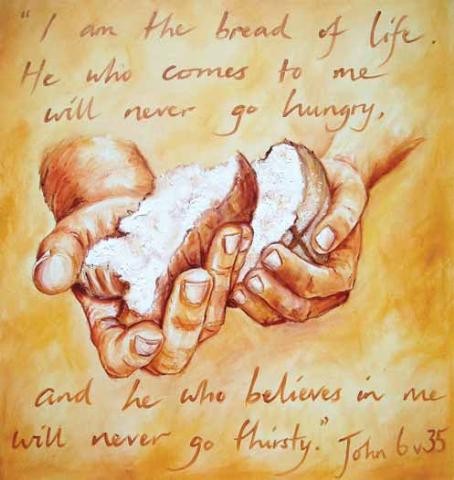
 Such background gives new meaning to Jesus’ words, “The bread of God is he who comes down from heaven and gives life to the world…I am the bread of life” (John 6:33, 35a).  In other words, he is the Sustainer of life.  Whoever comes to him can experience deep satisfaction of spirit (v. 35).

Jesus stands as the guardian of our abundant life now and eternal life in heaven yet to come.  He is also the guardian over of our minds and hearts, supplying peace, joy, comfort, and more.

Paul celebrated the magnificence of the Lord Jesus Christ at the close of Romans 8:

“I am convinced that neither death nor life, neither angels nor demons, neither the present nor the future, nor any powers, neither height nor depth, nor anything else in all creation, will be able to separate us from the love of God that is in Christ Jesus our Lord (vs. 38-39).

And now, what do these names signify to me?  Am I deeply grateful to my Lord Jesus Christ?  Are my thoughts, attitudes, and actions pure and holy gifts I can give back him– my Savior, anointed Deliverer, and Guardian of my life?

*     *     *     *     *     *     *     *     *     *

Lord Jesus, your very names proclaim astounding truths:  you are the Savior of the world!  In fact, you are the only Deliverer who can proclaim us “not guilty” before Almighty God.  And you are our Guardian, caring for our every need, when we depend upon you.  I praise and thank you for your love and grace, demonstrated supremely when you died in our stead.  Oh how I want my life to be a delightful Christmas present for you!

(photo & art credits:  www.babble.com, http://www.thefamily.com, http://www.ortzion.org, http://www.everydaywithmy savior.blogspot.com.)


Read Full Post »

I love decorating our Christmas tree, even though it takes at least two days.

Two days?” you ask.  “Why so long?”

There are several very logical reasons – if you are me.

One:  It takes time to arrange the branches.  We have an artificial tree, you see.  (Cut evergreens don’t last long in Florida because of the heat, and Steve and I like to decorate right after Thanksgiving.)  That means, before decorating can begin, the tree has to be assembled and the branches spread out.

Two:  It takes time to string the lights.  Although pre-lit trees are convenient, they often include too few lights.  The rule of thumb is 100 lights per foot.  We put 1,000 lights on our eight-footer.  Some are tucked in, some arranged on the tips of branches.  This creates a tree that truly glows.

Three:  It takes time to hang the decorations — the ultimate 3-D jigsaw puzzle of Santas, angels, and miniature manger scenes, animals, toys, and traditional ball ornaments.  Dozens and dozens of them.  (And nearly all given to us by family, friends, members of the churches we’ve served, and students from my classes.)

Long ago I worked for a creative designer.  One aspect of her business included decorating Christmas trees for banks and businesses.  She taught me several tricks for creating a stunning display.  I’ve already shared the first rule:  Use lots of lights.

Two:  Consider the size, theme, and material of each ornament.  Try not to hang several Santas, or a group of red decorations, all together.

Three:  Just as lights are tucked in or perched on branch-tips, it’s important to do the same with ornaments.

Four:  Use the tree lights as spotlights for the ornaments, as often as possible.

A beautiful, glowing Christmas tree is in the carefully executed details.

tree 2012

(Photo taken before the last step:  settling the treetop angel in place.)

*     *     *     *     *     *     *     *     *     *

Something else that’s found in the details?  Wonder.

Yes, that statement could be applied to decorations.  There is a sense of wonder when studying a breath-taking display.

But more significant?  The glorious wonder to be found in the carefully executed details of the Christmas story, the events surrounding the birth of Jesus.

Beyond the familiar events of angel visitations, a trip to Bethlehem, Baby Jesus laid in a manger, and a shepherds’ hurried trek to see the newborn Messiah, there is much to appreciate in the details.

For example:

One:  Little did Caesar Augustus know he was being used by God to fulfill an ancient Messianic prophecy, when he decreed the census that sent Mary and Joseph to Bethlehem.  “But you, Bethlehem Ephrathah,…out of you will come for me one who will be ruler over Israel, whose origins are from of old, from ancient times” (Micah 5:2).  God is sovereign — even over those who do not know him.

Two:  Observe whom God chose to notify first about this pivotal event in history–the birth of his Son.  Shepherds!  Members of the lowest class in Jewish society!  Perhaps God wanted us to know that wealth, position, and even the respect of others is of little consequence in his eyes.  What does matter?  Faith.  “Without faith it is impossible to please God” (Hebrews 11:6).

The shepherds did believe – in the old Messianic prophecies and in the angel’s message:  “Today!  Right now!  In the little town of David, your Savior, the Messiah, has been born” (Luke 2:10-11)!  Those sheep herders scurried off to Bethlehem as fast as they could go.  And their faith was highly rewarded.  They were first to see the long-awaited King of kings, the Messiah.  Their lowly position in society didn’t matter.

Three:  Most wondrous of all?  The Son of God, who was with God and was God from the very beginning, became human (John 1:1-2).  The One who created all things (Colossians 1:15-16), chose to become a helpless baby, and embrace every aspect of the human experience through thirty-some years of earth-dwelling.

I like the way Eugene Peterson says it:  “God became one of us and moved into the neighborhood” (John 1:14, The Message)!

And how do we respond to such wondrous details?  We follow the example of those shepherds.  We praise and glorify our God for all the things we have heard and seen, which prove what we’ve been told (Luke 2:20).

*     *     *     *     *     *     *     *     *     *

I DO praise you, Heavenly Father, that early in life I heard about your Son and your gift of eternal life.  I invited you into my life, and have experienced your love, joy, and peace, just as you promised.  In fact, I have seen many of your promises fulfilled in my life and in the lives of others.  You have proven to me over and over that what we’ve been told in scripture is indeed 100% truth.  With Mary, I exult:  “My soul glorifies the Lord and my spirit rejoices in God my Savior” (Luke 1:46-47a)!

Read Full Post »

Christmas is a season of lights.

Candles glow and twinkling lights glimmer from houses, buildings, and trees.

People love all the flickering and shimmering!  Some spend weeks decorating their yards and rooftops in spectacles of light.  If you asked them why, they might be hard-pressed to express more than, “They’re beautiful, that’s all.”


But perhaps it’s more than just aesthetics.  Perhaps it’s a heart-response.

Light is symbolic for:

  • Beauty.  Light grabs our attention, whether it’s  soft and luminous, or sparkling and dazzling. It can also be refracted into a glorious spectrum of colors.
  • Safety.  Where there is light, we can see our surroundings.
  • Comfort.  A nightlight offers just that for many a child who is afraid of the dark.
  • Hope.  Light gleams triumphantly over the darkness, at the end of a tunnel.
  • Guidance.  Light illuminates the way.

Might it be that people are drawn to the lights of Christmas because the human spirit is drawn to the Light?

Jesus said, “I am the Light of the world (John 8:12).  He is Light because God the Father is Light (1 John 1:5).

And the Light of God the Father and God the Son is not merely symbolic.

God the Son is safety, because he offers eternal life.  “My sheep listen to my voice; I know them and they follow me.  I give them eternal life, and they shall never perish; no one can snatch them out of my hand.” (John 10:28-29).

God the Father is comfort, because he is loving and compassionate.  “Praise be to the God and Father of our Lord Jesus Christ, the Father of compassion and the God of all comfort, who comforts us in all our troubles” (2 Corinthians 1:3-4a).

God the Son is hope, because of his resurrectionHe was raised from the dead, and we will be also.  “In his great mercy [God] has given us new birth into a living hope through the resurrection of Jesus Christ from the dead, and into an inheritance that can never perish, spoil or fade—kept in heaven for you” (1 Peter 1:3b-4).

God the Father is beauty, because of all his glorious attributes.  “I’m asking God for one thing…To live with him in his house my whole life long.  I’ll contemplate his beauty; I’ll study at his feet” (Psalm 27:4, The Message).

God the Father is guidance.  “He will guide you always” (Isaiah 58:11a).

Christmas lights cast a soft glow; spotlights illuminate large areas.  But Jesus said, “I am the Light of the World.”   To every person in every corner, he offers his Light.

Let’s make time to linger in his dazzling Light this season!

“Blessed are those…who walk in the light of your presence, O Lord” (Psalm 89:15)!

(photo and art credits:  www.onebestwall.com, http://www.moyerlawncare.com, http://www.8thfire.net, http://www.naturewatcher.wordpress.com)

Read Full Post »

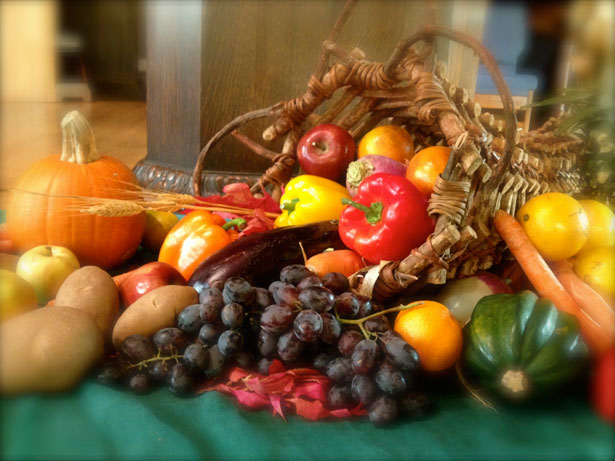
Cornucopia Free Stock Photo - Public Domain Pictures

The First Course:

“I would maintain that thanks are the highest form of thought, and that gratitude is happiness doubled by wonder.”

(G. K. Chesterton — 1874-1936. Columnist and author extraordinaire;  called the best writer of the twentieth century.)

The Second Course:

“The unthankful heart…discovers no mercies; but let the thankful heart sweep through the day and, as the magnet finds the iron, so it will find, in every hour, some heavenly blessings!”

(Henry Ward Beecher — 1813-1887.   Congregationalist minister, known for his support of the abolition of slavery.)

The Third Course:

“Thanksgiving gives effect to prayer, and frees from anxious carefulness by making all God’s dealings matter for praise, not merely for resignation, much less murmuring. Peace is the companion of thanksgiving.”

(Author Unknown – Quoted in Jamieson, Fausset and Brown Commentary on the Whole Bible, Philippians 4:6.)

May wonders and mercies surround you this Thanksgiving Day, bringing you peace and happiness!

(photo credit:  www.publicdomainpictures.net, George GrimmHowell)

Read Full Post »

Those of us who believe in Jesus are on a faith journey.

Sometimes we fly.

He carries us on eagles’ wings.


One example from scripture is God’s deliverance of the Israelites from Egypt.  He said, “You yourselves have seen what I did to Egypt, and how I carried you on eagles’ wings and brought you to myself” (Exodus 19:4).

The Israelites had done nothing to secure their release from Pharaoh.   God caused the plagues, God opened the Red Sea for the Israelites’ escape, and God destroyed the Egyptian army.

Moses and his sister, Miriam, sang a song to the Lord, to celebrate their deliverance.


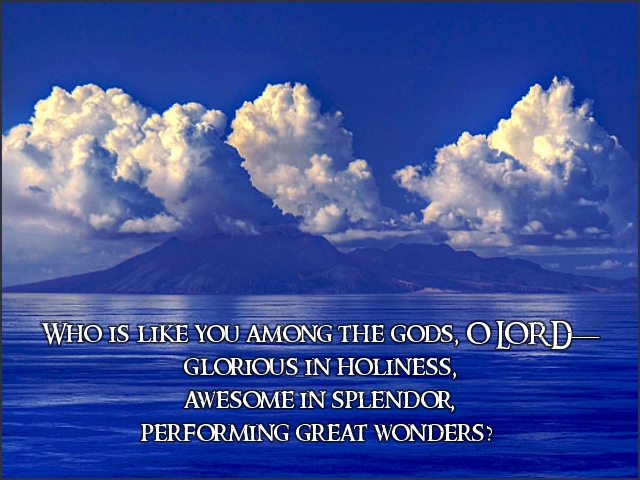
“Who among the gods is like you, O Lord?  Who is like you–majestic in holiness, awesome in glory, working wonders?” (Exodus 15:11).

Has your heart soared on the euphoria of an awesome and glorious miracle?

We have.  A number of times.  One day D. called to announce she wanted to buy us a car.  Arrangements were made with a dealership; all we had to do was go and pick one out.

“Oh–and get leather seats,” she insisted.  “They’re so much more comfortable.”

Can you imagine?  What an incredible blessing!  Our hearts soared for weeks on that miracle.   Even now, more than thirteen years later, that car is a constant reminder of God’s supernatural provision.  (Yes, it’s still running smoothly!) Through D., God proved unequivocally his love and power.

Sometimes we soar; sometimes we runon supernatural strength.

We feel the supernatural power of the Spirit coursing through our veins, providing strength and passion for the task at hand.  It is a spontaneous sprint, energized by omnipotent God.

New Christians are often empowered for a running start in their burgeoning faith. Eagerly they soak up Bible knowledge in small groups and personal Bible study.

In other cases, God places a special call on someone’s life to fulfill a need.  And with the call comes supernatural strength to meet the challenge.

That’s what happened to J.B.  God infused him with a passion to upgrade the sound system of our church.  Night after night, he worked at rewiring the sanctuary.  Much of that time was spent climbing about in the rafters.  This after working each day at his business.

When I asked J.B. about exhausting himself, he assured me  he was having fun!  He didn’t feel worn out at all.  God was giving him the strength to complete the project.

Yes, it’s exhilarating to fly on eagles’ wings of miracles and run on supernatural strength.  But…

…most of the time on our faith journey, we walk.

Step by step.  Choice by choice.  Slowly approaching the destination—the day of Christ Jesus (Phil. 1:6).  Sometimes the path is uphill and rocky.  We strain with effort to make progress.  Some days the path is winding, and we cannot see ahead.

Yet in spite of struggle and uncertainty, the walk can still bring much pleasure to the heart.  “Blessed are those…who walk in the light of your presence, O Lord” (Psalm 89:15).  You see, we do not walk alone.  The Company we keep makes all the difference.

Walking in faith involves plenty of ordinary tasks and days without miracles. Children to care for.  Laundry to do.  Meals to cook.  Calls to make.   Students to teach.  Sales to close.

But!  Whatever needs to be accomplished, we can walk through it and not collapse under the repetition and frustration.  How?  By inviting God to walk with us.


Years ago, when our three children were young, my life was a routine of laundry, cleaning, cooking, errands, and child care.  I was not one of those mothers who derived great fulfillment from these tasks.  Instead of walking joyfully through each day,  I often plodded.

Then I came across Colossians 3:23-24.  “Whatever you do, work at it with all your heart, as working for the Lord, not for men, since you know that you will receive an inheritance from the Lord as a reward.  It is the Lord Christ you are serving.”

In the margin of my Bible, next to those verses, I wrote, “including housework!”  I wanted Who I served to be more important than what I was doing.  Plodding didn’t end once and for all, but I learned to walk at a believer’s pace more frequently, as I invited God to cook, clean, and launder with me!

Those verbs–soar, run, and walk–are found in Isaiah 40:31, in that order:


“Those who hope in the Lord will renew their strength.  They will soar on wings like eagles; they will run and not grow weary, they will walk and not be faint.”

Perhaps soaring is first because  the euphoric wonder of flying on eagle’s wings seizes our attention with intensity.

Running is second.  Adrenalin runs high during spurts of divinely inspired growth and service.

And walking is last.  Did God save the most important until the end?  Because it’s in the persevering that we become strong.  It’s in the trusting  that our faith grows deep.  And it’s in practicing his presence that we learn consistency of character.

So revel in occasional soaring.  Rejoice in periodic  running.  But take deep satisfaction in the day-by-day walk on the paths of righteousness (Psalm 23:3).


“Come…let us walk in the light of the Lord” (Isaiah 2:5)!

(photo credits:  www.betterphoto.com; http://www.linksterdiversions.blogspot.com; http://www.BlackburnNews.com; http://www.foxnews.com; http://www.photobucket.som/user/jamiesolome/media.com; http://www.faithgateway.com; http://www.pinterest.com)

Read Full Post »

“The Lord make his face shine upon you and be gracious to you;  the Lord turn his face toward you and give you peace” (Numbers 6:25-26).

Lovely, poetic words.  But what do those phrases about God’s  face mean?  Even if God’s face did shine upon me, or turn toward me, how would I know?  I’ve never seen God.  No one has (1 John 4:12).

A little research turned up this explanation:   God’s face represents his character.

Read those verses from Numbers again.  But this time replace the word face with the word character.  The meaning becomes clearer.

The Lord make his character shine upon you

And be gracious to you;

The Lord turn his character toward you

And give you peace.

How many of God’s character traits can you name?  David named seven in a psalm of thanksgiving found in 1 Chronicles 16:8-34.  God is:

  • Powerful (v. 9)
  • Strong (v. 11)
  • Trustworthy (v. 15)
  • Majestic (v. 27)
  • Holy (v. 29)
  • Good (v. 34)
  • Loving (v. 34)

This brief list is just the beginning of descriptors we could name about God.  He is infinite; His attributes are infinite!

All of those character traits and more are shining upon our lives, as he cares for us, lives in us,and participates with us every moment of our lives.

  • His power works miracles.
  • His strength carries us through difficult times.
  • He can be trusted to always do what is best.
  • His supreme majesty speaks of his authority over the universe.
  • He is righteous and holy in all he does.
  • Out of his goodness he provides countless blessings.
  • And all of this is graciously given, not out of a sense of duty because he made us, but because he loves us.

God’s face shining upon us represents God’s radiance.

 If we insist on following our own way, as Israel did, He may choose to hide his face from us (Isaiah 1:15).

But.

“When a king’s face brightens, it means life; his favor is like a rain cloud in spring” (Proverbs 16:15).

When the King of the universe shines his approval upon us, what more could we want?  Life for us is not mere existence.  It is a rich, full life.  Rich with blessings, and full of satisfaction, peace, and joy!

*     *     *     *     *     *     *     *     *     *

Thank you, Almighty God, for manifesting your character in my life.  I have seen you work miracles and give strength to the weak.  I have watched as you engineered circumstances to accomplish your plan. (And it always turns out to be a hundred times better than anything I could dream up!)

 I marvel at your power and majesty on display in creation.  I have recorded hundreds of blessings you’ve provided for our family.  Your radiance shines brilliantly all around me! 

 And now, as a thank you gift back to you, dear Father, may my life reflect your radiance to others—with ever-increasing glory (2 Corinthians 3:18)!  Amen!

*     *     *     *     *     *     *     *     *     *

How has God shone his face upon you?  Share in the Comments below!

(art credit:  www.christianwordart.com)

Read Full Post »

Before my friend, Elizabeth, even spoke, I knew something was wrong.  The slump of her shoulders, the wrinkled brow, the tears welling up in her eyes–they spoke loud and clear.

“You know how Michael and I would like to have a little brother or sister for Ashley,” my friend said, dabbing at her eyes with a Kleenex.  “Well, it’s become more than just a desire for me.  I so desperately want another child.”  Her voice became tight.  “The waiting and uncertainty are becoming unbearable.”

We stood together, in the emptying sanctuary after church, arms entwined.  And I prayed for Elizabeth and Michael.

Psalm 113:9, a verse which had ministered to me years before, came to mind.  I included the promise in my prayer:  “God, you’ve promised ‘to settle the barren woman in her home as a happy mother of children.’  We are claiming that promise today for Michael and Elizabeth.  Even now we look forward to the day when they are holding a new, precious baby in their arms.”

Note the verse says children, not child.

The prayer came out of my mouth with certainty and brazen expectation, not in keeping with my cautious personality at all.  I have to admit, the thought crossed my mind, What if God intends for Elizabeth and Michael to have just one child?  You’ve gone way out on a limb with that prayer!

But I voiced no disclaimers, no caveats.  I let the prayer stand on its foundation of conviction–conviction that didn’t come from my spirit as much as from the Holy Spirit.

For the weeks that followed, I continued to pray that God would bless this couple with another child.

Weeks later, Elizabeth approached me once again.  Even before she spoke, I knew what she was going to say.  Her outspread arms, wide grin, and sparkling eyes spoke loud and clear.

“I’m pregnant!” she cried.

We hugged each other tight and noisily exclaimed our jubilation.

Would I have been as excited had I not been praying for this family?  Delighted, yes.  But jump-up-and-down-ecstatic?  Probably not.  My joy was greatly expanded because I had invested myself in the outcome—with the effort of prayer.

Yes, there are many reasons to pray, including these benefits:

  • Our wills are aligned to God’s will (Psalm 37:4).
  • Strength of character is developed through the discipline of perseverance (Luke 11:5-8).
  • We have the opportunity to bring glory to God (John 14:13).
  • Prayer is a means for fighting against evil (Ephesians 6:10-18, especially verse 18).

But the wonder of prayer, for me, is the privilege God gives us, to be part of the process, as he engineers circumstances to accomplish his will.

Every time God moves in situations for which we’ve prayed, he is giving us a precious gift:  the gift of participation with him–in a miracle.

Maybe two.

Michael and Elizabeth had twin girls!

*     *     *     *     *     *     *     *     *     *

Heavenly Father, thank you for the splendid privilege of participating with you in the healing, protection, provision, and guidance with which you bless others.  May I never get tired of bringing my requests to you, knowing that the joyful conclusion will be worth every moment spent in prayer!

Read Full Post »


As I set the dish washing soap down on the counter, a small cluster of bubbles burst from the open top.  Playfully they danced upward in front of the window.  And I didn’t just smile; I giggled.

Memories associated with bubbles floated through my mind as I watched those drifting bubbles—memories of our children, and now our granddaughter–gleefully capturing bubbles that family members provided for their popping pleasure.  As they grew older, the children took on the challenge of slow and steady blowing, to make the biggest bubbles possible.


But it’s just a pocket of air surrounded by a film of soap.  Why is it that a bubble grabs our attention?

First, no one can refute their beauty:

  • Bubbles reflect light and sparkle with iridescence.
  • Bubbles refract light into brilliant pastel hues.  Ever-changing ribbons of color pirouette over the surface in rainbow swirls.
  • Bubbles gracefully glide across space, undulating on the air currents.

Each of these aspects can also draw attention to another form of beauty: the beauty of the Lord.


(“One thing I ask of the Lord,

this is what I seek: …

to gaze upon the beauty of the Lord.”

–Psalm 27:4)


But what does the beauty of bubbles (of all things) have to do with God?

Bubbles remind me that:

1)  God is light (1 John 1:5).  Ezekiel saw him “as if full of fire…Brilliant light surrounds him” (Ezekiel 1:27).  “The Lord is my light” is also a symbolic statement, referring to his truth and goodness.

2)  The refraction of light into glorious colors is reminiscent of the first rainbow (Genesis 9:15-17).  God told Noah that never again would he send a flood to destroy all life on earth.  The rainbow was a sign of this promise.  To this day, a rainbow—even a rainbow on a bubble—is a reminder that God keeps his promises.


3) The grace with which bubbles move brings to mind the grace of God.  He, too, moves in gentle ways within our spirits, like a loving shepherd tenderly gathering the lambs to his heart (Isaiah 40:11).

Perhaps God’s whole intention for creating bubbles (and many other phenomenon in nature) was to grab our attention and turn our thoughts to him.

So the next time bubbles escape from the bottle of the dish soap, you may wish to send up a prayer of praise, as they merrily bob through the air:


You are resplendent with light, O God (Psalm 76:4)!

You are faithful to all your promises (Psalm 145:13c)!

You are compassionate and gracious, slow to anger,

abounding in love and faithfulness (Exodus 34:6)!


But why wait for serendipity bubbles?  Take some of that dish soap and create your own!


Revel in the sparkling light, the whirling rainbows, the graceful dance…


…and worship!


(photo credits:  www.flickr.com; http://www.pixabay.com;  www.dailyverses.net; wikimedia.com; http://www.pixabay.com.)

Read Full Post »

“You are a shield around me, O Lord;

You bestow glory on me and lift up my head.

To the Lord I cry aloud,

And he answers me from his holy hill.

Selah

(Psalm 3:3-4, NIV).

Seventy-one times in psalms we find that word, selah.

And no one can say definitively what it means, because the Hebrew root word is uncertain.  One humorist suggested it was a word spoken by David when a string broke on his harp!

Here’s a review of what more serious Bible scholars have proposed.

One possibility:  selah is related to calah which means “to hang” or “to measure or weigh in the balances.”

Or,  selah may come from three Hebrew words, s_lah (to praise) and s_lal, (to lift up), or salah (to pause).

Selah may have been a musical direction, for a pause in the vocal music and an interlude of instruments only.

I personally like how the Amplified version translates Selah: “pause and calmly think about that.”  An instrumental interlude would certainly lend itself to meditation on what was just sung, to weigh in the balance of the intellect the value of the statement, to give praise for its certain truth.

For a bit of practice, I skimmed through the psalms looking for the word, Selah, and quickly discovered places where pausing and calmly thinking about a passage could have heart-changing results:

Feeling alone and powerless against difficulty?  Pause and calmly think about Psalm 24:10.

“Who is he, this King of glory?  The Lord Almighty—he is the King of glory.  Selah.”

I’m reminded that nothing is too hard for our splendorous God.  He is all-powerful and all-wise.

Feeling worried?  Pause and calmly think about Psalm 32:7.

“You are my hiding place; you will protect me from trouble and surround me with songs of deliverance.  Selah.”

The hiding place of God’s presence is in the spiritual realm, where he makes his sweet peace and gentle comfort available.  Troubles may come, but they cannot destroy me.  My soul is secure for eternity because Jesus has delivered me from the consequences of my sin.  And  one day I will live with him forever!

Feeling frightened?  Pause and calmly think about Psalm 46:1-3.

“God is our refuge and strength, an ever-present help in trouble.  Therefore we will not fear, though the earth give way and the mountains fall into the heart of the sea, though its waters roar and foam and the mountains quake with their surging.  Selah.

Whatever calamity I might have to face, God will supply the necessary strength.  Again, God is my refuge—a personal retreat.  I can go to him for peace and comfort   He is always present, as close as a whispered prayer, not just ready to help, but eager.

Feeling useless?  Pause and calmly think about Psalm 57:2-3.

“I cry out to God Most High, to God, who fulfills his purpose for me.  He sends from heaven and saves me, rebuking those who hotly pursue me; God sends his love and his faithfulness.  Selah.”

God doesn’t waste his time making useless beings.  Every one of us has purpose, and as I cry out to him and make myself available to him, he has promised to fulfill that purpose.  He will also put passion and joy into my heart for his plan.  He “is too gracious to ask [me] to do something [I] hate” (Max Lucado, Just Like Jesus).

And so, a Selah interlude, I find, affirms, uplifts, and strengthens.

It can also be a moment of worship as I turn my thoughts into praise.

*     *     *     *     *     *     *     *     *     *

Heavenly Father, thank you for giving us the capacity to think deeply, to meditate and discover.  Truly, Selah interludes provide for the renewal of my mind and the transformation of my state of being.  Help me to remember to pause and calmly think about your Word—often!

(Photo credits:  www.flickr.com , http://www.marthaspong.com , http://www.ministrylift.ca )

Read Full Post »

« Newer Posts - Older Posts »

When the House is Quiet

Impressions Becoming Expressions

Mitch Teemley

The Power of Story

Still Traveling

Impressions Becoming Expressions

Living Our Days

Gaining a heart of wisdom

He Said What?!

I'm Patty, and my husband and I are living with our adult son who has autism and epilepsy. I love sharing lessons learned from life around me, especially life with Aaron.

Meditations of my Heart

Impressions Becoming Expressions

Linda Stoll

Impressions Becoming Expressions

Signora Sheila

Where faith meets la dolce vita

Heidi Viars

Finding the Image of God