Feeds:
Posts
Comments

Archive for the ‘Bible Study’ Category

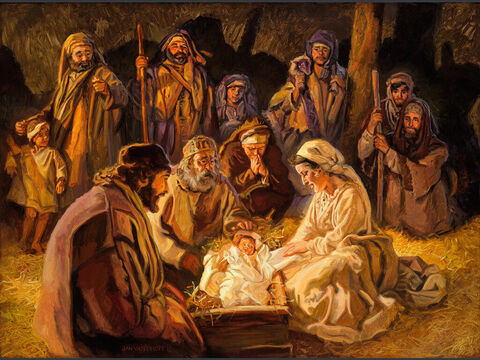
No Christmas season would be complete without the reading of the second chapter of Luke—the account of Mary and Joseph traveling to Bethlehem, presiding over the birth of Jesus in a stable or cave, and receiving shepherd-guests.

Toward the end of the account, as those shepherds were spreading the word of Jesus’ birth, Luke wrote, “Mary treasured up all these things and pondered them in her heart” (v. 19).

Indeed. She had much to process:

  • Her baby was the Messiah, the Promised One, who would save his people from their sin. I wonder if she studied him, looking for signs that he was different from other infants.
  • This was the Prince of Peace cradled in her arms. Yet he had been born to a common village girl in very primitive conditions.  Did that seem strange to her?
  • The shepherds had learned of his birth when angels visited them, just as the angel, Gabriel, had visited Mary and then Joseph.  Gabriel had also visited Zechariah, the father of John the Baptist. Four angel visitations in a matter of months. Never had that happened before.

I find myself pondering, too—pondering Mary herself–this dear, young girl who carried a tremendous burden for a long time.

Dear means beloved and valued. Mary is certainly that for numerous reasons.

  • She embraced Gabriel’s announcement with great faith. “May it be to me as you have said,” (Luke 1:38). She put herself in the care of God in spite of incomprehensible circumstances.
  • Her prayer, the Magnificat (Luke 1:46-55), gives indication of a heart fully committed to God.
  • She endured much: shame for her pregnancy, a long, uncomfortable journey to Bethlehem, and crude circumstances for the birth of her Son.

Mary was young—perhaps between thirteen and fifteen years of age. That was the typical age for a girl to be married in Bible times.

Yet, young as Mary was, Gabriel praised her for being “endued with grace” (v. 28, AMP). In addition, Mary demonstrated stamina, maturity, and gentleness beyond her years.

No doubt God graced her with these traits. But I have to believe Mary also had freedom of choice, as we all do, to embrace God’s way for her.

What I ponder most, however, is the fact Mary carried a tremendous burden, given to her by an elderly man, Simeon, eight days after Jesus was born.

You undoubtedly remember the story. Joseph and Mary took Jesus to the temple at Jerusalem to be circumcised.

There they met the righteous and devout Simeon who had been waiting decades for the Messiah. The Holy Spirit had revealed to him he would not die until he had seen the Lord Christ.

Immediately upon seeing the Child, Simeon knew this was the One.

He praised God for keeping his promise, blessed Mary and Joseph, and then spoke particularly to Mary, saying Jesus would cause some to rise and some to fall, he would be spoken against, the thoughts of many hearts would be revealed, and a sword will pierce your own soul too (Luke 2:21-35).

Those last words must have caused Mary’s eyes to grow wide and her heart to skip a beat. Wasn’t the worst behind her? Surely Mary wanted to ask Simeon, “What do you mean?” Scripture gives us no indication that she did so.

For thirty-three years those last words of Simeon must have echoed in Mary’s mind again and again. How does a person live with such long-term foreboding? Perhaps her mind turned back to the night of Gabriel’s visitation.

Perhaps, for thirty-three years, Mary repeated what she had told the archangel: “I am the Lord’s servant. May it be to me as you have said” (1:38).

Mary may very well have developed the calm assurance that even when God’s ways are baffling, we can rest assured he is orchestrating events to accomplish far more than we could ever imagine (Ephesians 3:20). She’d been witness to such orchestration in Bethlehem.

Mary knew that even our personal hardships can fulfill purposes that extend far beyond ourselves.

That’s a lesson for all of us to embrace with calm assurance.

(Revised and reblogged from December 15, 2014, while we enjoy a blessed week with family!)

Photo credit: http://www.stocksnap.io.

Processing…
Success! You're on the list.

Read Full Post »

As his father prayed, little Isaac peeked through his fingers to see what was causing a rustling sound. His eyes spied a mouse crawling up a bell-rope, and Isaac giggled.

After family prayers, Father wanted to know what had possessed his son to be so disrespectful.

“I saw a mouse running up the bell-rope, and it came to my mind:

There was a mouse for want of stairs,

‘Ran up a rope to say his prayers.”

Father was not amused and reached for the rod. Isaac fell to his knees and begged:

“Father, Father, pity take,

And I will no more verses make [1]!”

Neither the little poet Isaac Watts (1674-1748) nor his father could have known where the boy’s penchant for rhymes would take him.

As a late teen, Isaac complained often to his father about the tiresome, chanted hymns of the church. How was a person supposed to sing them with joy as the Bible-psalms often urged, when the music droned in a minor key?

From a 1600’s hymnal

Mr. Watts finally suggested he turn complaining into composing and create better melodies and lyrics. Isaac did, and over the next fifty-plus years more than six hundred of his hymns were published.

Some people found fault with Isaac’s contemporary worship songs. But at least several prominent leaders supported him, including Samuel Johnson, Cotton Mather, and John Wesley [2].

Isaac Watts

Probably the best known of Watts’ hymns is “Joy to the World,” although Watts never set it to music. Decades later Lowell Mason felt inspired to do so and upon publication in 1848, the song soon became a beloved Christmas carol.

Some insist this hymn has no place in the carol-category, because Watts included no elements of the Christmas story in the lyrics.

But as Alyssa Poblete points out: This song celebrates what Christ came to do. And along with looking back at the grace accomplished in the past, we also look forward to the grace accomplished for our future, to the ultimate joy to be revealed [3].

That enlightenment helps explain that puzzling first line, “Joy to the world, the Lord is come” (emphasis added). I’ve often wondered why Watts didn’t choose “has come.”

Ms. Poblete gives us indication. God’s grace (explained in part by the acronym, God’s Riches at Christ’s Expense) is active in all of time—past, present, and future.

Our Messiah’s birth was long-promised for centuries. His coming ushered in a new kingdom of Light. Those who believe in Jesus gain release from the kingdom of darkness, and one day that evil kingdom will be utterly destroyed [4].

In addition:

Christ’s coming is an ever-present and ongoing engagement in the world.

–Darrow L. Miller [5]

The Lord didn’t just come. He is here! And we can sing with dazzling Christmas joy because:

  • One day the whole earth will receive her King. Therefore, let heaven and nature sing (v. 1) [6]
  • The Savior reigns forever and ever (v. 2) [7]
  • Sins and sorrows will be no more, when Christ returns (v. 3) [8]
  • He comes to make his blessings flow (v. 3) [9]
  • He rules the world with truth and grace (v. 4) [10]
  • The glories of his righteousness and the wonders of his love are on display everywhere (v. 4) [11]

These musicians capture well the dazzling joy of knowing our Savior reigns!

For the reasons listed above and more, Watts invites: “Let every heart prepare him room” (v. 1), and “Let men [all humanity] their songs employ” (v. 1)!

May we be just such people who sing with intention, from a place of authenticity [12].

In fact, take a moment right now if you can, and worship, celebrate, and sing with dazzling Christmas joy!


[1] Betty Dunn, https://www.powerofchange.org/blog/2011/12/16/isaac-watts-joy-to-the-world.html

[2] Erin Tabor, https://www.zmiinternational.org/daily-dose-of-encouragement/joy-to-the-world-the-lord-is-come  

[3] https://www.thegospelcoalition.org/article/joy-to-the-world-a classic-christmas-hymn-reconsidered/

[4] Isaiah 7:14 and 9:6; Colossians 1:14; Revelation 20:7-20.

[5] https://disciplenations.org/wp-content/uploads/202004/Music-that-Writes-Culture-Reflections-on-Joy-to-the-World.pdf

[6] Romans 8:19-23; Revelation 22:20; Psalm 96:1-4

[7] Revelation 11:15

[8] Revelation 21:4

[9] Psalm 5:12; 34:10b; 2 Peter 1:3

[10] John 1:14; Colossians 1:16-17

[11] Psalm 33:4; 145:17 31:21

[12]  https://passioncitychurch.com/article/joy-to-the-world/

Art & photo credits: http://www.justanotherclaypotblogspot.com 9/10/2008; http://www.boudewijnhuijgens.getarchive.net; http://www.jenikirbyhistory.getarchive.net; http://www.canva.com (2); youtube.com; http://www.pxhere.com and canva.com.

Processing…
Success! You're on the list.

Read Full Post »

You’ve heard the Christmas story—probably multiple times.

You may even know interesting background information such as:

  • The number of miles Mary and Joseph traveled from Nazareth to Bethlehem—about seventy—and the number of days on the road—four to seven
  • Angels not necessarily singing to the shepherds but most likely speaking their message [1]
  • The gifts of the Magi holding symbolic meaning: gold for Christ’s royalty, myrrh (used in embalming) for his humanity, and incense for his divinity

But perhaps a new insight or two about the familiar story will add a bit of icing to your Christmas joy!

For example, consider:

A Disadvantaged Upbringing

Most of us would choose a sophisticated city like Jerusalem (in the homes of priests perhaps) for the upbringing of the mother and earthly father of the Christ Child.

Instead, God chose Nazareth–a small, nondescript town that nobody cared about. That’s where Mary and Joseph, the parents for the Son of God, were likely born and raised.

We mustn’t think anyone too weak, untrained, or undistinguished to fulfill God’s plans.

An Unknowing Participant

The Roman emperor Caesar Augustus—not a believer in God—unknowingly carried out holy purpose [2]. Our Lord can and does use the most unlikely people; we mustn’t underestimate his influence and power.

An Unlikely Invitation

by Alexander Laureus, 1815

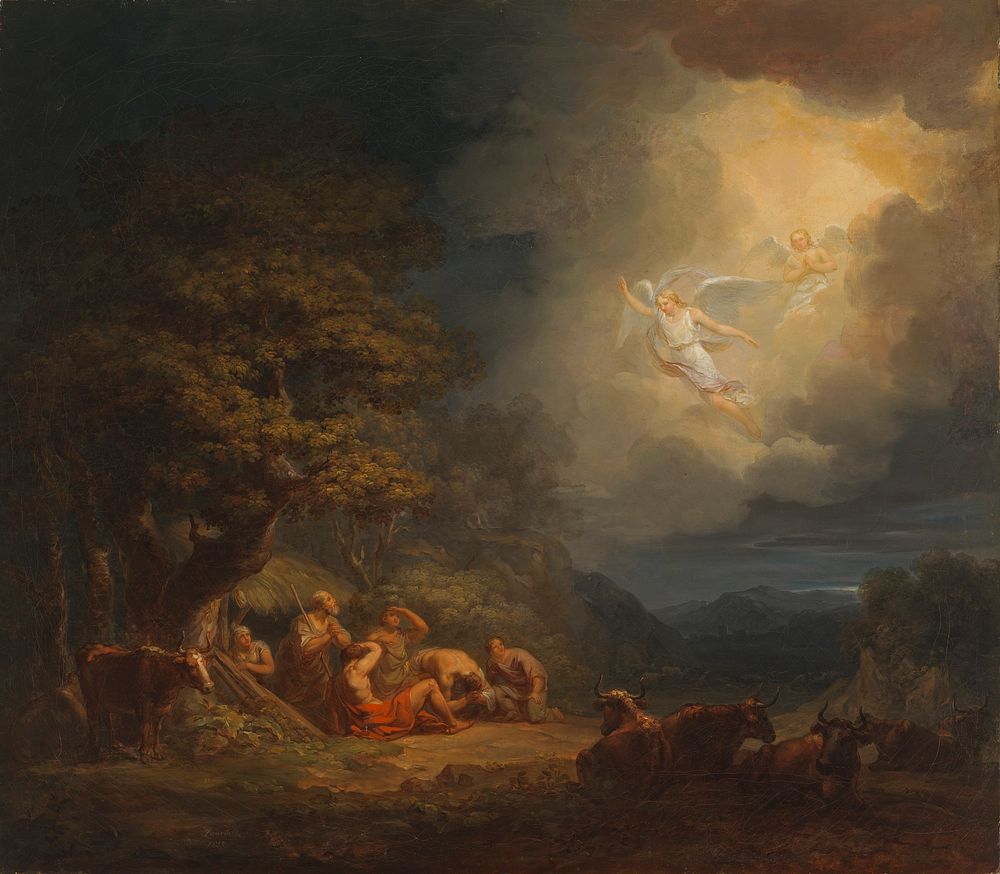
Neither the powers of Rome nor the priests of the Jewish people received an invitation to the birthplace of the King of kings. Instead, angels delivered the news of the Messiah’s birth to scruffy shepherds and told them where Christ could be found.

Often it is the lowly who are the beneficiaries of God’s special favors and blessings—more so than the rich or famous [3].

An Unassuming Humility

Our Savior God is a humble God. Even though he’s the sovereign power of the universe, Christ humbled himself to be born a helpless baby, grow into manhood, and suffer death in the place of all sinners who put their faith in him [4].

How dare I entertain even the smallest of prideful thoughts?

An Unexpected Circumstance

Our God loves surprises! Imagine the shepherds crying out in shock as an angel suddenly appears to them, only to be even more surprised by the angel’s message!

No doubt you’ve been surprised by God too, as he worked out impossible circumstances, miraculously supplied a dire need, or blessed beyond imagination. God’s surprises prove his creative capability to perform wonders that cannot be fathomed, and miracles that cannot be counted!

An Unlikely Juxtaposition

The shepherds visited the True Shepherd; the kings from the East visited the King of the universe. And that Shepherd-King (such a mind-boggling juxtaposition of humility and majesty!) now lives within us.

An Uncommon Possibility

When angels announced Christ’s birth to the shepherds, “the glory of the Lord shone around them [5].”

I wonder, might that celestial light have been rainbow-infused? Consider Revelation 4:3 where the Apostle John tries to describe the glory around God’s throne.

He wrote, “A rainbow that shone like an emerald encircled the throne.” Perhaps those same, glorious rainbow hues swirled in the light above the hills of Bethlehem that night!  

This is the only public-domain image that hints toward what I’m imagining!

Some people enjoy adding such facts and conjectures to their bank of knowledge.

Better yet is to let such information provide the icing on our Christmas joy—the icing of delicious astonishment and sweet encouragement that leads to worship.

*     *     *     *     *     *     *     *     *     *

I praise you Lord God, that your Word is living and active. No matter how often we read a passage or hear a scripture story, you can breathe fresh life into its meaning and impact.

The Christmas narrative is no exception. As we read and hear again the grand story of Jesus’ birth, may our hearts be open to your inspiration, may we overflow with renewed wonder, and in response, offer you our heartfelt worship.

Hebrews 4:12a; Proverbs 4:20-22;

Psalm 119:18; Psalm 40:5; Psalm 72:18-19


[1] Luke 2:13-14

[2] Luke 2:1-4

[3] http://www.examiner.com

[4] Colossians 1:17; Philippians 2:5-8

[5] Luke 2:9

Art & photo credits: http://www.freebibleimages.org; http://www.pickpik.com; http://www.flickr.com; http://www.rawpixel.com; http://www.canva.com; http://www.flickr.com; http://www.canva.com.

Processing…
Success! You're on the list.

Read Full Post »

Surely you’ve met them—those glowing saints whose eyes always twinkle, smiles always dazzle, and whose faith and attitude always inspire.  We’re left wondering, how did they grow that glow?

No doubt it begins with strong trust in Christ, cultivated by scripture-study and prayer. They apply what they’ve learned about:

  • Giving all their concerns to God, knowing he truly cares
  • Focusing on the positive, the joyful, the beautiful
  • The pleasure of giving such gifts as time, encouragement, and a listening ear
  • Practicing God’s presence to experience his peace, strength, and more [1]

But researcher Michael Zigarelli discovered another reason why godly saints radiate joy: gratitude. He found that expressing continual gratitude to God actually energizes the practice of other spiritual disciplines, and altogether they contribute to growing that saintly glow [2].

Insightful author, Ann Voskamp concurs:

“The brave who focus on all things good and all things beautiful and all things true, even in the small, who give thanks for it and discover joy even in the here and now, they are the change agents who bring fullest Light to all the world” [3].

In addition, author and theologian Warren Wiersbe would have us know:

“That’s all fine and good,” someone might say. “But right now I see very little to be thankful for. We’ve had one financial setback after another, my job is more stressful than ever, our son is having a hard time in school, and my brother and sister-in-law just announced they’re separating. ‘See what I mean?”

Yes, we do. Some seasons of life include multiple troubles all at once.

But take note of this good news: simply expressing thankfulness (even if we don’t feel grateful) has been proven to create positive change in our brain chemistry [4].

And we find: continual gratitude contributes to a sense of WELL-BEING.

Another surprise?

Continual gratitude provides HEALING for the wounds of distress [5] —especially appreciation for who our Savior God is and what he has done.

Think of it: He created all things! He sustains all things! He has supremacy over all things! He is our Emmanuel (God with us), our Good Shepherd, our Wonderful Counselor, and so much more [6]!

God hears us as we pray, loves us with an everlasting love, empowers us through the Holy Spirit, fills us with hope, and anchors us through the storms of life [7]

And as we cultivate continual gratitude for such realities, we find PEACE.

The truly thankful person

is a truly peaceful person.

—Lysa TerKeurst [8].

It makes sense. The more we thank God for all the benefits he bestows, the firmer our faith-stance in his competence to sustain us.

Third, continual gratitude cultivates JOY.

Turn [your] eyes toward Jesus and everything shines—

even the tough spots morph into excitement. . .

How is he going to solve my problem this time? . . .

When I am consciously aware of him,

life fills with wonder and wonder brings joy [9].

What better way to remain aware of God and expand joy-inducing wonder than with gratitude?

Last, continual gratitude “lays out planks of TRUST” [10].

Think of all the moments he’s been faithful, when:

  • an impossible situation worked out amazingly well
  • a potentially difficult conversation turned out to be restorative and beneficial
  • an inspired idea came to mind that cleverly solved a problem
  • a surprising bargain materialized, supplying a current need
  • a string of just-so-happened circumstances provided the answer to a prayer

Yes, some will call these coincidences. Around here we call them God-incidences, because “whatever is good and perfect is a gift coming down to us from God our Father” [11].

And every time we acknowledge such gifts of provision, protection, and guidance, we lay another plank of trust, constructing a strong bridge of faith from yesterday into tomorrow [12].

Now we know. Each of us can grow a glow as we embrace the power of gratitude.

And isn’t November—with Thanksgiving just a few weeks away—the perfect month to grow that glow a little bit brighter?


[1] 1 Peter 5:7; Philippians 4:8; Acts 20:35; Isaiah 26:3 NLT

[2] https://godsmissionarychurch.org/2018/10/26/growing-through-thankfulness/

[3] One Thousand Gifts, 58.

[4] https://www.focustsoul.com/blog/signs-of-maturity-in-christ-part-1-gratitude-and-joy

[5] https://cct.biola.edu/spirituality-suffering-gratitude/, emphasis added

[6] Colossians 1:15-20; Matthew 1:23; John 10:14; Isaiah 9:6

[7]  1 Peter 3:12; Jeremiah 31:3; 2 Timothy 1:7; Romans 15:13; Hebrews 6:19

[8] Embraced, 256.

[9] Deanna Chadwell, Soul Bare, 82-84.

[10] Ann Voskamp, One Thousand Gifts, 151.

[11] James 1:17 NLT

[12] Voskamp, 152.

Art & photo credits: http://www.commons.wikimedia.org; http://www.heartlight.org; http://www.pexels.com; http://www.pickpik.com; http://www.flickr.com; http://www.shutterstock.com.

Processing…
Success! You're on the list.

Read Full Post »

Some time ago I mentioned my quiet time notebook in response to one of Linda Stoll’s thoughtful essays on Substack.

(DO visit her at https://lindastoll.substack.com!)

This notebook provides a place to keep Bible study notes, scripture memory work, prayer-starters, and more. Then when I sit down each morning to spend time with God, I have what I need in one place.

Linda replied to my comment, “One of these days you’ll have to tell us more about that notebook!”

Well, today is the day! Here’s a brief explanation of its contents.

First, I’ve chosen looseleaf over spiral, allowing me the freedom to move things around, even remove pages and file them to make room for newer material.

The set-up of various sections allows me to organize by category, making it easier to find what I need.

Below you’ll find more details for each section, plus suggestions for others.

THE COVER

Here’s a chance to be creative! It might be as simple as a scripture coloring page (Many free ones are available online.), a favorite Bible verse or quote written with colorful markers, or an inspiring photograph. Make your notebook a pleasure to pull off the shelf.

PROMPTS FOR PRAISE

Many of us follow the pattern-for-prayer based on the acronym, A.C.T.S. A = Adoration, C = Confession, T = Thanksgiving, and S = Supplication.

To add freshness to my praise, I decided to focus on just one of God’s attributes each day, to avoid a repetitious list-prayer.

For each trait I’ve collected scriptures and quotes that help me express adoration for who our God is. That collection is the first section in my notebook.

CURRENT BIBLE STUDY

If I’m not using a workbook—a study by the likes of Jen Wilkin or Priscilla Shirer—I keep my notes together in this section.

When I finish journaling or verse-mapping through a book of the Bible (for example), I file these pages so, if needed, I can find them again.

However! Purging has been necessary now and then. Had I kept every study throughout the decades of my life, I’d probably need two or three file cabinets!

Also in this section: ideas for scripture meditation, to add variety to the ways I study. These too are available online. (One example: https://biblicalspirituality.org/wp-content/uploads/2015/03/Meditation-Methods-Summary-17.pdf).

MEMORY WORK

I keep a typed copy of each chapter I’ve memorized, the many shorter passages, and individual verses. Reviewing a page or two each day helps to keep the passages fresh in my mind.

PRAYERS

Some people keep a prayer list in this section. But years ago I transitioned to a prayer box of 3 x 5s. The cards provide more room to write, as some requests go through stages toward fulfillment. It’s encouraging to see God at work through the process, as well as in the final outcome.

So this section of my notebook isn’t for requests, it’s for model prayers that have especially touched my heart. I can turn to these when the words won’t come.

An index helps me find an appropriate one. For example, when I need discernment I turn to a prayer of Thomas Merton, for hope, John D. Rayner, and for peace, Teresa of Avila.

FROM THE INTERNET

Occasionally I come across articles and blog posts worth keeping close at hand: how to’s, poetry, inspiration, information, and more. (I need to create an index for this section too!)

WORD OF THE YEAR

Sometimes I participate in this practice of prayerfully choosing a word to focus on for a year. That focus can include searching out related scriptures, writing them out, journaling meditative thoughts, and then praying through them.

The goal is to allow such focus to form our character and enhance our relationship with God.

OTHER POSSIBILITIES

There are those who include a reflection journal, gratitude journal, written out prayers, and/or other personalized pursuits. I prefer actual journals or separate notebooks for certain endeavors.

One example: my God Is Faithful journal, mentioned here now and then.

The first pages are starting to show their age!

Dozens of pages offer a record of God’s faithfulness to our family since 1983. At first this journal did reside in my quiet time notebook. But it soon grew and required a notebook of its own.

And now, gracious readers, I’d love to hear how you organize your quiet time materials. Please share in the comment section below!

All photos: Nancy Ruegg

Processing…
Success! You're on the list.

Read Full Post »

Remember Peter Piper who picked a peck of pickled peppers? I wonder what he’d choose if he picked a peck of puzzling proverbs? And how many puzzling proverbs would Peter Piper pick?

Perhaps you’ve encountered some biblical proverbs that raised questions rather than supplied insight—at least at first reading. I certainly have.

Below are five examples. (Perhaps Peter Piper would pick these too!)

PUZZLING PROVERB #1

But how is instruction like a garland or jewelry?

When we receive the wise teaching of godly parents (and our Heavenly Father), our lives are crowned with the blessing and honor of maturity, integrity, and wisdom. We also radiate to others the beauty of godliness, like a chain of distinction around our necks [1].

I wonder too if this garland on the head alludes to the peace of mind that comes from living wisely, and the chain over the chest intimates joy of heart for those who follow biblical instruction.

PUZZLING PROVERB #2

But rest is necessary. So what’s the meaning here?

It’s a warning against apathy and a lack of responsibility, because it’s so easy to:

  • put off to tomorrow what we don’t feel like doing today
  • avoid certain tasks because they’re challenging
  • over-indulge in leisure and accomplish little

We’d do well to remember:

The enjoyment of leisure would be nothing if we only had leisure. It is the joy of work well done that enables us to [truly] enjoy rest.

— Elizabeth Elliot

PUZZLING PROVERB #3

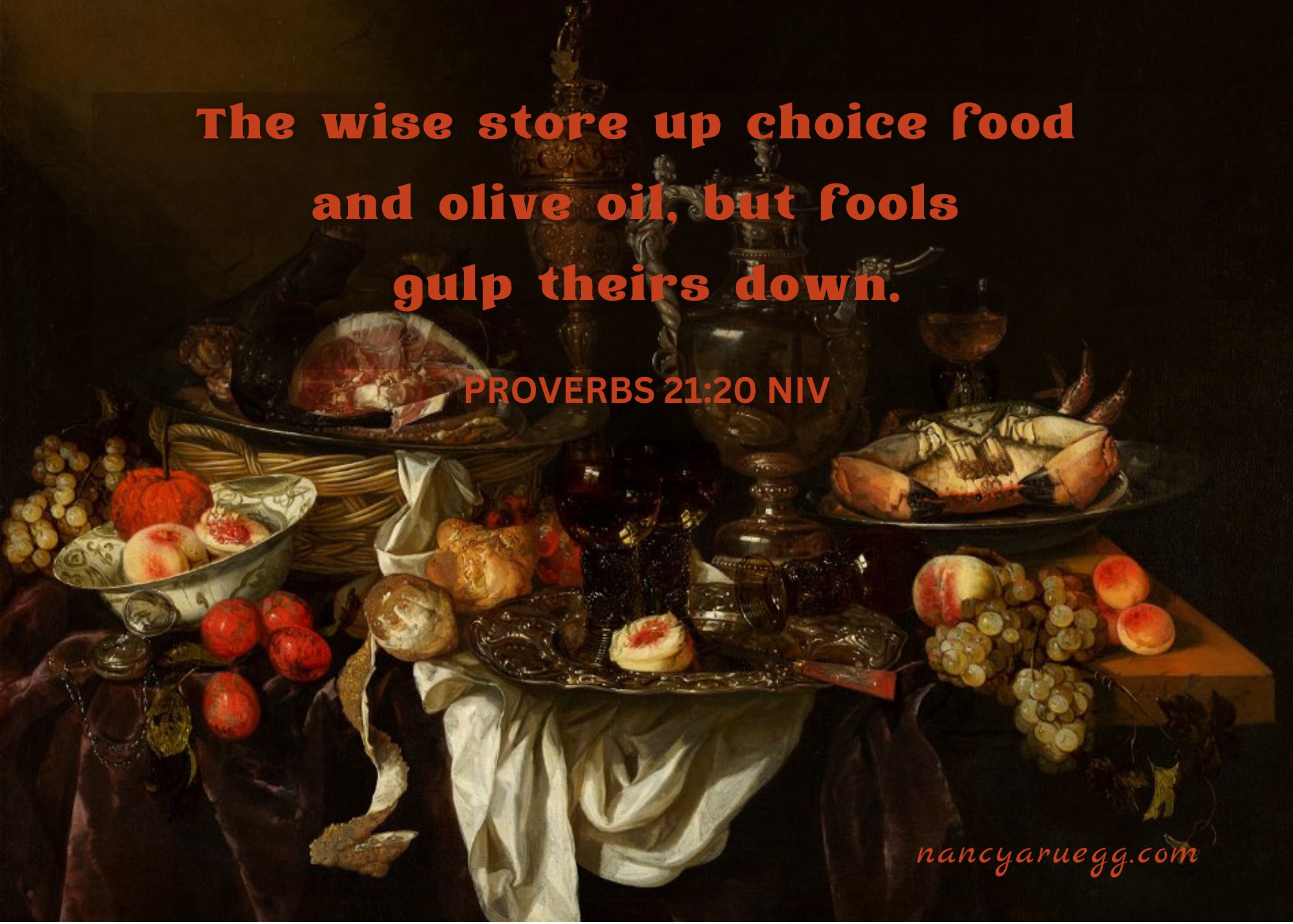
“Banquet Still Life” by Abrahan van Beyeren (1620-1690)

Is this a summary of Aesop’s fable, “The Grasshopper and the Ants,” or might there be a spiritual lesson here?

Actually, it’s both. Yes, God would have us live responsibly and save for the future, but he’d also have us share from our resources and enjoy the blessing of generosity.

The wise also store up within their spirits the choice nourishment of God’s Word and the oil of divine influence, to be ready for the work God calls them to do [2].

PUZZLING PROVERB #4

How can it be part of God’s glory (his splendorous attributes) to conceal a matter, and why is it the glory of a king to seek answers?

One reason God doesn’t reveal everything to us is this: knowledge of all things would overwhelm and frustrate our finite minds.

Second, if God answered all our why questions (like “Why did So-and-So have to die? She was so young!”), it’s likely we still wouldn’t be satisfied. We’d want to suggest he accomplish his plans some other less painful way.  

But. Living with uncertainty does teach us endurance and trust as we wait for the day when all will be made clear.

On the other hand, we do well to prayerfully seek guidance for our decisions. This is especially true for those in authority. It’s to their credit to learn the facts of a matter, consider probable solutions in light of outcomes and impact on others, and apply wisdom [3].

PUZZLING PROVERB #5

But what about those saints who’ve exhibited great wisdom, yet have suffered adversity, ill health, and/or untimely, undeserved death?

Obviously, King Solomon is not suggesting that wisdom results in complete protection from difficulty. His point is, by following the wise ways of scripture, we can avoid many of the troubles and heartaches that fools bring upon themselves.

In addition, true wisdom leads us to seek truth. Truth leads to Christ, and he leads us to the way of salvation and eternal safety in heaven [4].

I wonder, do you suppose Peter Piper is wise enough to be guided by these once-puzzling, now-clarified proverbs?

Are we?


[1] John 15:10-11; 1 Samuel 2:30; https://biblestudycourses.org/proverbs-bible-study-courses-sect-1/proverbs-1-8-19-exploring-the-passage/ ; Proverbs 1:8-9 NLT

[2] Acts 20:35; Barnes Notes on the Bible for Proverbs 6:1-11; Matthew 25:1-13; Deuteronomy 8:3b

[3] John 13:7; Psalm 119:130; https://www.bibleref.com/Proverbs/25/Proverbs-25-2.

[4] Proverbs 2:3-5, 9-11; John 1:17b; John 14:6; Acts 4:12

Art & photo credits: http://www.rawpixel.com; http://www.pexels.com; http://www.henikirbyhistory.getarchive.net; commons.wikimedia.org; http://www.pickpic.com; http://www.pexels.com; http://www.dailyverses.net.

Read Full Post »

(An imaginary conversation between God and me.)

ME:

You know me, Lord. If I’m not careful my mind can slide into fear and worry, especially about the needs and struggles of loved ones. Or I can slip backward into hurts or regrets of the past. Release from such thoughts is not always easy.

But I’ve heard it said, “What is IM-possible is HIM-possible” (Unknown).

So when negativity seeks to pull me down, I want to be quick to remember who YOU are, your promises, and what you can do that make all things HIM-possible.

GOD:

Indeed, nothing is IM-possible with me (Luke 1:37).

Here are four important truths to keep in mind that make for HIM-possible-living:

I am greater than your fears.

Think on My sovereignty and might.

I am in control of all things. I have established My throne in heaven and My kingdom rules over all. Therefore, the one who fears Me need not fear anything else [1].

I am all-wise and all-powerful, always with you and ready to offer counsel.

I am your all-sufficient Father, able to provide everything and anything you’ll ever need.

ME:

I praise You, Lord, for equipping me to contend with whatever circumstances unfold. You are the Mighty Warrior who saves!

(Psalm 103:19; 1 John 4:18a; Romans 11:33; Psalm 15:3, 46:1; Ephesians 3:20; Zephaniah 3:17)

GOD:

I am greater than your troubles.

Remember My power and strength.

Out of My omnipotence, I promise to supply you with strength sufficient for the day. Each morning I provide a fresh supply of all my mercies.

No matter what the future may hold, you can keep on bearing all things through My Son, Jesus Christ, who constantly infuses you with His strength.

Every trouble produces benefit–strong, honorable character in you, and blessing for others as they see My peace and joy reflected in you.

ME:

I praise you, Lord, for being a present-and-active help in times of trouble.

(2 Chronicles 20:6; Psalm 18:32; Lamentations 3:22-23; Philippians 4:13;

Romans 8:28; James 1:2-4; Matthew 5:16; Psalm 46:1)

GOD:

I am greater than your hurts.

Remember my love and tenderness, my grace and kindness.

I provide a solid foundation on which to rest, even when wave after wave of challenge sweeps through your life [2].

I am your Great Physician. Cling to Me by immersing yourself in My Word and find the cure for your heartache.

I am patiently transfiguring all the notes of your life into the song of My Son, Jesus . . . All is grace, as your hurts and heartaches become tools in My hands, to transform you into the image of Christ [3].

ME:

I praise you, Lord, for your devoted, attentive care.

(Isaiah 66:13a; Psalm 86:15; Psalm 147:3; Psalm 119:49-50; 2 Corinthians 3:18)

GOD:

I am greater than your regrets.

Remember my compassion and forgiveness.

Dwell on regrets and you’ll stir up a whirlpool of excruciating details. It’s an easy place to drown [4].

Leave the irreparable past in My hands, and step into the irresistible future with Me [5]. You’ll find joy replacing remorse and peace replacing agitation.

When thoughts of your failures do push their way into your consciousness, allow my total forgiveness to relieve your pangs of guilt. Then offer Me praise for accepting you just as you are, thanking Me for growing you into more than you were yesterday [6].

ME:

I praise you, Lord, for your mercy to forgive and your grace that meets me where I am but does not leave me where it found me [7].

I praise you that victory over fears, troubles, hurts, and regrets is more than HIM-possible with you!

(Psalm 103:8, 13; Romans 8:37)


[1] The fear of God in the original language doesn’t mean to be afraid. It means sustaining a joyful, astonished, awe and wonder before Him—Timothy Keller.

[2] Jane Fryar, Be Blessed, 34-35.

[3] Ann Voskamp, One Thousand Gifts, 100; Kay Arthur, His Imprint, My Expression, 180.

[4] Based on a David Powlison quote, https://www.sgclouisville.org/blog/2024/01/16/sermon-quotes-what-do-we-do-with-regret.

[5] Oswald Chambers, My Utmost for His Highest, Dec. 31.

[6] Ruth Bell Graham, Blessings for a Mother’s Day, 101.

[7] Anne Lamott, GRACE Eventually.

Art & photo credits: http://www.canva.com; http://www.heartlight.org; http://www.pxhere.com; http://www.canva.com; http://www.heartlight.org; http://www.dailyverses.net; http://www.rawpixels.com.

Read Full Post »

What if you opened your mailbox one day to see a thick, cream-colored envelope among the ads and bills. Your name and address have been hand-calligraphed in gold ink, and an intricate seal is embossed upon the flap.

Inside you find an elegant invitation, announcing a grand celebration at the palace of a highly-respected and beloved king.

“Come!” proclaims his request. “Come and enjoy an unlimited feast with me; come drink the finest wine. There is no cost to you.”

Would you attend? Surely you’d quickly return your R.S.V.P. with “YES” clearly marked!

Such a scenario is fiction, of course, except for one fact: God Almighty, the King of the universe, is a monarch to be highly-respected and beloved–above all others.

And he has issued an invitation to everyone–not just to a single banquet–but to a continual feast in his divine, spiritual kingdom. He bids us to come and enjoy a new, God-enhanced life.

Come, everyone who is thirsty, come to the waters;

and you without money, come, buy, and eat!

Come, buy wine and milk without money and without cost!

–Isaiah 55:1 HCSB

This invitation, proclaimed by the prophet Isaiah on behalf of our King, does include some puzzling statements. For example, why would he invite us “to the waters?” And what will we find there?

Just as water brings life and abundance in the realm of plants and trees, Christ’s living water provides soul-satisfying life and joyful abundance for us—the abundance of innumerable blessings [1].

And what about the wine that God says we can “buy without money?” Does it represent more than a celebratory drink? Oh yes! Wine is a metaphor here for spiritual joy, “a joy unspeakable and full of glory”[2] as we taste the goodness of God’s love.

And what about milk?

God would have us understand: his invitation to kingdom-living includes those entities that sustain our spirits, including encouragement, strength, instruction, and help. We find all that and more in the nourishment of His Word, the Bible [3].

Puritan author and preacher, Thomas Brooks (1608-1680) wrote:

The Word of the Lord is a light to guide you, a counselor to counsel you, a comforter to comfort you, a staff to support you, a sword to defend you, and a physician to cure you. The Word is a mine to enrich you, a robe to clothe you, and a crown to crown you.–Thomas Brooks

Countless Jesus-followers who read the Bible, study it, and meditate on its truths can affirm that Brooks is right; they’ve experienced time and again the life-changing power of God’s Word. That includes many of you reading this post.

In addition to his perpetual-banquet invitation, God includes these instructions:

Listen carefully to Me, and eat what is good.

Let your soul delight in abundance.

Incline your ear [to listen] and come to Me;

hear, so that your soul may live.

–Isaiah 55:2b-3a AMP

To listen carefully includes the action of follow-through. And what would God have us do? “Eat what is good”—that is, experience the fullness of his goodness as we follow his ways, and take delight in the abundance of his blessings.  

Then our souls can really live in the security and satisfaction he desires for us, in every moment of the present–and into eternity. And in the final analysis, isn’t that what we desire also?

All we need do is come.

*     *     *     *     *     *     *     *     *     *

I praise you, my King, for your open invitation to come and feast upon all the good things you offer. You prepare a table before me of forgiveness, salvation, peace, joy, strength, comfort, contentment, purpose, and more.

No amount of money on earth could purchase such priceless, heavenly gifts that you so freely give to those who simply COME. I will praise your name for ever and ever!

(Luke 13:29; Psalm 107:9; Psalm 23:5; Ephesians 3:20; Psalm 145:1b)

Have you accepted God’s invitation? If not, will you do so today [4]?

If you have, what goodness and delights have you tasted at his table? Please share in the Comments section below!


[1] David Gusik, https://enduringword.com/bible-commentary/isaiah-55/. See a starter-list of twenty-six examples: God’s Goodness from A to Z.

[2] Selwyn Hughes, Seasons of the Lord, 42.

[3] 1 Peter 2:2.

[4] See https://billygraham.org/answer/how-do-you-become-a-real-christian/ for a simple explanation and a prayer to guide you. Do it today—you’ll be so glad you did!

Photo credits: http://www.rawpixel.com; http://www.picryl.com; http://www.heartlight.org; http://www.canva.com.

Read Full Post »

After the cold starkness of winter, spring gleefully reawakens our senses with her: 

  • Effusion of colorful flowers
  • Scents of hyacinth, lilacs, and freshly-mowed grass
  • Symphony of bird song
  • Flavors of tender asparagus, luscious strawberries, and tart rhubarb
  • Textures of furry pussy willows, fuzzy moss, and silken magnolia petals

Praise God for our abilities to see, smell, hear, taste, and touch, allowing us to enjoy Spring in so many ways!

Even better, those abilities allow us to meet God in at least five ways.

Our five senses help us understand God more clearly.

Consider how the far-flung stars and planets speak of his power; the clever camouflage of lizard, fawn, and frog display his wisdom; the endless variety of colors, shapes, and textures prove his creativity; the instinctive parenting skills of adult animals demonstrate his goodness.

Our five senses help us experience God’s glory more profoundly.

  • We can see his power at work in the transformation of lives [1].
  • We can hear his wisdom in godly men and women, such as Thomas á Kempis or Corrie ten Boom (just two among millions!):
  • We can feel God’s loving touch through a hug that conveys compassion, a worship song that quickens the heart, or a landscape vista that gives us glory-goosebumps.
  • We can taste his goodness in all the variety of blessings we enjoy (Psalm 34:8).
  • We can smell the fragrance of his sweet presence (Psalm 45:6-8)—if we pay attention.

Our five senses help us connect with God more intimately in solitude.

Many people call it Quiet Time—moments they spend with God in scripture reading/study, prayer, perhaps journaling, and/or listening to peaceful worship music.

It’s in the quiet we begin to see important realities of the spiritual realm, hear God’s voice within our spirits providing wisdom and encouragement, feel his presence more palpably as we touch our knees to the floor in prayer, and again, smell the fragrance of his sweet presence as he meets us in our place of solitude.

   Our five senses help us worship God more intently in community.

Jerry Kerns [2]

Kerns would have us fully engaged–first to bless God’s heart and then to elevate the experience for us also.

How?

  • See the majesty and splendor of God on his throne–in your imagination. This is who you are worshiping [3]!
  • Hear the music and join in with grateful, enthusiastic praise [4].
  • Feel the presence of God as you pray. Try placing your hands on your lap, palms up—open and empty, symbolic of humility and receptivity [5].
  • Taste the bread and wine/juice with prayerful gratitude. Jesus is our Bread of Life who satisfies our spiritual hunger, who shed his blood for us so we might one day enjoy heaven with him. May we never become desensitized to the magnitude of his sacrifice.
  • Smell the fragrance of God’s saints as they leave the perfume of kindness, uplift, and joy in their wake.

Our five senses help us live out our faith more joyfully.

When our heart’s desire is to serve God by serving others, we’ll aspire to live so people:

  • See the Light of Jesus in our choices, behavior, and attitudes (Matthew 5:14-15)
  • Hear us speak truth, wisdom, and encouragement (Proverbs 10:20-21)
  • Feel the love of God in our interactions with them (John 13:35)
  • Taste the flavorful salt of God’s divine grace within us (Matthew 5:13)
  • Smell the fragrance of Christ in our lives (2 Corinthians 2:15-16)

 And as we engage all five senses in these five ways, what will happen?

We’ll bring more glory to God and enjoy more fully the satisfying, abundant life his Son provides.

That sounds mighty good to me. You too?


[1] Stunning examples include Jake DeShazer (https://nancyaruegg.com/2016/08/18/a-miracle-of-forgiveness/), Johnny Hart (https://nancyaruegg.com/2018/08/09/johnny-and-jesus/), and Isobel Kuhn (https://nancyaruegg.com/2024/04/11/goodness-and-mercy-followed/).

[2] https://www.experiencingworship.com/articles/general/2001-7-great-quotes-on-worship.html

[3] See: https://nancyaruegg.com/2023/07/06/in-awe-of-gods-magnificence/

[4] See: https://nancyaruegg.com/2015/09/07/when-worship-loses-the-wonder/

[5] See: https://nancyaruegg.com/2015/03/23/the-ultimate-delight/

Art & photo credits: http://www.pixabay.com; http://www.pexels.com; http://www.goodfon.com; http://www.stockvault.net; http://www.canva.com; http://www.pickpik.com (2); http://www.heartlight.org.

Read Full Post »

Many of those who haven’t asked Christ into their lives yet will still admit: historical evidence proves Jesus once lived on earth. They’ll agree he was a good man who taught wise principles to live by.

But even they might wonder: Why would God allow his Son to suffer such a cruel death at the hands of hateful men?

Welsh pastor and author Selwyn Hughes provided this insightful answer: what seemed to be the worst thing that could happen to Jesus—crucifixion—turned out to be the best thing for him [1].

That sounds ludicrous at first reading until we consider what Christ has enjoyed since returning to heaven, and what he’s looking forward to in the future–all because he fulfilled his mission at the cross.

As he suffered for us, Jesus kept in mind the joys set before him (Hebrews 12:2):

  • Sitting in the ultimate place of honor in the universe, at the right hand of the Majesty on high (Hebrews 1:3b).
  • Angels acclaiming him, saying, “Worthy is the Lamb who was slain, to receive power and wealth, wisdom and strength, honor, glory and praise” (Revelation 5:12).
  • God appointing him to be head over everything for the good of the church (Ephesians 1:22 GNT).
  • Being given authority and sovereign power that will last into eternity (Daniel 7:14).
  • All kings bowing before him one day, and all nations serving him (Psalm 72:11 NLT).
  • All nations and people of every language worshiping him (Daniel 7:14).
  • Being given the name above every name (Philippians 2:9).

And why is that last fact significant?  Jesus is the One and only Son of God, the only Redeemer and Savior, the only Christ and Anointed One of God. “His rank, his titles, his dignity, are above all others” [2].

Perhaps no one has explained the significance of Jesus’ name(s) more eloquently than theologian Charles Spurgeon:

Jesus’ name is “the sum total of all delights. It is the music with which the bells of heaven ring; a song in a word; an ocean for comprehension; although a drop for brevity, a matchless oratorio in two syllables; a gathering up of the hallelujahs of eternity in five letters” [3].

Charles Spurgeon

But Jesus doesn’t want to enjoy these accolades and privileges alone. Max Lucado wrote:

Jesus desires for us to be one with him, continually availing ourselves of all he has to offer.

Even more astonishing? Because of what Christ accomplished on the cross, we who’ve accepted Jesus into our lives get to share in his power and wealth, wisdom and strength, honor and glory!

For example:

  • The immeasurable and surpassing greatness of God’s spiritual POWER is in us who believe (Ephesians 1:19 AMP).
  • He supplies spiritual RICHES and blessings that cannot be fully understood or measured (Ephesians 3:8-9).
  • Christ’s word with all its WISDOM lives within us so we can experience his joy (Colossians 3:16; John 15:10-11).
  • We’re equipped for anything and equal to anything, through Christ who infuses us with inner STRENGTH (Philippians 4:13 AMP).
  • As beloved children adopted into God’s family through Christ, we are precious in his sight (Isaiah 43:4). He’s crowned us with HONOR and GLORY (Psalm 8:5; Romans 2:10), including the honor of representing Jesus in this world, and the glory of his character at work within us [4].

On this eve of Good Friday, we’d do well to remember:

We can pick up our own cross, inspired by Jesus’ example, empowered by God’s Spirit within us, and encouraged by the glorious outcome yet to be [5].

The worst circumstances we might face will become God’s best in our lives too.


[1] Every Day Light, 285.

[2] Barnes’ Notes on the Bible at www.biblehub.org

[3] Morning by Morning, 41.

[4] See also 2 Corinthians 5:17, 20

[5] To “pick up our cross” means trusting in God even when suffering comes our way, putting aside our self-will and embracing God’s will instead.

Photo credits: http://www.freebibleimages.com; http://www.canva.com (2); http://www.quotefancy.com; http://www.canva.com; http://www.pexels.com.

Read Full Post »

« Newer Posts - Older Posts »

Still Traveling

Impressions Becoming Expressions

Living Our Days

Gaining a heart of wisdom

He Said What?!

I'm Patty, and my husband and I are living with our adult son who has autism and epilepsy. I love sharing lessons learned from life around me, especially life with Aaron.

Meditations of my Heart

Impressions Becoming Expressions

Linda Stoll

Impressions Becoming Expressions

Debby Thompson

Impressions Becoming Expressions

Signora Sheila

Notes on Life, Faith & Italy

Colleen Scheid

Writing, Acting, Living in God's Love

Mitch Teemley

The Power of Story

Heidi Viars

Finding the Image of God