Feeds:
Posts
Comments

Archive for the ‘Encouragement’ Category

what-can-separate-us

“I am convinced that neither death nor life,

neither angels nor demons,

neither the present nor the future,

nor any powers,

neither height nor depth,

nor anything else in all creation,

will be able to separate us from the love of God

that is in Christ Jesus our Lord.”

–Romans 8:38-39

Consider the author of these lofty, poetic words: Paul—a man who endured beatings, stonings, shipwrecks, danger, sleepless nights, extreme hunger and thirst, and exposure to the elements (1).

Yet in spite of all these hardships, Paul never thought, Maybe God doesn’t love me anymore.  No, he was convinced otherwise.  And he wanted to assure his readers, including us today, that nothing can come between the believer and his/her God:

            “Neither death nor life…”

Every moment of our lives God is watching over us, working out his plans that will achieve the highest good. Sometimes that includes suffering, for reasons we don’t always understand.

But consider: the greatest tragedy of history, the cruel torture and death of God’s perfect Son on a cross, brought about the most glorious consequence–the eternal salvation of all who believe (2).

image.axd

And when we die? God will still be watching over us (3). Visit a dying Christian and you will be the one encouraged by their God-given peace, joy, and expectation.

“Neither angels nor demons…” 

Long ago, the rabbis believed some angels were grudgingly hostile to men, not wanting to share God with earthly creatures. Perhaps Paul was saying, “Even jealous angels can do nothing to separate us from God’s love” (William Barclay).

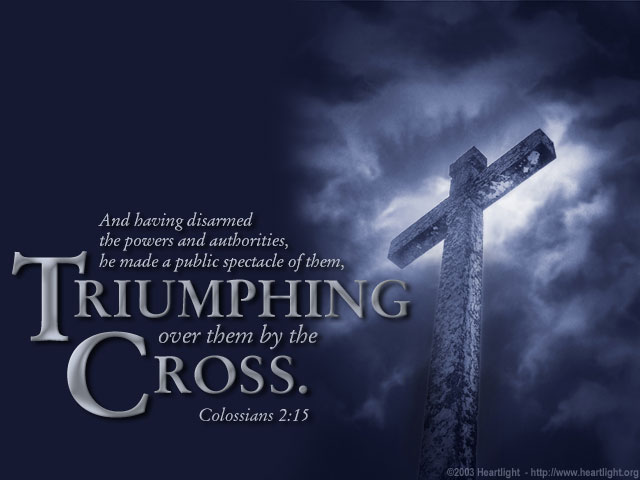
As for demons, they were defeated when Jesus died on the cross (4). Granted, they may prowl around and cause mischief, but they are powerless to sever us from God’s love. Their teeth were removed at Calvary!
colossians2_15

“Neither the present nor the future…”

 Sometimes we worry about the future. Will we be able to handle potential calamities down the road? Or, perhaps it’s the present that’s unbearable, and we wonder if better days will ever dawn.

But our omniscient God has never been surprised by any turn of events. What he says here (through Paul) is a guaranteed promise: nothing present or future—no circumstance–can separate us from his loving presence.

“Nor any powers…” 

All powers of the universe—whether physical or spiritual—are subject to God, because he alone is the Omnipotent One. No one supersedes him.

“Neither height nor depth…”

 Many in Paul’s day believed that the star a person was born under controlled that person’s destiny. Height referred to a star’s zenith; depth to the star’s lowest point in the sky. Paul may have been assuring his readers that the stars have no power over our lives.

By contrast, our Star of David, Jesus, is like the North Star. He never waxes and wanes; he never changes. And his love is present everywhere (5).

22b369c3e20ff6b9ced0597f35085cfb

            “Nor anything else in all creation…”  

No circumstance, no place, no person can remove us from God’s love. “God never loses his loving grip on his children” (Keith Krell, www.bible.org).

And so Paul covered every eventuality that might separate us from the love of God and assured us: It. Can’t. Happen. Surely, if Paul was convinced, after all he suffered, shouldn’t we be convinced as well?

*     *     *     *     *     *     *     *    *     *

Day after day, Father, you express your love to us: forgiving our sins, transforming our spirits, defending us from spiritual enemies, showering us with blessings. We praise you for the warm embrace of your love—a love that spans all time and space, overcomes all pain and suffering, and defeats every foe! “Because your love is better than life, [our] lips will glorify you” (6).

(1) 2 Corinthians 11:25-27

(2) John 3:16

(3) Psalm 23:4

(4) Colossians 2:15

(5) Psalm 139:7-10

(6) Psalm 63:3

Photo credit:  www.doughusen.com; http://www.klove.com; http://www.verseoftheday.com; http://www.pinterest.com.

Read Full Post »

image.ashx

Scripture is full of promises that speak of precious gifts God is willing to give us:

  • Unstoppable love (Romans 8:38-39)
  • Overflowing hope (Romans 15:13)
  • Wise guidance (Psalm 32:8)
  • Courageous confidence (Psalm 56:3-4)
  • Compassionate comfort (Psalm 34:18)
  • Peaceful rest (Matthew 11:28-29)

And that’s not a complete list by any means. The question is: Are we willing to receive all these blessings?

Or, are our minds full of:

  • Doubt?

“God may love me in a general sense, but personally? I doubt it. After disappointing him so many times, I don’t deserve his gifts.”

  • Negativity?

“Look at all these challenges in my life. I’m not seeing very many blessings.” 

  • Timidity? 

“That promise can’t be for me, can it?” 

These kinds of thoughts originate with Satan, the father of lies, who’s delighted when we don’t embrace God’s blessings.

For most of us, accepting gifts—even from God–can be more difficult than giving them. Gracious receiving is an art.

So how do we develop the art of receiving? 

  1. Reject those lies of the devil.

With the help of the Holy Spirit, we can take such thoughts captive and cast them out of our minds (2 Corinthians 10:5). The next step is to…

  1. Fill our minds with uplifting thinking.

“Whatever is noble, whatever is right, whatever is pure, whatever is lovely, whatever is admirable—if anything is excellent or praiseworthy—think about such things” (Philippians 4:8).

Such glorious categories on which to focus! And undoubtedly our hearts will fill with gratitude as we contemplate God’s magnificent gifts.

  1. Practice. 

Any art form—music, writing, painting, etc.—requires practice. So does the art of receiving. God has not chosen to instantaneously transform our attitudes for us. He almost always takes a gradual approach, providing numerous opportunities for practice.

The art of receiving is no different, developing over time through faith and self-discipline. We affirm that God loves and blesses his children—despite our feelings–and discipline our minds to counter doubt, negativity, and fear with trust-statements from his Word.

  1. Spend time in God’s Word. 

The more time we spend reading the Bible, the more scripture-gems we discover that speak of God’s gracious character, his promises, and blessings. And the more we learn, the more we respond, “Thank you, Father, for all the blessings of the abundant, God-enhanced life with you!”

  1. Receive graciously, even enthusiastically, from others. 

Too often, we’re uncomfortable at the receiving end.  We feel embarrassed or unworthy and worry about repaying the favor.

We need to remind ourselves: gracious, enthusiastic receiving is in itself a gift of: 

Affirmation.  Every gift bestowed with good intention is meaningful—whether it’s a compliment, a favor, or an object. Granted, we may feel awkward when complimented, we may not need the favor or desire the object, but the thoughtfulness can be affirmed just the same.

Pleasure.  God has engineered us so that when the receiver expresses pleasure, the giver also experiences pleasure—usually more so.

Gratitude.  Thoughtful gratitude shows honor and esteem for the giver.

So let’s grit our teeth and be gracious receivers!

No, gritting won’t be necessary if we remember: All gifts originate in the heart of our Heavenly Father (James 1:17). He is the One bestowing the blessings, frequently using people as his agents.

Our highest privilege is to bestow pleasure and honor upon God, by passing the praise and gratitude on to him

In doing so, the art of receiving comes full circle.

(Photo credit:  www.familyconnect.org.)


Read Full Post »

190-Distracted-While-Praying-1

Are you ever distracted while trying to pray? I am!  One minute I’m deep into intercession for a friend, the next I suddenly think to purchase Christmas cards today (triggered by thoughts of friends, you see).

Why is it my thoughts can drift so easily? How is it possible to lose focus while in the presence of Almighty God? Such a frustration. Guilt-producing, too.

Perhaps strategies such as these will be helpful:

  • Light a candle.

Let it symbolize the presence of Jesus, our Light of the world, with us as we pray.

candle

  • Picture a quiet place with Jesus.

For years my quiet time took place in the early morning hours before anyone else got up. For Bible study, I spread my books and papers across the kitchen table. For prayer time, I spread my arms across the table, visualizing Jesus sitting on the other side from me and holding my hands.

Our current home does not lend itself to this arrangement. My quiet time space is in our guest room/office at my computer armoire. There’s no table to spread my arms across. I need a new visualization.

Perhaps this photo?

2a542f1fea56b0061e673dd49d17150b

I can imagine Jesus and me sitting lakeside, enjoying the stunning view as I present my requests to him (Philippians 4:6).   We can still “hold hands,” as I rest my arm on the arm of the office (imaginary Adirondack) chair.

  • Keep the to-do list handy.

When a task or errand comes to mind, like purchasing Christmas cards, write it down. Then those pesky thoughts beginning with, “Oh! Don’t forget to…” can be put aside.

  • Pray about the distracting thought, if it’s related to a present concern.

For example:

“Lord, I’m sorry the meeting this afternoon keeps popping into my mind. Help me to rest in the knowledge you’ll be with me, providing the words to say as I rely on you. Thank you for your promise in James 1:5 that assures me of your wisdom, simply for the asking. I’m asking! And I trust you for the results that will most benefit everyone involved.” 

  • Pray out loud.

Even whispering the words may be enough to foster focus. 

  • Pray the scriptures.

The psalms work well for this exercise. Skim-read until a key word catches your eye. (If you’ve underlined meaningful passages, focus on those.) Chances are it will not take long to identify an applicable verse.

For example, a friend is very unhappy in her current job. How can I pray for her? Skimming quickly through the underlined verses of psalms, I come to:

6cdd17c921abfa9ef1d6d59dd8a29c44

(“From the Lord comes deliverance.

May your blessing be on your people.”

— Psalm 3:8)

And I pray:

Oh, Father, deliver Emily** from her situation at work by removing her from that office, changing circumstances within the office, or giving Emily a fresh perspective that releases her from the stress. Surround Emily, I pray, with blessing: delightful coworkers who will bring her joy and affirmation, encouragement from her boss, and maybe even a raise!

 As my mind focuses on ways the verse might apply to Emily, I find distractions are held at bay.

Yet, in spite of our best efforts, lapses into distractions will occur. I take great encouragement from the wisdom of St. Francis de Sales. Perhaps you will, too: If all you do is return to God’s presence after distraction, then this is very good prayer.  Your persistence shows how much you want to be with God.

*     *     *     *     *     *     *     *     *     *

How do you counter distractions during prayer? Please share your strategies in the Comments section below!

**Name changed.

Art and photo credits:  www.printmytract.com; http://www.refiningtruth.com; http://www.pinterest.com (3).

Read Full Post »

john15-1

(“I am the true vine, and my Father is the vinedresser.” — John 15:1)

With that metaphor, Jesus began teaching his followers about living like branches and abiding in him, the vine.

No doubt the disciples readily pictured a vineyard and the vinedresser tending to his work. They would have been familiar with the tasks he performed to assure a maximum yield.

But today, most of us live far removed from the sources of our food and drink. We have little knowledge of what ranchers, farmers, or vinedressers do to assure a high quality product.

We’re left wondering as we read this verse, How is God like a vinedresser?

Here is what I discovered:

His/her main duties include caring for the vines, pest management, irrigation, pruning, and harvest.

granmonte-vineyard

Caring for the Vines

 Grapevines produce fruit for thirty to fifty years. Therefore the vinedresser comes to know each vine like a shepherd knows each sheep. He understands the special care each one requires and how to provide the best growing conditions, depending on the type of grape, the amount and direction of sunlight, the soil conditions, and more.

When branches grow long enough, the vinedresser lifts them up from the ground and gives them support so they can grow upward toward the sun. This practice also helps protect the vine from disease.

Vinedressers remove individual leaves to increase the amount of sunlight on the grapes and air circulation around the clusters, which improves the color and flavor of the crop. The vinedresser must know which leaves to remove, depending on the angle of the sun. Just the right number must be chosen also. If too many leaves are removed, the vine won’t be able to absorb enough sunlight for photosynthesis. If not enough are removed, the crop will fail to achieve optimum quality.

Pest Management

Weeds must be removed by hand or with a hoe. Contemporary vinedressers might be tempted to use a Weed-Eater, but it could easily damage the trunks of the vines. Insects and diseases must also be eradicated.

Irrigation 

Though grapevines can survive dry conditions, parched vines will not produce much fruit. Some experts recommend watering deeply and thoroughly so roots receive plenty of moisture.

 Pruning

Grapevines produce some branches that are barren and worthless. These must be pruned radically. In fact, “vines never produce to full capacity without drastic pruning” (William Barclay).

Harvest

The vinedresser knows the exact moment to harvest.  The grapes are plump, juicy, and rich in color. The skins are slightly transparent; the flavor a balance between sweet and tart.

6351f7348ecdc436db1fb43b7b900e5f


 Given even this scant information, we begin to appreciate God’s role of Vinedresser in our lives:

  • He knows each of us just as an attentive vinedresser knows his vines (Psalm 139:1-5).
  • He tends to us with vigilant, individualized care, providing circumstances, relationships and events that will create the best growing conditions for our souls (Titus 2:11-14).
  • He lifts us up, encouraging our development toward the Son (James 4:10).
  • As we submit to our Vinedresser, he eradicates the disease of sin (Psalm 103:3).
  • He provides streams of living water so we need not fear a year of drought. We can continually bear the fruit of the Spirit and good deeds (Jeremiah 17:8).
  • Like any wise vinedresser, he prunes with discipline, cutting away bad habits, erroneous beliefs, harmful influences, poor attitudes, pride, selfishness and more. He helps us become spiritually healthy as well as productive influences in the world (Hebrews 12:5-11).

And when we’ve reached maturity, our transparency allows the sweet, rich nature of Jesus to radiate from within us.

*     *     *     *     *   *     *     *     *     *

Thank you, Heavenly Vinedressser, for your careful attention and protection. I marvel that you created me for abundance—abundant pleasure in you, abundant fruitfulness for you. Help me to abide in you, Jesus, the Vine, and respond in obedience and trust, so that I might live for your glory–the glory of my splendorous Vinedresser.

(Photo credits:  www.carolinasnalc.org; http://www.tripadvisor.com; http://www.pinterest.com.)

Read Full Post »

(Steve and I are enjoying time with family this week.  I’ll return soon with  new posts.  Meanwhile, I’ll reblog previous ones.  Hopefully you’ll find them meaningful again, or perhaps for the first time.  The following post was first published June 13, 2013.)

From stage left, she crosses the platform in confident strides.  One hand waves in sweeping arcs to the large audience. The crowd claps and cheers.

In the other hand, with confident ease, she holds the microphone.  And the smile—big and broad, bright white teeth visible even from the balcony.

Able to sing like a nightingale and articulate truth with conviction. Impacting thousands.

Now there is someone God is using in a powerful way, whispers an accusing voice.  Look at her significant contribution in the Kingdom of God. No doubt she’s highly valuable to him.  So what are you doing that’s important?  Your spot in the scheme of things is nothing compared to that shining star on the stage.  You might as well face the truth:  You are unimportant.  The ship of Significance has passed you by.

Sound the least bit familiar? You’re not alone. Demons use those same lies on a lot of us. Evil spirits aren’t very creative, are they?

But here’s the truth of the matter:

Each of us is the workmanship of God (Ephesians 2:10). The Greek word, workmanship, sometimes has the connotation of “work of art.” You are a work of art—carefully designed and meticulously executed.

The verse goes on to explain we’ve been created to do good works. It does not say the same work. Diversity of personality, talent, and interest are necessary among the children of God in order that all his plans are accomplished.

He made each of us unique, to fulfill a personalized plan. Every now and then we see such a plan unfold so clearly, we know God engineered the circumstances. Sometimes it’s a unique set of talents or gifts that work together sublimely to meet a need.

Take, for example, the naturally talented writer, who happened to grow up in a bilingual home, and studied Christian Education in college. She was especially prepared by God to write Spanish curriculum for a Christian publishing company.

Other times the plan is much less obvious, and we must trust that the task before us–caring for our families, teaching that Sunday School class, working at the homeless shelter–is indeed accomplishing divine purpose.

What we can know for certain:  each of us is valuable to God (Matthew  10:29-31).

Believe that he has prepared in advance good works for you to do (Ephesians 2:10).  Take joy and satisfaction from completing those good works.

It may not be walking across a stage with a microphone. It might mean walking across the kitchen with a rolling pin—to bake cookies for the neighbors.

That’s just a small, insignificant thing, you say?

Think about this: What if God takes particular pleasure in small things?

Personally, I’m fascinated by small things. Miniatures, doll houses, petit-point, babies!

Scripture gives us indication that God does indeed love small things as well:

Sparrows (Matthew 10:29-31).

Two little mites given by a widow (Mark 12:41-44).

Five small barley loaves and two small fish (John 6:1-13).

Bethlehem (Micah 5:2).

Let’s never again allow those little demons of abasement to put us down. God has promised: “I will bless those who fear the Lord—small and great alike” (Psalm 115:13, emphasis added).

You see, in God’s sight, we’re of equal worth.

Read Full Post »

(Steve and I are enjoying time with family this week.  I’ll return soon with  new posts.  Meanwhile, I’ll reblog previous ones.  Hopefully you’ll find them meaningful again, or perhaps for the first time.  The following post was first published November 14, 2013.)

(“The Lord make his face shine upon you and be gracious to you;  the Lord turn his face toward you and give you peace.”– Numbers 6:25-26)

Lovely, poetic words.  But what do those phrases about God’s  face mean?  Even if God’s face did shine upon me, or turn toward me, how would I know?  I’ve never seen God; no one has (1 John 4:12).

A little research turned up this explanation:   God’s face represents his character.

Read those verses from Numbers again.  But this time replace the word face with the word character.  The meaning becomes clearer.

The Lord make his character shine upon you

And be gracious to you;

The Lord turn his character toward you

And give you peace.

How many of God’s character traits can you name?  David named seven in a psalm of thanksgiving found in 1 Chronicles 16:8-34.  God is:

  • Powerful (v. 9)
  • Strong (v. 11)
  • Trustworthy (v. 15)
  • Majestic (v. 27)
  • Holy (v. 29)
  • Good (v. 34)
  • Loving (v. 34)

This brief list is just the beginning of descriptors we could name about God.  He is infinite; his attributes are infinite!

All of those character traits and more are shining upon our lives, as he cares for us, lives in us,and participates with us every moment of our lives.

  • His power works miracles.
  • His strength carries us through difficult times.
  • He can be trusted to always do what is best.
  • His supreme majesty speaks of his authority over the universe.
  • He is righteous and holy in all he does.
  • Out of his goodness he provides countless blessings.
  • And all of this is graciously given, not out of a sense of duty because he made us, but because he loves us.

God’s face shining upon us represents God’s radiance.

 If we insist on following our own way, as Israel did, he may choose to hide his face from us (Isaiah 1:15).

But.

“When a king’s face brightens, it means life; his favor is like a rain cloud in spring” (Proverbs 16:15).

When the King of the universe shines his favor upon us, what more could we want?  Life for us is not mere existence.  It is a rich, full life–rich with blessings, and full of satisfaction, peace, and joy!

*     *     *     *     *     *     *     *     *     *

Thank you, Almighty God, for manifesting your character in my life.  I have seen you work miracles and give strength to the weak.  I have watched as you engineered circumstances to accomplish your plan. (And it always turned out to be a hundred times better than anything I could dream up!)

 I marvel at your power and majesty on display in creation.  I have recorded hundreds of blessings you’ve provided for our family.  Your radiance shines brilliantly all around me. 

 And now, as a thank you gift back to you, dear Father, may my life reflect your radiance to others—with ever-increasing glory (2 Corinthians 3:18). 

*     *     *     *     *     *     *     *     *     *

How has God shone his face upon you?  Please share in the Comments below!

(art credit:  www.christianwordart.com)

Read Full Post »

(Steve and I are enjoying time with family this week.  I’ll return soon with  new posts.  Meanwhile, I’ll reblog previous ones.  Hopefully you’ll find them meaningful again, or perhaps for the first time.  The following post was first published September 13, 2013.)

Women's Bible Study

“I know we have to persevere and not give up on what we sense God wants us to do,” Melissa shared at Bible study.  “And from the lives of Joseph, Moses, Daniel, and others in the Bible, I know God rarely smooths out  the path perfectly.  But what I want to know is how to proceed.  I’d like steps to follow!”

Heads nodded around the table, mine included.  Wouldn’t it be nice if God laid out for us to see ahead of time step one, step two, and so on toward his perfect plan?

That idea has been circulating in my brain for nearly a week now.  Here are some observations.

1. God values our growth in faith more than our comfort in a revealed plan.   

If it was best for us to know his plan in advance, then that’s what God would provide.  Instead, he allows our faith to be tested, in order to build our character.  That is important to him:

“The Lord detests men of perverse heart but he delights in those whose ways are blameless” (Proverbs 11:20).

2.  God values the process of spiritual growth, not just the final outcome of a purpose fulfilled.

Times of challenge give us opportunity to develop maturity more readily than times of ease.  What might that development include?

  • Self-discipline–when we tackle difficult tasks.  Granted, the Holy Spirit empowers us (Galatians 5:22-23), but we must give ourselves over to him.  How?  Through frequent prayer, offered throughout the day, consistently asking for his guidance and help.
  • Self-denial–by doing without.  However, the attentive person will soon discover much to celebrate that may have been missed otherwise:  the stunning display of God’s creation, the joy of love and laughter with family and friends, the peace and strength from frequent communion with God.  Suddenly, gratitude flourishes in the heart, and what has been given up doesn’t seem so important anymore.
  • The full meaning of love–when given opportunity to respond in kind ways to difficult people.

None of these valuable traits of discipline, selflessness, and love would fully develop without lessons of experience.

3.  God values the development of our prayer lives–not for his benefit, but for ours.

Jean Nicolas Grou, a Jesuit priest of the 1700s, described healthy prayer as humble, reverent, loving, confident, and persevering.  As we practice those traits in our prayer lives, surely they will overflow into our character, in our actions and reactions.

Patient pursuit, then, is best applied to God’s ways, and then to God’s plan.

(photo credit:  http://www.st-tims-church.org )

Read Full Post »

The story of Cinderella always was my favorite fairy tale. The rags-to-riches, wrong-to-right, happily-ever-after story never grew old.

1437fdd92c98d193d310d64889316185


And that ball gown! How the illustrators of the various editions must have enjoyed creating the glory and splendor of that dress!

Rarely, if ever, are we common damsels provided opportunity to wear such grand finery. And I doubt many guys out there in the blogosphere have donned gold-braided jackets spangled with brightly colored medals. Such ostentation is almost exclusively reserved for royalty.

Ah! But whether we’re CEOs of the home front (stay-at-home parents) or CEOs of corporations, plumbers or painters, teachers or taxi drivers, we are priests of the Lord King of the universe.   And that designation makes us a royal priesthood:


81cbdeaa64193e714bde42f962d32d8a


(“You are a chosen people, a royal priesthood,

a holy nation, a people belonging to God,

that you may declare the praises of him

who called you out of darkness

into his wonderful light.”

–1 Peter 2:9)

Because we are his royal priesthood, God has provided a glorious new wardrobe for each of us, including:

  • Rich garments of salvation, replacing the sin-stained rags of our self-centeredness (1).
  • A robe of righteousness, radiant with the perfections of Jesus (2).
  • A belt of truth, studded with gems from God’s Word that inspire, instruct, encourage, and comfort (3).
  • Garments of praise, because he continually manifests his glorious attributes and showers us with blessings (4).
  • Ornaments of strength and joy (5).
  • A crown of beauty, as we allow the Holy Spirit to renew our minds and turn our thoughts to the positive (6).
  • Beautiful shoes of peace, equipping us to tread gently and share the peace of Jesus with others (7).

Note: None of this is earned, like the medals on Prince Charming’s uniform. Every radiant item has been magnanimously bestowed by our King.

Why would that be, we wonder. Is his purpose simply to display his generosity?

Surely that’s part of the answer. But the last half of 1 Peter 2:9 (above) reveals more: Now that we’re dressed in his garments of radiant splendor, we are commissioned to proclaim his excellency everywhere we go.


Two-women-talking-in-a-cafe-300x199


Sometimes we proclaim with words (Mark 16:15), as simple as “God is so good,” while sharing a story with a coworker.

Sometimes we proclaim with loving action (John 13:34-35), serving as a channel of blessing between God and others. That extra-generous tip to a waitress, for example, may pay eternal dividends  especially if she saw us praying before we ate, and we engaged her in friendly, upbeat conversation (about her).

Sometimes we proclaim with our attitudes—simply reflecting the radiance of Jesus’ peace and joy on our faces (2 Corinthians 3:18)—especially in difficult circumstances. Someone may very well ask, “I don’t know how you do it,” giving you opportunity to proclaim God’s excellencies and the blessings of living in his wonderful light—just as that verse in First Peter suggests.


sun-beams-through-forest-300x199


If our new wardrobe is on full display, people will notice.


“Let us put on the vestments of holiness

and minister before the Lord all day long.”

–Charles Spurgeon

Photo credits:  www.pinterest.com (2), http://www.icould.com; http://www.kingdomcalling.com.)

___________________________________________________________________

  1. Zechariah 3:4; Isaiah 61:10
  2. Isaiah 61:10
  3. Ephesians 6:14; 2 Timothy 3:16
  4. Isaiah 61:3
  5. Isaiah 49:18
  6. Isaiah 61:3; Romans 8:5; Philippians 4:8
  7. Isaiah 52:7; Ephesians 6:15; John 14:27


Read Full Post »

tumblr_n6al7hhRSw1rzadffo1_500


For long stretches of time, life can roll along quite satisfactorily. The kids are healthy and doing well in school. Bills are paid on time. The house and cars are holding together with no major repairs required.


Stone_mold


And then suddenly, we hit a stone wall. The promotion goes to someone else.   The company requires a move across the country. An addiction is disclosed. A life-threatening prognosis is delivered.

Pow.   We’re broadsided by disappointment, fear, and pain.

For a few moments we’re frozen in disbelief.

We grieve.

And that’s to be expected.   These are normal reactions.

What we want to avoid is parking at the stone wall, allowing it to consume our thoughts and prohibit forward movement.

That’s much easier said than done, right? That wall of trouble looms over us–thick, tall, and menacing. It’s not like we want to meditate on it; the ugly thing demands attention.

But, oh, praise God, he can tear down walls! (Remember Jericho?)


80a8523580822ed8e5556777b2c3a552


We can also defy the enemy who built the wall. Satan, the father of all strife (1 John 5:19), is the one with whom we must battle.

How? There are a number of worthy tactics, but let’s focus on three:

Let the Lord Jesus Christ be as near to you as the clothes you wear and be strengthened (Romans 13:14 CEV).  We can praise him for such affirmations as the following to lift our spirits and nourish hope.

He is our:


6b7162242c49e27d145b54f99f524f14


Sing or recite scripture and be revived (Psalm 119:25b).

Start writing down every verse that applies to your situation, and read through them frequently.  Fellow blogger, Bev Rihtarchik (over at Walking Well with God) chooses one meaningful verse, and copies it on a slip of paper to carry in her pocket. When worry comes to call, out comes the verse—truth, in black and white.  Now there’s a surefire way to boost our faith!

Count your blessings and be encouraged.

Yes, it’s an old cliché, but naming God’s benefits is soothing balm to the soul.

Several years ago, I struggled through a particularly challenging year, giving me the opportunity to practice the disciplines of forgiveness, perseverance, renewing the mind, and more.

I continued to keep my blessings journal, more eager than ever to notice the evidence of God at work around me.


photolibrary_rf_photo_of_woman_writng_in_journal


On December 31, I tallied the entries. Imagine my astonishment to count twenty more than any other year to that point, and I’d been keeping that journal over twenty-five years.

God had indeed been at work.  but if I not been recording the evidence, I surely would have missed the generous extent of his blessing.

*     *     *     *     *     *     *     *     *     *

Oh, how I praise you, Heavenly Father, that you are in control. I can move on from that stone wall–strengthened by you, led by you, and encouraged by you. Help me to see the unseen steps ahead as an adventure with you, and fill my heart with your hope. You are my Rock whose works are perfect; all your ways are just. You are a faithful God who does no wrong (Deuteronomy 32:4). I cannot praise you enough!


(Photo credits:  www.vesselforchrist.tumblr.com; http://www.survivingtoxicmold.com; http://www.pinterest.com (2), http://www.web.md.com.)


How do you fight the battle against discouragement, fear, and hurt?  Please share with us in the comment section below!

Read Full Post »

12-27-11iStock_000018316152

Years ago I read a story that still comes to mind now and then.

As I recall, an older church member–a woman of very high standards which she vocalized frequently–came to visit a young mother of the church unannounced.

The impromptu hostess—we’ll call her Beth—invited Mrs. Perfect into her home, grateful that she’d straightened up a bit after her two older children left for school. The two younger ones were playing quietly with new Legos (How fortunate was that?), allowing the two women to chat.

kitchen-after-counter-1

As they sat at the kitchen table, Beth considered the room from her guest’s perspective: table cleared, dishes done, counters not too cluttered or spotted. Whew.

Then she saw it: an orange peel on the floor—not a fresh strip from breakfast; more likely from last week. How did I miss that? Beth thought. One thing for sure: Mrs. Perfect wouldn’t miss it. It was in plain view from where she sat too.

Suddenly Beth experienced an epiphany. What difference did it make to her if this poor, old woman noticed the orange peel? Mrs. Perfect, however, would leave with a spring in her step because she would never allow such filth to remain undetected on her floor.

And Beth smiled to herself as the other woman prattled on about the upcoming bazaar.   I hope that orange peel makes her day. And Beth truly meant it.

God brings that story to my mind because I have to fight against perfectionism too.

Obsessive man laying on grass, perfection

And the reasons? So others will be pleased with me, appreciate me, and admire my efforts. Notice: me, me, my.

Clearly perfectionism is a close relative of self-centeredness.  Oh, Lord, forgive me.

I pray God steers me away from such counter-productive expectations of myself. Instead I want to strive for excellence.

Yes, there is a difference between perfection and excellence.

Perfectionists have the tendency to:

  • Set unreasonably high standards
  • Experience satisfaction only when those high standards are met
  • Become depressed over failures and disappointments
  • Be controlled by fear of failure and therefore procrastinate
  • Worry about disapproval when mistakes are made

On the other hand, those striving for excellence are likely to:

  • Set standards that are high but reachable
  • Enjoy the process as well as the outcome
  • Recover quickly from failures and disappointments
  • Keep fear under control with positive truth
  • View mistakes as opportunities for growth

c398dcb781f29c5f0c3e1946d50a4422

For the Christian, excellence should be our loving response to God with the desire to please him.

And what might those responses look like, as we strive for excellence?

  • Ask God to reveal his expectations. Then invite him to work toward meeting his standard:  maturity (James 1:4).
  • Take pleasure in signs of spiritual growth, as we manifest the fruit of the Spirit more and more each day (Philippians 1:9-11).
  • Turn to him for encouragement and strength when failures and disappointments come (Psalm 18:25-33).
  • Keep fear under control with appropriate scriptures and uplifting devotionals (Psalm 118:5-8).
  • View mistakes as opportunities to grow in maturity and in our relationship with God (Proverbs 24:16).

6f8af2878da632fd3fcbfe0e23c9a750

By the way, when the Bible tells us to be perfect (as in Matthew 5:48), the words mature and complete are helpful synonyms to interpose. Perfection is not within our abilities to achieve (Romans 3:23). We know it and God knows it.

Here’s what we can do:

“Strive toward holiness, yet relax in grace.”

–Philip Yancey


Isn’t that a wonderfully balanced goal?

Let’s remember: “Christ has set us free to live a free life. So take your stand! Never again let anyone [including ourselves] put a harness of slavery [to perfectionism] on you.” – Galatians 5:1 (MSG)*

*Words in brackets added.

Photo credits:  www.deeprootsathome.com; http://www.femhack.com; http://www.worshipmatters.com; http://www.pinterest.com (2).

What are your thoughts about perfectionism and Christian excellence?  Share your comments below!

Read Full Post »

« Newer Posts - Older Posts »

When the House is Quiet

Impressions Becoming Expressions

Mitch Teemley

The Power of Story

Still Traveling

Impressions Becoming Expressions

Living Our Days

Gaining a heart of wisdom

He Said What?!

I'm Patty, and my husband and I are living with our adult son who has autism and epilepsy. I love sharing lessons learned from life around me, especially life with Aaron.

Meditations of my Heart

Impressions Becoming Expressions

Linda Stoll

Impressions Becoming Expressions

Signora Sheila

Where faith meets la dolce vita

Heidi Viars

Finding the Image of God