Feeds:
Posts
Comments

Archive for the ‘Encouragement’ Category

“This world can be saved from political chaos and collapse

by one thing only, and that is _______________.”

How would you fill in the blank?

A. Wise leadership?

B. Liberal generosity?

C. Open-hearted worship?

D. Unconditional love?

Before we consider the answer, let me introduce the author of that quote, William Temple, who served as Archbishop of Canterbury from 1942-1944.

220px-WTemple

You may remember those were three of the six years when Great Britain and her allies fought against the Nazis. In fact, when Bishop Temple took office, England faced the real possibility of a German invasion.

Temple did not cloister himself within the church walls. He worked to aid Jewish refugees from Nazi Germany, supported a negotiated peace (instead of the unconditional surrender that Allied leaders desired), and traveled frequently throughout England, encouraging British citizens to take courage in their fight against evil and hold onto hope in God.

It was part of a radio broadcast during those grim days of German air attacks that Bishop Temple spoke about “one thing only.” His last word of that statement was Answer C, worship.

Now how did he expect a bit of hymn singing, scripture reading, and a sermon in church to make a difference?

He didn’t. Bishop Temple was referring more to personal worship than public.

His own definition of worship clarifies what he had in mind:

CfTp0ojVIAAXMCN

Imagine a world where each person worshiped God by:

  • Submitting his conscience to God as David did, when he asked for a pure heart and steadfast spirit (Psalm 104:10).
  • Seeking to fill his mind with the truth of God’s Word, recognizing that all his commands are trustworthy (Psalm 119:86a).
  • Replacing negative, impure, unkind, and prejudiced thoughts with whatever is true, noble, pure, and admirable (Philippians 4:8).
  • Availing himself of God’s love and then imitating him—his mercy to forgive, his grace to provide, his benevolence to bless (Ephesians 5:1).
  • Putting aside selfish desires and focusing effort on what God would have him achieve (1 Corinthians 10:31).

Surely there would be less animosity and power-grabbing in our world.

But I can’t point fingers at others when the truth is, I have yet to experience the fullness of what Bishop Temple asserted. An honest inventory of my life includes:

  • A heart not consistently pure, and a spirit not always steadfast.
  • Faith that sometimes falters in God’s trustworthy commands.
  • Thoughts that can grovel in the negative.
  • Choices and actions that do not always reflect God’s love.
  • Selfishness that still rears its ugly head.

On the other hand, guilt is not what God intended as the motivation for worship.

No, he designed it to be a delight, not a duty. He wants to expand our joy (Psalm 16:11), provide rest and refuge (Psalm 91:1-2), bestow his strength (Psalm 138:2-3), and more–through the acts of worship. We short-change ourselves by neglecting its pleasure each day.

Perhaps there’s a reciprocal relationship among all these processes. As we worship God with our adoration and appreciation, praise and prayer, might those other aspects of worship highlighted by Bishop Temple–submission, faith, a renewed mind, love-in-action, and selflessness–be the result?

Might there be an upward spiral effect because, the more a person worships, the more she’ll be transformed? And the more she’s transformed, the purer and more passionate her worship will become?

The influence of such a person—even against political chaos and collapse—knows no bounds, as God magnifies the impact.

One thing only is necessary: worship—with all its many facets.

God will do the rest.

(Art & photo credits:  www.wikipedia.org; http://www.twitter.com; http://www.piqsels.com; http://www.pixfuel.com.)

Read Full Post »


northern-cardinal-tree-branches 


Oh, look–a cardinal perched on that branch! Such a brilliant red. Against the foliage he reminds me of Christmas…What fun we had last year when Sophie* was here…Her school’s science fair is this week…I wonder how she’ll do? ‘Wish we could attend. Maybe Sophie could give her presentation on Skype…

 Now how did I get from cardinals to Skype? Well, you see the progression. That’s what often happens when the mind isn’t focused on a task: attention wanders from one thing to another.

Sometimes thoughts run in a positive direction, sometimes not.

Research has proved that positive thinking is actually good for us, providing:

  • A longer life span
  • Less depression
  • Less stress
  • Fewer colds
  • Better physical and mental health
  • Less risk of death from cardiovascular disease
  • The ability to cope better during hardship**

But oh, how easy it is to fall into the negativity trap, and before we know it, we’re wallowing in despair.

King Solomon knew the danger we face. “Above all else,” he warned, “guard your heart, for it is the wellspring of life” (Proverbs 4:23, NIV).


03a71f09e8f8ff655c35e0021ae09e0a


In other words, get smart about your thoughts and think about your thinking!

So, using Solomon’s imagery, let’s imagine ourselves as guards over our hearts. When a negative thought comes knocking, what should we do?

How about demolishing it with positive rebuttal from scripture? Here are a few verses that have helped me:


fd3ddff270b84696468cc48b3a806d08


  • Genesis 35:3 (NIV) – “He answered me in the day of my distress and has been with me wherever I have gone.” Jacob’s affirmation is a reminder that God has answered me many times in the past. He’s provided his calming presence, all-wise guidance, and loving care my entire life. I can trust him for all my tomorrows.


67f94b429affb04f26e139d47d5d5a4d


  • John 13:7 (NIV) — “You do not realize what I am doing, but later you will understand.” Granted, applying this statement of Jesus to my circumstances a few years ago took the verse out of context. Even so, the morning I came across this scripture, it was exactly what I needed to hear.


romans-1136_4872_1600x1200


  • Romans 11:36 (NLT) – “Everything comes from him and exists by his power and is intended for his glory.” I have returned to this verse countless times when events don’t make sense.

In addition to scriptural rebuttal, we can turn our thoughts into conversation with God.   First, consider the outcome of a thought-thread such as this:

I don’t know how we’re going to get everything done by Friday. If So-and-So would only do her share, we’d be fine. Why did she have to be put on our team? It’s not fair that the three of us have to work extra hard to pick up her slack!

 Can you feel the frustration and worry building?

 But what if, as soon as I realize my thoughts are spiraling downward, I included God in the conversation:

I don’t know how we’re going to get everything done by Friday…But you do, God! How thankful I am that you’re on this team with me. Guide my way to Friday! And grant me wisdom in dealing with So-and-So. Show me how to help her become a contributing team member.

 That’s much more productive than limiting the participants to me, myself, and I.

The best news yet?  God Almighty is downright eager to come alongside and assist no matter what situation I face.  He’ll gladly come alongside you, too.


63c57c037e9a14ba1b54a6b6ae544c86


We don’t have to stand guard over our hearts alone.


*     *     *     *     *     *     *     *     *     *


Forgive me, Father, for allowing negativity to enter my mind and wreak havoc. When this happens again, help me to use scripture as rebuttal, and include you in my thought processes. Thank you for your help to turn my mind  from destructive to constructive thinking, so that I may enjoy fully the God-enhanced life you offer.


*Sophie is our seven-year old granddaughter who, sad-to-say, lives seven states away.


** from www.mayoclinic.org


(Art & photo credits:  www.fwallpapers.com; http://www.pinterest.com; http://www.shereadstruth.com; http://www.pinterest.com; http://www.wallpaper4god.com; http://www.pinterest.com.)


Read Full Post »


Salmon-Salad_634


“This is the best salmon I’ve had in a long time,” commented my husband, Steve, after taking the first bite. He quickly forked another. “How’s your salad?”

“Delicious!” I enthused. “’Love this combination of turkey, feta, and cranberries!”

After a morning of shopping for the granddaughters (birthday gifts and summer clothes), we had stopped at a familiar café for a late lunch. The host graciously seated us in a back corner.

Patrons were leaving; our waiter chatted pleasantly with us, no longer responsible for multiple tables waiting to be served. Soft jazz played in the background, adding more charm to the experience.

Halfway through our meal, a waitress seated herself at the empty table across from us, a caddy of flatware and napkins in tow.  She proceeded to polish the former and wrap sets with the latter.


4ea6d15e075bcc99c1ba90cc1a875705


Clunk-clunk-ka-clunk, the knives, forks, and spoons clattered on the table after each piece received its shine. (Why couldn’t she at least spread out some of the cloth napkins from her caddy to absorb the racket?)

But the clamor wasn’t the worst of it. She had not disinfected the table. And two gentlemen had been sitting there when we first arrived. That tabletop received no more than a precursory wipe. I had to wonder about her hands, too—touching fork tines, spoon bowls, and knife blades as she polished.

If only the host had taken us to another corner. We’d never have witnessed this breach of sanitization-protocol, and our ignorance would have been bliss (unless we got sick, which we didn’t)!

Sometimes ignorance is a good thing.

I, for one, am glad the future is unknown to me, protecting me from worry. In my opinion, we’re better off not knowing everything that will happen next month or next year.

Our lack of knowledge—even about tomorrow–draws us to trust in God more intently. And growing trust allows us to delight in him more fully.


father-son-holding-hands


Think of a young child holding Dad’s hand while crossing a busy street. He revels in this one-on-one time with his hero, enjoying the security of his small hand in Dad’s big, strong one. He happily chatters on about what color sneakers to purchase when they reach the shoe store.

The boy doesn’t see Dad’s watchful eye on the traffic light, on the car that might turn into the lane where they’re walking, or on the texting teenager–heading straight toward them.

But Dad has the situation under control. All possible mishaps are avoided.

Ignorance is bliss for the little boy. He trusts his father to care for him and protect him, because Dad has proven himself over and over again.

And hasn’t our Heavenly Father repeatedly proved himself to us?

  • He has provided (Psalm 23:1).  All of our needs are met.
  • He has led (Psalm 23:3). God guides us in the way we should go.
  • He has been trustworthy (Psalm 9:10). He never forsakes his own.


encouraging-bible-verse-17


We can live in ignorant bliss of the future when we embrace child-like trust in God.

A child knows he is weak and helpless, lacking in knowledge and wisdom. He recognizes his dependence on adults.

In the spiritual realm, that translates to an attitude of humility, receptiveness, and neediness before God.

And the final result of ignorant bliss?  Peace.


751b7e9d6085438c5ca66116d6690f1b

(“You will keep in perfect peace him whose mind is steadfast,

because he trusts in you.”  –Isaiah 26:3)


(Art & photo credits:  www.cookdiary.net; http://www.pinterest.com; http://www.quotesgram.com; http://www.bibleverseimages.com; http://www.pinterest.com.)

 

Read Full Post »

2205254


Picture great cloudbanks gathered to the west, blocking the late afternoon sun except for several small openings. Through those fissures, glowing beams of ethereal light stretch earthward.

Have the windows of heaven actually opened so God’s celestial Light could burst forth?

So it seems.

Other glimpses of heaven present themselves, too.


sky-tree


Think of a perfect morning with a cloudless azure canopy overhead, soft, silken breezes brushing against your skin, and birds in every tree praising God with their songs. Heavenly, you might sigh. And no one would argue otherwise.

Consider standing atop a mountain for a long-distance view of God’s majestic creation—ridge upon ridge, as far as the eye can see, covered with countless trees, and teeming with wildlife.

Consider cradling a newborn infant for the first time—peering into a pixie face with Daddy’s eyes and Mommy’s chin, coaxing tiny fingers to grasp one of your own.

Consider embracing that long absent loved one, finally returned home safely, and seeing happy tears in his eyes through tears of your own.


b1c151687729bf88fdc240740b0840ea


Such euphoric moments surely provide us glimpses of heaven, a preview of the splendor to come that God has so lovingly prepared.

Yet there are more hints, when:

  • We sense God’s presence in the midst of a prayer, the melody of a song or the message of a timely scripture. “Heaven and earth are filled with his glory” (Isaiah 6:3; Psalm 8:1). Surely one hint of heaven is God with us now—everywhere and at all times.
  • We experience bona-fide God-enhanced moments, and holy God-bumps rise up on our skin. Perhaps you receive a phone call from someone you were just thinking about and praying for, or a thoughtful gift turns up on your doorstep the same day you received disheartening news. These are more than coincidences; they’re God-incidents.
  • We enter a peaceful, uplifting sanctuary with other folks who genuinely care about God’s ways and each other. Just entering the door lifts our spirits and warms our hearts. (The Church ought to offer the most brilliant glimpse of heaven.)
  • We revel in the sheer pleasure of worship, focused on celebrating our gracious God—a hint of the euphoric adoration of our King that we’ll enjoy in heaven.
  • We sing with focused passion and the angels seem to join us. The classic, “Total Praise” by Carolyn Cymbala, inspires just that kind of singing. Do you know it?

https://youtu.be/xCsJyzm83W0

  • We witness a healing. Who has not been moved to joyful tears when the illness abates, the lame walk, the blind see, the deaf hear?

https://youtu.be/3m3r5xoYod8

  • We join with the Holy Spirit to introduce someone to Jesus, and the person accepts him into his/her life. There. Is. No. Greater. Joy.

These twelve circumstances, some repeated frequently throughout our earthly lives, prove* that “heaven-on-earth” experiences are not rare.

As Psalm 16:11 makes clear:


5894100d1bd97ab7c7b8895e1bd2dd22


In God’s presence (here and now) is fullness of joy. In his right hand, (held out to us daily) are pleasures forevermore.

But, these wondrous events we enjoy in the present are just hints of what God has prepared for us in the future, for those who love him (2 Corinthians 2:9).

Just think:


What is to come will be 

more breath-taking, 

more joyous, 

more miraculous, 

more exciting

YET!


*In my humble opinion!


(Art & photo credits:  www.outdoor-photos.com; http://www.freebigpictures.com; http://www.pinterest.com (2).


Read Full Post »


hqdefault


Back in the early 60s when I was a young teen, Dad took me to an Artur Rubenstein concert. For those of you too young to recognize that name, Mr. Rubenstein was a well-known pianist of the last century.

You’d think a thirteen-year old would be bored at a classical performance. Far from it. Mr. Rubenstein’s flying fingers held me spellbound. Sometimes he’d even come up off the bench, putting body and soul into the piece.

One selection in particular Dad and I will never forget. While performing “Ritual Fire Dance” by DeFalla, Mr. Rubenstein’s arms beat up and down like hummingbird wings, from head level to keyboard, in rapid succession. How could he possibly bring his fingers down to the right keys from such a height and at such speed? It was a marvel of power and precision—from a man who was seventy-five at the time.

(You can access a video of Mr. Rubinstein playing “Ritual Fire Dance” here:  https://youtu.be/3SDeN9ZrRRI.  To view just the DeFalla piece, skip ahead to minute #11; to see just the portion described above, skip to 11 minutes, 30 seconds.)

Yes, older folks can still fly—maybe not physically like Mr. Rubenstein’s fingers, but certainly attitudinally and spiritually.


stock-photo-7776807-laughing-senior-man-portrait


Our youth can be renewed like the eagle’s (Psalm 103:5).

The eagle enjoys a long life compared to many other animals–up to thirty years in the wild and fifty years in captivity. Each year its feathers are renewed, providing new strength for flight.

We can renew our strength attitudinally by focusing on the benefits of growing older.

Yes, research has uncovered a number of advantages, including:

  • Improved self-esteem, self-control, and selflessness.
  • Decreased sadness, anger, fear, and other negative emotions. Stress and worry also decline.
  • Less concern for the trivial; more focus on what’s important.
  • Increased wisdom, due to a wide base of experience and a broader perspective on life.
  • Less attention on the negative, more focus on the positive.

As a Christian senior, I’d have to add:

  • Increased faith in God as I’ve seen more evidence of God’s faithfulness.
  • Greater appreciation for the simpler things of life—each one a precious gift from my loving Heavenly Father.
  • The glorious hope of heaven as it grows closer to becoming reality.  John Newton said:


quote-i-am-still-in-the-land-of-the-dying-i-shall-be-in-the-land-of-the-living-soon-his-last-john-newton-37-35-68

(“I am still in the land of the dying;

I shall be in the land of the living soon.”)

I like his perspective.

We can also renew our strength spiritually with the help of God.

eagle-in-rainbow-small


Just as the eagle rides on the wind high above the earth, we too can ride above our infirmities on the wind of the Spirit. He provides renewal of faith, strength, and passion in numerous ways—through scripture, song, other biblical reading, strong teaching, mature Christians, and more. Then we can:

  • flourish and be fruitful (Psalm 92:14).
  • stand firm and immovable (1 Corinthians 15:58).
  • always give ourselves fully to God’s work (same verse).
  • run and not be weary (Isaiah 40:31).


f9e249d4cf00edc142a701994e9771e6


Here’s an idea:  Let’s start a list of advantages we observe in growing older, to help keep us uplifted on wings of praise.

What “blessings of aging” have you noticed? Please share in the comments section below. (If you’re still enjoying the first half of life, tell us what you’ve observed in others, or what you’re looking forward to.)


“The last chapter in life can be the best!” – Vance Havner


(Art & photo credits:  www.youtube.com; http://www.freeimages.com; http://www.azquotes.com; http://www.wildlifeworkshops.com; http://www.pinterest.com.


Read Full Post »

41pJcI5AU1L


“Haste makes waste,” Benjamin Franklin wisely observed. And most of us would agree. When we hurry, we spill things, drop things, forget things, trip over things.

But Ben’s proverb may be true in a way he never intended.

Haste makes waste of the beauty around us, the joy and goodness to be found in the present moment.

 If we’re not careful, we rush right by such priceless splendors as:

  • Tiny leaves courageously reaching for sun in spite of snow


tulip-spears-in-snow


  • Evergreens encrusted with raindrop jewels


IMG_0545

  • The first butterfly of spring (‘Just spotted one like this yesterday!)


white butterfly


  • An impromptu hug from family member or friend


hug


  • A wisp of a bug living between flower bud and leaf


IMG_0564

(See it?  On the left side of the bud!)

  • A child’s giddy grin, wreathed in chocolate


boy-709943_960_720


But how do we become people who live aware—vigilantly watchful for beauty, goodness, and joy?

Ann Voskamp would say: begin a list of wonders. Many of you know she challenged herself to live aware and record One Thousand Gifts (the title of her book about the quest and its impact on her life). Somehow the act of collecting and writing helps us become more intentional.

Spring is the perfect time to practice living with joyful awareness.

Have you noticed the greening of the landscape, beginning at ground level with the grass, and working skyward through bush and shrub? The largest trees will be the last to unfurl their leaves in a grand display of emerald luxuriance.


spring-forest


Perhaps even more glorious is the splendor of the magnolia, dogwood, and redbud in full bloom. Their individual beauty can only be surpassed when clustered together.


50c5394d8fb4fdfd00476cf7b7962bd9


And of course, the blooming of flowers, the songs of birds and the scampering of squirrels give us much to savor.

But beautiful or joyful as these may be, what’s the value of paying attention to such details?

Heightened awareness of all these gifts (and more) fosters gratitude.   And gratitude positively impacts the way we see the world and experience life.

Of course, appreciation in itself is rather meaningless. How silly to say “thank you” to the air. No, gratitude must be expressed to someone. And all we have, all we enjoy, is due to the loving kindness of a singular Someone—our benevolent Father.

When we express our thankfulness to him, we’re ushered into his presence.  Yes, right into the throne room of Almighty God.

Now you may have been wondering as you skimmed this post, When is she going to get to the part about “How to Be Rich—Today?” (That was the title, in case you missed it!)

Here’s what we can do:

Focus on what we already have, not on what we lack.


111123-580x386


“It is only with gratitude that life becomes rich.”

(Dietrich Bonhoeffer)

You see?  We’re already rich.

*     *     *     *     *     *     *     *     *     *


Thank you, God, for countless, precious blessings every day—blessings that make me smile or gaze in awe at the wonders you’ve created. May your praise always be on my lips, as I seek to live aware of your bounty around me. And may my gratitude bring joy to your heart also.


(Art & Photo Credits:  www.amazon.com; http://www.tulipsinthewoods.com; Nancy Ruegg; http://www.scalar.usc.edu; http://www.hookedonthebook.com; Nancy Ruegg; ww.pixabay.com; http://www.freebigpictures.com; http://www.pinerest.com (2).

Read Full Post »

Yes, the title is a bit of word play, generated by the discovery of this quote:

0725d644e0e4eb43f7a1c2e9904a02e5

M-m-m. Spiritual lessons in the woods are relatively easy to extrapolate.  The Bible offers several inspiring metaphors/similes from trees (1).

But stones—lifeless, drab stones? What can we learn from them?

stones-02

So began my query into stones, and a bit of research turned up the following:

There are at least 120 different sub-categories of rocks, within the igneous, sedimentary, and metamorphic groupings. Another thirty-one types make up a group of their own, not fitting those three common categories.  One website stated there are over 700 varieties of igneous rocks alone.

Geologists and rock collectors will tell you:

There is delight in diversity.

Beach stones washed in the surf

That goes for people, too, doesn’t it. A planet inhabited by identical beings would be painfully boring.

But even similar, ordinary stones can generate interest. For example, take this little pebble:

med_ap025s5408

Rather dull and ordinary, right?

But what if you put it with numerous, similar stones? What then?

water_landscapes_rocks_pebbles_ocean_beaches_cool

We discover that:

Many ordinary stones together can provide breathtaking beauty.

Within the church that truth applies to people. Regular folks become remarkable as we join together and serve under the power of God. Someone put it this way:

When a river sings, it is thanks to the stones.

Now some stones appear dull and plain on the outside. The casual observer passes them by. But the trained eye detects a hint of the splendor within.   And when such a rock is split open, a colorful, gleaming wonder is revealed.

LagunaAgate1
an agate

You have to open up some stones to discover their treasures.

Agates of a different nature are all around us—in our neighbors, coworkers, church acquaintances, etc. What if we reached out with a friendly question or two and gave them opportunity to open up? Perhaps gleaming treasure awaits.

Beauty in stone can occur in other ways, too.  For example:

A stone in the hand of a master sculptor becomes a new creation.

 The genius of Michelangelo gives us a glimpse of such transformation. Out of nondescript marble he chiseled exquisite, life-like statues.

Madonna from the Pieta

Praise God that even dull, ordinary people of stone can become works of art when we give ourselves over to him.

God, our Rock, is Lord of stones. 

*     *     *     *     *     *     *     *     *     * 

I praise you, oh God, for being a Rock of constancy, stability, and protection. You graciously build us into a spiritual house—individually and corporately– where the Holy Spirit can reside.  As “living stones,” we too become everlasting and durable, united together with the One Living Stone, your Son, Jesus (1 Peter 2:5).

(1) For metaphors/similes of trees, see Psalm 1:3, 52:8, and 92:12; Jeremiah 17:8; Micah 4:4.

Photo Credits:  www.pinterest.com; http://www.free-pictures-photos.com; http://www.pxhere.com; http://www.freephotosbank.com; http://www.hdwallpapers.com; http://www.bhmpics.com; http://www.d.umn.edu; http://www.flickr.com.

Read Full Post »

What might have been uppermost in Jesus’ mind the morning after his triumphal entry into Jerusalem? Surely his thoughts were already swirling around the inevitable suffering just days away.   Perhaps the emotional anguish that peaked in the Garden of Gethsemane (Luke 22:39-44) was already starting to build.

How did he maintain the presence of mind to continue teaching his disciples and the crowds, telling parables, and answering the religious leaders’ trick questions?


Scene 07/53 Exterior Galilee Riverside; Jesus (DIOGO MORCALDO) is going to die and tells Peter (DARWIN SHAW) and the other disciples this not the end.


Then, as the Last Supper, Judas’ betrayal, and the horrors of the crucifixion took place, how did he endure, much less maintain his calm and resolute demeanor?

The writer to the Hebrews reveals at least part of the answer: Jesus kept his focus on “the joy set before him” (12:2).

What might that joy have included?

  • Returning to heaven. No doubt he could vividly see in his mind the splendor and bliss of his home that he’d given up some thirty-three years before.
  • Returning to his Father. Jesus looked forward to being glorified with God, reveling in the glory he had enjoyed with the Father before the world began (John 17:5).


26765


  • Commanding angels, authorities and powers subjected to him (1 Peter 3:22). This privilege was not a self-aggrandizing end in itself. It was a means of aiding and rescuing his people–us (Acts 5:31).
  • Becoming our mediator and saving us from the natural consequence of our sin: eternal death (Hebrews 7:25).
  • Offering glory to God for the work he had faithfully and perfectly completed on earth (John 17:4).

These joys were set before Jesus. They provided sublime assurance of what was to come.

These joys helped to sustain him through horrific agony—agony that was swallowed up in anticipated and certain victory (1 Corinthians 15:54).


ac7e84ccd3f21b2fff7bc9c1293097e7


We, too, can fix our attention on the joy set before us. And just what do we have to look forward to?

  • Discovering heaven as our splendorous, blissful home.
  • Residing in the realm of our perfect Heavenly Father, the King of the universe.
  • Ruling with Jesus, at the right hand of God, as joint heirs of the kingdom (Romans 8:17, Revelation 20:6).
  • Offering glory and honor to the Lord (Revelation 4:11). I imagine a grand choir made up of all of us–millions of voices, singing heart-stirring melodies with intricate harmonies.  I see our arms raised toward the throne, reaching out in holy reverence toward our awesome King.

Years ago, a talented singer named Helen Lemmel (1863-1961) enjoyed the fulfilling life of a concert soloist, sharing her faith through song in many churches throughout the Midwest. For a number of years Helen ministered with evangelist, Billy Sunday, singing and song-writing for his crusades. (She composed over 500 poems and hymns in her lifetime.)

Suddenly in midlife Helen began to go blind, her husband left her, and other heartaches enveloped her as well. Through it all, however, the singer/composer maintained her faith and joy—all ninety-seven years of her life.

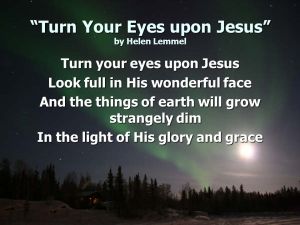
One of her best-known songs, perhaps, is “Turn Your Eyes Upon Jesus” (1918), written in the midst of her trials. You might recognize the chorus:


slide_31


(“Turn your eyes upon Jesus,

Look full in His wonderful face,

And the things of earth will grow strangely dim

In the light of His glory and grace.”)


Peace, determination, and strength result from focus—focus that’s riveted on Jesus and the joy set before us.


(Photo credits:  www.truthforfree.com; http://www.biblepic.com; http://www.pinterest.com; http://www.slideplayer.com.)

Read Full Post »

Ever try sleeping on a rock pillow? I, for one, can’t imagine actually falling asleep on such a hard surface.

The only person I know who had to try was Jacob of the Bible. (The story of that night is found in Genesis 28:10-22. It was also the subject of a previous post, which you can access here: Surely God Is in This Place.)


jacob


The scene above of Jacob resting on his rock pillow provides a worthwhile image for a Spurgeon quote I encountered recently:


“Use the Lord’s words as your pillows.

Lie down and [rest] in Him.”


Indeed, resting on the rock-solid assurances of God’s Word is wise advice, fostering peace within our spirits.

Just reciting scripture can provide effective comfort.

A good place to start? In the book of Beginnings. This example comes from Jacob himself:


fd3ddff270b84696468cc48b3a806d08


“Let us go up to Bethel where I will build an altar to God,

who answered me in the day of my distress

and who has been with me wherever I have gone.”

–Genesis 35:3 (NIV)


Notice this excerpt is seven chapters and many years past the “rock pillow” event. Jacob is no longer a young man; he’s seventy-seven as he embarks for Bethel. And during those intervening years, Jacob has experienced many days of distress as he:

  • ran away from home (Genesis 27-28),
  • worked for his Uncle Laban who took advantage of him (chapter 29 and 31:7), and then
  • set out on his own through enemy territory to return to Bethel, the home of his father, Isaac (chapters 35).

But in the verse quoted above, Jacob recognizes that through all those challenges, God demonstrated his favor, because with the Lord’s presence comes his guidance, provision, and protection.

I, too, have experienced distressing days. Who hasn’t?

But God has been with me through them all—circumstances such as these:

  • When my husband’s boss caused turmoil for us week after week,
  • When we received the unwelcome news (five times) that we were being moved to another church*, and
  • When pressure from certain administrators and parents caused ongoing stress at school (during my twenty-six years in the elementary classroom).

Yet now, looking back, I see that in each situation God was teaching me patience, perseverance, and reliance upon him. In fact, some distressing experiences were undoubtedly designed specifically to accomplish those benefits.

From the advantage of hindsight, I can see the pathway God prepared, to get us/me through those stressful days, and how he richly blessed on the other side.

As Charles Udall observed:


2b474d3c1facc1c1b3f28bfe6339057d

(“In life you will always be faced with a series of

God-ordained opportunities

brilliantly disguised as problems and challenges.”)


I wish I could say that through all of life’s challenges I’ve rested completely on pillows of promise and statements of faith. That wouldn’t be true. But I know that scripture-promises, prayer, and faith-statements have made a positive difference. And the strength of my faith did grow through each experience.

Notice Mr. Udall says we’ll always face challenges. I can give in to the distress of that fact or choose to rest on the pillow of promise that God is preparing me for what lies ahead as well as preparing the way through it.

*     *     *     *     *     *     *     *     *     * 

I praise you, Father, for being an all-knowing God.  No event catches you by surprise; you know every challenge I may yet face. Like Jacob, I think back upon stressful days of the past and affirm your comforting presence, attentive provision, and wise guidance through it all. May I be mindful to rest on your rock-solid pillows of promise from this day forward.

Art & photo credits:  www.keyway.ca; http://www.pinterest.com (2).


*For those who may not know, my husband was a pastor for forty years.

Read Full Post »

(Based on the story of the Prodigal Son, Luke 15:11-24)


019-prodigal-son300x225


Eliab plodded to the top of a familiar rise.  Just ahead he could see the flat rooftop of his ancestral home. Eliab’s heart began to drum in his ears, his face grew hot with shame, and sweat trickled down his back. Soon Eliab would face his father.

As he watched his feet take one step after another, thoughts circled around one question:

What would his father say?

Perhaps, “Get out of my sight! I no longer have two sons, only one.”

Perhaps, “Alright, Eliab, you may work in the fields and barn to pay back your debt. You may also sleep in the barn and take your meals with the other hired hands. Such flagrant waste of your inheritance must be recompensed.”

Eliab would soon know the response that would determine his fate.  He looked up once again to check his progress.  A man was running toward him down the road. What would cause him to be in such a hurry?

No sooner had the question formed in his mind than he recognized the bearing of the approaching figure. It was his father. Eliab’s knees grew weak, and not just from hunger. He collapsed to the ground in a heap, tears streaming down his face.

Quick steps approached; strong arms lifted Eliab up and grasped him in a tight embrace. He heard his father cry, “Oh, Eliab!” And together they wept.


prodigalson


Moments passed and Eliab steeled himself for the speech he had prepared during his long journey.

“Father,” he choked, “I’ve sinned against God and I’ve sinned before you. I know I can no longer be considered your son, but…”

Eliab’s father wasn’t even listening. He turned to call out to his servants, “Get a clean set of clothes and new sandals. Bring the family signet ring. Then prepare the grain-fed heifer for roasting.   We are going to have the grandest celebration our village has ever seen! My son that was as good as dead to me is alive again!”

And with that, Eliab, caretaker of pigs, was lavishly honored because his father:

  • Forgave him for being so foolish, squandering his inheritance.
  • Restored his position in the family, symbolized by the specific request of shoes. (Family members wore shoes; slaves did not.)
  • Clothed him in fresh, clean robes.
  • Honored him with the signet ring, a symbol of authority.
  • Loved him, pure and simple.


return-of-prodigal-son-celebrated


Now I’ve never been a caretaker of pigs. You probably haven’t been either. But I’ve certainly committed my own foolish acts of selfish rebellion. Maybe you have, too.

And yet, when we throw ourselves on God’s mercy, he

  • Forgives our sins and remembers them no more (Hebrews 8:12).
  • Adopts us into his family, making us his children (John 1:12-13).
  • Clothes us in the righteousness of Jesus (Isaiah 61:10), and God sees us as if we had never sinned (Colossians 1:21-22).
  • Honors us (Psalm 91:15)—with his presence and countless gifts. Someday we’ll receive a crown of glory that will never fade away (1 Peter 5:4).
  • Loves us, pure and simple, for now and always (Jeremiah 31:33).

tumblr_nc8rcivx4e1ttry05o1_500

*     *     *     *     *     *     *     *     *     *

How I thank you, Heavenly Father, for taking pity on me, as the father did in the story of the prodigal son.  You redeemed my life from the pig sty.  You forgive my sins–every one of them.  You have more than satisfied me with your goodness and faithful love.  Never do I want to lose the wonder of your love and grace!

(Psalm 103:1-5, 13)

Eliab means “to whom God is Father.”

(Art & photo credits:  www.childrenschapel.org; http://www.ncregister.som; http://www.susaneball.com; http://www.spiritualinspiration.tumblr.com.)

Read Full Post »

« Newer Posts - Older Posts »

Sylvia Schroeder

Impressions Becoming Expressions

Mitch Teemley

The Power of Story

Still Traveling

Impressions Becoming Expressions

Living Our Days

Gaining a heart of wisdom

He Said What?!

I'm Patty, and my husband and I are living with our adult son who has autism and epilepsy. I love sharing lessons learned from life around me, especially life with Aaron.

Meditations of my Heart

Impressions Becoming Expressions

Linda Stoll

Impressions Becoming Expressions

Signora Sheila

Where faith meets la dolce vita

Heidi Viars

Finding the Image of God