Feeds:
Posts
Comments

Archive for the ‘God’s Power’ Category

life-is-not-fair


“Here’s something that happens all the time and makes no sense at all: Good people get what’s coming to the wicked, and bad people get what’s coming to the good. I tell you, this makes no sense.”

Haven’t we all said or at least heard such comments? It’s a fact: life is not fair. But knowing it and accepting it are two different responses.

That quote above came from a guy who had it all—fame, wealth, and power. If anyone could claim that life had been fair to him, it was this guy. Yet in spite of the veneer of an enchanted life, he, too, experienced disappointment and confusion.

What was his name? King Solomon, the wisest man who ever lived. Those sentiments of his at the beginning of the post come from Ecclesiastes 8:14, as interpreted in The Message.

No doubt you’ve experienced your share of disappointment and confusion, too. Perhaps you’re floundering right now, desperately in need of a handhold to keep you from falling.

Selwyn Hughes, that wise, Welsh pastor from a generation ago, recommends we fight uncertainty with certainties.

Certainties would include truths from scripture that apply to our situations. Truths that we can hold tightly in our hearts, such as:

  1. God is in control over the difficulties as well as the blessings. Yes, he could rescue us from trouble in an instant. But in his infinite, all-knowing wisdom, he has chosen not to. The reasons why may never be revealed. What we do know is this: God never acts or withholds action without purpose.

 Think of Joseph, a poster-child for unfair treatment. Yet, to the brothers who sold him into slavery, he said, “You intended to harm me, but God intended it for good to accomplish what is now being done, the saving of many lives” (Genesis 50:20).


Joseph-brothers-reunited


God brings good out of all things—even the problems, hurts, and pain (Romans 8:28).

  1. God has you in his mighty hand—mighty in power (Psalm 89:13), mighty to save (Zephaniah 3:17), mighty in deed (Jeremiah 32:19).
  1. Out of his infinite might, God will provide strength to get us through. “God is our refuge and strength, an ever-present help in trouble” (Psalm 46:1).
  1. Even as we plod through adversity, “The Lord is good to those whose hope is in him, to the one who seeks him” (Lamentations 3:25). That goodness includes his comforting presence, his provision, his blessings in the midst of difficulty, and more.

King Solomon also observed:

“The good life is reserved to the person who fears God, who lives reverently in his presence,…the evil person will not experience a “good” life. No matter how many days he lives, they’ll all be as flat and colorless as a shadow—because he doesn’t fear God” (Ecclesiastes 8:12-13, The Message).

 In other words, life with God is far superior to life without God–no matter what.

These certainties are just a few God has graciously provided in his Word that can be applied when uncertainty threatens. But if you’re like me, simply reading them doesn’t help for very long. “Out of sight, out of mind” happens frequently.

Perhaps we can make the most of God’s promises by:

  • Keeping a list, particularly those that apply specifically to our situations. As the list grows, so will our faith.
  • Copy especially meaningful promises on Post-Its and tuck them in unlikely places. When we spot them they’ll provide a pleasant surprise and uplift. Possibilities include: inside a cabinet door, on the coffee container, on the dashboard. Move them every week to keep the surprise (and uplift) fresh.
  • Memorize promises while doing mindless tasks like washing the dishes, waiting at red lights, taking a walk. Soon you’ll be able to pray the promises back to God—anytime, anyplace–to bolster your spirit and strengthen your faith.


 Rainbow


Let’s stand on the certainties of scripture and God’s promises because:


“To stand is more important than to understand.”

–Selwyn Hughes, Every Day Light


*     *     *     *     *     *     *     *     *     *


Thank you, Heavenly Father, for the handholds in scripture, the truths and promises that help us keep our balance, so we can stand in the midst of adversity. Although I do not understand why troubles and heartache sometimes attack, I do understand that you are unequivocally reliable and you will see us through. I praise you, for you are the strength of my heart (Psalm 73:26b).


(Photo & art credits:  www.mygratitudelife.wordpress.com; http://www.ncbv.org; http://www.sjeciowa.org.)


Read Full Post »


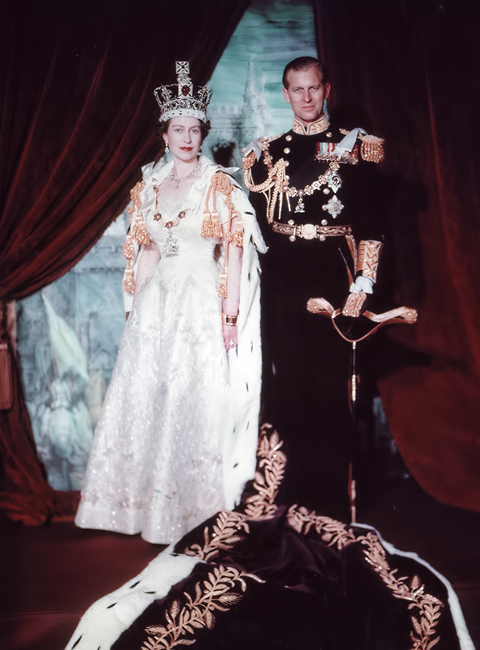
On June 3, 1953, millions of people watched the inauguration of Queen Elizabeth II on television. Amidst much fanfare and pomp she slowly and elegantly processed down the aisle of Westminster Abbey. Behind her trailed a robe of royal purple velvet, eighteen feet long. Six maids of honor supported the weight of the magnificent train.

But even Queen Elizabeth’s grand, stately robe does not begin to compare to one mentioned in scripture:

“In the year that King Uzziah died,

I saw the Lord seated on a throne,

High and exalted,

And the train of his robe

Filled the temple.”

(Isaiah 6:1)

I have to wonder: What might the train of the Lord’s robe symbolize? Is there significance to the expansiveness of this robe? Why would Isaiah include the detail that it “filled the temple?”

A bit of research revealed interesting, heart-stirring answers.

The train of his robe: In ancient times, the flowing train on a monarch’s robe was a symbol of glory and splendor. To understand the importance of a train, we have to remember that in those days, all clothing had to be constructed “from scratch”—fibers of cotton, linen, or wool had to be spun into thread, threads had to be woven into cloth, cloth had to be cut and sewn into garments by hand. It was a time-consuming process.

Only the rich and powerful could afford to add extra length to their robes. The longer the train, the more glorious and splendid the king. And as he paraded past his subjects, the length of his robe was meant to impress.

Filled the temple: Isaiah’s statement conveys the magnitude of God’s glory compared to any earthly king or queen. Symbolically, the robe represents God’s infinite splendor and majesty—his glory. As one preacher explained, “air is the atmosphere of earth, God’s glory is the atmosphere of heaven.”  One day we will breathe God’s glory!  That gives me goosebumps.

God’s glorious robe that fills the temple signifies:

his absolute authority. “There is no room for anyone else in this high-exalted place. God is all in all” –Selwyn Hughes (1928-2006, Welsh pastor, theologian, author).

his divine perfections. There is no one else who is all-powerful, all-knowing, unhindered by the limitations of time and space, and absolutely righteous in all he does.

his incomparable splendor. Isaiah, Ezekiel, Daniel, and John the Revelator gave us glimpses of their heavenly visions.  They saw a high and exalted throne encircled by an ethereal rainbow, seraphs crying “Holy, holy, holy,” lamps blazing, lightning flashing, thunder rumbling, angels and saints worshiping.

Artists have tried to imagine the sight:


441495a7b7e000ac4e649a52998c0a9f


But God’s authority, perfection, and incomparable splendor are not only on display in heaven. His glory is on display in creation–all around us. Consider these few examples:

• The delicate wing of the butterfly, emblazoned with brilliant colors in intricate patterns.


MM7820_090523_20124_xgaplus


• The intriguing double-spiral of sunflower seeds—one spiral in a clockwise direction, the other, counter-clockwise.


george-grall-close-up-of-a-sunflower-showing-the-spiraling-center-filled-with-seeds


• Lacy feathers of frost gathering on a window.


frost-patterns-on-windows-1387971944JG1


• The graceful curl of the wentletrap shell.


Epitonium_scalare_shell


• The jewel-like qualities of grains of sand.


Scala_dei_Turchi_Sand_062313


“Our God is lavish in splendor.  His creative fullness spills over in excessive beauty” (John Piper, pastor and author).

And why is that important to embrace and celebrate? Because we are so often distracted by the concerns of life.  We allow them to consume too much of our attention.  There’s a better way to live that many people never discover.

“Many people gaze at their problems and glance at the Lord.  But I tell you to gaze at the Lord and glance at your problems” (Ted Smith, pianist for Billy Graham Crusades).

Let’s visualize God’s grandeur–every day, as we prepare ourselves to pray.  Let’s become enthralled in the throne room of heaven, in the splendor and majesty of Almighty God.  And let’s bow down in humble gratitude that this magnificent God is also our loving Heavenly Father.  Think of it.  The glorious, all-powerful King of the universe is our Abba–our Dad!  Can any realization be more comforting, strengthening, or empowering than that?

*     *     *     *     *     *     *     *     *     *

Dearest Abba, too often my thoughts are a tangled mess of concerns.  I need a fresh vision of your glory to supersede the “what-ifs.”   Remind me that with you, the God of all authority and might, I have nothing to fear.  You are all I need.

(Photo and art credits:  www.wikimedia.com; http://www.pinterest.com; http://www.forums.thesims.com; http://www.allposters.com; http://www.publicdomainpictures.net; http://www.wikipedia.org; http://www.wikimedia.com.)

Read Full Post »


 Antiques-Roadshow


“Do you have any idea how much your painting is worth?” asks the antiques dealer.

“No, not really,” the owner answers.

“At auction, this portrait would probably bring…(a bit of a pause)…$5,000 or more.

The owner gasps. “And to think I only paid $25.00 at a garage sale!”

Scenes such as this are quite frequent on the popular TV program, Antiques Roadshow.  It’s astonishing how valuable some common-looking items turn out to be.  But I can’t help feeling a bit sad for the previous owners, who had no idea the worth of their possessions.

There are some folks who see little worth in the teachings of Jesus.  To their way of thinking, his world view and expectations seemed upside down and backwards.

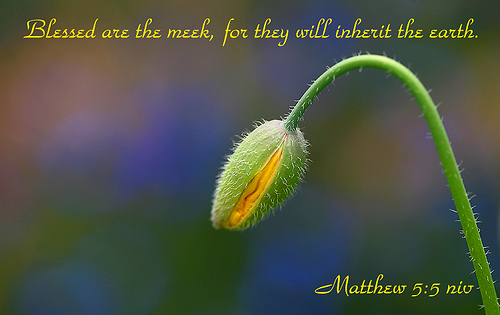
For example, in the Sermon on the Mount, Jesus highlighted attributes that the world does not value, yet God considers of great worth.  Meekness would be a prime example.

Part of the problem lies in a common misunderstanding of the attribute. People think a meek person as weak-willed, passive, and too nice for her own good.

Such thinking is far from the truth.

1747489843_2066ef0122

Meekness includes:

  • Surrender to God
  • Trust and confidence in His ways and provision
  • Gentleness and humility with others
  • More concern for the interests of others than one’s own
  • Self-control, self-sacrifice, faith, patience, and forbearance
  • A gentle and soothing disposition

A weak-willed, passive person cannot demonstrate such traits.   Meekness requires strength of character; it is power under control.

 031311wildhorses_x

Imagine wild stallions running free across rolling hills.   Manes and tails undulate and flow in the wind, muscles strain beneath gleaming coats, hooves pound a rapid rhythm. Indeed, stallions in motion are a majestic sight. They exude power. But that power is useless to man unless it is harnessed and trained.

 9dcc98fa20ec776ed6380e492675c065

That’s the picture of meekness–strength under control. Strength to do the right thing at the right time. It’s not a human personality trait; it’s a super-human God trait. And the more we know his Son and abide in him, the more we’ll demonstrate meekness.

What might that look like, day-to-day? First, there would be no:

  • Mean-spirited sarcasm and rudeness
  • Arrogant behavior
  • Concern for prestige
  • Over-sensitivity or defensiveness


b5e664098ee28d482f1e253676a356e8


Instead, the beauty of meekness includes:

  • Quiet trusting in God to supply
  • Adherence to the Golden Rule
  • Love in action—caring, giving, helping
  • Gracious understanding and forgiveness

The world would be a different place if meekness were a more prevalent trait.

Some of you may recall the old tune, “Let There Be Peace on Earth.” Do you remember the next line? “And let it begin with me.”

Surely the same could be said for meekness. We can each be an example. As opportunities arise that require meekness, we can allow the Holy Spirit to fill us with his power, much as we fill our lungs with air. In fact, we can use that physical act of taking a deep breath as a reminder of “the breath of God” within us, providing everything we need for meekness: trust in God, self-control, compassion, kindness, and patience.

Meekness is so important to God, he included specific promises in scripture for those who demonstrate this trait:

c7f50f37de05f692e131e54ac399b328

  • “I hear the desires of the meek. I strengthen their hearts” (Psalm 10:17, RSV).
  • “The meek shall…be satisfied” (Psalm 22:26, ERV).
  • “The meek will he guide in justice; And the meek will he teach his way” (Psalm 25:9, ASV).
  • “The meek will…enjoy great peace” (Psalm 37:11).
  • “The Lord lifts up the meek” (Psalm 147:6a).
  • “The meek shall obtain fresh joy in the Lord (Isaiah 29:19a, RSV).

Strength, satisfaction, guidance, peace, uplift, and fresh joy. Valuable blessings, don’t you think?

Let’s seize the day in meekness. Let’s partake in the adventure of living our lives upside down and backwards, Jesus’ way!

We will NOT be disappointed in the results.

(Art & photo credits:  www.dealtrackersf.com; http://www.flickr.com; http://www.pinterest.com; http://www.kansas.com; http://www.pinterest.com;


Read Full Post »

prd_007161


His kayak paddle provided more steering than propulsion, as the tourist enjoyed a quiet excursion past tall conifers and wide-armed hardwoods. Slowly he meandered southward, confident that returning to his launching point would not be a challenge.  The man at the kayak-rental shack had assured him: surface water flowed at just over one mile per hour. And should he fall out of his craft, no real danger would threaten. The water was only three feet deep, and the shore not more than ten feet to either side.

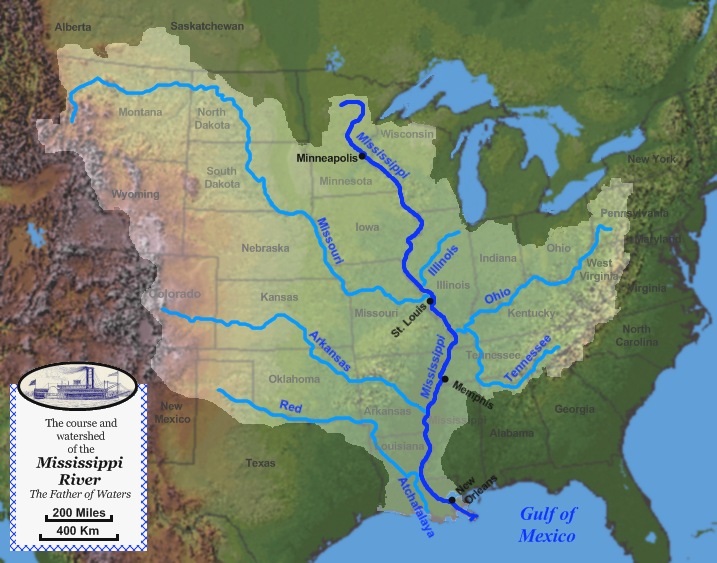
It’s hard to imagine, the kayaker thought,  that this narrow, shallow stream actually becomes a mammoth river. He’d been told the stream was fed by underground springs, and flowed another 2,300 miles from where he paddled. Along the way, more rivers would flow into it. And when the fresh water finally met salt, the river would be over a mile wide.

Mississippi-River

Have you guessed the name of this waterway? It’s the grand and powerful Mississippi. Yet its headwaters is a tame little stream, fed by a few underground springs or fountains.

Such a river offers an illuminating picture of our relationship with God. We are the rivers, and…

…“[God] is the fountain of life,” (Psalm 36:9).

Anglican bishop John James Stewart Perowne (1823-1904) said: “These are some of the most wonderful words in the Old Testament. Their fullness of meaning no commentary can ever exhaust.”

But if we don’t at least try to grasp the wealth of truth in these six words, we stand to lose much profit.

So let’s consider that, as our fountain of life:

  • God the Son is the source of all life, and all life is sustained by him (Hebrews 1:3). Without him, all life would cease.
  • In him we live, and move, and have our being (Acts 17:28).
  • He is like a spring of water welling up to eternal life in our spirits (John 4:14).

Those are wonderful concepts, which Dr. Perowne surely had in mind as he contemplated Psalm 36:9. Yet our triune God is like a fountain of spring water in more ways.

First, a bit of digression. No doubt you’re aware that bottled spring water is a big business these days, supposedly offering water that is much superior to what comes out of the tap. Critics have their doubts.

But our God is 100% perfect! No doubt about it.

 psalm8-how-excellent-your-name0

“He is the Rock, his works are perfect, and all his ways are just. A faithful God who does no wrong, upright and just is he” (Deuteronomy 32:4).

Consider as well the following scriptures, which itemize his excellent perfections. And keep in mind they come to us in unending supply:

  • Presence.  “I am with you always” (Matt. 28:20).
  • Reliability.  “The plans of the Lord stand firm forever; the purposes of his heart through all generations” (Psalm 33:11).
  • Right-Doing. “His righteousness endures forever” (Psalm 111:3).
  • Faithfulness.  “The faithfulness of the Lord endures forever” (Psalm 117:2).
  • Sovereignty.  “He rules forever by his power, is eyes watch the nations” (Psalm 6:7).
  • Love.  “His love endures forever” (Psalm 100:5).
  • Compassion.  “[The Lord’s] compassions never fail” (Lam. 3:22).
  • Protection.  “Save your people and bless your inheritance; be their shepherd and carry them forever” (Psalm 28:9).
  • Stability.  “The Lord is the Rock eternal” (Isaiah 26:4).
  • Joy.  “With joy you will draw water from the wells of salvation” (Isaiah 12:3).
  • Blessing.  “Surely you have granted him eternal blessings and made him glad with the joy of your presence” (Psalm 21:6).
  • Grace.  “God is able to make all grace abound to you, so that in all things at all times, having all that you need, you will abound in every good work” (2 Cor. 9:8).

That’s an even dozen attributes. But since our God is infinite, his attributes are also infinite. We’ve barely begun to explore his perfections. In addition, he will forever expend those attributes for our good (Romans 8:28)—not only outwardly, as he engineers circumstances, but inwardly as we allow his attributes to flow in us.

In addition, God is flowing through us, so we can provide life-giving grace to those around us—grace that expresses itself in love, compassion, and blessing.

And that brings me to another metaphor–for those tributaries that pour into the Mississippi. They remind us of the influence of others in our lives–faithful and mature family members, friends, pastors, and teachers, who come alongside us by example and with wisdom, providing strength and growth.

Mississippi_watershed_map_1

Chances are, those tributaries of the Mississippi are also fed by springs. For every believer, our triune God is the pure, ever-flowing, life-giving source of all that is excellent, and everything we need for a fulfilling life.

Is your heart overflowing with praise?

*     *     *     *     *     *     *     *     *     *

We do give you praise, oh God! You are the fountain of our abundant and excellent spiritual life. You are the only spring that quenches our thirst for fulfillment, joy, peace, and satisfaction.  Thank you for flowing in us, so these desires and more are fully met. And thank you for flowing through us, so we might have the privilege of sharing your living water with others.


(Information about the headwaters of the Mississippi from the Mississippi Headwater Board and wikipedia.org.  Photo & art credits:  www.nature.org; http://www.1mississippi.org; http://www.fbcphil.org; http://www.agodman.com; http://www.wikipedia.org.)


Read Full Post »

 Pretend you’re on an ocean liner that has embarked from New York City and is sailing to England.   You and several thousand other passengers enjoy your days at sea, free to choose from dozens of activities—games, shopping, shows, sports, crafts, and more.

You can eat anytime you like, sleep whenever you feel drowsy, make friends among the other passengers, or remain solitary. In other words, you make many choices during the voyage, but all the while the ship is headed towards its predetermined destination.

A.W. Tozer gave us this illustration in his classic, The Knowledge of the Holy, to help us understand God’s sovereignty:

  • Our all-powerful God has total authority in the universe, just as the shipping authorities exercise sovereignty over the course of a ship.
  • We have been given much freedom, within the confines of God’s sovereignty, to move about and make choices.

Now some folks take issue with God’s control. They want to direct the course of their life-ships.  I, for one, find great comfort in the numerous, reassuring scriptures about God’s sovereignty.

For example, everything in heaven and earth belongs to Him. He is the glorious head over all, the ruler of all things (1 Chronicles 29:11-12). That includes us–those who know Jesus and belong to the family of God. As our Heavenly Father, he provides for our needs, guides us through decisions, bestows many blessings, and more. What encouraging truth! The Almighty God of the universe is in charge of our lives, as we submit to him. We don’t have to navigate alone.

The key, however, is submission. God is a gentleman and will not force himself upon us. He has chosen to limit his sovereignty, to allow man free choice.

Another reassuring truth: God is totally competent. We’ve all known inept leaders who could not fulfill their responsibilities. But our Ruler is supremely capable.  Nothing is too hard for him (Jeremiah 32:17).  As we focus on his complete sufficiency, our worries shrink in significance.

In addition, no plan of God’s can be thwarted (Job 42:2).   What God says, happens.

His sovereign plan is efficient and goal-oriented. He works out everything in conformity with the purpose of his perfect plan (Ephesians 1:11).

God’s sovereignty is also employed with infinite wisdom (Job 12:13).  No foolish decisions come from God’s throne!

And contrary to appearances, he does maintain over-arching rule on mankind (Jeremiah 32:27). That would include the barbaric Babylonians of Jeremiah’s day, who destroyed Jerusalem, murdered the nobles of Judah, and took thousands of Jewish captives to Babylon.  God’s over-arching rule also applies to the wicked forces creating havoc in our day.

Good people are often hurt in the process, and it breaks our hearts.   Every century has had its martyrs for the faith. And our questions of why God allows bad things to happen to good people don’t always get answered. We’re not privy to everything God knows or to all the reasons behind his decisions (Romans 11:33-36).

What we do know is this: Evil never wins in the end. Every evil empire of history that rose in prominence and power eventually fell in ruin. Our sovereign God knows what he is doing. He will have the last word.

So when the squeaky wheels of worry, doubt, or fear begin to spin in your head, and you wonder, Is God in control?, apply the oil of gladness in who God is—our all-powerful, all-knowing, all-wise, and yes, in-control God!

Take joy in the knowledge that “If God is for us, who can be against us” (Romans 8:31)?

And rest in the affirmation that “from him and through him and to him are all things” (Romans 11:36, emphasis added).

*     *     *     *     *     *     *     *     *     *

Sovereign Lord of the universe, we bow in worshipful wonder of your magnificence. Your greatness shatters all boundaries! We stand in awe of your vast power and infinite wisdom, always at work in the world.

“And when I cannot understand” [your plan or your ways], “help me just to stand” (Selwyn Hughes).

Read Full Post »

(In honor of Black History Month)


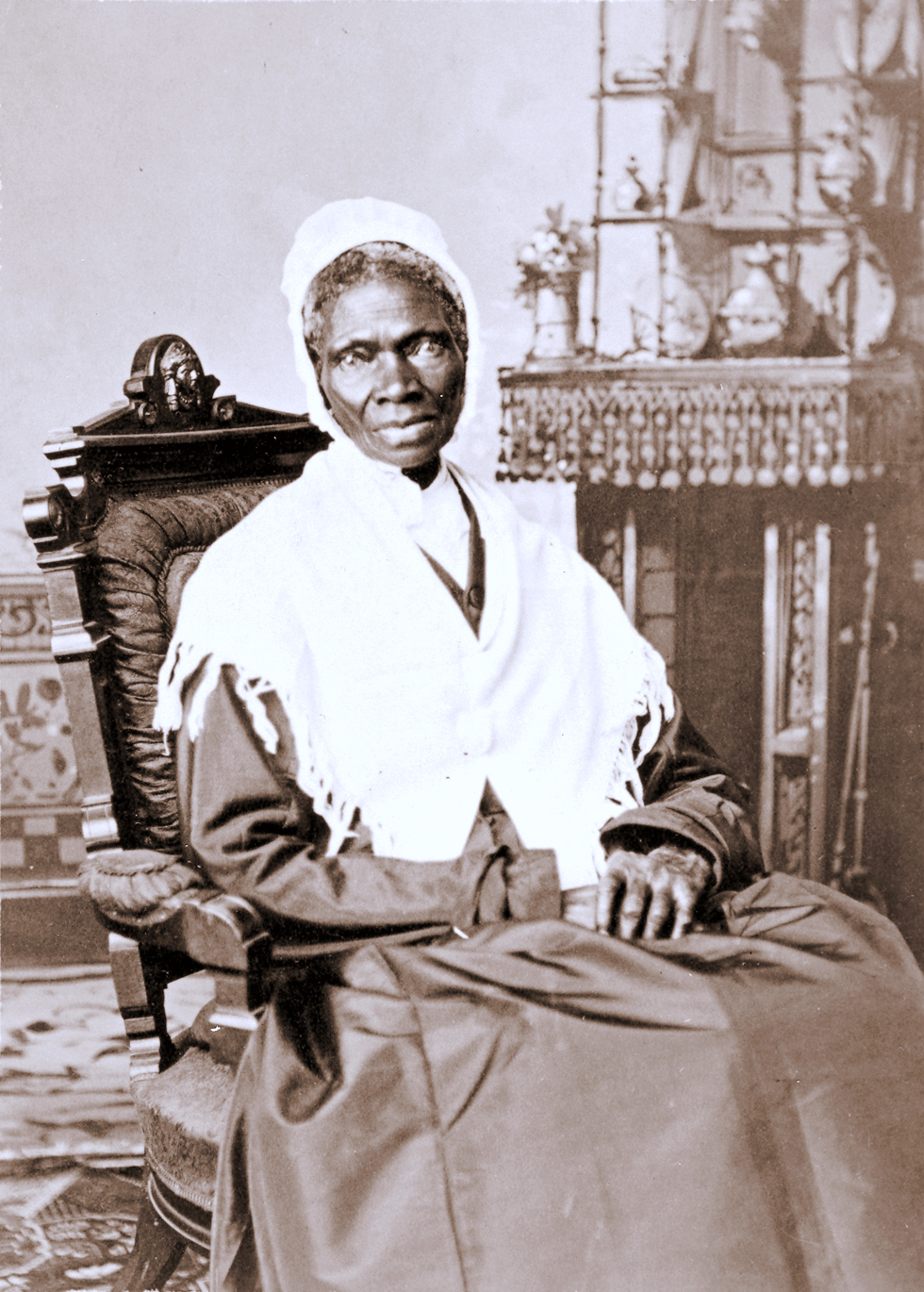
Isabella, the daughter of James and Elizabeth Baumfree, was born a slave in New York state about 1797. No one knows the exact date, because birth records weren’t kept for “property.”

Did her parents know the name means, “consecrated to God?” Even if they chose the name for its meaning, those parents could not have dreamed of the future awaiting their Baby Belle.

Her early years were difficult.  Belle was sold five times, several times to cruel masters.

At age eighteen or so, Belle fell in love with Robert, a young slave from a nearby farm. The couple had a daughter. But Belle’s master, John Dumont, forbade her to see Robert again. According to the law, all children of the union would belong to Robert’s master, not Dumont.

Two years later, Dumont forced Belle to marry an older slave. They had three children: Peter, Elizabeth, and Sophia.

In 1826, Belle escaped the Dumont farm with Baby Sophia. In a vision, God showed her a particular home to go to. That home belonged to a Quaker family, the Wageners, who took in the young woman and her baby. They even paid Belle’s price to Dumont and made her a free woman. Belle became a housekeeper, then a maid.

Shortly after her escape from slavery, Belle learned that her five-year old son, Peter, had been illegally sold in Alabama. She took the matter to court and won her case. Peter was returned to New York. That was the first time a black woman challenged a white man in a U.S. court. It was also the first time of many that Belle’s resolve and courage were put on display.

Several years later Belle was falsely accused of poisoning her former employer. In 1835 she took that case to court and won again.

Someone must have encouraged Belle to tell her story of being a slave and becoming a free woman. But she had never learned to read or write, so a friend wrote as Belle dictated. A Northern Slave was published in 1850.

In her book, Belle explained that several years after she was freed, God revealed himself to her, “with all the suddenness of a flash of lightning, showing her, in the twinkling of an eye, that he was all over, that he pervaded the universe, and that there was no place where God was not.”

The book sold many copies and Belle became well-known. She was asked to speak at a women’s rights convention in Massachusetts. Before long, Belle was traveling with abolitionist, George Thompson, speaking against slavery and for human rights.

In 1851, Belle gave a speech at another women’s conference, this time in Ohio. She spoke convincingly (and extemporaneously) about women being every bit as capable as a man:

“I have plowed and reaped and husked and chopped and mowed, and can any man do more than that?”

And, no doubt with a twinkle in her eye, she added:

“As for intellect, all I can say is, if a woman have a pint, and a man a quart — why can’t she have her little pint full? You need not be afraid to give us our rights for fear we will take too much, for we can’t take more than our pint’ll hold. The poor men seems to be all in confusion, and don’t know what to do. Why children, if you have woman’s rights, give it to her and you will feel better. You will have your own rights, and they won’t be so much trouble.”

She concluded by asking: “And how came Jesus into the world? Through God who created him and the woman who bore him. Man, where was your part?”

It’s not surprising that some were displeased with Belle’s speeches. One time she was told that the building where she was to preach would be burned down if she dared to speak. “Then I will speak to the ashes,” she replied.

Belle was also physically assaulted. One brutal attack caused permanent injury, and she had to walk with a cane for the rest of her life.

In 1863, Harriet Beecher Stowe wrote an article about Belle for the Atlantic Monthly:

“I do not recollect ever to have been conversant with anyone who had more of that silent and subtle power which we call personal presence…She seemed perfectly self-possessed and at her ease. An audience was what she wanted—it mattered not whether high or low, learned or ignorant. She had things to say, and was ready to say them at all times, and to anyone.”

Imagine. A slave woman who never had the opportunity to go to school, never learned to read or write. Yet the power of her spoken word helped bring the end of slavery and pave the way for women to be granted the right to vote.

Belle proved:

“There is no difficulty that cannot be defeated.

There is no victory that cannot be achieved,

if you believe in the power of God!”

— Anonymous

Of course, by the time she achieved notoriety, Belle was known by another name.

You see, Belle had asked God for a new name several decades before the Civil War. Again, it was the result of a vision. She said God chose her new first name based on the fact she would travel. Then Belle asked God for a second name, “’cause everybody has two names.” And the Lord granted her request. Her second name proclaimed what Belle always declared from her podium.

Perhaps you remember Sojourner Truth.


Sojourner_truth_c1870

(Photo from http://www.wikipedia.org.)


Sources:  www.biography.com; http://www.sojournertruth.org; http://www.; http://www.blackpast.org; http://www.americanswhotellthetruth.org; http://www.christianitytoday.com.)

Read Full Post »

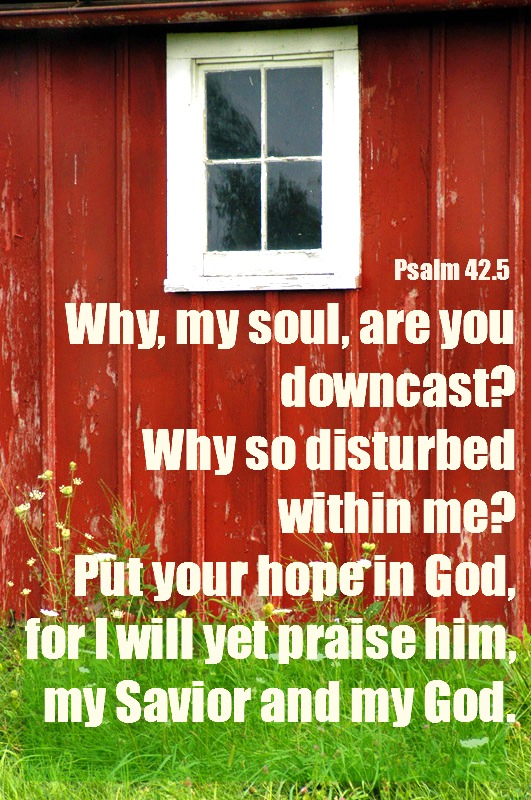
psalm-42.5


On Friday, September 26, my younger brother, John, called with the heartbreaking news that our mother, age 85, had suffered a massive stroke. Her entire right side was affected; she could neither see nor talk. The prognosis left little room for hope.

By Sunday morning I was on a plane for Austin, Texas, to see Mom and care for Dad (age 90) while John and his wife, Collene, took care of numerous business matters related to Mom’s and Dad’s welfare.

For at least ten years Mom has been Dad’s primary care giver, due to his degenerative arthritis and Parkinson’s disease. But she considered her responsibilities a privilege, often saying, “He took care of me for many years; now it’s my turn. He’s my ministry now.”

For ten days we put our hope in God and witnessed his power at work.  In spite of great sadness, we could say, “For we will yet praise him, our Savior and our God” (Psalm 42:5), as he blessed us with his presence, guidance, and provision.

Mom was taken to Brackenridge, a teaching hospital, where she received conscientious, compassionate care. Doctors and nurses alike spent time with us, patiently explaining Mom’s condition and what we could expect.

Though she could not speak, and her brain had sustained extensive damage due to swelling, Mom communicated her love with hand squeezes. She also drew our hands to her lips for kisses.

My daughter, Heather, received permission from her kind boss to take time away from work and fly to Austin. She was able to stay for three days, visiting her grandmother, offering help, and lifting the spirits of us all.

On Day Five, I believe, it was recommended that Mom be moved to Hospice.   Immediately the name of a highly respected facility came to Collene’s mind. Wouldn’t it be wonderful if Grandma were taken to Christopher House, she thought. But that particular hospice is small. What were the chances that a bed would be available? Collene kept the thought to herself, just in case Mom was assigned elsewhere.

Sure enough, a representative from Christopher House came to the hospital and directed us through the process to have Mom transferred there. An added blessing: John and Collene knew one of the nurses. She asked to be assigned to our mother for the duration of Mom’s stay.

Meanwhile, we visited three nursing homes for Dad. (He had told Mom on numerous occasions, “Just put me in a nursing home!” She wouldn’t hear of it. Only four months ago did she agree to have a care-giver come four hours a day.)

All three facilities were close to John and Collene, all relatively new.   One seemed a particularly good fit for Dad’s needs and interests.

Two doctor’s appointments, many phone calls, and much paperwork later, Dad was approved and processed for admittance to the nursing home we had hoped for.   The day before my flight home I did laundry for Dad, gathered toiletries and other items, and marked his name on all belongings.

The next morning, Wednesday, John and Collene got Dad settled, and I flew home.

Later, John sent me a video of Dad playing a piano duet with a staff member. Granted, he could only play with one finger, but he packed a lot of rhythm and soul into those single notes.  What a delight to see him having a good time–already.

That night we spoke by phone.  Dad told me the folks at his dining table enjoyed his jokes, and he’d already taken advantage of the library.

On Thursday, October 9, Mom graduated to heaven. It was her father’s birthday.

Do they celebrate birthdays in heaven? I’d like to think that my grandmother and grandfather stood at the gate to greet Mom, as Jesus ushered her in. Together with many family and friends who already reside in heaven, they celebrated her arrival as a precious gift for Gramps’ birthday. Somehow it seems very fitting.


*     *     *     *     *     *     *     *     *     *


You can read my mother’s story at http://www.memorialwebsites.legacy.com/gerischaub.


(Photo credit:  www.jeanierhoades.com )


Read Full Post »

article-step-by-step_ds-photo_getty_article_178_67_200377237-001_XS

Back in the 1970s somebody came up with the idea of worry stones—small, smooth pebbles that people could rub between their fingers to release their worries. (What a great money-maker, huh?  Collect some free pebbles, clean ’em up and sell for 100% profit.  Genius.)

According to enthusiasts, the constant rubbing activates the nerves at the base of the thumb, releasing endorphins. As a result, a sense of calmness purportedly settles in the user’s mind.

Even if that’s true, what happens when the person stops rubbing? Since the worry has not been resolved; isn’t it likely to return? I can’t see myself rubbing a stone until I fall asleep at night, can you?

Here’s a better idea.  Instead of going to a small pebble for worry-relief, go to the Rock.

What Rock, you ask?

“There is no one holy like the Lord; there is no one besides you; there is no Rock like our God” (1 Samuel 2:2).

Next question:  Why go to the Rock?

1.  God our Rock is more stable and reliable than Gibraltar.

igibrat001p4

The Rock of Gibraltar has become a symbol for stability, having stood sentry on the southern coast of Spain for centuries. Some say it dates back to the Jurassic Period.

But our God is older still, isn’t he.

“Trust in the Lord forever, for the Lord is the Rock eternal” (Isaiah 26:4).

And he is the same yesterday, today, and forever (Hebrews 13:8).  Now that’s reliable.

2.  God our Rock is more sheltering than a deep cave.

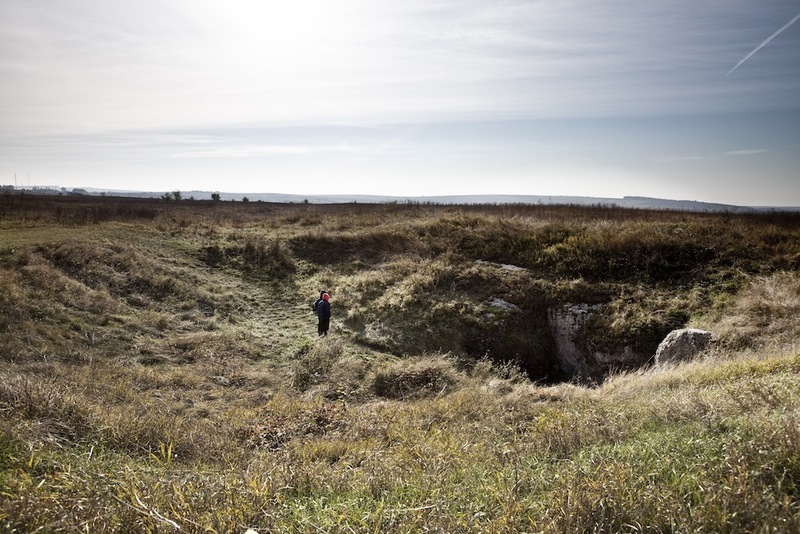
Verteba_Cave

(Verteba Cave, Ukraine)

During World War II, a small group of Ukrainian Jews found a way to escape the Nazis. They lived underground in caves for a year and a half.

At night they foraged for food. They even built showers and latrines deep inside.

But imagine living every day in pitch blackness and in fear of being discovered.

One day it happened. Nazi soldiers stumbled upon their hiding place. A courageous woman spoke for the group, as German guns pointed straight at her.

“What are you afraid of here?” she said. “Is the Furhrer going to lose the war because we live here?” Miraculously the soldiers left without doing anyone harm.

The band of Jewish villagers found relative safety in those caves,  and in April, 1944, the cave dwellers were liberated, able to return to the light.

But God our Rock offers guaranteed eternal safety for our souls. His Son, Jesus “became the source of eternal salvation for all who obey Him” (Hebrews 5:9)

3.  God our Rock is more protective than Masada.

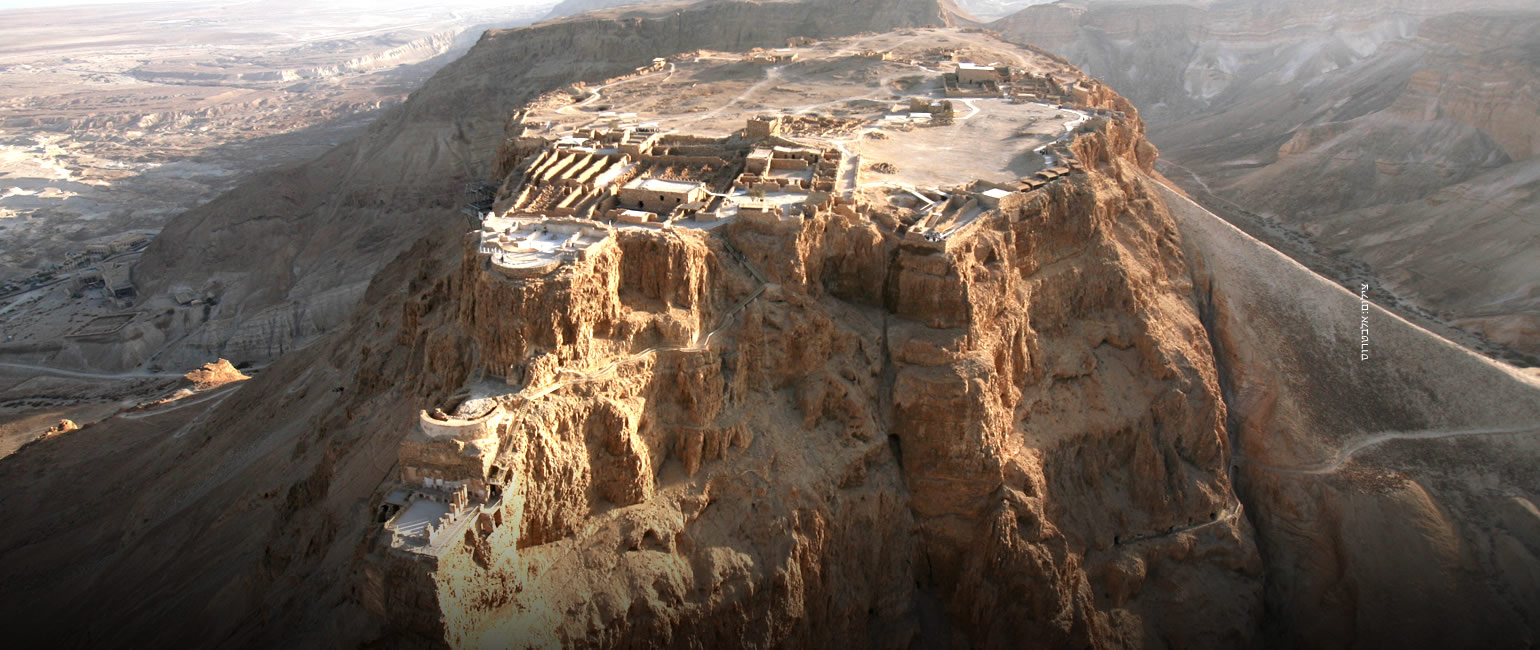
slide-static

Perhaps you’re familiar with the mountaintop fortress, towering 1500 ft. above the Dead Sea.   The refuge was built by Herod the Great, from 37 to 31 B.C., to showcase his power.

Infamous for his brutality, Herod had good cause to be paranoid. He spared no expense to make sure this desert fortress could withstand attack and provide long-term refuge. His plan included protective casement walls, an ingenious water-collection system and cisterns for storage, storehouses, barracks, palaces, an armory and more.

Impregnable? Almost.

When Herod died, Jewish rebels were able to overtake the Roman guard remaining at the fortress. A thousand Jewish zealots lived atop Masada for three years.

Yet nothing or no one on earth can compare to God our Rock.

“Lead me to the Rock that is higher than I,” cried David. “For you have been my refuge, a strong tower against the foe” (Psalm 61:2-3).

And how do we avail ourselves of God’s refuge?  Through gratitude, praise, and prayer.  We can:

  • Thank him for his promises, for the times he has protected and provided in the past.  We must feed our confidence in God rather than our fear.
  • Praise him for his glorious attributes that he is bringing to bear upon our situations–attributes such as power, wisdom, trustworthiness, and love.
  • Affirm our faith. If we occupy our minds with expressions of trust, there won’t be room for thoughts of worry.

“My soul finds rest in God alone;

my salvation comes from him.  

He alone is my rock and my salvation;

he is my fortress, I will never be shaken…

Find rest, O my soul, in God alone;

my hope comes from him”

(Psalm 62:1-2, 5).

(Photo credits:  www.ehow.com; http://www.kids.brittanica.com; http://www.noplaceonearthfilm.com; http://www.masada.org.il.)

Read Full Post »

Psalm-73_26

Have you met Asaph? He was one of the worship leaders appointed by King David. Twelve of the psalms are credited to him or his sons, including #73.

Read that particular psalm in a modern translation or paraphrase, and you’ll think Asaph is a present-day poet.   He writes about pretentious, arrogant people who wear the latest fashions–how they’re pampered, overfed, and full of hot air.

“People actually listen to them—can you believe it?” he complains (vs. 6-10, The Message).

Asaph found his attention drawn to these people who seemed to have it made. He lost sight of true reality for a moment–until he refocused on God and his ways.   Asaph realized that many who appear confident and successful are actually on a slippery slope toward disaster. They do not know God.

Tucked at the end of Psalm 73 Asaph celebrates a number of glorious blessings we enjoy as children of the Most High God:

  • He is as close as a father holding his son or daughter by the hand
  • With perfect wisdom he guides us through life
  • When our earthly lives are completed, he’ll take us to heaven to be with him
  • He is our strength—dependable and empowering
  • He is our portion forever (vs. 23-26)

These are precious gifts that money cannot buy. God—our constant companion, our perfect guide, our omnipotent strength. Simply affirming such attributes can energize my spirit and provide new resolve.

But one concept does leave me puzzled: “God, my portion.”

A bit of research revealed that the statement, “My portion forever,” is a metaphor taken from an ancient custom of the Jews. When the patriarch of a family died, they would divide the inheritance among the sons. Each would receive his allotted portion, and have his basic necessities taken care of.

The psalmist is proclaiming that GOD is his portion. That portion includes the Lord’s presence, power, strength, peace, joy—all supplied in generous measure. And those are just a few of his many attributes, blessing us with sublime goodness.

Unlike the inherited portion of ancient times, all of God’s children receive all of him, not just a part.

And God as our portion will never diminish. Never could we exhaust all of these attributes. He will be our gracious, caring, empowering Heavenly Father forever.

“As for me, it is good to be near God,” the psalmist continued (v. 28).   He’s saying, to live with God is good for us.  

Oh, yes.  To rest secure upon him as our foundation is the epitome of peace.

To allow him to work through us to fulfill his perfect plan is the essence of fulfillment.

To know that heaven awaits is the height of security.

God as our portion means complete wholeness and absolute contentment.

Who could want anything more?

*     *     *     *     *     *     *     *     *     *

Like Asaph, Father, I can lose my focus on what is truly important and valuable. Thank you for this timeless psalm that draws me back to you and the splendorous gifts you offer. Thank you for nurturing me so that I may affirm with Asaph: “ Earth has nothing I desire besides you” (v. 25). Amen—so be it.

(Photo credit:  www.susancady.com.)

Read Full Post »

(As most of you know, Steve will soon be retiring from the pastorate, after serving forty years in Florida. Mid-June we move to the Midwest, to be close to our sons and their families. If our daughter and her family would just move east from Washington State, life would be near-perfect!

No doubt you’re also aware that packing and unpacking are time-consuming tasks, so I’m putting the blog on hold for a few weeks. But please continue to visit! I’ll re-blog some previous posts, and hopefully you’ll find them meaningful again, or perhaps for the first time.

The following post was first published 11-7-13.)


tears


Before my friend, Elizabeth, said a word, I knew something was wrong. The slump of her shoulders, the wrinkled brow, the tears welling up in her eyes–they spoke loud and clear.

“You know how Michael and I would like to have a little brother or sister for Ashley,” my friend said, dabbing her eyes with Kleenex. “Well, it’s become more than just a desire for me. I so desperately want another child.” Her voice became tight. “The waiting and uncertainty are becoming unbearable.”

We stood together, in the emptying sanctuary after church, arms entwined. And I prayed for Elizabeth and Michael.

Psalm 113:9, a verse which had ministered to me years before, came to mind. I included the promise in my prayer: “God, you’ve promised ‘to settle the barren woman in her home as a happy mother of children.’ We are claiming that promise today for Michael and Elizabeth. Even now we look forward to the day when they are holding a precious, new baby in their arms.”

Note the verse says children, not child.

The prayer came out of my mouth with certainty and brazen expectation, not in keeping with my cautious personality at all. I have to admit, the thought crossed my mind, What if God intends for Elizabeth and Michael to have just one child? You’ve gone way out on a limb with that prayer!

But I voiced no disclaimers. I let the prayer stand on its foundation of conviction–conviction that didn’t come from my spirit as much as from the Holy Spirit.

For the weeks that followed, I continued to pray that God would bless this couple with another child.

Weeks later, Elizabeth approached me once again. Before she said a word, I knew what she was going to say. Her outspread arms, wide grin, and sparkling eyes spoke loud and clear.

“I’m pregnant!” she cried.

We hugged each other tight and noisily exclaimed our jubilation.

Would I have been as excited had I not been praying for this family? Delighted, yes. But jump-up-and-down ecstatic? Probably not.

My joy was greatly expanded because I had invested myself in the outcome—with the effort of prayer.

Yes, there are many reasons to pray, including these benefits:

Our wills are aligned to God’s will (Psalm 37:4).
Strength of character is developed through the discipline of perseverance (Luke 11:5-8).
We have the opportunity to bring glory to God (John 14:13).
Prayer is a means of fighting against evil (Ephesians 6:10-18, especially verse 18).

But the wonder of prayer, for me, is the privilege God gives us to be part of the process, as he engineers circumstances to accomplish his will.

Every time God moves in situations for which we’ve prayed, he is giving us a precious gift: the gift of participation with him–in a miracle.

Maybe two.

Michael and Elizabeth had twin girls!


il_340x270.446306088_4ipl


*      *      *      *      *      *      *      *      *      *

Heavenly Father, thank you for the splendid privilege of participating with you in the healing, protection, provision, and guidance with which you bless others. May I never get tired of bringing my requests to you, knowing that the joyful conclusion will be worth every moment spent in prayer!

(Photo credit:  www.saveourschoolsnz.files.wordpress.com; http://www.etsy.com.)

Read Full Post »

« Newer Posts - Older Posts »

When the House is Quiet

Impressions Becoming Expressions

Mitch Teemley

The Power of Story

Still Traveling

Impressions Becoming Expressions

Living Our Days

Gaining a heart of wisdom

He Said What?!

I'm Patty, and my husband and I are living with our adult son who has autism and epilepsy. I love sharing lessons learned from life around me, especially life with Aaron.

Meditations of my Heart

Impressions Becoming Expressions

Linda Stoll

Impressions Becoming Expressions

Signora Sheila

Where Faith Meets La Dolce Vita

Heidi Viars

Finding the Image of God