Feeds:
Posts
Comments

Archive for the ‘God’s Salvation’ Category

She stands before the judge, tears filling her eyes, as one misdeed after another plays out on a Jumbotron for all to see.

He waves his arm toward the mammoth screen. “The evidence is clear,” he thunders. “You’ve committed numerous indiscretions. What do you have to say for yourself?”

Her response is barely audible. “I am guilty as charged, your Honor.”

“Highly disappointing,” he asserts.  “However, my Book of Life does indicate you accepted the gift of eternal life made possible by my Son, so you will be allowed to enter heaven, but of course, your place will be far to the rear.

“You can also expect far fewer blessings in my celestial kingdom, compared to those who have lived truly saintly lives. You understand, of course.”

She nods and bows her head in shameful misery.  

Such a scene is imaginary, of course, but reflects the fear and foreboding I used to feel toward the Judgment Day to come, when it’s my turn to face the Judge of all the earth.

After all, he is holy and I am a wretched sinner—even as a Jesus-follower. And though God has provided the way for me to escape hell when I die, he’ll have every right to reprimand me, even banish me to some far corner of heaven.

Perhaps you’ve been plagued by such thoughts as well. If so, have I got good news for YOU!

First, consider this passage from a praise-psalm of King David:
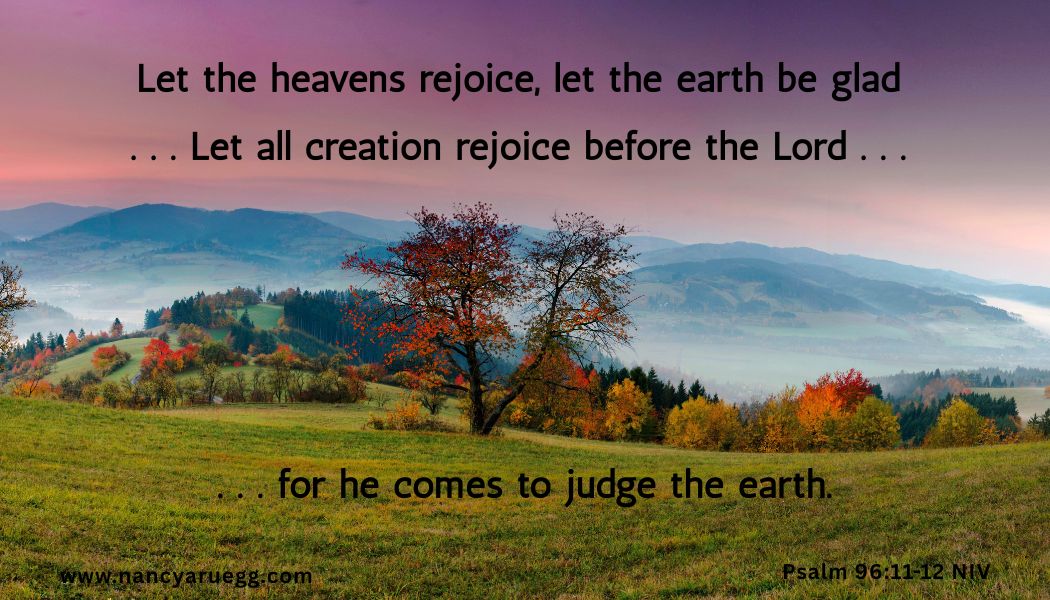
A rather surprising reason to rejoice, agreed?

David goes on to explain: “He will judge the world in righteousness and the peoples in his faithfulness” (v. 13).

Could God judge any other way? No. He is holy and perfect in all that he does and says.

That means all his righteous and faithful perfections will come into play as he fulfills this role: his compassion and grace, wisdom and discernment, goodness, patience, and more.

We can rest assured: on Judgment Day God will not divorce himself from these attributes and become a stern, vindictive, and unforgiving judge.

He is for us, not against us [1].

In addition we mustn’t forget that God is rich in mercy [2]–mercy “so great that you may sooner drain the sea of its water, or deprive the sun of its light, or make space too narrow, than diminish the great mercy of God”–Charles Spurgeon [3].

Another factor to keep in mind: the affirming promise the Apostle Paul included in his letter to the Romans. For clarity’s sake, here’s the Amplified Version:

“There is now no condemnation [no guilty verdict, no punishment] for those who are in Christ Jesus [who believe in Him as personal Lord and Savior]” [4].

Elsewhere Paul makes clear: the charge of our legal indebtedness has been cancelled.

I repeat, cancelled.

In fact, our sins are removed as far as the east is from the west [5].

So how might that opening scenario proceed differently for that Christ-following woman, standing before the Judge of all the earth?

He may open his Book of Life, find her name, and announce, “Ah! Here you are! Your debt has been fully paid by my Son.”

Then perhaps he’d lean forward on his forearms and smile warmly upon her. “Proceed through those doors to your right, my child, and enjoy forever my complete peace, joy, and blessing!”

 *     *     *     *     *     *     *     *     *     *

I praise you, O God, for your gift of salvation, not granted grudgingly because you feel sorry for us wretched creatures, but because you love us. That love is manifested by your kindness and compassion in spite of our sinful tendencies.

And now we can stand in a place of confidence and peace as we anticipate our homegoing to heaven—with no fear of retribution. Thank you, Lord God, our Father!
(Romans 5:8; Psalm 103:8-14; John 5:24)

P.S. Though all those who believe in Christ will receive all the benefits of eternal life in heaven, the rewards we receive for godly behavior will differ [6].

What might those rewards include and how do we earn them? Topics for another day!


[1] Romans 8:31b

[2] Ephesians 2:4-5

[3] Charles Spurgeon (1834-1892), British preacher and author

[4] Romans 8:1 AMP

[5] Psalm 103:12

[6] John 3:16; 1 Corinthians 2:9; 3:8

Image credits: http://www.itoldya420.getarchive.net; http://www.stockvault.net; http://www.canva.com (3); http://www.stockcake.com.

Processing…
Success! You're on the list.

Read Full Post »

‘Ever watch home-makeover shows? I especially enjoy those where designers and their teams tackle old, dilapidated wrecks, with the goal of preserving as much original charm as possible.

And while they describe the process, you can hear the passion in their voices for the work they do.

Often they must remove dumpsters full of garbage, old appliances, and demolition refuse. Substandard wiring and plumbing have to be replaced, and sometimes even the foundation needs shoring up.

The designer also searches the home for such treasures as original doors, old fixtures, or hardware that can be restored.

Some walls are covered with faded, grimy wallpaper, causing a depressive atmosphere. What a difference when the paper is removed and replaced by a pastel shade of paint. The room radiates cheer.

For weeks the team repairs, rejuvenates, and re-beautifies in order to “return the home to its former glory.”

And when the project is complete, the previous eyesore is transformed into an eyeful of delights: refinished floors, gleaming woodwork, glittering chandeliers, and more.

A house that once appeared ready for the wrecking ball has been revived, ready to stand strong for another hundred years.

Like the attentive designers overseeing such projects, God too is an attentive Designer, overseeing projects of his own: you and me.

Although we may not be so dilapidated that we’re dreadful wrecks of humanity, all of us have to admit: there’s the grime of sin dingy-ing up the walls of our souls.

There may also be a sense of outdated faith because we’ve not paid much attention to God lately. Or we need the Designer’s help to remove substandard habits in favor of those that revitalize our spirits—less screen time and more scripture time, for example.

The Bible has much to say about our Designer’s work. For example:

Our Designer Revives

As you read that verse, do you hear the passion in his voice? Imagine: The God of heaven desires to dwell within us. Our part is to invite him to do so, with a repentant and humble heart.

Then, as he moves in God breathes new life into our spirits—new life that includes unsurpassed peace and pure joy through his Son, Jesus [1].

That’s not to say we never experience discouragement, pain, or crisis. But as we rely upon God, he shores up our foundation of faith and strength.

One morning years ago I confessed to my early morning prayer group that ongoing frustration at school plagued many of us on the faculty. Betty prayed for me.

Minutes later as I drove to school, God took my breath away with his artistry as shimmering sunbeams reached heavenward from behind great billowing clouds.

It seemed the glory of God was right there, just beyond that cloud bank. And I could almost hear him say, “You’re going to be fine—I’m right here to help you!”

I felt revived and ready to face the day.

Our Designer Restores

On a tour of antebellum homes in Charleston, South Carolina, we watched an artisan painstakingly remove layers of old paint from an intricately-carved fireplace surround–paint so thick it had obliterated the full beauty of the design.

Over our lifetimes, we can accumulate layers of erroneous thinking, harmful habits, and guilt. Underneath, however, are the people God created us to be–people intricately designed for purpose, to reflect “the unfading beauty of a gentle and quiet spirit,” and intended to enjoy his shalom [2].

Our Designer Renews

No doubt, when homeowners plan extensive renovations, they choose their designer carefully, wanting someone who’s congenial to work with, helpful, and trustworthy.

Imagine a designer who’s also encouraging, patient when faced with dozens of questions, and respectful of everyone. Such conduct wields positive influence on those around her.

Our Creator-Designer manifests all the above-mentioned traits and more. As we spend time with him through His Word, we find ourselves growing to be like him in our thoughts and attitudes, actions and reactions.

We experience renewal because:

Hallelujah!


[1] 2 Corinthians 5:17

[2] 1 Peter 3:4; Philippians 1:6;  https://www.preceptaustin.org/shalom

Image credits: http://www.stocksnap.io; http://www.pexels.com (landsmann); http://www.stockcake.com; http://www.heartlight.org; http://www.freerangestock.com; http://www.canva.com; http://www.flickr.com

Processing…
Success! You're on the list.

Read Full Post »

In May of 2019 archaeologists in central England discovered an ancient shield made of bark, dating back to the Iron Age. It’s the oldest shield ever found.

Some might think such a shield would offer little protection during battle. But experiments have proven the bark of such trees as alder and willow would have served well, providing an effective but lightweight shield, easy to maneuver [1]

Fast forward to today. Modern technology has made Israel’s Iron Dome possible. The system shields the country with exceptional radar protection–detecting, tracking, and destroying incoming enemy rockets, high in the sky before they can do any harm [2].

One of Israel’s missile launchers in action

Both shields impress—one for its age and unusual material; the other for its advanced technology and precision.

Scripture speaks of another shield, much older than the one found in England yet still available today, and even more impressive than Israel’s Iron Dome:

The Lord himself.

As we consider that truth, a few questions present themselves:

  • Why would God inspire that metaphor?
  • What does God want me to understand about him being my shield?
  • How might new understanding impact my life?

In researching and pondering the answers to those questions, I discovered that:

God is our shield because of his attributes.

His power shields us from ultimate ruin.

His wisdom shields us from foolishness.

His compassion shields us from emotional and spiritual wounds too deep to heal.

His righteousness shields us from the evil one.

His mercy and grace shield us from the punishment we deserve for our wrongdoing [3].

The list could go on.

God is also our shield because of his actions.

His shield offers:

  • Protection against our arch-enemy Satan and all his cohorts
  • Salvation, saving us from the condemning power of sin
  • Help in times of trouble
  • Faithfulness we can rely on, because of his covenant of love
  • Truth—like the promises of God’s Word that can protect us against discouragement and confusion
  • Favor in the form of lovingkindness, mercy, and grace [4]

God’s shield can cover every aspect of our lives, but . . .

 . . . we must each take up our shield.

God is a gentleman; he doesn’t force his protection, help, or favor upon us. We must come to him and choose to take refuge in him [5].

How? Through prayer.

We invite him to watch over us and protect us.

We affirm the promises and encouragement from his Word.

We remind ourselves of who he is, our Almighty God of Refuge, Shelter and Strength, our Rock of Stability and Safety.

Will you pray with me right now?

*     *     *     *     *     *     *     *     *     * 

I praise you, O God, for being my strength and impenetrable shield. I can put my trust in you with unwavering confidence because of who you are [6].

I praise you for not only being a shield in front of me; you are a shield that surrounds me, guarding on all sides [7].

You are above, beneath, around, and within, protecting me from ultimate ruin, irreparable damage to my spirit, and foolishness. You shield me from the full brunt of trouble, the fiery darts of the enemy, and his lies [8].

I praise you for the overflowing peace in knowing you are guarding me as a shield!


[1] https://www.theguardian.com/science/2019/may/23/2300-year-old-iron-age-bark-shield-leicestershire

[2] https://www.bbc.com/news/world-middle-east-20385306#:~:text=Iron%20Dome%20detects%20and%20tracks,to%20fall%20on%20open%20ground.

[3] Proverbs 3:23-26; 28:26; Psalm 86:12-15; 2 Thessalonians 3:3; Ephesians 2:4-5

[4] Ephesians 6:16; Psalm 18:35 ESV; Deuteronomy 33:29; Psalm 91:4 and Deuteronomy 7:9; Psalm 91:4c; Proverbs 30:5; Psalm 5:12

[5] Matthew 11:28-30

[6] Psalm 28:7 AMP

[7] Psalm 3:3 GWT

[8] Psalm 91:4a; Isaiah 28:16; Psalm 3:3; Colossians 1:27; Ephesians 6:16

Image credits: http://www.commons.wikimedia.org (2); http://www.biblepics.co & http://www.canva.com; http://www.canva.com (2); http://www.heartlight.org (3).

Processing…
Success! You're on the list.

Read Full Post »

Another time, another meal

Easter afternoon we’ll join our son, daughter-in-law, and two granddaughters for dinner in their home—with six other guests.

E. and H. have planned a Georgian feast, based on traditional dishes from the Eastern European country of Georgia. (Did you know that 85% of that nation’s population are Christian? I certainly didn’t.)  

Each family or single person attending this celebration has been given a recipe, so we’ll be able to sample eight different dishes of this new cuisine. And because of the many delicious meals we’ve enjoyed with E. and H., we know:

Within the warm ambiance of their home and the congenial atmosphere as we converse and laugh together, each of our individual concerns will recede to the background. In their place, joy, contentedness, and peace (shalom) will settle upon our spirits.

By contrast, the Passover feast that Jesus celebrated with his disciples, the night before his crucifixion, held little joy or peace for him. In fact, the Apostle John wrote, “Jesus was troubled in spirit” [1].

He knew what would happen that night and into the next day: the pain of betrayal, scourging [2], a crown of thorns thrust on his head, mockery, the crucifixion, and separation from his Father.

The plan had already been set in motion, when Judas approached the chief priests and officers of the temple guard to discuss how—for a price—he might hand Jesus over to them when no crowd was present [3].

Under these stressful circumstances Jesus stated to his disciples, “Peace I leave with you; my peace I give you. I do not give to you as the world gives. Do not let your hearts be troubled and do not be afraid” [4].

The Amplified Version adds: “Let My perfect peace calm you in every circumstance and give you courage and strength for every challenge.”

But if Jesus was troubled in his own spirit, how could he promise his peace to the disciples? How could he tell them not to be troubled?

The answer lies in his confidence in his Father. Though fully aware of the suffering to come, Jesus displayed confidence in the purpose and power of his Father and moved forward unhesitatingly to meet the pending crisis [5].

Consider his demeanor over the next eighteen hours or so. Jesus conducted himself with calm quietude from the moment of his arrest to his last breath on the cross. God did indeed supply courage and strength for every torment.

This is the nature of the peace Christ gives to all of us who trust in him [6].

But how do we avail ourselves of this precious gift? (And for those of us who are familiar with these ways to peace, how well are we implementing them?)

Get to know God in his Word.

We considered one way in the post, “Celebrating God in the Psalms.” So many of his attributes and gracious actions are highlighted in these ancient songs.

Practice his presence.

Possibilities include expressing gratitude, speaking simple prayers throughout the day, and singing worship songs.

Be quick to praise God.

You’ll find your cares reduced and your anxieties lessened. The result: expanded peace.

Come Sunday, our son and daughter-in-law’s home will provide a splendid place of refuge and peace—for a few hours.

How glorious to contemplate that Christ’s refuge and peace is much more splendorous, much more impactful, and for all time!

* * * * * * * * * *

Thank you, Lord Jesus Christ, for enduring unimaginable suffering in order to restore our relationship with God and provide the gift of eternal life. Now you are our Lord of peace, ready to give us peace at all times and in every way. You ARE indeed worthy to receive honor and glory and praise!

1 Peter 3:18; 2 Thessalonians 3:16; Revelation 5:12


[1] John 13:21

[2] A flogging, inflicted with a whip of leather straps imbedded with pieces of metal and glass, meant to rip into the flesh. Such a brutal beating often led to death.

[3] Luke 22:1-6

[4] John 14:27

[5] Merrill Tenney, www.preceptaustin.org

[6] Colossians 3:15

Image credits: Nancy Ruegg; http://www.canva.com (3); http://www.pxhere.com; http://www.flickr.com.

Read Full Post »

“You might remember my grandmother,” J. mentioned in our conversation. “although she’s been gone a long time now.”

“Who could forget her?” I responded. “She was such a vibrant woman.”

J. nodded. “I was privileged to be with Grandma during her last hours on earth—a surreal experience for sure. She radiated peace and wore the sweetest smile. Grandma kept whispering with wonder, ‘Oh, it’s beautiful—so beautiful!’

“And she called out people’s names too, names that meant nothing to us. At the time it seemed such a strange thing to do.

“Then a few years ago when I researched our family ancestry, some of those names turned up on our family tree from a generation or two prior to Grandma’s—relatives she must have known when she was young and people of faith already in heaven. She had to have seen them from her deathbed!”

We marveled at what J. had observed as she stood on the threshold of heaven with her grandmother. And we embraced the assurance that dying need not be feared—IF we’ve accepted God’s gift of eternal life by believing in Christ.

In fact, the great preacher Charles Spurgeon declared we can welcome death with intense delight, that it is sweet to die in the Lord [1].

In my younger days though, I wondered if playing a harp all day would be sweet enough to keep me happily occupied. My next thought was, at least that beats the alternative.

Little did I understand:

Of course that’s true. God in all his glory resides there. Also, if he’s provided astounding beauty, pleasurable activity, and satisfying purpose for us on earth, he will certainly provide all that and more in heaven.

Lewis wasn’t talking about fleeting joy, but permanent, moment-by-moment, perfect joy.

He also wrote:

I also used to wonder, How will we get there? Will we have to “walk toward the light” alone? I’d like some company.

First of all, Jesus promised to be with us always [4]. His very name Emmanuel means God with us—in the here and now, as we approach and cross the threshold of heaven, and forever thereafter.

Second, in Jesus’ parable about the rich man and the poor beggar Lazaruz, the latter was carried by angels to heaven [5].

Looks like we’ll have plenty of company. 

But the journey from earth to heaven won’t be very long anyway. To be absent from the body is to be present with God [6].

Even if the threshold of heaven was far distant, and even if we had to make the journey alone, the potential discomfort would be more than worth it.

The Bible only gives us a few quick glimpses of what’s to come, but they stagger the imagination: twelve gates, each made from a single pearl, streets of gold as pure as transparent glass, and walls made of precious stones.

A river as clear as crystal runs down from God’s throne and through the middle of the main street. It’s a place where no pain, sorrow, death, or suffering can mar the perfection of God’s realm [7].

Some Bible teachers and scholars have characterized heaven in these ways:

  • Life far better, richer, fuller, purer, and more joyful than here [8]
  • Tranquility, fullness, blessedness, calm, sweetness, holiness, joy, a haven of rest [9]
  • Unsurpassed joy, unfading glory, undiminished bliss, unlimited delights, and unending pleasures [10]

We can depend upon it. That last moment, as each of us stands on the threshold of eternity, will be the best moment we have ever known!

J.’s grandmother and others provide the proof.

P.S. This post highlights what others had to say as they stood on the threshold of heaven: https://nancyaruegg.com/2018/02/01/famous-last-words/


[1] Morning by Morning, 113.

[2] Quoted in Streams in the Desert, L. B. Cowman, ed. Jim Reimann, 157.

[3] Letters to Malcolm, 92-93.

[4] Matthew 28:20

[5] Luke 16:19-31.

[6] 2 Corinthians 5:8 HCSB

[7] Revelation 21:4; 18-21; 22:1

[8] Jon Bloom, Not by Sight, 67.

[9] Jonathan Edwards (www.gracequotes.org).

[10] John MacArthur, The Glory of Heaven, 68.

Art & photo credits: http://www.freerangestock.com; http://www.heartlight.org; http://www.canva.com; http://www.stockcake.com; http://www.pexels.com; http://www.canva.com.

Processing…
Success! You're on the list.

Read Full Post »

The Apostle Paul included a curious instruction for us in Romans 12:12:

Does it pique your curiosity too? I can see rejoicing in the hope of salvation from death, the hope of blessings yet to come, and the hope of intervention in our lives. But HOPE in and of itself?

In addition, there are occasions when our hope is desperate, accompanied by impatience, fear, and anxiety—certainly not rejoicing.

So what did Paul mean?

Later in this letter Paul gives a clue in Romans 15:13. There Paul calls God the “God of hope.”

To rejoice in the God of hope, no matter our circumstances, increases our confidence in him to bring us through what we face. Such hope is like an anchor for the soul (Hebrews 6:19), offering stability for our lives. Now that’s something to rejoice in!

I pray the following truths about God will cause more joyful hope to overflow in your heart:

We can depend on his TRUSTWORTHINESS–even in the midst of trouble (Psalm 9:9-10).

He can wield his REDEEMING POWER over any situation (Matthew 19:26).

In his Word we find his soul-strengthening AFFIRMATION and calming ASSURANCE (Psalm 19:7-8).

His NATURE includes numerous, magnificent attributes, which he employs on our behalf (Psalm 145).

Take note of these examples:

And those descriptors just touch the surface!

God’s SOVEREIGNTY over all things (Jeremiah 32:17) includes the timing of his interventions.

Out of his FAITHFULNESS, God bestows hope. We don’t have to search for it; we don’t have to muster it ourselves (1 Peter 1:3).

Christ proved to be the victorious OVERCOMER, no matter what the world hurled at him (John 16:33): every temptation, every discouragement, every setback, and more. And though we could never measure up to his perfections, he makes us victorious overcomers too (Romans 8:37).

His RESTORATION upon our spirits fortifies hope (Isaiah 41:10).

God’s MINDFULNESS of us never wavers (Psalm 40:5 ESV).

His EXCELLENCIES defy our ability comprehend (Psalm 145:1-3).

God’s loving DETERMINATION keeps him from ever giving up on us (1 Corinthians 1:7 MSG).

And when we consider all these attributes of our God of hope—his . . .

Trustworthiness

Redeeming power

Affirmations and Assurances

Nature above reproach

Sovereignty

Faithfulness

Overcoming victory

Restoration

Mindfulness

Excellencies

Determination . . .

. . . we find ourselves rejoicing in confident hope because such truths have TRANSFORMED our spirits.

I pray that’s your experience today!

Art & photo credits: http://www.pexels.com; http://www.heartlight.org; http://www.flickr.com; http://www.pexels.com; http://www.canva.com.

Processing…
Success! You're on the list.

Read Full Post »

I praise you, Lord Jesus, for surrendering all the glorious perfections of heaven, to live among us with all our un-glorious imperfections [1].

Also astounding is your arrival as an infant, born to peasants, in a stable-cave. How ignoble for the King of kings, the Alpha and Omega who always was and always will be.

As Mary and Joseph tried to rest on scratchy straw, did they wonder, “How could this be part of your plan, Lord Jehovah? How could the Messiah fulfill his grand destiny from such lowly beginnings?”

Little did the couple know:

  • their helpless baby who could not stand “would one day walk on water” [2]
  • his little hands that could not grasp would one day break five rolls and two fish into pieces and feed five thousand people
  • their Child who could not speak would one day make the hearts of men burn within them as he spoke words of supernatural wisdom and insight
  • his flailing arms would one day spread wide on a cross, to save his people from their sins [3]

The depth of your humility and the magnitude of your sacrifice, Lord Jesus, overwhelm me.

I praise you for all the ways you demonstrated God’s character to us during your earthly ministry—his love, compassion, goodness, and more.

I praise you, Lord Jesus, for your power on display in the miracles you performed and those you continue to perform to this day, confirming who you are—not just a wise teacher or mystic but the Son of God.

I praise you for the glimpses of heaven we experience from time to time of what it will be like when all creation is “brought into the freedom and glory of the children of God,”–because of what you accomplished [4].

Such glimpses include:

  • The exquisite beauty of nature, causing us to gasp in wonder
  • The profound heart-to-heart connections we experience with other believers
  • The songs that move our spirits and cause tears of blissful joy
  • The sense of your presence—your encompassing and perfect shalom [5]

–C. S. Lewis (The Problem of Pain, 150-151)

I praise you, Lord God, that before time began, you’d already established the plan for your Son’s birth, ministry, death, and resurrection [6].

I praise you, Lord Jesus, for withstanding horrific suffering in our place, paying the penalty for our sins [7].

I praise you Heavenly Father, for your power over death, proven by the resurrection of your Son. He received a grand welcome back to heaven and now sits on his throne, receiving the honor, glory, and power he deserves [8].

I praise you for the promise—repeated many times through scripture—that upon our physical deaths, those of us who believe in Christ will live forever with you, surrounded by the wonders of heaven [9].

I praise you, Lord Jesus, we’ll even sit with you on your throne [10]!

Such an honor seems downright absurd, and yet there it is—promised and guaranteed in your infallible Word—promises we can trust, a guarantee we can believe in.

I pray that many will see:

And may many embrace you, O Christ, as their Prince of Peace and King of kings, to experience your shalom and joy. May they accept your gift of gifts: eternal life!


[1] Philippians 2:5-7

[2] From Mark Lowry’s carol, “Mary Did You Know”; see also Matthew 14:22-33 for one example

[3] Matthew 14:13-33; Luke 24:13-24; Luke 23:33; Matthew 1:21

[4] Romans 8:21

[5] Shalom includes not only peace, but complete well-being and wholeness

[6] Titus 1:2

[7] Romans 5:8

[8] Revelation 3:21

[9] John 3:16

[10] Revelation 3:21

[11] From a sermon, “The Great Birthday of Our Coming Age,” December 21, 1884.

Photo credits: http://www.freebibleimages.com; http://www.canva.com; http://www.heartlight.org; http://www.dailyverses.net; canva.com.

Processing…
Success! You're on the list.

Read Full Post »

As his father prayed, little Isaac peeked through his fingers to see what was causing a rustling sound. His eyes spied a mouse crawling up a bell-rope, and Isaac giggled.

After family prayers, Father wanted to know what had possessed his son to be so disrespectful.

“I saw a mouse running up the bell-rope, and it came to my mind:

There was a mouse for want of stairs,

‘Ran up a rope to say his prayers.”

Father was not amused and reached for the rod. Isaac fell to his knees and begged:

“Father, Father, pity take,

And I will no more verses make [1]!”

Neither the little poet Isaac Watts (1674-1748) nor his father could have known where the boy’s penchant for rhymes would take him.

As a late teen, Isaac complained often to his father about the tiresome, chanted hymns of the church. How was a person supposed to sing them with joy as the Bible-psalms often urged, when the music droned in a minor key?

From a 1600’s hymnal

Mr. Watts finally suggested he turn complaining into composing and create better melodies and lyrics. Isaac did, and over the next fifty-plus years more than six hundred of his hymns were published.

Some people found fault with Isaac’s contemporary worship songs. But at least several prominent leaders supported him, including Samuel Johnson, Cotton Mather, and John Wesley [2].

Isaac Watts

Probably the best known of Watts’ hymns is “Joy to the World,” although Watts never set it to music. Decades later Lowell Mason felt inspired to do so and upon publication in 1848, the song soon became a beloved Christmas carol.

Some insist this hymn has no place in the carol-category, because Watts included no elements of the Christmas story in the lyrics.

But as Alyssa Poblete points out: This song celebrates what Christ came to do. And along with looking back at the grace accomplished in the past, we also look forward to the grace accomplished for our future, to the ultimate joy to be revealed [3].

That enlightenment helps explain that puzzling first line, “Joy to the world, the Lord is come” (emphasis added). I’ve often wondered why Watts didn’t choose “has come.”

Ms. Poblete gives us indication. God’s grace (explained in part by the acronym, God’s Riches at Christ’s Expense) is active in all of time—past, present, and future.

Our Messiah’s birth was long-promised for centuries. His coming ushered in a new kingdom of Light. Those who believe in Jesus gain release from the kingdom of darkness, and one day that evil kingdom will be utterly destroyed [4].

In addition:

Christ’s coming is an ever-present and ongoing engagement in the world.

–Darrow L. Miller [5]

The Lord didn’t just come. He is here! And we can sing with dazzling Christmas joy because:

  • One day the whole earth will receive her King. Therefore, let heaven and nature sing (v. 1) [6]
  • The Savior reigns forever and ever (v. 2) [7]
  • Sins and sorrows will be no more, when Christ returns (v. 3) [8]
  • He comes to make his blessings flow (v. 3) [9]
  • He rules the world with truth and grace (v. 4) [10]
  • The glories of his righteousness and the wonders of his love are on display everywhere (v. 4) [11]

These musicians capture well the dazzling joy of knowing our Savior reigns!

For the reasons listed above and more, Watts invites: “Let every heart prepare him room” (v. 1), and “Let men [all humanity] their songs employ” (v. 1)!

May we be just such people who sing with intention, from a place of authenticity [12].

In fact, take a moment right now if you can, and worship, celebrate, and sing with dazzling Christmas joy!


[1] Betty Dunn, https://www.powerofchange.org/blog/2011/12/16/isaac-watts-joy-to-the-world.html

[2] Erin Tabor, https://www.zmiinternational.org/daily-dose-of-encouragement/joy-to-the-world-the-lord-is-come  

[3] https://www.thegospelcoalition.org/article/joy-to-the-world-a classic-christmas-hymn-reconsidered/

[4] Isaiah 7:14 and 9:6; Colossians 1:14; Revelation 20:7-20.

[5] https://disciplenations.org/wp-content/uploads/202004/Music-that-Writes-Culture-Reflections-on-Joy-to-the-World.pdf

[6] Romans 8:19-23; Revelation 22:20; Psalm 96:1-4

[7] Revelation 11:15

[8] Revelation 21:4

[9] Psalm 5:12; 34:10b; 2 Peter 1:3

[10] John 1:14; Colossians 1:16-17

[11] Psalm 33:4; 145:17 31:21

[12]  https://passioncitychurch.com/article/joy-to-the-world/

Art & photo credits: http://www.justanotherclaypotblogspot.com 9/10/2008; http://www.boudewijnhuijgens.getarchive.net; http://www.jenikirbyhistory.getarchive.net; http://www.canva.com (2); youtube.com; http://www.pxhere.com and canva.com.

Processing…
Success! You're on the list.

Read Full Post »

You’ve heard the Christmas story—probably multiple times.

You may even know interesting background information such as:

  • The number of miles Mary and Joseph traveled from Nazareth to Bethlehem—about seventy—and the number of days on the road—four to seven
  • Angels not necessarily singing to the shepherds but most likely speaking their message [1]
  • The gifts of the Magi holding symbolic meaning: gold for Christ’s royalty, myrrh (used in embalming) for his humanity, and incense for his divinity

But perhaps a new insight or two about the familiar story will add a bit of icing to your Christmas joy!

For example, consider:

A Disadvantaged Upbringing

Most of us would choose a sophisticated city like Jerusalem (in the homes of priests perhaps) for the upbringing of the mother and earthly father of the Christ Child.

Instead, God chose Nazareth–a small, nondescript town that nobody cared about. That’s where Mary and Joseph, the parents for the Son of God, were likely born and raised.

We mustn’t think anyone too weak, untrained, or undistinguished to fulfill God’s plans.

An Unknowing Participant

The Roman emperor Caesar Augustus—not a believer in God—unknowingly carried out holy purpose [2]. Our Lord can and does use the most unlikely people; we mustn’t underestimate his influence and power.

An Unlikely Invitation

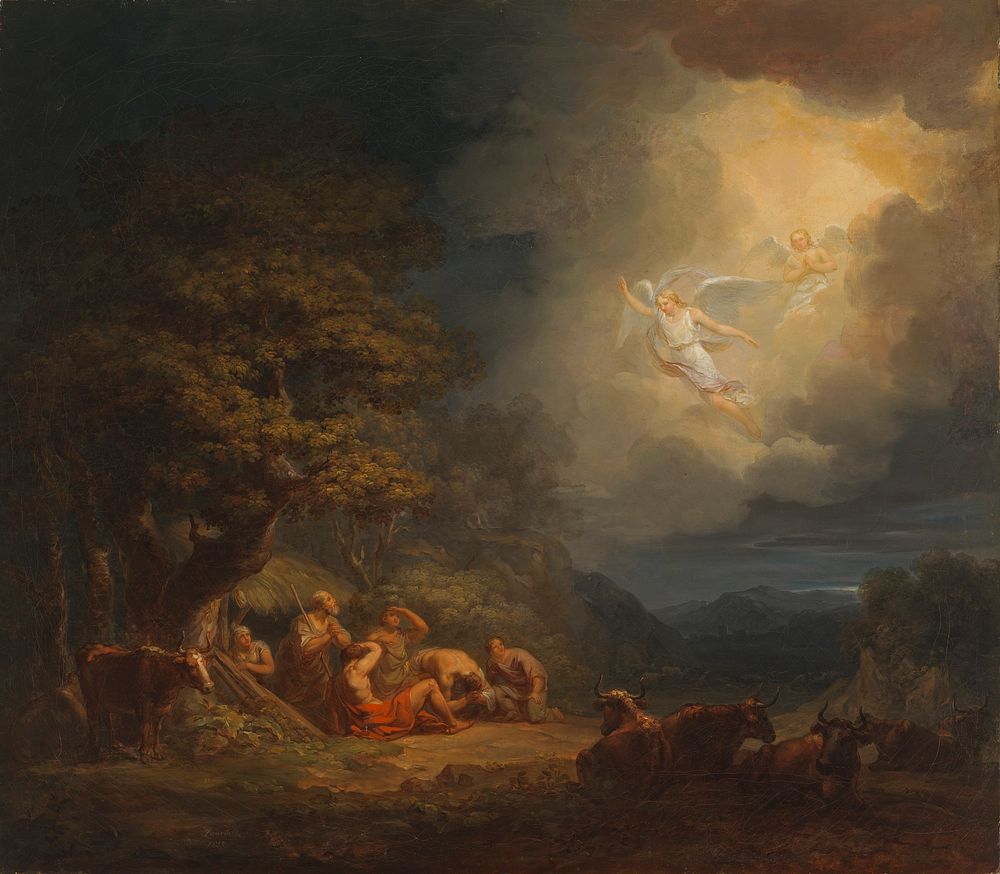
by Alexander Laureus, 1815

Neither the powers of Rome nor the priests of the Jewish people received an invitation to the birthplace of the King of kings. Instead, angels delivered the news of the Messiah’s birth to scruffy shepherds and told them where Christ could be found.

Often it is the lowly who are the beneficiaries of God’s special favors and blessings—more so than the rich or famous [3].

An Unassuming Humility

Our Savior God is a humble God. Even though he’s the sovereign power of the universe, Christ humbled himself to be born a helpless baby, grow into manhood, and suffer death in the place of all sinners who put their faith in him [4].

How dare I entertain even the smallest of prideful thoughts?

An Unexpected Circumstance

Our God loves surprises! Imagine the shepherds crying out in shock as an angel suddenly appears to them, only to be even more surprised by the angel’s message!

No doubt you’ve been surprised by God too, as he worked out impossible circumstances, miraculously supplied a dire need, or blessed beyond imagination. God’s surprises prove his creative capability to perform wonders that cannot be fathomed, and miracles that cannot be counted!

An Unlikely Juxtaposition

The shepherds visited the True Shepherd; the kings from the East visited the King of the universe. And that Shepherd-King (such a mind-boggling juxtaposition of humility and majesty!) now lives within us.

An Uncommon Possibility

When angels announced Christ’s birth to the shepherds, “the glory of the Lord shone around them [5].”

I wonder, might that celestial light have been rainbow-infused? Consider Revelation 4:3 where the Apostle John tries to describe the glory around God’s throne.

He wrote, “A rainbow that shone like an emerald encircled the throne.” Perhaps those same, glorious rainbow hues swirled in the light above the hills of Bethlehem that night!  

This is the only public-domain image that hints toward what I’m imagining!

Some people enjoy adding such facts and conjectures to their bank of knowledge.

Better yet is to let such information provide the icing on our Christmas joy—the icing of delicious astonishment and sweet encouragement that leads to worship.

*     *     *     *     *     *     *     *     *     *

I praise you Lord God, that your Word is living and active. No matter how often we read a passage or hear a scripture story, you can breathe fresh life into its meaning and impact.

The Christmas narrative is no exception. As we read and hear again the grand story of Jesus’ birth, may our hearts be open to your inspiration, may we overflow with renewed wonder, and in response, offer you our heartfelt worship.

Hebrews 4:12a; Proverbs 4:20-22;

Psalm 119:18; Psalm 40:5; Psalm 72:18-19


[1] Luke 2:13-14

[2] Luke 2:1-4

[3] http://www.examiner.com

[4] Colossians 1:17; Philippians 2:5-8

[5] Luke 2:9

Art & photo credits: http://www.freebibleimages.org; http://www.pickpik.com; http://www.flickr.com; http://www.rawpixel.com; http://www.canva.com; http://www.flickr.com; http://www.canva.com.

Processing…
Success! You're on the list.

Read Full Post »

Elohim [1], Lord of heaven, summoned the angel Gabriel to his craft studio. The latter winged his way down the hallways of paradise and soon entered the Master’s presence.

He found Elohim hunched over his work table, pouring over design sheets, but he looked up as the grand angel entered.

“Gabriel!” boomed Elohim. “Thank you for coming so quickly. I need to discuss with you my plans for the human race before creating Adam and Eve.

“It’s important you know these plans since you’ll play an important role in the coming world.”

Gabriel stood erect and folded his wings in precise pleats. “I am your servant, Lord, ready to do your bidding [2].”

Elohim smiled. “Thank you, Gabriel. Now—here’s what I’m thinking. First, you’ll remember we’ve already decided to give humans the freedom of choice, since puppet-children would be pointless.

“I can’t enjoy the blessing of relationship with puppets! No, my children must have free will [3].”

Elohim began to pace around his mammoth work table. “Second, much as I’d love to lavish each of my future children with perpetual happiness, I know such circumstances in their human state would only spoil them.

“There must be a balancing of the scales between blessing and challenge in order to do them good—to demonstrate my love and grace, yet bring them to a place of maturity and strength [4].”

“Yes, my Lord. I can see the wisdom of such a plan. How will you execute it?”

Elohim swished his flowing train around a corner of the table and continued to pace. “I’ll have to allow bitter along with the sweet, since too much pleasure will intoxicate them and too much sorrow will crush them.

“Too much success will lead to conceit, and too much failure will cause debilitation. Too much praise will contribute to pride, and too much criticism will bring on despair [5].”

Gabriel nodded thoughtfully. “I see what you mean, Elohim.”

“Even so, I want humans to grow in their understanding that happiness will not only be within them, nor will it solely be without. Happiness will be most dependent on their relationship with me.”

“Well said, my Lord!”

Elohim stopped pacing, a twinkle dancing in his eyes. “Thank you, Gabriel. Eons from now I’ll inspire one of my children, Blaise Pascal, to write similar words.”

With his star-studded pen Elohim pointed to a shelf holding one large scroll and tied with a scarlet cord.

That is my plan for initiating relationship with humans: faith in my Son, Jesus—either looking forward to his coming, or trusting in him for eternal life after his death and resurrection [6].”

Elohim then indicated the design sheets strewn on his work table. “Currently in the planning stages, these individually-designed blessings to lift the spirits of my children when faced with difficulty.

“For example, I’ll bring a loving friend alongside a person who’s grieving, or paint a glowing sunrise to remind them of My presence, or lead them to a scripture that perfectly addresses their need—that sort of thing.”

With a flourish of his white-robed arm, Elohim pointed to countless rolls of such design sheets tucked into cubby-holes along the wall. “As you can see, I’ve planned out a number of good things already [7]!”

Now it was Gabriel’s turn to smile. “And no doubt you’ve enjoyed all the creating and designing.”

Elohim affirmed Gabriel’s assumption with a satisfied grin. “I shall have blessings ready for every circumstance my dear children face, though they will have to keep watch so they don’t miss them!”

Elohim paused. In softer tones, yet with passion and resolve he declared, “Gabriel, even before this epic of humanity begins, I already love them.

“Yes, they’ll choose to behave foolishly, but I will still bestow kindness with generosity, mercy with understanding, and goodness with wisdom [8].

“My greatest desire is that all humankind turn to me. And for those who do, a multitude of tender mercies await [9].” Elohim indicated the overflowing cubbies on the wall.

Gabriel bowed in reverence. “May all the peoples-of-the-earth-to-come stand in awe of your gracious provisions [10]!”


[1] The name “Elohim” indicates God is the Creator and ruler in the circumstances of humankind

[2] Psalm 103:20

[3] Galatians 5:13

[4] Psalm 86:15; James 1:4

[5] Based on a Don Fortner quote, www.gracequotes.org

[6] John 3:16; 1 John 4:9-10; John 6:29

[7] Psalm 31:19

[8] Jeremiah 31:3; Isaiah 53:6; Psalm 69:16 AMP; Lamentations 3:22-23; Psalm 145:9

[9] 1 Timothy 2:4; Psalm 69:16

[10] Psalm 33:8

Photo credits: http://www.pexels.com; http://www.canva.com (2); http://www.heartlight.org (2); http://www.pickpik.com.

Processing…
Success! You're on the list.

Read Full Post »

Older Posts »

Still Traveling

Impressions Becoming Expressions

Living Our Days

Gaining a heart of wisdom

He Said What?!

I'm Patty, and my husband and I are living with our adult son who has autism and epilepsy. I love sharing lessons learned from life around me, especially life with Aaron.

Meditations of my Heart

Impressions Becoming Expressions

Linda Stoll

Impressions Becoming Expressions

Debby Thompson

Impressions Becoming Expressions

Signora Sheila

Notes on Life, Faith & Italy

Colleen Scheid

Writing, Acting, Living in God's Love

Mitch Teemley

The Power of Story

Heidi Viars

Finding the Image of God