Feeds:
Posts
Comments

Archive for the ‘God’s Wisdom’ Category

Check a map that traces the trek of the Israelites from Egypt to Canaan, and you’ll see a meandering, looping pathway:

Wilderness Journey

God could have taken them along the coast of the Mediterranean Sea, a much more direct route. One commentator says that route would have required just days of travel. A short journey would have been so much easier on everyone, right?  Less chance of fatigue, boredom, and impatience to develop and create problems.

But God had his reasons for a long, winding route.

Reason #1: The Philistines. That’s not conjecture; that’s exactly what scripture tells us. “When Pharaoh let the people go, God did not lead them on the road through the Philistine country though that was shorter. For God said, ‘If they face war, they might change their minds and return to Egypt’ ” (Exodus 13:17).

The Philistines’ territory stretched for fifty miles along the Mediterranean Sea, with the southern border touching Egypt. They were a well-organized, warring people. Five great cities, strategically located throughout their coastal holdings, created an alliance, the famous Philistine pentapolis.

A people suppressed by slavery for four hundred years would not be able to fight such an adversary. The Israelites didn’t have any trained soldiers among them either. Could God have given them a rousing victory over the Philistines anyway? Of course. But he chose not to.

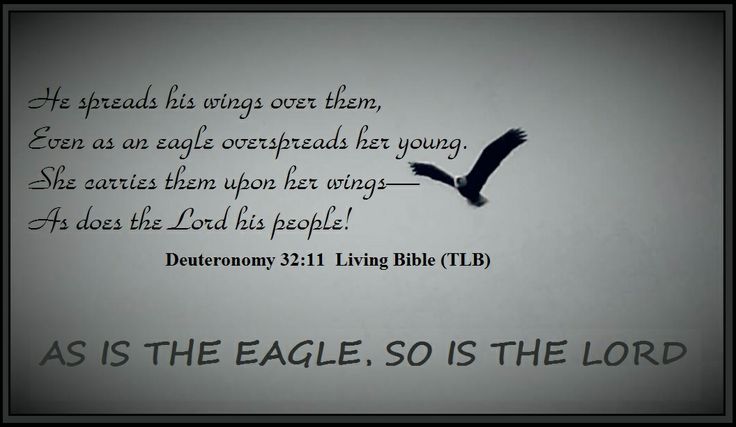
Reason #2: Perhaps God determined his people needed some wilderness experience to train them in his ways and build their trust in him. Instead of quick and easy, God chose slow, step-by-step progress. He was like an eagle, teaching his fledglings by degrees how to fly (Deuteronomy 32:11).

4ffd5fa25fbd4e401e15ae1fe344938f

I wonder if the Israelites thought, Does God have any idea where he’s taking us? What is he DOING?!

In hindsight we can see God’s purpose:

  • To prepare them to be his holy people by giving them the law. (By the way, according to Exodus 19:1, Moses went up to Mount Sinai during the third month after they left Egypt. God was certainly in no hurry to get his children to the Promised Land.)
  • To teach them.  Through the laws he gave Moses, God taught the Israelites how to treat one another and how to worship him. They were to be different from all other peoples on earth.   “I am the Lord your God; consecrate yourselves and be holy,” he said, “because I am holy” (Leviticus 11:44).
  • To challenge them. For example, God let them experience great thirst and hunger. Then he stepped in and supplied their needs. By degrees God taught them to trust him.

I have to admit: my life experiences have paralleled the Israelites’ in a number of ways. I’ve encountered a few winding roads, puzzling detours, uncomfortable wait times, and unanswered questions of my own.

You, too?

Here’s what we can remind ourselves of: God may not direct us by the nearest, fastest way—even though he could. In his omnipotent wisdom, he knows a better way. And he has perfectly sound reasons for his decision.

My choice in the matter? I can plead for the shorter route, complain about the delay, try to forge ahead on my own self-chosen fast track, OR…

…trust my all-knowing, all-wise Heavenly Father.

5db138f980d331b5ee31f939d399464e

Seeing the choices laid out in black and white, here on my computer screen, the decision is easy. However, complete trust in the moment of uncertainty, fatigue, and discomfort is much more challenging.

Perhaps I can encourage myself by reviewing God’s purposes for the Israelites. Chances are, he desires the same results in me:

  • God prepared the Israelites; he may be preparing me for the next chapter in my life.
  • God taught the Israelites; he may be teaching me what the next level of maturity includes.  (Yes, even an old Christian like me still has growing to do!)
  • God challenged the Israelites; he may be challenging me to trust him—in spite of a long, winding road and uncomfortable wait time.

In summary:  As I cooperate with him, God can transform me into a prepared, mature, trusting servant for the next chapter of my life.   I like the sound of that!

You, too?

*     *     *     *     *     *     *     *     *     *

“Who compares with you, O God?  Who compares with you in power, in holy majesty, in awesome praises, wonder-working God” (Exodus 15:11, The Message)?  You are over-the-top trustworthy!  So, in advance, I thank you for the good that will come out of the winding road, detours, and wait time in my life–experiences you ordained for me, before one of them came to be (Psalm 139:16).  I place my hand in yours, my caring, constant Companion.  Help me to focus on your strong grip, not the uncertainties ahead.  Amen.


(Art credits:  www.registrypartners.net; http://www.pinterest.com.)

Read Full Post »

blog-prayer-woman


How would you finish this prayer: 

“Oh, Lord, what I need most right now is ____________________.”

What word would you put in the blank?

Guidance?

Provision?

Strength?

Purpose?

One glorious Bible verse tucked into Isaiah presents four comforting promises that cover each of those needs:


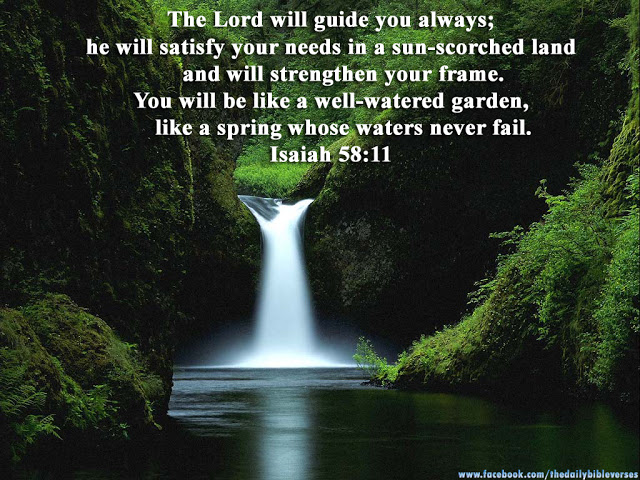
Isaiah58.11 

“The Lord will guide you always;

He will satisfy your needs in a sun-scorched land

And will strengthen your frame.

You will be like a well-watered garden,

Like a spring whose waters never fail” (58:11).

Lots of truth packed into five short lines. Each phrase warrants careful consideration. For example:


1.  The Lord will guide you always.


He’s not a life coach, counselor, or psychologist. The almighty God of the universe promises to be your guide—free of charge! And he’s available 24/7. Think, too, of his astounding attributes that make him the perfect guide:

  • God is omniscient—He knows everything (Psalm 139:1-6), including every detail of your situation and the people involved.
  • God is righteous—Everything he does is good (Deuteronomy 32:4). He can be relied upon to lead you down a perfect path.
  • God is merciful—He responds in loving compassion (Psalm 116:5). He’s your understanding Father, your strongest ally.
  • God is truthful—All that he says can be trusted (Titus 1:2). He will not lead you astray.
  • God is faithful—He keeps his Word (Psalm 33:4). God does not lie or forget what he said. Neither does he change his mind.

Notice that first phrase says God will always be your guide. Not every once in a while when you’re really in a quandary, but always. You are never left alone to your own devices—unless that’s the way you want to live. God is a gentleman; he leaves the choice up to you.


2.  He will satisfy your needs in a sun-scorched land.


Not he might satisfy your needs if he feels like it. He will. 

No matter what the landscape of your life looks like, God will see that your needs are met.

Have you ever been surrounded by sun-scorched land, perhaps a desert or wilderness where no life is visible?

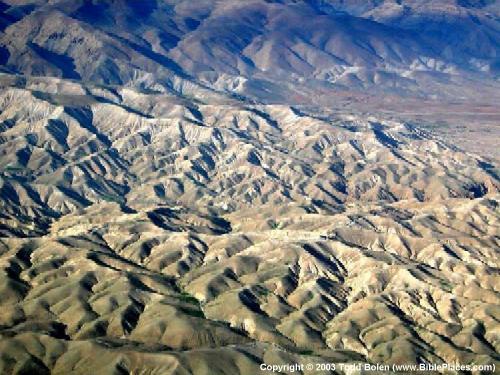
Steve and I visited Israel a number of years ago. One of our tour stops was in the Judean wilderness—a desolate and foreboding sight to behold. Not a single tuft of grass. No bushes or plants of any kind—not even cactus. Only two things are visible when standing in the midst of this desert: sky and pale gray-brown mountainous rock, as far as the eye can see.


judean_wilderness_west_of_jericho_ariel_tb_q010_03


Should you decide to live there, you’d have to bring with you everything necessary for survival: all your food, water, and clothing. For shelter, you might find a cave.

Ah! But what if there was Someone there ahead of you? Someone who already had at his disposal the supplies you required? And they would never run out? That’s the life-giving, unfailing provision of your Heavenly Father.

Let’s you and me rest in the assurance that the essentials—and even many delights!—will be generously supplied. If something is meant to be, he will take care of it—just as he’s been doing since each of us was born.

Think how he has led you through the wilderness of broken relationships and difficult circumstances. His grace has been sufficient for every challenge (2 Corinthians 12:9), right?

Now project that assurance into the future. Even if we walk through the valley of the shadow of death, we have no need to fear. Our all-powerful God is with us (Psalm 23:4)–guiding and providing.

(Please remind me of that when I come to a wilderness-patch, will you?)


*     *     *     *     *     *     *     *     *     *


Heavenly Father, I praise you that day by day, moment by moment, you are delighted to guide us in perfect wisdom. You generously provide for our needs and lovingly care for us body, soul, and spirit. Thank you for your compassion, your faithfulness, and grace to see us through the wilderness valleys. “I trust in you, O Lord; I say, ‘You are my God. My times are in your hands.’” (Psalm 31:14-15a).  


Please come back on Monday. We’ll meditate on the second half of Isaiah 58:11.


(Photo credits:  www.hischurchwomen.com; http://www.freerepublic.com; http://www.biblestudytools.com.)


Read Full Post »

time

Does it ever seem to you that God shows up late sometimes? Surely you’ve had it happen to you.  In spite of persistent prayer and patient waiting (OK, almost patient), God did not intervene in a timely manner.

For example:

  • Applications for grad school were turned down—three years in a row. Finally, the fourth year, acceptance was granted. Why?
  • The job you needed ASAP didn’t materialize for two years. Why?
  • The bracelet that had been your grandmother’s suddenly disappeared. Heartsick, you searched and searched and prayed to find it. No bracelet. Suddenly, months later, there it was–caught in a sweater you hadn’t worn in ages. Why?

Why the delay???

I know this sounds impertinent, but in all of these cases and many more, it would appear God was not paying attention.

Or…

…Could it be God operates in a different time frame, one not governed by days, months, or years?

After all, God is eternally the same, always was and always will be. Time is rather inconsequential to him. He lives in a dimension where past, present, and future are not separated.

Time for God is measured more in seasons. Paul included the concept in his persuasive address at Athens:

“From one man [God] made every nation of men, that they should inhabit the whole earth; and he determined the times set for them and the exact places where they should live” (Acts 17:26).

The Greek word Paul used in that verse is kairos. It means, “the suitable or appropriate time for something to occur or for something to be accomplished.”

In his speech, Paul was referring to the appropriate times certain people-groups would rise to power, such as the Egyptians, Assyrians, Greeks, and Romans.

The Greeks had a second word for time: chronos. This is the kind of time we measure with clocks and calendars. This is our comfort zone–the kind of time we know and understand best. Perhaps that’s why we anticipate God should operate within chronos.

But kairos is God’s time, as in “I choose the appointed time, it is I who judge uprightly” (Psalm 75:2).

Taking the definition of kairos into consideration, this verse would read:

“I choose the suitable and appropriate time to accomplish my purposes.”

And what would be the foundation of God’s choice of kairos?

His righteousness.

“Righteousness and justice are the foundation of your throne” (Psalm 89:15).

Everything God does is right, including when he does it.

His wisdom.

“Oh, the depth of the riches of the wisdom and knowledge of God! How unsearchable his judgments, and his paths beyond tracing out” (Romans 11:33)!

It’s been said: “If I had the power of God, there are many things that I would change; but if I had the wisdom of God, I would not change a thing.”

That would include the timing of events, too.

His love.

“God showed how much he loved us by sending his one and only Son into the world so that we might have eternal life through him” (1 John 4:9, NLT).

Would a God who loves like that fail to pay attention, and mess up the timing of his involvement?

Kairos implies “at just the right time.”

At just the right time, the door opened for grad school.

At just the right time, that job was provided.

At just the right time, the keepsake bracelet was found.

By not asking why we had to wait, perhaps we demonstrate a modicum of maturity.

(Art credit:  www.inscribewritersonline.blogspot.com.)

Read Full Post »

If I asked you, “What’s the most popular flower?”, you’d probably get the answer right. It’s the rose. En masse on the bush, they provide a striking sight—dozens of large blooms framed by dark green leaves.


Rose-bush


But most of us can’t pass by a rose-bush without leaning in close to view the soft petals, and breathe in the singular scent. To study a blossom up close enhances our appreciation.


3513957969_384a6f45ac


We notice the varying colors, the delicate curl of each petal, the intricate, spiraling pattern. Our sense of wonder increases the more we gaze.

Might the same be true as we study the beauty of our God? That’s what David wanted to do:


1b799f481eab9b6e3bb2af8eab01c1dc

(“One thing I ask of the Lord, this is what I seek: that I may dwell in the house of the Lord all the days of my life to gaze upon the beauty of the Lord and to seek him in his temple” (Psalm 27:4).


But how can we gaze upon an invisible God? By contemplating all his glorious attributes. One commentator described the beauty of the Lord as the harmony of his perfections. I like that.

Just as the petals of a rose create a harmony of color, pattern, symmetry, and form, so the traits of our holy God manifest a harmony of perfect grace, holiness, triunity, and power.

And though we may be acquainted with a number of God’s attributes, appreciation of their beauty expands with a close-up view—through the lenses of scripture and personal experience.  For example:

God’s beautiful grace becomes visible in the story of the prodigal son, as we witness the father actually running to welcome his wayward son home.  He throws his arms around the filthy youth, even kissing him (Luke 15:11-20).

prodigal-son

God’s glorious holiness (purity, righteousness, and separateness from everything else in the universe) is highlighted in Revelation 4:1-11 as John strains for words to describe the Lord of heaven…

… ”Seated on the Throne, suffused in gem hues of amber and flame with a nimbus of emerald…Lightning flash and thunder crash pulsed from the Throne. Seven fire-blazing torches fronted the Throne (these are the Sevenfold Spirit of God)” — vs. 3-5, The Message.  

God’s harmonious triunity (Father, Son, and Holy Spirit) is celebrated in Ephesians 1. Paul reminds us that:

  • God the Father bestows all spiritual blessings upon us (v.3).
  • God the Son provided redemption and forgiveness of our sin (v.7).
  • God the Spirit guarantees our inheritance in heaven and gives us assurance (vs. 13b-14).

And God’s magnificent power is on display throughout scripture and creation, even in our personal lives.  Our Heavenly Father is a God of infinite wisdom, unfailing guidance, strong empowerment, attentive care, competent help,  rich blessings, and more.

We can contemplate each of these attributes as we would the individual petals of a perfect rose.  We can remember occasions when he has demonstrated each trait in our lives.  And perhaps we’ll burst into song as Moses did:


who-is-like-you

(“Who among the god is like you, O Lord?  Who is like you–majestic in holiness, awesome in glory, working wonders?” — Exodus 15:11).

*     *     *     *     *     *     *     *     *     *

My heart fills with wonder and praise, O Lord, because you are a beautiful, holy God.  No one is your equal in power, wisdom, creativity, splendor, or love.  No one else is perfect in all he does.  And you, in all your holy glory are  My.  Heavenly.  Father.   Such statements are too glorious to comprehend!  

But oh, how grateful I am that they are true.

(Photo & art credits:  www.dorsetcereals.com; http://www.flickr.com; http://www.ameliarhodes.com; http://www.luke-15.org; http://www.praisejesustoday.com.)

Read Full Post »

 frazzled-career-woman


Ever had a pending appointment you didn’t want to keep? A person you didn’t want to encounter? A task you didn’t want to complete?

Some days are filled with unpleasantries. And if I’m not careful, it’s an easy slide down into a gloomy funk.

How does that happen?

My thoughts provide the slippery slope…

What a lousy day this is going to be. I sure hope So-and-So is in a good mood for that meeting this afternoon. Last time he was as irritable as Oscar the Grouch. And while I’m looking forward to that (Ha-Ha!), look at this impossible to-do list. Talk about crazy. And then there’s our double-date tonight with that new couple from church. I am in no mood to be sociable. All I want to do is go home, put on my sweats, and park on the couch!

 Can you identify my problem here? I’m focusing on the negative. The solution is obvious: turn my thoughts to the positive.

But some days that is next to impossible. It’s as if the problems and challenges are shouting giants, jumping up and down, with arms waving no less. They block any view of the positive.

Making the effort to think about praiseworthy things works for a while, but those negative thoughts often return, unbidden and oh, so unwanted. To make matters worse, I feel guilty for allowing those giants access to my mind and spirit.

Why can’t I get rid of them once and for all?

Maybe I’m not supposed to. Maybe God wants me to become more watchful, to learn perseverance, and to practice proactive behaviors, like gratitude and praise.

But one strategy for fighting the giants is particularly important: Get out my sword.

I’m talking about the Sword of the Spirit, which is the word of God (Ephesians 6:17).

Scripture is full of wisdom and encouragement for doing battle, like Psalm 73.

Asaph writes about his challenge: arrogant and wicked people (v. 3) who scoff and speak malice (v. 8).

“What is going on here?” he writes. “Is God out to lunch? Nobody’s tending the store. The wicked get by with everything; they have it made…When I tried to figure it out, all I got was a splitting headache” (vs. 11-14, The Message).

Sounds like the giants of negativity had been pestering Asaph, too.

But at the end of the psalm, Asaph affirms what he knows about God and his ways:


“You [God] hold me by my right hand.

You guide me with your counsel,

And afterward you will take me into glory.

Whom have I in heaven but you?

And earth has nothing I desire besides you.

My flesh and my heart may fail,

But God is the strength of my heart

And my portion forever.”

(Psalm 73:23-26)


I need to meditate on Asaph’s affirmations and make them my own:

  1. My loving Heavenly Father holds me by the hand, offering protection and security.
  1. He guides me with wisdom, especially through his Word, infusing me with comfort and strength.
  1. God gives me perspective for my earthly troubles as I look forward to blissful eternity with him.
  1. He is all I need.


Thank you, Asaph. I’m going to memorize those verses so they’re ready to draw like a sword—on a moment’s notice!


(photo credit:  www.ideas.tome.com.)


Read Full Post »

 proverbs-36_2821_1024x768

(“In all your ways acknowledge [God] and he will make your paths straight.” — Proverbs 3:6, NIV)

M-m-m.  God will make my paths straight? Sounds as if he is promising a life of ease on a flat, straight course. Smooth transitions from Point A to Point B.

But I know God doesn’t work that way. Life on Easy Street can result in laziness and worthlessness.

In checking other translations of the Bible, I discovered fresh insights for this familiar verse.

Berkeley says, “He will direct your paths.”

The Douay-Rheims Bible presents a nuance of difference: “He will direct thy steps.”

New Living Translation, “He will show you what path to take.”

Holman Christian Standard Bible, “He will guide you on the right paths.”

And my personal favorite: “He’s the one who will keep you on track” – The Message.

I wonder if I could compose my own amplified version, combining all these translations? Something like: “He will direct my steps along the path that he knows is right and keep me on track.”

How glorious that our Heavenly Father cares enough to guide us so attentively. What a relief to know…

…we can trust the One who knows us  better than we know ourselves. After all, God made us.   He can be trusted to choose just the right path for each of us. “He will teach [us] his ways, so that [we] may walk in his paths” (Isaiah 2:3).

…we don’t have to direct our own steps. In fact, “It is not for man to direct his steps” (Jeremiah 10:23). How wonderful to depend on God, who can see into the future. We certainly can’t!

…He won’t just set us off in the right direction, then leave us to our own devices. He will remain by our side, providing guidance all along the way.  Our God is all-wise; we are not.

I’m remembering a visit to the Governor’s Palace in Colonial Williamsburg, Virginia. In back of the large home is a labyrinth of boxwood bushes, replicating the maze that was first constructed there hundreds of years ago. Children and adults alike find it hard to resist the challenge, including me.


D2004-DMD-0413-1176.tif


Oh, my. With my lousy sense of direction, I became hopelessly lost. Every time I thought the next corner would be the way out, a wall of greenery would greet me. What I needed was somebody with a bird’s-eye view of the path who could tell me which way to turn.

That’s exactly what we have in our Heavenly Father.

“Whether you turn to the right or to the left, your ears will hear a voice behind you saying, ‘This is the way; walk in it.’” (Isaiah 30:21).

And we’re talking about much more important matters than a labyrinth of bushes! We’re talking about:

  • Day-to-day choices that form our character
  • Decisions that impact our influence upon those around us
  • Selections of what church to attend, what friendships to cultivate, what activities to pursue, and more
  • Guidance for those unexpected twists and turns of life

In all these ways, “He will direct our steps along the path that he knows is right and keep us on track.”

*     *     *     *     *     *     *     *     *    *

Oh, Lord, help me to look up toward you—often! I want to walk the right path you have chosen for me, with confidence and strength, because I am trusting in you. May I turn my thoughts to you and your Word continually—so I can receive frequent instruction. And thank you for walking with me, offering support and encouragement, every step of the way. “Show me the way I should go, for to you I lift up my soul” (Psalm 143:8b).


(Photo credits:  www.rockchurchofindia.org; http://www.colonialwilliamsburg.photochelter.com.)


Read Full Post »

Northern Cardinal


For several weeks this spring we enjoyed a special visitor to our home, a male cardinal.

At least once each day he perched on the window sill above our front door.  His head would cock from side to side as he considered his reflection in the glass. Then he would flutter upwards, sometimes as high as two feet or so, his wings batting against the window.


DSCF9641


No doubt he thought the reflection was another cardinal, and he wasn’t about to allow an interloper to move in on his territory!

Every morning I heard his fluttering wings against the glass and stood to watch his proprietary dance.

What if he hurts himself, I thought. Too bad I can’t communicate with the little guy, and let him know his fight for territory is unnecessary.

 M-m-m-m.

We humans ARE capable of receiving communication.  And God has graciously given us his Word–full of infallible wisdom–so we don’t waste time and energy on worthless pursuits.

Too often, though, I am like that little cardinal, fluttering my wings in a frenzy of self-gratification, or questions that have no answers, or worthless contemplation of what ifs.  The results are as unproductive and meaningless as territorial rituals with a nonexistent rival.

Unlike that red bird, I can understand instruction, but sometimes I fail to pay attention.

It’s not as if God hasn’t clearly explained through many scriptures the way to peace and contentment. Some are embarrassingly familiar:

Do not fret…Trust in the Lord and do good…Delight yourself in the Lord and he will give you the desires of your heart.  Commit your way to the Lord; trust in him and he will do this (Psalm 37:1-5).  [So, it boils down to this:  Am I going to believe that God will do what he says?  Am I going to lean into him and trust?]

“It is more blessed to give than to receive” (Acts 20:35).  [That principle applies to gifts of time and effort as well as monetary.  And just how often does the giver experience more blessing than the receiver?  Almost always!]

“Do not be anxious about anything, but in everything, by prayer and petition, with thanksgiving, present your requests to God.  And the peace of God, which transcends all understanding, will guard your hearts and you minds in Christi Jesus” (Philippians 4:6-7). [Note to self:  Focus on your all-powerful, all-knowing, all-wise God.  He is bigger than any problem, any need.]

Instead of beating my wings in a flutter-frenzy, I want to take inspiration from another activity cardinals are known for:  singing!

I lift my voice in praise to you, my God and King!

Your majesty and greatness are beyond comprehension,

yet you care for me.

You extend your mercy to forgive,

your grace to provide,

your wisdom to direct,

your strength to uphold.

Everything you do is right.

May my heart be steadfast

to trust you and follow your Word.

Turn my heart toward your ways

and away from worthless pursuits.

If I’m serving and singing, I won’t have time for flutter-frenzies!

(Photo credits: http://www.planetofbirds.com; http://www.coldhandswarmearth.blogspot.com.)


Read Full Post »

Mr. Chump thinks he’s pretty smart.

He doesn’t need experts; he already knows what’s best.

He doesn’t need repairmen; he fixes things himself.  Of course, many items turn out to be very poorly made, so parts don’t go back together the way they’re supposed to.  Frequently he’s forced to replace such items.  It never dawns on him how often that scenario occurs.

Mr. Chump also thinks he knows better than God.

“So many things in this world just don’t make sense,” he loudly complains to his neighbor.  “For example, why did God create mosquitoes?  And what’s up with the rain?  Sometimes we get too much, and sometimes not enough.  What would be wrong with a little balance?  And why does winter have to be so cold?

“And look at this tall, strong oak tree here, with all of its tiny acorns,” Mr. Chump continues.  “And then over there, on that puny, limp vine lying on the ground, huge, heavy pumpkins grow.  It makes no sense.

“People talk about an all-wise God in control of the universe, but there are just too many inane situations in nature for me to believe in Intelligent Design, much less God.”

And then an acorn falls on his head.  And his neighbor quietly remarks:

“What if that had been a pumpkin?”

Poor Mr. Chump.  Little does he realize that:

“God is exalted in his power.   Who is a teacher like him?  Who has prescribed his ways for him,  Or said to him, ‘You have done wrong?’  (Job 36:22-23).

Or…

“What a wonderful God we have!  How great are his wisdom and knowledge and riches!  How impossible it is for us to understand his decisions and his methods!  For who among us can know the mind of the Lord?  Who knows enough to be his counselor and guide?…For everything comes from God alone.  Everything lives by his power, and everything is for his glory.  To him be glory evermore (Romans 11:33-36 TLB).

I begin to shake my head in pity for Mr. Chump, who doesn’t understand that God most certainly knows what he is doing.

Then I realize:  there are times when I am no different from Mr. Chump.  Oh, I may not complain that acorns should grow on vines and pumpkins on trees.  But I allow negative thoughts to swirl around in my mind that sound an awful lot like complaining.  Thoughts like…

…This situation is unbearable, Lord.  When will you intervene?

…I don’t know why I keep hoping for such-and-such to happen.  It would appear I’ve been working and waiting for nothing.  Am I wasting my time, God?

…I’m frightened, Lord.  What is going on?  Where are you?

So what can I do to avoid behaving like Mr. Chump?

Paul’s idea in the Romans passage above is a great place to start.  Paul confesses he’s at a loss, that the depths of God are beyond his reach.  So he humbly sits down at the brink, and adores the depth.*

Worship.  That’s the answer.

Move over Mr. Chump.  Make room for adoration, gratitude, and trust.

Amend that.  Move out, Mr. Chump.  Your foolishness is not welcome here.


*paraphrased from Matthew Henry’s Commentary


(photo credits:  www.alexandriavaappliancerepair.com ; http://www.onlineathens.com ; http://www.flickr.com ; http://www.godmeandacupofcoffee.blogspot.com )


Read Full Post »

Steve and I received a calendar for Christmas with a quote for each day. Sometimes the choice is quite meaningful, such as:

Babe Ruth, full-length portrait, standing, fac...

“Never let the fear of striking out get in your way” – Babe Ruth.

We can actually find similar truth in scripture.

“Be strong and courageous. Do not be terrified; do not be discouraged, for the Lord your God will be with you wherever you go” (Joshua 1:9).

Sometimes, as I turn the calendar page to a new day, I have to wonder what the selection committee was thinking. See if you agree.

Sample #1:

“Do not fear mistakes. There are none.” (I won’t name the person who said that!)

Forgive me, but that makes no sense. Am I missing something? If so, please set me straight.

But here’s what makes sense to me:

Winston Churchill, Prime Minister of the Unite...

“All men make mistakes, but only wise men learn from their mistakes” — Winston Churchill.

Wise men also admit mistakes and correct them. When we don’t, we heap another mistake on top of the first: pride.  Ouch!

When we do admit and correct, we develop humility and maturity. And God values those traits (James 4:6, 1:4)

Sample #2:

“Every day is a journey, and the journey itself is home.”

Here’s what makes sense to me:

Although there is joy in the journey, it is not home. Our final home is heaven. I do not want to become enamored with the journey and lose sight of my home.

With Paul, I want to “press on toward the goal to win the prize for which God has called me heavenward in Christ Jesus” (Philippians 3:14).

Heaven

(Photo credit: irunandshoot)

Sample #3:

“Take care of your body. It’s the only place you have to live.”

Problem is, no matter how well we take care of ourselves, these bodies have expiration dates. But praise God our earthly bodies are not the only place to live!

In fact, for those of us who know Jesus, “to die is gain” (Philippians 1:21). We’ll have new, spiritual bodies fit for heaven — strong and vibrant, with no expiration date.  Can you imagine?

Paul said, “I desire to depart and be with Christ, which is better by far” (v. 23).

Oh, yes.

Quadruple combination opened to the Book of Is...

Thank you, Father, for your Word that speaks reliable wisdom and truth—truth that guides, teaches, and protects. But I need your help to live by its truths. Remind me that only fools despise your wisdom (Proverbs 1:7).

Read Full Post »

Henry James, by John Singer Sargent (died 1925...

Henry James, by John Singer Sargent (died 1925). See source website for additional information. (Photo credit: Wikipedia)


“A writer should strive to be a person on whom nothing is lost.” – Henry James.

Some of you may recognize that name from literature class. Does Portrait of a Lady or The Turn of the Screw sound familiar?

Henry James became known for well-developed characters and for stories with an undercurrent of commentary on politics, the social classes, feminism, and morality.

With many works to his credit, his advice for writers–to “live aware”–is advice worth taking.

So we writers become observers–of people, situations, and creation.

We try to see more – the swirling rainbow on a bubble; the slight arch of the eyebrow indicating doubt.

We try to hear more – the squirrel’s staccato tapping as he scampers up a tree; the brief pause of uncertainty.

We try to smell more – the promise of harvest in the freshly turned soil of spring; the aroma of love in a Thanksgiving feast.

We try to taste more – the flavor of winter in a snowflake; the delectable sweetness of moments spent with family or old friends.

We try to feel more – the downy softness of silk on a milkweed seed; the comforting warmth of traditions.

As a result, we’re better equipped to convey meaning to our readers—with clarity and specificity, we hope.

And it occurred to me, Christians should also strive to be persons on whom nothing is lost.

We Christians need to live aware, so as not to miss what God reveals.

We must try to see more – in His Word, His people, and creation.

We must try to hear more – of his still, small voice.

We must try to smell more – in the fragrance of His presence.

We must try to taste more of God’s goodness in our everyday circumstances.

We must try to feel more of the wonder.

And what will be the result?

Out of the glorious riches of all these things, “we may be filled to the measure of all the fullness of God” (Ephesians 3:19). God wants to fill us with His attributes:

His love—everlasting, mindful of our needs, caring.

His wisdom—truthful, trustworthy, impartial.

His holiness—pure, separate from all else, beautiful.

His righteousness—promise-keeping, miracle-working, faithful.

His power—creative, sovereign, protective.

Think of it. The King of the universe wants us to fully enjoy all that He is, all that He has to offer.

Oh, how I want to be a person on which nothing of the King is lost.

Read Full Post »

« Newer Posts - Older Posts »

Still Traveling

Impressions Becoming Expressions

Living Our Days

Gaining a heart of wisdom

He Said What?!

I'm Patty, and my husband and I are living with our adult son who has autism and epilepsy. I love sharing lessons learned from life around me, especially life with Aaron.

Meditations of my Heart

Impressions Becoming Expressions

Linda Stoll

Impressions Becoming Expressions

Debby Thompson

Impressions Becoming Expressions

Signora Sheila

Notes on Life, Faith & Italy

Colleen Scheid

Writing, Acting, Living in God's Love

Mitch Teemley

The Power of Story

Heidi Viars

Finding the Image of God