Feeds:
Posts
Comments

Archive for the ‘God’ Category

Check a map that traces the trek of the Israelites from Egypt to Canaan, and you’ll see a meandering, looping pathway:

Wilderness Journey

God could have taken them along the coast of the Mediterranean Sea, a much more direct route. One commentator says that route would have required just days of travel. A short journey would have been so much easier on everyone, right?  Less chance of fatigue, boredom, and impatience to develop and create problems.

But God had his reasons for a long, winding route.

Reason #1: The Philistines. That’s not conjecture; that’s exactly what scripture tells us. “When Pharaoh let the people go, God did not lead them on the road through the Philistine country though that was shorter. For God said, ‘If they face war, they might change their minds and return to Egypt’ ” (Exodus 13:17).

The Philistines’ territory stretched for fifty miles along the Mediterranean Sea, with the southern border touching Egypt. They were a well-organized, warring people. Five great cities, strategically located throughout their coastal holdings, created an alliance, the famous Philistine pentapolis.

A people suppressed by slavery for four hundred years would not be able to fight such an adversary. The Israelites didn’t have any trained soldiers among them either. Could God have given them a rousing victory over the Philistines anyway? Of course. But he chose not to.

Reason #2: Perhaps God determined his people needed some wilderness experience to train them in his ways and build their trust in him. Instead of quick and easy, God chose slow, step-by-step progress. He was like an eagle, teaching his fledglings by degrees how to fly (Deuteronomy 32:11).

4ffd5fa25fbd4e401e15ae1fe344938f

I wonder if the Israelites thought, Does God have any idea where he’s taking us? What is he DOING?!

In hindsight we can see God’s purpose:

  • To prepare them to be his holy people by giving them the law. (By the way, according to Exodus 19:1, Moses went up to Mount Sinai during the third month after they left Egypt. God was certainly in no hurry to get his children to the Promised Land.)
  • To teach them.  Through the laws he gave Moses, God taught the Israelites how to treat one another and how to worship him. They were to be different from all other peoples on earth.   “I am the Lord your God; consecrate yourselves and be holy,” he said, “because I am holy” (Leviticus 11:44).
  • To challenge them. For example, God let them experience great thirst and hunger. Then he stepped in and supplied their needs. By degrees God taught them to trust him.

I have to admit: my life experiences have paralleled the Israelites’ in a number of ways. I’ve encountered a few winding roads, puzzling detours, uncomfortable wait times, and unanswered questions of my own.

You, too?

Here’s what we can remind ourselves of: God may not direct us by the nearest, fastest way—even though he could. In his omnipotent wisdom, he knows a better way. And he has perfectly sound reasons for his decision.

My choice in the matter? I can plead for the shorter route, complain about the delay, try to forge ahead on my own self-chosen fast track, OR…

…trust my all-knowing, all-wise Heavenly Father.

5db138f980d331b5ee31f939d399464e

Seeing the choices laid out in black and white, here on my computer screen, the decision is easy. However, complete trust in the moment of uncertainty, fatigue, and discomfort is much more challenging.

Perhaps I can encourage myself by reviewing God’s purposes for the Israelites. Chances are, he desires the same results in me:

  • God prepared the Israelites; he may be preparing me for the next chapter in my life.
  • God taught the Israelites; he may be teaching me what the next level of maturity includes.  (Yes, even an old Christian like me still has growing to do!)
  • God challenged the Israelites; he may be challenging me to trust him—in spite of a long, winding road and uncomfortable wait time.

In summary:  As I cooperate with him, God can transform me into a prepared, mature, trusting servant for the next chapter of my life.   I like the sound of that!

You, too?

*     *     *     *     *     *     *     *     *     *

“Who compares with you, O God?  Who compares with you in power, in holy majesty, in awesome praises, wonder-working God” (Exodus 15:11, The Message)?  You are over-the-top trustworthy!  So, in advance, I thank you for the good that will come out of the winding road, detours, and wait time in my life–experiences you ordained for me, before one of them came to be (Psalm 139:16).  I place my hand in yours, my caring, constant Companion.  Help me to focus on your strong grip, not the uncertainties ahead.  Amen.


(Art credits:  www.registrypartners.net; http://www.pinterest.com.)

Read Full Post »

Fantasyland_Full_17089

Visit a theme park and you soon learn that part of the adventure is waiting in line–even if you pay extra for fast passes.

Such was our experience at Disney World two years ago. The castle of Beauty and the Beast required wait time—well over an hour. But friends of our daughter had told her, “Don’t miss it,” so we joined the long, looping line.

You may also know that, while you wait, the folks around you can become like friends. Topics such as home state, kids’ ages, and other experiences in the park, get the conversation going. Commiserating over the long line adds to the camaraderie.

Finally we approached the entrance to the castle. Only fifty or so guests were allowed past the gilded rope. This was our first surprise, since most theater-attractions seat hundreds of people. (No doubt there are at least several theaters within the castle, to accommodate the crowds. But each group enters separately, totally unaware that there must be identical venues down alternate hallways.)

First, we were ushered into an outer room, hosted by a footman, I believe. He assigned roles to many of the guests. Among them, the father from Michigan with the four kids became a butler, the little ballerina (who had performed intermittently as we waited in line) became a teacup, our son-in-law, a knight, and our granddaughter, a salt shaker. Each participant was given a colorful placard to identify his or her part. The footman explained what they would need to do, once we entered the library to meet Belle.


Enchanted-Tales-with-Belle1


One particular role seemed completely inappropriate. For the Beast, the footman chose a little girl with an obvious limp.  It seemed cruel to choose such a child for the Beast, of all characters.  As he draped a red cape over her shoulders, I thought, He probably didn’t notice her difficulty walking. But those of us who had become acquainted outside the castle knew full well: this was going to be awkward.

Soon we were ready to enter the library and meet Belle. Our small gathering of almost-friends filed into the dimly lit, cozy room.  Most of us sat close together on benches.

Beautiful Belle, in her yellow satin gown, directed the teacups, salt shakers, and other dancers in a delightful little polka, while the knights stood guard. Such an elegant and charming princess, that Belle.

Then she said it was time for her dance with the Beast.

Our new little friend slowly and carefully approached Belle without any sign of self-consciousness. Her eyes locked with Belle’s, glistening with pleasure and adoration. Gently, they nearly waltzed, Belle being mindful to accommodate Beast’s handicap. And for a few precious moments, that little girl’s physical challenges were forgotten in the inexpressible delight of dancing with Belle.

Suddenly, my eyes filled with tears. That little girl had been the perfect choice for Beast. Her ecstatic joy was obvious in the non-stop smile and luminous eyes. She was the center of attention of a princess—someone whom she dearly loved and greatly admired. Even more poignant, the sweet look of love returned by Belle, her gracious intentness focused entirely upon the child.

Love soon encompassed the entire room. Surely every guest felt it, not just me. We loved the child for her precious innocence. We loved Belle for her warmth and kindness. We even loved each other, as almost-friends, sharing in this  miracle—a once-in-a-lifetime experience, never to be repeated.

But wait.  In actuality such euphoria and reverence is available to us–every day.

We can keep company with Jesus, our Prince of Peace —not just for a few miraculous moments, but  All.  The.  Time.  In fact, like the father of the prodigal son, he waits in eager anticipation for us to come “home” to him and linger there.

We can be transformed, just like that little girl.   For the length of that magical dance, she was blissfully unaware of her handicap. Why? Her attention was riveted on Belle.  Paul challenges us to do the same in the spiritual realm:   “Fix your attention on God,” he said.  “You’ll be changed from the inside out” (Romans 12:2, The Message).

We can experience love beyond imagination. Belle portrayed perfect love for one shining moment; God is perfect love (1 John 4:8). And the love of his Son, Jesus, is wider than any experience we encounter, longer than our lives last here on earth, and higher, purer, and deeper than any other love (Ephesians 3:18).

And then, one glorious gift that even the lovely Belle could not bestow.  We can be healed of our handicap, the handicap of sin.  Jesus paid the price for our sin when he died on the cross.  He sacrificed himself so that we could be healed of the ravages of sin and enjoy a God-enhanced life (1 Peter 2:24; John 10:10).

With ecstatic joy we can revel in all the privileges of one-on-one relationship with our Prince, who loves each of us as if there was only one of us (St. Augustine).

*     *    *     *     *     *     *     *     *     *

Oh, Prince of Peace, what an astounding privilege you grant us, to bask in your perfect love each day.  Thank you for the assurance of your love throughout scripture, reminding us that we are precious and beloved to you.  May our status as your precious ones free us to live unencumbered by self-consciousness, fear, and worry.  And may we never fail to express your gracious love to those around us.


(Photo credits:  www.wdwmagic.com; http://www.galleryhip.com)

Read Full Post »

Our neighbor, Christine, happened to be in her yard yesterday morning (in spite of frigid temperatures), as I was leaving to babysit our granddaughter. Christine was picking up trash that had blown in front of her house.

“I’ll be so glad when this weather warms up,” she called, stooping to gather more bits in her bag-covered hand. We encouraged each other with the forecast for the weekend: temperatures approaching fifty degrees.

Actually, I haven’t minded the deep freeze that has gripped the Midwest for most of January.  After living in Florida for forty years, I see cold weather as a pleasant change from stifling hot temperatures and hard-to-breathe humid air. (Give me a few years up here, and I might be longing for that heat again.)

th1

For now, these wintry January days offer a multitude of pleasures:

  • A bit of rest after the bustle of Christmas.
  • Feathery cirrus clouds gracing the sky.
  • Cardinals, juncos, and flickers cavorting in the trees on the occasional temperate, sunny day. (Without foliage to obscure the view, we can watch their antics unobstructed.)
  • The soft, pale glow of winter sunsets.
  • Plumes of smoke winding lazily upward from the neighbors’ chimneys.

stock-footage-little-town-s-morning-winter-view-the-main-accent-in-the-shot-is-rising-sun-and-rising-up-smoke

  • Candles glimmering cheerily as dusk falls.
  • The scent of homemade chicken soup simmering on the stove. (Granted, soup can be enjoyed anytime, but it takes a chilly evening to bring out the best of a savory bowl.)
  • Hibernating by the fire, computer on my lap, hot tea in a thermal mug at my side.
  • Layering myself in soft, cozy clothing—and Smartwool socks!
  • Quenching my thirst with a drink of water from the faucet–and it’s already cool – no ice necessary.
  • That first “Ah” moment upon entering the warm house. (Entering a cool house in Florida is more of a “Whew!” moment!) The coziness of home is most appreciated when cold winds blow outside.
  • Nature renewing itself for the life-burst of spring. One sign: buds on the magnolia tree are already growing plump.

Winter_Snow-covered_trees_at_the_lake_046387_

And what about those times when snow covers the landscape? Oh my. The enjoyment is magnified ten times.

  • Delicate flakes waltz in quiet descent.
  • Trees become dressed in lace.
  • Light glistens and sparkles from the brilliant snowscape.
  • A quiet hush surrounds us, as the freshly fallen snow absorbs sound.

All precious gifts, indeed.

*     *     *     *     *     *     *     *     *     *

Heavenly Father, I thank you that the whole earth is full of your glory, even in bleak winter.

In the snowflakes we see your never-ending creativity.

In the full magnolia buds we see the hope of spring, symbolic of our sure hope in you.

In the pleasure of a warm home and crackling fire we glimpse the refuge you offer to us: a place of safety, comfort, rest, and delight.

In the purity of white snow that covers the gray and the dismal, we see a reminder that you cleanse away our sins and make them white as snow (Isaiah 1:18).

And in the beauty and hush of a winter snowscape, we find our attention drawn to you. In quiet, wondrous worship. we give praise to you, our gracious, glorious God!


*     *     *     *     *     *     *     *     *     *


What gifts of winter do you most appreciate?


(Photo credits:  www.zatavki.com; http://www.blog.snyderac.com; http://www.shutterstock.com.)


Read Full Post »

Ec3.11

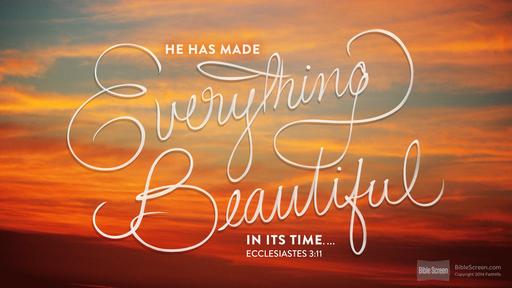
“Everything is beautiful in its time,” Solomon wrote (Ecclesiastes 3:11).

That means today is beautiful—in spite of the long to-do-list, the stress, the mess, the frustrations, the disappointments, the uncertainty, the pain.

How can that be?

Because the negative aspects of our lives do not need to supersede the positive.

God’s glory—his splendor, his creative genius, his love—is being expressed all around us, every day, as…

…pinpoints of sunshine glimmer on a fresh dusting of snow.

…cups of hot tea warm the hands and spicy citrus flavors warm the spirit.

…the baby squeals with delight while chasing bubbles in the kitchen.

…the mail includes a handwritten note.

…a song on the radio speaks encouragement, perfectly suited to a current situation.

…the fire crackles merrily, enticing one to sit and rest in its glow.

The question is, am I aware of the God-infused beauty around me? Am I pausing from my work every now and then to look for it?

Sometimes my vision is clouded by the past. Guilt over poor choices and hurt over unfair treatment can interfere with the enjoyment of now. Even past blessings can be a distraction, if my attitude is, “Oh, if only I could go back to __________. Those were the best years of my life.”

Not that the past doesn’t serve us in the present. Experience is an important teacher. But when I keep looking back with longing, I miss the present.

On the other hand, a preoccupation with the future (the way I would like life to be next month or next year) can also interfere with my full participation in the present. Wishful thinking can easily slip into covetousness.

“Watch out!” Jesus said. “Be on your guard against all kinds of greed; a man’s life does not consist in the abundance of his possessions” (Luke 12:15). Would I be stretching the truth of his statement to say: A beautiful life does not consist of the perfect spouse, perfect children, a perfect house, and a perfect job—even if such perfection existed.

A joy-filled life comes from embracing the gifts of each day. “We should make the most of what God gives, both the bounty and the capacity to enjoy it, accepting what’s given and delighting in the work. It’s God’s gift! God deals out joy in the present, the now (Ecclesiastes 5:19-20a, MSG).

I need to train myself to stay in the present, to enjoy the beautiful moments God is granting me now—to the fullest.

If the to-do list is long, I want to invite God to set the priorities and help me accomplish what is needful for that day. Those items that must be held over to another day may be postponed guilt free, because “there is a time for everything” (Ecclesiastes 3:1). A simpler, slower-paced life will certainly be a more beautiful life.

If uncertainty plagues my thoughts, I want to embrace the truth that God is in control, including the timing of events. He will keep me in perfect peace when I keep my mind steadfastly on him and trust in him (Isaiah 26:3). Trust is at the heart of a beautiful life.

If Plan A (that I was counting on) suddenly becomes Plan B (a debilitating disappointment), I want to accept and even appreciate the change of plan as an opportunity to grow. After all, Plan B did not catch God by surprise. There will be beauty in Plan B, too.

*     *     *     *     *     *     *     *     *     *

Dear God, I thank you that you have made everything beautiful in its time. May I rest in the knowledge that this season of my life, with its particular challenges, was appointed by you. On this day may I:

  • embrace the blessings of NOW,
  • celebrate the completed tasks you gave me to do,
  • handle the challenges with grace and trust in you,
  • grow to be a little more like your beautiful Son, and
  • behold your beautiful glory, on display all around me.  

(Art credit:  www.biblia.com.)

Read Full Post »

iStock_000013894567XSmall-300x199


“What traits should you look for when determining if someone is trustworthy?” asked the subtitle of a magazine article.

That question piqued my interest, and I read further.

According to the researcher, integrity is a crucial component, but there’s another trait that’s equally important: competence. The author gave the following scenario as an example: His best friend, Charlie, had proven himself completely reliable, but he wouldn’t want that friend performing an operation on him.  Charlie is not a surgeon.

So a trustworthy person is not only honest and fair, he is also competent for what you need him to do.

Those of us who know God have just such a friend.  Think of all we know from scripture about the character of our virtuous, competent God.  He is:

  • just, faithful, and upright (Deuteronomy 32:4).
  • righteous (Psalm 119:142) and holy (Leviticus 19:2).
  • wise (Daniel 2:20) and good (Psalm 106:1).
  • truthful (Psalm 31:5).

An  enlightened understanding of our trustworthy God should calm our fears and doubts, right?

But perhaps you’re like me—struggling a bit from time to time, asking questions like:

  • Lord, I know you have a plan, but when are you going to reveal it to me?
  • Why hasn’t Bill been healed? We’ve prayed so hard and for so long!
  • Dealing with Meredith day after day is sapping my strength, God.  When will the frustration end?

According to Philip Yancey, faith boils down to the matter of trust in the relationship. Do I have confidence in God or not? If I do stand on a bedrock of trust, the worst of circumstances will not destroy the relationship (Grace Notes, p. 198).

Vintage country


So how can I develop that strong bedrock of trust? Saturating myself in scriptures about the character of God, such as those listed above, is a good place to start. Another worthy study-pursuit: the promises of God, because…

…“God is not a man, that he should lie, nor a son of man that he should change his mind. Does he speak and then not act? Does he promise and not fulfill” (Numbers 23:19)?  No, of course not.

To truly impact my trust quotient, a change of habit is necessary–a habit such as: T-squared. Any time I find doubt or fear creeping at the edges of my thoughts, I want to Turn, Trust, and Thank. T x 3 includes:

  1. Turn away from thinking about the what-ifs, the negative, the hurtful.
  1. Express trust in God through song, prayer, and scripture. “Doubts are dismantled by declarations,” says my good blogger-friend, Jody Collins.*
  1. Thank God for his attributes that he’s bringing to bear on any negative situation.  Thank him also for every scripture-promise that applies.

I think I’ll try it right now.

*     *     *     *     *     *     *     *     *     *

psalm287-nlt1


Oh, Father, I praise you that you are strong, and protect like a shield.   My heart leaps for joy knowing you care for me and will help me. I praise you for surrounding me with your love, because I trust in you. All my life you have proved yourself trustworthy; why would I want to stop trusting you now? Oh, how I praise you that, as I keep my mind steadfast upon you, you will fill me with your peace. You are my trustworthy Rock—reliable and unchanging.      

(Psalm 28:7; 32:10b; 71:5-6; Isaiah 26:3-4)

 *Visit Jody’s blog at http://www.threewaylight.blogspot.com.


(Photo credits:  www.pixgood.com., http://www.katherinepasour.net., http://www.tyndalerewards.com.)

Read Full Post »

F7007


Christmas. The first syllable surely needs no explanation of origin. It speaks of the One we celebrate.

But what about the second syllable, -mas?

Christmas is a term that has been around for nearly a thousand years, coming to us from Old English. Cristes Maesse meant “Mass of Christ.” It was established by church leaders to disconnect the church celebration of Jesus’ birth from pagan holidays and customs—holidays such as Winter Solstice. (Even before the birth of Christ, Romans were celebrating the shortest day of the year, in anticipation of the sun’s gradual return.)

As a matter of fact, as early as the fourth century, Christians were creating their own wintertime celebration. One theologian pointed out in 320 A.D.: “We hold this day holy, not like the pagans because of the birth of the sun, but because of Him who made it.”

Yet there are those who wish to keep the customs of Christmas without including the One being celebrated. Seems they’d like to take away the first syllable, Christ. But then all that’s left is –mas.

Sounds like mess.

Indeed. I am confident that without Christ, my life would be a mess. 

A mess of fears.

A mess of brokenness.

A mess of worry.

A mess of guilt.

A mess of dissatisfaction.

It’s possible that for a long while I’d be able to hide the mess under glittery packages of stuff, noise and distraction, busy-ness.

But eventually, a body must stop and rest. That’s when my mind would kick into high gear and the mess would wreak havoc in my soul. Chances are I’d develop sleep problems, depression, or perhaps even physical manifestations like ulcers. Stress can do that to a person.

Shouldn’t I at least consider the alternative? What if I do allow Christ in my life?

Oh, my. The list of precious gifts He bestows is astounding and practically endless. To begin, he provides:

  • Calm in place of fear.

“Do not let your hearts be troubled. Trust in God; trust also in me” (John 14:1), Jesus said.

  • Restoration in place of brokenness.

 “Anyone united with the Messiah gets a fresh start, is created new. The old life is gone; a new life burgeons” (2 Corinthians 5:17, The Message)!

  • Peace of mind in place of worry.

 “Steep your life in God-reality, God-initiative, God-provisions. Don’t worry about missing out. You’ll find all your everyday human concerns will be met…God will help you deal with whatever hard things come up when the time comes” (Matthew 6:33-34, The Message).

  • Forgiveness in place of guilt.

 “Everyone who believes in [Jesus] receives forgiveness of sins through his name” (Acts 10:43).

  • Contentment in place of dissatisfaction.

 “Godliness with contentment is great gain” (1 Timothy 6:6).

 And among his many other gifts to us, Jesus grants us the incredible privilege of eternal life (John 3:16)—with him in heaven.

But how will I be able to enjoy all these gifts if I don’t give Christ a chance?

I really have nothing of value to lose. Just the mess.


“Thanks be to God for his indescribable gift” (2 Corinthians 9:15)–the Christ of Christmas!


(Art credit:  www.emblibrary.com .)

Read Full Post »

thanksgiving-table-with-food-4-1

Abundance: a word that easily comes to mind as we contemplate Thanksgiving Day.

Many dining room tables will be filled to overflowing with delectable offerings this afternoon. Most Americans will consume a plentiful amount of turkey, salads, vegetables, and pies. Food in abundance has become synonymous with Thanksgiving.

Very soon Steve and I will head over to our son’s house to celebrate Thanksgiving with family–for the first time in about ten years.  We and our three children, their spouses, and children have lived states apart for that long, and we’ve had to wait until Christmas each year for get-togethers.  (Sadly, not all of us will be able to gather today, but most.)  In June, Steve and I moved close to our older son and his family, not far from our younger son and his wife.

Friends will also be joining us this afternoon, making for a full, heart-warming day. Even more than the abundant feasting, I look forward to the abundant togetherness—the camaraderie, affection, story-telling, reminiscing, and humor.

But abundance also describes the plentiful amount of blessings bestowed by another family member, our Heavenly Father.

His abundance includes:

Grace.

“Those who receive the abundance of grace and of the gift of righteousness will reign in life through the One, Jesus Christ(Rom. 5:17, Ryrie).

We were ruined by sin. But out of his loving forgiveness and acceptance, God offers the gift of eternal life through his Son, Jesus.

Mercy.

“Blessed be the God and Father of our Lord Jesus Christ, who with his ample mercy has given us new birth into a life of hope, due to the resurrection of Jesus Christ from the dead” (1 Peter 1:3, Berkely Version).

When God gives us what we do not deserve, that’s grace. When God does not give us what we do deserve, that’s mercy.   He is abundantly generous with both.

Peace and security.

 “I will heal my people and will let them enjoy abundant peace and security” (Jeremiah 33:6).

We can rest in calm assurance of God’s loving care and his provision of salvation.

Love and faithfulness.

“The Lord, the compassionate and gracious God, slow to anger, abounding in love and faithfulness(Exodus 34:6).

God expresses his love in countless ways.  He is faithful, never forgetting a promise.  And he never fails to provide for our needs.

Goodness.

“They will celebrate your abundant goodness and joyfully sing of your righteousness” (Psalm 145:7).

All of God’s glorious attributes are generously poured out upon us day by day.

Holy Spirit.

“He saved us, not because of righteous things we had done, but because of his mercy. He saved us through the washing of rebirth and renewal by the Holy Spirit, whom he poured out on us generously” (Titus 3:5-6).

Empowerment, renewal, guidance, and comfort are just a few of the benefits our precious Holy Spirit provides.

Life

“I am come that they might have life, and that they might have it more abundantly” (John 10:10, KJV).

 Not mere existence, but a rich, full, satisfying life, in relationship forever with The. King. Of. The. Universe.  Incredible.

*     *     *     *     *     *     *     *     *     *

How is it possible, Lord, you would even want to open the storehouses of heaven to pour out this abundance upon us? How do we begin to thank you for such rich, abounding blessings? Words are pathetically inadequate.  All we can offer you is our lives—to live for the praise of your abundant glory. Help me to do so—today and always.

(Photo credit:  www.happyfathersday.com.)

Read Full Post »

Mixed-Messages


Perhaps you can help me answer a question.

I’m wondering why, in spite of the fact all of us Christians are using the same manual, the Bible, we don’t always agree on a course of action?

For example, some Bible teachers will advise us to persevere in pursuit of Christian character or the fulfillment of a dream that seems God-inspired. A favorite scripture to support their premise is Philippians 3:13-14.

“One thing I do:

Forgetting what is behind

and straining toward what is ahead,

I press on toward the goal to win the prize

for which God has called me heavenward in Christ Jesus.”

So we dig deep into our resolve, rise early in the morning to spend time in God’s Word, work hard with self-discipline and determination, pray fervently, and more.

BUT. Others will say, God never intended us to toil from early morning till late at night. They will say, “Learn to rest in God (Psalm 91:1). There is no need for nonstop activity. ‘The Lord will fight for you; you need only to be still’” (Exodus 14:14).

So which is it? Press on or be still?

Here are a few more contradictions that have come to my attention:

  • Waiting in faith (Psalm 27:14), as opposed to stepping out in faith–like Abraham, when he left Haran and had no idea where he was going (Genesis 12:1-4).
  • Dreaming big, because all things are possible with God, and he can do far more than we could ask or think (Luke 1:37; Ephesians 3:20). On the other hand, God’s ways aren’t always our ways, so we need to be prepared.  Events may not unfold as we planned (Isaiah 55:8-9).
  • Trusting in God’s provision (1 Timothy 6:17b), or providing for ourselves as he expects (1 Thessalonians 4:11,12; 2 Thessalonians 3:10).
  • Trusting in God’s loving care to protect us (Psalm 91:9-11), or expecting trials and suffering (Philippians 1:29).
  • Remembering what God has done, including the transformation from old ways to new (Deuteronomy 6:12; Psalm 77:11-12), or forgetting the past and focusing on the goal ahead (Philippians 3:13-14).

How do we handle such mixed messages? Here are a few possibilities:

  1. Aim for balance.

Each set of contradictions above need not represent either/or choices. For example, we can be still and at peace in our spirits while pressing on to accomplish what God has impressed upon us to do. We can wait patiently for a prayer to be answered and step out in faith to follow God’s leading for that answer. We can dream big even as we pray, “My life is in your hands, Lord. Do with me as you will.”

Balance makes for blessing. — St. Augustine

  1. Realize that God has purpose in the contradictions.

For example, if every decision was clearly a black and white matter, there would be no need for his personal guidance. But his greatest desire is to be in relationship with us. So perhaps he allows a bit of ambiguity in our lives so we’ll choose to stay close to him.

  1. Embrace the adventure of contradiction!

We never know when God is going to step in and make something happen–something unusual and exciting! As we work to provide for our own needs, God may very well supply a miracle–far above and beyond our expectations. Even during a trying time, God will deliver showers of blessing, beginning with supernatural strength and peace that defies explanation.

No doubt there are other contradictions in scripture that you have noticed.   Perhaps you’ve given some thought as to their purpose, and how to deal with them.

So please. Share your insights below, and let’s learn from each other!


(Photo credit:  www.brandesign.co.za.)


Read Full Post »

desert

Last Thursday we pondered these promises from Isaiah 58:11:

 “The Lord will guide you always,” and

“He will satisfy your needs in a sun-scorched land.”

 Today, more discoveries and encouragement await as we meditate upon the last two promises:

  • “[He] will strengthen your frame.”
  • “You will be like a well-watered garden, like a spring whose waters never fail.”

garden-waterfall-design


Do you long for strength within your frame, that is, inner strength? Perhaps you’re moving as fast as you can, but never quite reaching the end of the to-do list. And you’re bone-weary from the effort.

Perhaps the stresses of life—difficult relationships, a high-pressure job, financial obligations—are squeezing in hard.

Perhaps boredom or depression surround you in a gray shroud, and you haven’t the energy to fight against them.

“He will strengthen your frame.”

But God doesn’t wave a magic wand over us and suddenly turn weakness into strength. Usually he invites us to be part of the process.   And his solutions are radical.

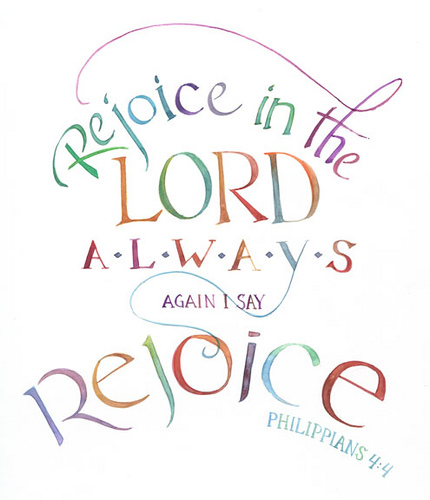
For example, celebrate anything and everything (Philippians 4:4).

3095781994_90a392c03f

Take joy in:

  • Your cozy robe to ward off the morning chill
  • That cute tuft of hair sticking up on your toddler’s head
  • A parking place opening up when and where you need it
  • Licking the stamp just as the mail carrier pulls up in her truck
  • An earring lost last week turns up between the counter and stove this week.

You see, joy and strength are closely related. Ezra told the people of Israel, “The joy of the Lord is your strength” (Nehemiah 8:10).

Those five examples above, and thousands like them, are gifts from your Heavenly Father. “Every good gift and perfect gift is from above, coming down from the Father of the heavenly lights” (James 1:17).

In the same way we can build up physical strength with exercise, we can build up spiritual strength with praise—by expressing gratitude and joy for every good and perfect gift.

And now, the last promise of this verse describes in metaphor the result of living according to God’s design.

“You will be like a well-watered garden, like a spring whose waters never fail.”

TotalChildCareVegetables7 

Visualize a flourishing garden, with rich, green plants overflowing with healthy, ripe produce.

Those can be descriptors of you and me.  We are:

  • Rich in God’s grace, which he has lavished on us with all wisdom and understanding (Ephesians 1:8).
  • Green and flourishing, because we spend time with the Master Gardener and allow him to cultivate our spirits (Psalm 1:2-3).
  • Healthy and prosperous of soul (v. 3). As we soak up God’s Word, we’ll produce actions and attitudes that honor God and bring us inner satisfaction.
  • Ripe and mature, lacking in nothing (James 1:3).

God offers us “a continual source of thirst-quenching, drought-ending, fruit-producing, spiritual hydration” (James MacDonald).

Doesn’t that sound refreshing?  Who could turn down such provision?

*     *     *     *     *     *    *     *     *     *

Thank you, Father, for the precious assurances of these promises: 

  • You are leading me along the path you preordained before time began.
  • Every day of this earthly journey I can count on you to supply my needs.
  • Every day you provide fresh strength. One way is through the exercise of praise.  
  • As I spend time in your presence, I will be transformed–like a garden replenished by hydration. In fact, I can grow into your likeness with ever-increasing glory!

 “Such knowledge is too wonderful for me. It is too lofty for me to attain.” Yet I know it to be true because these are truths from your reliable Word.  My heart overflows with wonder and gratitude.

(Psalm 139:16; Philippians 4:19; 2 Corinthians 3:18; Psalm 139:6)

(Photo and art credits:  www.dayofgrace.me; http://www.anativegarden.blogspot.com; http://www.flickr.com; http://www.naturalearning.org.)


Read Full Post »

blog-prayer-woman


How would you finish this prayer: 

“Oh, Lord, what I need most right now is ____________________.”

What word would you put in the blank?

Guidance?

Provision?

Strength?

Purpose?

One glorious Bible verse tucked into Isaiah presents four comforting promises that cover each of those needs:


Isaiah58.11 

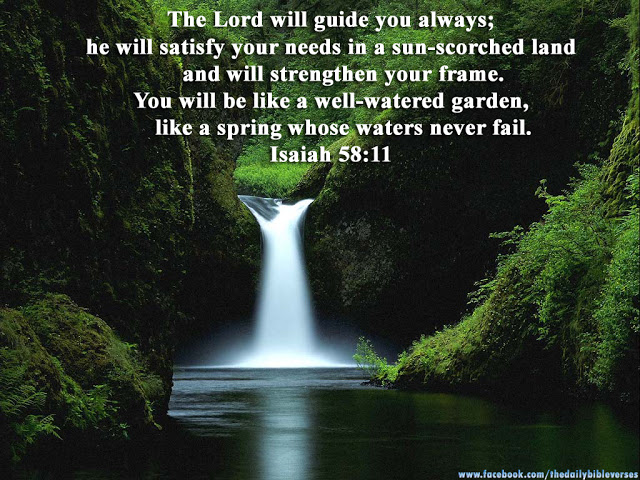
“The Lord will guide you always;

He will satisfy your needs in a sun-scorched land

And will strengthen your frame.

You will be like a well-watered garden,

Like a spring whose waters never fail” (58:11).

Lots of truth packed into five short lines. Each phrase warrants careful consideration. For example:


1.  The Lord will guide you always.


He’s not a life coach, counselor, or psychologist. The almighty God of the universe promises to be your guide—free of charge! And he’s available 24/7. Think, too, of his astounding attributes that make him the perfect guide:

  • God is omniscient—He knows everything (Psalm 139:1-6), including every detail of your situation and the people involved.
  • God is righteous—Everything he does is good (Deuteronomy 32:4). He can be relied upon to lead you down a perfect path.
  • God is merciful—He responds in loving compassion (Psalm 116:5). He’s your understanding Father, your strongest ally.
  • God is truthful—All that he says can be trusted (Titus 1:2). He will not lead you astray.
  • God is faithful—He keeps his Word (Psalm 33:4). God does not lie or forget what he said. Neither does he change his mind.

Notice that first phrase says God will always be your guide. Not every once in a while when you’re really in a quandary, but always. You are never left alone to your own devices—unless that’s the way you want to live. God is a gentleman; he leaves the choice up to you.


2.  He will satisfy your needs in a sun-scorched land.


Not he might satisfy your needs if he feels like it. He will. 

No matter what the landscape of your life looks like, God will see that your needs are met.

Have you ever been surrounded by sun-scorched land, perhaps a desert or wilderness where no life is visible?

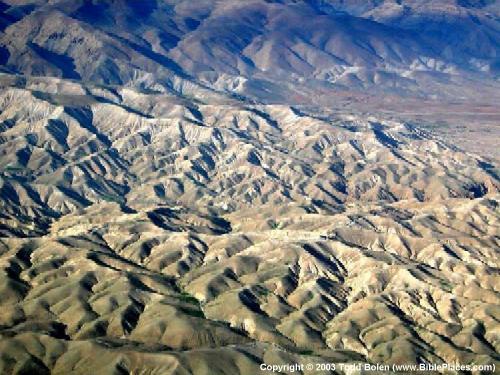
Steve and I visited Israel a number of years ago. One of our tour stops was in the Judean wilderness—a desolate and foreboding sight to behold. Not a single tuft of grass. No bushes or plants of any kind—not even cactus. Only two things are visible when standing in the midst of this desert: sky and pale gray-brown mountainous rock, as far as the eye can see.


judean_wilderness_west_of_jericho_ariel_tb_q010_03


Should you decide to live there, you’d have to bring with you everything necessary for survival: all your food, water, and clothing. For shelter, you might find a cave.

Ah! But what if there was Someone there ahead of you? Someone who already had at his disposal the supplies you required? And they would never run out? That’s the life-giving, unfailing provision of your Heavenly Father.

Let’s you and me rest in the assurance that the essentials—and even many delights!—will be generously supplied. If something is meant to be, he will take care of it—just as he’s been doing since each of us was born.

Think how he has led you through the wilderness of broken relationships and difficult circumstances. His grace has been sufficient for every challenge (2 Corinthians 12:9), right?

Now project that assurance into the future. Even if we walk through the valley of the shadow of death, we have no need to fear. Our all-powerful God is with us (Psalm 23:4)–guiding and providing.

(Please remind me of that when I come to a wilderness-patch, will you?)


*     *     *     *     *     *     *     *     *     *


Heavenly Father, I praise you that day by day, moment by moment, you are delighted to guide us in perfect wisdom. You generously provide for our needs and lovingly care for us body, soul, and spirit. Thank you for your compassion, your faithfulness, and grace to see us through the wilderness valleys. “I trust in you, O Lord; I say, ‘You are my God. My times are in your hands.’” (Psalm 31:14-15a).  


Please come back on Monday. We’ll meditate on the second half of Isaiah 58:11.


(Photo credits:  www.hischurchwomen.com; http://www.freerepublic.com; http://www.biblestudytools.com.)


Read Full Post »

« Newer Posts - Older Posts »

When the House is Quiet

Impressions Becoming Expressions

Mitch Teemley

The Power of Story

Still Traveling

Impressions Becoming Expressions

Living Our Days

Gaining a heart of wisdom

He Said What?!

I'm Patty, and my husband and I are living with our adult son who has autism and epilepsy. I love sharing lessons learned from life around me, especially life with Aaron.

Meditations of my Heart

Impressions Becoming Expressions

Linda Stoll

Impressions Becoming Expressions

Signora Sheila

Where faith meets la dolce vita

Heidi Viars

Finding the Image of God