Feeds:
Posts
Comments

Archive for the ‘Godly Character’ Category


You’ve heard of spiritual gifts–those special abilities the Holy Spirit endows, which equip us to serve others.  Teaching, prophecy, discernment, and healing are examples.  Altogether, the apostles Peter and Paul listed at least twenty.

May I be so bold as to suggest there may be a few more spiritual gifts than those  listed in the New Testament?

For example:

The Gift of Thoughtfulness

Oh, my.  If I started listing the number of people who have this gift, I’d be writing through the night.  But recently…

Donna and I were admiring a craft project created by a mutual friend–little dresses made out of dish towels, to hang over the oven door.  I mentioned what fun it would be to make some of those myself, but I didn’t have a machine anymore. 

“Then I want to give you mine,” she said.  “Now that I’m living with Brenda” (her daughter), “I really don’t need it.  I can use hers.”

In spite of protests (“You can sell it, Donna.”), she was insistent.  So I now have a sewing machine!

In a world of greed and selfishness, such kindness is rare–except in the family of God where the spiritual gift of thoughtfulness abounds.

 The Gift of Joy

All my friend, Grace, has to do is chuckle, and everyone nearby joins in.  Hers is the most infectious laugh I’ve ever encountered.  She also supplies plenty of material for laughter with her quick wit.

You’d never know to look at Grace’s smiling face and twinkling eyes that she frequently suffers pain.  A case of shingles that never went away completely continues to cause problems.  But Grace never complains.

How does she manage to spread so much cheer in the midst of suffering?  It’s the spiritual gift of joy, I’m sure, bubbling up from a heart focused on Jesus.

The Gift of Chicken Soup

My husband, Steve, had just been released from the hospital, after a fever that defied explanation and aspirin.  It finally broke, although its cause remained a mystery. After a few days he was released to come home.  Meanwhile,  while Steve was hospitalized, I suffered a brutal attack of stomach flu.

The two of us were sprawled on couch and recliner when Barbara called.  “I’m making chicken soup for the two of you and bringing it over this afternoon,” she announced.

“Oh, no,” I quickly replied.  “That won’t be necessary.  We’re recouping fine.”

But Barbara didn’t buy it, and the delivery was made. 

NEVER have I tasted such savory, flavorful chicken soup.  By the end of the first bowl I felt strength returning to my limp arms and legs.  By the second bowl, I was ready for jumping jacks.

OK, I’m exaggerating–but only slightly.  That soup DID rejuvenate us!  So, there’s the proof that the spiritual gift of chicken soup exists.

If we want to be technical, I suppose these gifts and others could be categorized under those listed in scripture.  Exercising thoughtfulness like Donna is surely an example of generosity (Romans 12:8).   Dispensing joy like Grace is part of the gift of encouragement (same verse).  And Barbara’s chicken soup may very well be a manifestation of the gift of healing (1 Corinthians 12:28).

It’s true:  “All kinds of things are handed out by the Spirit, and to all kinds of people!  The variety is wonderful” (1 Corinthians 12:7, The Message).

What unique spiritual gifts have you encountered?  Share your story in the comment section below!

(Image of bow from http://www.publicdomainpictures.net.)

Read Full Post »

main Jirsak shutterstock_64481404

A new year requires a new calendar.  Don’t you just love the crisp, uncurled pages–the empty spaces for each day, filled with nothing but optimistic possibilities?

Perhaps you’re starting the new year with a fresh journal.  Again, the pristine pages are filled with nothing but hope and expectation.

We might also desire to start the new year with:

  • New eyes—to see the glory of God around us
  • New ears—to hear his still, small voice.
  • New resolve—to follow God’s direction.
  • New courage—to speak his truth boldly.
  • New faith—to live with confident trust in our Heavenly Father.

These abilities cannot be bought at Barnes & Nobles, like a calendar or journal.  They are procured through prayer and discipline.

A good place to begin?  David’s prayer in Psalm 51:   “Create in me a pure heart, O God, and renew a steadfast spirit within me…Restore to me the joy of your salvation and grant me a willing spirit, to sustain me” (Psalm 51:10, 12).

Allow me to personalize it a bit.

Create in me a pure heart, O God (just as you created a perfect universe from chaos).

And renew a steadfast spirit within me (that my greatest desire might be to please you).

Restore to me the joy of your salvation (just as we experience in the euphoria of Christmas Eve)!

Grant me a willing spirit, to sustain me (throughout 2014).

The typical new year’s resolution is made, broken, and forgotten.  Rarely does someone make a once-a-year promise and keep it faithfully for the next 364 days.

Perhaps we’d be wise to see each new day as a fresh opportunity for beginning anew.  To repent of yesterday’s failures and forget them. To strain toward what is ahead—with enthusiasm, expectation, and hope (Philippians 3:13).

And gradually those new abilities we aspire after, will begin to flourish.

God says, “Forget the former things; do not dwell on the past.  See I am doing a new thing” (Isaiah 43:18-19a)!

*     *     *     *     *     *     *     *     *     *

Thank you, Father, for your mercy to forgive the past, and  your grace to provide for the future.  Thank you that each morning is a fresh start, and each new day holds hidden opportunities.  With great anticipation I turn the page!   

Read Full Post »

No doubt we would all agree:  Christmas is much more than carols, cookies, and cards.  The heart of this holiday goes even deeper than the love we express with presents.  It is a celebration of God’s inexpressible gift (2 Corinthians 9:15).

And those of us who accept God’s gift of eternal life through faith in Jesus, ought to live our lives with overflowing gratitude.  The motivation behind our words and deeds should be the same sacrificial love which motivated Jesus.

Henry van Dyke (1852-1933)

Henry van Dyke (1852-1933, photo credit: Wikipedia)

What might that look like in everyday life?  Henry van Dyke* made several suggestions through these thought-provoking questions:

“Are you willing to forget what you have done for other people, and to remember what other people have done for you;

To ignore what the world owes you, and to think what you owe the world;

To put your rights in the background, and your duties in the foreground;

To own that probably the only good reason for your existence is not what you are going to get out of life, but what you are going to give to life;

To close your book of complaints against the management of the universe, and look around you for a place where you can sow a few seeds of happiness—

Are you willing to do these things even for a day?

Then you can keep Christmas.”

Ouch.  If God made these stipulations into law, and only law-abiders were allowed to celebrate Christmas, I’d be left out.  My thoughts and motivations are not always pure.  I do not consistently put others’ needs before my own.  My focus is not always on what I can give.

But Rev. van Dyke’s essay does not end on that hopeless note.  He adds one more glorious line.

“But you can never keep it alone.”

Of course not!  “We are utterly incapable of living the glorious lives God wills for us” (Romans 3:23, The Message).

However.  God does not expect instantaneous perfection, the minute we invite Jesus into our lives.  “God who began the good work within [us] will keep right on helping [us] grow in his grace until his task within [us] is finally finished on that day when Jesus Christ returns” (Philippians 1:6, The Living Bible).

Hallelujah!

(Photo credit:  www.worshipkids.com)

Joyful, joyful, we adore Thee,

God of glory, Lord of love;

Hearts unfold like flowers before Thee,

Opening to the sun above.

Melt the clouds of sin and sadness,

Drive the dark of doubt away;

Giver of immortal gladness,

Fill us with the light of day.

(also by Henry van Dyke)

*     *     *     *     *     *     *     *     *     *

*Henry van Dyke (1852-1933) was an author, educator, and clergyman.  His lengthy list of accomplishments included professor of English literature at Princeton, minister to the Netherlands and Luxembourg (by appointment of President Wilson), and author of many poems, stories, and essays. “The Other Wise Man” and “The First Christmas Tree.” are among his most popular works.  He also wrote the lyrics for a number of hymns, including “Joyful, Joyful, We Adore Thee.”  The first verse is quoted above.


Read Full Post »

With quick steps I entered T.J. Maxx.  Mustn’t waste a minute in December.  Too much to do, right?

First order of business:  get a cart.  The first one I grabbed was stuck to another.  Couldn’t get them apart.

Just as I reached for one in the second row, a cheery woman with sparkling eyes approached from the side, ready to return her cart.   “Here,”  she said. “Take mine.”

“Thank you very much!”  I replied.  As she turned the cart to face me, I couldn’t help but notice how smoothly it made the circle.  “Wow!  No wobbly wheels or squeaks!”

I tested the cart myself, turning it one way and then another.  This was the Cadillac of carts.  Very fluid and responsive.   Quiet.

Mrs. Lovely Lady chuckled a bit at my excitement.  “Yes, it’s a great cart.  I really hate to leave it,” she added wistfully.

Now I was chuckling.  “You are very kind to pass it on to me.”

“Well, pay it forward,” she called and headed to the exit.

That little episode got me to thinking.  Mrs. Lovely Lady had paid forward to me much more than a kind deed.  She also gave:

  • the gift of good cheer and laughter
  • A friendly moment of camaraderie, in spite of the fact we were strangers to one another
  • A large serving of the fruit of the Spirit – his love, joy, kindness, and goodness

As a result, I felt incredibly refreshed and invigorated.  Just that brief encounter made a huge difference in the condition of my spirit.

And I pray that kind woman who passed on her cart experienced the same uplift.

*     *     *     *     *     *     *     *     *     *

Lord, help me to pay forward many kindnesses during this Christmas season, and beyond into 2014.  May I reflect you – your love, joy, kindness, and goodness—with plenty of good humor!  And one more thing, Father.  I don’t know who that woman was in T. J. Maxx, but you do.  (Such a fantastic truth—your omniscience!!)  Would you bestow a special blessing upon that lovely lady, for her delightful demeanor and thoughtfulness?  Thank you, Father!

(photo credits:  www.marketplace.org; http://www.unfadingelegance.blogspot.com.)

Read Full Post »

Those of us who believe in Jesus are on a faith journey.

Sometimes we fly.

He carries us on eagles’ wings.


One example from scripture is God’s deliverance of the Israelites from Egypt.  He said, “You yourselves have seen what I did to Egypt, and how I carried you on eagles’ wings and brought you to myself” (Exodus 19:4).

The Israelites had done nothing to secure their release from Pharaoh.   God caused the plagues, God opened the Red Sea for the Israelites’ escape, and God destroyed the Egyptian army.

Moses and his sister, Miriam, sang a song to the Lord, to celebrate their deliverance.


“Who among the gods is like you, O Lord?  Who is like you–majestic in holiness, awesome in glory, working wonders?” (Exodus 15:11).

Has your heart soared on the euphoria of an awesome and glorious miracle?

We have.  A number of times.  One day D. called to announce she wanted to buy us a car.  Arrangements were made with a dealership; all we had to do was go and pick one out.

“Oh–and get leather seats,” she insisted.  “They’re so much more comfortable.”

Can you imagine?  What an incredible blessing!  Our hearts soared for weeks on that miracle.   Even now, more than thirteen years later, that car is a constant reminder of God’s supernatural provision.  (Yes, it’s still running smoothly!) Through D., God proved unequivocally his love and power.

Sometimes we soar; sometimes we runon supernatural strength.

We feel the supernatural power of the Spirit coursing through our veins, providing strength and passion for the task at hand.  It is a spontaneous sprint, energized by omnipotent God.

New Christians are often empowered for a running start in their burgeoning faith. Eagerly they soak up Bible knowledge in small groups and personal Bible study.

In other cases, God places a special call on someone’s life to fulfill a need.  And with the call comes supernatural strength to meet the challenge.

That’s what happened to J.B.  God infused him with a passion to upgrade the sound system of our church.  Night after night, he worked at rewiring the sanctuary.  Much of that time was spent climbing about in the rafters.  This after working each day at his business.

When I asked J.B. about exhausting himself, he assured me  he was having fun!  He didn’t feel worn out at all.  God was giving him the strength to complete the project.

Yes, it’s exhilarating to fly on eagles’ wings of miracles and run on supernatural strength.  But…

…most of the time on our faith journey, we walk.

Step by step.  Choice by choice.  Slowly approaching the destination—the day of Christ Jesus (Phil. 1:6).  Sometimes the path is uphill and rocky.  We strain with effort to make progress.  Some days the path is winding, and we cannot see ahead.

Yet in spite of struggle and uncertainty, the walk can still bring much pleasure to the heart.  “Blessed are those…who walk in the light of your presence, O Lord” (Psalm 89:15).  You see, we do not walk alone.  The Company we keep makes all the difference.

Walking in faith involves plenty of ordinary tasks and days without miracles. Children to care for.  Laundry to do.  Meals to cook.  Calls to make.   Students to teach.  Sales to close.

But!  Whatever needs to be accomplished, we can walk through it and not collapse under the repetition and frustration.  How?  By inviting God to walk with us.


Years ago, when our three children were young, my life was a routine of laundry, cleaning, cooking, errands, and child care.  I was not one of those mothers who derived great fulfillment from these tasks.  Instead of walking joyfully through each day,  I often plodded.

Then I came across Colossians 3:23-24.  “Whatever you do, work at it with all your heart, as working for the Lord, not for men, since you know that you will receive an inheritance from the Lord as a reward.  It is the Lord Christ you are serving.”

In the margin of my Bible, next to those verses, I wrote, “including housework!”  I wanted Who I served to be more important than what I was doing.  Plodding didn’t end once and for all, but I learned to walk at a believer’s pace more frequently, as I invited God to cook, clean, and launder with me!

Those verbs–soar, run, and walk–are found in Isaiah 40:31, in that order:


“Those who hope in the Lord will renew their strength.  They will soar on wings like eagles; they will run and not grow weary, they will walk and not be faint.”

Perhaps soaring is first because  the euphoric wonder of flying on eagle’s wings seizes our attention with intensity.

Running is second.  Adrenalin runs high during spurts of divinely inspired growth and service.

And walking is last.  Did God save the most important until the end?  Because it’s in the persevering that we become strong.  It’s in the trusting  that our faith grows deep.  And it’s in practicing his presence that we learn consistency of character.

So revel in occasional soaring.  Rejoice in periodic  running.  But take deep satisfaction in the day-by-day walk on the paths of righteousness (Psalm 23:3).


“Come…let us walk in the light of the Lord” (Isaiah 2:5)!

(photo credits:  www.betterphoto.com; http://www.linksterdiversions.blogspot.com; http://www.BlackburnNews.com; http://www.foxnews.com; http://www.photobucket.som/user/jamiesolome/media.com; http://www.faithgateway.com; http://www.pinterest.com)

Read Full Post »

(This post is in response to a friend who asked, “Could you write about how to deal with those little aggravations that cause such trouble in our marriages?”  Here are my thoughts!)

Tremendous trifles–that’s what my sociology professor called the irritating habits of spouses that can drive us crazy.  Things like…

  • Allowing odds and ends to pile up on the kitchen counter, and never putting them away
  • Leaving lights on in vacated rooms
  • Hitting the snooze alarm five times before actually getting up
  • Checking messages during a dinner-date
  • Rarely being ready to leave the house on time

Tremendous trifles present choices, don’t they.

1.  We  can  choose our attitudes.

Will we dwell on the negative or will we focus on the positive qualities of our spouses?

Paul’s advice about our thought-lives (Philippians 4:8) can be applied to how we think about our spouses:

“You’ll do best by meditating on things noble…the best, not the worst; the beautiful, not the ugly; things to praise, not things to curse” (Philippians 4:8, The Message).

Years ago, I completed a Bible study on marriage,  specifically written for wives.  The author recommended writing down all the positive traits of one’s husband.  I surprised myself by filling a page with more than a dozen qualities I admired about Steve.  As I wrote, my heart filled with refreshed love for the generous, thoughtful, hard-working man God has given me.

That familiar scripture above is accompanied by a promise, which also applies to marriage:

[Meditate on the best], “and God, who makes everything work together, will work you into most excellent harmonies” (v. 9, also from The Message).

Doesn’t that sound like the perfect marriage?  Two people blending together in perfect harmony!

2.  We can choose our responses.

Will we complain every time a light is left on?

Or, might the best choice be to just turn off the lights ourselves?

Yes, flipping a switch is a no-brainer for some folks, but for others—the creative and/or problem-solving types?  They seem to struggle with such mundane matters. Turning off the lights just isn’t in their skill-set, no matter how much they may want to remember.

So if saving electricity is important to you, it may be wise to flip those switches yourself.

Your motto can be:  “Love covers over a multitude of sins” (1 Peter 4:8b)!

3.  We can choose to discuss the issue.

Does that mean we blast away when the pressure builds?

Or, will we ask the Holy Spirit to guide the conversation and provide wisdom and grace to share honestly but kindly?

Begin with a careful choice of time and place.   It’s best to discuss important matters when both parties are well-rested and well-fed.  A private location is also a must.  Perhaps the corner booth of a pleasant restaurant would offer a setting conducive for  heart-to-heart conversation.

And then limit the discussion to one matter.  An overload of negativity will sabotage the discussion.

Try a praise-then-prompt approach.  That’s a teacher-tip I learned in college, but it works in any conversation when you want to present a serious request.  Share with the other person at least several traits you appreciate.  Then ask if it would be possible for him/her to turn out the lights!

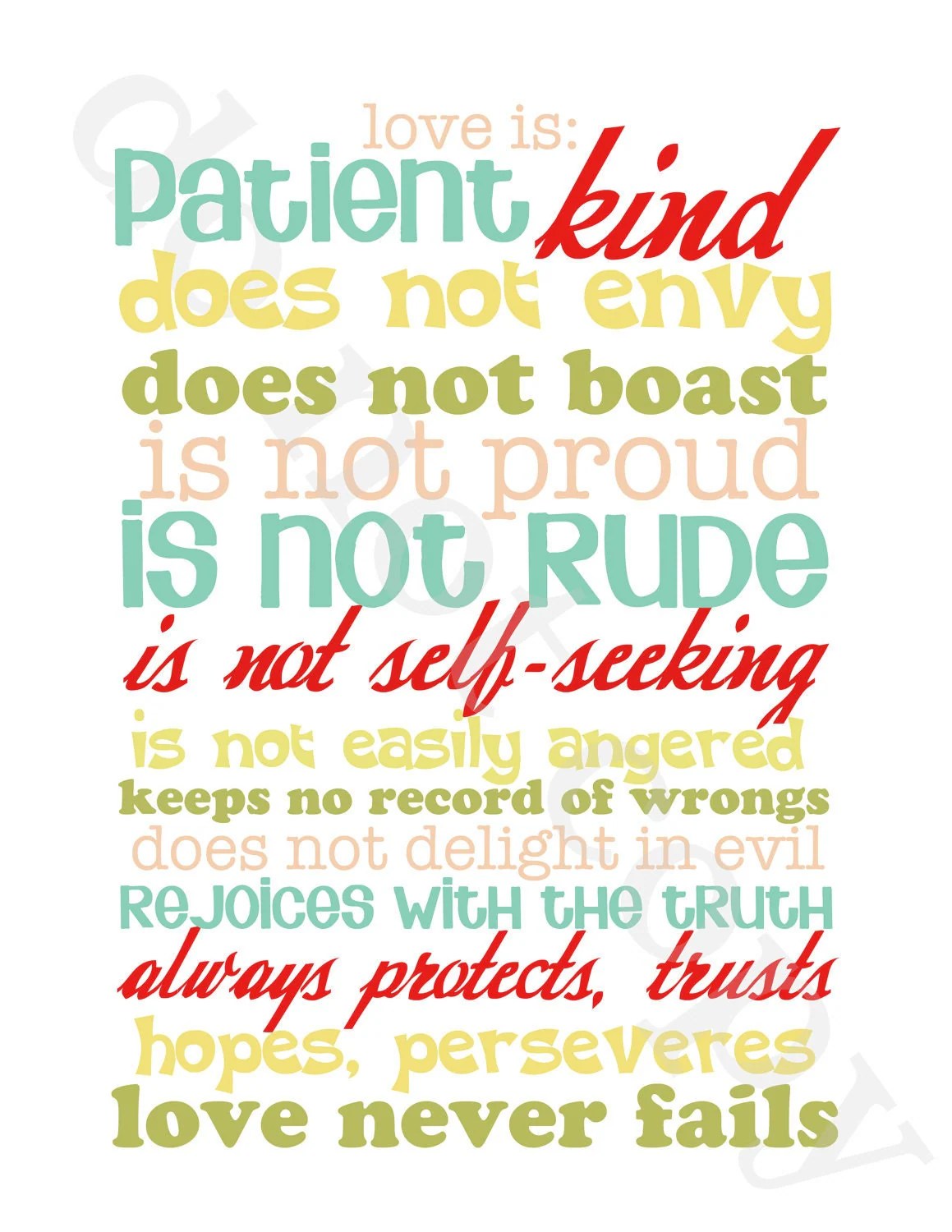
Each choice above gives us the opportunity to express our love the First-Corinthians-Thirteen Way.

Love is patient (when the clutter-pile grows),

Love is kind (when the mirror is splattered),

It is not rude (when she finishes your sentence),

It is not self-seeking (when he wants to watch a football game),

It is not easily angered (when the cupboard doors are left open–again),

It keeps no record of wrongs (when she leaves the sponge in the sink–again).

Love always perseveres.

It takes perseverance for a stable, mutually fulfilling relationship to grow.   Happily-ever-after marriages  don’t just happen.   They are created carefully, moment by moment–in the choices we make.

(photo and art credits:  www.homelifesimplified.com , http://www.lifestyle.ca.msn.com , www,jagran.com , http://www.justalittlebreezy.com )

Read Full Post »

“Take up one idea.  Make that one idea your life — think of it, dream of it, live on that idea.  Let the brain, muscles, nerves, every part of your body, be full of that idea, and just leave every other idea alone.  This is the way to success” — Swami Vivekananda (1863-1902).

Ever have a boss who seemed guided by this philosophy? He may not be familiar with the person who wrote these words (Swami was a Hindu monk.), but the same principles influence his decisions.


This kind of boss expects employees to work long hours to achieve his personal goals.  Ideas from others are not well accepted, because he is, after all, the expert.  He’s read all the books on management theory, marketing strategies, and profit maximization.  Suggestions are superfluous.

But, there is a new form of executive leadership garnering attention.  September’s issue of Sky Magazine ran an article, “The Enlightened Leader,” that highlights this innovative leadership model.   Workshops, webinars, even courses are available for training.

Included in the curriculum are these four topics:  1) Character , 2) Purpose, 3) Integrity, and 4) Values.

How ironic that business experts are returning to such ancient principles–Biblical principles.  For example:

1) A person of character is trustworthy, respectful, responsible, fair, and caring.  Someone with character pursues righteousness and love; then he finds life, prosperity, and honor (Proverbs 21:21).

2) A person of worthwhile purpose is not focused on the bottom line of the financial spreadsheet.  He/she takes to heart Paul’s advice:  “Don’t push your way to the front; don’t sweet-talk your way to the top.  Put yourself aside, and help others get ahead.  Don’t be obsessed with getting your own advantage.  Forget yourselves long enough to lend a helping hand” (Philippians 2:3-4, The Message).

3) A person of integrity walks securely (Proverbs 10:9).  He’s not wishy-washy, making decisions based on what’s expedient for the moment.  “The integrity of the upright guides them” (Proverbs 11:3) to be wise and caring.

4) A person with moral values lives by an ethical code of behavior, summed up by Jesus in the Golden Rule.  “In everything, do to others what you would have them do to you” (Matthew 7:12).

It’s tempting to respond with a smug comment like, “It’s about time the experts came around to God’s way of handling business!”  Except…

…I still have character traits that need refinement.

…I do not live up to God’s purpose for me each day.

…Integrity still needs further development in my life.

…My choices do not always reflect my values.

It doesn’t matter if I am a leader of a large organization or a leader in my home.    I am called to have a positive effect within my circle of influence (Matthew 6:13-16).  And that circle is surprisingly wide when I include extended family, friends, neighbors, business associates, church acquaintances, etc.  In fact…

“…Sociologists say that even introverted people will influence an average of 10,000 people in their lifetime” (The Maxwell Leadership Bible by Dr. John C. Maxwell, p. x).

So what’s the first step toward success?

Perhaps commitment—commitment to God as a willing student in his course of leadership.  Commitment to prayer throughout the day, as choices present themselves.  And commitment to persevere toward wisdom, because:

“Blessed is the man who listens to me [wisdom], watching daily at my doors…For whoever find me finds life and receives favor from the Lord” (Proverbs 8:34-35).

*     *     *     *     *     *     *     *     *     *

Thank You, Father, for the absolute truth of your word.  New ideas come and go, but your wisdom that leads us to success never fails.  Forgive me for the times I have ignored your word.  I want to be a woman of godly character, fulfilling your purpose with integrity, and reflecting your values.  That’s the kind of success that will provide lasting satisfaction and fulfillment in my soul.  Thank you for continuing to work on me.  Amen. 

(photo & art credits:  www.signsforyourlife.com, http://www.averyemployment.com, macondesigns.wordpress.com, http://www.signsforyourlife.com, calcuttaherald.wordpress.com.)

Read Full Post »


“You are not going to believe what Natalie did,” Gabby-Gossip starts.  And with much detail she begins to describe the foolish, spiteful actions of a mutual acquaintance.

And even though she’s only spoken two sentences, I know Gabby’s tirade is going to be gossip.  Not only don’t I need this information, but participation with her will be downright harmful.  The problem is, how do I tactfully stop Gabby-Gossip?

These strategies may be just what I need; perhaps you’ll find them helpful, too:

1.  Say nothing at all.  Refuse to participate. 

Just like Thumper said in the Disney movie, Bambi, “If you can’t say somethin’ nice, don’t say nothin’ at all.”

Even scripture backs up the value of silence:  “A gossip betrays a confidence, but a trustworthy man keeps a secret” (Proverbs 11:13).

2.  Ask, “Why are you telling me this?”

Be aware of the tone of your voice as you ask.  Speak with innocence, as if you assume Gabby is sharing for a legitimate reason.  Chances are, such a question will catch her off guard.  She often has no agenda beyond passing on a juicy bit of unflattering news.

Sometimes Gabby-Gossip prefaces her sharing with the directive, “I’m telling you this so you’ll be able to pray for Natalie.”

Perhaps I can stop the flow of details by suggesting, “I’m so glad God knows all the ins and outs of this situation.  He also knows Natalie’s heart, and I don’t.  I will most definitely be praying.”  Then change the subject.

3.  Insert positive talk.

Perhaps we can share something Natalie did recently that was commendable, or highlight one of her character traits we admire.

We could begin by saying, “You know what I appreciate about Natalie?”  Follow up with an example.  Perhaps Gabby will realize her talk has gone off-track and will follow our lead.

Solomon noted, “The lips of the righteous nourish many” (Proverbs 10:21).  What a fulfilling purpose to keep in mind for our conversations:  to feed nourishing words of wisdom and encouragement into the lives of others.

When we choose to speak positively, it demonstrates respect for others, respect for the One who created them, and respect for ourselves.  Kind words also bring positive energy and uplift to a conversation.  By contrast, negative talk drains our energy and we feel depressed, discouraged, or even angered as we part company.

4.  Seek to help Gabby-Gossip.

If the negative talk centers on a problem between Gabby and Natalie, discuss some possibilities to solve the conflict.  Turn the conversation from fault-finding to solution-brainstorming.

5.  Pray, even as you speak.

Without the wisdom and power of the Holy Spirit, we will fail to solve the problem or win over Gabby-Gossip to positivity.  Send up a silent sky-text as the conversation begins.  Ask God to direct your thoughts and give you the words to say that will minister to Gabby.

6.  Resist the urge to gossip to someone else. 

With David we need to pray, “Set a guard over my mouth, O Lord; keep watch over the door of my lips” (Psalm 141:3).

Few of us run the risk of saying too little; it is the opposite that causes trouble!  Three little words can guide us, as we think before we speak:  Is our next comment true, kind, and necessary?

*     *     *     *     *     *     *     *     *     *

Heavenly Father, I do not want to participate in gossip.  Instead I want to be a positive influence, even a force of change.  With David, I ask you to set a guard over my mouth.  Be my attentive Watchman, God.  Even now, in preparation for the next encounter with Gabby-Gossip, I pray for your wisdom and courage to react rightly.  Because the bottom line is:  I want the words of my mouth and the meditation of my heart to be pleasing in your sight, O Lord, my Rock and my Redeemer (Psalm 19:14).

(photo credit:  www.gazettedebonton.)

Read Full Post »

Back in the 1970s I saw Helen Hayes in a made-for-TV movie.  Some of you may recognize her.  She was known as the “First Lady of the American Theater,” beginning her career on Broadway in 1905, when she was only five years old.  In the 1930s, Helen expanded her stardom to films, and finally to television.

The reason she comes to mind now and then is the impression she made upon me, as an energetic, sparkly eyed senior citizen.  I remember thinking, “When I get old, I want to be like that!”

Poof.  Four decades have passed, and I am indeed getting old!  I don’t feel like it, but that doesn’t stop the incessant turning of the calendar pages.

So I was delighted to come across these verses from Psalm 92 that cast aging in a positive light:

“The righteous will flourish like a palm tree, they will grow like a cedar of Lebanon; planted in the house of the Lord, they will flourish in the courts of our God.  They will still bear fruit in old age, they will stay fresh and green, proclaiming, “The Lord is upright; He is my Rock, and there is no wickedness in Him” (vs. 12-15).

Palm trees do indeed flourish, living up to 100 years.  Withstanding heat, drought, and high winds, these trees stand tall and strong; their leaves fresh and green all year long.


What a perfect picture of an energetic, sparkly eyed senior citizen! 

How do we achieve such age-defying qualities? 

First, notice that the righteous will flourish.  When our faith is grounded in God, when we follow his principles for a prosperous life, we flourish.

Like the palm tree that grows straight up toward heaven, the righteous reach for the God of heaven.  That’s how they’re able to stand strong through the winds of change and difficult circumstances.

The psalmist then continues:  “The righteous will…grow like a cedar of Lebanon.”

Majestic cedar trees grow to 120 feet in height and up to 30 feet in circumference.  They provide the perfect picture of a firm, stable person.  Just as the cedar’s roots go deep into the soil, so the righteous person is rooted and grounded in God’s love (Ephesians 3:17).  From those roots comes the nourishment needed to remain strong and spiritually healthy.

Second, notice where these trees are planted:  in the house of the Lord.  They flourish in the courts of our God.

Charles Spurgeon, that eloquent preacher and writer of the 1800s, had this to say about those who dwell in habitual fellowship with God:  “They shall become men [and women] of full growth, rich in grace, happy in experience, mighty in influence, honored and honorable.”  Now that sounds like a very satisfying way to live—so much better than the opposite!

Think of a complaining oldster whose mouth turns down from constant disgruntlement.  His bottom lip protrudes from perpetual pouting, and his brow is permanently lowered into a frown because anger often rules his emotions.  All this negativity has stunted the growth of his maturity.  He’s unhappy much of the time, and is not held in high regard by others.  Do you suppose he ever considers that his way of life is terribly unsatisfying?   

However!  When our lives are centered upon worship of God, as we express gratitude for his blessings, praise for his attributes, contentment for where he’s placed us, and joy in the midst of trials, we become those admirable men and women Dr. Spurgeon described above:  mature, gracious, and happy.

Dr. Spurgeon also added “mighty in influence and honored.  God rewards the righteous aged with “fruit.”  In other words, we may still bring glory to God by our words and actions—well into old age.

We can be:

  • Energetic—with the power of the Holy Spirit
  • sparkly-eyed—with the indwelling of God’s peace
  • grace-filled—with continual demonstrations of God’s love to others
  • joyful—with hearts focused on God’s blessings

These kinds of saints provide a powerful example of God’s faithfulness—through pleasant times and challenges, through plenty and want, year after year.

May we continue to grow deep and stand tall—all the days of our lives.

(photo credits:  www.pachd.com, www.captainkimo.com, www.forestertreeservice.com, www.centrifueleadership.com, www.seniors.ovetoknow.com)

Read Full Post »

English: Portrait of Ella Wheeler Wilcox. Fron...

English: Portrait of Ella Wheeler Wilcox. Frontispiece from her book of poems “Three Women” (Photo credit: Wikipedia)


“With every deed you are sowing a seed, though the harvest you may not see.”

–Ella Wheeler Wilcox, author and poet (1850-1919)

Observation #1:

We never know when a small deed may plant a seed of faith or encouragement that will reap a bountiful harvest in the life of someone else.

Live attentively to the fact that every deed is a seed. The people around us are watching and listening.

Perhaps you’re familiar with the story of a church elder who once led a worship service for two. It happened over 150 years ago in England. A blizzard on Saturday night made it impossible for villagers to get to the church—including the pastor.

English: Oakwood Park, London N14 - snow storm...

The elder almost sent home the two individuals who had come, an older man and a young boy. But something (Someone?) compelled him to speak. Later he confessed his words came out rather jumbled and brusque.

But. The elder planted a seed that immediately took root. The young boy accepted Jesus as his Savior. His name? Charles Spurgeon—preacher and author extraordinaire, whom God used mightily. People are still impacted by his writings to this day.

(For an example of Dr. Spurgeon’s God-given genius, see the post, “Not Length But Strength,” from last week, May 9).

Observation #2:

Our responsibility is the planting of “deed seeds”; the harvest is up to God.

The same principle that works in the physical realm works in the spiritual realm: A farmer may plant, fertilize, and water, but the germination of each seed is a miracle only God can bring about. Don’t become tightly focused on results.

English: Seedling

English: Seedling (Photo credit: Wikipedia)

The elder who led Charles to the Lord that snowy, wintry day, had no idea the boy would grow up to have such a profound effect on the world. The gentleman may not have lived long enough to see the results of his deed that morning. But we know, and we marvel.

Observation #3:

The true harvest is not measurable in physical terms, and it’s hidden from view in the spiritual realm.

Only now and then does God give us a glimpse of what our small deeds are accomplishing. Perhaps God planned it that way so pride and self-gratification do not taint the glory of the harvest.

Imagine the joy that elder continues to experience every time a saint comes through the gates of heaven, who has been influenced by Charles Spurgeon—fourth and fifth generation Christians, whose ancestors accepted Jesus because of Dr. Spurgeon. Others have been influenced and encouraged by the preacher’s writings.

The positive influence of a man or woman of God never dies.

Ivan Grohar: The Sower. The motif from this pa...

Ivan Grohar: The Sower. (Photo credit: Wikipedia)

Such a possibility should translate into enthusiastic motivation for planting seeds wherever we go.


Read Full Post »

« Newer Posts - Older Posts »

When the House is Quiet

Impressions Becoming Expressions

Mitch Teemley

The Power of Story

Still Traveling

Impressions Becoming Expressions

Living Our Days

Gaining a heart of wisdom

He Said What?!

I'm Patty, and my husband and I are living with our adult son who has autism and epilepsy. I love sharing lessons learned from life around me, especially life with Aaron.

Meditations of my Heart

Impressions Becoming Expressions

Linda Stoll

Impressions Becoming Expressions

Signora Sheila

Notes on Life, Faith & Italy

Heidi Viars

Finding the Image of God