Feeds:
Posts
Comments

Archive for the ‘Heroes of the Faith’ Category

009276


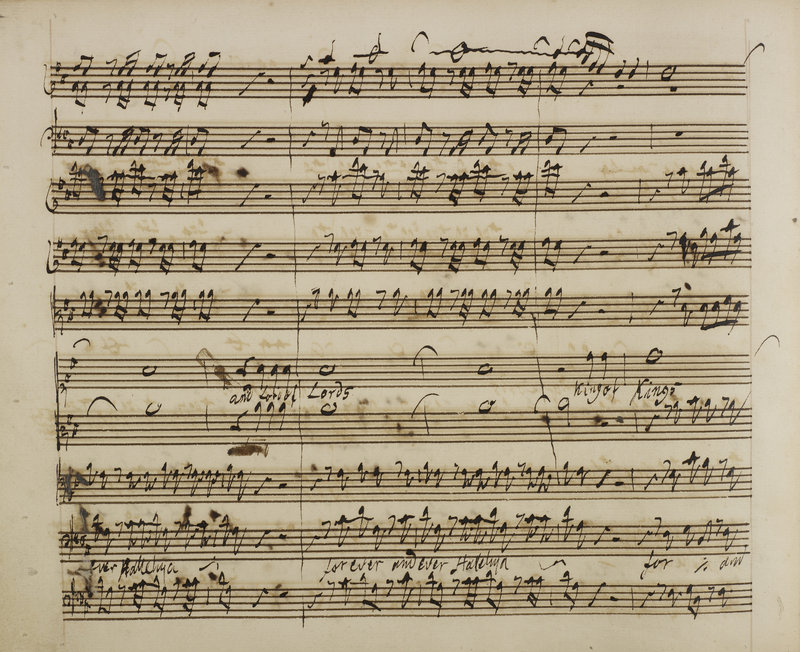
The musical notes appeared on the score as fast as he could draw them.

Melodies and harmonies not only filled his mind, they resonated in his soul. In fact, they consumed him. He ate little and barely slept. For twenty-four days he wrote.  And wrote.  And wrote.

The music maestro? George Frederic Handel (1685-1751).


CGHandel


The composition? Messiah.

Imagine the magnitude of composing such a lengthy piece in such a short time. My personal copy of the vocal score is 252 pages. That would mean Handel produced more than ten pages per day—not just a line of melody, but often four-part harmonies for twenty choral numbers AND orchestration for the entire piece. No doubt most of us would struggle to copy that much music, much less create it.

One of Handel’s biographer’s, Sir Newman Flower wrote, “Considering the immensity of the work and the short time involved, it will remain, perhaps forever, the greatest feat in the history of music composition.”

The idea for the oratorio actually originated with Handel’s friend, Charles Jennens. He was a librettist, a writer of operatic text. He and Handel had collaborated on three previous works.

Jennens wrote to Handel in 1741 that he wanted to create an anthology of scripture on the life of the Messiah. His idea was to tell the story of Christ, strictly through passages of scripture set to music. Jennen’s text included seventy-two verses.

Handel immediately became enthused about the idea. Perhaps he saw the potential for such a piece during an era when illiteracy was widespread and Bibles much too expensive for most people to own. This composition would teach the scriptures through music.

So he created the concept of oratorio: a musical composition for voices and instruments, narrating a sacred story without dramatic action or costumes.

Handel told Jennens it would probably take a year to compose all the music for so much text. But he finished in less than four weeks, never leaving the house during that time.

I can only imagine Handel’s euphoria as he sensed God’s inspiration of the glorious melodies and ingenious harmonies.

Upon completing the “Hallelujah” chorus, he turned to his servant with tears in his eyes. “I did think I did see all Heaven before me, and the great God Himself,” he cried.

Sometime during those twenty-four days, a friend visited Handel and found him sobbing with intense emotion. Handel could not put into words the depth of his spiritual experience as he composed. Later he borrowed words from Paul (2 Corinthians 12:2), in an effort to recount the indescribable:


quote-whether-i-was-in-my-body-or-out-of-my-body-i-know-not-god-knows-it-george-frideric-handel-234765

(“Whether I was in the body or out of my body when I wrote it I know not.”)

According to music scholar, Richard Luckett, the number of errors in Handel’s draft is remarkably small for a document of its length. Might that be another indication of divine inspiration?

Surely Handel realized that the music had not come from his creative abilities alone. At the end of his manuscript is the inscription: SDG—Soli Deo Gloria, which means “to God alone the glory.”

Because we often associate Messiah with Christmas, we may think the first performance occurred during Advent. But Handel intended the oratorio to be an Easter offering. The debut occurred on April 13, 1742—two hundred seventy-two years ago this Sunday. Handel conducted the performance himself.

A reviewer of that first concert wrote, “The sublime, the grand, and the tender, adapted to the most elevated, majestic and moving words, conspired to transport and charm the ravished heart and ear.”

That assessment has remained accurate through the decades, even till now.

For many years I sang in choirs that performed Messiah without knowing the story behind the oratorio.  Now, more than ever, I add my voice to Handel’s and millions across the years who proclaim, “Soli Deo Gloria–to God alone the glory,” for this magnificent piece of music.

I hope you feel the same.


(Sources:  www.beliefnet.com; http://www.thinkinaction.org; http://www.christians.com; http://www.christianity.com; http://www.patheos.com.)


(Photo & art credits:  www.prints.bl.uk; http://www.baroquemusic.org; http://www.izquotes.com.)


Read Full Post »

Supposedly, these housewife tips were circulated in the late 1800s:

“Have dinner ready, prepare yourself, be fresh-looking, clear away the clutter, prepare the children, minimize all noise, be happy to see him, listen to him (remember his topics of conversation are more important than yours), make him comfortable, take off his shoes, be a little gay.”

If that was the prevailing attitude, we might smugly comment, “That advice had to be written by a man.  As if the woman of the house hasn’t put in a long day already, cleaning, cooking, laundering, ironing, taking care of the children, and more.  Now she gets to wait on her husband?  Ridiculous!”

If exposed to enough old nonsense, such as the above, we’re likely to miss true gems.  We see an old picture, a copyright date from decades ago, and we think the article or book will be as worthwhile as those housewife tips.  But that’s not necessarily the case.

For example, allow me to introduce you to Desiderius Erasmus, born around 1467 in Holland.

Erasmus was a teacher, theologian, and author, critical of the Catholic church and its abuses of the time.  One belief held by the church hierarchy:  Scripture is much too complicated for the common man to understand.  Only priests should have access to the Bible, and they are the only ones qualified to interpret for the masses.

Erasmus wrote:  “I disagree very much with those who are unwilling that the Holy Scripture…be read by the uneducated, as if Christ taught such intricate doctrines that they could scarcely be understood by very few theologians.”

Such writings helped prepare the way for Martin Luther and the Protestant Reformation.

The common sense of Erasmus becomes obvious in more quotes such as these.

  • “If you keep thinking about what you want to do or what you hope will happen, you won’t do it and it won’t happen.”
  • “Prevention is better than cure.”
  • “A nail is driven out by another nail; habit is overcome by habit.”

Good advice, even if it is five hundred years old.

Throughout the centuries, women, too, have acquired wisdom to share. Unfortunately, most was never published.  In the male-dominated world of past generations, women were not offered that privilege.

One exception is Julian of Norwich, born 1342.  She actually prayed for a serious illness to help her understand the sufferings of Jesus.  At age thirty, the illness came, accompanied by sixteen visions.  She spent the rest of her life meditating on her visions and writing about them.  Her book was the first written in English by a woman.  Here are several of her truth gems:

  • “The greatest honor we can give Almighty God is to live gladly because of the knowledge of his love.”

Sounds like an addendum to Paul’s instruction to rejoice always (Philippians 4:4).  I appreciate the sweet motivation she offers for finding joy in each day.

  • “Truth sees God, and wisdom contemplates God, and from these two comes a third, a holy and wonderful delight in God, who is love.”

Oh, yes.  The more we know of God, the more we direct our thoughts to Him, the more we enjoy Him!

  • “Of all the things our minds can think about God, it is thinking upon his goodness that pleases him most and brings the most profit to our souls.”

Again, such astute observations.  Even if formulated six hundred years ago.

*     *     *     *     *     *     *     *     *      *

Thank you, Father, for preserving a wealth of evidence, confirming your presence and inspiration throughout the ages.  Thank you for the testimony of thousands of the saints from ages past. Their perseverance and faith continue to inspire us centuries later.  May we not be among those who ignore the wisdom you have already revealed. 


(Photo credit: http://www.jenikirbyhistory.getarchive.net.)

Read Full Post »

Portrait_of_George_Washington

Many of our founding fathers were men of Christian faith.  The record of their background, correspondence, and character attests to that fact.  Consider:

  • Twenty-four of the fifty-six men who signed the Declaration of Independence attended seminary or Bible school.
  • Hundreds of letters of these men speak of God and their faith in Him.
  • Honor and integrity were important attributes which characterized their lives.  Most of them sacrificed much for the cause of American liberty.  “With firm reliance on the protection of the divine Providence*, we mutually pledge to each other our Lives, our Fortunes, and our Sacred Honor,” they declared.

George Washington was no exception. With great integrity,  courage, faith, wisdom, and humility, he was instrumental in bringing America through perilous times.  We should know his legacy well, and follow his example.  Can you imagine an America where men and women would display…

 …The Integrity of George Washington

Washington was the only president unanimously chosen by the electoral college, an indication of the trust the American people invested in the general.  Frequently throughout his life, he demonstrated strong reliance on God.  Remember the portrait of him, kneeling in prayer at Valley Forge?    And decades after his death, pastors were still preaching sermons that honored his exemplary life.

…The Courage of George Washington

Washington’s accomplishments can be rivaled by few.  At age 23 he was commissioned colonel at the outset of the French and Indian War (1754).  His courage was legendary.  In one battle he directed the troops while riding up and down the front lines on his horse, seemingly not to care he was an easy target.  After that battle (which the British and American forces won), George wrote home that his safety was the result of “the miraculous care of Providence*.”

…The Faith of George Washington

Washington recognized that God had been strongly involved in the colonies’ battle for liberty.

“The hand of Providence* has been so conspicuous in all this that he must be worse than an infidel that lacks faith and more than wicked, that has not gratitude enough to acknowledge his obligations.”

His first act upon being sworn in as President?  He prayed, reminding his listeners at the inauguration that it is Almighty God who presides over the universe.  Washington also closed his inaugural address with prayer.

As he signed official government documents, he often concluded with the closing, “In the year of our Lord Christ.”

…The Wisdom of George Washington

In an address given in 1796, George wisely stated:  “Of all the dispositions and habits which lead to political prosperity, religion and morality are indispensable supports.”

(Might the economic and political decline now happening in America be the result of those supports–religion and morality–being slowly but surely removed?)

…The Humility of George Washington

In spite of a long list of outstanding accomplishments over a lifetime of sacrificial service to his country, Washington said:  “I have only been an instrument in the hands of Providence*.”

What chance did the weak, floundering colonies have to become a strong, prosperous nation?  Small, indeed.  But God used men of Christian character such as Washington to achieve the impossible.

What chance does our nation have today, to recapture our strength and prosperity?  Small, indeed.  But, God can use men and women of Christian character, just as he did George Washington–those willing to follow God’s lead and live sacrificially, to achieve the impossible. Because “nothing is impossible with God (Luke 1:37) .”

*     *     *     *     *     *     *     *     *     *

*Providence was a word used frequently in early America, to indicate God’s active care and protection.  Noah Webster, in his first dictionary (1828), noted that Divine providence is often understood as God Himself.  The word appeared over 100 times in the Geneva Bible, the translation of choice among many early Americans.  Now the word is translated with synonyms for care, such as “tender mercies,” “loving kindness,” and “protection.”

Because the word, providence, no longer appears in our Bibles, some have concluded that those forefathers who used the term were Deists who believed in an impersonal God.  But many outspoken Christians of the day used the term, including Rev. Dr. John Witherspoon (minister and signer of the Declaration), John Quincy Adams (officer of the American Bible Society, active patriot, and sixth president of the United States), John Jay (president of the American Bible Society and first chief justice of the Supreme Court), and Dr. Benjamin Rush (founder of the Sunday School in America and signer of the Declaration).  All of these men and others, whose allegiance to Christ is verifiable in their writings, also  included many references to Providence in their works.

(Sources:  The Founders’ Bible, http://www.wallbuilders.com, http://www.ochristian.com)

(Art Credit:  www.en.widipedia.org)

Read Full Post »

Have you ever noticed that, except for the first line, the familiar Thanksgiving hymn, “We Gather Together” is not about God’s blessing?

We sing such statements as:

  • The wicked oppressing now cease from distressing
  • So from the beginning the fight we were winning
  • Let Thy congregation escape tribulation

Don’t those seem strange concepts to emphasize on a day set aside for thanks?

The truth is:   although Thanksgiving is about gratitude, it is also a celebration of religious freedom.  That was surely on the minds of the Pilgrims back in 1621.

Freedom to worship God, and to read the Bible for themselves, were among the chief reasons the small band of believers left England for Holland in 1609.  Then, as circumstances became difficult there as well, they courageously set out for America to establish their own colony (albeit with a charter from the king of England, which granted them permission to inhabit the Virginia Colony).

The Pilgrims had faced the threat of imprisonment and death in Holland as well as England.  In addition, the trip to America included such hazards as shipwreck, illness, and accident.

Yet troubles only mounted upon reaching the New World.  The Mayflower landed too far north–at Cape Cod—not in Virginia as planned.  A late launch and a sixty-six day voyage on stormy seas (instead of the planned three weeks) meant they arrived in late fall.  Shelters were not completed until February.   Then there were Indians to worry about.

Yet they were willing to face all these challenges in order to establish a colony “for the Glory of God and Advancement of the Christian Faith” (from the Mayflower Compact).

The third line of the hymn  speaks of one joy they embraced:  “The wicked oppressing” (King James of England and his bishops) “now cease from distressing.” God had removed the Pilgrims far out of the king’s reach.  No longer could he persecute them.

The first verse ends with:  “Sing praises to His name.” There is no historical record that the Pilgrims sang at their first Thanksgiving celebration in 1621.  But music was typical at their gatherings, so perhaps they did participate in a psalm or two.  After all, the feasting lasted three days!

Undoubtedly the Pilgrims would have offered their prayerful thanks– even though half their number had died the previous winter, and the first harvest had been quite meager.  (The ninety Native Americans who attended that celebration actually brought most of the food.)

The second verse of the hymn begins:  “Beside us to guide us, our God with us joining.”

God certainly chose an interesting way to guide the Pilgrims and join with them in surviving the harsh conditions of New England.  Remember Squanto?  He’s the one who showed the Pilgrims how to fertilize the soil with fish.  Without that first crop of decent corn, the Pilgrims never would have survived.

Even more amazing?  Squanto just happened to speak English!

The third verse of “We Gather Together” begins:  “We all do extol Thee, Thou Leader triumphant.”  The Pilgrims honored God as Lord.  They recognized that from him all blessings flow.  And the hymn concludes:  “Thy name be ever praised; O Lord, make us free.”

In actuality, this hymn was not written as a direct tribute to the Pilgrims’ experience.   It dates back to Holland, in the late 1500s, written in celebration of a Dutch victory over the Spanish at the Battle of Turnhout (1597).

Under the rule of Spain’s King Philip II, Dutch Protestants had been forbidden to gather for worship.   Perhaps the Pilgrims heard the song while living in Holland.  But the words we sing today were translated into English by Theodore Baker, in 1894.

Even so, the words remind us that the Pilgrims suffered much and risked everything to found a colony where they could gather together in freedom—to proclaim:

“All glory be Thine!”

May we, too, extol our Leader triumphant, as we sing this hymn through the coming week.

(Sources:  The Founders’ Bible, www.plimoth.org, History News Network at http://www.hnn.org )

Read Full Post »

Boris Nicholayevich Kornfeld, political prisoner of the former Soviet Union.

Incarcerated in the late 1940s at Ekibastuz, a forced labor camp, in Siberia.

A doctor.

Because of his medical training, the camp authorities put him to work in the hospital.

Dr. Kornfeld was Jewish, but a Christian prisoner attracted his attention.  The man evinced a quietness of spirit, in spite of the horrors, deprivation, and hopelessness of their situation.  Often the doctor would hear this fellow prisoner reciting the Lord’s Prayer.

One day, a guard was brought into the surgery.  An artery had been cut during a knifing incident.  As Dr. Kornfeld began to repair the artery, he thought, I could make the sutures in such a way that this horrid man would slowly bleed to death later.  The authorities would ever know.

But no sooner did the idea cross his mind than Dr. Kornfeld’s stomach turned at the cruelty of his own thoughts.  Words from the Lord’s Prayer came to his mind, and he spoke them silently in his heart:  Forgive us our sins as we forgive those who sin against us.

Day by day, Dr. Kornfeld sensed change occurring in his spirit.  He wanted to speak to the Christian prisoner about his experience in the surgery, to discuss what was happening within himself, but the fellow had been transferred to another gulag.  The doctor told no one about his growing faith in Jesus.

As he was being transformed on the inside, Dr. Kornfeld’s character began to change.  He started saying “No” to some of the sordid practices of the prison camp. Once he reported on an orderly who had stolen food from a dying patient.  Such misdeeds were actually quite common.  After all, why waste food on someone who was going to die anyway?

But telling the authorities what was going on put Dr. Kornfeld in danger.  No one was going to appreciate his sense of fairness and kindness.  Every prisoner lived for himself, doing whatever was necessary to survive.

One evening, Dr. Kornfeld examined a patient named Alex, who had undergone surgery for cancer.  He felt compelled to describe to Alex his journey toward faith in Christ.  The words came in a flood.  For at least several hours, Kornfeld spoke to the young cancer patient.

The next morning, Dr. Kornfeld was dead.  Someone had beaten him in the head with a mallet.

Alex thought long and hard about the doctor’s story and his life-changing faith.  He, too, decided to become a Christian.  Miraculously, Alex survived the gulag and wrote about his experiences there.  The book was smuggled to the West and published.

More books followed, all revealing the cruel and disastrous results of the Soviet system under the leadership of Stalin.  (At least sixty-five million Russian citizens were murdered in the gulags.)

That prisoner-become-author was Alexander Solzhenitsyn, who won the Nobel Prize for Literature in 1970.  The Gulag Archipelago and One Day in the Life of Ivan Denisovich were two of his most famous works.  Many credit his writings as the beginning of the end of the Soviet Union.

Photo of Aleksandr Solzhenitsyn in 1953, right...

Photo of Aleksandr Solzhenitsyn in 1953, right after his release from the special Gulag camp at Ekibastuz (Photo credit: Wikipedia)

But certainly Dr. Boris Kornfeld also deserves credit.  His influence was an important catalyst.  And what about the nameless Christian who introduced Dr. Kornfeld to Jesus?

He also was used by God in a chain of events to achieve great impact upon the world.

But no one knew, including himself.  He very likely died in the gulags.

Oh, but consider his home-going to heaven.  Think of Jesus, wrapping his arm around the shoulders of this saint, saying “Well done, my devoted one.  Have I got a story for you!  Come and let me share what you have been a part of!”

We must not allow fear or anonymity to dissuade or discourage.  God may use any one of us to change the world, but he may very well wait to reveal our impact until he can tell us all about it — face to face!

*     *     *     *     *     *     *     *     *     *

Heavenly Father, may I never miss an opportunity to be a part of your grand, over-arching plan.  May the legacy of Dr. Kornfeld, Alexander Solzhenitsyn, and millions of nameless martyrs compel me to be courageous and passionate for you.  I have nothing important to lose and everything worthwhile to gain.

Read Full Post »

Remember those black and white portraits in our history textbooks–those figures posed stiffly with expressionless faces?   They looked more like statues than real people.  In fact, they appeared downright bored, didn’t they?

Take A.B. Simpson here.

Albert Benjamin Simpson

Albert Benjamin Simpson (Photo credit: Wikipedia)

He looks the part of a serious preacher, which he was.  Reverend Simpson was also a theologian and prolific author.  He wrote 101 books, numerous hymns, periodicals, articles, and even complete curriculums.

Oh.  And he founded a denomination.  A rather impressive list of accomplishments.  No wasting time for Albert.

But A.B. did much more than sit in a book-lined office with stacks of research everywhere.  While pastoring a prestigious church in New York City, God laid a special call upon his heart–to establish a church specifically for the immigrants pouring into the city.  A.B. felt burdened for the poor, homeless, sick and displaced.

Yet his dream did not stop there.  Albert wondered how he could reach people overseas who did not yet know Jesus.  And one thing began to lead to another.  He gathered like-minded people together that led to Sunday afternoon meetings, which became revivals along the East Coast.  And The Christian and Missionary Alliance denomination was born.

From the soul of such an impassioned, focused, persevering man came these warm-hearted words:

Let us but feel that

He has His heart set upon us,

that He is watching us from those heavens

with tender interest,

that He is following us day by day

as a mother follows her babe

in his first attempt to walk alone,

that He has set His love upon us,

and in spite of ourselves

is working out for us

His higher will and blessing,

as far as we will let Him –

and then nothing can discourage us.

–A. B. Simpson (1843-1919)

Knowing that A.B. gave his life in selfless service, I find his words all the more meaningful.  Surely he felt God’s heart set upon him and following close during his many endeavors, that his Heavenly Father was working things out–in spite of himself.  Not just minimal sustenance, but for God’s higher will and blessing.

I like that.  Those words “higher will and blessing” hold hope and excitement for what’s to come for each of us, as God’s plan unfolds indefinitely until we meet him face to face.

I’m with A.B;  I want nothing to hold me back.  No doubt you feel the same.

*     *     *     *     *     *     *     *     *     *

Thank you, Heavenly Father, for introducing me to A.B. Simpson today.  I love this quote that highlights your compassionate love, your desire to use us, and even bless us.  May I be mindful of your watchfulness, and then nothing can discourage me.  


Read Full Post »

Kind words do not cost much. Yet they accomplish much. ~  Blaise Pascal

“Kind words do not cost much.  Yet they accomplish much.”

*     *     *     *     *     *

“Do you wish people to think well of you?  Don’t speak well of yourself.”

*     *     *     *     *     *

The power of a man’s virtue should not be measured by his special efforts,

but by his ordinary doing.”

*     *     *     *     *     *

Do the above quotes remind you of Proverbs in the Bible?  They do have a similar tone, and certainly impart wisdom.  But they were not penned by King Solomon.  Credit goes to Blaise Pascal (1623-1662).

Portrait of Pascal

His name probably sounds familiar.  Chances are, you studied him in school, either in math class or science, maybe both.

Pascal’s first noteworthy accomplishment?  He formulated  a basic theorem of projective geometry, called Pascal’s theorem– at age sixteen!

He invented a calculating device, to help his father, who was a tax collector–when he was only nineteen.

A Pascaline, an early calculator.

(A Pascaline, Pascal’s early calculator)

Another set of experiments produced his famous law of hydraulics.  He contributed important study on the vacuum, on the weight and density of air, and the arithmetic triangle.

Pascal also developed the theory of probability, which is still used today.

And he invented the syringe, the hydraulic lift, as well as the first mechanical computer.  A computer language is named after him.

Such broad giftedness wrapped up in one young man!  But Pascal was actually embarrassed by all his talents.

Even as he was studying mathematics and conducting scientific experiments, Pascal was also exploring spiritual matters.  He and his sister joined a group of Catholics in France, called Jansenists, who believed that salvation was a gift of God’s grace, and could not be earned through good works.

Pascal said, “There is a God-shaped vacuum in the heart of every man which cannot be filled by any created thing, but only by God, the Creator, made known through Jesus Christ.”

In 1654, Pascal was thrown from a carriage when the horses bolted.  The horses died, but Pascal was unhurt.  He felt convinced God had saved him, and he began thinking seriously about what God might want him to do.

That night Pascal had a vision of the crucifixion and experienced a profound renewal in his spirit.  From that point forward, scientific work was of secondary importance in his life.

At that time, Pascal wrote:  “Certainty!  Joy!  Peace!  I forget the world and everything but God!…I submit myself absolutely to Jesus Christ my Redeemer.”

Pascal recorded  this and other statements about his mystical experience on a piece of parchment, then sewed the document into his coat.  There it remained hidden until it was discovered after he died.  Pascal was only thirty-nine years old.

(Pascal’s “Night of Fire” parchment)

Also discovered after his death:  twenty-seven bundles of notes for a major work defending the Christian faith.  These notes were published posthumously and titled Pensees, or Thoughts.  It became a classic of Christian thinking.

 Pascal’s truth-gems include:

“The supreme function of reason is to show man that some things are beyond reason.”

“Happiness is neither without us nor within us.  It is in God, both without us and within us.”

“If our condition were truly happy, we would not seek diversion from it in order to make ourselves happy.”

“People almost invariably arrive at their beliefs not on the basis of proof but on the basis of what they find attractive.”

Perhaps his most famous statement in the Pensees is a short essay titled “The Wager.”  Here are a few excerpts:

“Either God exists, or He does not.  Which will you gamble on?  If God exists, you win everything.  If He does not exist, you lose nothing.  Do not hesitate, then:  gamble on His existence!”

In other words:

Thank You, Father, for wise men and women such as Blaise Pascal, who express themselves in such rare and beautiful ways.  Their words stretch our intellects and stir our hearts. 

Yet Your greatest joy would be for their words to touch our lives so that tomorrow we are nearer Your best for us–words such as that quote about virtue not being measured by special efforts but by ordinary doing.  Help me to remember that it is in the ordinary that I can reflect You most brilliantly.

 (References:  Eerdman’s Christian Classics;  www.christianitytoday.com ; www.ccel.org; www.answersingenesis.org. ; http://www.brainyquote.com ; http://www.goodreads.com ) 

Photo and graphics credits: http://www.smallactsofkindness.wordpress.com ; http://www.wikipedia.com ; http://www.famousquotesabout.com; http://www.conflicted collegechristians.wordpress.com.


Read Full Post »

English: William Tyndale, Protestant reformer ...

English: William Tyndale, Protestant reformer and Bible translator. Portrait from Foxe’s Book of Martyrs. Česky: William Tyndale (portrét ve Foxeově Knize mučedníků) (Photo credit: Wikipedia)


“If God be on our side, what matter maketh it who be against us?”
–William Tyndale (1494-1536)


Perhaps you’ve heard of Tyndale Publishing, best known for The Living Bible?

Then perhaps you’ve heard of William Tyndale, after whom the company is named. He’s been called by some “the Father of the English Bible.” His passion was to get the Bible into the hands of the common man.

You see, several centuries before his time, the Church Council of Toulouse (in France, 1229) forbade the use of the Bible by ordinary people. The Pope and priests felt that the common man could not understand the Bible, that clergy were the only ones who could properly interpret scripture.

Actually, Tyndale was not the first person to translate the Bible into English. That honor belongs to John Wycliffe, who lived in the 1300s. He translated from Latin into pre-renaissance English.

But Gutenberg hadn’t invented the printing press yet. All copies of Wycliffe’s translation had to be written out by hand.

Tyndale was perfectly suited for the task God gave him. He was skilled in seven languages: ancient Hebrew, ancient Greek, Latin, Italian, Spanish, French, and English. By the time Tyndale was ready to pursue his dream, the printing press had been in use for almost seventy-five years. So Tyndale sought permission and financial backing from the bishop of London to translate the New Testament from the original Greek into post-renaissance English. Permission was denied.

That didn’t stop Tyndale. He traveled Europe, looking for a place to settle. Worms, Germany, a Lutheran city, became his home.


English: John Wycliffe in his study

English: John Wycliffe in his study (Photo credit: Wikipedia)


I can’t help but notice: German was not on his list of known languages. The right location may not have been a comfortable choice for Tyndale, but it was God’s choice.

By 1525, the New Testament in English was complete. Because of the printing press, several thousand pages could be produced in one day. In Wycliffe’s day, only a few pages could be hand-copied each day.

The newly-printed Bibles were smuggled into England in barrels, covered with cloth and articles for sale. Sometimes they were packed in bales that looked like cloth, or even hidden in sacks of flour.

It wasn’t long before the bishops and priests in England discovered that English Bibles were being sold. Officers of seaports were instructed to find and burn all copies.

Yet Bibles were still smuggled in.

A clever Catholic bishop of London decided he would buy all copies of the Bible that were being printed. He contacted a merchant in Germany to make arrangements. The bishop’s plan was to burn every Bible, once they arrived in England.

What that bishop didn’t know was: that merchant in Germany was a friend of Tyndale’s.

Yet the friend made a deal with the bishop anyway. Why? So he could give the proceeds from the bishop to Tyndale. More copies than ever were printed and sent to England. The bishop could not possibly buy every copy.

Imagine his shock when that bishop learned later it was his money, spent to keep English Bibles out of England, that actually paid for a veritable flood of Bibles into the country!

One might expect that Tyndale worked on to translate the Old Testament and lived well into old age, able to write and minister under God’s loving care. One would be wrong.

For nine years, Tyndale did escape authorities and was able to continue his work. But a man named Phillips, a frequent guest in Tyndale’s home, betrayed him. Tyndale was tried for heresy and condemned as a heretic. In 1536, he was strangled and then burned at the stake.

I’m tempted to ask, “Why, God? Tyndale was obedient to you. He left his home country, his friends, everything familiar. He worked so hard, ministered to others, and helped the poor. You miraculously blessed his work, and protected him for nine years. Yet in the middle of translating the Old Testament, Tyndale was arrested and martyred. Why, God?”

One commentator remarks: When God’s work for Tyndale was completed, God took Tyndale out of this life; and God gave his faithful servant the privilege of leaving this life through a martyr’s death (www.prca.org).

My perspective is so short-sighted. I tend to see death (martyrdom in particular) as tragic and distasteful. But from eternity’s point of view, “if God be on our side, what matter maketh it who be against us?”

Heaven awaits!

* * * * * * * * * *

Thank you, Father, that there is no cause to fear suffering and death. You have promised to be with us, to give us the strength to endure, just as you did for William Tyndale. And then, after just a little while, you will take us to our real home of eternal bliss. Glory!

Read Full Post »


C. H. Spurgeon, "The Prince of Preachers&...

C. H. Spurgeon, “The Prince of Preachers” (Photo credit: Wikipedia)

Charles Spurgeon, that well-known British minister of the 1800s, was called the “prince of preachers.” Not only did he speak and write eloquently, he packed a great deal of meaning into few words. Large crowds flocked to hear him speak—some historians estimate the total to approach 10,000,000 people. Add to that sum the vast number of readers, impacted by Spurgeon’s writings since his death, and it’s clear his powerful influence has had far-reaching results.

Here’s an example of his God-given genius, the topic being prayer:

Short prayers are long enough. There were but three words in the petition which Peter gasped out [“Lord, save me,” found in Matthew 14:30], but they were sufficient for his purpose. Not length but strength is desirable. A sense of need is a mighty teacher of brevity. If our prayers had less of the tail feathers of pride and more wing they would be all the better. Verbiage is to devotion as chaff to the wheat (from “Sinking Times are Praying Times”).

Note the italicized phrase in the middle of that paragraph. It is not the length of our prayers that matters; it is the strength. That statement begs the question: What does strong prayer look like? Even from Dr. Spurgoen’s brief text (Matthew 14:30), we can find three components of strong prayer.

One, a strong prayer is one of urgency and energy. Peter was no doubt very serious and passionate as he pleaded with Jesus save him. Now I may not be drowning, but such passion in prayer does seem appropriate. Why should I expect God to pay attention to ho-hum prayers? Conclusion #1 becomes clear: Consider the seriousness of my requests and pray fervently.

St Peter Walking on the Water

St Peter Walking on the Water (Photo credit: Wikipedia)

Second, Peter’s first word is, “Lord.” He didn’t use his master’s name, Jesus. He called him, “Lord,” instinctively focusing his attention on God the Son, in whom he had placed all his faith. I also must be mindful to whom I pray: my all-powerful, all-wise, triune God. Just as Peter placed his trust in Christ, so must I. Conclusion #2: My prayers need to be characterized by reverence for and confidence in the Lord of the universe.

Third, Peter had no time to string together lovely, impressive words. All he spoke of was his need. Conclusion #3: Simple, heartfelt, humble prayers are best.

Photo credit:  flickr

These are the elements of praying with strength:  passion, simplicity, and faith.

Help me, Lord, to embrace them.

Read Full Post »

St John Chrysostom, St Patrick's cathedral, Ne...

St John Chrysostom, St Patrick’s cathedral, New York City (Photo credit: Wikipedia)

A few months ago, if you had asked me about John Chrysostom, a Christian of ancient times, you’d have been answered with, “John who?” Since then, I’ve come across him several times in my reading. Now I know him as a worthy entrant into the Christianity Hall of Fame.

John was born around 350 A.D. As a youth, he aspired to become a monk. The monastic movement had begun in the late 200s by those who believed the world was an inherently sinful place, and the best thing to do was to live separately.

But John’s mother urged him to wait. She had been widowed as a young mother, only twenty years old, and devoted all her time and effort to her son and his education.

“You do not know how hard it was for me to take care of you,” she told him. “I don’t want you to be unhappy, but I do want for you to stay with me until I die.”

John stayed. But when she passed on to heaven, John did become a monk. From 374 to 380 A.D. he lived in a cave on a mountain near Antioch (Turkey).

Over time, John came to realize that a more meaningful life might be spent helping others, rather than living separate from them. (No doubt the Holy Spirit was guiding him!) He returned to the city of Antioch and became ordained as a priest.

John became well-known as an eloquent speaker, although he did not use lofty language. He kept his focus on explaining the scriptures plainly. Today, Bible scholars and church history students can study 640 of his sermons, of which we still have record. Here is one worthy example of John’s God-given wisdom:

“Take time regularly to read the Bible. Don’t let anyone make excuses like, ‘I’ve got this duty to fulfill,’ ‘I’m a skilled worker, I must get on with my job,’ or ‘I must provide for my family. I’ll leave that to professional Christians like monks and priests and theology students.’

“What on earth are you saying? It’s not your business to read the Bible because you’ve got too many other things to bother about? But that’s the very reason why you need to read the Bible! The more worries you have, the more you need the Bible to keep you going!

“People like monks and nuns who have left the troubles of the world behind are quite safe; they are like ships sailing on a calm sea, or moored in a quiet harbor. But you are in the middle of this godless world’s stormy sea, and so you need spiritual help and sustenance far more urgently.”

John accompanied his preaching with love and care for his congregation. He was known as a courteous, affectionate, and kindly priest. Perhaps that explains how he was able to be very pointed in his remarks. For example, John told his people:

“Money is like water. It goes bad if it does not run. Don’t think you have done enough because you beat down your body with fasting. I don’t object to your fasting, but helping others is more important.”

Restored section of the Walls of Constantinople

Restored section of the Walls of Constantinople (Photo credit: Wikipedia)

John’s fame grew all over the Roman Empire. When a bishop was required for the capital city of Constantinople, the emperor’s prime minister wanted to put John, the most famous orator, into that position. But he knew Antioch would never give up their beloved priest, and John would not want to leave his beloved Antioch. So the prime minister had soldiers kidnap John, and take him to Constantinople! There he was installed as bishop.

Perhaps John considered sneaking out of the city, but the historical record indicates he accepted the turn of events as the intervention of God.

John maintained his pure, simple lifestyle, giving away much of his salary to the poor. He also continued his frank style of preaching. That was not well received. The rich grew angry, the hierarchy of the church grew indignant, and a jealous bishop in Alexandria became bitter because he coveted that prestigious post at Constantinople. All of these people conspired against him, and as the result of false charges of heresy, John was banished from the city. He died in exile.

Sometime after his death, John was given the title Chrysostom, which means “golden-mouthed.”

Surely no one could refute that John Chrysostom was a moral man, who was dedicated to pious simplicity, unvarnished truth, and loving-kindness to others. Yet he was one selected for persecution, while unlawful greed and selfishness ruled in high places as well as low. Those against John surely wished to shame the caring priest. But for how many centuries has the shame actually been on them?

Now, 1600 years later, the world is still inhabited by greedy, selfish, shameful people. But there are few who follow John Chrysostom’s example. I want to be among the latter.

Heavenly Father, I thank you for men like John who resolutely lived out their beliefs, and whose greatest desire was to please you. May I remain strong in faith and practice. Help me to listen attentively to your Spirit and be obedient. I want to serve you with integrity, determination, and focus, just like John Chrysostom.

Cover of "Christianity Through the Centur...

Cover of Christianity Through the Centuries

Resources:

Christianity through the Centuries by Earle E. Cairns, 1970.
The Church of Our Fathers by Roland H. Bainton, 1969.
Eerdmans’ Book of Christian Classics compiled by Veronica Zundel, 1985.

Read Full Post »

« Newer Posts - Older Posts »