Feeds:
Posts
Comments

Archive for the ‘Hope’ Category

(This is the last new post until July 3.  As most of you know, Steve is retiring from the pastorate, after serving forty years in Florida.  Mid-June we move to the Midwest, to be close to our sons.  And if our daughter and her family would just move east from Washington State, life would be near-perfect!

Packing and unpacking are time-consuming tasks, as you know, so I’ll put the blog on hold for a few weeks.

But please continue to visit!  I’ll re-blog some previous posts, and hopefully you’ll find them meaningful again, or perhaps for the first time.)


TODAY’S POST


True or False:

 God will do the right thing at the right time.

–Max Lucado


We believe that’s true, right?  We can even find scripture to back up that statement:

“I choose the appointed time; it is I who judge uprightly” (Psalm 75:2).

Never in a million years would we say, “This statement is false. God can’t be trusted to do the right thing!”

But we do sometimes wonder why our ideas of the right thing don’t seem to match his idea.

And we do unabashedly wonder about his idea of right timing.

We also wonder why there’s not even a hint of progress toward that right thing we desire. We wonder why God is silent.

 

Wondering


But God’s silence is not like that of people.   He doesn’t give us the silent treatment in some petty game of payback. And it’s not a case of forgetfulness either.

More than likely God is working on other matters rather than that one we’re focused on– other matters such as perseverance, faith, and spiritual maturity. These character traits and others don’t grow so well if we’re always getting what we want when we want it.

We can rest assured there is purpose in the pause.

And just knowing that can ease our impatience.

Something else that’s important to know, too:

There’s really no such thing as silence with God, because we always have his Word, chock full of glorious promises and encouragement.  And it’s always available.  (I’m assuming you have an iPhone or computer–you’re reading this post; therefore you have access to a Bible–even if it’s online!)

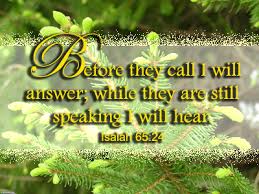
One of my favorite promises is Isaiah 65:24.
 

Unknown


(“Before they call I will answer; while they are still speaking, I will hear.”)

And one more, also from Isaiah:

“I will accomplish all my purpose” (46:10b).

God is not only working in our behalf now, he foresaw our need and began working toward its fulfillment before we uttered the first prayer. He started arranging events and bringing together people and resources so that at just the right time the right thing will happen.

Notice the “I will” in each of those verses above. Isaiah did not record God’s good intentions. These are promises of the Almighty God of the universe, our always-truthful, always trustworthy Heavenly Father.

WHY DO I WONDER?!


*     *     *     *     *     *     *     *     *     *


I praise you, Heavenly Father, for being reliable and trustworthy. I can’t imagine life without you as my foundation. Thank you for every promise in your Word that gives me support. Once again, I avail myself to your plan, so you can do the right thing at the right time—without the interference of my impatience or doubt!


(Art and photo credits:  www.kemingshen.com , http://www.brendaboen.blogspot.com.)


Read Full Post »

images


I am a person of roots and routine. Are you?

Do you grieve when it’s time to leave one community for another, because emotional attachments have grown deep?

Do you take comfort in familiar routine, because you can move forward with confidence?

Then you’ll understand this statement: I am a person who struggles with change.

So this post is for me, to review what I know about accepting–even celebrating–change. You’re welcome to read over my shoulder.

First and foremost: I need to be selective of vocabulary, even in my thoughts. Thoughts impact attitudes; attitudes impact soul and spirit. For example:

  • Instead of change, I need to speak of the circumstances as an adventure.
  • Instead of problem, I should say possibility.
  • Instead of challenge, I can call the situation an opportunity.

Such a small commitment, really. But retooling my word-choices could have a profound impact on my spirit.

First, the change I don’t want to embrace takes on a glowing, new aura when I rename it adventure—the adventure of participating with God to bring about his good purpose (Romans 8:28). Such thinking would surely foster excitement!

Second, the problem I see is nothing compared to the possibilities God is capable of. “God can do anything, you know—far more than you could ever imagine or guess or request in your wildest dreams” (Ephesians 3:20, The Message)! As I consider the possibilities, hope and anticipation will flourish.

Third, the challenge I find so uncomfortable will undoubtedly provide opportunity to see God’s power and provision at work. Perhaps I’ll witness a whole string of God-engineered events. Or, the power and provision may occur in me, as he molds my personality and spirit into a more Christ-like version. (That is even more miraculous!) And who would turn aside from seeing—even participating in—a miracle?

It begins with my words.

*     *     *     *     *     *     *     *     *     *

This might sound strange to some, but thank you, Father, for the uncomfortable changes, challenges, and disappointments you’ve brought into my life. Not one of them was without purpose. Forgive me for the times I have fretted about how circumstances would turn out. How easy it is for me to forget that you hold all things in your hands.

May I anticipate the adventure, the possibilities, and the opportunities of each day, NO MATTER WHAT, because you are by my side–my all-powerful, all-wise, all-loving God. Thank you for the promise that you WILL fill me completely with joy and peace as I trust in you.  Then I can overflow with hope (Romans 15:13).

(Photo credit:  www.desiremercy.wordpress.com.)

Read Full Post »

$T2eC16Z,!ykE9s7t)22nBQ0lKpDuG!~~60_35

(Success is not final, failure is not fatal; it is the courage to continue that counts.” — Winston Churchill)


The annals of history are filled with failures.  Consider:

Example #1: A.’s parents may have felt like failures when their son did not speak until age four and did not read until he was seven. Later they faced the embarrassment of his expulsion from school.

But surely his parents must have breathed a sigh of relief when A. was finally admitted to a university–only to be discouraged again when a professor called him a lazy dog! Who was this disappointing failure of a son? Albert Einstein.

Example #2: As a young man, W. worked for a newspaper, but not for long. His editor told him he lacked imagination and had no good ideas. In the coming years he started a number of short-lived enterprises that ended in bankruptcy. The name of this business failure? Walt Disney.

Example#3: M. was set up for failure. Jealous competitors convinced an employer to assign him a difficult, time-consuming project, outside M.’s area of expertise. It was a sure-fire plan to keep him busy, ruin his reputation, and be rid of him.

The employer? Pope Junius II. The person set up for failure? Michelangelo. The project was the ceiling of the Sistine Chapel.

Michelangelo had no experience with fresco painting. In addition to tackling a new medium, he had to paint upside down on a curved surface. It took him four years to complete the project.

But. Giorgio Vasari (1511-1574), painter, writer, and historian said, “The whole world came running when the vault was revealed, and the sight of it was enough to reduce them to stunned silence.”  I’ll bet his competitors were among them!

As I seek to put myself in the place of each of these individuals, I sense their disappointment, embarrassment, and frustration. Failure is painful! It damages our dignity and destroys our morale.

Simply put, failure feels bad…

…but that’s good!

Defeats push us to refocus and redirect. And with God’s help, those two steps can bring us to peace in spite of failure, and hope for a future of contentment.  Our relationship with God is deepened; our character is strengthened.

Care to join me in a closer look at those two verbs, refocus and redirect?

Refocus by turning our attention upward—not backward. Dwelling on the disappointments of the past is counterproductive.

As soon as we realize negativity has moved in, we must refocus our thoughts on gratitude for God’s gifts and praise for his attributes. (If my past experience is any indication, we may have to do this frequently. The enemy does not give up easily!)

But when we fill our hearts and minds with faith-statements, peace, encouragement and hope have a chance to flourish.

Redirect  our energy. God gives us our marching orders in Psalm 37. Again, note the verbs.

Trust in the Lord and do goodDelight yourself in the Lord…Commit your way to the Lord…Be still before the Lord and wait patiently for him…Do not fret—it leads only to evil (Psalm 37:3-8).

And all the while we can remind ourselves, God specializes in providing…

  • Strength for the weary and power for the weak
  • Light in place of darkness
  • New ways out of a wasteland
  • Comfort for the afflicted
  • Gladness and joy after sorrow and sighing
  • Beauty out of ashes

(Isaiah 40:28-29; 42:16; 43:19; 49:13; 51:11; 61:3)


Thank God he also provides what Winston Churchill (at the beginning of the post) says counts the most:   the courage to continue.


(Photo and quote credit:  www.ebay.co.uk.com.)


Read Full Post »


“I can’t remember the last time I felt truly happy.”

“Nobody understands what this situation is like.”

“I don’t know what I’m going to do.”

Chances are, at some point in your life, you’ve experienced one or more of the emotions behind those statements,  including:  discouragement, self-pity, hopelessness, and fear.

When circumstances seem out of control and problems defy solution, what can we do?

A good place to start:  praise God.

I know.  That seems an odd course of action and counter-intuitive.  But that’s what God instructs us to do (1 Thessalonians 5:18).

Now why would that be?

Reason #1:  Praise is a powerful weapon against those emotions listed above. It fosters peace and contentment by taking our minds off our problems and focusing our attention on God.

David shows us the way in Psalm 103.  In verse two he says,  “Forget not all [God’s] benefits.”  Then he lists  a number of them:  forgiveness of all sins, healing of all diseases*,  redemption from the pit, God’s love, compassion, righteousness, and justice (vs. 3-6).

What would your personal list include?  What specific ways has he provided for you, guided and protected you, fulfilled promises to you, and empowered you?

“Praise is the honey of life

which a devout heart extracts

from every bloom of providence and grace.”

–Charles H. Spurgeon

Reasons #2:  Praise invites his presence, and with his presence comes his strength and help.

“Praise be to the Lord, for he has heard my cry for mercy.  the Lord is my strength and my shield; my heart trusts in him, and I am helped.” (Psalm 28:6-7).

I have to be honest here.  There have been times when my praise to God had to be squeezed through gritted teeth.  And the first words of affirmation did not immediately lift me into golden clouds of euphoria.

What I can tell you is this:  Depression, discouragement, self-pity, and hopelessness were kept at bay.  And I felt the presence of God around me, giving me strength to press on.

How has praise brought God’s strength and help into your life?

Reason #3:  Praise lifts our spirits and gives us hope.  When words won’t come, we can turn to the psalms.  Chapter 145 offers one example of eloquent praise:

“God is magnificent; he can never be praised enough.  There are no boundaries to his greatness. ..

“God is all mercy and grace–not quick to anger, is rich in love.  God is good to one and all; everything he does is suffused with grace…

“Generous to a fault, you lavish your favor on all creatures.  Everything God does is right–the trademark on all his works is love…

“My mouth is filled with God’s praise” (vs. 3, 8-9, 16-17, 21,  The Message)!

Can you feel the hope, comfort, and strength stirring in the depths of your soul?

Keep praising!

*     *     *     *     *     *     *     *     *     *

Oh, yes, Lord, may my mouth be filled with your praise, whether I’m celebrating on a mountaintop or plodding through a valley.  Thank you for the delight of the former and your comfort and care through the latter.  I praise you that all things are under your control.  With a grateful heart,  I put my hope and trust in you. 

* All of our diseases are healed:  1) instantly and miraculously, often as the result of prayer, 2) slowly over time, often with extended prayer and medical intervention, or 3) eternally, when we reach heaven.

(photo credits:  www.pxhere.com; http://www.stockvault.com.)

Read Full Post »

The holiday season between Thanksgiving and New Year’s Day fills our senses with:

  • Sights of Christmas trees, candles, Santas, and angels.
  • Sounds of carols, from the light-hearted “Frosty the Snowman” to the heart-stirring “O Holy Night.”
  • Textures from prickly pine to plush velvet.
  • Aromas of cinnamon, spice, and gingerbread.
  • Tastes of iced sugar cookies and egg nog.

But the seasonal pleasures are over for another year.  And the uncertainties of our times—political, economical, as well as personal—that we set aside for a few weeks, are coming to the forefront again.  If we’re not careful, troublesome thoughts can raise our blood pressure and take away restful sleep!

What to do?  Take comfort in God’s Word.  “Great peace have they who love your law,” said the psalmist,” and nothing can make them stumble” (Psalm 119:165).  I suppose that would include uncertainties, don’t you?

Two verses have ministered to me lately, Romans 8:30-31:

“Those he [God] predestined, he also called; those he called, he also justified, those he justified, he also glorified.  What then, shall we say in response to this?  If God is for us, who can be against us?”

Of course, those key words in the first sentence beg to be examined more closely.

Predestination has been the subject of entire books and sometimes causes controversy.  I like the way the Living Application Bible explains the concept, in a footnote to Ephesians 1:5.  “Predestined” means marked out beforehand.

God knew each of us and loved us before we were even born.  He provided the way of salvation so we could be in relationship with him.  That does not negate our responsibility to believe in Jesus, in order to bring to pass God’s predetermined plan.

Called means we have been divinely summoned or invited.   Some Christians are divinely summoned for specific tasks.  Peter (John 21:15-17) and Paul (Acts 9:15) are perfect examples.

Most of us are called to love, obey, and serve God right where he’s placed us—in our homes, churches, business, schools, and neighborhoods.

Whatever our task, he cheers us on to work heartily because we’re doing it for him—to please him and bring him honor (Colossians 3:23-24).

And with his call comes hope, peace, joy, and blessing!

Justification is God’s way of making us right with him.  Out of his gracious love for us, he declares us “not guilty” for our sins. We deserve harsh punishment, but he treats us as righteous if we put our trust in Jesus.  Then the perfect sinlessness of God’s Son is credited to us  (Romans 3:22-25).

Imagine standing before a mighty king who’s dressed in elegant robes.  And there you are, wearing ragged, smelly clothes, staring at the floor, and wishing to be anywhere else but in this imposing throne room.

Suddenly the king’s words break through your embarrassment.  He’s calling for one of his son’s perfect robes to be brought for you.  He doesn’t just want to trade your rags for a  beautiful, pristine robe—he’s eager to do it!  And then, even more amazing, he welcomes you to his banquet table.

That’s justification—being treated as if we weren’t soiled by sin.  Being treated like  a royal son or daughter of the king, though it’s the last thing we deserve.

Full glorification  will occur when we arrive in heaven.  It refers to that moment when you and I will become like Christ (1 John 3:2.)  It is so certain, Paul uses past tense.  Our glorification is taken care of; it’s just a matter of when.

But the process has already begun.  Our glory—that is, anything that brings honor and praise to God—is developing day by day as we allow the Holy Spirit to have influence of our thoughts and choices.

*     *     *     *     *     *     *     *     *     *

Now consider the magnitude of these four processes which God lovingly, even anxiously, works within us.  I like the way Ken Taylor expresses verse twenty-nine in The Living Bible:

 “Having chosen us, he called us to come to him; and when we came he declared us ‘not guilty,’ filled us with Christ’s goodness, gave us right standing with himself, and promised us his glory.”

 And last, in light of whatever you may be facing in 2014, please take comfort in these joyous words:

“What can we ever say to such wonderful things as these?  If God is on our side, who can ever be against us?” (Romans 8:30, The Living Bible).


Read Full Post »

main Jirsak shutterstock_64481404

A new year requires a new calendar.  Don’t you just love the crisp, uncurled pages–the empty spaces for each day, filled with nothing but optimistic possibilities?

Perhaps you’re starting the new year with a fresh journal.  Again, the pristine pages are filled with nothing but hope and expectation.

We might also desire to start the new year with:

  • New eyes—to see the glory of God around us
  • New ears—to hear his still, small voice.
  • New resolve—to follow God’s direction.
  • New courage—to speak his truth boldly.
  • New faith—to live with confident trust in our Heavenly Father.

These abilities cannot be bought at Barnes & Nobles, like a calendar or journal.  They are procured through prayer and discipline.

A good place to begin?  David’s prayer in Psalm 51:   “Create in me a pure heart, O God, and renew a steadfast spirit within me…Restore to me the joy of your salvation and grant me a willing spirit, to sustain me” (Psalm 51:10, 12).

Allow me to personalize it a bit.

Create in me a pure heart, O God (just as you created a perfect universe from chaos).

And renew a steadfast spirit within me (that my greatest desire might be to please you).

Restore to me the joy of your salvation (just as we experience in the euphoria of Christmas Eve)!

Grant me a willing spirit, to sustain me (throughout 2014).

The typical new year’s resolution is made, broken, and forgotten.  Rarely does someone make a once-a-year promise and keep it faithfully for the next 364 days.

Perhaps we’d be wise to see each new day as a fresh opportunity for beginning anew.  To repent of yesterday’s failures and forget them. To strain toward what is ahead—with enthusiasm, expectation, and hope (Philippians 3:13).

And gradually those new abilities we aspire after, will begin to flourish.

God says, “Forget the former things; do not dwell on the past.  See I am doing a new thing” (Isaiah 43:18-19a)!

*     *     *     *     *     *     *     *     *     *

Thank you, Father, for your mercy to forgive the past, and  your grace to provide for the future.  Thank you that each morning is a fresh start, and each new day holds hidden opportunities.  With great anticipation I turn the page!   

Read Full Post »

Christmas is a season of lights.

Candles glow and twinkling lights glimmer from houses, buildings, and trees.

People love all the flickering and shimmering!  Some spend weeks decorating their yards and rooftops in spectacles of light.  If you asked them why, they might be hard-pressed to express more than, “They’re beautiful, that’s all.”


But perhaps it’s more than just aesthetics.  Perhaps it’s a heart-response.

Light is symbolic for:

  • Beauty.  Light grabs our attention, whether it’s  soft and luminous, or sparkling and dazzling. It can also be refracted into a glorious spectrum of colors.
  • Safety.  Where there is light, we can see our surroundings.
  • Comfort.  A nightlight offers just that for many a child who is afraid of the dark.
  • Hope.  Light gleams triumphantly over the darkness, at the end of a tunnel.
  • Guidance.  Light illuminates the way.

Might it be that people are drawn to the lights of Christmas because the human spirit is drawn to the Light?

Jesus said, “I am the Light of the world (John 8:12).  He is Light because God the Father is Light (1 John 1:5).

And the Light of God the Father and God the Son is not merely symbolic.

God the Son is safety, because he offers eternal life.  “My sheep listen to my voice; I know them and they follow me.  I give them eternal life, and they shall never perish; no one can snatch them out of my hand.” (John 10:28-29).

God the Father is comfort, because he is loving and compassionate.  “Praise be to the God and Father of our Lord Jesus Christ, the Father of compassion and the God of all comfort, who comforts us in all our troubles” (2 Corinthians 1:3-4a).

God the Son is hope, because of his resurrectionHe was raised from the dead, and we will be also.  “In his great mercy [God] has given us new birth into a living hope through the resurrection of Jesus Christ from the dead, and into an inheritance that can never perish, spoil or fade—kept in heaven for you” (1 Peter 1:3b-4).

God the Father is beauty, because of all his glorious attributes.  “I’m asking God for one thing…To live with him in his house my whole life long.  I’ll contemplate his beauty; I’ll study at his feet” (Psalm 27:4, The Message).

God the Father is guidance.  “He will guide you always” (Isaiah 58:11a).

Christmas lights cast a soft glow; spotlights illuminate large areas.  But Jesus said, “I am the Light of the World.”   To every person in every corner, he offers his Light.

Let’s make time to linger in his dazzling Light this season!

“Blessed are those…who walk in the light of your presence, O Lord” (Psalm 89:15)!

(photo and art credits:  www.onebestwall.com, http://www.moyerlawncare.com, http://www.8thfire.net, http://www.naturewatcher.wordpress.com)

Read Full Post »

“It is good to wait quietly,” Jeremiah said (Lamentations 3:26a).

At the risk of sounding impudent, “What’s good about it?”

Waiting can make us feel anxious and stressed.  If we’re waiting for a prayer to be answered or a scriptural promise to be fulfilled, we can become doubtful, discouraged, and despondent.  Not good.

Yet the act of waiting seems important to God.  Numerous times in the Bible we see people of faith who had to endure Wait Time:

  • Abraham and Sarah waited 25 years for the birth of Isaac.
  • Jacob waited 14 years to take Rachel as his bride.
  • Joseph waited 13 years, first as a slave, then as a prisoner, before being rescued and elevated by God to second-in-command over Egypt.
  • The Israelites waited through 400 years of slavery in Egypt before God’s miraculous intervention.

  • Caleb waited 45 years to inherit his portion of the Promised Land.
  • David waited at least 15 years to become king of Israel, after his anointing by Samuel.
  • Simeon, Anna, and many other Jews waited for their Messiah.

God’s delays must serve a purpose.  And a diligent search through scripture gives us answers to:  What good can come from waiting?

  • Times of waiting strengthen our trust in God and our resolve (Psalm 27:14).  If every day was problem-free and blissful, surely our faith would remain shallow.
  • We grow in our relationship with God while resting in his sovereignty and reliability (Psalm 62:5-8).  The Almighty of the universe becomes our closest confidant.  Intimacy with him deepens as we turn to him for comfort, encouragement, strength, and more.

  • Spiritual maturity develops (James 1:2-4).  Waiting is a challenge all by itself, but can also be accompanied by worry, pain, and sacrifice.  The test of waiting, however, develops our patience and perseverance and gives us opportunity to grow in character.  None of these benefits would blossom within us if God provided for every whim, and rescued from every trial.
  • We learn to take joy in the blessings we already have.  Paul wrote, “Be joyful always” (1 Thessalonians 5:16) to a church experiencing persecution.  They were undoubtedly praying and waiting for relief.  But Paul knew that focusing on what Christ had already done for the believers, and the benefits they already enjoyed, would help offset their anxiety and frustration.  The same is true for us.
  • Others see our patience and trust while we wait (Psalm 40:1-4).  Then, when God answers our cries, others take note of his provision, and their faith is encouraged.

It seems we’re always waiting for something; it’s only the intensity of emotion attached to the waiting that tends to vary.  When that intensity begins to grow, perhaps it would help to say, “I’m waiting with great anticipation!

There can be sweet delight in anticipation.  For example, as the Christmas holidays approach, I anticipate the glorious homecoming of family members.  I relish the imaginings of long conversations at the candle-lit dinner table, the hugs and laughter, and the gathering around the Christmas tree for family worship and gift-giving.

I need to apply that joy of anticipation to waiting on God.  I can relish the fact that his plan – including the Wait Time — always includes positive aspects.  I can reaffirm that God is always on time – never late, never early.  I can generate excitement in my spirit by musing on God’s promises and looking forward to the creative, miraculous ways he will fulfill those promises.  With an attitude of anticipation, waiting shouldn’t be nearly so uncomfortable.

(You have my permission to remind me of that, should impatience or frustration start to manifest themselves!)

*     *     *     *     *     *     *     *     *     *

Heavenly Father, I don’t think I’ve ever thanked you for the Wait Times in my life.  Thank you for holding me back, so trust, intimacy, gratitude, patience, and spiritual maturity have a chance to grow.  Help me to embrace the Wait Times as opportunities to discover more of who you are, more of the priceless treasures hidden in your Word, and more of who I can be when I am rooted and built up in you (Colossians 2:7)—especially through times of waiting.

(Art & photo credits:  www.bible-stories-library.com , http://www.moseseditor.blogspot.com . http://www.photosbyravi.com , http://www.pinterest.com.

Read Full Post »


On January 17, 2005, this title emblazoned the cover of Time Magazine:  “The Science of Happiness.”

On December 5, 2008, the Associated Press released this article:  “Smile!  Study Says Happiness is Contagious.”

And the entire January/February 2012 issue of the Harvard Business Review was dedicated to:   “The Value of Happiness.”

For over a decade now, a large group of scientists and researchers have turned their attention to the study happiness.

Some of their findings are valuable to know:

  1. Happy people live longer.  In one study, the happiest group lived nine years longer than the unhappiest group.  When you consider that cigarette smoking can shorten one’s life three to six years, depending on how much a person smokes, it becomes clear the effect of happiness is huge.
  1. Once the basic necessities of food, clothing, and shelter are taken care of, extra riches do not make people happier.  Scientists think it’s because we adapt to pleasure, and it quickly wears off.
  1. Relationships are key.  The wider and deeper the relationships, the happier we’re going to be.


As the researchers have studied happy people, they have discovered common characteristics.  Happy people tend to:

A.  Notice more of the positive details of their lives. These people have learned how  to savor the small, joyful moments as well as the memorable, euphoric ones.

B.  Appreciate more.  Grateful people even sleep better!

C.  Think optimistically.  Those who have a sense of purpose, who look forward  with hopeful expectation to the future, are more satisfied with their lives.

D.  Give generously of their time and resources.  Researchers discovered that it was the giver who actually reaped more benefits than the receiver.

E.  Empathize with others.  They have learned to put themselves in the place of  others, in order to understand their situations.  They genuinely care about others and demonstrate compassion.  Researchers found that compassion     contributes to health and more productive living.  The side effect?  Happiness.

As I’ve perused these findings, I couldn’t help but smile.  Everything secular research is “discovering” about happiness is already laid out in scripture!

Take the three findings mentioned above.

1.  Happy people enjoy a longer life.  God says, “With long life will I satisfy him and show him my salvation” (Psalm 91:16).  Also, “Do not forget my teaching, but keep my commands in your heart, for they will prolong your life many years and bring you prosperity” (Proverbs 3:1-2).  In other words, long life and prosperity come to those who know God and obey his Word.  In fact, as his children (those who have received Jesus into their lives), we have eternal life to look forward to!

2.  Riches do not guarantee happiness.  Solomon figured that out eons ago.  “I denied myself nothing,” he said.  “Yet when I surveyed all that my hands had done, and what I had toiled to achieve, everything was meaningless” (Ecclesiastes 2:10-11).

3.  Relationships are key.  The most important and valuable relationship we can have is with Jesus.  When we accept him into our lives, he calls us friends (John 15:15).  Jesus wants to give us life to the full (10:10) so that our joy may be complete (15:11).  Relationships with other Christians can also be highly gratifying.  The bonds of faith and friendship forge a deep familial connection (Proverbs 18:24b).

Scripture also verifies the five characteristics of happy people:

A.  Attention — to the positive details of life.  The psalmists were masters at drawing our attention to the beauty and grandeur of creation, God’s amazing ability to engineer circumstances, and His glorious attributes at work in our lives.  We would be wise to do the same.

B.  Gratitude.  Paul instructed us, “Rejoice in the Lord always…In everything, by prayer…with thanksgiving, present your requests to God.  And the peace of God…will guard your hearts and minds in Christ Jesus (Philippians 4:4-7).  Is not peace of mind closely related to happiness?  Surely we cannot have one without the other.

C.  Optimism.  The Christian’s optimism is not based on wishful thinking.  We have a strong foundation for our hope:  God himself.  David affirmed that truth when he wrote, “Find rest, O my soul, in God alone; my hope comes from him” (Psalm 62:5).  And what is the result of that hope?  “Blessed is he whose help is the God of Jacob, whose hope is in the Lord his God…the Lord, who remains faithful forever” (Psalm 146:5-6).

D.  Generosity.  The researchers almost echo word for word what Jesus taught:  “It is more blessed to give than to receive” (Acts 20:35).

E.  Empathy.  Compassion is an extension of generosity.  As we give attention, understanding, and care to others, we experience a sense of satisfaction and fulfillment in our spirits.  It is not only more blessed to give money or material goods, it is more blessed to give of ourselves.

One neuroscientist involved in the study of happiness said…

happiness could best be described as a state of contentment.

And A.W. Pink, author of Comfort for Christians wrote…

“Contentment is the product of a heart resting in God.”


That, my friends, is the key to happiness:  resting in God.


(Photo credits:  newpathwaytohealing.com ; lifeingeneral.blogspot.com ; rncentral.com ; zazzle.com ; my.opera.com)


Read Full Post »

Not by Sight: A Fresh Look at Old Stories of Walking by Faith  -             By: Jon Bloom, John Piper

Imagine…

…the woman caught in adultery (John 8:2-11), walking home after her encounter with Jesus.  What must she have been thinking?

…Zacchaeus, the despised tax collector, coming to your door to return the money he owed you—plus four times more (Luke 19:1-10).  What would have been your reaction?

…how it felt to be Joseph Barsabbas, the candidate not chosen to replace Judas Iscariot (Acts 1:26). How might he have responded?

These are just three out of thirty-five scenarios Jon Bloom explores in his book, Not by Sight: A Fresh Look at Old Stories of Walking by Faith (Crossway Books, 2013).    Indeed, they are fresh, creative takes on familiar Bible stories.

And although quite short, just three pages or so in length, each vignette still gives plenty of food for thought. I found them to be compelling, insightful, and instructive—encouraging my walk of faith.

One of my favorites is “Staying Faithful When Things Get Worse.”  Jon imagines what Joseph must have been thinking as a falsely accused prisoner in Egypt.  For at least twelve years he endured the hellish conditions and tormenting hopelessness.  Those should have been the best years of Joseph’s life—his youth.  Many would have said, “What a waste.”


Imagine year nine, Jon suggests.  Surely Joseph fought against depression and discouragement, even as he recited to himself the promises of God.  No doubt he reviewed in his mind the stories of his ancestors—Abraham, Isaac, and even those of his own father, Jacob.

Jon Bloom imagines Joseph affirming repeatedly that, just as God had been faithful to them, he would be faithful to Joseph.  Each patriarch had faced situations that seemed impossible.

Abraham and Sarah were much too old to have a child.

The older brother, Esau, would never serve his younger brother, Jacob–even if the age difference between twins was slight. That promise of God went against all tradition and logic.

Jacob was a poor runaway.  He couldn’t possibly become a wealthy herdsman.

But each man and his family had been blessed, just as God had promised.  Why?  They remained faithful.  Yes, they made mistakes and failed to obey God on occasion.  But they never turned their backs on him, even when circumstances turned bleak.

Jon Bloom also imagines Joseph reaffirming his faith in God and his willingness to wait for him to act.  Meanwhile, he would continue to honor God, even within prison walls.

As Jon brings the vignette to a close, he shares fresh application:

Even in the care of Almighty God, circumstances may get worse, not better.  “Faith in God’s future grace for us is what sustains us in those desperate moments,” Jon says.  Our hope is best placed in God, in his promises, and especially the assurance of eternal bliss in heaven yet to come.

Jon Bloom perfectly fulfills the role of a writer, as defined by Anais Nin, American author of the twentieth century:  “The role of a writer is not to say what we all can say, but what we are unable to say.”

Page after page, this is what Jon Bloom did for me.  No doubt he will do the same for you.

(Art Credits:  www.angieblattner.theworldrace.org ; www.illustrationartgallery.com )

Read Full Post »

« Newer Posts - Older Posts »

When the House is Quiet

Impressions Becoming Expressions

Mitch Teemley

The Power of Story

Still Traveling

Impressions Becoming Expressions

Living Our Days

Gaining a heart of wisdom

He Said What?!

I'm Patty, and my husband and I are living with our adult son who has autism and epilepsy. I love sharing lessons learned from life around me, especially life with Aaron.

Meditations of my Heart

Impressions Becoming Expressions

Linda Stoll

Impressions Becoming Expressions

Signora Sheila

Notes on Life, Faith & Italy

Heidi Viars

Finding the Image of God