Feeds:
Posts
Comments

Archive for the ‘Thanksgiving’ Category

mri-scanner


My brother had to get an MRI last week. The technician warned him the machine was very loud—similar to a large motorcycle.

“I like motorcycles!” John told her.

Nevertheless she gave him earplugs, to block the noise as much as possible, and a set of headphones, through which he could listen to the music of his choice.

Earplugs and headphones. That’s what I need to drown out the devil’s loud voice.   Sometimes he can be incredibly persistent with his irritating chatter in my spiritual ears, saying things like:

  • “You are past your prime. Why bother trying to accomplish anything?”
  • “Look how blessed your neighbor is. You must have upset God in some way or you’d be blessed like that, too.”
  • “Can you believe how insensitive Ms. __________ is? How can she be so hurtful and not even realize it?

Wouldn’t it be nice if God handed out earplugs and headphones for our spiritual ears?

Maybe God wants us to develop some worthy habits in the process of manufacturing our own auditory devices.

And how might we do that?

Earplugs could be fashioned out of gratitude. We can occupy our minds with continual rejoicing in the blessings of this moment. Then we won’t be able to hear the devil’s negative and critical comments.

Let’s see…I wonder if I could name a blessing for each of the five senses, for what I am experiencing right now?

  • Thank you, Lord, for books and the gift of sight that allows me to read and enjoy them, as well as learn from them.
  • Thank you for soft breezes that create a cheerful rustling of fall leaves.
  • Thank you, Father, for the cozy warmth of my fleece jacket.
  • Thank you for the nutty goodness of hazelnut coffee,
  • And thank you, Lord, for the homey aroma of vanilla, coming from a nearby candle.


candleflame


Oh! That was fun, and I didn’t have one negative thought during the exercise. No wonder Paul told us to rejoice always.

Alright–earplugs are in place. Now it’s time for the headphones—something worthwhile to pay attention to, that drowns out the noise of negativity and criticism.

And what could be more worthwhile than scripture, where God offers reassurance, encouragement, and strength? The psalms are a perfect place to begin:

  • “Blessed is the man who makes the Lord his trust” (Psalm 40:4).
  • “I will sing of your strength, in the morning I will sing of your love; for you are my fortress, my refuge in times of trouble” (Psalm 59:16).
  • “Your ways, O God, are holy. What god is so great as our God? You are the God who performs miracles; you display your power among the peoples” (Psalm 77:13-14).

And one of my favorites:
 

Ps.89.15.16


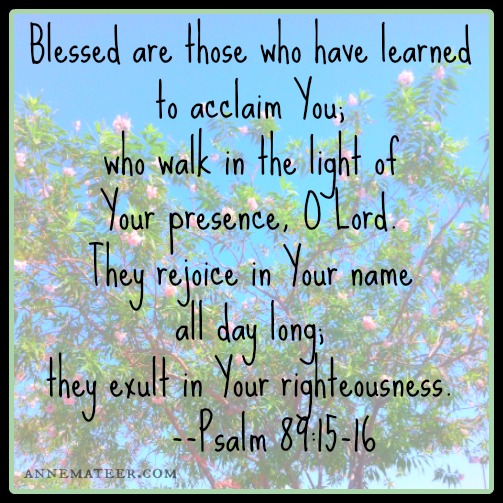
(“Blessed are those who have learned to acclaim you, who walk in the light of your presence, O Lord. They rejoice in your name all day long; they exult in your righteousness. For you are their glory and strength” (Psalm 89:15-17).)

Notice: We are blessed when we acclaim God. Disparaging ourselves or others, bemoaning our circumstances—even just in our thought life—is counter-productive.  It is worship that transforms our minds and spirits.

So let’s insert those earplugs and pop on those headphones! The difference will be remarkable.


(Photo and art credits:  www.cancerresearchuk.org; http://www.cozyhearthcandles.com; annemateer.com.)


Read Full Post »

IMG_2275


“Nancy, come here!” Tabbitha called, as she poked her head through the door of my classroom.  Tabbitha taught across the hall from me. It was still early morning, and students hadn’t begun to arrive yet.

“I want to show you something!” she beckoned. Tabbitha’s smile and sparkling eyes gave me a hint that, whatever her surprise, it was going to be good.

Quickly she led me out of the school building and back towards the parking lot. She stopped at a row of low, scraggly bushes that grew along the sidewalk.

“Look!” Tabbitha cried, pointing down at one of the bushes.

I looked but saw nothing. “What am I supposed to see?”

“Right here,” she said, and moved her finger closer to the object.

My eyes finally focused on what she saw: a shriveled brown pouch adhered to a branch. A chrysalis.


chrysalis


I couldn’t remember ever seeing one in the wild before, only in a butterfly habitat.

We studied the chrysalis closely, marveled at the miracle within, and wondered whether the end result would be a butterfly or moth.

“Actually, I have to tell you. I didn’t spot the cocoon,” Tabbitha confessed. “Brooke did.”

Of course.   Tabbitha’s daughter, Brooke, was four years old at the time–closer to the ground to notice such details as an odd protrusion on a low stem. But Brooke was also an observer. Her little eyes and ears didn’t miss much, and her mind was always active—learning, wondering, connecting,

As for me, I hardly even noticed there were bushes along that sidewalk, much less a miracle taking place among them. My mind was always busy with the to-do list, lesson plans, students needing special attention that day, the emails to be answered, the meeting after school, etc., etc.

Little Brooke taught me a lesson that morning:  Pay attention!

God is revealing himself to me every day—his creative genius, his loving care, and his wisdom. He arranges little serendipity gifts for me to discover. My challenge is to be watchful.

The blessings are there, the joy available–not just in grand rainbows and sunsets that grab my attention, but in the sheen on rain-washed leaves or in the mesmerizing flicker of a candle flame.


candle_flame_2


Joy is not the result of happy events, a collection of lovely things, or even near-perfect relationships with family and friends.  Joy is experienced in the presence of God (Psalm 16:11). And when God and I together enjoy his creation, his people or his engineering of events, the joy becomes rapturous.

However! I have been a slow student to learn the habit of attentive living. I’m still developing a praise-frame of mind.

But when I pause long enough to enjoy a cocoon on a stem, a group of children on a playground, or the smile on the face of a friend, I want to extend that pause into a prayer:

Oh, God, thank you for lavishing gifts of love upon me each day. Thank you for filling me with eternal pleasures at your right hand (Psalm 16:11), all day long, now and forever. Yet there is more!  Thank you that, as I celebrate these blessings together with you, my joy is expanded even further. Help me to become attentive like little Brooke. And perhaps, as I express my contentment in you and in all your gifts, your heart will be filled with joy as well.


(photo credits:  www.princetonaturenotes.blogspot.com; http://www.discovermagazine.com; http://www.brantfordfire.ca.) 

Read Full Post »

I awoke around midnight one evening in December, crept out of bed, and peeked out the loft window facing the street.  All was quiet.  No cars passed, no breeze rustled the trees.  The pavement below glowed faintly under the street lamp.

Again, around two, the same tiptoe trip to the window.  Same view; same stillness.

No, I was not watching for Santa.  I was watching for snow.

The last snowfall this Floridian witnessed was thirty-eight years ago.  So during a rare Christmas visit to Ohio, when snow was forecast during the early hours of one morning, I didn’t want to miss it.

The third time I awoke, around three o’clock, my trip to the window was rewarded.  In the dim light, I could make out large flakes falling fast and straight.

As much as I anticipated its arrival, now I looked forward to the accumulation that had been forecasted: at least several inches.

Sure enough, the pale light of morning revealed a world transformed.  Each tree branch, even every twig, appeared iced in white frosting.

And yet more snow was falling.  Now the flakes were lighter and smaller, drifting gently and softly to the ground.

Donning my coat, I slipped out to the front porch, and extended my arm.  Soon I had a lovely collection of tiny star-shaped flakes on my sleeve.  Delicate displays of lacy symmetry.  Each one a magical wonder.

The next day, under a crystalline blue sky, we rode through a nearby cemetery where the snow created an even more stunning display.  Hillsides, ancient trees, and tangles of bushes were majestically trimmed in sparkling white.  Frozen ponds glistened subtly, like great pearls.  By contrast, the streams twinkled, as if crystals had been laid out on rippling, steel-gray silk.  I oohed and aahed at every turn.

Those of you who experience snow every winter may not be so enthusiastic.  There’s a dark side to the white stuff!  Bundling up in extra clothing for outdoors, then shedding the layers for indoors.  Slow, snarled traffic.  Shoveling.  Scraping off the car.

But, oh, the beauty!  The splendor!

“He spreads the snow like wool and scatters the frost like ashes” (Psalm 147:16)

*     *     *     *     *     *     *     *     *     *

Thank you, O God, for the glorious wonders of your winter creation.  I marvel that you design each tiny snowflake unique from all others.  How mind-boggling to consider the millions of flakes required to cover just one tree, much less a forest or a whole region.  And  I marvel at your artistry with just one color—white!

How great and glorious you are, the almighty Creator and Sustainer of the universe! How  awe-inspiring to know you are also our loving Heavenly Father.  And that same awesome power that paints winter-white landscapes is at work in our lives, creating the beauty of holiness.   Thank you.  Thank you.  Thank you. 

Read Full Post »

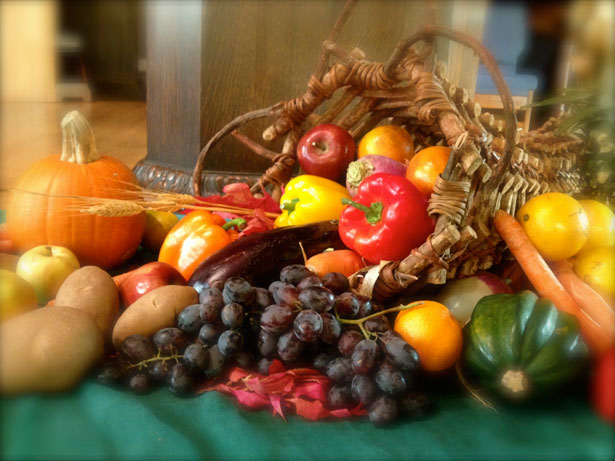
Cornucopia Free Stock Photo - Public Domain Pictures

The First Course:

“I would maintain that thanks are the highest form of thought, and that gratitude is happiness doubled by wonder.”

(G. K. Chesterton — 1874-1936. Columnist and author extraordinaire;  called the best writer of the twentieth century.)

The Second Course:

“The unthankful heart…discovers no mercies; but let the thankful heart sweep through the day and, as the magnet finds the iron, so it will find, in every hour, some heavenly blessings!”

(Henry Ward Beecher — 1813-1887.   Congregationalist minister, known for his support of the abolition of slavery.)

The Third Course:

“Thanksgiving gives effect to prayer, and frees from anxious carefulness by making all God’s dealings matter for praise, not merely for resignation, much less murmuring. Peace is the companion of thanksgiving.”

(Author Unknown – Quoted in Jamieson, Fausset and Brown Commentary on the Whole Bible, Philippians 4:6.)

May wonders and mercies surround you this Thanksgiving Day, bringing you peace and happiness!

(photo credit:  www.publicdomainpictures.net, George GrimmHowell)

Read Full Post »

I don’t know what’s better:

That first sip of coffee in the morning, or the first moment on the pillow at night!

The anticipation of an exciting event, or the lingering memories after.

Ice cream in the summertime, or thick, hot soup in winter.

Gazing at a wide vista of mountains and trees, or studying a tiny flower up close.

Snuggled up by the fire, or walking through crisp, autumn leaves.

Dark chocolate or white popcorn!

A new book with a tantalizing title, or an old, prized volume, underlined and dog-eared.

The raucous noise of a festive party, or the delicious quiet afterward.

The uplift of a clear, cloudless day, or the coziness of a cloud canopy.

Looking forward to wonders yet to be discovered, or looking back on wonders already known.

Oh, yes, Lord.  “You have made everything beautiful in its time” (Ecclesiastes 3:11).

*     *     *     *     *     *     *     *     *     *

Thank you, Father, for continually blessing your people—not just corporately but individually.  You even bestow custom-blessings, specifically designed for the pleasure of one!  And thank You that, as I draw near to you with a grateful heart, your presence fills me with awe and joy.

*     *     *     *     *     *     *     *     *     *

What blessings are you hard-pressed to choose between this Thanksgiving?  Share your thoughts in the Comments below!

(photo credits:  www.3dwaltz.com/babies-pictures-6.html, http://www.popsdigital.com,  www.levenger.com, http://www.footage.shutterstock.com.)   

Read Full Post »

Have you ever noticed that, except for the first line, the familiar Thanksgiving hymn, “We Gather Together” is not about God’s blessing?

We sing such statements as:

  • The wicked oppressing now cease from distressing
  • So from the beginning the fight we were winning
  • Let Thy congregation escape tribulation

Don’t those seem strange concepts to emphasize on a day set aside for thanks?

The truth is:   although Thanksgiving is about gratitude, it is also a celebration of religious freedom.  That was surely on the minds of the Pilgrims back in 1621.

Freedom to worship God, and to read the Bible for themselves, were among the chief reasons the small band of believers left England for Holland in 1609.  Then, as circumstances became difficult there as well, they courageously set out for America to establish their own colony (albeit with a charter from the king of England, which granted them permission to inhabit the Virginia Colony).

The Pilgrims had faced the threat of imprisonment and death in Holland as well as England.  In addition, the trip to America included such hazards as shipwreck, illness, and accident.

Yet troubles only mounted upon reaching the New World.  The Mayflower landed too far north–at Cape Cod—not in Virginia as planned.  A late launch and a sixty-six day voyage on stormy seas (instead of the planned three weeks) meant they arrived in late fall.  Shelters were not completed until February.   Then there were Indians to worry about.

Yet they were willing to face all these challenges in order to establish a colony “for the Glory of God and Advancement of the Christian Faith” (from the Mayflower Compact).

The third line of the hymn  speaks of one joy they embraced:  “The wicked oppressing” (King James of England and his bishops) “now cease from distressing.” God had removed the Pilgrims far out of the king’s reach.  No longer could he persecute them.

The first verse ends with:  “Sing praises to His name.” There is no historical record that the Pilgrims sang at their first Thanksgiving celebration in 1621.  But music was typical at their gatherings, so perhaps they did participate in a psalm or two.  After all, the feasting lasted three days!

Undoubtedly the Pilgrims would have offered their prayerful thanks– even though half their number had died the previous winter, and the first harvest had been quite meager.  (The ninety Native Americans who attended that celebration actually brought most of the food.)

The second verse of the hymn begins:  “Beside us to guide us, our God with us joining.”

God certainly chose an interesting way to guide the Pilgrims and join with them in surviving the harsh conditions of New England.  Remember Squanto?  He’s the one who showed the Pilgrims how to fertilize the soil with fish.  Without that first crop of decent corn, the Pilgrims never would have survived.

Even more amazing?  Squanto just happened to speak English!

The third verse of “We Gather Together” begins:  “We all do extol Thee, Thou Leader triumphant.”  The Pilgrims honored God as Lord.  They recognized that from him all blessings flow.  And the hymn concludes:  “Thy name be ever praised; O Lord, make us free.”

In actuality, this hymn was not written as a direct tribute to the Pilgrims’ experience.   It dates back to Holland, in the late 1500s, written in celebration of a Dutch victory over the Spanish at the Battle of Turnhout (1597).

Under the rule of Spain’s King Philip II, Dutch Protestants had been forbidden to gather for worship.   Perhaps the Pilgrims heard the song while living in Holland.  But the words we sing today were translated into English by Theodore Baker, in 1894.

Even so, the words remind us that the Pilgrims suffered much and risked everything to found a colony where they could gather together in freedom—to proclaim:

“All glory be Thine!”

May we, too, extol our Leader triumphant, as we sing this hymn through the coming week.

(Sources:  The Founders’ Bible, www.plimoth.org, History News Network at http://www.hnn.org )

Read Full Post »

pray

Frequently we thank God for blessings already received:  our families and friends, the beauty of creation, material possessions, and circumstances which have turned out well.  Today in particular we joyfully celebrate God’s benevolence.

But in Psalm 7:17, David demonstrates a different kind of thanksgiving prayer.  He determines to praise God in spite of facing false accusations, slander, and injustice.

David says, “I will give thanks to the Lord because of his righteousness and will sing praise to the Lord Most High” (Psalm 7:17).

How can David be so positive in such dire circumstances?  You’ll find the answer in the middle of the verse:  “Because of his righteousness.”

And what does God’s righteousness include?

  • He abounds in love to all who call upon him (Psalm 86:5b).
  • He answers even before we call (Isaiah 65:24).
  • He’s an involved God–not one who watches from afar with impersonal detachment (Isaiah 41:10).
  • He’s always working to bring his plans to fulfillment (Psalm 33:4).
  • He brings good out of evil (Genesis 50:20), and victory out of defeat (1 Corinthians 15:57).

And that’s just a start.  In fact, the righteousness of our God is infinite, so such a list would never near completion.

To sum it up, we can be filled with thanksgiving and praise because our God acts and reacts rightly all the time.  Every time.  To every prayer.  Even the prayers to which he has responded…

…“Not now, dear one.”

Or…

…“No, my child.  For reasons beyond your understanding, I cannot grant that request.”

But what then?  How do we survive the pain?  The loneliness?  The unfairness of it all?

We cling to his righteousness.

Heavenly Father, even though there are many prayers for which I am awaiting answers, I thank you, Lord, for your righteousness.  Even though you have said, “No, that’s not part of my plan,” I thank You, Lord, for your righteousness.  You are righteous in all your ways, and loving toward all you have made.  You are near to all who call upon you.  My mouth will speak in praise of You (Psalm 145:17-18a, 21a).

 What aspect of God’s righteousness is ministering to you right now?  Leave a comment and tell us about it.

(Photo credit:  www.religionblog.dallasnews.com.)

Read Full Post »

“Blessed are those who have learned to acclaim you, who walk in the light of your presence, O Lord (Psalm 89:15).

Ever watch a movie scene in slow motion and notice details you missed when the action was normal speed?  That same phenomenon applies when we slow down our reading to meditation-speed.  Especially scripture.  Latent truths begin to surface.

For example, let’s examine closely several phrases from the scripture above, to see what God would have us discover.

“Blessed are those who have learned to acclaim you,” the psalmist asserts.  In other words, good things come to those who give enthusiastic approval to God.  What causes you to acclaim God?

My list would include:

  • a supportive, caring husband,
  • three grown children and their spouses, who are delightful company
  • a spunky four-year old granddaughter,
  • rainbows and sunbeams, clouds and surf,

,Waves breaking at Porto Covo, west coast of Po...

  • the way God engineers circumstances,
  • the way he comforts and strengthens.

If I put my mind to it, this list would surely grow very long.

“Blessed are those who have learned to acclaim you.”  Same clause; different emphasis.  Giving enthusiastic approval to God–frequently throughout the day–is a learned behavior.

How do we learn this discipline?  Certain cues would certainly help, much as ringing bells cued a certain reaction in Pavlov’s dogs.  I can develop the habit of acclaiming God at particular times of day:

  • during my quiet time in the morning,
  • when driving,
  • as I gaze out the window at clouds and sky while working at the kitchen sink,
  • while completing other household tasks,
  • as I drift off to sleep each night.

I want such moments to automatically trigger Praise Time.  Practice will make perfect.

Psalm 89:15 also asserts that blessings will come when I walk in the light of God’s presence.

Think of being in the company of a dearly loved person, just sitting in cozy silence, simply enjoying the precious gift of being together.  There’s no awkwardness in the absence of conversation, just a peaceful settledness.

That’s one aspect of walking in the light of God’s presence–to rest in the knowledge he is:

  • Beside me, providing support and encouragement,
  • Watching over me, providing protection,
  • In  me, providing strength and wisdom.

These provisions and more prove his presence.  His invisibility and inaudibility make him no less close.

Heavenly Father, my heart bubbles with gratitude.  I want to rejoice in you all day long, exclaiming over every one of your righteous acts. I want your majesty and splendor to be my focus; because you are the source and power behind everything good in my life (personal paraphrase of Psalm 89:16-17a).

What cues automatically trigger Praise Time in your life?  I’d love to hear your ideas!

Read Full Post »

« Newer Posts

When the House is Quiet

Impressions Becoming Expressions

Mitch Teemley

The Power of Story

Still Traveling

Impressions Becoming Expressions

Living Our Days

Gaining a heart of wisdom

He Said What?!

I'm Patty, and my husband and I are living with our adult son who has autism and epilepsy. I love sharing lessons learned from life around me, especially life with Aaron.

Meditations of my Heart

Impressions Becoming Expressions

Linda Stoll

Impressions Becoming Expressions

Signora Sheila

Notes on Life, Faith & Italy

Heidi Viars

Finding the Image of God