Feeds:
Posts
Comments

Archive for the ‘Uncategorized’ Category

Given that everything in the universe has its origin in God [1], it stands to reason music originated with God. 

Granted, he could have bestowed the gift without participating himself, but scripture indicates otherwise.

In Psalm 42:8b we’re comforted with this assurance: “by night his song is with me.”  Our part is to pay attention to the lyrics that proclaim his perfections and good works—lyrics he sings over us straight from his Word. When we memorize verses of God’s Song, they can comfort our hearts even in the darkest of times [2].

In Psalm 32:7 we read of God’s “songs of deliverance” that encourage and inspire.  Where might we hear these songs?

In the calming sounds of nature.  Creation is full of God-Song—beyond the musical offerings of birds.  Think of burbling streams, the wind humming through evergreens, frogs ha-rumphing, crickets chirping, and the soulful underwater cries of humpback whales. 

Indeed, God-Song surrounds us in the air, on land, and in the sea, reminding us we’re enveloped in his love.  And because of that love, he provides deliverance from fear, trouble, distress, and the evil one [3].
Second, we hear songs affirming his goodness, dependability, and compassion in his Word [4].

Third, we hear God’s Song through the uplift of hymns and other Christian music. Men or women may be listed as the composers and lyricists, but surely all would give God the credit for his inspiration and empowering.

In Zephaniah 3:17 the prophet depicts God delighting in his people with song. 

“He rejoices with joy and joys with his singing,

which shows how delighted he is with his people . . .

his own righteousness upon them,

his own grace in them.”

— John Gill

Of course, God wants us to make music also, and not just with our voices and instruments.  God longs to come alongside, and within the sphere of his influence, make sublime music with our lives—much more beautiful and satisfying than anything we could accomplish on our own.

Perhaps you saw the video—based on an actual event (and available on YouTube):

A young father settles into his concert hall seat next to his wife, just as a performance is about to begin.

“Where’s Tommy?” he asks.

“I thought he was with you,” she exclaims, worry lines already criss-crossing her forehead.

At that moment the curtain goes up to reveal a little boy, oblivious to the audience, sitting at a grand piano, legs dangling above the pedals.  Tommy.

 One single note at a time—and rather haltingly at that—he begins to play “Twinkle, Twinkle, Little Star.”

“Go get him!” Mom cries in a stage whisper.

Too late.  A tuxedoed man is already approaching the piano from behind Tommy.

Will he reprimand the boy for touching the concert grand? Will he demand that the parents of the delinquent come to collect him?

No, he quietly leans over the boy and tells him to keep playing.  Then he envelopes Tommy with his arms, and begins to add Mozart’s intricacies to the simple melody.  Together they make sublime music, and both smile with pleasure.  So does the audience.

That’s a picture of how the Virtuoso of the universe delights to make music with us, to raise our paltry human effort into transcendent God-Song.  With his righteousness over us, and his grace in us, we can make beautiful music. 

And those around us will hear and smile with pleasure, including the Maestro himself [5].

If you’d like to watch the video:

Art & photos credits: http://www.heartlight.org; http://www.dailyverses.net; http://www.heartlight.org; http://www.dailyverses.net; http://www.publicdomainpictures.net; http://www.heartlight.org; http://www.flickr.com; http://www.pixabay.com.


[1] Colossians 1:16

[2] Psalm 23:4

[3] Psalm 34:4, 17; 107:6; Matthew 6:13

[4] Psalm 31:19; 145:17; 103:13-14

[5] Ephesians 3:20

Read Full Post »

Eight-year old Jennifer Wiseman tagged along behind her parents down the road in front of their farm, just as she did every evening on their habitual walk.  No matter how many times the family of three and various pets set out under the dark sky, Jennifer always ended up trailing them, her head craned backward to study the stars.

With no city lights within miles, the countryside of her Ozark Mountain home offered a spectacular heavenly view.  Jennifer shuffled along, mesmerized. 

It seemed as if heaven’s glory itself shone through thousands of pinpricks in the black canopy of sky.  Jennifer knew about heaven from her parents and their church community where she saw lived out what was being taught.

Her interest in stars grew as she watched Carl Sagan’s television program, Cosmos.

(Carl Sagan)

 What would it be like to explore space, she wondered, to stand on a far-distant planet amidst its craters and mountains? To make new discoveries about the universe? Maybe one day I can be a part of space exploration.

That interest remained with Jennifer.  But whether to become an astronaut, astronomer, scientist or engineer building space probes—Jennifer didn’t know. So she majored in physics at MIT, since that basic science could be applied in many areas of study.

A few months before graduation in 1987, Jennifer traveled with other students to the Lowell Observatory in Arizona.  On photographic plates taken by astronomer Brian Skiff, she discovered a new comet that became known as the Wiseman/Skiff Comet.

(An unidentified comet)

Jennifer continued her education at Harvard, receiving a Ph. D. in astronomy in 1995.  From Massachusetts she moved to Virginia as a Jansky Fellow at the National Radio Astronomy Observatory to research star formation.  Her childhood dream had finally become reality [1].

(Galaxy Grand star forming, photo from Hubble Space Telescope)

Currently she is the Senior Project Scientist for the Hubble Space Telescope.

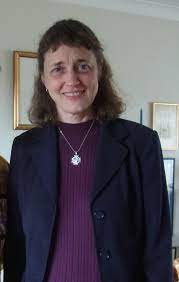
(Dr. Jennifer Wiseman)
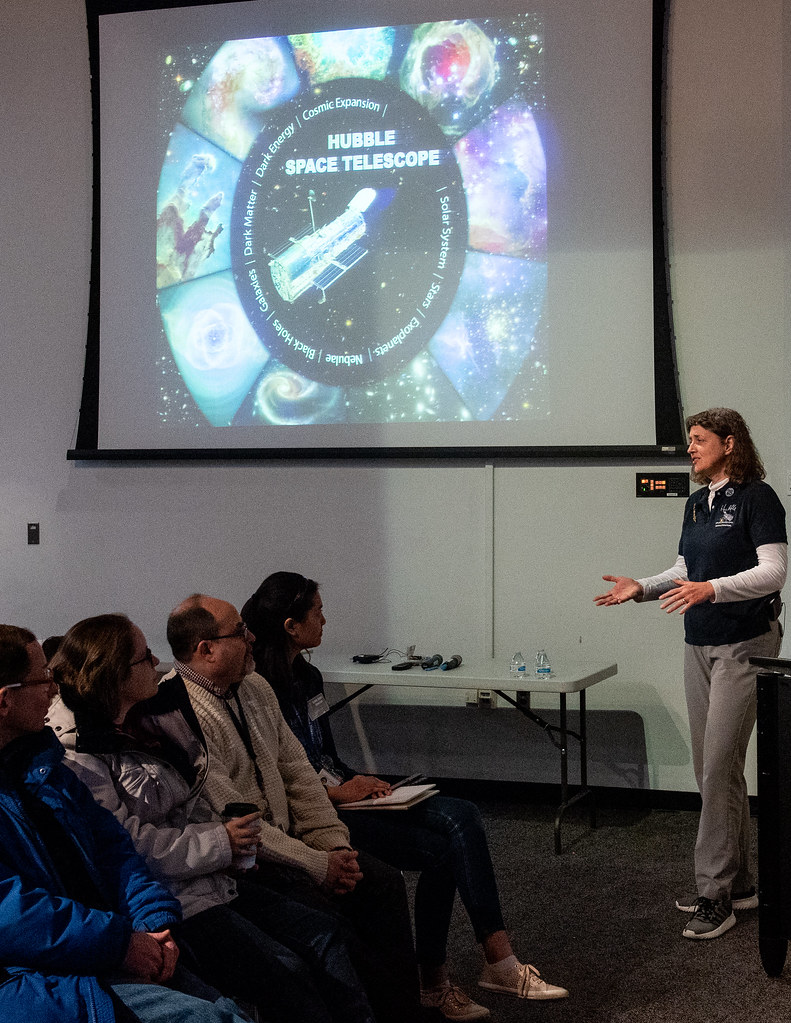
(Jennifer teaching a seminar)

Dr. Wiseman is a sought after speaker because not only is she articulate and passionate about her subject of outer space, but as a believer in Christ she’s a strong defender of exploration as a divinely Christian activity.  She sees no conflict between science and her faith, sharing often a quote from John Calvin [2]:

As Jennifer considers the billions of galaxies, each with billions of stars, she recognizes God is responsible for it all, and has been supporting and sustaining this ever-changing universe over billions of years, long before life existed.

(a star forming, captured by the Hubble Space Telescope)

For some, that realization fosters a feeling of insignificance, but not for her.  Jennifer senses a reverent fear and gratefulness that God engineered the universe to mature over eons of time until at least one planet can support abundant life.

“And I get to be a part of that for just a little while,” she says. “So I’m grateful. It also makes me a little fearful:  am I using my time well [3]?”

Jennifer allows her awe to impact her worship as she contemplates her Savior, the one who sustains the universe (Hebrews 1:3).  “He’s the one responsible for galaxies, black holes, planets, oceans, and porcupines!” she says.

(NASA photo of a dwarf galaxy)

“When we say, ‘Jesus is Lord,’ we must mean that Jesus is Lord of all time and space.  Who was the Lord at the Big Bang when Time began?  Jesus.

“Who was Lord when the first galaxies coalesced and the first stars turned on?  Jesus.

(Colliding galaxies. Photo credit: ESA, Hubble, & NASA)

“Who was Lord as our own solar system came into being?  Jesus.

“Who was Lord during all the epochs of life on Earth—the Cambrian, the Pleistocene, the era of [early humans]?  Jesus.

“And who will be Lord as long as time exists, and forever outside of time as well?  Jesus [4].”

(The Omega Nebula or Swan Nebula)

*     *     *     *     *     *     *     *     *     *

We do praise you, O God, for the wonders of your universe. Thank you for giving us the capability to study and understand its marvels at least in part, providing opportunity to gain insight into your greatness.

(Planetary Nebula)

We also praise you for working at the infinitesimal level—in our individual lives. How glorious we can never come to the end of your attentive loving kindness any more than we can reach the end of your universe.

(Psalm 19:1; Genesis 1:27; 1 Chronicles 29:11;

Matthew 10:29-31; Psalm 57:10)

 Notes


(NASA’s Power Couple, Jennifer Wiseman and Mark Shelhamer)

[1] Meanwhile she married fellow NASA scientist Mark Shelhamer in 1997.  They met at MIT when she was an undergrad and he was pursuing his master’s degree.

[2] https://news.belmont.edu/dr-jennifer-wiseman-speaks

[3] https://blog.emergingscholars.org/2013/07/interview-with-jennifer-wiseman-part-2/

[4] www.letterstocreationists.wordpress.com/2010/11/20/how-science-can-inspire-can-inform-worship-jennifer-wiseman/

Other Sources:

www.technologyreview.com

www.testoffaith.com

https://biologos.org/podcast-episodes/jennifer-wiseman-light-in-space

Photo credits: http://www.flickr.com; http://www.pxhere.com;www.pixabay.com; http://www.stockvault.net; http://www.snappygoat.com; http://www.wikimedia.org; http://www.flickr.com; http://www.azquotes.com; http://www.pxhere.com; http://www.flickr.com; http://www.pixabay.com; http://www.wikimedia.com; http://www.flickr.com; http://www.wikimedia.org; http://www.picryl.com; http://www.flickr.com; http://www.canva.com; http://www.wikimedia.org.

Read Full Post »

I first heard that title-phrase–thin places–from a woman in my writers’ group. (Thank you, Colleen!) It refers to a location or moment in which we’re more aware of God’s presence, where the veil between heaven and earth seems particularly thin, and we experience a taste of how glorious heaven will be.

Someone might say, “But the Bible says so little about our eternal home.  How do we recognize those thin places?”

A few examples may help.  Think of a time when:

  • You encountered a breath-taking panorama of woodland flowers amid greening trees– on a day of sublime spring weather.  Did your heart fill with praise to the Creator for such beauty and perfection?
  • You found your skin tingling and your eyes stinging in response to music.  It may have been a moving classical piece like Rachmaninov’s Piano Concerto No. 2, a rousing hymn such as Great Is Thy Faithfulness, or a soul-touching worship song like Christ Our Hope in Life and Death (Matt Papa/Keith and Kristyn Getty).  And during the moments those lovely notes lingered, were you carried on wings of splendor into the heavenlies?
  • You received an unexpected gift, a note of genuine appreciation, or a sincere affirmation.  Did a wave of bright euphoria sweep through your spirit in response to this delightful love-expression, and did your heart turn to God with overflowing gratitude as the One who inspired it (James 1:17)?
  • A prayer was answered—more perfectly than you imagined—or an over-the-top miracle unexpectedly materialized.  Were you rendered speechless by the glory and wonder of it all?

Just think: 

If we celebrate astonishing beauty in this world . . .

. . . if we’re carried on wings of splendor by events here on earth . . .

. . . and if we experience euphoric moments within imperfect relationships . . .

. . . what pleasures must await in heaven that Christ was willing to die, in order that we might enjoy them with him?

Let the thin places be a reminder:  Though the earth is full of God’s glory (Isaiah 6:3), heaven offers more—much more.

Let that thought lead to praise.

*     *     *     *     *     *     *     *     *     *     *

I praise you, Father, for those times and places I’ve sensed your intimate presence, when my heart felt strangely warmed as if touched by your holy hand.

I praise you for the fullness of joy you provide here and now in spite of my sins and shortcomings.  How precious is your loving kindness, O Lord! 

With happy expectation (a delight of its own), I look forward to the day when you’ll walk me through the veil and I will dwell with you in your glorious realm forever!

(Psalm 23:4; 16:11; 36:7; 23:6)

When or where have you encountered a thin place? Please tell us about it in the comment section below!

Photo credits: http://www.flickr.com; http://www.snappygoat.com; http://www.wikimedia.com; http://www.pixabay.com; http://www.pxhere.com; http://www.pixnio.com; http://www.heartlight.org; http://www.snappygoat.com; http://www.heartlight.org; Nancy Ruegg; http://www.pixabay.com; http://www.wikimedia.com; http://www.heartlight.org; http://www.pxhere.com; http://www.dailyverses.net.

Read Full Post »

As you probably know, Dove chocolates come wrapped in foil with uplifting statements written inside. Not long ago I found this one:

“The more you praise and celebrate your life,

the more there is in life to celebrate.”

A positive attitude of praise and celebration, even for the little blessings, does contribute to a sense of well-being. But there’s an important omission in this quote—the cause of all those blessings.  Perhaps the sentiment should read:

“The more you praise and celebrate God in your life,

the more there is in life to celebrate.”

Now a pleasing sentiment has become solid truth, because with God in our lives, joy is our constant companion.

It requires such a small effort, really—to note the supreme pleasures in ordinary events or to choose a positive perspective.

Sometimes joy involves making a magnificent moment . . .

I’d been mall shopping for several hours, scouring the sales racks to no avail. Suddenly I noticed my sweater—one of my favorites–was no longer tied to my purse. 

Not only had I not purchased an addition for my wardrobe that afternoon, I’d subtracted a piece of clothing already owned.

Retracing my steps seemed daunting; I had browsed in so many stores.  Besides, it was time to meet Steve for dinner at one of the mall restaurants.  

After we ordered our meals, I told him what happened. “I’ll check the lost-and-found after we eat,” I said. “By then maybe someone will have found my sweater and turned it in.”

So that’s what we did.  No sweater.

Steve suggested we stop at the stores where I’d shopped as we made our way back to the car.

At the very first store the eyes of the young sales girl lit up when I asked about a lost sweater. “What color was it?” she asked.

“Cranberry red.”

“We did find it! It’s right back here!” she replied while heading to the rear of the store. Sure enough, the young woman returned with my sweater. Someone had even put it on a hanger.

Well! I thanked her and the manager behind the counter, not knowing which had found it and been so thoughtful.

One of them jokingly said something about doing good deeds for chocolate.

As it happened, just two doors down was the Godiva Chocolate Shop. Before leaving the mall, Steve and I popped in, bought two little boxes, and went back to the clothing store.

When those two girls saw the Godiva bag they whooped in surprise and started to laugh. We did too.

“God blessed me through you by returning my sweater; we wanted to bless you,” I told them.

“Oh! That remark about chocolate was just a joke!” the salesgirl cried. “But you have no idea how much I needed this. Today has been especially rough.” She started around the counter with her arms outstretched. “Come here! I need to give you a hug!”  Then she added, “Look!  I’m crying!”

I had tears in my eyes as well.

The level of endorphins in that shop soared so high the lights shone brighter and the atmosphere crackled with joy.  And all because Steve and I magnified the significance of a small moment and celebrated a God-orchestrated event.

Truly, “The more you praise and celebrate God in your life, the more there is in life to celebrate.”

*     *     *     *     *     *     *     *     *     *

What are you celebrating in life today?  Magnify the moment by sharing your joy in the comments below!

Art & photo credits: http://www.flickr.com; http://www.publicdomainpictures.net; http://www.pixabay.com; http://www.flickr.com; http://www.canva.com.

(Revised and reblogged from April 23, 2015.)

Read Full Post »

We’re now six weeks and five days into spring, and evidence of the season abounds:

  • Greenery flourishes from ground cover to tree tops
  • Lilac, lily of the valley, and hyacinth scent the air
  • Birds perform arias of warbles and trills
  • Butterflies bob from flower to leaf
  • Warm breezes dance through the trees

Most of us revel in these signs of spring.  We find our senses highly engaged, taking in each stage of the transformation. Perhaps that explains why many people experience more joy this time of year. 

I wonder:  what if we engaged our five senses in worship and quiet time with God?  Might some of that springtime joy well up in our spirits—all year long?

Christian psychologist, author, and teacher David Benner would have us understand:

The senses are a doorway to the sacred.

The question becomes:  how might these organs help us connect with God more profoundly?

Here are a few sacred sensory activities to get us started.

Sight

Gaze upon the beauty of the Lord while meditating on his attributes, his works, and wonders (Psalm 27:4).  Record the resulting thoughts on a journal page and increase the impact of reflection.

Revel in the glories of nature and write a page of praise, acclaiming God for his creative genius and impeccable workmanship.

Sound

 Play or listen to worshipful music.

Where words fail, music speaks.

Hans Christian Anderson

Or, listen in silence.

Silence is not an absence of sound

but rather a shifting of attention

toward sounds that speak to the soul.

Thomas Moore

Again, keep a journal and pen at hand to write the thoughts and impressions God speaks into your heart as you listen.

Smell

Begin quiet time by lighting a scented candle.  Perhaps reserve a favorite fragrance for this sacred time of day.  As the aroma fills the air, remember that God is with you, surrounding you with his Presence.

Taste

For many of us a mug of coffee or tea sits alongside our Bibles and journals.  What if we recited Psalm 34:8 as we take that first sip?

Praise God for his goodness; thank him for his blessings. Record one or two of his gifts in a gratitude journal. 

The more we focus on him and his wonderful works, the better we can taste his goodness.  So delight in the sweetness of his unfailing love.  Savor the hearty flavor of his strength.  Satisfy the hunger of your heart with the joy and peace of his presence.*

Touch

Years ago in a class on prayer we participants were instructed to put our hands in our laps, palms up.  After a few silent moments I suddenly felt a tingling sensation.  Was the Spirit of God holding my hands as we prepared to pray?

The professor explained that the pressure on the backs of our hands was causing the phenomenon.  But wasn’t it wonderful to imagine God gracing each of us with his personal touch?  Oh yes!

That evening began a life-long habit of turning my palms upward to pray, to avail myself more fully to the nearness of God.  It’s a divine way to augment worship.

Harold Best believes:

“Of all people, Christians should have the best noses,

the best eyes and ears,

the most open joy, the widest sense of delight.”

As we engage our senses in worship, we will find ourselves ushered through the doorway to the sacred and into the presence of our magnificent and beautiful God.

Do you incorporate any sacred sensory activities into your quiet times with God? Please tell us about it in the comment section below!

*Sarah Young, Jesus Always, Thomas Nelson, 2004, p. 333.

Photo credits: http://www.pxhere.com; ww.flickr.com; http://www.decaturdaily.com; http://www.dailyverses.net; http://www.hippopx.com; http://www.pixnio.com; http://www.flickr.com.

Read Full Post »

Since 1996 spring has become associated with poetry. That’s the year the Academy of American Poets established April as National Poetry Month.

This season does lend itself to getting creative with words. So before we turn the calendar page to May, let’s celebrate spring–with poetry.

To begin, allow Ralph Waldo Emerson to inspire:

In addition to those grand changes around us, we often find delight in minute pleasures as well.  The following cinquain resulted from a small moment at our nearby nature center.

Beetle,

dotted and domed,

Pausing, watching, preparing

To fly away on hidden wings.

Lady bug

Delight is found in humor also.  God had fun with us Midwesterners last week, supplying a day of outlandish weather.  To celebrate I tackled a poetry form called nonet (non’-et):  nine lines starting with nine syllables in the first and descending in number until the last line only includes one syllable.

April 21, 2021

Sun and Snow engaged in tug-of-war.

At dawn, Snow controlled the landscape,

cloaking every blade and branch.

But Sun fought valiantly

and gained back her ground.

However, Snow

returned!  Yet . . .

. . . spring Sun

Won!

Sun and balmy breezes of April send many out to their gardens, preparing for May planting while dreaming of what’s to come:

Come fall however, our gardens will fade to pale stems and dried petals.   “The grass withers and the flowers fall,” wrote the prophet Isaiah (40:8a).  “But,” he added,  “the word of our God endures forever” (v. 8b).

In celebration of the eternal spring of God’s Word, I experimented with the pantoum form—a poem that includes four-line stanzas in which the second and fourth lines of each become the first and third lines of the next.  The last line of the poem is often the same as the first.

Growing in God’s Word

Thank you, Father, for the delights of scripture!

Your Word refreshes my soul.

Your promises produce security, hope, and comfort.

Your truth sows wisdom, encouragement, and strength.

Your Word refreshes my soul.

Understanding develops contentment.

Your truth sows wisdom, encouragement, and strength,

And diligent study causes my spirit to flourish.

Understanding develops contentment.

Your Word abounds with wonderful things,

And diligent study causes my spirit to flourish.

Thank you, Father, for the delights of scripture!*

*     *     *     *     *     *     *     *     *     *

I praise you O God for Spring, its delights of birth and life that feed our souls.  I praise you also for your Word, its delights and depths that provide the nutrients for a fulfilling spiritual life.  May I send my roots deep into your truths.

*Psalm 119:24; 28 AMP; Ephesians 1:13; Psalm 119:14; 50 NLT; 19:7; 119:28 NLT & NIV; Proverbs 19:23; 119:15-16; 119:18

Photo credits: http://www.wikimedia.com; http://www.hippopx.com; Nancy Ruegg; http://www.pixabay.com; http://www.flickr.com; http://www.canva.com; http://www.pxhere.com.

Read Full Post »

The internet offers plenty of advice for maximizing time and effort in order to achieve success. The suggestions include:

  • Prioritize and protect your agenda.  Identify the crucial tasks for each day and focus on those items first.  Limit interruptions; shut down distractions.
  • Build an efficient routine into your schedule to streamline how time is allocated.
  • Pursue your own goals; don’t let others set them for you.
  • Network—especially with influential people who can expedite your success.

Jesus failed to follow any of that advice.

Instead:

His agenda shifted often, and he allowed frequent interruptions.

People interrupted his teaching and traveling all the time with requests for miracles.  Jewish leaders interjected questions while he was speaking.  When he tried to take the disciples to a quiet place for rest, the crowds followed, eager to hear him preach. 

And out of compassion, Jesus complied. [1]

Sometimes even his interruptions were interrupted.

While answering a question of John the Baptist’s disciples one day, a ruler intruded upon the conversation, begging him to come and raise his daughter from the dead.  En route to the ruler’s house, another interruption occurred when a woman touched his robe in hope of healing.[2]

It’s a wonder he ever arrived at his intended destinations.

Jesus had no routine.

Scripture seems to indicate Jesus lived in the moment—teaching, building relationships, healing, and performing miracles as opportunities presented themselves.

However, Christ did make time for important habits, including seclusion, prayer, and worship.[3]

Jesus’ overarching goal in life was to accomplish his Father’s goal.

“For I have come down from heaven

not to do my will but to do

the will of him who sent me.”

–John 6:38

Jesus set his sights on the joy awaiting him, when all earthly pain, frustration, and humiliation would be over and he’d be seated at the right side of his Father’s throne.[4]

Jesus built relationships, not a network.

At the end of three years, he’d assembled 120 followers.[5]  That’s an average of 40 per year; less than one per week.  Not very impressive.

Yet Jesus was the most successful Person who ever lived because:

True success is excellent living—

when a person’s thoughts, decisions,

and actions honor God.

–Chrystal Evans Hurst[6]

And Christ accomplished that perfectly.  

Now, thousands of angels encircle his throne, giving Jesus praise, honor, and glory because of his triumph over sin and death.[7]

What about us?  Are we focused on the culture’s view of success or God’s? 

Do we accept—even celebrate—what he chooses to do through us and then leave the results to him?

*     *     *     *     *     *     *     *     *     *     *     *

Lord God, help me to be a failure like Jesus! I confess that worldly standards of success cloud my vision of what true excellence entails:  obedience to you. Remind me you know what you’re doing and you do all things well; circumstances are not reliable indicators.  I reaffirm my trust in you whose works are always perfect.

(Jeremiah 7:23; Proverbs 19:21; Deuteronomy 32:4)


[1] Matthew 9:18-19; 21:23-24; 20:29-34; Mark 6:30-34

[2] Matthew 9:14-26

[3] Mark 1:35; Luke 4:16

[4] Hebrews 12:2

[5] Acts 1:15

[6] Kingdom Woman Devotional, Tyndale House Publishers (2013), p. 49.

[7] Revelation 5

Art & photo credits: http://www.pixabay.com (2); http://www.freebibleimages.org (2); http://www.canva.com; http://www.dailyverses.net; http://www.pxhere.com; http://www.canva.com.

Read Full Post »

One day a neighbor of Fanny Crosby complained, “If I had wealth I would be able to do just what I wish to do, and I would be able to make an impression in the world.”

Some might have expected Fanny to reply, “At least you have eyes that can see.”

Fanny had been blind since the age of two months. Few would blame her for reminding the dissatisfied neighbor that his lack did not begin to compare with her own.

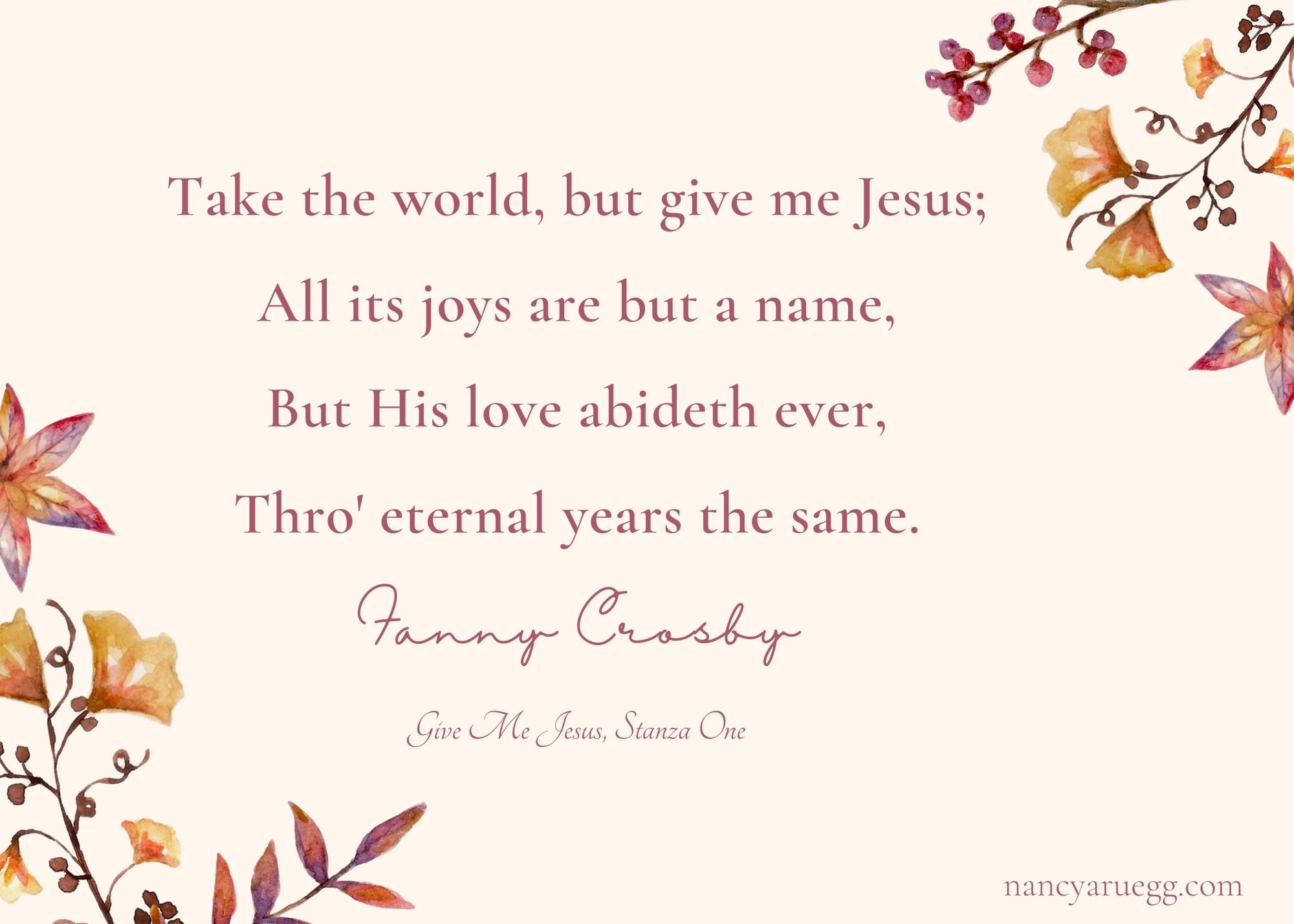
But Fanny answered instead, “Well, take the world, but give me Jesus” (1).

(Fanny Crosby)

Why would Fanny respond like that?  She provided part of the answer in the hymn she wrote, inspired by the above encounter.  The title:  Give Me Jesus (1878).

Her reasons mentioned included his everlasting love, watchful care, deep mercy, and redemption for our sins.

Fanny’s 8000+ hymns and choruses celebrate numerous other reasons, as you can imagine.

If I ever wrote a hymn, the lyrics might include such blessings as these:

With Jesus,

Every need is provided,

Every promise fulfilled,

Every delight enhanced (2).

With Jesus,

Every sin is forgiven,

Every shame erased,

Every grace applied (3).

With Jesus,

Every worry is calmed,

Every fear assuaged,

Every prayer answered (4).

With Jesus,

Every decision is guided,

Every step ordered,

Every circumstance controlled (5).

With Jesus,

Every moment is lovingly attended,

Every necessary truth revealed,

Every God-given task empowered (6).

To view these gifts altogether is like gazing into an overflowing treasure chest.  We find the impact of each blessing magnified, the splendor augmented, the wonder increased by the sheer number of gifts.

And wonder ushers us into worship.

We praise you, O holy God!  You are completely separate from all else in the universe.  No one is your equal in power, wisdom, splendor, and love—all manifested in the glorious work you do in us and for us.

Thank you, Giver of all good gifts, for every kindness mentioned above and more.

With Fanny each of us can say:


Of course this post includes only a partial list of the blessings we experience with Jesus. What would you add? Please share in the comment section below!

Notes:

1. https://wordwisehymns.com/2011/12/16/take-the-world-but-give-me-jesus-2/

2. Philippians 4:19; Psalm 145:13b; Psalm 16:11

3. 1 John 1:9; Isaiah 43:25; John 1:16 ESV

4. Philippians 4:6-7; Psalm 23:4; 1 John 5:14-15

5. Psalm 32:8; Psalm 37:23 NLT; Psalm 103:19

6. Psalm 23:4; John 8:32; Philippians 2:13

Art & photo credits: http://www.worldwidehymns.com; http://www.canva.com; http://www.dailyverses.net; http://www.canva.com; http://www.dailyverses.net; http://www.flickr.com; http://www.canva.com (2).

Read Full Post »

On January 25, 1905, diamond mine superintendent Frederick Wells inspected the walls of the Premier Diamond Mine in South Africa—as usual.  Suddenly his practiced eye caught a telltale glimmer in the rock.  

Workmen cut free the luminous stone that very day, then took it to be weighed in the office of mine owner Thomas Cullinan.

The miners knew the fist-sized gem was a stellar find, but no one expected what the scale revealed.  Before them lay the largest diamond ever found—3,106 carats worth, and a perfectly clear specimen except for one black spot in the middle.

Frederick Wells with the Cullinan Diamond

Named for the mine owner, the Cullinan Diamond was sold to the Transvaal provincial government and eventually presented as a birthday present to England’s King Edward VII in 1907. 

King Edward hired master-lapidary I. J. Asscher of Amsterdam to divide the stone.  Asscher studied the Cullinan for six months before making the first cut, and subsequently created nine major stones along with ninety-six smaller ones.

Opened in 1854; still in business.

The largest diamond is called the “Star of Africa I” or “Cullinan I” and sits atop the British royal scepter; Star of Africa II is part of the Imperial State Crown.[1]

Star of Africa I is the pear-shaped embellishment atop the scepter.
Star of Africa II, front and center of the crown, just above the band of ermine.

Why did God create diamonds?  For the same reason he created everything in the universe:  to display his glory.[2]

Diamonds offer a magnificent example of God’s creative power, as he applied heat and pressure to simple black carbon and created mesmerizing stones.

Of course, it takes tremendous pressure (50,000 times more than that at the earth’s surface) and severe heat (2000 degrees Farenheit) for the transformation to take place.  Such extreme conditions only occur deep in the ground—at least 90 miles below the surface.

Humans have only been able to drill a little over seven miles into the earth.  So how were diamonds even discovered?  Because of another spectacular display of God’s power:  volcanoes, which spew them up to the surface.

And though raw diamonds do glimmer, their full magnificence is not released until the lapidary cuts the stones on all sides, to maximize the refraction and reflection of light. Today’s popular brilliant cut requires 58 facets. The process takes up to two weeks.

The ancient Greeks believed that a diamond was a chip of star that had fallen to earth.  We smile at their naiveté until we learn astronomers discovered a star in 2009 that has cooled and compressed into a massive diamond—10 billion trillion trillion carats worth!

Imagine the smile on God’s face as the scientists proved lyricist Jane Taylor closer to truth than she knew: “Twinkle, twinkle, little star . . . like a diamond in the sky” (1806).

With Job, we can affirm:

In addition to displaying God’s glory, diamonds also provide valuable lessons—much as he’s used trees, sheep, and ants to teach us.[3]  At least two lessons have been encapsulated in memorable quotes. 

Lesson #1: 

You know what else makes God smile?  Transforming black-carbon lives into radiant diamond-people.  Think of those like Kirk Cameron, George W. Bush, and Franklin Graham, all of whom once lived in dark rebellion and now reflect the light of Christ.

Such transformations require a lengthy process, and most often the heat and pressure of difficult circumstances, but the results are quite spectacular.[4]

Lesson #2:


A lapidary reminds us of our Heavenly Father.  He chips away at our self-centeredness and pride until we’re Stars of Heaven, fit for his crown and radiating his glory in brilliant perfection.[5]

So, my fellow stars-in-process, “let faith and patience have their perfect work, for in the day when the crown will be set on the head of the King Eternal, Immortal, Invisible, one ray of glory will stream from you”—Charles Spurgeon.


Notes

[1] https://www.history.com/this-day-in-history/worlds-largest-diamond-found# and https://www.capetowndiamondmuseum.org/blog/2017/01/worlds-largest-diamond-the-cullinan/

[2] Psalm 19:1

[3] Jeremiah 17:7-8; Psalm 23; Proverbs 6:6-8

[4] Hebrews 12:5-11

[5] Zechariah 9:16; 2 Corinthians 3:18

Photo images: http://www.wikimedia.org; http://www.flickr.com (2); http://www.wikipedia.org; http://www.canva.com (2); http://www.wikimedia.org.

Read Full Post »

Most of us have asked at one time or another, “Why does God allow so much suffering?  Why doesn’t he intervene?” 

Surprisingly, people of the Third World where suffering is common don’t ask these questions.  They accept the fact that no one leaves this life without enduring times of trial and distress [1].

Even God’s own Son endured suffering. Unimaginable suffering.  And it didn’t begin with the physical torture inflicted by Roman soldiers or the horrific crucifixion sanctioned by Pilate.

It began the night before, in the garden of Gethsemane, as he experienced overwhelming desperation and sorrow, and his sweat fell like drops of blood [2].

BUT!  God Almighty takes the worst deeds of man that cause the greatest pain and turns them into glorious victory with eternal benefits.

As we wait for that day, God uses our suffering to fulfill higher purpose beyond our comfort and prosperity—purposes such as these:

God doesn’t intervene so we can learn to surrender and obey.

Even Jesus “learned obedience from what he suffered” [3]—poverty, hunger, temptation, pain, exhaustion, derision, and stress.  Anything we face, he faced.

God knows if we don’t learn to surrender to his ways and purposes, we end up living to please ourselves—and not liking the selves we’ve pleased.

On the other hand, obedience does lead to confidence in God, prosperity of soul, and the ability to face life with resilience and poise.

God doesn’t intervene so we can develop character.

Suffering works for the believer, not against, producing perseverance which leads to character; and character to hope [ 4].

So we strive to act wisely and in the process learn self-control.  We withstand discomfort and learn fortitude.  We endure self-sacrifice and learn how to love.

God doesn’t pour the rains of affliction upon our souls for nothing.  “Springing up beneath the pounding rain are spiritual flowers.  And they are more beautiful and fragrant than those that ever grew before in your stormless and suffering-free life” [5].

God doesn’t intervene so we can inspire others.

Some of you may know the name Bill Sweeney, a popular blogger diagnosed with Lou Gehrig’s disease in 1996.  He graduated to heaven just after Christmas 2021. 

Bill outlived many others with the same diagnosis, but he suffered much.  For years his entire body was immobile.  Eventually Bill was composing his posts on a computer that tracked eye movements—posts that reflected deep faith, great strength of spirit, and delightful humor.

Commenters affirmed again and again Bill’s impact in their lives as he provided stellar encouragement and inspiration, all the more impactful because of his deteriorated health.

God doesn’t intervene so we can exhibit faith.

Bill Sweeney exhibited great faith even though he was incapable of anything beyond typing with eye movements.  But it wasn’t the suffering itself that produced spiritual strength.  It was his response.  Without self-pity he lived his life and shared his heart—humbly and honestly. And thousands of people found hope.

It’s important to understand: Christ did not suffer to exclude us from suffering; he suffered to exclude us from the consequences of our sins.  However, we can be confident of this:

That means Bill Sweeney’s sacrifice of suffering counts for all eternity.

And God will make your sacrifices of suffering count for all eternity too [6].


[1] Philip Yancey, Grace Notes, p. 69.

[2] Luke 22:44; Mark 14:34-36

[3] Hebrews 5:8

[4] Romans 5:3-4

[5] L. B. Cowman, Jim Reimann, ed., Streams in the Desert, June 15.

[6] F. Elaine Olsen, Beyond the Scars, p. 163.

Photo credits: http://www.wikimedia.com; http://www.hippopx.com; http://www.canva.com; http://www.heartlight.org; http://www.flickr.com; http://www.canva.com; http://www.dailyverses.net.

Read Full Post »

« Newer Posts - Older Posts »

When the House is Quiet

Impressions Becoming Expressions

Mitch Teemley

The Power of Story

Still Traveling

Impressions Becoming Expressions

Living Our Days

Gaining a heart of wisdom

He Said What?!

I'm Patty, and my husband and I are living with our adult son who has autism and epilepsy. I love sharing lessons learned from life around me, especially life with Aaron.

Meditations of my Heart

Impressions Becoming Expressions

Linda Stoll

Impressions Becoming Expressions

Signora Sheila

Where faith meets la dolce vita

Heidi Viars

Finding the Image of God