Feeds:
Posts
Comments

Archive for the ‘Uncategorized’ Category

Hurricane Frances, 2004, provided Steve’s and my first experience with that level of storm, even though we’d lived in Florida nearly thirty years. For twelve hours we listened to the roar of the wind and the banging of storm shutters, because Frances did not whoosh through the state, she shuffled.
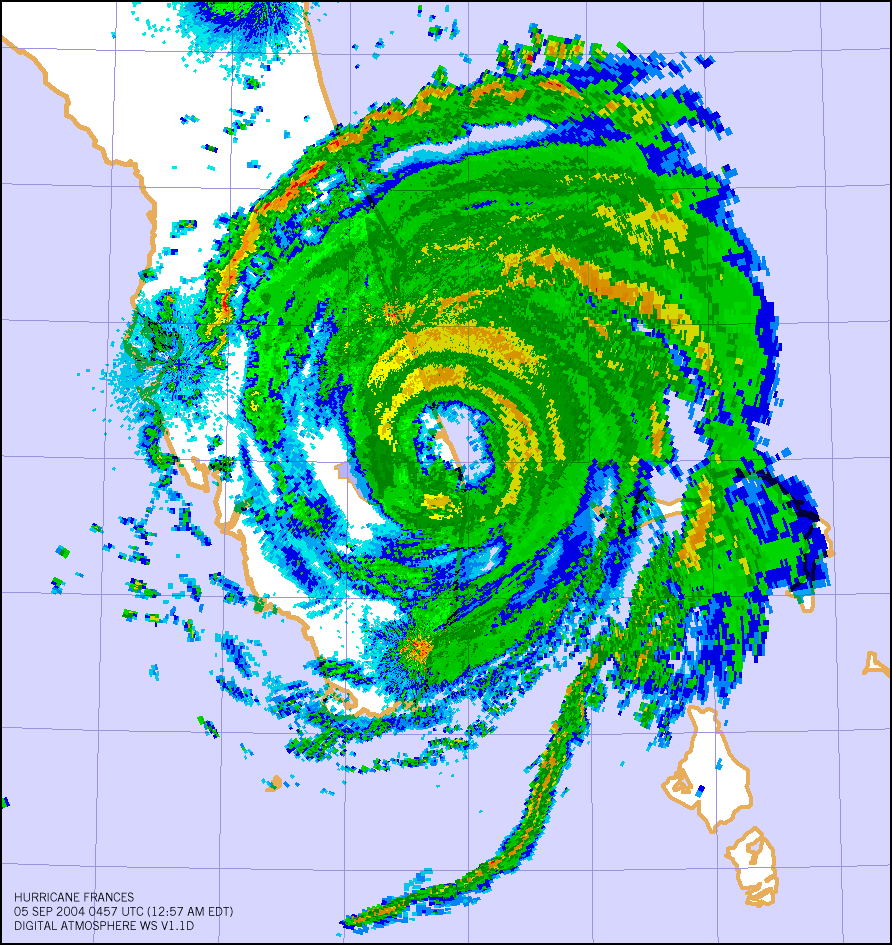
 

(Note the eye.  That’s just slightly north of where we lived.)


Challenges continued after the storm, with a steam bath of heat and humidity compounded by the absence of electrical power for five or six days.

Even so, we celebrated:

  • Minimal damage–a mangled pool enclosure, many missing shingles, and a debris-filled yard. That was it.
  • A neighbor who shared his generator power with us, preserving the food in our refrigerator.
  • Time to rest after the ordeal of preparation; time to read and just be together.

The most memorable moment, perhaps, was the night we lathered up with Off, stood in the backyard, and stared into the cloudless heavens. (Plodding Frances had made a clean sweep of the sky on her way through.)

With the power out all along the coast of South Florida, more stars were visible than I thought possible to see without a telescope. Thousands upon thousands pierced every square inch of sky. Even one arm of the Milky Way spiral was discernible to the west.



Such an image is a worthy accompaniment to Philippians 2:15, where Paul urges us to be blameless and pure in a crooked and perverted generation, “among whom you shine like stars in the world” (emphasis added).


Paul surely had plenty of opportunity during his travels to contemplate the night skies. His view of the stars would always have been unencumbered by manmade light. And with all the ancients, he would have known that stars always shine brightest on the darkest nights.

So perhaps one inference we can make from Paul’s shine-like-stars encouragement: The brighter we shimmer with love, joy, and a positive outlook, the more we’ll stand out from those who focus on self, criticism, and negativity.

My thoughts turn toward those of you reading this right now who face dark circumstances in your lives. Every day you endure physical and/or emotional pain, yet you glow! You’re lit up by the Spirit within! And you scatter beams of grace to everyone around you–your family and friends, coworkers and neighbors. We bask in the light of your example and praise God for you.
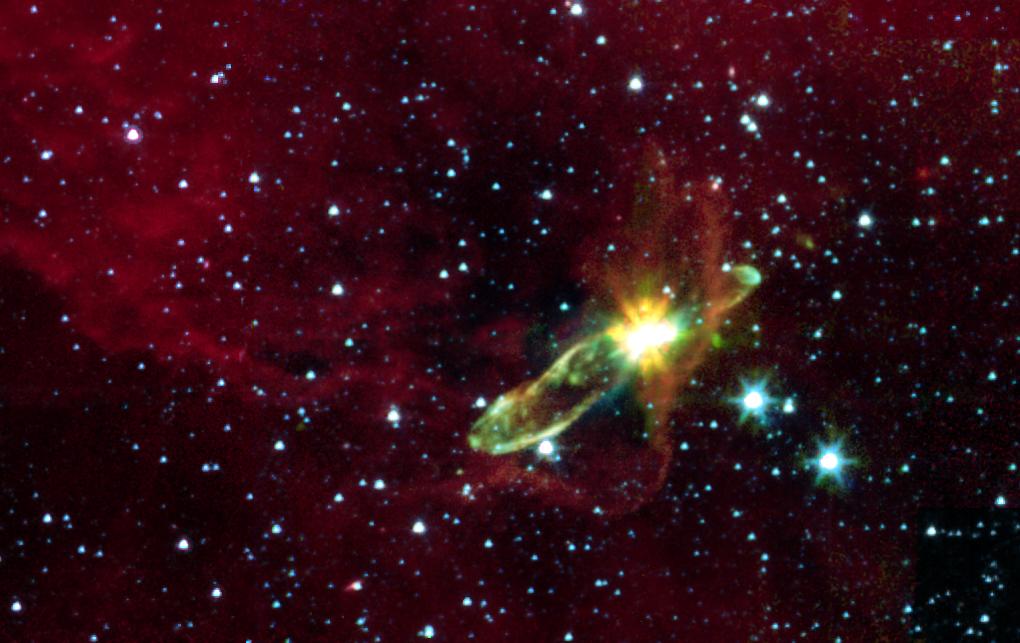


Another inference we might make from Philippians 2:15: If only one pin-point star gleamed in the sky, we’d hardly notice. It’s the sheer number of stars that grabs our attention.


I wonder if Paul wanted us to contemplate the power of numbers. By the time he wrote to the Philippians, Christian churches had been established throughout much of the Roman empire. Today, thirty-seven million Christian churches spread across the globe*, and 2.3 billion people identify themselves as Christians**. That’s nearly one-third of all people on Planet Earth.

God has invited us to be part of a cosmos of believers—as grand as the night sky and awe-inspiring as the stars.

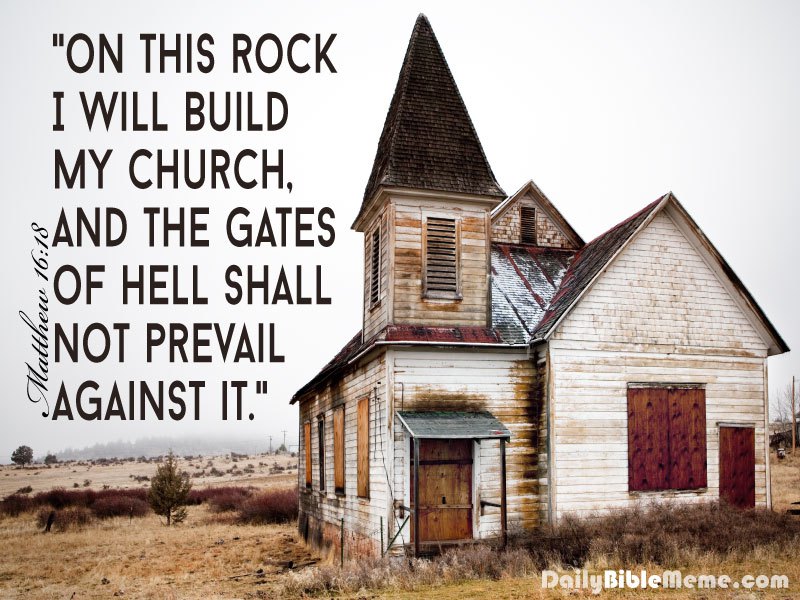
Just as the stars cannot be destroyed, nothing can destroy his church. Members may be persecuted, oppressed, and even murdered for their faith, but the church will not be extinguished (Matthew 16:18).


For 2000 years, kings, emperors, and dictators have tried. No one has succeeded. There are more believers in Jesus than ever.

True, people may scoff at or even refuse to listen to our words.  But a shining example of star quality is difficult to refute—especially against a dark sky.


*     *     *     *     *     *     *     *     *     *


Lord God, on any given day I fail to shine like the star you’ve created me to be. I want my words and actions to manifest YOU, to be a glimmer of hope, encouragement, and joy to others. Just as the stars continually gleam in the heavens, I pray for consistency in my life—consistency to rely upon you, my Source of delightful Light.


* http://www.christianpost.org

**http://www.pewresearch.org


Photo credits:  www.wikimedia.com; http://www.Forestwander.com on wikimedia.com; http://www.pinterest.com; http://www.jpl.nasa.gov; http://www.goodfreephotos.com; http://www.dailybiblememe.com; http://www.flickr.com.)


Read Full Post »


In a rented room not far from the State House in Philadelphia, Thomas Jefferson found himself surrounded with books and pamphlets as resources for a daunting assignment: to compose the first draft of a Declaration of Independence.

The others on the five-person committee had convinced Jefferson he was the best choice for the task. He had few enemies in the Continental Congress and was already known as an excellent penman, having drafted the Virginia Constitution.

Among Jefferson’s resources was the pamphlet, Vindication of the Government of New England Churches by Rev. John Wise. Originally published in 1717, it was reprinted in 1772 for its persuasive arguments backing the cause of liberty from British tyranny.*

Now why would New England churches have needed to defend themselves?

As early as 1687, the Anglican Church of England sought to extract tax revenue from the colonial churches. John Wise was the Congregational pastor of Ipswich, Massachusetts at the time. In a sermon he used scripture to assert that taxation without representation was tyranny. He also led the revolt against the Royal Governor, Sir Edmond Andros, in response to the tax levy.

Wise and other leaders were heavily fined and briefly imprisoned. But a group of Massachusetts citizens conducted a lawful “citizens’ arrest” of the governor and sent him back to England. As a result of their effort to be free from oppression, Ipswich became known as “The Birthplace of American Independence.”


John Wise’s experience with unlawful taxation and his persuasive arguments against tyranny made his work a likely resource as Thomas Jefferson prepared to draft the Declaration.

But where did John Wise obtain those compelling arguments? Surely they came from the Bible.

For example, Wise wrote: “Every man must be acknowledged equal to every man.”

Thomas Jefferson similarly wrote, “All men are created equal.”


That principle is found in Malachi 2:10.  “Have we not all one Father? Did not one God create us? Why do we profane the covenant of our fathers by breaking faith with one another?”

Another example of Wise’s influence includes: “The end of all good government is to cultivate humanity and promote the happiness of all, and the good of every man in all his rights, his life, liberty, estate, honor, etc., without injury or abuse done to any.”

Sound familiar?

In the Declaration we read, “All men…are endowed by their Creator with certain inalienable rights, that among these are life, liberty, and the pursuit of happiness.”

“Inalienable rights” are those God bestowed when he created humankind. Because they are from God himself, governments do not have the prerogative to take them away. Examples are found within our Bill of Rights. Others include: to earn a living and keep the profits of our labor, to move freely within the country or leave the country, and to live secure in our homes.

Such rights should be respected by all, because each of us was created in the image of God (Genesis 1:27).  He is our Heavenly Father, who loves each of us passionately (Jeremiah 31:3) and desires we act justly toward one another (Micah 6:8).


What parent doesn’t desire that siblings live happily and peacefully together?

But“Life, Liberty, and the pursuit of Happiness” for all are only possible if we follow Jesus’ teaching of the Golden Rule: “In everything do to others what you would have them do to you” (Matthew 7:12).

Finally, one more example from John Wise:  “Only by the voluntary consent of individuals can a government have authority, since it must be delegated from the individual.”

Jefferson included similar reasoning in the Declaration. “To secure these rights, governments are instituted among men, deriving their just powers from the consent of the governed.”

Even kings are under the law of God, not above it. They have no right to arbitrarily make laws and decrees that benefit them but are unjust to the governed. Again, scripture makes such truth clear:


(“Woe to those who make unjust laws,

to those who issue oppressive decrees,

to deprive the poor of their rights

and withhold justice from the oppressed of my people,

making widows their prey and robbing the fatherless.”

–Isaiah 10:1-2 NIV)


With such inspiration from John Wise and others, Jefferson picked up his pen and began to write:


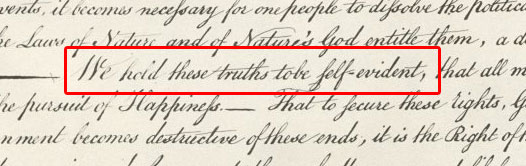
“We hold these truths to be self-evident…”


Indeed, the truths espoused by the Declaration of Independence are based on absolutes, ordained by our Creator God for our best welfare–as individuals, communities, and nations.


Lord, help each of us live out these self-evident truths.

________________________________


*One of the committee members, John Adams, wrote in a letter to his friend, Timothy Pickering, in 1822:  “There is not an idea in it [the Declaration] but what had been hackneyed in Congress for two years before…Indeed, the essence of it is contained in a pamphlet, voted and printed by the town of Boston before the first Congress met.”  According to Dr. Paul Jehle, Executive Director of the Plymouth Foundation, that pamphlet was Pastor Wise’s Vindication of the Government of New England Churches.  (“The Origen of the Declaration,” http://www.plymrock.org).


Resources:


Art & photo credits:  www.wikimedia.org; http://www.pinterest.com (2); http://www.godswordimages.com; http://www.slideshare.net; http://www.ushistory.org.


Read Full Post »


“Ask the animals, and they will teach you,

or the birds of the air, and they will tell you;

or speak to the earth, and it will teach you,

or let the fish of the sea inform you.

Which of all these does not know that

the hand of the Lord has done this?”

–Job 12:7-9


It’s true. Just a bit of knowledge in the fields of zoology, botany, or geology does inform us of the precision with which our God created all things:

  • Every living thing is provided just the right kind of nourishment it needs.
  • The Amazon rain forest supplies the entire planet with half its oxygen.
  • Rivers respond to God’s laws of physics, causing them to meander instead of run straight. As a result, calm estuaries form so young aquatic animals are protected while they grow.


Countless facts such as these make it difficult to disregard the evidence: A Supreme Being had to mastermind all this.

Even mathematical explorations lead us to the same conclusion.

Take for example Fibonacci* numbers—a sequence where each succeeding number is the sum of the two preceding numbers. 0+1=1; 1+1=2; 1+2=3, 2+3=5, and so on, produces this sequence: 1, 2, 3, 5, 8, 13, 21, 34, 55, 89, 144, 233, etc.

So what’s the big deal? someone may ask. There are more than a few big deals.

First, the number of petals on a flower very often comes from the Fibonacci sequence. The calla lily has one petal; Euphorbia, two; trillium, three; violets, five; bloodroot, eight; and black-eyed Susan, thirteen. The list could continue.


Or, imagine each Fibonacci number as the sides of a square arranged like this:


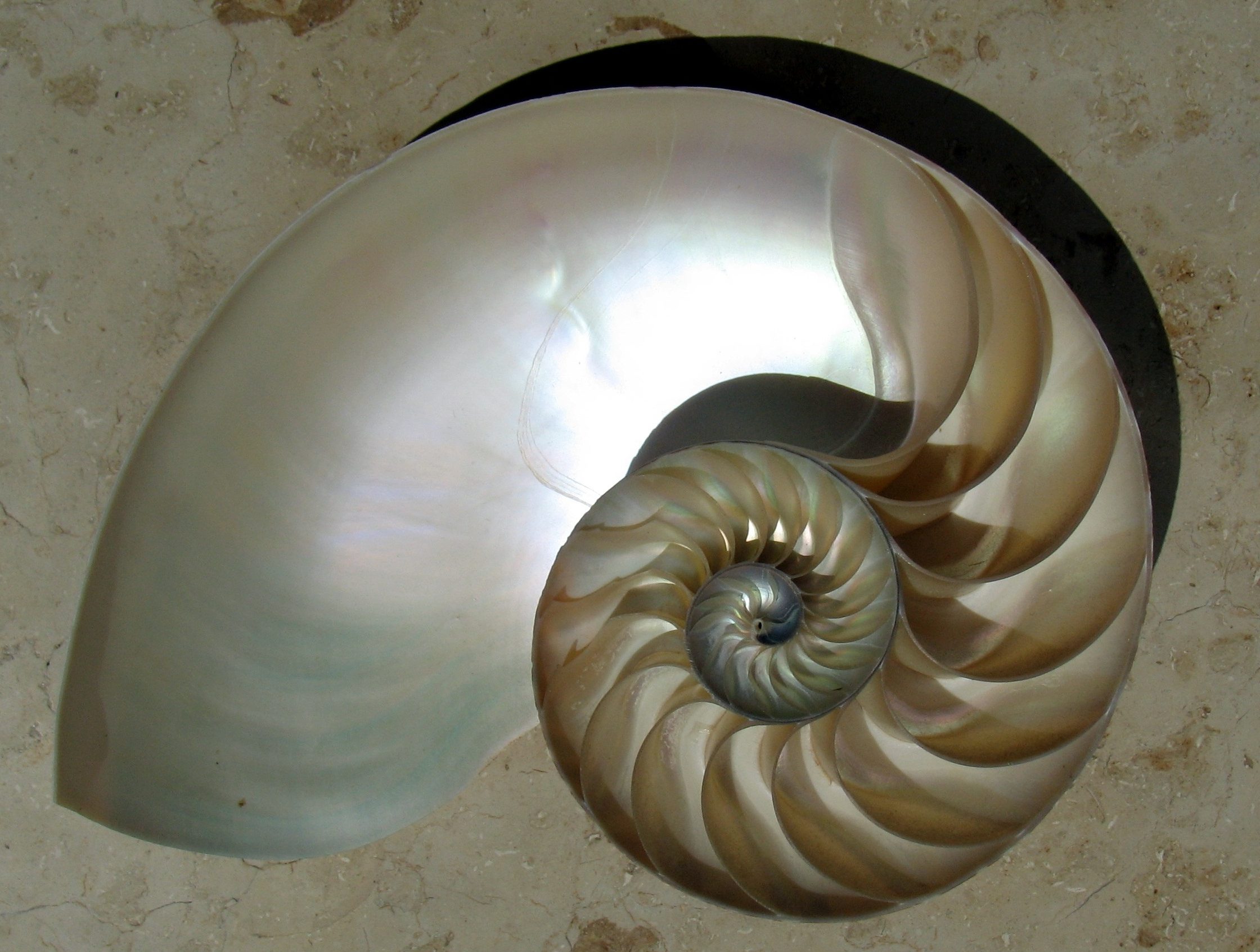
Now add an arc from opposite corners in each square, to form a spiral. Someone designated it the Golden Spiral.


Look familiar?  You’ve seen it in the interior view of a nautilus shell,


the pattern of sunflower seeds,


the tail of a seahorse,


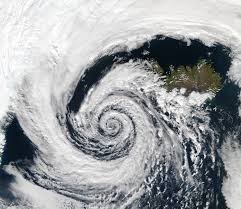
the rotation of a hurricane,


and the expansive reach of some galaxies.


Other spirals are also in evidence:

Imagine holding a stem of leaves. Look carefully at how each leaf is attached to the stem and you’ll see a spiral pattern. Now put your (imaginary) finger on one leaf and turn the stem to find another leaf in the same position on the stem. The number of turns will be a Fibonacci number.

Count the leaves in between those two leaves you’ve just identified, and again, the total will be a Fibonacci number. For example, the ratio of turns to leaves is 1:2 for elms, 1:3 for beech, 2:5 for oak.


Trees are not the only vegetation to display spirals in a consistent ratio of side-by-side Fibonacci numbers. The scales of pinecones grow in opposing spirals in a 5:8 ratio, the bumps on a pineapple are 8:13.

Even the DNA molecule measures 34 angstroms long by 21 angstroms wide for each full turn of its double helix spiral—again, neighboring numbers in the Fibonacci sequence.


Similar ratios are found on sunflowers. The number of seed-spirals going in one direction will add up to a Fibonacci number; those going in the other direction will be a neighboring Fibonacci number.


Evidence of these number sequences is so vast in creation, The Fibonacci Quarterly was established in 1963, published by The Fibonacci Association. Their purpose is to document the occurrence of the phenomenon in nature.

I wonder if they would agree with Galileo (1564-1642) who proclaimed:


“Mathematics is the language

in which God has written the universe.”


Just the Fibonacci sequence alone gives much proof.


*     *     *     *     *     *     *     *     *     *


Glorious God, you are the Artist who fashioned mountains and sunsets of breath-taking beauty. You are the Scientist who designed flora and fauna to thrive and regenerate. You are the Mathematician who shaped the world with symmetry, organization, and pattern.   The whole earth is filled with your glory (Isaiah 6:3)—down to the last molecule! How can we express the overwhelming wonder that fills our hearts?        


* Leonard da Pisano, also known as Fibonacci (son of Bonaccio), discovered the sequence pattern around 1200 A.D.


(Art & photo credits:  http://www.pexels.com; http://www.pixhere.com; http://www.wikimedia.org (3); http://www.wikipedia.org; http://www.peakpx.com; http://www.flickr.com; http://www.wikipedia.org (2); http://www.wikimedia.org (2); http://www.pxhere.com.

Read Full Post »


Years ago I created a memory booklet to celebrate my dad on his birthday. Good thing I did. Over the intervening decades, some of those recollections would surely have been forgotten. And now the memories are more precious than ever.


(Dad and me 1964)


Their meaning, however, goes deeper than mere sentiment. Throughout my life, Dad has modeled the loving ways of my Heavenly Father.

For example:

Dad often took my brother and me to the community pool or on bike rides through the back streets near our home.  We also accompanied Dad to the hardware store, the lumberyard—even the dump! When he asked us to tag along, we always said yes. It meant quality time with our hero.

How incredible to realize God Almighty desires our intimate company, too (2 Corinthians 6:16).


    *     *     *


John and I had our own personal shoe fitter—Dad. He’d gently press on toes, instep, and heel, to ensure proper fit. Such attention to detail was his modus operandi. As a result, we could trust him. He always had our best interests at heart.

God also carefully attends to the details of our lives (Isaiah 40:11).   For a number of months in 2013 we searched realty websites for a new house. Two weeks before the actual walk-throughs, a perfect brick ranch just happened to become available. Though we looked at other homes, this became his obvious choice for us—a true gift.


 *     *     *


Dad started taking me to the library as a toddler. It was on his lap and my mother’s I learned to appreciate books.

My Heavenly Father guided me to appreciate his Book.  Nowhere else have I found such wisdom, consolation, inspiration, and direction. David was right: The scriptures are more valuable than gold (Psalm 19:10).


 *     *     *


One time I ran out of reading material while sick with a virus. Dad went to the library to remedy the situation. Because he knew me well, Dad could choose books he was reasonably confident I’d like. And sure enough, I read all four.


My Heavenly Father knows me more intimately yet and cares about my interests (Psalm 139:1-3). After I had taken up writing again, a woman at church just happened to invite me to her writers’ group. Not only did the members offer encouragement and challenge, they became delightful friends as well.


  *     *     *


Dad and I were on an errand at Sears when we passed the bicycle display. Suddenly he asked, “If you’re willing to pay half out of your savings, what do you say we get you a new bike today?”   My heart pounded so loudly at such a glorious surprise, I found it difficult to focus on the decision of red or blue. (Blue won.)

God in heaven blesses us in delightful, surprising ways as well (Matthew 7:7-11). One afternoon a member of our church (where my husband, Steve, was pastor) called to seek a recommendation on a car. Why me? he wondered.  Steve thought perhaps she planned to purchase one for her grandson’s graduation. But no, it was for us.


    *     *     *


When I was seven or eight, Dad taught me the card game, “21,” so I could practice addition and subtraction. (Math never was my friend.) Not only did he sacrifice his time to help me, he aimed to make the exercise pleasurable too.

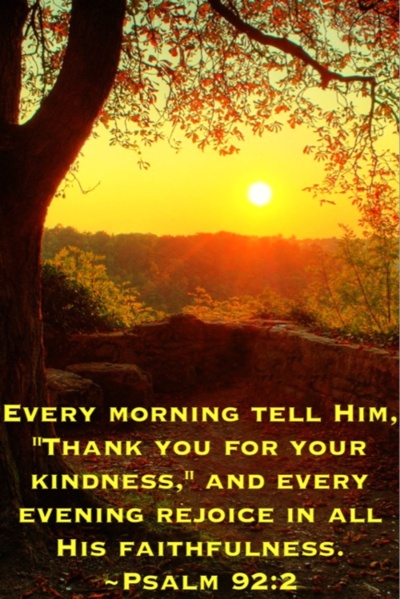
My Heavenly Father has gently taught me life skills too (2 Timothy 3:16-17). Recently I came across Ephesians 5:4 about what should be coming out of my mouth instead of foolish talk. Paul encourages thanksgiving, because it is life changing.   Positive thoughts become positive words that foster positive action. In addition, God knows a grateful heart is a joy-filled heart (Psalm 92:1-2, 4).


  *     *     *


My father is ninety-three, and still a remarkable man of strength, wisdom, and faith. His godly influence greatly helped shape my life.

I wonder how different the world would be if all fathers followed the model of our Heavenly Father (1 Corinthians 13:4-8)?  He lavishes such attentive, everlasting love on his children.  My heart fills with awe and adoration at the wonder that I am his and he is mine.


(Art & photo credits:  Nancy Ruegg (2), http://www.pinterest.com; Nancy Ruegg; http://www.slideshare.net; http://www.pinterest (2).


Read Full Post »


Many of us have endured lots of rain this spring, but the payoff has been worth it. On our little hillside, tightly compacted foliage now covers trees and shrubs. Hearty blades of grass press thickly together like subway travelers at rush hour. The whole landscape is so green, you’d think we lived on the Emerald Isle.


(Trees and shrubs behind our house.  ‘Wish the light was better,

but it’s another day of clouds and  rain.)


Close inspection reveals, however, that spring foliage comes in many more shades of green than emerald.


Isn’t green a glorious color? No matter the shade, there’s something about green that breathes restoration and life into our beings.

Researchers have studied the response of the body when a person is surrounded by a particular color. Green causes muscles to relax and blood vessels to dilate. Therefore, it has a calming effect and lowers stress.

The positive effects of green are even more pronounced when we get outdoors. Studies have shown that such capacities as short-term memory, mental energy, creativity and concentration all improve after time spent in nature. Even five minutes can produce positive effects.


Researchers are even discovering restorative responses in the body after a person has been outdoors. For example, inflammation decreases, nearsightedness is less pronounced, and the immune system improves.

What do you suppose accounts for all those benefits? Perhaps God intentionally designed his creation (at least in part) to provide restoration of body, soul, and spirit–for us.


The challenge is getting out there. Too often I’ve allowed indoor tasks and activities to take precedence over sitting on the deck or taking a walk.

And once situated on the deck or strolling in the neighborhood, I need to take note of my surroundings. If my mind is preoccupied with the to-do list or troubling concerns, restoration is not going to happen. I have to pay attention.

How?

Engage the senses.


  • Take note of the light dappling the foliage.
  • Listen to the breezes whisper among the evergreens.
  • Fill the lungs with pure air cleansed by flourishing, CO2-breathing trees.
  • Touch the cool, curled edges of the geranium leaves.


Experience the wonder.

  • Limbs and gentle winds join in an intermittent dance.
  • Leaves bob and sway.
  • Treetops enthusiastically participate; creek bed foliage plays the wallflower, quiet and still.
  • Sun glints through the woods, creating a spotlight effect on some branches. Others are draped in deep, green-black shadow.


And the most important step of all:


Express gratitude.


I thank you, Father, for the gift of greenery, the grandeur of stately trees, the delight of shapely leaves, the peaceful calm of an open field or forest temple.


I thank you for the lessons they teach—reminders to grow our roots deep into your love (Ephesians 3:17), to be watered by your Word (Psalm 1:2-3), and to live in the Light of your Son, Jesus (John 8:12).


It’s not just the infinite heavens that declare your glory and display your wisdom and power (Psalm 19:1). Even the minutest of plants offers evidence of your splendor and artistry.


The whole of nature is your living room, God, and I humbly thank you for the precious privilege of meeting you there.


(“Nature is God’s living room,” a Michael Hyatt creative expression.)


Photo credits:  www.pexels.com; Nancy Ruegg (3), http://www.maxpixel.freegreatpicture.com; http://www.pexels.com; Nancy Ruegg; http://www.pexels.com (2), http://www.publicdomainpictures.net; geograph.org.uk; http://www.maxpixels.freegreatpicture.com; http://www.pexels.com; http://www.maxpixel.freegreatpicture.com; http://www.pexels.com.

Read Full Post »

Though another cold spell (down to 33 degrees!) just moved through our area, spring is still evident everywhere. Small leaves on tree and bush have quickly grown into verdant foliage. Flowers bloom in dazzling colors, and birds happily twitter nonstop. I’m captivated again by the beauty and grandeur of nature, especially as the earth reawakens from winter.


Just being outdoors surrounded by God’s splendor can increase our awareness of him. His attributes are on grand display every day, in every corner of our planet. For example, we see confirmation of:

His glory – God’s magnificence is personified in the splendor of sweeping prairie vistas, the majesty of mountains, and the vastness of oceans.


(Cook’s Inlet, Alaska)


His power – Who else could create innumerable galaxies of stars, planets, and moons, then place them over light years of endless space?


His holiness – God is perfect; his works are perfect.   Evidence abounds in the exact count of petals on a buttercup (It’s always five), the ever-changing hues of a sunset sky, and on the rainbow wings of a Fire Clipper butterfly.


His grace – God keeps Planet Earth in a state of perpetual renewal as the sun provides energy, rain supplies hydration, flora and fauna exchange carbon dioxide and oxygen.


His wisdom – Unlike most substances, water expands when frozen, increasing its volume. As a result, ice floats. Imagine what would happen if glaciers sunk to the ocean floor. Sea water would have chilled dramatically a long time ago and cooled the planet. Life would have been unsustainable.


His ability to work wonders – God made creatures that morph in astounding ways: caterpillars become butterflies, tadpoles turn into frogs, and newborn kangaroos, no more than pink blobs the size of bees, transform into two hundred pound adults.


His goodness – Our world abounds with countless plants and animals in various shapes, colors, textures, and more. Such diversity is surely not necessary for our survival. Wouldn’t a world in shades of gray suffice? Wouldn’t bread and water keep us alive? But God sees fit to bless us with the delight of variety.


His orderliness — God has designed entire ecosystems so precisely that every organism is perfectly provided for in a methodic, rhythmic cycle.


His creativity – Planet Earth is home to at least 9,000 species of birds, 15,000 different kinds of mammals, 27,000 types of fish, 400,000 different sorts of flowers, and 900,000 species of insects. Each one is unique.


(Rainbow Leaf Beetle)


The scope of creation is so vast, the most detailed descriptors only skim the surface of its marvels. Everywhere we look—into the deepest recesses of space with a telescope, or into the minutia placed under a microscope, we see intricacy, precision, and complexity.


(Microbe Organism)


*     *     *     *     *     *     *     *     *


The earth is full of your riches, O God. Day and night the visible things of creation silently shout the unspoken truth that you are the all-powerful, ever faithful, and perfectly wise God. Lead me, I pray, to experience your world with the eyes of worship.

Psalm 104:24 ASV; Romans 1:20; Grace Notes by Philip Yancey, p. 165.


What additional evidence of God’s attributes do you see in creation?  Please share in the comments section below!


(Photo credits:  www.pixabay.com; http://www.maxpixel.freegreatpicture.com; http://www.wikimedia.com; http://www.pinterest.com; http://www.flickr.com; http://www.youtube.com; http://www.wikimedia.com; http://www.pinterest.com; http://www.pixabay.com; http://www.pinterest.com.)

 

Read Full Post »

(a personal psalm based on Psalm 36:1, 5-8, 10 and other scriptures)


Our world is in travail, O God.

Wicked men create schemes to fraud others;

They viciously hunt down the innocent.

Their mouths are full of curses, lies, and threats.

Blameless victims suffer at the hands of their selfishness and greed.

In prideful arrogance, they even mock You, Father.


How is it that the wicked accumulate wealth and wield power?

Their dark deeds and unjust treatment of others

stir up frustration and resentment in our hearts.

Then we remember: the days of the wicked are numbered.

Our best course of action is to contemplate You,

And affirm our trust in your wise and loving ways.


Yes, You are our God of steadfast, self-sacrificing love,

As expansive and incomprehensible as the heavens.

Evidence of your attentive love is all around us—

In the gracious people we meet,

The delightful circumstances we experience,

The unexpected gifts we receive and enjoy.


You are our God of reliable and unchanging faithfulness.

You keep all of your scripture promises—all 2,300-plus of them!

You always have and always will act according to your holy character;

Therefore we can forever trust you to do what is right.

Never will you turn your back on us,

Even if we turn our backs on you.


You are our God of perfect and transcendent righteousness,

As firm, immovable, and majestic as mountains.

Everything you do is good,

Motivated by a purity that will not forever tolerate wrong.

Your perfect plans always conform to the prudent purpose of your will.

Everything you say is truth; you cannot lie.


You are a God of certain yet merciful justice.

To be honest, we’re often mystified by your actions.

We see evil men prosper and righteous men suffer.

Your judgments are as unfathomable as the deepest oceans.

But what we do know is this, and we cling to its hope:

In your infinite wisdom you work all things for good.


You are our God of strong and ever-present refuge,

Offering comfort, peace, and security through your Word.

In your Presence we are strengthened; our faith is renewed.

You shelter us from the full force of the storms of life.

You even protect us from what we thought we wanted

And provide for us instead what You know is best.


You are our God of abundant and delightful blessings

That flow continually like a great river.

Who can count all the wonderful works you have done?

But above all, you O Lord, are the embodiment of all blessing—

In you alone we find rest, support, and salvation.

In you alone we place our trust.


Stanza #1: Psalm 10:2, 7

Stanza #2: Psalm 36:1, 10

Stanza #3: Psalm 36:5a, 7, 10

Stanza #4: Psalm 36:5b; Psalm 145:13; Deuteronomy 32:4; 2 Timothy 2:13

Stanza #5: Psalm 36:6a; Psalm 119:68; Habakkuk 1:13; Ephesians 1:11; 1 Chronicles 16:27; Numbers 23:19

Stanza #6: Psalm 36:6b; Jeremiah 12:1; Romans 8:28

Stanza #7: Psalm 36:7; Psalm 46:1; Psalm 31:19-20; Psalm 9:9; Psalm 18:2

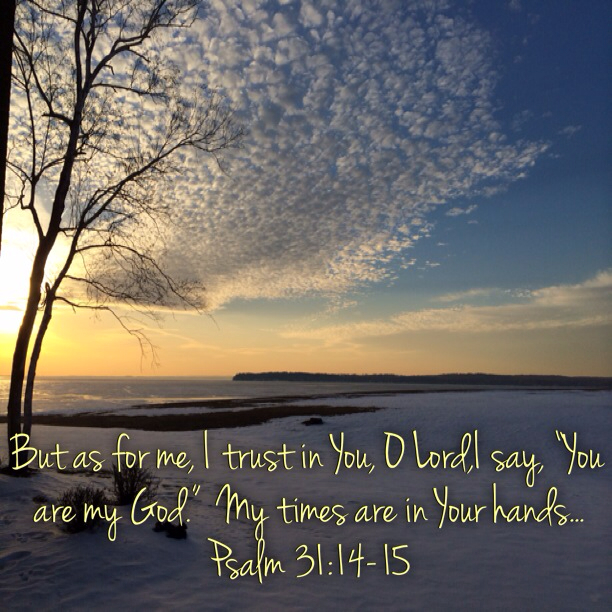
Stanza #8: Psalm 36:8; Psalm 105:5a; Psalm 62:5-8; Psalm 31:14

(Art & photo credits:  www.wikimedia.com; http://www.flickr.com (2); http://www.dailyverses.net; http://www.pinterest.com (2); http://www.flickr.com; http://www.dailyverses.net; pinterest.com.)

Read Full Post »

Last week, our three grown children, their spouses, and three granddaughters gathered here–in one place, at one time. Even Steve’s sister and brother-in-law were able to join us for a day.  Such gatherings do not happen often.

For Steve and me, the greatest pleasure in life is the opportunity to enjoy our children– what King Solomon called “God’s best gift” (Psalm 127:3 MSG).

He went on to say: 

How blessed are you parents,

with your quivers full of children!”

–Psalm 127:5 MSG

And what is a quiver-full?  Dr. Howard Hendricks of Dallas Seminary explained years ago that, in Bible times, a quiver most often held six arrows.  Thanks to our three children who chose their spouses wisely, Steve and I now have a full quiver–with three little arrows as well.

Oh yes, we are blessed, and always count down the days until our clan can gather once more.

Even four-year old Elena reveled in the long-awaited together time.

During the week, we  visited several parks with playgrounds…

…and even explored the zoo on Wednesday.  But perhaps some of the sweetest memories will be those associated with home…

… such as one afternoon at Eric’s and Hilja’s, catching up with one another and playing games.

There were fun moments at Nana’s and Papa’s house, too.

(The Night of the Big Sleepover)

Now these moments are treasures to hold close in our hearts–not so much for what we did as for who we were with.

“Let us be grateful to people who make us happy;

They are the charming gardeners who make our souls blossom.”

–French novelist, Marcel Proust (1871-1922)

How fitting that, as the landscape blossomed last week, so did our souls–because of a family who make us very happy.

*      *      *     *     *     *     *     *     *     *

I thank you, Father, for the joy of doing life with this particular group of folks.  We may not live in close proximity, but because of you, our spirits are intertwined.  Every opportunity to be together is cause for great celebration.  And we praise you for the gift of recollection, so beautiful moments like these may live in our hearts forever.


Read Full Post »


Whether I heard it or read it, I don’t remember. But the words caught me by surprise, and I jotted them down:

“What was uppermost in Jesus’ mind as Good Friday approached?  The answer is, Joy.”

Do you find that surprising too?

Yet at least three times on the eve of his crucifixion Jesus spoke about joy (John 15:11; 16:22, 24; 17:13)–a most unexpected topic and completely unnatural.  Who thinks about joy when they know catastrophe is about to strike?

Jesus, that’s who.

Within the next twenty-four hours he would face excruciating pain, total abandonment by his Father, and the most horrific death ever devised.

But his concern was for his disciples, not himself.  Jesus wanted them to remember the important principles of love, obedience, and joy–an empowering joy that no one could take away from them.

Perhaps you remember the scene. Jesus and his disciples had just finished their last Passover supper together. After the meal, he taught his final lesson.

The first mention of joy came near the end of his teaching about the vine and the branches:


(“I have told you this

so that my joy may be in you

and that your joy may be complete.”

–John 15:11.)


The word, this, refers to the ways Jesus had just mentioned that will contribute to joy:

1.  Live close to him and produce much good in and through your life (vs.4-8).

2.  Live in obedience to Jesus and experience the warmth, peace, and care of His love (vs. 9-10).


Note that Jesus wanted his joy to be in the hearts of his disciples. What characterized his joy compared to that of others?

  1. Strong awareness of the Father’s love for him, and his own love for the Father (vs. 9-10).
  1. Absolute surrender to his Father, and the joy of doing what his father had sent him to do. Even during his great travail in the Garden of Gethsemane, his one desire was to do his Father’s will (Luke 22:42).

Jesus’ joy coexisted with the profound sorrow of impending suffering, because he was already well-acquainted with the satisfaction and fulfillment of obedience.

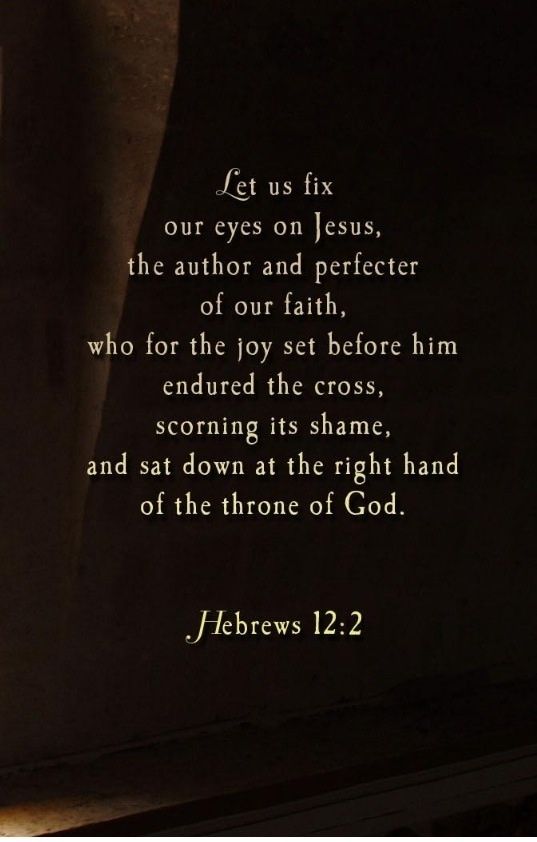
  1. The understanding that joy deferred to the future is anticipatory joy in the present. “For the joy set before him he endured the cross” (Hebrews 12:2).


And finally, Jesus told his disciples that he desired complete joy for them. What does complete joy look like? It is:

  • Not so much an emotion as it is a conviction (Keith Krell, “Moment by Moment,” http://www.bible.org).
  • Inner contentment, resulting from continually cultivating an intimate relationship with Jesus.
  • Constant, not dependent on circumstances.
  • Enduring, day after day. Indestructible.
  • Perfect—the perfect, joy-filled fulfillment of the destiny for which God created you, even when a portion of that destiny is suffering.

I’m thinking of the martyrs–Stephen, Polycarp, Ignatius of Antioch, John Wycliffe and countless others who demonstrated complete joy even as they died in anguish.


Polycarp, disciple of the Apostle John and Bishop of Smyrna for many years, refused to revile Jesus. For that he was burned at the stake.

But before the flames rose up, Polycarp prayed:

“O Lord God Almighty, Father of thy blessed and beloved Son, Jesus Christ, through whom we have been given knowledge of thyself…I bless thee for granting me this day and hour, that I may be numbered amongst the martyrs, to share the cup of thine Anointed and to rise again unto life everlasting…”

Such devotion, courage, and supernatural strength are impossible to fathom apart from the enablement of the Holy Spirit.

Can you hear the grace in Polycarp’s voice as he blessed God for the privilege of dying a martyr?

That is complete joy, only experienced by those who trust in Jesus implicitly.

Complete joy that Jesus purchased for us at Calvary.

*     *     *     *     *     *     *     *     *

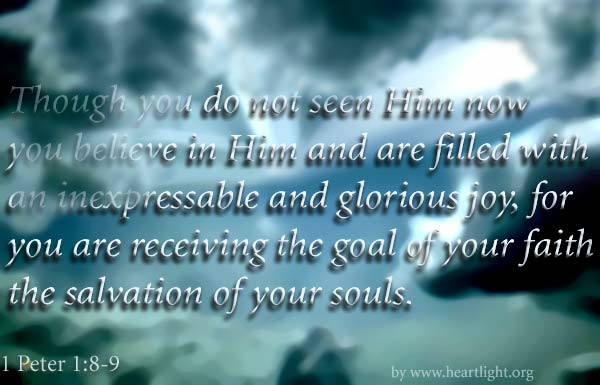
We marvel, Heavenly Father, in the extreme paradox that is the cross. Out of the evil unleashed upon your Son comes your holy, righteous goodness–upon us. Out of the horror of the crucifixion that Jesus endured comes inexpressible and glorious joy, to those who put their faith in him–not a temporary feeling of elation, but deep, abiding, abundant joy. 

All praise to you, our loving, gracious God!       

(Acts 3:13-16, 1 Peter 1:8, John 6:47, John 10:10)


(Reblogged from April 7, 2015.  The Ruegg family has gathered this week for an overdue reunion.  Art & photo credits:  www.rejesus.co.uk; http://www.pinterest.com (2); http://www.wikimedia.org; http://www.heartlight.org.)

Read Full Post »

In one of his picture books, Barney Saltzberg asks all young artists: What can be done when your paper tears, a corner gets bent, or paint drips on your project? Throw it away and start over?

No, Saltzberg has better ideas, and through the pages of his book demonstrates his creative mastery of the mishap. A tear in paper, for example, can become the snaggly smile of an alligator. A bent corner can be turned into the head of a penguin, and paint drips into wheels on vehicles.

Saltzberg titled his masterpiece, Beautiful Oops!


What perfect imagery his book presents for the beautiful life Jesus creates out of each of us!

Without Jesus we make ourselves victims of mishaps and mistakes, motivated by the desires for self-gratification, power, and notoriety (to name a few). The results can include: gluttony, alcohol and drug abuse, sexual promiscuity, physical and emotional abuse, cheating, and slander (to name a few again).

But with Jesus, even those mishaps and mistakes can be transformed into something beautiful:


“Anyone united with the Messiah

gets a fresh start, is created new.

The old life is gone; a new life burgeons!”

–2 Corinthians 5:17, MSG


And what a life it is!

Those of us who ask Jesus into our lives get to enjoy incredible benefits such as:

  • A new perspective. No longer are we scrabbling for the next gratification, promotion, or thrill. Our eyes are opened to the delight of blessing others.


  • A new source of power. Dependence on ourselves is exhausting and worrisome. What a relief to rely on Someone all-wise and strong, Someone who even knows what will happen in the future.


  • A new certainty. No more lying awake at night with unanswerable questions pounding in our heads—questions like, “Is there life after death? How can a person know whether there’s a heaven and hell? If there is, how can I be sure to experience the former and not the latter?”  One step toward Jesus settles those questions. The believer knows his eternal destiny in heaven is secure.*


  • A new plan of action. No more striving after things that don’t satisfy. Life takes on new meaning, purpose, and fulfillment when God is integral to our lives.


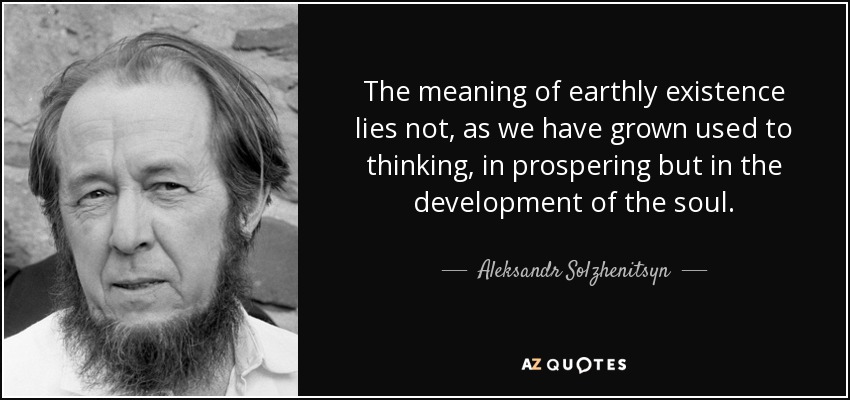
(“The meaning of earthly existence lies not,

as we have grown used to thinking, in prospering

but in the development of the soul.”

Aleksandr Solzhenitsyn)


  • New delights, such as: 1) anticipation and hope for the future, 2) awareness of God’s presence, 3) augmented relationships, and 4) understanding of and pleasure in Bible reading.


The person who doesn’t know Jesus may read this list and doubt its validity. Perhaps they don’t sense the need (yet) for these things or they question Jesus’ ability to provide them.

But like all the Oops in Barney Saltzberg’s book, we don’t really know the difference the Master can make until we turn the page.


______________________________


Have you turned the page to new life with the Master? If so, what aspect of your new life would you add to the list above? Share your experience in the comment section below!


*  Why would we believe what Jesus claimed in the Bible, that he’s the One to trust for the gift of eternal life in heaven? Whole books have been written to answer that question, to prove that the historical record of Jesus is accurate and his claims are absolutely true. One I highly recommend is The Case for Christ (Zondervan, 1998) by former legal editor of the Chicago Tribune, Lee Strobel.

Mr. Strobel was an atheist when he embarked on a thorough investigation of the evidence for a historic Jesus and his claims. When he had finished, Mr. Strobel had this to say: “The great irony was this: it would require much more faith for me to maintain my atheism than to trust in Jesus of Nazareth” (p. 265)! Mr. Strobel was convinced by the overwhelming evidence and chose to become a Christian.


(Art & photo credits:  www.pinterest.com (2); http://www.flickr.com; http://www.pinterest.com (2); http://www.azquotes.com; http://www.pinterest.com.)


Read Full Post »

« Newer Posts - Older Posts »

When the House is Quiet

Impressions Becoming Expressions

Mitch Teemley

The Power of Story

Still Traveling

Impressions Becoming Expressions

Living Our Days

Gaining a heart of wisdom

He Said What?!

I'm Patty, and my husband and I are living with our adult son who has autism and epilepsy. I love sharing lessons learned from life around me, especially life with Aaron.

Meditations of my Heart

Impressions Becoming Expressions

Linda Stoll

Impressions Becoming Expressions

Signora Sheila

Where faith meets la dolce vita

Heidi Viars

Finding the Image of God