Feeds:
Posts
Comments

Archive for the ‘Worship’ Category

At Bible Study the other night we were discussing the wonders of creation as evidence of God’s glory (Isaiah 6:3). One woman shared that she and her husband had witnessed a triple rainbow once, while driving on the interstate. Each bow stretched from one side of the sky to the other in bright, glowing splendor. Vehicle after vehicle slowed, then pulled off the road, so the occupants could marvel at the spectacle.

Triple Rainbow

Those of us at the table listened with wide-eyed wonder. We had witnessed double rainbows, but not a triple. Several of us had seen the same double rainbow after choir practice late last spring. It, too, extended completely from north to south in luminous brilliance. I remember thinking, If only we were on the plains of Kansas for this moment, so no buildings or trees blocked this view!

English: Double rainbow

Even a single rainbow grabs our attention. The glowing colors, grand size, and rarity of rainbows all contribute to the wonder. And for those of us who know Creator God, we whisper a prayer of praise and adoration for this manifestation of his glory.

Two Rainbows at Dusk in Denmark.

Did you Know…

…rainbows are caused by light being refracted (bent) while entering a droplet of water, then reflected inside on the back of the droplet and refracted again when leaving it. It boggles my mind that light shining on tiny droplets of water, suspended in the air, can result in the astounding beauty of a rainbow. Give God a cup of water, and look what he can do!

In a double rainbow, a second arc is seen outside the primary arc. The order of its colors are reversed, red on the inside, violet on the outside. This second bow is caused by light reflecting twice inside water droplets. Once is amazing enough, but twice? You wouldn’t think droplets were big enough for a double phenomenon, much less a triple!

Descriptions of rainbows often include seven basic colors – red, orange, yellow, green, blue, indigo, and violet.  Actually, the rainbow is a whole continuum of colors from red to violet and even beyond to colors the human eye can’t see. Yes, according to the National Center of Atmospheric Research, there are more colors in the universe we haven’t seen–yet (http://eo.ucar.edu/rainbows/ ). But someday we’ll have eyes that can see all!

That brings me to…

The Rainbow of Heaven

Even in heaven, a rainbow encircles God’s throne (Ezekiel 1:28, Revelation 4:3), symbolic of God’s grace and faithfulness. Those attributes were highlighted when the first rainbow arched over the sky. Because of God’s grace and faithfulness, he promised Noah that never again would he flood the earth, even though “every inclination of [man’s] heart is evil from childhood” (Genesis 8:21). That first rainbow was a sign God would remain faithful to His promise (Genesis 9:12-17).

The rainbow in heaven is also a sign of God’s grace and faithfulness. John Gill asserts that the colors express His promises and blessings (www.bibletools.com ). Now that thought presents a challenge! What promise or blessing might each color represent? (Before you read on, you may wish to consider the possibilities.)

Red = the blood of Jesus, through which we have the promise and blessing of forgiveness of sin (Hebrews 9:14).

Orange = fruitfulness (John 15:5), providing the blessings of purpose and fulfillment in our lives. (Can you guess I live in Florida?)

Yellow = the light of God’s Word (Proverbs 6:20-23), giving us guidance, comfort, encouragement and more.

Green = the promise and blessing of everlasting life (1 John 5:11-12).

Blue = the skies and heaven, where someday we will enjoy eternity with our Heavenly Father (2 Peter 3:13).

Violet = royalty, because of the promise we will reign with Christ in his eternal kingdom (2 Timothy 2:12).

The next time a rainbow sweeps across the sky, we might remember these promises and blessings.

But rainbows can represent even more.

A Personal Rainbow

Several years ago, while sitting in the living room, I glanced down to discover a small but brilliant bit of rainbow shimmering on my leg. Revelation 4 had just recently been part of my Bible study, so the rainbow encircling the throne of God came to mind. At that moment in the living room, it was as if God had scooped up a bit of that ethereal rainbow and placed it on me, that God himself was personally touching me!

Now, when you or I reach out to touch a loved one, our unspoken message might be: “I love you; I’m here to empathize, to support, and infuse you with strength.” Well, that little rainbow “spoke” those words to me, from my Heavenly Father (even though it was caused by the beveled glass in the front door). It was a special moment of blessing and promise that brought tears to my eyes.

Of course, rainbows are not the only manifestations of God’s glory on earth. What rare and awe-inspiring moment have you experienced that “spoke” to you? “Glorify the Lord with me; let us exalt his name together” (Psalm 34:3). Share your story below in the comment box!

Read Full Post »

“Glorify the Lord with me” David invited.  “Let us exalt his name together” (Psalm 34:3). 

M-m-m.  That’s puzzling.  Why didn’t David say, “exalt his names?” 

He has dozens—Creator, Father, Holy One, King, I AM, —to name just a few. 

My question led to three observations. 

One, most of us do have at least three names:  first, last, and middle.  Royals are often given multiple names.  Prince William of Great Britain, for example, is actually William Arthur Philip Louis Windsor.  Yet even when he’s asked to give his full name, that word “name” is used in singular form. 

Two, most parents, including royalty, take great care in choosing names for their progeny.  They not only consider how first, middle, and last sound when spoken together, they consider the meanings of  the names.


Three, some moms and dads choose names that honor family members or friends.  Perhaps they hope that the name will also bequeath to their child the positive traits and accomplishments of the honorees. 

Based on these observations, it would seem appropriate to do the following when we desire to praise or rejoice in God’s name: 

  • Think on at least several of his names
  • Consider their meanings, especially as they relate to personal experience
  • Meditate on the attributes and accomplishments of God associated with that name. 

Let’s try it.  The name-list above offers a start.  

God of heaven and earth, you are Creator of all.  My mind cannot begin to fathom your power, wisdom, and creative genius that brought this universe into existence—out of nothing.  From vast planetary movements to intricate ecosystems, your divine proficiency produces perfect function. 

  English: A Blue Starfish (Linckia laevigata) r...

You are the Holy One of the universe—completely righteous and totally separate from anything or anyone else.  You are the only one who is omnipotent, omniscient, and omnipresent.  There is no one like you. 

Yet you are my Heavenly Father!  You lovingly and patiently care for me, providing guidance and instruction on how best to live.  You graciously bestow blessings—sometimes the desires of my heart, and sometimes serendipity gifts that I haven’t even asked for. 


 You are the King of the universe, in control of everything.  But unlike some overlords, you know what you’re doing.  Everything you do is perfect.   I can trust you with the concerns of my life because of your great wisdom and understanding. 

You are the great I AM, who always was and always will be.  You live in a perpetual present tense.  And you are always the same—dependable and faithful, loving and gracious to your children. 

Thank you, God, for revealing these names to us—and many more.  They help us to understand who you are and how you respond to your children.  And as we meditate upon them, our hearts are filled with wordless wonder and overwhelming gratitude. 

Read Full Post »

Wisdom dictates that we learn from our mistakes. Better yet is to learn from the mistakes of others, and save the trouble of making them ourselves.

Listed below are a few of my recent mistakes, which may provide a learning opportunity. Actually, they’re typing errors—typos with significance!

Example #1:

Instead of thankfulness, I typed thinkfulness.

My mistake reminded me of a quote I read years ago: “If we would think more, we would thank more.”

And why is thankfulness a worthwhile pursuit? According to recent research, multiple benefits result from expressing gratitude:

• Better physical health
• Better sleep
• Better relationships
• Lower stress levels
• More optimistic attitude
• Longer life

Gratitude Journal

Seems like scripture was right all along: “Whatever is excellent or praiseworthy—think about such things…And the God of peace will be with you” (Philippians 4:8-9) That’s the bottom line, isn’t it? Peace of mind and heart contributes to the items on that list. And gratitude is key.

 Example #2:

I meant to type worship, but what appeared on the screen was workship.

The truth is, worship does involve work. Not the work of getting to church on time, or the effort of tuning out distractions to focus on God. As valuable as those objectives are, there’s more.

Paul tells us to offer ourselves as living sacrifices, holy and pleasing to God. This is our spiritual act of worship (Romans 12:1). True worship involves the work of obedience.

Gratitude

But again, God provides benefits that far outweigh the effort. Psalm 112 reveals a number of them:

• Households are blessed (vs. 2-3)
• God’s light breaks through the darkness (v. 4)
• Goodness comes (v. 5)
• Strength develops (vs. 6-7)
• Joy and peace fill the heart (v. 8)

 No doubt there are dozens more scattered through scripture. That’s one of the things I greatly appreciate about our God. When He asks us to work at something, and we comply, He generously blesses us!

Example #3:

Somehow my stumbling fingers produced medication on my computer screen instead of meditation.

It occurred to me, though, that meditating upon God and His Word works like medication to:

• Ease the aches and pains of life, such as miserable circumstances or  hurtful people
• Calm the acid of frustration
• Speed the healing of stinging remarks and wounded feelings

“The law of the Lord is perfect, reviving the soul” (Psalm 19:7a)!

Example #4:

I saved the best for last. My intention was to make this point:

It is our responsibility and joy to “minister encouragement and hope into the lives of others.”

That’s what I meant. Here’s what I typed:

“Minister encouragement and hope into the livers of others.”

Wings of Encouragement

Quite silly at first glance; quite profound after some introspection.

You see, everything that goes into our body goes through the liver. It is in the liver that transformation takes place, the food we eat becoming nutrients.

Here’s the application: In order for our words of encouragement to be transformational, they must sink deep into the core of our listener. The comments need to be thoughtful and spoken with conviction. Glib platitudes will never nourish a hungry soul.

Another interesting fact about the liver: To some extent, this organ is able to remove toxins from the body. That’s what we can do with our words of hope. We can help overcome the toxins that have collected in a person’s spirit.

So, my friends, let’s:

Be thinkful in our thankfulness.

Embrace obedience as a spiritual act of workship.

Meditate on God and His Word, as medication for our souls.

Minister heartfelt encouragement and hope into the livers of others.

* * * * * * * * * * * *

And please share the outcomes of your efforts to make something meaningful out of these mishaps!

Read Full Post »

 bibles

Dad has a large collection of Bibles in many different versions. Recently he gave me two of them. Very precious gifts, indeed. They represent countless hours of study and recording, because the margins are filled with his notes.

When I say countless, I’m not exaggerating. On numerous pages, Dad has squeezed five or six lines of fine, tiny printing in the upper margin, a space just ¾” wide. I almost need a magnifying glass.

To read his collection of word meanings, explanations, and applications has been bittersweet. Dad now has severe arthritis and Parkinson’s disease. Although he is still an avid reader, he is no longer able to write.

As Christmas has approached, I’ve wondered, what might Dad have written in his Bibles about the birth of Jesus?

The first note that caught my attention was from his New American Standard, Ryrie Study Bible (1976, Moody Press). The note concerns Mary’s song, the Magnificat, found in Luke 1:46-55). We looked at her beautiful prayer last Thursday, in the post titled, “Mary’s Song.”

Mary began her song by saying, “My soul exalts the Lord” (NAS). The New International Version translates that sentence, “My soul glorifies the Lord.”

Before we proceed to the quote itself, let’s examine those words, exalt and glorify. (No doubt that’s what Dad would do. And surely somewhere in one of these two Bibles I’ll come across a pithy definition or two for exalt and glorify. For now, I’m on my own!)

Exalt means to raise in status, to elevate, to glorify and praise.

Glorify means to give glory, honor, or high praise, to exalt.

Put in simple terms: to exalt and glorify is to compliment truthfully and profusely.

Now here’s what Dad wrote:

To exalt the Lord at Christmas, we need to refocus our attention on the event we celebrate rather than on the celebration of the event.

Oh, Lord Jesus. My eyes fill with tears as I think of all the times my attention has been on the celebration and not on the sacred moment when you became flesh and made your dwelling among us. Too often my focus has been on…

…the gifts under the tree instead of the implausible Gift of Yourself. You left the glorious riches of heaven, to be born into the depravity of humanity. I cannot fathom the depth of such love.

…the joyous, boisterous family get-togethers, instead of the supernatural get-together of all believers (including me, of all people) and God Almighty. Your birth, and especially your death and resurrection make our relationship with you possible. I cannot fathom that kind of sacrifice.

…the decorations and twinkling lights that make the house sparkle and glow, instead of You, the Light of the world, who makes my sin-bent heart sparkle and glow. I cannot fathom such transformation.

For these last precious hours of the Christmas season, 2012, I want to focus on You. I want to give you honor and praise for everything Your birth has made possible: the experience of your love, the benefit of your sacrifice, and the glorious transformation you generate within each of us. In the name of our Savior, Christ the Lord, Amen.

*See the post titled, “Mary’s Song,” from December 20, 2012.

Read Full Post »

Can you remember the first time you studied a snowflake under a magnifying glass? What was your reaction to those delicate intricacies of pattern?

Or how about your first glimpse through a microscope at a drop of pond water? Suddenly you were viewing infinitesimal, squiggly creatures you never knew existed. Chances are your responses included “Wow!” “Look at that!” “I can’t believe it!”

And perhaps that’s when you learned: Only when we examine something closely can we begin to appreciate its value.

Like our Heavenly Father.

Scripture urges us to “magnify” God: “O magnify the Lord with me, and let us exalt his name together” (Psalm 34:3, KJV, RSV).

To magnify God is to look closely at Him and take careful notice of his actions and attributes. Mary did exactly that, when she visited her cousin, Elizabeth. Elizabeth was much older than Mary, well beyond child-bearing age. But like Sarah of the Old Testament, God had intervened for her. Elizabeth would be the mother of John the Baptist.

When Marry first arrived and greeted her cousin, Baby John leaped in Elizabeth’s womb. (I’m not exaggerating. That’s the exact word in Luke 1:41, NIV. Can you imagine how it would feel to have a baby jump inside you?)

Elizabeth responded with a blessing for Mary and the baby she carried. Mary was so overcome with joy and incredulity, she burst into praise. Her song is called the Magnificat. (See Luke 1:39-45 for more details.)

For ten verses, Mary magnifies the Lord, examining the reason for her joy (vs. 46-49) and looking closely at God’s attributes and actions (50-55) that contribute to her joy. If your Bible includes cross references you’ll notice that Mary recites a varied collection of verses from the psalms, specifically from chapters 34, 138, 71, 103, 98, and 132.

Take note: that’s six psalms. It would seem she chose appropriate thoughts, and wove them together into this beautiful prayer. On the spot, no less! Dare I suggest that Mary was a highly intelligent young woman?

Such an ability would also indicate Mary grew up in a godly home where scripture was highly esteemed. Her family evidently took to heart the words of Psalm 1:2, “His delight is in the law of the Lord, and on his law he meditates day and night.”

Full of emotion, Mary rejoiced in God, her Savior. He had been mindful of her, a humble peasant girl. God had blessed her beyond imagining, to be the mother of the Messiah.

Then Mary itemized specific ways God had benefited all his people:

• He extends mercy to those who reverence him (v. 50)
• He has performed mighty deeds (v. 51)
• He has scattered the proud (v. 51)
• He has brought down rulers, but lifted up the humble (v. 52)
• He has filled the hungry, but sent the rich away empty (v. 53)
• He has been merciful to Israel (vs. 54-55)

Has God been at work in your life, perhaps in similar ways? Has God been mindful of you and blessed you (v. 48)? What great things has He done for you (v. 49)? Has his mercy been extended to you (v. 50)?

View the activity of God in your life through the magnifying glass of meditation.

Feel free to comment below, and share with us your observations!

Here’s another idea to consider: as a Christmas gift to your Savior, write a Magnificat of your own.

Read Full Post »

As I was decorating the house for Christmas and listening to carols, “God Rest Ye Merry, Gentlemen” caught my attention. The words proclaim the joyous news of “Jesus Christ our Savior, born on Christmas Day, to save us all from Satan’s power when we were gone astray.” Yet the tune is in minor key, which gives the song an air of sadness. My curiosity kicked in (it doesn’t take much), wanting to know why the composer would make such a choice.

After a bit of research, here’s what I discovered: This is an old carol, dating back to 15th century England. The composer is unknown, so we have no record of the musical/ lyrical choices he made. However, we can make an educated guess about his motivation, to answer the question why he wrote this carol.

Church music of that time was rather dreary, and sung in Latin. The common folk would never have been allowed to compose music for worship, especially in English. So historians surmise that a peasant wrote this song, perhaps to be sung in his own home.

(May I be so bold as to suggest a woman may have created the song, as a diversion during household chores?!)

Whatever its inception, the carol grew in popularity and soon was sung by many. It remained a favorite through subsequent generations and was finally published in 1833. Charles Dickens even chose the song for a scene in The Christmas Carol (1843):

“…at the first sound of — ‘God bless you merry, gentlemen! May nothing you dismay!’— Scrooge seized the ruler with such energy of action that the singer fled in terror, leaving the keyhole to the fog and even more congenial frost.”

Back to the question that began this investigation: Why such a positive message expressed with such a sad-sounding tune? Without much background information to go on, my curiosity has to be satisfied with conjecture. What would be a logical explanation for uplifting words set in a minor-key?

Perhaps the composer was trying to express the dichotomy in which we live.

First, the minor key suggests the sad reality that we live in a world oppressed by “Satan’s power” (from verse 1 of the carol). He is a roaring lion, prowling around for someone to devour (1 Peter 5:8) with his lies and temptations. And what do lions choose to prey upon? The weakest of creatures who cannot easily flee.

The second half of the dichotomy comes from the cheerful lyrics, retelling the glorious story of Jesus’ birth. The chorus resounds again and again with “tidings of comfort and joy.” Why? “This day is born a Savior of virtue, power, and might” (from verse 3 of the carol).

And now the icing on the cake. (Or, more appropriately for this time of year, the star on top of the tree!) This Savior of virtue, power, and might is in us! Somehow His Spirit entwines with each of ours. We can experience His comfort and joy, just as the carol proclaims.

Yet there’s more. We can experience His presence. We can rest in His peace, rely upon His wisdom, and go to Him for help and guidance. Not even these seven blessings cover the gamut of His loving-kindness to us.

Now, because our Savior of virtue, power, and might lives within us, we are not weak creatures, who cannot easily flee that roaring, prowling lion called Satan. Jesus, our Lord and Savior, is much greater than he is (1 John 4:4)!

My heart almost skips a beat, just thinking about such astounding realities. With a humbled, grateful, merry heart, I “now to the Lord sing praises” (verse 6 of the carol)–enthusiastically!

Will you join me?

Read Full Post »

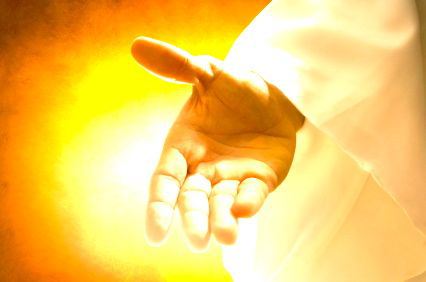
1119-hand-of-god

See if this sounds familiar:  You’re reading along in the Bible when you come upon a phrase you’ve seen before, maybe even many times.  But suddenly the realization dawns.  You don’t really know what that phrase means.

That was my experience as I read this verse:  “I have set the Lord always before me.  Because he is at my right hand, I will not be shaken” (Psalm 16:8).  I had to wonder, what is so significant about God’s right hand?

After a bit of research, here is what I discovered.

1) In Bible times, the position to the right was considered a place of honor.  This concept is seen at its finest in Hebrews 1:3 where Jesus “sat down at the right hand of the Majesty in heaven.”  But according to Psalm 16:8 (above), he is in the place of honor in my life and yours.  With our reverence and obedience we can demonstrate our honor of him.

2) If a man has God at his right hand, it means God’s shield is next to him.  God’s sword arm is free to deal with the enemy.  Visualize yourself walking behind that impenetrable shield.  And in his right hand, God wields His sword, ready to strike down the enemy—Satan and his demons.  “He stands at the right hand of the needy one, to save his life from those who condemn him” (Psalm 109:31).  I love that visualization of God on the offensive for us.

3) A bride stands with the groom on her right, symbolizing the groom’s protection.  The Lord Jesus is our Bridegroom and we, his church, are the bride (Revelation 21:1-3).  David proclaimed God’s protective right hand in Psalm 17:7.  “You…save by your right hand those who take refuge in you from their foes,” he said.  God is our undefeated defense.

4) For many of us the right side of our bodies is stronger than the left.  Perhaps David had that idea in mind when he wrote, “Your right hand sustains me” (Psalm 18:35b).  And what does sustain mean?  Uphold, encourage, and affirm.   Imagine God’s right hand upholding you—day in and day out.  Just the warmth and strength flowing from his touch has the power to encourage and affirm.

5) In addition to extra strength on the right, most of us have extra dexterity in our right hands.  We use that hand for writing, drawing, cutting, and other such tasks.  Any good handwork is accomplished with that dominant hand.  So what comes from God’s right hand?  The psalmist proclaimed:  “Your right hand is filled with righteousness,” (48:10).  Everything God does is good and morally correct.  He always gives his best to his work.

I thank you, Father, for the many times I have been protected, sustained, and blessed by your right hand.  If you never lifted your hand again on my behalf I would have no cause for complaint.  And yet you have promised us “eternal pleasures at your right hand.” (Psalm 16:11c).  I bow before you in wordless wonder.

(Photo credit:  sonfeld.wordpress.com.)

Read Full Post »

« Newer Posts

When the House is Quiet

Impressions Becoming Expressions

Mitch Teemley

The Power of Story

Still Traveling

Impressions Becoming Expressions

Living Our Days

Gaining a heart of wisdom

He Said What?!

I'm Patty, and my husband and I are living with our adult son who has autism and epilepsy. I love sharing lessons learned from life around me, especially life with Aaron.

Meditations of my Heart

Impressions Becoming Expressions

Linda Stoll

Impressions Becoming Expressions

Signora Sheila

Where Faith Meets La Dolce Vita

Heidi Viars

Finding the Image of God