Feeds:
Posts
Comments

k0246655

Some years ago I started keeping prayer cards instead of a prayer list. A 3x 5 gives plenty of room to record updates and answers. Another benefit: It’s easy to rotate through the stack, praying for ten to fifteen people/organizations per day.

One card in the stack trips me up. At the top is written the name of “a difficult person.” He’s arrogant, dishonest, and unreliable.

I know I need to include him in my prayers, but I hardly know where to begin, except for “God, help this man!”

So I finally did some reading on the subject of difficult people, to find out how to pray for such individuals. Below are several suggestions I found helpful. If you have challenging folks in your life, perhaps you’ll find these thoughts useful also.

First, I need to begin with repentance. Before I pray about the faults and shortcomings of others, I need to address my own (Matthew 7:1-5). In addition, before I look at the person to be forgiven, I must look to God for the power to forgive.*

46df59e7dc32186533b88be0aeef20ad

Second, I can ask God to:

  1. Open the heart of this person to the error(s) of his ways.
  1. Reveal the truth of the gospel to him—that Jesus is the only Way to salvation.
  1. Grant the person self-awareness so he’ll see how his choices and behavior negatively impact others.
  1. Curtail his influence so that innocent people might be protected.
  1. Bring godly people into his sphere, to exemplify the God-enhanced life.
  1. Cause circumstances that draw his attention to God.
  1. Reveal the difference to him between godly wisdom and human foolishness.

b5ccc1819a17468823166684695b0a5d

Third, I can praise God that:

  • He is sovereign over all—even difficult people.
  • He can cause positive outcomes—in spite of erroneous judgments.
  • “Mistakes” on their part can actually produce God-ordained benefits.

bc1673e936603096e503a497e43850f2

And just how might such a prayer unfold? Perhaps something like this:

Oh, God, as I pray for those who

cause great frustration and even suffering for others,

it’s easy to lose sight of my own sinfulness.

I have not lived free of pride, dishonesty or unreliability either.
1fefaec18c0067820fbe6f19a290a4db


Forgive me, Father, for the many ways

I fall short of your desires for me.

Thank you for your grace and love that

prompt you to accept my confession and

prod me toward greater reliance upon you,

to become a better version of myself.

a3be021e71487c9b6e3b306bf27700f3


Because I fall short

(even though I know you as my Savior and Master),

it is with deep humility I pray for Mr. X.

I am no better than he is.


First, may he recognize the truth of your Word

and the reality of salvation through your Son, Jesus.

I pray Mr. X will seek the Light of your wisdom to guide his way.

May your Holy Spirit shed Light on the choices he’s already made,

and reveal to him the full, true consequences of his behavior.

Guide him to change course to your ways.

7b5ef7c8ae21186dc92a04b1354c2cf1


I thank you, Lord, that every day you are

sending Christians into Mr. X’s life as bearers of your Light,

to draw him to you.

You are engineering circumstances that highlight your power,

and using that sovereign power to curtail his influence.

I thank you for your ability

to produce positive outcomes even through difficult people.

The story of Joseph is one example.

In addition, even mistakes on the part of Mr. X

can actually produce just and righteous benefits.
041185d55067fa351a673ae25749dd81


Oh, how I praise you, Almighty God,

that you have established your throne in heaven,

and your kingdom rules over all—

even over difficult people.

a33ec94660decab61b232f373d580948


(Psalm 51:1-5; Romans 3:23; Romans 7:18; Ecclesiastes 2:13; John 16:13; Psalm 119:130; Matthew 5:16; Romans 1:20; Psalm 37:17; Proverbs 19:21; Psalm 103:19)

*Ralph Sockman,The Higher Happiness, Pierce & Smith, 1950, p. 107.

How do you pray for difficult people?  Please share your insights in the Comments section below!

(Art & photo credits:  www.fotosearch.com; http://www.pinterest.com (5), http://www.ourdailyblossom.com; http://www.pinterest (2).


At My Right Hand


closeup-on-womans-hand-writing-in-planner460x300 


Angie Perez sat on one side of her boss’s massive desk, he on the other. She began a lengthy list of reminders for the day…

“Now at ten o’clock this morning, George, you’re meeting with Sam about the Collins account. All the files you’ll need are in that portfolio. I put them in order from most important to least.” Angie pointed front-and-center with her pen.

“Great. ‘Appreciate you getting them organized.” George smiled. “I’ll need to review this paperwork beforehand—can you hold calls for me till I finish, probably around nine?”

Angie dashed herself a quick note. “Of course. And speaking of calls. Darcy Roberts already phoned, wanting to see you late this afternoon. I postponed her until tomorrow. I figured with your aunt’s seventy-fifth birthday dinner tonight, you’ll want to leave here on time today—maybe even early. You deserve to take a break after last week. Oh, and Aunt Lily’s gift is wrapped and ready to go in that black bag on the credenza.”


e488ba7f8c5cb4942cea7c5191331ce5


“Oh, terrific. Thanks again for picking up the necklace.” George turned to glance behind him at the lovely gift bag Angie had prepared. “You’re probably right about taking off a little early today. I’m exhausted. And good thinking about postponing Darcy. That woman can stretch five minutes of business into a half hour of stories I don’t need to hear.”

…And so, one right-hand administrative assistant sets into motion the day’s activity for one corporate executive.

Wouldn’t it be nice to have a right-hand assistant who took care of life’s unending details?

In reality, we have something far better: a right-hand God.


da0219437649492919bfe84d3eb1f3b8


“I have set the Lord always before me.

Because he is at my right hand,

I will not be shaken”

-Psalm 16:8 (italics added)


With God at my right hand, I have the strongest Protector—able to shield me from trouble much worse than George’s talkative clients:


“The Lord is my strength and my shield;

my heart trusts in him and I am helped.”

Psalm 28:7


God is the wisest Counselor—able to advise on matters much more important than business accounts:


7b5ef7c8ae21186dc92a04b1354c2cf1

“The Lord gives wisdom,

And from his mouth come knowledge and understanding.”

–Proverbs 2:6


God is the sweetest Comforter, offering empathy and support:


“As a father has compassion on his children,

so the Lord has compassion on those who fear him.”

–Psalm 103:13


And our God is the most loyal Advocate:


rs-wonder-advocate

“We have one who speaks to the Father in our defense—

Jesus Christ, the Righteous One.”

–1 John 2:1


God breathes strength into me by the touch of his hand. Granted, I can’t sense physical contact. But when I hear a hymn or worship song and tears well up, when I read a scripture or passage from a book that speaks directly to a current situation, it’s every bit as expressive of support as a clasp on the shoulder.

Our God is always close at hand, as if standing by, ready to assist however needed. He is always present, holding me by my right hand (Psalm 73:23).

And like a shade tree offering respite from the sweltering summer sun, God offers restful moments from the cares of this world.


221

“The Lord watches over you—

the Lord is your shade at your right hand.”

–Psalm 121:5


He renews our strength as we rely upon him (Isaiah 40:28-31), and offers the rejuvenation of constant hope because we know our heavenly home is waiting for us (2 Corinthians 4:16-18).


*     *     *     *     *     *     *     *     *     *


I praise you, O God, for your presence. You are near as my Friend, ready as my Helper, dependable as my Guide. How breathtaking to consider I am never alone, left to struggle on my own. You are always at my right hand.


(Art & photo credits:  www.hercampus.com; http://www.pinterest.com (2); http://www.reviveourhearts.com; http://www.faithpictures.wordpress.com.)


How would you complete this statement?

“____________________ is the rarest and purest form of generosity.”

Possibilities might include:

A. Financial assistance

B. A thoughtful, meaningful present

C. A favor or kind deed

D. Attention

According to a speaker I heard on the radio, the answer is D.  He was evidently quoting Christian author and activist for the poor, Simone Weil (1909-1943):

eb658885a794a1c7c13c2be9604f8a12

Attention is a rare form of generosity, because it involves time and effort—both of which are precious commodities.

But every now and then, all of us need someone to focus her eyes on ours, listen to our words with mental concentration, and respond appropriately–even pick up on our facial expressions and tone of voice.

listening-ear

That’s often the exception, however, not the norm. Who has not tried to share a deep, heartfelt concern, only to have the listener look away at a slight distraction or steal a glance at her phone, then fail to react appropriately because she wasn’t tuned in to the story? Worse yet is when she interrupts with her own story, her own agenda.

I don’t want to be that distracted person. I’d like to follow my brother’s example. John has always been one to give up the precious commodity of time for others.

During our growing up years, we lived next door to a family with five children. Tragedy struck one afternoon when the father fell while repairing their roof.   He hit his head on the concrete driveway and never regained consciousness. The next day he was gone.

Though John was at least seven or eight years older than three of those neighbor boys, he would play ball with them now and again, giving them a bit of attention, which they surely needed.

One time when Fred, the third oldest child, came to our door and asked, “Can John come out to play?” we had to laugh. (Not in front of Fred, of course.) At the time, John was in his early twenties, serving in the Air Force and home on leave! But he did go out to play.

A silhouette of a father and his young child playing baseball outside, isolated against the sunsetting sky on a summer day.

I’d also like to follow the example of Dixie, the choir director of one of the churches where my husband served as pastor. She perfectly demonstrated how to live out Philippians 2:4 (NIV): “Each of you should look not only to your own interests, but also to the interests of others” (1).

Dixie always stayed focused on the persons sharing with her. She was responsive, without saying too much, letting the speakers know they were being heard and understood.

Great satisfaction can result from providing the gift of attention to another. But that’s not the only blessing.

  • We gain a better understanding of life while listening to the experiences of others. “A fool finds no pleasure in understanding but delights in airing his own opinions” (Proverbs 18:2 NIV).
  • Our own relationships can be strengthened as we learn from the examples of those who share with us.
  • Worthwhile ideas are discovered—ideas we may never have thought of on our own.
  • When we’re kind to the needy, we honor God (Proverbs 14:31b).

05dfa09e07bd1ea4ca76936a3b82618e

*     *     *     *    *     *     *     *     *     *

Lord, I don’t want to be wrapped up in my own agenda. I’d much rather be like my brother, John—generous with my time and communicating encouragement through my attentive presence. Help me also to be an attentive listener like Dixie. Remind me, Father, to slow down, embrace the moment and genuinely interact with those around me.


  1. Note to self: Concern for self is not wrong as long as true compassion for others balances the scale of my attention.

(Art & photo credits:  www.pinterest.com; http://www.publicdomainpictures.net; http://www.pinterest.com (2).

Who has provided the rare gift of attention for you?  What did you appreciate most about that gift?  Please share your story in the Comments section below!

Father of Lights

God-is-light-in-him-there-is-no-darkness-at-all-christian-wallpaper_1366x768

You, oh God, are resplendent with light

As if full of fire—

Blazing with power, dazzling in majesty,

shimmering in an aura of glory (1).

You are the Father of lights

The Creator of sun, moon, and stars.

From the moment You spoke them into being,

The heavenly lights have never ceased to shine (2).

Starsinthesky

Neither has your Light of Goodness

Ceased to shine upon your people.

You are loving and patient, generous and gracious,

Always seeking the brightest, highest good (3).

You are the Light of my Salvation,

Showing me the way to heaven through your Son, Jesus,

Guiding me home through the twists and turns of life,

The dark shadows of uncertainty and fear (4).

psalm-27-1

You are the Light of Life,

Providing Son-lit days of peace, joy, and contentment

As I avail myself of your calming presence,

And celebrate your gifts (5).

You are the Light of Truth,

Who graciously shares his omniscient wisdom with his people.

Through your Word you expose falsehoods and evil.

You show me the best way to live—side by side with You (6).

sunrise6002

You are the Light of Holiness

Pure and perfect, completely separate from all else in the universe.

Through Jesus you already see me as perfect,

Yet day by day you are molding me to be holy, like you (7).

You are the Light of Blessing,

Making your face shine upon me

With grace, mercy, and compassion,

Lovingly exercising your power for my benefit (8).

06MayP126JE800x500

You provide the Light of the Knowledge of the Glory of God.

I find it when I seek your Son, Jesus.

His earthly life gives me a glimpse of your glory in human form–

A form I can more easily understand (9).

And now, you have made me a Child of the Light,

Called to reflect your glory to others,

Shining brighter, I pray, as the years pass,

Till the full light of day–inside heaven’s gates (10).

9e5932689ed9b20d5722ba998f3c82d5

I praise you, oh God, that your Light shattered the darkness

Of evil that first Easter morning—and for all time.

I praise you for the privilege of living in that Light,

Now and into eternity!

  1.  Psalm 76:4; Ezekiel 1:28
  2. James 1:17
  3. Psalm 89:15, 34:8-9
  4. Psalm 27:1; 23:4
  5. John 8:12, 14:27; Psalm 16:11; Hebrews 13:5
  6. Psalm 43:3; 119:105; Proverbs 6:23; Ecclesiastes 2:13
  7. Isaiah 5:20; Romans 13:12
  8. Numbers 6:24-26
  9. 2 Corinthians 4:6
  10. Philippians 2:15-16; Ephesians 5:13; 2 Corinthians 3:18; Proverbs 4:18


Digital StillCamera


My knowledge of boat parts is limited, but this much I know: throw an outboard motor in the water; it will sink. Throw a propeller in the water; it, too, will plunge to the bottom. So will seats, cleats, and other parts. But when they are assembled together on a strong hull, the boat floats.

Similarly, our lives are comprised of a variety of experiences: some heavy and hurtful, others light and joyful. When properly assembled as a whole, they create a life that floats, and one that’s headed on a course toward worthwhile purpose.

Proper assembly of negative as well as positive events requires the trait of resiliency—the ability to press on through setbacks again and again.

Do those words, press on, sound familiar? The great missionary-adventurer, Paul, said he pressed on toward the goal of becoming what God intended for him (Philippians 4:12-14).  Paul is a worthy case-study for resiliency.

Saint_Paul,_Rembrandt_van_Rijn_(and_Workshop?),_c._1657

(The apostle Paul by Rembrandt)


He suffered plenty of hurt, disappointment, and failure. For example, Paul was:

  • stoned (Acts 14:19),
  • flogged and imprisoned (Acts 16:23),
  • unjustly charged with treason (Acts 18:13),
  • nearly killed on at least several occasions (Acts 21:30-31), and
  • rejected by many, even after brilliantly preaching about God and his Son, Jesus (Acts 17:16-34).


How do you bounce back from such defeats? Researchers have identified the following ways to cultivate resiliency:


  1. Get real.

No one sails through life problem-free. Accept the reality that troubles will come, then apply those strategies that provide relief, strategies such as: exercise and proper nutrition, sufficient sleep, laughter, and meaningful activity, including acts of kindness each day.


b8a886a4d226b7c342d7be36add4f9e6


  1. Get hope.

Be watchful for God’s blessings in spite of the circumstances, and thank him for his loving attention. Gratitude does indeed transform attitudes.

Find fresh strength in God’s Word, especially in his promises and assurance of his faithfulness to keep those promises (Romans 15:4; Psalm 145:13; 1 Corinthians 1:9).

We can ask God to help us set new, worthwhile goals, then look forward to the day when those goals will be met.

Researchers have noted that resilient people do not strive for riches, fame, power, or recognition. Instead they are focused on their legacies—what contributions their lives will make to those around them.  Hope in God—in all circumstances—is in itself an invaluable legacy.


dc018940ab0edea3d3f776dc4336173f


  1. Get in community with other Christians—not just by being present, but by actively participating.

Years ago while I was dealing with an ongoing disappointment, Sunday morning worship on the praise team and mid-week rehearsals did much to recharge my spirit. (Not that all was smooth sailing in between! I still struggled to stay on an even keel; but with God’s help I didn’t stop trying.)

In addition, when we contribute hope to others through listening and encouragement, we find our own outlook much improved.


d64f6b0348399c6ab1a2db4d6da0e560


*           *          *

A boat that floats is not built by just lining up the various parts in the boatyard. It requires the hands and expertise of a master boat builder, to craft a skiff of beauty, function, and purpose.


017c661391a97e6ad96158e0211995fb


A satisfying, meaningful life cannot be achieved by mere acceptance of the various events in our lives. It requires the hands and expertise of the Master. He takes all of it—the delightful and the demoralizing—to craft a life of beauty, function, and purpose.


(The boat metaphor idea came from Ralph W. Sockman, author of The Higher Happiness (1950).


Art & photo credits:  www.inland-boats.com; http://www.slideplayer.com; http://www.wikipedia.org; http://www.pinterest.com (3).


“The whole meaning of history is in the proof that

there have lived people before the present time

whom it is important to meet” (1).


I greatly enjoy meeting the heroes of history and hope you do, too.

One such hero, a founding father of America, is remembered more for his words than his deeds–words such as:


“Give me liberty or give me death.”


His name: Patrick Henry, born May 29, 1736. (His birthday is this Sunday.)


Imacon Color Scanner


But what brought Patrick Henry to that pivotal moment in history and that immortal statement? What influence did he carry afterwards?

A bit of exploration revealed the following:

Patrick Henry’s education and faith began at home, under the guidance of his college-educated father and his namesake-uncle, an Episcopal minister. Uncle Patrick’s teaching, example, and encouragement helped instill in young Patrick the Christian virtues that would impact his entire life.

As Henry grew into manhood, he transitioned from business to law to government. He was elected to the Virginia House of Burgesses in 1765.

Soon after, Great Britain established the Stamp Act, which required almost everything printed in the American colonies to be inscribed on specially stamped paper, available only from agents of the British crown–with the payment of a hefty tax.

Henry spoke eloquently against the Stamp Act: “If this be treason, make the most of it,” he challenged. The Virginia Stamp Act Resolutions passed, and those with pro-British leanings did consider the action treasonous.


sku-gt184


In 1774, Patrick Henry was elected to the First Continental Congress. Delegates met to determine a course of action for the colonies, in response to Great Britain’s offenses: taxation without representation, searches and seizures without probable cause, confiscation of firearms, and more.

On March 23, 1775, Henry rallied the Second Virginia Convention, calling them to arms against advancing British troops. England was already at war against the colonies, he reasoned. Then Henry concluded with those famous, rousing words:


2015-06-03-d50a1173_large


(“Is life so dear, or peace so sweet

as to be purchased at the price of chains and slavery?

Forbid it, Almighty God!

I know not what course others may take;

but as for me, give me liberty, or give me death!”)


No doubt such eloquent and impassioned words held the delegates spellbound. But more astounding still? Henry had not prepared a speech for that day; he held no notes in his hands.

Another surprise for most of us: Henry spoke of God throughout that speech, and quoted from the Bible.  In one short paragraph, he used eight scriptural phrases.


patrick_henry5


Other examples include:

  • “Gentlemen may cry, Peace, Peace—but there is no peace (Jeremiah 6:14). The war is actually begun! 
  • “The battle, sir, is not to the strong alone” (Eccl. 9:11). 
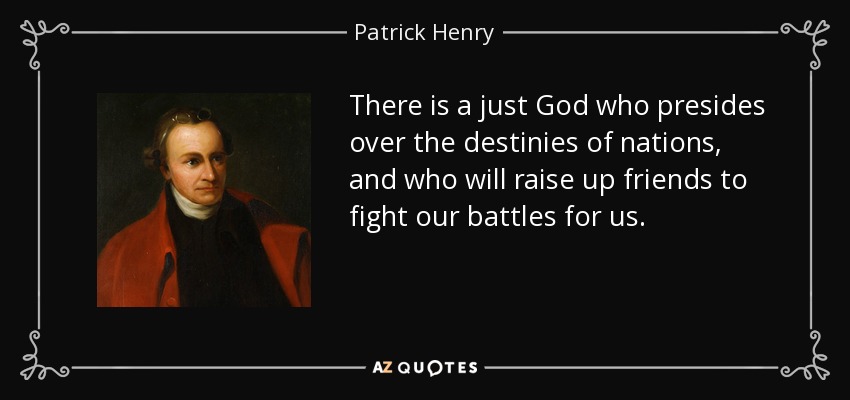
  • “There is a just God who presides over the destinies of nations, and who will raise up friends to fight our battles for us” (2 Chron. 32:8).


quote-there-is-a-just-god-who-presides-over-the-destinies-of-nations-and-who-will-raise-up-patrick-henry-53-32-60


Remember, his speech was delivered with no notes. These verses and many more were imprinted in Henry’s memory.

On many occasions during the war that ensued, he encouraged the beleaguered soldiers to pray for divine intervention, reminding them that:


“…the same God whose power divided the Red Sea for the deliverance of Israel,

still reigns in all of his glory, unchanged and unchangeable…” (3).


The American Revolution officially began April 19, 1775 at the Battle of Lexington and dragged on for  eight long years.  At first, Henry served in the military, as commander-in-chief of the Virginia militia.  But in 1776, Henry shifted his attention from the military to governmental aspects of the war and the development of a new nation.

In fact, governmental affairs were to be his main focus from that time forward. Henry served five terms as governor of Virginia and as a representative in the state legislature.

Yet it was not his accomplishments that he prized most.


thumbs_ph-beingachristian

(“Being a Christian…is a character which I prize

far above all this world has or can boast” (4).


After Henry’s death, this note was found, containing truth just as appropriate for today as in 1799:


“Whether this [the American Revolution] will prove a blessing or a curse

will depend upon the use our people make of the blessings

which a gracious God hath bestowed on us.

If they are wise, they will be great and happy.

If they are of a contrary character, they will be miserable.

Righteousness alone can exalt them as a nation [Proverbs 14:34].

Reader! – whoever thou art, remember this! –

and in thy sphere practice virtue thyself and encourage it in others.

–P. Henry” (5).


Patrick Henry certainly practiced Christian virtue himself, and is still encouraging it—in those who will listen.


Notes:

(1) Eugene Rosenstock Huessy, Speech and Reality, Argo Books, 1970, p. 167.

(2) The Founders’ Bible, p. 1734

3) http://www.christianhistorysociety.com

(4) www.faithofourfathers.net

(5) The Founders’ Bible, p. 957


Sources:

www.christianhistorysociety.com

www.faithofourfathers.net

The Founders’ Bible, Shiloh Road Publishers, 2012

www.patrickhenrycenter.com

www.wallbuilders.com


Art credits:  www.wikitree.com; http://www.thinkershirts.com; http://www.patriotpost.us; ce-wiki.wikispaces.com; http://www.azquotes.com http://www.thefederalistpapers.org.)

Crazy Blessings!

Say the word, “blessing,” and what immediately comes to mind?

For me, it’s happy events and lovely gifts, engineered or bestowed by God out of his loving kindness.

But James, the brother of Jesus, saw a different side of blessing: “Consider it a sheer gift, friends, when tests and challenges come at you from all sides” (James 1:2, MSG, italics added).

Tests and challenges as gifts?! Sounds a bit daft—until we consider:

What-Seems-To-Us-As-Bitter-Trials-Are-Often-Blessings-In-Disguise

Take, for example…

THE CRAZY BLESSING OF WANT

Do you wish you had a bigger house? A newer car? Better furniture? Consider yourself blessed, that you’re not like King Solomon–the wealthiest person who ever lived. For all his striving to achieve and accumulate, Solomon discovered that when every desire is gratified, the end result was nothing but meaningless smoke (Ecclesiastes 1:2, MSG).

The blessing of want protects us from the pit of depression caused by self-indulgence.

The blessing of want fosters contentment, as we learn to enjoy and be grateful for what we already have.

THE CRAZY BLESSING OF DIFFICULTY

Difficulties provide a surprising number of positive opportunities. Here are ten:

  • To press in closer to God and trust him more completely.
  • To experience the adventure of God’s sufficiency (Philippians 4:13) as he enables us to endure—in ways we never thought possible.

Philippians4_13

  • To see how God will bring beauty out of ashes (Isaiah 61:3).
  • To discover more of who God is.
  • To witness the fulfillment of his never-failing promises.
  • To present a sacrifice of praise to God, beginning with the affirmation that he has our best interests at heart—in spite of what we see.
  • To be prepared for greater usefulness for God (John 15:2), which fosters greater fulfillment and satisfaction in our spirits.

46dd131cacc19b855d589b3358b83851

  • To have a compelling story to share, as encouragement for others. Years ago I heard a speaker say, “With no test there is no testimony.” In the final analysis, I’d rather have the latter. You, too?
  • To become mature, complete, not lacking anything (James 1:4). That doesn’t happen without trials.  As Thomas Carlyle wrote:

quote-no-pressure-no-diamonds-thomas-carlyle-31833

  • To love our Savior more passionately. Josif Trif, a pastor from Romania during the days of Communism, said, “If it weren’t for Communism, I would not have loved our Lord as much. I kissed the cross the Communists gave me” (1).

THE CRAZY BLESSING OF FAILURE

If failure served no purpose in our lives, God would not allow it to happen. But since he does, we can know that failure is either for our benefit or for God’s glory—often both.

Failure is the soil from which great success can grow, beginning with a crop of positive character traits, such as perseverance, humility, and greater reliance upon God.

Green-Bean-Sprouts1

Out of failure comes experience; from experience comes greater wisdom; and wisdom leads to a godly life.

“How blessed are those who are hungry and thirsty for righteousness, because it is they who will be satisfied (Matthew 5:6, ISV)!

*    *     *     *     *     *     *     *     *     *

Crazy as it sounds, I want to praise you, Father, for the blessings of challenges and tough times. Thank you for your loving attention that carries me through, transforming me and makes me a better version of myself.  I also praise you for the glorious promise that through trouble, hardship, disappointment, or pain–“overwhelming victory is ours through Christ” (Romans 8:37, NLT)!

What crazy blessing have you experienced in the crucible of trouble, hardship, disappointment, or pain?  Please join the conversation below!

(1) His Imprint, My Expression, Kay Arthur, Harvest House, 1993, p. 135.

(Art & photo credits:  www.imagesbuddy,com; http://www.wallpaper4god.com; http://www.pinterest.com; http://www.izquotes.com; http://www.pinterest.com; http://www.harvesttotable.com.)

Wholeness

woman_sick_with_cold_314_208


After more than a week of full-blown cold symptoms—painful sore throat, totally stuffed-up nose, throbbing headache, and complete lack of energy–I finally woke up feeling more like my old self.

Such euphoria!  I could swallow without pain, take in glorious gulps of air through my nose, and function without the tight hat of sinus pressure on my head or the virtual suit of heavy armor on my body.  Throat, nose, head, and limbs were once again operating in unified wholeness!

But what if I still carried deep heartache, suffered from depression, or continually dealt with on-going stress at work? Relief of cold symptoms would be a small matter by comparison.

Unified wholeness must include mind and spirit as well as body.

This was the kind of completeness Jesus was referring to when he told a healed leper, “Arise, go your way: your faith has made you whole (Luke 17:19, King James 2000 Bible).


maxresdefault


You no doubt remember him, the one-out-of-ten healed lepers who took an extra step beyond healing, returned to Jesus, and expressed his gratitude.

Such effort demonstrated a spirit of humility and righteousness as he set aside his own agenda and did the right thing. His faith had impacted his body, yes, but also his mind and spirit.

The leper’s wholeness* manifested holiness—not perfection or proud piousness—but completeness and health of the total person as God fully intended.

Thomas Carlyle (1795-1881) explained it like this:

“The old word for holy in the German language, heilig, also means healthy. And so Heilbronn means holy-well, or healthy-well. You could not get any better definition of what holy really is than healthy—completely healthy.”

Wholeness is holiness, and God is our example. He is the picture of complete perfection with the sum of his glorious attributes: love, joy, peace, wisdom, and more.

By contrast, we are pictures of imperfection, with our deficient condition and inability to perfect ourselves on our own.

Yet God comes to us, arms outstretched in welcome, and says, “Your faith can make you whole.” We can turn to him like that one leper did, and he will begin the work of making us like him.


ephesians4_24


Oh, that sounds wonderful! Just as I desperately want to be made whole when a cold wreaks havoc in my body, so I want to be made whole as sin wreaks havoc in my spirit.

But such transformation involves choices.

During a cold, the choices of rest and plenty of fluids will speed the healing process toward wholeness.

My mental and spiritual wholeness this side of heaven will also require at least two choices:


120817-590x393


  1. “Look to the Lord and his strength; seek his face always” (1 Chronicles 16:11, NIV).
  1. Distill the positive out of the negative—goodness out of evil, peace out of pain, joy out of sorrow.


2corinthians12_9

And from the fullness of Jesus’ grace we will receive one blessing after another (John 1:16)—beginning with his power and wisdom to make these sound choices toward wholeness.


*     *     *     *     *     *     *     *     *     *


Oh Father, sound choices are easy to talk about, not so easy to live out. Remind me that from your wholeness, you provide grace upon grace—if only I look to you. Help me turn away from fear, self-pity, and anger, which lead to brokenness, not wholeness. How I praise you for your good will toward me and the good work of restoration you continue to develop within me!


*Synonyms from Webster’s New College Dictionary include: health, restoration, healing, and completeness.


(Art & photo credits:  www.families.com; http://www.youtube.com; http://www.verseoftheday.com; http://www.ourdailyblossom.com; http://www.verseoftheday.com.)


Every Day

every-day-we-should-hear-at-least-one-little-song-read-one-good-poem-see-one-e-403x403-nk4ndt


(“Every day we should hear at least one little song,

read one good poem, see one exquisite picture,

and, if possible, speak a few sensible words.”

–Johann Wolfgang von Goethe, 1749-1838)

Author and lawyer, von Goethe, was much too easily satisfied.

Yes, a day without music would be dreary.

Poetry does feed the soul and intellect in ways that prose does not.

An exquisite picture does lift the spirit.

It’s also true that sharing a few words of wisdom can be satisfying.

Yet, is that enough for one day?  What about:

  • Offering the music of “thank you” or “you go first” or “I love your smile?”
  • Reading and pondering several verses of scripture?  That will feed the soul and intellect even more than poetry.
  • Creating an exquisite picture of kindness by finding ways to be helpful and engaging?  Such artful living often impacts people more than we realize.
  • Speaking a few sensible words of encouragement, and feeling uplifted ourselves?

But beyond von Goethe’s suggestions of music, poetry, art, and wisdom are many more possibilities for a day full of delight.  We can:


scooter-girl


  • Savor a pleasurable moment or memory–better yet, when the two happen back-to-back.  Just today a neighbor girl whooshed by on her scooter, and I was reminded of happy, long ago days doing some whooshing of my own on bicycles or skates.  I smiled.
  • Make a discovery or learn something new.  Read.   Listen.  Think.  Recently in C. S. Lewis’s The Weight of Glory (Eerdman’s Publishing, 1949), I came across this statement:  “Obedience is the road to freedom, humility the road to pleasure, unity the road to personality” (p. 36).  Well deserving of some careful pondering, I think.
  • Celebrate at least one small miracle of nature:  a magnificent cloud formation, bright green growth on the tips of evergreen boughs, a cardinal’s song echoing through the woods.
  • Engage the creative side:  draw (even if it’s doodling), paint (even if it’s adding color to someone else’s art), or write (even if it’s in a journal that no one else will see).
  • Offer a smile–wherever we are.  “Every time you smile at someone, it is an action of love, a gift to that person, a beautiful thing.  Peace begins with a smile” (Mother Teresa).  Better yet, add words–a cheerful greeting, a compliment, a bit of gratitude.


1d01b85e5982b13020291f2742000bdc


  • End the day by counting blessings.  Drift off to sleep in an attitude of prayer–a prayer such as this:

*     *     *     *    *     *     *     *    *     *

Thank you, Father, for your gifts that offer daily delight–gifts like the warm pleasure of childhood memories bubbling to the surface unexpectedly, discoveries that challenge the mind and inspire the soul, and miracles of nature that amaze.

Thank you, oh God, for creating us in your image, including the ability to imagine, design, and produce.  Thank you for the deep satisfaction of the creative process.

And thank you for the astounding privilege to be a positive influence in this world, an ambassador for your Son.


50702841368e60c6ee2fb6cc62167f23

(Art & photo credits:  www.doublequotes.net; http://www.beactive.com; http://www.pinterest.com (2).

(reblogged from 10-24-13)

“Mail’s here early today!” called Lorna, as she entered the kitchen.

Oh, that was good news. Living far from home in Quito, Ecuador made letters a very precious commodity.

“Terrific!” I responded, and dashed upstairs to get my keys.

Lorna and her husband, Elbert, served as missionaries with HCJB. I was a short-termer, living with them for the four months of my assignment as a preschool and kindergarten teacher.


250px-Hcjbquito


The compound was only a brief walk from the house. Once there, it was just a matter of unlocking the gate, heading down the main walkway a short distance, up a few steps, and into the post office alcove where all our mailboxes were located.

I jogged the whole way there and back, excited to read my mail. But no sooner did I return home than my head started to pound, nausea engulfed me, and all I wanted to do was lie down. Never mind those coveted letters!

My problem was not a sudden onset of the flu, but mild hypoxia–oxygen deprivation. Quito is located 10,000 feet above sea level in the Andes Mountains.

My experience (as well as those of countless others) proves: we humans require oxygen—lots of it.

Even folks who live near sea level can suffer from lack of oxygen, because they’ve become accustomed to shallow breathing. Their bodies never receive enough oxygenated air, causing them to feel short of breath and anxious.

On the other hand, research has proven that deep breathing helps us manage stress and anxiety, lower blood pressure and heart rate, and even spark brain growth. By not taking slow, deep breaths now and again, we deprive ourselves of these benefits.

M-m-m. Reminds me of Ecclesiastes 2:10-11, where King Solomon lamented the results of shallow living: chasing after wealth, accomplishments, and pleasure. In the end, nothing gave him lasting satisfaction and fulfillment.

Shallow living brings on symptoms in the spirit, similar to oxygen deprivation in the mind and body: heartache, fatigue with life, nausea from repetitive, meaningless activity, and shortness of temper.

In contrast to Solomon’s lament in Ecclesiastes is Paul’s praise to God for the power and strength of deep living:

“Oh, the utter extravagance of his work in us who trust him—endless energy, boundless strength” (Ephesians 1:19, MSG)!

Deep living happens when we breathe in God’s strength with a prayer, his wisdom and encouragement with a scripture, his joy with a song.

Deep living happens when we practice his presence as automatically as we breathe.

And how do we do that, “practice his presence?”

By pausing frequently throughout each day, to turn our attention to God.

I might say such things as:

  • Thank You, Lord, for this new day. Work through me to accomplish your purpose.
  • I love you, Heavenly Father. Thank you for filling my heart with peace and joy every time I turn my attention to you.
  • Thank you for your power at work in me as I complete this task.
  • The wonders of your creation–graceful tree branches dancing in the breeze, lyrical songs of the mockingbirds, delicious aromas of pine and orange blossoms–They make my heart sing with praise!
  • Oh, Lord, I shouldn’t have spoken to Mary like that. Forgive me, I pray. Help me to think before I speak. And yes, I will apologize to her.

Refreshing. Energizing. Purifying. Like a deep breath of oxygen.

Shallow breathing causes a lesser quality of life. So does shallow living.

Deep breathing fosters strength of mind and body. Deep living does that and more.

Deep living radically transforms the spirit.

Let’s breathe/live deep!

* * * * * * * * * *

What deep living habits help you practice the presence of God?

(photo credit: http://www.wikipedia.com)

When the House is Quiet

Impressions Becoming Expressions

Mitch Teemley

The Power of Story

Still Traveling

Impressions Becoming Expressions

Living Our Days

Gaining a heart of wisdom

He Said What?!

I'm Patty, and my husband and I are living with our adult son who has autism and epilepsy. I love sharing lessons learned from life around me, especially life with Aaron.

Meditations of my Heart

Impressions Becoming Expressions

Linda Stoll

Impressions Becoming Expressions

Signora Sheila

Notes on Life, Faith & Italy

Heidi Viars

Finding the Image of God