Feeds:
Posts
Comments

Like most expectant parents, Steve and I considered dozens of names before each of our three children were born.

First of all, the name had to have a pleasing ring with our unusual last name, Ruegg (pronounced “rug”).  We passed by Douglas.  Doug Ruegg rings too loudly.

We wanted a name that would not attract teasing or silly nicknames.  We passed by Dustin.  Dusty Ruegg would be too tempting.

And we wanted a name that meant something worthwhile, so we passed by Darnell.  “A-Type-of-Grass” Ruegg would not be very inspiring.

No doubt many of you who are parents experienced the same struggle to find appropriate names for your children.

Mary and Joseph, however, had no such struggle with their firstborn.  The angel who visited Joseph in a dream to tell him about Mary’s child, also informed him of the name.  “You are to give him the name Jesus,” he said (Matthew 1:21a).

And when an angel brought good news of great joy to the shepherds, he said, “A Savior has been born to you; he is Christ the Lord (Luke 2:11).

These two scriptures give us the three names we probably use most often when referring to God’s Son:  Jesus, Christ, and Lord.

And each name carries significant meaning.

Jesus, or Yeshua in Hebrew, means “Yahweh (the Lord) is Salvation.”  Could a more perfect name be chosen for the One who would “save his people from their sins?” (Matthew 1:21b).  Yeshua becomes “Joshua” when translated into English.  And in Greek (the language in which the New Testament was written), Yeshua becomes Iesous, or Jesus in English.

Jesus, our Savior.  The only perfect God-Man able to save us from the consequences of our sins.  He is our supreme Christmas gift, given by God, because he loves us.  Deeply.

Christ is English for Christos (Greek), which means “anointed.”  In Hebrew the word would be moshiach, or “Messiah.”

Anointing was a God-ordained custom, to dedicate someone for a special task.  You might remember the prophet, Samuel, anointed David to be king over Israel (1 Samuel 16).  That is, Samuel took oil (probably olive oil) and poured it over David’s head, signifying divine equipping for his royal position.

Again, what could more appropriate than our Savior to be symbolically anointed by God? Jesus was divinely equipped for the special task of saving his people from their sins.

Lord is also a name bestowed on God’s Son.  It is the name that is above every name.  And the glorious day is coming when every tongue will confess that Jesus Christ is Lord (Philippians 2:9-11).  Imagine that.  Millions of voices proclaiming his majesty!

Lord is a familiar term, come down to us from feudal times in England, when kings and nobles were addressed as “lord.”  It denoted power and influence.

The history of the word, though, reveals a fascinating connection to Jesus.

Lord is derived from a compound of two very early Old English words:  hlaf (pronounced with a long “a”)  and weardHlaf means “bread,” and weard means “ward” or “guardian.”  Lord literally means “guardian of the bread.”  In feudal times, such a position would be highly important to the household.  And so lord came to mean “a man of authority and rank” (Webster’s New College Dictionary).

 Such background gives new meaning to Jesus’ words, “The bread of God is he who comes down from heaven and gives life to the world…I am the bread of life” (John 6:33, 35a).  In other words, he is the Sustainer of life.  Whoever comes to him can experience deep satisfaction of spirit (v. 35).

Jesus stands as the guardian of our abundant life now and eternal life in heaven yet to come.  He is also the guardian over of our minds and hearts, supplying peace, joy, comfort, and more.

Paul celebrated the magnificence of the Lord Jesus Christ at the close of Romans 8:

“I am convinced that neither death nor life, neither angels nor demons, neither the present nor the future, nor any powers, neither height nor depth, nor anything else in all creation, will be able to separate us from the love of God that is in Christ Jesus our Lord (vs. 38-39).

And now, what do these names signify to me?  Am I deeply grateful to my Lord Jesus Christ?  Are my thoughts, attitudes, and actions pure and holy gifts I can give back him– my Savior, anointed Deliverer, and Guardian of my life?

*     *     *     *     *     *     *     *     *     *

Lord Jesus, your very names proclaim astounding truths:  you are the Savior of the world!  In fact, you are the only Deliverer who can proclaim us “not guilty” before Almighty God.  And you are our Guardian, caring for our every need, when we depend upon you.  I praise and thank you for your love and grace, demonstrated supremely when you died in our stead.  Oh how I want my life to be a delightful Christmas present for you!

(photo & art credits:  www.babble.com, http://www.thefamily.com, http://www.ortzion.org, http://www.everydaywithmy savior.blogspot.com.)


O Holy Night

God often uses improbable people, in obscure places, to accomplish his purpose.  Scripture is full of examples; and each of us can probably site contemporary proof.

The story of the familiar carol,  “O Holy Night,” certainly confirms the premise.

In 1847, a parish priest of Roquemaure, France asked Placide Cappeau, a winemaker, to compose a poem for the Christmas mass.  Placide was not a published author; he only wrote poetry as a hobby.

So did the priest choose Placide because he was a devout follower of Jesus and faithful in his support of the church?  No, in actuality, he rarely attended mass.  Did God choose Placide, and prompt the priest to ask him the favor?  Perhaps.

(Placide Cappeau)

What we do know is, Placide said,  “Yes.”    Not long after, while en route to Paris by coach, he began the creative process by imagining himself at the birth of Jesus.  His spirit became inspired, and before Placide arrived at his destination, “O Holy Night” was finished.

What this poem needs is music,  Placide thought, and asked his friend, Adolphe Adams, to provide a melody.

(Adolphe Charles Adams)

Adolphe was a gifted musician, having studied at the Paris conservatoire.  Before age thirty, he had produced two operas and several ballets.  He received commissions from around the world to write symphonies and ballets for orchestras and ballet companies.

Adolphe could have said, “No.”  After all, he was a busy man, and what would he gain by writing a tune for a Christmas Eve service?

Perhaps he was motivated by fondness for his friend.  Or did he find the lyrics strangely compelling?

You see, Adolphe was not a church-goer either.  In fact, he was of Jewish ancestry.  He had no interest in Christmas!  So did God work in his heart, giving him the desire to create music for this carol, then inspiring the moving melody?  Perhaps.

Just three weeks later, “Cantique de Noel” was performed for Christmas mass.

You might expect a “happily-ever-after” ending at this point.  Something like:  “Quickly the song spread from church to church, and within several years, the song had become a favorite carol across Europe, and even in America.”

“Cantique de Noel” did become a beloved carol very quickly, but church leaders banned the song from services.   Placide had joined the socialist movement, and it became known that the composer was Jewish.

The French people, however, continued to sing it.

Ten years later  in America,  a former-minister-become-publisher, John Sullivan Dwight, “happened” across the French carol.  Like so many before him, he fell in love with the song.  John translated it into English and published “O Holy Night” in his Journal of Music.

(John Sullivan Dwight)

The third verse particularly impressed him:

Truly He taught us to love one another;

His law is love and His Gospel is peace.

Chains shall He break for the save is our brother

And in His Name all oppression shall cease.

The confrontation between North and South was already brewing, being heavily debated throughout America.  John was an abolitionist, and found those words (which he translated faithfully from the original French) to be incredibly meaningful.

Many Americans joined John in his enthusiasm for the carol, especially in the North.

Had God brought the carol to John’s attention, just when Americans needed a reminder of God’s love for all men and His Gospel of peace?  Perhaps.

The history of this carol does not end there.

According to legend, “O Holy Night” brought about a Christmas miracle in 1871.  France and Germany were at war.  Even on Christmas Eve, the battle raged.  Suddenly a French soldier jumped out of a trench, stood boldly without his weapon, and began to sing “Cantique de Noel.”  Gunfire ceased.  Except for the man’s singular voice, all was quiet.  He sang all three verses.

Suddenly a German infantryman climbed out of his trench to sing a carol written by Martin Luther:  “From Heaven above to Earth I Come.”

For twenty-four hours the fighting stopped, in honor of Christmas.

(Reginald Fessenden)

Thirty-five years later, in 1906, “O Holy Night” was part of another historical event.  Reginald Fessenden, a professor and former chemist for Thomas Edison, broadcast his voice over airwaves on Christmas Eve.  First he read from Luke, chapter 2.

Can you imagine the shock of radio operators, used to hearing the long and short pulses of Morse code, suddenly hearing a voice?

And my guess is, there were a few tears as the Christmas story ended and Reginald took up his violin to play “O Holy Night”– the first song ever heard on radio.

What prompted Reginald to choose that particular carol?  Did he wish to remind the world that:

“It is the night of the dear Savior’s birth!

…He appeared and the soul felt its worth.

A thrill of hope, the weary soul rejoices,

For yonder breaks a new and glorious morn.”

Perhaps.

(Sources:  Stories Behind the Best-Loved songs of Christmas by Ace Collins, Zondervan, 2001, Stories of the Great Christmas Carols by Kenon D. Renfrow and June C. Montgomery, Alfred Publishing Co., 2003, and the website for the Museum of Radio and Technology, Inc, at http://www.ohio.edu/people/postr/mrt/Cmas1906, htm.)

Art & photo credits:  www.hdwallpapersinn.com, www25.uua.org, http://www.wikipedia.org; http://www.stormfront.org.

 christmas-greetings-messages


When some folks say, “Merry Christmas” they mean, “I hope you have a fun and festive holiday.”

That would be in keeping with the definition of merry:  full of high-spirited gaiety, delightful, entertaining, joyful, and mirthful.

But centuries ago the word merry denoted peacefulness and blessedness.  “Merry Christmas” meant, “May you have a peaceful Christmas” and “May Christmas bring the blessing of God to you” (Christmas by Charles L. Allen and Charles L. Wallis, Fleming Revell Co., 1977).

An old carol highlighted this idea:

“God rest ye merry, gentlemen;

Let nothing you dismay.

Remember Christ our Savior

Was born on Christmas Day,

To save us all from Satan’s pow’r

When we were gone astray.”

Did you pause after the comma in the first line?  Without it, the meaning changes.  The anonymous poet was wishing peaceful, contented, joyful rest to others, as they remembered Christ their Savior.

“Merry Christmas,” then, can be a prayer within a greeting.  Something like:

Oh, Lord, may your spirit of peace rest upon the life of this person.  May he/she experience the blessing of your presence and your joy.”

There are many people around us who need a divine touch, especially during the Christmas season.  The merriment around these folks seems a mockery of their despair.  Perhaps that includes you.  May the prayers below speak a Merry Christmas blessing to you, especially if you are:

Lonely.  Oh, God, wrap a loving embrace of your comfort around those who do not have family or friends with them this Christmas.  I thank you for the promise that you are our refuge and strength, always ready to help when we need you (Psalm 46:1).  Be a warm solace, I pray, to the one who feels alone.

Enduring hardship.  Oh, God, may the blessing of Christmas include grace and mercy for your children who are suffering through difficulty.  Out of your compassionate mercy, ease their burden, and out of your unfailing grace, grant them strength and favor (Hebrews 4:16).

Struggling with painful memories of Christmases past.  Oh, God, shower your tender, loving care upon those with hurts from the past, hurts that cast a shadow over the joys of the present.  Grant them liberating freedom from emotional distress.  May your peace cover those memories, so they no longer cause anguish (John 14:27).

For all of us, Heavenly Father, may the blessing of Christmas include renewed wonder for the indescribable gift of your Son.  Thank you for providing through him the way to eternal life.  Such peace and blessing are ours in that single assurance! 

(art credit:  www.christmasgreetingsmessages.com.)

Pay It Forward

With quick steps I entered T.J. Maxx.  Mustn’t waste a minute in December.  Too much to do, right?

First order of business:  get a cart.  The first one I grabbed was stuck to another.  Couldn’t get them apart.

Just as I reached for one in the second row, a cheery woman with sparkling eyes approached from the side, ready to return her cart.   “Here,”  she said. “Take mine.”

“Thank you very much!”  I replied.  As she turned the cart to face me, I couldn’t help but notice how smoothly it made the circle.  “Wow!  No wobbly wheels or squeaks!”

I tested the cart myself, turning it one way and then another.  This was the Cadillac of carts.  Very fluid and responsive.   Quiet.

Mrs. Lovely Lady chuckled a bit at my excitement.  “Yes, it’s a great cart.  I really hate to leave it,” she added wistfully.

Now I was chuckling.  “You are very kind to pass it on to me.”

“Well, pay it forward,” she called and headed to the exit.

That little episode got me to thinking.  Mrs. Lovely Lady had paid forward to me much more than a kind deed.  She also gave:

  • the gift of good cheer and laughter
  • A friendly moment of camaraderie, in spite of the fact we were strangers to one another
  • A large serving of the fruit of the Spirit – his love, joy, kindness, and goodness

As a result, I felt incredibly refreshed and invigorated.  Just that brief encounter made a huge difference in the condition of my spirit.

And I pray that kind woman who passed on her cart experienced the same uplift.

*     *     *     *     *     *     *     *     *     *

Lord, help me to pay forward many kindnesses during this Christmas season, and beyond into 2014.  May I reflect you – your love, joy, kindness, and goodness—with plenty of good humor!  And one more thing, Father.  I don’t know who that woman was in T. J. Maxx, but you do.  (Such a fantastic truth—your omniscience!!)  Would you bestow a special blessing upon that lovely lady, for her delightful demeanor and thoughtfulness?  Thank you, Father!

(photo credits:  www.marketplace.org; http://www.unfadingelegance.blogspot.com.)

It’s in the Details

I love decorating our Christmas tree, even though it takes at least two days.

Two days?” you ask.  “Why so long?”

There are several very logical reasons – if you are me.

One:  It takes time to arrange the branches.  We have an artificial tree, you see.  (Cut evergreens don’t last long in Florida because of the heat, and Steve and I like to decorate right after Thanksgiving.)  That means, before decorating can begin, the tree has to be assembled and the branches spread out.

Two:  It takes time to string the lights.  Although pre-lit trees are convenient, they often include too few lights.  The rule of thumb is 100 lights per foot.  We put 1,000 lights on our eight-footer.  Some are tucked in, some arranged on the tips of branches.  This creates a tree that truly glows.

Three:  It takes time to hang the decorations — the ultimate 3-D jigsaw puzzle of Santas, angels, and miniature manger scenes, animals, toys, and traditional ball ornaments.  Dozens and dozens of them.  (And nearly all given to us by family, friends, members of the churches we’ve served, and students from my classes.)

Long ago I worked for a creative designer.  One aspect of her business included decorating Christmas trees for banks and businesses.  She taught me several tricks for creating a stunning display.  I’ve already shared the first rule:  Use lots of lights.

Two:  Consider the size, theme, and material of each ornament.  Try not to hang several Santas, or a group of red decorations, all together.

Three:  Just as lights are tucked in or perched on branch-tips, it’s important to do the same with ornaments.

Four:  Use the tree lights as spotlights for the ornaments, as often as possible.

A beautiful, glowing Christmas tree is in the carefully executed details.

tree 2012

(Photo taken before the last step:  settling the treetop angel in place.)

*     *     *     *     *     *     *     *     *     *

Something else that’s found in the details?  Wonder.

Yes, that statement could be applied to decorations.  There is a sense of wonder when studying a breath-taking display.

But more significant?  The glorious wonder to be found in the carefully executed details of the Christmas story, the events surrounding the birth of Jesus.

Beyond the familiar events of angel visitations, a trip to Bethlehem, Baby Jesus laid in a manger, and a shepherds’ hurried trek to see the newborn Messiah, there is much to appreciate in the details.

For example:

One:  Little did Caesar Augustus know he was being used by God to fulfill an ancient Messianic prophecy, when he decreed the census that sent Mary and Joseph to Bethlehem.  “But you, Bethlehem Ephrathah,…out of you will come for me one who will be ruler over Israel, whose origins are from of old, from ancient times” (Micah 5:2).  God is sovereign — even over those who do not know him.

Two:  Observe whom God chose to notify first about this pivotal event in history–the birth of his Son.  Shepherds!  Members of the lowest class in Jewish society!  Perhaps God wanted us to know that wealth, position, and even the respect of others is of little consequence in his eyes.  What does matter?  Faith.  “Without faith it is impossible to please God” (Hebrews 11:6).

The shepherds did believe – in the old Messianic prophecies and in the angel’s message:  “Today!  Right now!  In the little town of David, your Savior, the Messiah, has been born” (Luke 2:10-11)!  Those sheep herders scurried off to Bethlehem as fast as they could go.  And their faith was highly rewarded.  They were first to see the long-awaited King of kings, the Messiah.  Their lowly position in society didn’t matter.

Three:  Most wondrous of all?  The Son of God, who was with God and was God from the very beginning, became human (John 1:1-2).  The One who created all things (Colossians 1:15-16), chose to become a helpless baby, and embrace every aspect of the human experience through thirty-some years of earth-dwelling.

I like the way Eugene Peterson says it:  “God became one of us and moved into the neighborhood” (John 1:14, The Message)!

And how do we respond to such wondrous details?  We follow the example of those shepherds.  We praise and glorify our God for all the things we have heard and seen, which prove what we’ve been told (Luke 2:20).

*     *     *     *     *     *     *     *     *     *

I DO praise you, Heavenly Father, that early in life I heard about your Son and your gift of eternal life.  I invited you into my life, and have experienced your love, joy, and peace, just as you promised.  In fact, I have seen many of your promises fulfilled in my life and in the lives of others.  You have proven to me over and over that what we’ve been told in scripture is indeed 100% truth.  With Mary, I exult:  “My soul glorifies the Lord and my spirit rejoices in God my Savior” (Luke 1:46-47a)!

A Season of Light

Christmas is a season of lights.

Candles glow and twinkling lights glimmer from houses, buildings, and trees.

People love all the flickering and shimmering!  Some spend weeks decorating their yards and rooftops in spectacles of light.  If you asked them why, they might be hard-pressed to express more than, “They’re beautiful, that’s all.”


But perhaps it’s more than just aesthetics.  Perhaps it’s a heart-response.

Light is symbolic for:

  • Beauty.  Light grabs our attention, whether it’s  soft and luminous, or sparkling and dazzling. It can also be refracted into a glorious spectrum of colors.
  • Safety.  Where there is light, we can see our surroundings.
  • Comfort.  A nightlight offers just that for many a child who is afraid of the dark.
  • Hope.  Light gleams triumphantly over the darkness, at the end of a tunnel.
  • Guidance.  Light illuminates the way.

Might it be that people are drawn to the lights of Christmas because the human spirit is drawn to the Light?

Jesus said, “I am the Light of the world (John 8:12).  He is Light because God the Father is Light (1 John 1:5).

And the Light of God the Father and God the Son is not merely symbolic.

God the Son is safety, because he offers eternal life.  “My sheep listen to my voice; I know them and they follow me.  I give them eternal life, and they shall never perish; no one can snatch them out of my hand.” (John 10:28-29).

God the Father is comfort, because he is loving and compassionate.  “Praise be to the God and Father of our Lord Jesus Christ, the Father of compassion and the God of all comfort, who comforts us in all our troubles” (2 Corinthians 1:3-4a).

God the Son is hope, because of his resurrectionHe was raised from the dead, and we will be also.  “In his great mercy [God] has given us new birth into a living hope through the resurrection of Jesus Christ from the dead, and into an inheritance that can never perish, spoil or fade—kept in heaven for you” (1 Peter 1:3b-4).

God the Father is beauty, because of all his glorious attributes.  “I’m asking God for one thing…To live with him in his house my whole life long.  I’ll contemplate his beauty; I’ll study at his feet” (Psalm 27:4, The Message).

God the Father is guidance.  “He will guide you always” (Isaiah 58:11a).

Christmas lights cast a soft glow; spotlights illuminate large areas.  But Jesus said, “I am the Light of the World.”   To every person in every corner, he offers his Light.

Let’s make time to linger in his dazzling Light this season!

“Blessed are those…who walk in the light of your presence, O Lord” (Psalm 89:15)!

(photo and art credits:  www.onebestwall.com, http://www.moyerlawncare.com, http://www.8thfire.net, http://www.naturewatcher.wordpress.com)

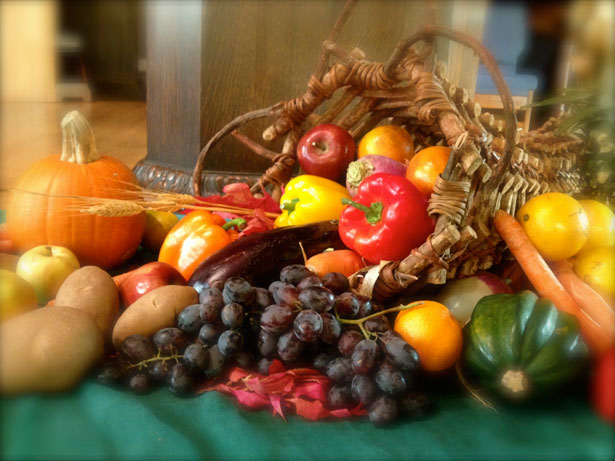
Cornucopia Free Stock Photo - Public Domain Pictures

The First Course:

“I would maintain that thanks are the highest form of thought, and that gratitude is happiness doubled by wonder.”

(G. K. Chesterton — 1874-1936. Columnist and author extraordinaire;  called the best writer of the twentieth century.)

The Second Course:

“The unthankful heart…discovers no mercies; but let the thankful heart sweep through the day and, as the magnet finds the iron, so it will find, in every hour, some heavenly blessings!”

(Henry Ward Beecher — 1813-1887.   Congregationalist minister, known for his support of the abolition of slavery.)

The Third Course:

“Thanksgiving gives effect to prayer, and frees from anxious carefulness by making all God’s dealings matter for praise, not merely for resignation, much less murmuring. Peace is the companion of thanksgiving.”

(Author Unknown – Quoted in Jamieson, Fausset and Brown Commentary on the Whole Bible, Philippians 4:6.)

May wonders and mercies surround you this Thanksgiving Day, bringing you peace and happiness!

(photo credit:  www.publicdomainpictures.net, George GrimmHowell)

What’s Better?

I don’t know what’s better:

That first sip of coffee in the morning, or the first moment on the pillow at night!

The anticipation of an exciting event, or the lingering memories after.

Ice cream in the summertime, or thick, hot soup in winter.

Gazing at a wide vista of mountains and trees, or studying a tiny flower up close.

Snuggled up by the fire, or walking through crisp, autumn leaves.

Dark chocolate or white popcorn!

A new book with a tantalizing title, or an old, prized volume, underlined and dog-eared.

The raucous noise of a festive party, or the delicious quiet afterward.

The uplift of a clear, cloudless day, or the coziness of a cloud canopy.

Looking forward to wonders yet to be discovered, or looking back on wonders already known.

Oh, yes, Lord.  “You have made everything beautiful in its time” (Ecclesiastes 3:11).

*     *     *     *     *     *     *     *     *     *

Thank you, Father, for continually blessing your people—not just corporately but individually.  You even bestow custom-blessings, specifically designed for the pleasure of one!  And thank You that, as I draw near to you with a grateful heart, your presence fills me with awe and joy.

*     *     *     *     *     *     *     *     *     *

What blessings are you hard-pressed to choose between this Thanksgiving?  Share your thoughts in the Comments below!

(photo credits:  www.3dwaltz.com/babies-pictures-6.html, http://www.popsdigital.com,  www.levenger.com, http://www.footage.shutterstock.com.)   

We Gather Together

Have you ever noticed that, except for the first line, the familiar Thanksgiving hymn, “We Gather Together” is not about God’s blessing?

We sing such statements as:

  • The wicked oppressing now cease from distressing
  • So from the beginning the fight we were winning
  • Let Thy congregation escape tribulation

Don’t those seem strange concepts to emphasize on a day set aside for thanks?

The truth is:   although Thanksgiving is about gratitude, it is also a celebration of religious freedom.  That was surely on the minds of the Pilgrims back in 1621.

Freedom to worship God, and to read the Bible for themselves, were among the chief reasons the small band of believers left England for Holland in 1609.  Then, as circumstances became difficult there as well, they courageously set out for America to establish their own colony (albeit with a charter from the king of England, which granted them permission to inhabit the Virginia Colony).

The Pilgrims had faced the threat of imprisonment and death in Holland as well as England.  In addition, the trip to America included such hazards as shipwreck, illness, and accident.

Yet troubles only mounted upon reaching the New World.  The Mayflower landed too far north–at Cape Cod—not in Virginia as planned.  A late launch and a sixty-six day voyage on stormy seas (instead of the planned three weeks) meant they arrived in late fall.  Shelters were not completed until February.   Then there were Indians to worry about.

Yet they were willing to face all these challenges in order to establish a colony “for the Glory of God and Advancement of the Christian Faith” (from the Mayflower Compact).

The third line of the hymn  speaks of one joy they embraced:  “The wicked oppressing” (King James of England and his bishops) “now cease from distressing.” God had removed the Pilgrims far out of the king’s reach.  No longer could he persecute them.

The first verse ends with:  “Sing praises to His name.” There is no historical record that the Pilgrims sang at their first Thanksgiving celebration in 1621.  But music was typical at their gatherings, so perhaps they did participate in a psalm or two.  After all, the feasting lasted three days!

Undoubtedly the Pilgrims would have offered their prayerful thanks– even though half their number had died the previous winter, and the first harvest had been quite meager.  (The ninety Native Americans who attended that celebration actually brought most of the food.)

The second verse of the hymn begins:  “Beside us to guide us, our God with us joining.”

God certainly chose an interesting way to guide the Pilgrims and join with them in surviving the harsh conditions of New England.  Remember Squanto?  He’s the one who showed the Pilgrims how to fertilize the soil with fish.  Without that first crop of decent corn, the Pilgrims never would have survived.

Even more amazing?  Squanto just happened to speak English!

The third verse of “We Gather Together” begins:  “We all do extol Thee, Thou Leader triumphant.”  The Pilgrims honored God as Lord.  They recognized that from him all blessings flow.  And the hymn concludes:  “Thy name be ever praised; O Lord, make us free.”

In actuality, this hymn was not written as a direct tribute to the Pilgrims’ experience.   It dates back to Holland, in the late 1500s, written in celebration of a Dutch victory over the Spanish at the Battle of Turnhout (1597).

Under the rule of Spain’s King Philip II, Dutch Protestants had been forbidden to gather for worship.   Perhaps the Pilgrims heard the song while living in Holland.  But the words we sing today were translated into English by Theodore Baker, in 1894.

Even so, the words remind us that the Pilgrims suffered much and risked everything to found a colony where they could gather together in freedom—to proclaim:

“All glory be Thine!”

May we, too, extol our Leader triumphant, as we sing this hymn through the coming week.

(Sources:  The Founders’ Bible, www.plimoth.org, History News Network at http://www.hnn.org )

The Believer’s Pace

Those of us who believe in Jesus are on a faith journey.

Sometimes we fly.

He carries us on eagles’ wings.


One example from scripture is God’s deliverance of the Israelites from Egypt.  He said, “You yourselves have seen what I did to Egypt, and how I carried you on eagles’ wings and brought you to myself” (Exodus 19:4).

The Israelites had done nothing to secure their release from Pharaoh.   God caused the plagues, God opened the Red Sea for the Israelites’ escape, and God destroyed the Egyptian army.

Moses and his sister, Miriam, sang a song to the Lord, to celebrate their deliverance.


“Who among the gods is like you, O Lord?  Who is like you–majestic in holiness, awesome in glory, working wonders?” (Exodus 15:11).

Has your heart soared on the euphoria of an awesome and glorious miracle?

We have.  A number of times.  One day D. called to announce she wanted to buy us a car.  Arrangements were made with a dealership; all we had to do was go and pick one out.

“Oh–and get leather seats,” she insisted.  “They’re so much more comfortable.”

Can you imagine?  What an incredible blessing!  Our hearts soared for weeks on that miracle.   Even now, more than thirteen years later, that car is a constant reminder of God’s supernatural provision.  (Yes, it’s still running smoothly!) Through D., God proved unequivocally his love and power.

Sometimes we soar; sometimes we runon supernatural strength.

We feel the supernatural power of the Spirit coursing through our veins, providing strength and passion for the task at hand.  It is a spontaneous sprint, energized by omnipotent God.

New Christians are often empowered for a running start in their burgeoning faith. Eagerly they soak up Bible knowledge in small groups and personal Bible study.

In other cases, God places a special call on someone’s life to fulfill a need.  And with the call comes supernatural strength to meet the challenge.

That’s what happened to J.B.  God infused him with a passion to upgrade the sound system of our church.  Night after night, he worked at rewiring the sanctuary.  Much of that time was spent climbing about in the rafters.  This after working each day at his business.

When I asked J.B. about exhausting himself, he assured me  he was having fun!  He didn’t feel worn out at all.  God was giving him the strength to complete the project.

Yes, it’s exhilarating to fly on eagles’ wings of miracles and run on supernatural strength.  But…

…most of the time on our faith journey, we walk.

Step by step.  Choice by choice.  Slowly approaching the destination—the day of Christ Jesus (Phil. 1:6).  Sometimes the path is uphill and rocky.  We strain with effort to make progress.  Some days the path is winding, and we cannot see ahead.

Yet in spite of struggle and uncertainty, the walk can still bring much pleasure to the heart.  “Blessed are those…who walk in the light of your presence, O Lord” (Psalm 89:15).  You see, we do not walk alone.  The Company we keep makes all the difference.

Walking in faith involves plenty of ordinary tasks and days without miracles. Children to care for.  Laundry to do.  Meals to cook.  Calls to make.   Students to teach.  Sales to close.

But!  Whatever needs to be accomplished, we can walk through it and not collapse under the repetition and frustration.  How?  By inviting God to walk with us.


Years ago, when our three children were young, my life was a routine of laundry, cleaning, cooking, errands, and child care.  I was not one of those mothers who derived great fulfillment from these tasks.  Instead of walking joyfully through each day,  I often plodded.

Then I came across Colossians 3:23-24.  “Whatever you do, work at it with all your heart, as working for the Lord, not for men, since you know that you will receive an inheritance from the Lord as a reward.  It is the Lord Christ you are serving.”

In the margin of my Bible, next to those verses, I wrote, “including housework!”  I wanted Who I served to be more important than what I was doing.  Plodding didn’t end once and for all, but I learned to walk at a believer’s pace more frequently, as I invited God to cook, clean, and launder with me!

Those verbs–soar, run, and walk–are found in Isaiah 40:31, in that order:


“Those who hope in the Lord will renew their strength.  They will soar on wings like eagles; they will run and not grow weary, they will walk and not be faint.”

Perhaps soaring is first because  the euphoric wonder of flying on eagle’s wings seizes our attention with intensity.

Running is second.  Adrenalin runs high during spurts of divinely inspired growth and service.

And walking is last.  Did God save the most important until the end?  Because it’s in the persevering that we become strong.  It’s in the trusting  that our faith grows deep.  And it’s in practicing his presence that we learn consistency of character.

So revel in occasional soaring.  Rejoice in periodic  running.  But take deep satisfaction in the day-by-day walk on the paths of righteousness (Psalm 23:3).


“Come…let us walk in the light of the Lord” (Isaiah 2:5)!

(photo credits:  www.betterphoto.com; http://www.linksterdiversions.blogspot.com; http://www.BlackburnNews.com; http://www.foxnews.com; http://www.photobucket.som/user/jamiesolome/media.com; http://www.faithgateway.com; http://www.pinterest.com)

When the House is Quiet

Impressions Becoming Expressions

Mitch Teemley

The Power of Story

Still Traveling

Impressions Becoming Expressions

Living Our Days

Gaining a heart of wisdom

He Said What?!

I'm Patty, and my husband and I are living with our adult son who has autism and epilepsy. I love sharing lessons learned from life around me, especially life with Aaron.

Meditations of my Heart

Impressions Becoming Expressions

Linda Stoll

Impressions Becoming Expressions

Signora Sheila

Where faith meets la dolce vita

Heidi Viars

Finding the Image of God