Feeds:
Posts
Comments

Posts Tagged ‘God’s Ways’

Mixed-Messages


Perhaps you can help me answer a question.

I’m wondering why, in spite of the fact all of us Christians are using the same manual, the Bible, we don’t always agree on a course of action?

For example, some Bible teachers will advise us to persevere in pursuit of Christian character or the fulfillment of a dream that seems God-inspired. A favorite scripture to support their premise is Philippians 3:13-14.

“One thing I do:

Forgetting what is behind

and straining toward what is ahead,

I press on toward the goal to win the prize

for which God has called me heavenward in Christ Jesus.”

So we dig deep into our resolve, rise early in the morning to spend time in God’s Word, work hard with self-discipline and determination, pray fervently, and more.

BUT. Others will say, God never intended us to toil from early morning till late at night. They will say, “Learn to rest in God (Psalm 91:1). There is no need for nonstop activity. ‘The Lord will fight for you; you need only to be still’” (Exodus 14:14).

So which is it? Press on or be still?

Here are a few more contradictions that have come to my attention:

  • Waiting in faith (Psalm 27:14), as opposed to stepping out in faith–like Abraham, when he left Haran and had no idea where he was going (Genesis 12:1-4).
  • Dreaming big, because all things are possible with God, and he can do far more than we could ask or think (Luke 1:37; Ephesians 3:20). On the other hand, God’s ways aren’t always our ways, so we need to be prepared.  Events may not unfold as we planned (Isaiah 55:8-9).
  • Trusting in God’s provision (1 Timothy 6:17b), or providing for ourselves as he expects (1 Thessalonians 4:11,12; 2 Thessalonians 3:10).
  • Trusting in God’s loving care to protect us (Psalm 91:9-11), or expecting trials and suffering (Philippians 1:29).
  • Remembering what God has done, including the transformation from old ways to new (Deuteronomy 6:12; Psalm 77:11-12), or forgetting the past and focusing on the goal ahead (Philippians 3:13-14).

How do we handle such mixed messages? Here are a few possibilities:

  1. Aim for balance.

Each set of contradictions above need not represent either/or choices. For example, we can be still and at peace in our spirits while pressing on to accomplish what God has impressed upon us to do. We can wait patiently for a prayer to be answered and step out in faith to follow God’s leading for that answer. We can dream big even as we pray, “My life is in your hands, Lord. Do with me as you will.”

Balance makes for blessing. — St. Augustine

  1. Realize that God has purpose in the contradictions.

For example, if every decision was clearly a black and white matter, there would be no need for his personal guidance. But his greatest desire is to be in relationship with us. So perhaps he allows a bit of ambiguity in our lives so we’ll choose to stay close to him.

  1. Embrace the adventure of contradiction!

We never know when God is going to step in and make something happen–something unusual and exciting! As we work to provide for our own needs, God may very well supply a miracle–far above and beyond our expectations. Even during a trying time, God will deliver showers of blessing, beginning with supernatural strength and peace that defies explanation.

No doubt there are other contradictions in scripture that you have noticed.   Perhaps you’ve given some thought as to their purpose, and how to deal with them.

So please. Share your insights below, and let’s learn from each other!


(Photo credit:  www.brandesign.co.za.)



Read Full Post »

White_Oak-15_acorns


Elena, almost eighteen months old, loves to collect acorns. A grand oak tree on the church property across the street from her home provides perfect hunting grounds. She trundles along the edge of the sidewalk, her eyes on the grassy edge. Now and then she bends over, chooses a prime specimen, and clutches it tightly to her chest.

Yesterday was a banner day for acorns. Way too many shiny nuts with perfect caps. Her little hands couldn’t carry them all. I was given the honor of transporting a few of her treasures home. And this opportunity became the starting point for a train of thoughts.

You’ve no doubt noticed this yourself:  acorns do not appear capable of producing oak trees.  They’re too small and too hard.  How can the seeds inside even escape those tough shells?   Yet given the right soil, the right climate, and plenty of time, the miracle of growth occurs.  White oak trees can reach the height of 150 feet, growing twelve to fourteen inches per year.  Acorns do not appear until the twentieth year.  In the end, the majestic giant provides hundreds of benefits (www.arborday.org and http://www.ehow.com).


white_oak_5036-320


Now a few tall plants, like bamboo, grow very quickly. But not tall, strong trees.  I wonder why?

We humans are also slow-growing–in body and spirit. And I wonder about that, too.  Why didn’t God make us more like bamboo, able to reach maturity quickly? Instead, we progress through a protracted, sometimes painful learning process to become “mature, lacking in nothing” (James 1:4).

Perhaps God willed our development to happen slowly so we have many opportunities to follow his chosen path and fulfill the potential he’s especially prepared for each of us. A false step in the wrong direction can be corrected, just as a crooked tree can be straightened if attended to promptly.


 HardMaple1


Yes, there are those who choose not to mature, not to participate with God.

But we know that God is good, that what he does is good. I want him to train and teach me (Psalm 119:68). My guess is you feel the same.

Day by day, choice by choice, we can progress along the spectrum from self-centered to selfless, from impatient to patient, from lesser to greater.  But we have to realize: it happens slowly over time.

Here’s another possibility, even better than just accepting slow progress.  Let’s embrace it.

You see, our culture tends to look at time as a thief who steals away our youth, worth, mental acuity, and energy.

But what if we view time as a gift–a gift of countless opportunities provided day by day, choice by choice–to grow into the mature and gracious people God ordained? Instead of regretting the passage of time we can celebrate:

  • Our progress to become rooted and built up in Jesus, strengthened in our faith (Colossians 2:6).
  • The growing ability to bear fruit (the fruit of the Spirit, exemplary living, glorifying God to others)–even into old age (Psalm 92:14).
  • Becoming “oaks of righteousness, a planting of the Lord, for the display of his splendor” (Isaiah 61:3).

Oh, I like that last verse especially, don’t you?

And it can happen through  slow and steady perseverance, with God as our guide.


(Photo credits:  www.bio.brandeis.edu; http://www.treetopics.com; http://www.awesometools.com.)


Read Full Post »


Let me take a wild guess here.  You are waiting for something.  Either a prayer to be answered, a need to be met, or an event to take place.  Of course you are. Waiting is a part of life.

But why? God could intervene sooner than later if he wanted to. Why the delay?

Because particular blessings result from wait-time. You’ll find several of them itemized in a previous post: “The Blessings of Wait Time” (October 10, 2013).  You can click on it below.

But recently I came across an addendum that grabbed my attention; perhaps you’ll find it noteworthy too.

First, you’re probably familiar with the instruction of Psalm 27:14 and other scriptures that tell us to wait on the Lord.


psalm27.14


Centuries ago, in the old Prayer Book Version (which predated even the King James Version) that sentence was translated: “O tarry thou in the Lord’s leisure.”

Gives the verse a new layer of meaning, doesn’t it.

I’m thinking of an anxious child, waiting not-so-patiently for the moment aunts, uncles, and especially young cousins will arrive on a summer Saturday. How he looks forward to the table heaped with picnic fare, the games of tag and hide-and-seek, and perhaps Marco Polo in the pool.

“When will they get here?” he pines — again.

“All in good time,” Dad responds while preparing the grill.


frustration


Do you remember being that child? Your very insides were jumping around with pent-up excitement. Maybe your outsides were jumpy, too. Sitting still was an impossibility. You wanted the fun to begin NOW. Did you wonder, How can Dad be so calm?

We weren’t quite wise enough to recognize Dad’s vantage point of experience. He knew that highly anticipated events do eventually happen, and anxiety does not speed up the process. Dad could relax, enjoying the peace and quiet perhaps, before the whirlwind of relatives descended.

Is it possible that such a scenario describes (in part) the way our all-knowing, all-powerful Heavenly Father looks at our circumstances?

He knows exactly when each prayer will be answered, when each need will be met, when each anticipated event will occur.

So calmly and leisurely he waits until the time is just right.

Perhaps God is waiting until we’re ready to receive what he has planned.  Might a little more spiritual maturity be in order?

Perhaps others are involved and he’s engineering circumstances to meet several purposes all at once.  Joseph was released from prison at just the precise moment Egypt would need his God-inspired wisdom and leadership.

Perhaps our Father provides wait time to take our faith to the next level.  He knows how contented we will be upon learning to rest and trust in quiet calm –with  no jumpy impatience.  How wonderful to affirm with calm conviction: “All in good time.”

Just like Dad said.


*     *     *     *     *     *     *     *     *     *

Oh, Father, I don’t want to be like an immature, restless child who cannot be patient. Instead, may I “tarry in your leisure” –resting in your sovereignty and trusting in your timing — implicitly. I want to hope, anticipate, and endure as evidence of ever-growing faith.   Bottom line: I want to please you. And, without faith, I know that is impossible (Hebrews 11:6).


(Photo credits:  www.joyshope.com; http://www.betterparenting.com.)


Read Full Post »

(As most of you know, Steve will soon be retiring from the pastorate, after serving forty years in Florida. Mid-June we move to the Midwest, to be close to our sons and their families. If our daughter and her family would just move east from Washington State, life would be near-perfect!

No doubt you’re also aware that packing and unpacking are time-consuming tasks, so I’m putting the blog on hold for a few weeks. But please continue to visit! I’ll re-blog some previous posts, and hopefully you’ll find them meaningful again, or perhaps for the first time.

The following post was first published 11-7-13.)


tears


Before my friend, Elizabeth, said a word, I knew something was wrong. The slump of her shoulders, the wrinkled brow, the tears welling up in her eyes–they spoke loud and clear.

“You know how Michael and I would like to have a little brother or sister for Ashley,” my friend said, dabbing her eyes with Kleenex. “Well, it’s become more than just a desire for me. I so desperately want another child.” Her voice became tight. “The waiting and uncertainty are becoming unbearable.”

We stood together, in the emptying sanctuary after church, arms entwined. And I prayed for Elizabeth and Michael.

Psalm 113:9, a verse which had ministered to me years before, came to mind. I included the promise in my prayer: “God, you’ve promised ‘to settle the barren woman in her home as a happy mother of children.’ We are claiming that promise today for Michael and Elizabeth. Even now we look forward to the day when they are holding a precious, new baby in their arms.”

Note the verse says children, not child.

The prayer came out of my mouth with certainty and brazen expectation, not in keeping with my cautious personality at all. I have to admit, the thought crossed my mind, What if God intends for Elizabeth and Michael to have just one child? You’ve gone way out on a limb with that prayer!

But I voiced no disclaimers. I let the prayer stand on its foundation of conviction–conviction that didn’t come from my spirit as much as from the Holy Spirit.

For the weeks that followed, I continued to pray that God would bless this couple with another child.

Weeks later, Elizabeth approached me once again. Before she said a word, I knew what she was going to say. Her outspread arms, wide grin, and sparkling eyes spoke loud and clear.

“I’m pregnant!” she cried.

We hugged each other tight and noisily exclaimed our jubilation.

Would I have been as excited had I not been praying for this family? Delighted, yes. But jump-up-and-down ecstatic? Probably not.

My joy was greatly expanded because I had invested myself in the outcome—with the effort of prayer.

Yes, there are many reasons to pray, including these benefits:

Our wills are aligned to God’s will (Psalm 37:4).
Strength of character is developed through the discipline of perseverance (Luke 11:5-8).
We have the opportunity to bring glory to God (John 14:13).
Prayer is a means of fighting against evil (Ephesians 6:10-18, especially verse 18).

But the wonder of prayer, for me, is the privilege God gives us to be part of the process, as he engineers circumstances to accomplish his will.

Every time God moves in situations for which we’ve prayed, he is giving us a precious gift: the gift of participation with him–in a miracle.

Maybe two.

Michael and Elizabeth had twin girls!


il_340x270.446306088_4ipl


*      *      *      *      *      *      *      *      *      *

Heavenly Father, thank you for the splendid privilege of participating with you in the healing, protection, provision, and guidance with which you bless others. May I never get tired of bringing my requests to you, knowing that the joyful conclusion will be worth every moment spent in prayer!

(Photo credit:  www.saveourschoolsnz.files.wordpress.com; http://www.etsy.com.)

Read Full Post »

(This is the last new post until July 3.  As most of you know, Steve is retiring from the pastorate, after serving forty years in Florida.  Mid-June we move to the Midwest, to be close to our sons.  And if our daughter and her family would just move east from Washington State, life would be near-perfect!

Packing and unpacking are time-consuming tasks, as you know, so I’ll put the blog on hold for a few weeks.

But please continue to visit!  I’ll re-blog some previous posts, and hopefully you’ll find them meaningful again, or perhaps for the first time.)


TODAY’S POST


True or False:

 God will do the right thing at the right time.

–Max Lucado


We believe that’s true, right?  We can even find scripture to back up that statement:

“I choose the appointed time; it is I who judge uprightly” (Psalm 75:2).

Never in a million years would we say, “This statement is false. God can’t be trusted to do the right thing!”

But we do sometimes wonder why our ideas of the right thing don’t seem to match his idea.

And we do unabashedly wonder about his idea of right timing.

We also wonder why there’s not even a hint of progress toward that right thing we desire. We wonder why God is silent.


Wondering


But God’s silence is not like that of people.   He doesn’t give us the silent treatment in some petty game of payback. And it’s not a case of forgetfulness either.

More than likely God is working on other matters rather than that one we’re focused on– other matters such as perseverance, faith, and spiritual maturity. These character traits and others don’t grow so well if we’re always getting what we want when we want it.

We can rest assured there is purpose in the pause.

And just knowing that can ease our impatience.

Something else that’s important to know, too:

There’s really no such thing as silence with God, because we always have his Word, chock full of glorious promises and encouragement.  And it’s always available.  (I’m assuming you have an iPhone or computer–you’re reading this post; therefore you have access to a Bible–even if it’s online!)

One of my favorite promises is Isaiah 65:24.


Unknown


(“Before they call I will answer; while they are still speaking, I will hear.”)

And one more, also from Isaiah:

“I will accomplish all my purpose” (46:10b).

God is not only working in our behalf now, he foresaw our need and began working toward its fulfillment before we uttered the first prayer. He started arranging events and bringing together people and resources so that at just the right time the right thing will happen.

Notice the “I will” in each of those verses above. Isaiah did not record God’s good intentions. These are promises of the Almighty God of the universe, our always-truthful, always trustworthy Heavenly Father.

WHY DO I WONDER?!


*     *     *     *     *     *     *     *     *     *


I praise you, Heavenly Father, for being reliable and trustworthy. I can’t imagine life without you as my foundation. Thank you for every promise in your Word that gives me support. Once again, I avail myself to your plan, so you can do the right thing at the right time—without the interference of my impatience or doubt!


(Art and photo credits:  www.kemingshen.com , http://www.brendaboen.blogspot.com.)


Read Full Post »

 proverbs-36_2821_1024x768

(“In all your ways acknowledge [God] and he will make your paths straight.” — Proverbs 3:6, NIV)

M-m-m.  God will make my paths straight? Sounds as if he is promising a life of ease on a flat, straight course. Smooth transitions from Point A to Point B.

But I know God doesn’t work that way. Life on Easy Street can result in laziness and worthlessness.

In checking other translations of the Bible, I discovered fresh insights for this familiar verse.

Berkeley says, “He will direct your paths.”

The Douay-Rheims Bible presents a nuance of difference: “He will direct thy steps.”

New Living Translation, “He will show you what path to take.”

Holman Christian Standard Bible, “He will guide you on the right paths.”

And my personal favorite: “He’s the one who will keep you on track” – The Message.

I wonder if I could compose my own amplified version, combining all these translations? Something like: “He will direct my steps along the path that he knows is right and keep me on track.”

How glorious that our Heavenly Father cares enough to guide us so attentively. What a relief to know…

…we can trust the One who knows us  better than we know ourselves. After all, God made us.   He can be trusted to choose just the right path for each of us. “He will teach [us] his ways, so that [we] may walk in his paths” (Isaiah 2:3).

…we don’t have to direct our own steps. In fact, “It is not for man to direct his steps” (Jeremiah 10:23). How wonderful to depend on God, who can see into the future. We certainly can’t!

…He won’t just set us off in the right direction, then leave us to our own devices. He will remain by our side, providing guidance all along the way.  Our God is all-wise; we are not.

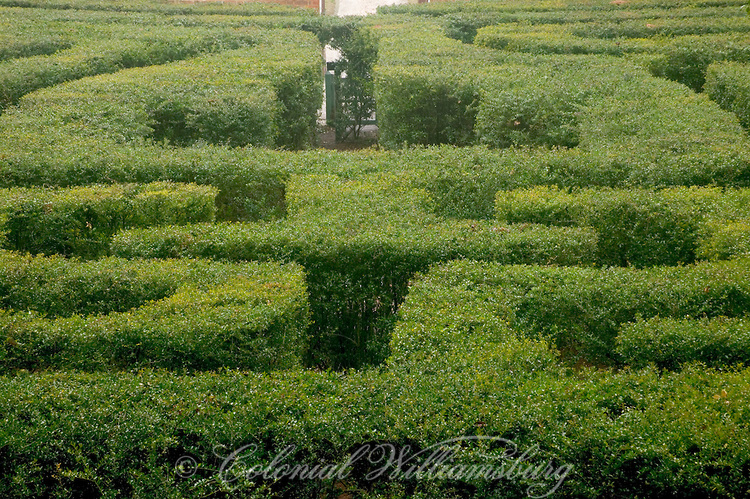
I’m remembering a visit to the Governor’s Palace in Colonial Williamsburg, Virginia. In back of the large home is a labyrinth of boxwood bushes, replicating the maze that was first constructed there hundreds of years ago. Children and adults alike find it hard to resist the challenge, including me.


D2004-DMD-0413-1176.tif


Oh, my. With my lousy sense of direction, I became hopelessly lost. Every time I thought the next corner would be the way out, a wall of greenery would greet me. What I needed was somebody with a bird’s-eye view of the path who could tell me which way to turn.

That’s exactly what we have in our Heavenly Father.

“Whether you turn to the right or to the left, your ears will hear a voice behind you saying, ‘This is the way; walk in it.’” (Isaiah 30:21).

And we’re talking about much more important matters than a labyrinth of bushes! We’re talking about:

  • Day-to-day choices that form our character
  • Decisions that impact our influence upon those around us
  • Selections of what church to attend, what friendships to cultivate, what activities to pursue, and more
  • Guidance for those unexpected twists and turns of life

In all these ways, “He will direct our steps along the path that he knows is right and keep us on track.”

*     *     *     *     *     *     *     *     *    *

Oh, Lord, help me to look up toward you—often! I want to walk the right path you have chosen for me, with confidence and strength, because I am trusting in you. May I turn my thoughts to you and your Word continually—so I can receive frequent instruction. And thank you for walking with me, offering support and encouragement, every step of the way. “Show me the way I should go, for to you I lift up my soul” (Psalm 143:8b).


(Photo credits:  www.rockchurchofindia.org; http://www.colonialwilliamsburg.photochelter.com.)


Read Full Post »

let_the_glory_out_tshirts-rf982b89d7b1846dbb186d467bd317390_8naah_324

Defeat may serve as well as victory

To shake the soul and let the glory out.

When the great oak is straining in the wind

The boughs drink in new beauty and the trunk

Sends down a deeper root on the windward side.

Only the soul that knows the mighty grief

Can know the mighty rapture.  Sorrows come

To stretch out spaces in the heart of joy.

–Edwin Markham (1852-1940)

Mr. Markham–educator, author, and poet– gives us much to contemplate in just eight lines, beginning with the first seven words:

“Defeat may serve as well as victory.”

No, thank you, my spirit says.  Defeat is humiliating, uncomfortable, and depressing.

Mr. Markham inspires a different perspective and a note-to-self:  God may very well bring defeats into my life “to shake my soul and let the glory out.”

Reminds me of Jonah, the reluctant prophet who tried to run from God.  The Lord told him to go east to Nineveh, an important city of Assyria.  Instead he headed west, boarding a ship for Tarshish.

But a fierce storm churned the seas into a boil.  In desperation to appease the gods, the sailors hurled Jonah overboard.  Surely in those tense moments of near-drowning and then being swallowed by a great fish, Jonah felt crushing defeat.  His life was over; it was just a matter of seconds.

Yet he didn’t die.  Hour after hour in the utter blackness of the fish’s belly, he remained alive.

No doubt he felt shaken in his soul, and in his distress, he called to the Lord (2:1ff).

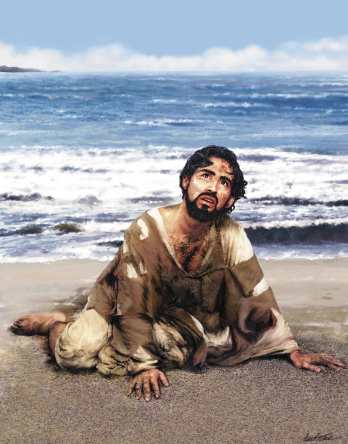
God heard his prayer and commanded the fish to vomit Jonah onto dry land.

Jonah_shore

 Then the Lord repeated Jonah’s marching orders: “Go to the great city of Nineveh and proclaim to it the message I give you” (3:1).

This time Jonah obeyed, and the glory came forth.   Jonah preached and the people repented. God had compassion upon the citizens of Nineveh, and did not bring destruction upon them.

What appeared to be a mortal defeat for Jonah turned into a glorious revival for a wicked city.

Read Mr. Markham’s poem again and you’ll discover more benefits of defeat, as outcomes of:

  • Straining in the wind.  Pressing on during adversity results in perseverance and strength of character.
  • Drinking in new beauty.  During times of distress we’re more aware of God’s glorious attributes at work in our spirits–attributes such as empowerment, faithfulness, peace, and grace.
  • Sending down deep roots.  Defeat often brings us to new depths of surrender and submission.  It also brings us to new depths of God’s love (Ephesians 3:17).
  • Experiencing grief.  Only those that know a mighty grief can know the mighty rapture.  Like diamonds against dark velvet, joy needs a backdrop of sadness in order to be appreciated fully.
  • Experiencing sorrow.  Sorrows create space for joy.  Joy is never so sweet and overwhelming as after sorrow.

God knows what he’s doing, and he doesn’t waste time or effort.  False starts and fruitless endeavors just don’t happen with our perfect Heavenly Father.

Therefore, when defeat comes into my life or yours, we can rest assured he is accomplishing his good purpose for us.

There will be victory in defeat.

Guaranteed.


(photo and art credits:  www.zazzle.co.nz.com; http://www.searchforbibletruths.blogspot.com.)


Read Full Post »

Does your to-do list for tomorrow include such items as:

  • Send birthday, get-well, or encouragement cards?
  • Attend a meeting or rehearsal at church?
  • Prepare for teaching a Bible study or Sunday School lesson?
  • Pick up your husband’s prescription?
  • Prepare for dinner guests?

Young woman cooking in her kitchen

Our days are often filled with small deeds. We tend to think they’re insignificant and therefore, so are we.

But that negative evaluation is not from God!

“Who despises the day of small things?” he spoke to Zechariah (4:10).

In fact, evidence indicates that God loves to take small, seemingly insignificant actions, and use them in creative, powerful ways:

  • A piece of wood thrown into bitter water turned it sweet (Exodus 15:25).
  • A cord hung from a window saved a family from destruction (Joshua 2:17-21).
  • An army of 300 defeated a powerful enemy, just by blowing trumpets and breaking clay jars to expose torchlight (Judges 7).
  • A dab of mud applied to a man’s blind eyes restored his sight (John 9).
  • Paul’s handkerchiefs and aprons became healing agents as they were laid upon the sick ((Acts 19:12).

mud

It doesn’t matter that we’re not famous, wealthy, intellectual, or strong, because it is “‘Not by might nor by power, but by my Spirit,'” says the Lord Almighty” (Zechariah 4:6).

Might = strength, resources, and ability.  If that describes you, wonderful!  But those blessings alone will not guarantee significance.

Power = persistence, resolve, and consistency.  Again, if you are able to power through with effort and efficiency to accomplish much, terrific!  But what’s truly important is if the effort is achieving God’s purpose.

Granted, God has given us talents and gifts, opportunities and choices.  We must be prayerful and wise in the ways we use them.

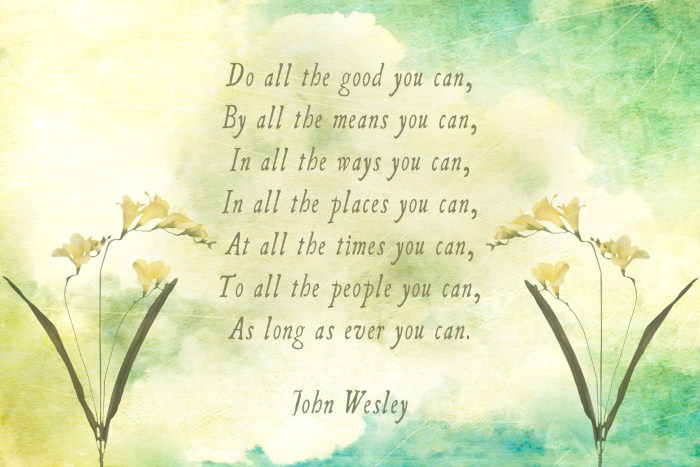
John Wesley advised:

025-All-You-Can-John-Wesley

(“Do all the good you can, by all the means you can, in all the ways you can, in all the places you can, at all the times you can, to all the people you can, as long as ever  you can.”)

Just remember:  apart from the Lord Almighty, we accomplish nothing worthwhile (John 15:5).

On the other hand, little is much–IF God is in it.

He rejoices in what is right, you see, not necessarily in what is big.

So, when you feel like a nobody who’s accomplishing nothing, be mindful of this:

Does the place you’re called to labor

Seem small and little known?

It is great if God is in it

And He’ll not forget His own.

–Kitty Suffield

(Art & photo credits:  www.whattoexpect.com; http://www.auyouth.com; http://www.kokabella.com.)

Read Full Post »

Wise Man - Foolish Man House

You probably remember the story.

A foolish man built his house on sand; a wise man built his home on rock.  When a storm came, the house built on sand fell with a great crash.  But the wise man’s house stood firm (Matthew 7:24-27).

With this parable Jesus offers visual imagery for choosing man’s way to live or God’s way:

1) You can choose to build your life on getting ahead and having a good time, but in the end you will have nothing.

Or,

2) You can choose to build your life on faith in Jesus, and in the end you will receive great gain–a Rock of stability to depend on now, and perfect bliss in heaven for eternity.

Jesus is:

  • Reliable.  “He is the Rock, his works are perfect, and all his ways are just.  A faithful God who does no wrong, upright and just is he” (Deuteronomy 32:4).
  • Unchanging.  “Jesus is the same yesterday and today and forever” (Hebrews 13:8).
  • Protective.  “In the day of trouble he will keep me safe in his dwelling..and set me high upon a rock” (Psalm 27:5).

But I’m thinking the story about houses built on sand and rock could be applied to our thought lives, too.

For example, if we allow our minds to focus on the shifting sands of circumstance,  we sink into negativity, worry, and fear.

If we focus on a firm foundation of scriptural absolutes, a sense of tranquility and strength pervades our spirits.

What are those absolutes?  The Bible teaches many, including the following:

God loves us — so much that he sent his only Son to die in our place.  Jesus took the punishment for our sins that we deserve (John 3:16).  Now, I’ve heard that statement thousands of times.  Perhaps you have, too.  But we mustn’t allow familiarity to reduce this truth to banality. His love for us is everlasting.   Deep.   Caring.   Forgiving.   Full of grace.  Let’s bask in the wonder of his love!

God has a plan for each of our lives, and it’s a good plan (Jeremiah 29:11).  Notice God doesn’t promise a pleasurable plan.  God loves us too much to allow addiction to fun.  With his goodness comes discipline, so that we become mature. In the final analysis, immature people are not the most content anyway.  They are self-centered and tend to whine and complain.  I don’t want to be that kind of person, and I’ll bet you don’t either.  So let’s accept the absolute goodness of God’s plan.

God will equip and empower us for his plan (Isaiah 41:10).  He’s the one who formed mountains, engineered ecosystems, and filled infinite space with countless stars.  This same God lives within us and works through us, fostering resolve, strength, and perseverance.  Let’s turn to him moment by moment to avail ourselves of his power.

And as we affirm such truths, we are reinforcing our foundation upon the Rock. Stone upon stone.  Solid, firm, and strong.  When the storms come– economic setbacks, health problems, emotional hurts–we will not collapse into a heap.

With David we will be able to exult in God’s provision:

“I waited patiently for the Lord; he turned to me and heard my cry.  He lifted me out of the slimy pit, out of the mud and mire; he set my feet on a rock and gave me a firm place to stand…Blessed is the man who makes the Lord his trust” (Psalm 40:1-2, 4b).

*     *     *     *     *     *     *     *     *     *

What scriptural absolutes are part of your foundation?  Please share your thoughts in the comment section below!

( art credit:  www.intheleafytreetopsthebirssing.blogspot.com)


Read Full Post »


“Oh no, Elena, you don’t want that,” I say to our one-year old granddaughter.  Obligingly she holds up to me a minuscule scrap of paper she’s found on the floor.  Thanks to much practice with Cheerios, her thumb and forefinger can pick up the tiniest items.

Elena and I are on an excursion through the living room and dining room.  From her jaunty steps, I can tell she’s loving the freedom to explore.  And I’m glad to provide the watchful eye she needs.

No sooner do I slip the paper into my pocket than her little hands are grabbing for a cell phone on a side table.  You wouldn’t think her arms are long enough to reach that far.  Daddy says she has the wingspan of a pterodactyl.

“I’m sorry, Elena,” I tell her.  “We’ll have to put that up here on the shelf.  Mommy’s phone isn’t a toy.”

I think she’s heard that before.  The removal of the phone doesn’t upset her; she just moves on. Quickly Elena toddles toward the living room fireplace where unlit candles stand in a decorative formation.  Not for long.  She grabs the chunky, center candle, clutches it to her chest, and proceeds on her way around the table.

“Let’s leave the candle here,” I say, gently prying it out of her fingers.  “If you drop that on your toes, it will hurt.”

I’m surprised Elena doesn’t become upset.  For a moment I think she’ll march on to other discoveries and leave the other candles in the fireplace.  Instead, she wastes no time turning around and heading back.  Soon there are five candles up on the table.

And so it goes as I tag along behind a toddler who knows very little, fears practically nothing, and desperately wants to be free and independent.  We adults must be attentive, instructive, and protective.

You know what?  There are times I’m not much more than a toddler in God’s family.  I, too, know very little, lack a healthy fear of those things that could hurt me, and struggle against the desire to be free and make my own choices.

Good thing I have a Heavenly Father who is so attentive.

“He who watches over [me] will not slumber” (Psalm 121:3).

My Heavenly Father is instructive.

“He guides the humble in what is right and teaches them his way” (Psalm 25:9).  Key word:  humble.  I have to be accepting of instruction and willing to apply it.

My God is also protective.

“He is my loving God and my fortress, my stronghold and my deliverer, my shield, in whom I take refuge” (Psalm 144:2).

*     *     *     *     *     *      *     *     *     *

Oh, Father, forgive me for the times I act like a toddler and take off on my own.  Thank you for your constant, watchful presence, for those times you’ve grabbed things from my grasp because you knew they were not in my best interest. Thank you for instructing me through your word and through wise, godly people.  Slowly but surely you have equipped me with the knowledge of your ways–ways that are good and right.  Then you’ve patiently trained me to follow those ways.  May my heart be set on keeping your decrees to the very end (Psalm 119:112)!

(Photo credit: http://www.pexel.com)

Read Full Post »

« Newer Posts - Older Posts »

Still Traveling

Impressions Becoming Expressions

Living Our Days

Gaining a heart of wisdom

He Said What?!

I'm Patty, and my husband and I are living with our adult son who has autism and epilepsy. I love sharing lessons learned from life around me, especially life with Aaron.

Meditations of my Heart

Impressions Becoming Expressions

Linda Stoll

Impressions Becoming Expressions

Debby Thompson

Impressions Becoming Expressions

Signora Sheila

Notes on Life, Faith & Italy

Colleen Scheid

Writing, Acting, Living in God's Love

Mitch Teemley

The Power of Story

Heidi Viars

Finding the Image of God