Feeds:
Posts
Comments

Posts Tagged ‘Jesus’

A view from Signal Hill

Frank Laubach trudged up Signal Hill again, despair shrouding his heart. After patient waiting and great effort he’d reached an impasse, with no path forward toward success.

Frank had spent seven years earning college and seminary degrees, married Effa Seely in 1912, and together they’d sought to follow God’s plan and become missionaries.

In 1915 the couple traveled to the Philippines, eager to work with the Muslim Moro people on Mindanao.

Mindanao is the large island to the south among the Philippines.

But just a few weeks after their arrival, the U.S. Army post commander stationed there required them to leave, insisting the area was too dangerous for Christians.

First they moved to north Mindanao, and ministered among the people there. In 1922, Frank and Effa moved their growing family to Manila where Frank became dean of Union College and established churches.

Surely he could take satisfaction in these accomplishments. But his heart’s desire was still set on working among the Moros.

Nearly eight years later, the trouble in southern Mindanao finally subsided. Frank left his family in Manila and returned, only to be rejected wherever he went. No one would listen to Frank, and after a month he had to admit defeat.

Moro people of Mindanao

One evening atop Signal Hill, Frank poured out his heart to God again and asked, “Why have my efforts failed?”

And this time God answered, identifying the problem. Frank saw the Moro people only as potential converts to Christianity, not as people to love.

“You feel superior to them because you are white,” God said. “If you can forget you are an American and think only how I love them, they will respond.”

The truth compelled Frank to pray, “Drive me out of myself, Lord. Come and take possession of me and think your thoughts in my mind.”

God then revealed his course of action for Frank. “If you want the Moros to be fair to your faith, be fair to theirs. Study the Koran with them.”*

The next day Frank told the Moro priests he wanted to study the Koran. Eagerly they talked with him, and Frank began to build relationships with these men, sharing the good news about the great prophet they already knew: Jesus.

Most of the Moro people couldn’t read. Frank knew that literacy would be important for teaching about Christ, so he worked to provide a dictionary of their language, Maranaw, and established a school. The Moros expressed enthusiastic gratitude.

Frank procured a printing press and devised an adult literacy program that proved highly successful. But as the Great Depression reached the Philippines, the program seemed destined to collapse. How would they pay for materials?

Frank’s solution: “Each One Teach One.” Everyone who learned to read was urged to teach someone else, using the materials they had. And as Frank taught, he shared about Christ.

Over the ensuing years, Frank wrote books about his teaching methods which were adopted around the world. An estimated sixty million people have learned to read, thanks to Frank’s techniques.

But more important are the thousands of people he brought into a rich experience with God——through his other writings.

For Frank, that night on Signal Hill was the beginning of growing intimacy with God, revealed in his subsequent journal entries, articles, and books.

One habit in particular transformed his life. Like Brother Lawrence three centuries before, Frank sought to live moment by moment in relationship with God.

Frank’s Letters by a Modern Mystic trace the beginning of this journey toward intimacy.

“I resolved that I would succeed better this year with my experiment of filling every minute full of the thought of God than I succeeded last year” (1-3-1930).

“This year I have started out trying to live all my waking moments in conscious listening to the inner voice, asking without ceasing, ​’What, Father, do you desire said? What, Father, do you desire done this minute’” (1-20-1930)?

“It is exactly that ​‘moment by moment,’ every waking moment, surrender, responsiveness, obedience, sensitiveness, pliability, ​’lost in His love,’ that I now have the mind-bent to explore with all my might” (1-26-1930).

So began his life-long practice of constant, blessed connection with his heavenly Father, which he eagerly desired for others.
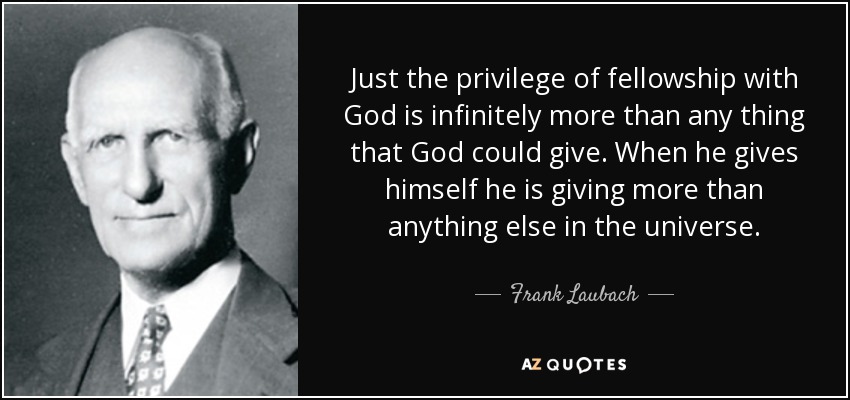
https://www.azquotes.com/quote/803882

“Why do I harp on this inner experience? Because I feel convinced that for me and for you who read there lie ahead undiscovered continents of spiritual living compared with which we are infants in arms” (Frank Laubach, 1884-1970).

And what will result from such a pursuit? No doubt we’ll experience a level of shalom in the presence of God that for now we can only imagine.

Let’s explore! Next week we’ll consider Frank’s suggestions that will take us to those “continents of spiritual living!”


*https://www.ananda.org/blog/laubach-christian-literacy-god/

Additional Sources:

https://www.jcsvillage.org/blog/2017/3/23/frank-laubachs-great-experiment

https://renovare.org/articles/living-each-moment-with-a-sense-of-gods-presence-frank-laubach

Image credits: http://www.flickr.com; http://www.picryl.com; http://www.flickr.com; http://www.azquotes.com.

Processing…
Success! You're on the list.

Read Full Post »

I praise you, Lord Jesus, for surrendering all the glorious perfections of heaven, to live among us with all our un-glorious imperfections [1].

Also astounding is your arrival as an infant, born to peasants, in a stable-cave. How ignoble for the King of kings, the Alpha and Omega who always was and always will be.

As Mary and Joseph tried to rest on scratchy straw, did they wonder, “How could this be part of your plan, Lord Jehovah? How could the Messiah fulfill his grand destiny from such lowly beginnings?”

Little did the couple know:

  • their helpless baby who could not stand “would one day walk on water” [2]
  • his little hands that could not grasp would one day break five rolls and two fish into pieces and feed five thousand people
  • their Child who could not speak would one day make the hearts of men burn within them as he spoke words of supernatural wisdom and insight
  • his flailing arms would one day spread wide on a cross, to save his people from their sins [3]

The depth of your humility and the magnitude of your sacrifice, Lord Jesus, overwhelm me.

I praise you for all the ways you demonstrated God’s character to us during your earthly ministry—his love, compassion, goodness, and more.

I praise you, Lord Jesus, for your power on display in the miracles you performed and those you continue to perform to this day, confirming who you are—not just a wise teacher or mystic but the Son of God.

I praise you for the glimpses of heaven we experience from time to time of what it will be like when all creation is “brought into the freedom and glory of the children of God,”–because of what you accomplished [4].

Such glimpses include:

  • The exquisite beauty of nature, causing us to gasp in wonder
  • The profound heart-to-heart connections we experience with other believers
  • The songs that move our spirits and cause tears of blissful joy
  • The sense of your presence—your encompassing and perfect shalom [5]

–C. S. Lewis (The Problem of Pain, 150-151)

I praise you, Lord God, that before time began, you’d already established the plan for your Son’s birth, ministry, death, and resurrection [6].

I praise you, Lord Jesus, for withstanding horrific suffering in our place, paying the penalty for our sins [7].

I praise you Heavenly Father, for your power over death, proven by the resurrection of your Son. He received a grand welcome back to heaven and now sits on his throne, receiving the honor, glory, and power he deserves [8].

I praise you for the promise—repeated many times through scripture—that upon our physical deaths, those of us who believe in Christ will live forever with you, surrounded by the wonders of heaven [9].

I praise you, Lord Jesus, we’ll even sit with you on your throne [10]!

Such an honor seems downright absurd, and yet there it is—promised and guaranteed in your infallible Word—promises we can trust, a guarantee we can believe in.

I pray that many will see:

And may many embrace you, O Christ, as their Prince of Peace and King of kings, to experience your shalom and joy. May they accept your gift of gifts: eternal life!


[1] Philippians 2:5-7

[2] From Mark Lowry’s carol, “Mary Did You Know”; see also Matthew 14:22-33 for one example

[3] Matthew 14:13-33; Luke 24:13-24; Luke 23:33; Matthew 1:21

[4] Romans 8:21

[5] Shalom includes not only peace, but complete well-being and wholeness

[6] Titus 1:2

[7] Romans 5:8

[8] Revelation 3:21

[9] John 3:16

[10] Revelation 3:21

[11] From a sermon, “The Great Birthday of Our Coming Age,” December 21, 1884.

Photo credits: http://www.freebibleimages.com; http://www.canva.com; http://www.heartlight.org; http://www.dailyverses.net; canva.com.

Processing…
Success! You're on the list.

Read Full Post »

As his father prayed, little Isaac peeked through his fingers to see what was causing a rustling sound. His eyes spied a mouse crawling up a bell-rope, and Isaac giggled.

After family prayers, Father wanted to know what had possessed his son to be so disrespectful.

“I saw a mouse running up the bell-rope, and it came to my mind:

There was a mouse for want of stairs,

‘Ran up a rope to say his prayers.”

Father was not amused and reached for the rod. Isaac fell to his knees and begged:

“Father, Father, pity take,

And I will no more verses make [1]!”

Neither the little poet Isaac Watts (1674-1748) nor his father could have known where the boy’s penchant for rhymes would take him.

As a late teen, Isaac complained often to his father about the tiresome, chanted hymns of the church. How was a person supposed to sing them with joy as the Bible-psalms often urged, when the music droned in a minor key?

From a 1600’s hymnal

Mr. Watts finally suggested he turn complaining into composing and create better melodies and lyrics. Isaac did, and over the next fifty-plus years more than six hundred of his hymns were published.

Some people found fault with Isaac’s contemporary worship songs. But at least several prominent leaders supported him, including Samuel Johnson, Cotton Mather, and John Wesley [2].

Isaac Watts

Probably the best known of Watts’ hymns is “Joy to the World,” although Watts never set it to music. Decades later Lowell Mason felt inspired to do so and upon publication in 1848, the song soon became a beloved Christmas carol.

Some insist this hymn has no place in the carol-category, because Watts included no elements of the Christmas story in the lyrics.

But as Alyssa Poblete points out: This song celebrates what Christ came to do. And along with looking back at the grace accomplished in the past, we also look forward to the grace accomplished for our future, to the ultimate joy to be revealed [3].

That enlightenment helps explain that puzzling first line, “Joy to the world, the Lord is come” (emphasis added). I’ve often wondered why Watts didn’t choose “has come.”

Ms. Poblete gives us indication. God’s grace (explained in part by the acronym, God’s Riches at Christ’s Expense) is active in all of time—past, present, and future.

Our Messiah’s birth was long-promised for centuries. His coming ushered in a new kingdom of Light. Those who believe in Jesus gain release from the kingdom of darkness, and one day that evil kingdom will be utterly destroyed [4].

In addition:

Christ’s coming is an ever-present and ongoing engagement in the world.

–Darrow L. Miller [5]

The Lord didn’t just come. He is here! And we can sing with dazzling Christmas joy because:

  • One day the whole earth will receive her King. Therefore, let heaven and nature sing (v. 1) [6]
  • The Savior reigns forever and ever (v. 2) [7]
  • Sins and sorrows will be no more, when Christ returns (v. 3) [8]
  • He comes to make his blessings flow (v. 3) [9]
  • He rules the world with truth and grace (v. 4) [10]
  • The glories of his righteousness and the wonders of his love are on display everywhere (v. 4) [11]

These musicians capture well the dazzling joy of knowing our Savior reigns!

For the reasons listed above and more, Watts invites: “Let every heart prepare him room” (v. 1), and “Let men [all humanity] their songs employ” (v. 1)!

May we be just such people who sing with intention, from a place of authenticity [12].

In fact, take a moment right now if you can, and worship, celebrate, and sing with dazzling Christmas joy!


[1] Betty Dunn, https://www.powerofchange.org/blog/2011/12/16/isaac-watts-joy-to-the-world.html

[2] Erin Tabor, https://www.zmiinternational.org/daily-dose-of-encouragement/joy-to-the-world-the-lord-is-come  

[3] https://www.thegospelcoalition.org/article/joy-to-the-world-a classic-christmas-hymn-reconsidered/

[4] Isaiah 7:14 and 9:6; Colossians 1:14; Revelation 20:7-20.

[5] https://disciplenations.org/wp-content/uploads/202004/Music-that-Writes-Culture-Reflections-on-Joy-to-the-World.pdf

[6] Romans 8:19-23; Revelation 22:20; Psalm 96:1-4

[7] Revelation 11:15

[8] Revelation 21:4

[9] Psalm 5:12; 34:10b; 2 Peter 1:3

[10] John 1:14; Colossians 1:16-17

[11] Psalm 33:4; 145:17 31:21

[12]  https://passioncitychurch.com/article/joy-to-the-world/

Art & photo credits: http://www.justanotherclaypotblogspot.com 9/10/2008; http://www.boudewijnhuijgens.getarchive.net; http://www.jenikirbyhistory.getarchive.net; http://www.canva.com (2); youtube.com; http://www.pxhere.com and canva.com.

Processing…
Success! You're on the list.

Read Full Post »

After the cold starkness of winter, spring gleefully reawakens our senses with her: 

  • Effusion of colorful flowers
  • Scents of hyacinth, lilacs, and freshly-mowed grass
  • Symphony of bird song
  • Flavors of tender asparagus, luscious strawberries, and tart rhubarb
  • Textures of furry pussy willows, fuzzy moss, and silken magnolia petals

Praise God for our abilities to see, smell, hear, taste, and touch, allowing us to enjoy Spring in so many ways!

Even better, those abilities allow us to meet God in at least five ways.

Our five senses help us understand God more clearly.

Consider how the far-flung stars and planets speak of his power; the clever camouflage of lizard, fawn, and frog display his wisdom; the endless variety of colors, shapes, and textures prove his creativity; the instinctive parenting skills of adult animals demonstrate his goodness.

Our five senses help us experience God’s glory more profoundly.

  • We can see his power at work in the transformation of lives [1].
  • We can hear his wisdom in godly men and women, such as Thomas á Kempis or Corrie ten Boom (just two among millions!):
  • We can feel God’s loving touch through a hug that conveys compassion, a worship song that quickens the heart, or a landscape vista that gives us glory-goosebumps.
  • We can taste his goodness in all the variety of blessings we enjoy (Psalm 34:8).
  • We can smell the fragrance of his sweet presence (Psalm 45:6-8)—if we pay attention.

Our five senses help us connect with God more intimately in solitude.

Many people call it Quiet Time—moments they spend with God in scripture reading/study, prayer, perhaps journaling, and/or listening to peaceful worship music.

It’s in the quiet we begin to see important realities of the spiritual realm, hear God’s voice within our spirits providing wisdom and encouragement, feel his presence more palpably as we touch our knees to the floor in prayer, and again, smell the fragrance of his sweet presence as he meets us in our place of solitude.

   Our five senses help us worship God more intently in community.

Jerry Kerns [2]

Kerns would have us fully engaged–first to bless God’s heart and then to elevate the experience for us also.

How?

  • See the majesty and splendor of God on his throne–in your imagination. This is who you are worshiping [3]!
  • Hear the music and join in with grateful, enthusiastic praise [4].
  • Feel the presence of God as you pray. Try placing your hands on your lap, palms up—open and empty, symbolic of humility and receptivity [5].
  • Taste the bread and wine/juice with prayerful gratitude. Jesus is our Bread of Life who satisfies our spiritual hunger, who shed his blood for us so we might one day enjoy heaven with him. May we never become desensitized to the magnitude of his sacrifice.
  • Smell the fragrance of God’s saints as they leave the perfume of kindness, uplift, and joy in their wake.

Our five senses help us live out our faith more joyfully.

When our heart’s desire is to serve God by serving others, we’ll aspire to live so people:

  • See the Light of Jesus in our choices, behavior, and attitudes (Matthew 5:14-15)
  • Hear us speak truth, wisdom, and encouragement (Proverbs 10:20-21)
  • Feel the love of God in our interactions with them (John 13:35)
  • Taste the flavorful salt of God’s divine grace within us (Matthew 5:13)
  • Smell the fragrance of Christ in our lives (2 Corinthians 2:15-16)

 And as we engage all five senses in these five ways, what will happen?

We’ll bring more glory to God and enjoy more fully the satisfying, abundant life his Son provides.

That sounds mighty good to me. You too?


[1] Stunning examples include Jake DeShazer (https://nancyaruegg.com/2016/08/18/a-miracle-of-forgiveness/), Johnny Hart (https://nancyaruegg.com/2018/08/09/johnny-and-jesus/), and Isobel Kuhn (https://nancyaruegg.com/2024/04/11/goodness-and-mercy-followed/).

[2] https://www.experiencingworship.com/articles/general/2001-7-great-quotes-on-worship.html

[3] See: https://nancyaruegg.com/2023/07/06/in-awe-of-gods-magnificence/

[4] See: https://nancyaruegg.com/2015/09/07/when-worship-loses-the-wonder/

[5] See: https://nancyaruegg.com/2015/03/23/the-ultimate-delight/

Art & photo credits: http://www.pixabay.com; http://www.pexels.com; http://www.goodfon.com; http://www.stockvault.net; http://www.canva.com; http://www.pickpik.com (2); http://www.heartlight.org.

Read Full Post »

Several years ago I read these words written by a pastor: “When hard times come, say to yourself, ‘Now is the time to use my faith in a new way.’”

I had to wonder, What might that new way include? He didn’t say.

But while considering my own hard times I remembered a few new-to-me strategies God brought to my attention that did indeed strengthen my faith. 

First, he led me to a new way to read scripture, recording any thoughts, insights, or prayers in a notebook. Writing helps slow my thinking so I can absorb more of what God would have me understand.

A few questions, prayerfully considered, might help our pens begin to write. For example:

  • God, what do you want me to understand and embrace from this passage/verse?
  • How would you desire this insight to impact my attitudes, beliefs, and/or actions going forward?
  • What does this passage teach me about you, as God the Father, Son, and/or Holy Spirit? How might this knowledge impact my current frame of mind?

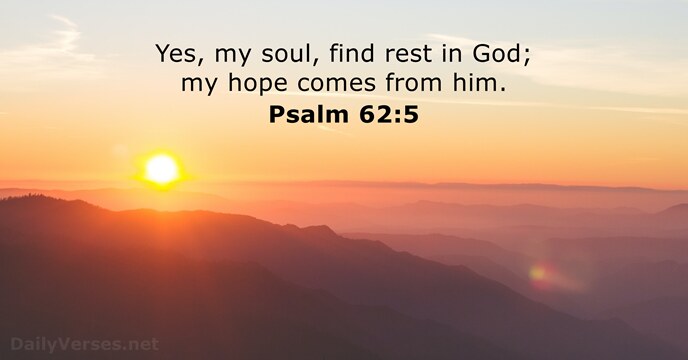
During one time of upheaval I wrote the following, based on Psalm 62:5.

You are my hope, O God. Your plan is to prosper me, to help me grow in faith and Christian maturity. My eternal hope in you can help keep this present difficulty in perspective. After all, when compared to eternity, any hardship here on earth is brief. Someday I’ll live forever with you and the problems I’ve faced will seem insignificant in the light of heaven!

God also introduced me to a new way to pray: spend less time rehashing the problem, and more time rejoicing with gratitude. It’s the kind of praying Paul encouraged (Philippians 4:6-7):

We can thank God for each of his attributes at work on our behalf: his wisdom, power, goodness and more. We can also thank him for graciously upholding us, surrounding us with encouraging family and friends, and allowing us to sense his presence more palpably.

Consider also the positive impact on mind and spirit if we pray with anticipation, affirming God will act to fulfill his highest purpose. If we thank God that it will be so before it is so—that’s faith!*

Such a prayer might be:

I praise you, O God, for your power that can fulfill grand purpose even through (name the situation.) I praise you for being a creative God who solves problems in amazing, miraculous ways.

I thank you for being an involved God who takes an active, loving role in the lives of his children. I thank you that you are faithful and trustworthy, that when we commit our way to you and trust in you, you will act (Psalm 37:5)!

God also led me to a new way to embrace the promises, by acquiescing to his plan for fulfilling them.

For example, when a beloved fellow believer is diagnosed with cancer, our prayer is for a complete restoration, of course. We might site the promise of Psalm 41:3:

And sometimes God’s answer is yes. Even the doctors are surprised how quickly the patient recovers. Sometimes God’s answer is wait, as the patient endures radiation, surgery, and chemotherapy. And sometimes the answer is no.

But isn’t that complete healing as well as the patient is taken home to heaven where no sickness exists?

Life-experience and a growing relationship with God teach us:

It is then we turn to promises like these—promises we can count on no matter what:

  • He will guide us along the right paths (Proverbs 3:5-6)
  • He will provide peace of heart (John 16:33)
  • He will bring good out of every situation (Romans 8:28)
  • His grace will see us through (2 Corinthians 12:9)
  • He will provide everything we need (Philippians 4:19) 

These are among the promises to hold especially close.

And as we exercise such ways of faith presented above, they lead us to know God more, trust God more, and experience more of the spiritual blessings he longs to bestow.

And now, what new way of faith have you discovered that strengthens you during hard times? Please share in the Comments section below!

*Arnold Prater, Bonding with God, 81.

Art & photo credits: http://www.picryl.com; http://www.rawpixel.com; http://www.dailyverses.net; http://www.commons.wikimedia.org; http://www.canva.com; http://www.picryl.com; http://www.canva.com; http://www.pexels.com.

Read Full Post »

Many of those who haven’t asked Christ into their lives yet will still admit: historical evidence proves Jesus once lived on earth. They’ll agree he was a good man who taught wise principles to live by.

But even they might wonder: Why would God allow his Son to suffer such a cruel death at the hands of hateful men?

Welsh pastor and author Selwyn Hughes provided this insightful answer: what seemed to be the worst thing that could happen to Jesus—crucifixion—turned out to be the best thing for him [1].

That sounds ludicrous at first reading until we consider what Christ has enjoyed since returning to heaven, and what he’s looking forward to in the future–all because he fulfilled his mission at the cross.

As he suffered for us, Jesus kept in mind the joys set before him (Hebrews 12:2):

  • Sitting in the ultimate place of honor in the universe, at the right hand of the Majesty on high (Hebrews 1:3b).
  • Angels acclaiming him, saying, “Worthy is the Lamb who was slain, to receive power and wealth, wisdom and strength, honor, glory and praise” (Revelation 5:12).
  • God appointing him to be head over everything for the good of the church (Ephesians 1:22 GNT).
  • Being given authority and sovereign power that will last into eternity (Daniel 7:14).
  • All kings bowing before him one day, and all nations serving him (Psalm 72:11 NLT).
  • All nations and people of every language worshiping him (Daniel 7:14).
  • Being given the name above every name (Philippians 2:9).

And why is that last fact significant?  Jesus is the One and only Son of God, the only Redeemer and Savior, the only Christ and Anointed One of God. “His rank, his titles, his dignity, are above all others” [2].

Perhaps no one has explained the significance of Jesus’ name(s) more eloquently than theologian Charles Spurgeon:

Jesus’ name is “the sum total of all delights. It is the music with which the bells of heaven ring; a song in a word; an ocean for comprehension; although a drop for brevity, a matchless oratorio in two syllables; a gathering up of the hallelujahs of eternity in five letters” [3].

Charles Spurgeon

But Jesus doesn’t want to enjoy these accolades and privileges alone. Max Lucado wrote:

Jesus desires for us to be one with him, continually availing ourselves of all he has to offer.

Even more astonishing? Because of what Christ accomplished on the cross, we who’ve accepted Jesus into our lives get to share in his power and wealth, wisdom and strength, honor and glory!

For example:

  • The immeasurable and surpassing greatness of God’s spiritual POWER is in us who believe (Ephesians 1:19 AMP).
  • He supplies spiritual RICHES and blessings that cannot be fully understood or measured (Ephesians 3:8-9).
  • Christ’s word with all its WISDOM lives within us so we can experience his joy (Colossians 3:16; John 15:10-11).
  • We’re equipped for anything and equal to anything, through Christ who infuses us with inner STRENGTH (Philippians 4:13 AMP).
  • As beloved children adopted into God’s family through Christ, we are precious in his sight (Isaiah 43:4). He’s crowned us with HONOR and GLORY (Psalm 8:5; Romans 2:10), including the honor of representing Jesus in this world, and the glory of his character at work within us [4].

On this eve of Good Friday, we’d do well to remember:

We can pick up our own cross, inspired by Jesus’ example, empowered by God’s Spirit within us, and encouraged by the glorious outcome yet to be [5].

The worst circumstances we might face will become God’s best in our lives too.


[1] Every Day Light, 285.

[2] Barnes’ Notes on the Bible at www.biblehub.org

[3] Morning by Morning, 41.

[4] See also 2 Corinthians 5:17, 20

[5] To “pick up our cross” means trusting in God even when suffering comes our way, putting aside our self-will and embracing God’s will instead.

Photo credits: http://www.freebibleimages.com; http://www.canva.com (2); http://www.quotefancy.com; http://www.canva.com; http://www.pexels.com.

Read Full Post »

Years ago I served as a short-term missionary in Ecuador. One of my first meals there included a fruit I’d eaten many times back home in Illinois, although more often from a can than the produce section.

But that day the golden wedges provided an uber-delightful surprise: more flavor, more sweetness, and less acidity than any I’d enjoyed in the States. It was as if I was eating a different fruit.

That’s because Ecuador grows some of the world’s best pineapple. Their location on the equator and the volcanic soil of the Andes Mountains provides perfect growing conditions. I gained new appreciation for what pineapple could be.

There’s another kind of fruit that many of us are familiar with, but it’s not the kind we eat. It’s the fruit of the Spirit, listed in Galatians 5:22-23. Many of you can probably recite its nine aspects:

What follows are brief thoughts on each. I pray we gain new appreciation for what this fruit can be—perhaps even uncover a surprise or two.

LOVE

If you were asked, what’s a powerful, practical way to express love for others, what would you say? Theologian John Calvin suggested intercession [1]. To pray for a person is to love that person.

Who might you love with a prayer today?

JOY

Scripture tells us to “rejoice always” [2], but that’s hard to do when problems and pain come our way.

Selwyn Hughes offers this perspective: Even though our difficulties may have begun with the devil, by the time they get to us and through us, they will have a divine purpose running through them [3].

Now that we can joyfully celebrate.

PEACE

“The truly thankful person is a truly peaceful person,” asserts Lysa TerKuerst [4]. And Isaiah 26:3 suggests why:

What better way to fix our thoughts than with thanksgiving? And as we affirm God’s blessings, peace will warm our hearts.

PATIENCE

Patience blossoms best in the soil of God’s promises, as we wait for him to intervene. His promises cover every circumstance; our part is to know them and believe, then patiently anticipate their fulfillment.

Are you clinging to a scripture-promise today? Turn it into a prayer of faith, hope, and patience [5].

KINDNESS

We can grow this attribute with one action: meditate on God’s kindness to us [6]. Meditation fosters appreciation; appreciation fosters emulation, and soon we find God’s kindness becoming more a part of who we are.

GOODNESS

This trait often seems out of reach. But instead of trying harder to be good, author Philip Yancey recommends: simply love God. “A person who truly loves God will be inclined to please God” [7].

Also worth remembering, the inclination to always please self results in dissatisfaction and restlessness [8].

FAITHFULNESS

Every year thousands gather to see Old Faithful, even though it’s not the tallest geyser in the world. Why is it so popular? Dependability. You can count on Old Faithful.

What might dependability look like for you today?

GENTLENESS

A list of traits of successful people rarely includes gentleness. Yet this attribute contributes much to prosperity in life. That’s because: “[Gentleness] creates in us a capacity for the closest possible intimacy with God” [9].

It’s the gentle-spirited souls who lean in toward God with yielding hearts to rest in his sovereignty. And then, think of it: God, with all his glorious attributes, comes close (James 4:8).

SELF-CONTROL

“A person without self-control is like a city with broken-down walls”[10]–vulnerable to all sorts of problems.

Better to take the wise course, prayerfully availing ourselves of the Holy Spirit’s help, to develop those habits we know will bring benefit and usefulness.

*     *     *     *     *     *     *     *     *     *

And now, our fruit bowl is full! Did you find any surprises?

I pray this week, you enjoy one or more aspects of this familiar fruit–with fresh appreciation!


[1] https://gracequotes.org/topic/love-others_for/

[2] 1 Thessalonians 5:16

[3] Every Day Light, 124.

[4] Embraced, 256.

[5] A few favorite scripture-promises include: Psalm 32:8; Isaiah 41:10, 31; Romans 8:28; James 1:5.  

[6] From a sermon our pastor preached last spring.

[7] Grace Notes, 325.

[8] Ecclesiastes 2:10-26

[9] Albert M. Wells, Jr., Inspiring Quotations Contemporary & Classical, 91.

[10] Proverbs 25:28 NLT

Art & photo credits: http://www.needpix.com; http://www.heartlight.org; http://www.pickpic.com; http://www.flickr.com; http://www.negativespace.com; http://www.deviantart.com (vulcanknight).

Read Full Post »

Three weeks ago we embarked upon a reflection of one of the most important songs in the history of the Christian faith: “O Come, O Come, Emmanuel.”

The lyrics beautifully weave together the Old and New Testaments, telling the story of our Messiah, “the chosen One”—who would come to deliver his people from the consequences of their sins and establish his kingdom forever [1].

Each verse helps us place our eyes on Jesus’ return by remembering his first coming and then expressing hope and yearning for his second coming [2].

As noted before, the unknown lyricist (from the eighth or ninth century) carefully based each stanza on scripture. You’ll find references for further reflection listed at the end of this post.

One fact not mentioned thus far: the poet constructed the Latin lyrics in the form of a seven-sentence acrostic. When the first letter of the second word of each sentence (the names of Jesus) are put together, they spell SARCORE.

Read that word backwards, and the letters form two words of sublime hope: Ero cras, which means, “I will be present tomorrow.”

Whatever the future may hold, our Emmanuel will see us through. What a faith-stirring surprise the lyricist created for us [3]!

Now let’s turn our attention to the last two verses [4].

VERSE SIX

I praise you, Lord Jesus, that just as the morning star shines brightly against the darkness of night, you are the glorious Light of the world, shining brightly against the darkness of evil [5].

Just as the morning star glows steadily without a flicker, you shine in our lives with unwavering faithfulness and love [6].

Just as the morning star is a promise of coming day, your light provides hope and assurance that you will come again, to usher in The Day of the Lord, when a new heaven and a new earth will be established and righteousness will dwell [7].

Finally, just as the morning star can guide those at sea, your light guides our way through life. “In your light we see light”—the light of wisdom and discernment [8].

Such truths do bring us comfort, dispelling shadowy thoughts and flooding our spirits with the light of your perfection.

I praise you, Lord Jesus, for turning the darkness of sin, anxiety, discouragement, and more, into the light of your forgiveness, peace, hope, and joy [9]!

VERSE SEVEN  

I praise you, Lord Jesus, our King! How comforting to know that Someone all-wise and supremely gracious is the Ruler of all nations, all things [10].

Yet you are also a respecter of persons. You’ve bestowed upon us the gift of choice, the ability to determine our own way. And what have we accomplished? Our world is tainted by selfishness, pride, and contention [11].

How we need you, Lord Jesus! You are our only hope for our selfishness to be transformed into selflessness, pride into humility, and contention into unity.

So we boldly pray that every person on earth would come to faith in you [12].

Is that an unattainable dream? No, because you also are unwilling that anyone should perish. And all things are possible with you, our sovereign God and Savior [13].

After all, you:

  • Created all things everywhere
  • Maintain order in the entire universe
  • Control the course of human history
  • Depose kings and raise up others
  • Exist in all places at the same time [14]

I praise you, Lord Jesus, that nothing can prevent you from accomplishing your purpose [15].

And I praise you, Lord Jesus, that you’ve given us the wherewithal to experience harmony with one another, as we demonstrate love and compassion with humility [16].

May we be examples to the world, whetting their appetite for what we experience: the joy of living in the presence of the King of Peace [17]!


[1] Ace Collins, Stories Behind the Best-Loved Songs of Christmas,127; Isaiah 59:20; John 1:40-49; Romans 6:23; Revelation 11:15.

[2] https://www.danielim.com/2017/12/19/the-hidden-theology-and-history-of-o-come-o-come-emmanuel/

[3] https://www.ligonier.org/learn/articles/o-come-o-come-emmanuel

[4] From www.hymnary.org. (Lyrics vary depending on source.)

[5] Revelation 22:16

[6] Psalm 100:5; John 8:12

[7] 2 Peter 3:12-13

[8] Psalm 36:9b; Ecclesiastes 2:13-14

[9] Psalm 18:28

[10] Revelation 19:16

[11] Proverbs 5:23

[12] 1 Timothy 2:1-4

[13] 2 Peter 3:9; Mark 10:27b

[14] Colossians 1:16-17; Daniel 2:21; Jeremiah 23:23-24 GNT

[15] Psalm 115:3

[16] 1 Peter 3:8

[17] Psalm 16:11

Photo credits: http://www.flickr.com; http://www.heartlight.org; http://www.stockvault.net; http://www.rawpixel.com; http://www.stockvault.net; http://www.canva.com; http://www.pickpik.com.

Read Full Post »


Consider.  Jesus, our Savior, is:


  • Incomparable– without equal or rival (Psalm 86:8)


  • Incomprehensible– beyond understanding or knowing; unfathomable (Romans 11:33)


  • Indescribable– exceeding words to characterize (Jeremiah 10:6-7)


  • Indisputable— incontestable (Isaiah 40:13-14)


  • Inestimable– of incalculable value (Psalm 145:3)


  • Inexhaustible– incapable of being used up or consumed or becoming tired (Revelation 1:8; Psalm 121:3)


  • Infallible– cannot fail or even make a mistake (Psalm 145:17)


  • Invariable– never-changing (Hebrews 13:8)


  • Invisible (John 1:18)


And those nine descriptors only begin to define Jesus. No matter how many fancy, multi-syllable words we might collect, the attributes of God’s Son are beyond full comprehension.

And he is God’s gift to us.

*     *     *     *     *     *     *     *     *     *

Oh, Jesus, how we thank you for giving up the splendor of heaven and the glory of your deity, to take on human form and become our Savior.  How incomprehensible that you could love such pitiful creatures as mankind.

Nevertheless you came so that we, too, could become God’s sons and daughters. Even more incredible, many of the descriptors above will be true of us—on that day when you appear again, and we shall be like you. 

(Philippians 2:6-7; John 3:16; Romans 8:29; 1 John 2:2)


(Photo credit:  http://www.heartlight.org.)


Reblogged from December 7, 2015


Read Full Post »

In one of his picture books, Barney Saltzberg asks all young artists: What can be done when your paper tears, a corner gets bent, or paint drips on your project? Throw it away and start over?

No, Saltzberg has better ideas, and through the pages of his book demonstrates his creative mastery of the mishap. A tear in paper, for example, can become the snaggly smile of an alligator. A bent corner can be turned into the head of a penguin, and paint drips into wheels on vehicles.

Saltzberg titled his masterpiece, Beautiful Oops!


What perfect imagery his book presents for the beautiful life Jesus creates out of each of us!

Without Jesus we make ourselves victims of mishaps and mistakes, motivated by the desires for self-gratification, power, and notoriety (to name a few). The results can include: gluttony, alcohol and drug abuse, sexual promiscuity, physical and emotional abuse, cheating, and slander (to name a few again).

But with Jesus, even those mishaps and mistakes can be transformed into something beautiful:


“Anyone united with the Messiah

gets a fresh start, is created new.

The old life is gone; a new life burgeons!”

–2 Corinthians 5:17, MSG


And what a life it is!

Those of us who ask Jesus into our lives get to enjoy incredible benefits such as:

  • A new perspective. No longer are we scrabbling for the next gratification, promotion, or thrill. Our eyes are opened to the delight of blessing others.


  • A new source of power. Dependence on ourselves is exhausting and worrisome. What a relief to rely on Someone all-wise and strong, Someone who even knows what will happen in the future.


  • A new certainty. No more lying awake at night with unanswerable questions pounding in our heads—questions like, “Is there life after death? How can a person know whether there’s a heaven and hell? If there is, how can I be sure to experience the former and not the latter?”  One step toward Jesus settles those questions. The believer knows his eternal destiny in heaven is secure.*


  • A new plan of action. No more striving after things that don’t satisfy. Life takes on new meaning, purpose, and fulfillment when God is integral to our lives.


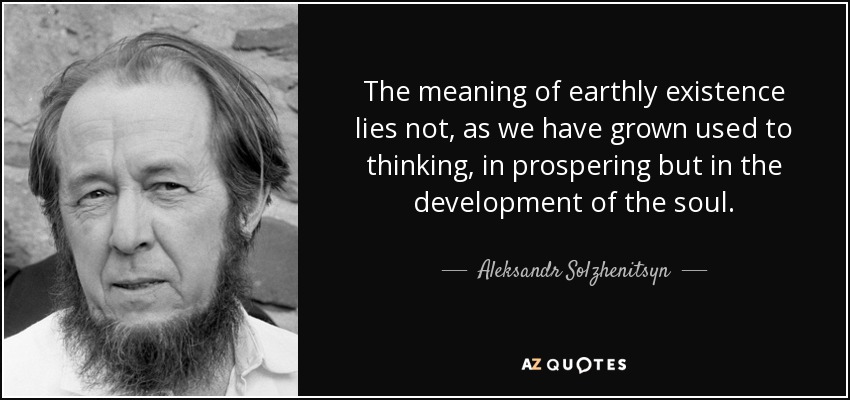
(“The meaning of earthly existence lies not,

as we have grown used to thinking, in prospering

but in the development of the soul.”

Aleksandr Solzhenitsyn)


  • New delights, such as: 1) anticipation and hope for the future, 2) awareness of God’s presence, 3) augmented relationships, and 4) understanding of and pleasure in Bible reading.


The person who doesn’t know Jesus may read this list and doubt its validity. Perhaps they don’t sense the need (yet) for these things or they question Jesus’ ability to provide them.

But like all the Oops in Barney Saltzberg’s book, we don’t really know the difference the Master can make until we turn the page.


______________________________


Have you turned the page to new life with the Master? If so, what aspect of your new life would you add to the list above? Share your experience in the comment section below!


*  Why would we believe what Jesus claimed in the Bible, that he’s the One to trust for the gift of eternal life in heaven? Whole books have been written to answer that question, to prove that the historical record of Jesus is accurate and his claims are absolutely true. One I highly recommend is The Case for Christ (Zondervan, 1998) by former legal editor of the Chicago Tribune, Lee Strobel.

Mr. Strobel was an atheist when he embarked on a thorough investigation of the evidence for a historic Jesus and his claims. When he had finished, Mr. Strobel had this to say: “The great irony was this: it would require much more faith for me to maintain my atheism than to trust in Jesus of Nazareth” (p. 265)! Mr. Strobel was convinced by the overwhelming evidence and chose to become a Christian.


(Art & photo credits:  www.pinterest.com (2); http://www.flickr.com; http://www.pinterest.com (2); http://www.azquotes.com; http://www.pinterest.com.)


Read Full Post »

Older Posts »

Still Traveling

Impressions Becoming Expressions

Living Our Days

Gaining a heart of wisdom

He Said What?!

I'm Patty, and my husband and I are living with our adult son who has autism and epilepsy. I love sharing lessons learned from life around me, especially life with Aaron.

Meditations of my Heart

Impressions Becoming Expressions

Linda Stoll

Impressions Becoming Expressions

Debby Thompson

Impressions Becoming Expressions

Signora Sheila

Notes on Life, Faith & Italy

Colleen Scheid

Writing, Acting, Living in God's Love

Mitch Teemley

The Power of Story

Heidi Viars

Finding the Image of God