Feeds:
Posts
Comments

Posts Tagged ‘Obedience’

English: William Tyndale, Protestant reformer ...

English: William Tyndale, Protestant reformer and Bible translator. Portrait from Foxe’s Book of Martyrs. Česky: William Tyndale (portrét ve Foxeově Knize mučedníků) (Photo credit: Wikipedia)


“If God be on our side, what matter maketh it who be against us?”
–William Tyndale (1494-1536)


Perhaps you’ve heard of Tyndale Publishing, best known for The Living Bible?

Then perhaps you’ve heard of William Tyndale, after whom the company is named. He’s been called by some “the Father of the English Bible.” His passion was to get the Bible into the hands of the common man.

You see, several centuries before his time, the Church Council of Toulouse (in France, 1229) forbade the use of the Bible by ordinary people. The Pope and priests felt that the common man could not understand the Bible, that clergy were the only ones who could properly interpret scripture.

Actually, Tyndale was not the first person to translate the Bible into English. That honor belongs to John Wycliffe, who lived in the 1300s. He translated from Latin into pre-renaissance English.

But Gutenberg hadn’t invented the printing press yet. All copies of Wycliffe’s translation had to be written out by hand.

Tyndale was perfectly suited for the task God gave him. He was skilled in seven languages: ancient Hebrew, ancient Greek, Latin, Italian, Spanish, French, and English. By the time Tyndale was ready to pursue his dream, the printing press had been in use for almost seventy-five years. So Tyndale sought permission and financial backing from the bishop of London to translate the New Testament from the original Greek into post-renaissance English. Permission was denied.

That didn’t stop Tyndale. He traveled Europe, looking for a place to settle. Worms, Germany, a Lutheran city, became his home.


English: John Wycliffe in his study

English: John Wycliffe in his study (Photo credit: Wikipedia)


I can’t help but notice: German was not on his list of known languages. The right location may not have been a comfortable choice for Tyndale, but it was God’s choice.

By 1525, the New Testament in English was complete. Because of the printing press, several thousand pages could be produced in one day. In Wycliffe’s day, only a few pages could be hand-copied each day.

The newly-printed Bibles were smuggled into England in barrels, covered with cloth and articles for sale. Sometimes they were packed in bales that looked like cloth, or even hidden in sacks of flour.

It wasn’t long before the bishops and priests in England discovered that English Bibles were being sold. Officers of seaports were instructed to find and burn all copies.

Yet Bibles were still smuggled in.

A clever Catholic bishop of London decided he would buy all copies of the Bible that were being printed. He contacted a merchant in Germany to make arrangements. The bishop’s plan was to burn every Bible, once they arrived in England.

What that bishop didn’t know was: that merchant in Germany was a friend of Tyndale’s.

Yet the friend made a deal with the bishop anyway. Why? So he could give the proceeds from the bishop to Tyndale. More copies than ever were printed and sent to England. The bishop could not possibly buy every copy.

Imagine his shock when that bishop learned later it was his money, spent to keep English Bibles out of England, that actually paid for a veritable flood of Bibles into the country!

One might expect that Tyndale worked on to translate the Old Testament and lived well into old age, able to write and minister under God’s loving care. One would be wrong.

For nine years, Tyndale did escape authorities and was able to continue his work. But a man named Phillips, a frequent guest in Tyndale’s home, betrayed him. Tyndale was tried for heresy and condemned as a heretic. In 1536, he was strangled and then burned at the stake.

I’m tempted to ask, “Why, God? Tyndale was obedient to you. He left his home country, his friends, everything familiar. He worked so hard, ministered to others, and helped the poor. You miraculously blessed his work, and protected him for nine years. Yet in the middle of translating the Old Testament, Tyndale was arrested and martyred. Why, God?”

One commentator remarks: When God’s work for Tyndale was completed, God took Tyndale out of this life; and God gave his faithful servant the privilege of leaving this life through a martyr’s death (www.prca.org).

My perspective is so short-sighted. I tend to see death (martyrdom in particular) as tragic and distasteful. But from eternity’s point of view, “if God be on our side, what matter maketh it who be against us?”

Heaven awaits!

* * * * * * * * * *

Thank you, Father, that there is no cause to fear suffering and death. You have promised to be with us, to give us the strength to endure, just as you did for William Tyndale. And then, after just a little while, you will take us to our real home of eternal bliss. Glory!

Read Full Post »

I love words. I love the rhythm of syllables, like automaticity or higgledy-piggledy.

I love the precise images words can create: glam-shackle house, iridescent skin, aquamarine waters.

I thought about water

                                                   (Photo credit:  www.flickr.com)

And some words I love for their depth of meaning.

LEARN is just such a word. (Leave it to this former teacher to notice the word LEARN!)

When curious about a word and its nuances of meaning, a good place to begin research is with the dictionary. LEARN means: 1) to gain knowledge, comprehension, or mastery of through study or experience, 2) to fix in the mind, 3) to become informed.

Those definitions certainly describe the LEARNing that is part of the Christian life. God wants us to:

• Gain knowledge of Him and His Word (Psalm 9:10; 119:24)
• Comprehend His ways for us (Psalm 25:4)
• Seek mastery over selfish impulses (Romans 13:14)
• Keep focused on Him (Psalm 141:8)
• Become informed about what pleases Him (Ephesians 5:10).

And God promises blessed dividends as we LEARN, like contentment, joy, and fulfillment in life. But how do we accomplish all this LEARNing?

A bit of research produced the following steps that also form an acronym of L.E.A.R.N.

L = Laws. “I will praise you with an upright heart as I LEARN your righteous laws” (Psalm 119:7). God’s Instruction Manual, the Bible, lays out the way to a rich, satisfying life. A wise person LEARNs all he/she can, because the Author is 100% trustworthy. He will never lead us astray.

Reading the Christmas Story

                                                   (Photo credit:  www.flickr.com)

E = Effort and Experience. “Continue in what you have LEARNed and have become convinced of” (2 Timothy 3:14a). What we learn from God’s Words we put into practice. Yes, it takes effort, but as our experience grows, so will our resolve.

I’m reminded of how I feel before my work-out most days. I hate exercising. But like so many distasteful tasks, getting started is the hardest part. Once I’m into the routine, it’s easier (not easy, just easier!) to keep going. The results of regular exercise are what motivate me: 1) The strength and energy I feel. 2) My back doesn’t give me as much trouble. 3) Moderately-firm flesh trumps flabby!

Exercise

Exercise (Photo credit: sanchom)

You see, I’ve LEARNed that effort (to exercise) leads to experience (the results are worth the effort). The same holds true in the spiritual realm. As I make the effort to apply God’s Word to my life, the experiences prove God’s way is best. And I like the results—the peace, joy, and contentment mentioned earlier.

Am I successful every day to apply God’s truth? No. But I take great encouragement from Philippians 1:6: The God who began this good work in me will keep at it and bring it to completion when Jesus returns.

A = Acclamation. “Blessed are those who have LEARNed to acclaim you, who walk in the light of your presence, O Lord” (Psalm 89:15). Practice acclaiming—enthusiastically approving—your God. We can establish several “interludes of gratitude” into our daily routines—even leave notes here and there as reminders. Whatever it takes. According to the verse, great blessing awaits!

R = Righteousness. “Instruct a wise man and he will be wiser still. Teach a righteous man and he will add to his LEARNing” (Proverbs 9:9). The more we LEARN, the more teachable we become. LEARNing accelerates. It gets easier.

I remember looking at my grandmother with admiration. She seemed perfect to me. How does she do it, I wondered. No doubt it came through years of attention to God’s Word, effort that produced experience, and much acclamation for her God.

Grandmother

Grandmother (Photo credit: Samantha Steele)

N = Notice. “Join with others in following my example, brothers, and take note of those who live according to the pattern we gave you…Whatever you have LEARNed or received or heard from me, or seen in me—put into practice” (Philippians 3:17; 4:9).

Paul was not claiming to be a perfect. Back in verse 12 he had made clear, “Not that I have already obtained all this, or have already been made perfect.” Paul, too, was LEARNing.

But his life of passionate pursuit after Christ-likeness was a worthy pattern to follow.

Perhaps there is someone in your family, church, or small group that would make a good role model. Look to him/her and LEARN.

And why is all this LEARNing about God’s Word and godly behavior worthwhile?

“Whoever gives heed to instruction prospers, and blessed is he who trusts in the Lord” (Proverbs 16:20). To flourish in my soul, to exhibit the fruit of the Spirit, to rest in trust—these are the ends that more than justify the means of LEARNing.

Read Full Post »

Wisdom dictates that we learn from our mistakes. Better yet is to learn from the mistakes of others, and save the trouble of making them ourselves.

Listed below are a few of my recent mistakes, which may provide a learning opportunity. Actually, they’re typing errors—typos with significance!

Example #1:

Instead of thankfulness, I typed thinkfulness.

My mistake reminded me of a quote I read years ago: “If we would think more, we would thank more.”

And why is thankfulness a worthwhile pursuit? According to recent research, multiple benefits result from expressing gratitude:

• Better physical health
• Better sleep
• Better relationships
• Lower stress levels
• More optimistic attitude
• Longer life

Gratitude Journal

Seems like scripture was right all along: “Whatever is excellent or praiseworthy—think about such things…And the God of peace will be with you” (Philippians 4:8-9) That’s the bottom line, isn’t it? Peace of mind and heart contributes to the items on that list. And gratitude is key.

 Example #2:

I meant to type worship, but what appeared on the screen was workship.

The truth is, worship does involve work. Not the work of getting to church on time, or the effort of tuning out distractions to focus on God. As valuable as those objectives are, there’s more.

Paul tells us to offer ourselves as living sacrifices, holy and pleasing to God. This is our spiritual act of worship (Romans 12:1). True worship involves the work of obedience.

Gratitude

But again, God provides benefits that far outweigh the effort. Psalm 112 reveals a number of them:

• Households are blessed (vs. 2-3)
• God’s light breaks through the darkness (v. 4)
• Goodness comes (v. 5)
• Strength develops (vs. 6-7)
• Joy and peace fill the heart (v. 8)

 No doubt there are dozens more scattered through scripture. That’s one of the things I greatly appreciate about our God. When He asks us to work at something, and we comply, He generously blesses us!

Example #3:

Somehow my stumbling fingers produced medication on my computer screen instead of meditation.

It occurred to me, though, that meditating upon God and His Word works like medication to:

• Ease the aches and pains of life, such as miserable circumstances or  hurtful people
• Calm the acid of frustration
• Speed the healing of stinging remarks and wounded feelings

“The law of the Lord is perfect, reviving the soul” (Psalm 19:7a)!

Example #4:

I saved the best for last. My intention was to make this point:

It is our responsibility and joy to “minister encouragement and hope into the lives of others.”

That’s what I meant. Here’s what I typed:

“Minister encouragement and hope into the livers of others.”

Wings of Encouragement

Quite silly at first glance; quite profound after some introspection.

You see, everything that goes into our body goes through the liver. It is in the liver that transformation takes place, the food we eat becoming nutrients.

Here’s the application: In order for our words of encouragement to be transformational, they must sink deep into the core of our listener. The comments need to be thoughtful and spoken with conviction. Glib platitudes will never nourish a hungry soul.

Another interesting fact about the liver: To some extent, this organ is able to remove toxins from the body. That’s what we can do with our words of hope. We can help overcome the toxins that have collected in a person’s spirit.

So, my friends, let’s:

Be thinkful in our thankfulness.

Embrace obedience as a spiritual act of workship.

Meditate on God and His Word, as medication for our souls.

Minister heartfelt encouragement and hope into the livers of others.

* * * * * * * * * * * *

And please share the outcomes of your efforts to make something meaningful out of these mishaps!

Read Full Post »

Last Thursday I shared with you a decision-making discovery God brought to my attention while studying Acts 10:1-11:18. In that passage we read the story of Peter’s encounter with Cornelius (a non-Jew). As a result of the apostle’s visit to this Roman centurion’s home, his entire family and many friends became Christians. (For a summary of those events, click on the link above to Part One.)

In review…

God doesn’t always connect all the dots when guiding our decisions.

Peter experienced a strange vision, and received brief instructions from the Holy Spirit. But a number of important questions were left unanswered. It appears Peter was left to connect the dots on his own.

The lesson for us seems to be: act upon what you know (from scripture), heed the inner impressions from the Spirit, and step out in faith.

And now…

Decision-Making Discovery—Part Two:

Peter received confirmation from others that a visit to Cornelius was the right choice. (Remember, according to Jewish law, it was the wrong thing to do.)

Affirmation #1: The entourage from Cornelius knew exactly where to find him.

Peter was traveling about the country (9:32). There was no way for those messengers from Cornelius to know he was in Joppa, staying at Simon the tanner’s seaside home—except by divine intervention (v. 5).

Surely this extraordinary revelation was not lost on Peter. Events were lining up in a miraculous way. God was about to do something extraordinary.

Affirmation #2: Six Christian brothers from Joppa accompanied Peter to Cornelius’ home (10:23, 11:12).

There is no record that Peter had to cajole them. Scripture simply says, “Some of the brothers from Joppa went along.” Remember, Cornelius’ home in Caesarea was thirty miles away. This was no quick trip across town. By volunteering their time and effort, these six friends offered valuable encouragement and support.

Lessons #1 for us:  Affirmation of others can be important evidence of God’s approval.

I say can be because if we try to manipulate people’s response, if we shamelessly seek after it, that affirmation may not be reliable.

But let’s consider what happened to Peter, and learn from his experience.

Lesson #2: Step out in faith and accept the affirmation, especially if there’s any hint of God’s miracle-working ways involved. Peter’s encounter with the three messengers is our example.

Lesson #3: When a number of people tell us the same thing, it’s probable the message is accurate. Six men showed their support of Peter’s decision to visit Cornelius by going with him to Joppa. There may have been others who gave encouragement also. Scripture includes no record of opposition.

Are you puzzling over a course of action?


Do you have supporters coming alongside to offer encouragement, verification and support for a particular choice? Count them. You may be surprised how much confirmation God is presenting!

Thank you, Father, for the encouragers in my life. They have created uplift in my soul when circumstances have weighed me down.

May I remain faithful to renew my mind with the wisdom and guidance of your word. May I step out in faith each day, ready to embrace any surprises you have for me–like a spur-of-the-moment trip to Joppa! And may I rest in the confirmation you have already given. Equip me, I pray, to be a wise, encouraging support for others.

* * * * * * * * * *

What affirmation have you received as you faced uncertainty or a tough decision? Please share your experience and be a voice of encouragement for someone else!

Read Full Post »

The Annunciation by Eustache Le Sueur, an exam...

The Annunciation by Eustache Le Sueur, an example of 17th century Marian art. (Photo credit: Wikipedia)

Imagine a young woman, engaged to be married. Her mind is occupied with a long to-do list that includes preparations for the wedding, and for the new home she’ll create with her husband.

Husband. Just thinking about him sends her mind floating to dreams for the future. And all her plans and dreams rise and fall over hills of emotion: great excitement in the new adventure to come, yet melancholy, too, because life-as-it’s-always-been will soon be no more.

Surely Mary, the mother of Jesus, must have been thinking similar thoughts as she planned and prepared for her wedding and married life, just like any other bride.

Now imagine her surprise when the angel, Gabriel, appeared to her. The Bible tells us that as Gabriel spoke, Mary was greatly troubled (Luke 1:19). I like Eugene Peterson’s choice of words: “She was thoroughly shaken” (The Message).

Do you suppose Mary jumped at the sound of his voice? Did her eyes grow wide and her hand clap over her mouth? Might she have taken in a quick gasp of air as her heart began to pound?

Gabriel hurried on to explain God’s plan for her—so radically different from the plans she and Joseph were making. Mary was no doubt envisioning a small wedding (after all, they were not wealthy), and settling down to a quiet life in Nazareth. Little did she know that a trip to Bethlehem was in her future—during her ninth month of pregnancy no less.

Mary had been chosen by God to bear the Messiah! The Jews had been waiting centuries for this event. God could have chosen any time or any place for the birth of his Son. He could have named any woman to be the mother of Jesus. He chose Mary, a small-village girl. No wealth, no sophistication, no influence. Did Mary’s cheeks burn with modesty, to be selected for such a monumental privilege?

Yet the magnitude of this honor quickly gave way to practical matters. She asked Gabriel, “How will this be, since I am a virgin” (v. 34)?

Gabriel explained as best he could. I wonder if God the Father had given him explicit instructions about what to say. After all, he was trying to explain cosmic, miraculous, humanly impossible events.

And Mary stood on the precipice of eternity, facing a decision with eternal consequences. Which way would she choose?

She could have said, “Oh, no, Sir. This cannot be. I am not qualified. Such a responsibility is much too frightening even to consider! Please choose someone else.” A very logical answer, right?

But instead, Mary responded, “I am the Lord’s servant. May it be to me as you have said” (v. 38).

Perhaps it was Gabriel’s last words that gave her such boldness. “For nothing is impossible with God” (v. 37). Did the numerous miracles of the Old Testament whisk through her mind, as proof of Gabriel’s words?

Might it be, as Gabriel began to relate what would happen, that the Holy Spirit came upon her right then? And the power of the Most High overshadowed her (v. 35) even as Gabriel spoke? Perhaps, at that very moment, the presence and empowerment of God rushed into Mary’s mind and heart.

We won’t know this side of heaven. But I do know is this:

In her defining moment, young Mary exemplified the epitome of innocent trust in God and unfaltering obedience.

*     *     *     *     *     *     *     *     *    *

Oh, Father, I want to trust you with pure abandon, just as Mary did. Too often I fret about consequences.

I want to live out your plan, in the place you have chosen, at the selected time, just as Mary did. Too often I’m in a hurry and want things to happen here and now.

And like Mary, I want to stand strong on the edge of eternity, with my arms spread wide, and jump into the abyss of your plan—confident in the knowledge that you will carry me on eagles’ wings (Exodus 19:4).

Read Full Post »


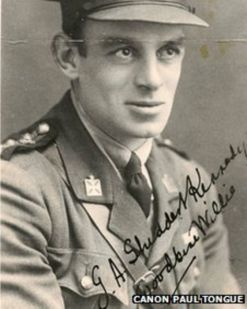
_71778550_tbphoto2originalgrundyphoto


“Faith is not believing in spite of evidence;

it’s obeying in spite of consequence.” 

Geoffrey Studdert-Kennedy


I love quotes that succinctly express truth.  I love to get acquainted with the people who make these wise, memorable statements.  I hope you do, too.

Geoffrey was the son of a vicar who became a minister himself.  But soon after accepting his first appointment in Worcester, England in 1914, war was declared against Germany.

Studdert-Kennedy volunteered as an army chaplain, and served in the trenches along the Western Front.  He’d joke a bit with the soldiers, say a prayer with them, and pass out cigarettes.  Geoffrey was a chain smoker himself, especially fond of Woodbine cigarettes.  He soon became known as Woodbine Willie.  (Remember, this was long before anyone knew the health-risks associated with smoking.)

Studdert-Kennedy put his Christian faith to the supreme test at Mesines Ridge, 1917.  He ran out into no man’s land, that area between the trenches of the British/French forces, and those of the Germans.  Geoffrey tended to wounded and dying soldiers, even as bullets and bombs caused devastation and death around him.  His only weapons:  a wooden cross and prayer.  And whether the soldier in need of his care was English or German, he paid no attention.

Geoffrey had no foreknowledge or guarantee that his own life would be spared.  He simply obeyed the call upon his life to minister to the soldiers, in spite of the consequences.  For his heroism, the vicar earned the Military Cross.

One might expect Studdert-Kennedy to come home from the war and take it easy.  He had done more than his part.  But the hero went to work with the homeless and unemployed in the London slums.  Soon his nickname, Woodbine Willie, became loved and respected throughout the whole city. He was often a speaker at Industrial Christian Fellowship Crusades, introducing others to Jesus.

Geoffrey Studdert-Kennedy more than lived up to his statement quoted at the beginning of this post.  In fact, he, along with many self-sacrificing men and women, seem to reside on pedestals so tall we can barely see them.  And I find myself wondering, Is there any hope I might someday demonstrate such faith—with the same courage and  passion as these saints?  I have such a long way to go…

 Help me, Lord, to be more obedient, to sacrifice more willingly, and serve You more diligently.  I want to be faith-filled–undistracted by the things of this world, focused on what will bring you glory.  Thank You for working in me, helping me want to obey You and then even helping me to choose Your way for my life (Philippians 2:13).

(Photo credit:  www.bbc.org.)

Read Full Post »

« Newer Posts

Still Traveling

Impressions Becoming Expressions

Living Our Days

Gaining a heart of wisdom

He Said What?!

I'm Patty, and my husband and I are living with our adult son who has autism and epilepsy. I love sharing lessons learned from life around me, especially life with Aaron.

Meditations of my Heart

Impressions Becoming Expressions

Linda Stoll

Impressions Becoming Expressions

Debby Thompson

Impressions Becoming Expressions

Signora Sheila

Notes on Life, Faith & Italy

Colleen Scheid

Writing, Acting, Living in God's Love

Mitch Teemley

The Power of Story

Heidi Viars

Finding the Image of God