Feeds:
Posts
Comments

Posts Tagged ‘Perseverance’

lower-part-of-the-trail-as-we-got-closer-to-the-stream

“Success is a journey, not a destination.”

–Arthur Ashe

Too often we think of success as the final, glorious outcome of endeavor. But achieving a goal requires the successful completion of many steps along the way, some of which are slippery, steep, and uneven.  As time passes and difficulties mount, hopelessness can hold us back.

However, history is full of examples of people who persevered in spite of great difficulty, even failure. They didn’t allow tumbles and trip-ups to stop them. They maintained their optimism and effort toward the goal.  Prime examples include:  Bill Gates, Walt Disney, Albert Einstein, and Winston Churchill.

“Success is going from failure to failure without loss of enthusiasm.”

–Winston Churchill

Another prime example is Thomas Edison. You might remember he tested over 6000 materials for the filament of his electric light bulb, and performed 1200 experiments before reaching ultimate success.

Once the invention had been released, a reporter asked Mr. Edison, “How did it feel to fail over a 1000 times?”

The inventor replied, “Young man, I did not fail 1000 times. I simply found 1000 ways how not to create a light bulb.”

Edison had learned to celebrate progress, not just the end result.

We, too, can learn to celebrate the steps toward our God-ordained, individual goals, not just the finish line.

And what are the steps worth celebrating? Here are a few:

  1. Making good choices, even in small things (Luke 16:10).

Doing little things with a strong desire to please God

makes them really great.”

–St Francis De Sales 

  1. Maintaining a positive attitude (Colossians 3:23-24).

Feed your hope with positive expectancy.

Instead of wondering, Why isn’t God doing anything?

Ask, I wonder what God will do next?

  1. Exercising self-control (Galatians 5:23).

“You must do the very thing you think you cannot do.”

–Eleanor Roosevelt

  1. Applying wisdom (Proverbs 19:8).

“Wisdom is the means by which the godly can both

discern and carry out the will of God.”

–Douglas Moo 

  1. Striving for humility (Proverbs 22:4).

“I believe that the first test of a truly great man is his humility…

Really great men have a curious feeling

that the greatness is not of them, but through them…

And [they] are endlessly, foolishly, incredibly merciful.”

–John Ruskin 

  1. Overcoming disappointment and failure (Psalm 37:23-24).

“Discouragement and failure

are two of the surest

stepping-stones to success.”

–Dale Carnegie

Too often we’re sidelined by our failures—even the little ones. We have to remember: success has nothing to do with immunity to failure.

“Success is getting up just one more time than you fall.”

–Oliver Goldsmith.

So! I’ve devised a little questionnaire, to help us appreciate our steps of success:

  • Did we accomplish one task today, leading toward our God-ordained goals, even though we didn’t want to do it?
  • Did we thank God for even one blessing today? Gratitude takes our minds off the way we’d like things to be and refocuses our attention on what God has already provided.
  • Was there at least one small thing we chose not to do, in order to apply our time and energy on the goals set before us?
  • Did we apply a bit of wisdom today that kept us on the path of success?
  • Did we demonstrate genuine interest in someone else without even thinking about ourselves at all? That’s C.S. Lewis’s definition of true humility.
  • Did we encourage ourselves with words or action, in order to press on?

Success is found on the path of most persistence.

So, let’s celebrate progress–those moments, those steps, that are leading us toward God’s call on each of our lives.

And if progress is slow, let’s not lose heart.  Most progress is slow.  God rarely rushes in with a delivery of instant success.

Let’s all take a deep breath and affirm:  God isn’t finished with us yet. He’s still working, still guiding, still engineering circumstances for the personal goals he has ordained for each of us.

That doesn’t mean we sit back and wait for God to achieve our success for us.  It’s a matter of balance.  We must trust him as if everything depended on him, and work as if everything depended on us (Living Application Bible note, Proverbs 16:3).

(Photo credit:  www.hikingtohealthy.com)

*     *     *     *     *     *     *     *     *     *

What steps to success would you add?

And, how do you celebrate the successful steps along the way?

Please join the conversation below! 
  

Read Full Post »

(In honor of Black History Month)


Isabella, the daughter of James and Elizabeth Baumfree, was born a slave in New York state about 1797. No one knows the exact date, because birth records weren’t kept for “property.”

Did her parents know the name means, “consecrated to God?” Even if they chose the name for its meaning, those parents could not have dreamed of the future awaiting their Baby Belle.

Her early years were difficult.  Belle was sold five times, several times to cruel masters.

At age eighteen or so, Belle fell in love with Robert, a young slave from a nearby farm. The couple had a daughter. But Belle’s master, John Dumont, forbade her to see Robert again. According to the law, all children of the union would belong to Robert’s master, not Dumont.

Two years later, Dumont forced Belle to marry an older slave. They had three children: Peter, Elizabeth, and Sophia.

In 1826, Belle escaped the Dumont farm with Baby Sophia. In a vision, God showed her a particular home to go to. That home belonged to a Quaker family, the Wageners, who took in the young woman and her baby. They even paid Belle’s price to Dumont and made her a free woman. Belle became a housekeeper, then a maid.

Shortly after her escape from slavery, Belle learned that her five-year old son, Peter, had been illegally sold in Alabama. She took the matter to court and won her case. Peter was returned to New York. That was the first time a black woman challenged a white man in a U.S. court. It was also the first time of many that Belle’s resolve and courage were put on display.

Several years later Belle was falsely accused of poisoning her former employer. In 1835 she took that case to court and won again.

Someone must have encouraged Belle to tell her story of being a slave and becoming a free woman. But she had never learned to read or write, so a friend wrote as Belle dictated. A Northern Slave was published in 1850.

In her book, Belle explained that several years after she was freed, God revealed himself to her, “with all the suddenness of a flash of lightning, showing her, in the twinkling of an eye, that he was all over, that he pervaded the universe, and that there was no place where God was not.”

The book sold many copies and Belle became well-known. She was asked to speak at a women’s rights convention in Massachusetts. Before long, Belle was traveling with abolitionist, George Thompson, speaking against slavery and for human rights.

In 1851, Belle gave a speech at another women’s conference, this time in Ohio. She spoke convincingly (and extemporaneously) about women being every bit as capable as a man:

“I have plowed and reaped and husked and chopped and mowed, and can any man do more than that?”

And, no doubt with a twinkle in her eye, she added:

“As for intellect, all I can say is, if a woman have a pint, and a man a quart — why can’t she have her little pint full? You need not be afraid to give us our rights for fear we will take too much, for we can’t take more than our pint’ll hold. The poor men seems to be all in confusion, and don’t know what to do. Why children, if you have woman’s rights, give it to her and you will feel better. You will have your own rights, and they won’t be so much trouble.”

She concluded by asking: “And how came Jesus into the world? Through God who created him and the woman who bore him. Man, where was your part?”

It’s not surprising that some were displeased with Belle’s speeches. One time she was told that the building where she was to preach would be burned down if she dared to speak. “Then I will speak to the ashes,” she replied.

Belle was also physically assaulted. One brutal attack caused permanent injury, and she had to walk with a cane for the rest of her life.

In 1863, Harriet Beecher Stowe wrote an article about Belle for the Atlantic Monthly:

“I do not recollect ever to have been conversant with anyone who had more of that silent and subtle power which we call personal presence…She seemed perfectly self-possessed and at her ease. An audience was what she wanted—it mattered not whether high or low, learned or ignorant. She had things to say, and was ready to say them at all times, and to anyone.”

Imagine. A slave woman who never had the opportunity to go to school, never learned to read or write. Yet the power of her spoken word helped bring the end of slavery and pave the way for women to be granted the right to vote.

Belle proved:

“There is no difficulty that cannot be defeated.

There is no victory that cannot be achieved,

if you believe in the power of God!”

— Anonymous

Of course, by the time she achieved notoriety, Belle was known by another name.

You see, Belle had asked God for a new name several decades before the Civil War. Again, it was the result of a vision. She said God chose her new first name based on the fact she would travel. Then Belle asked God for a second name, “’cause everybody has two names.” And the Lord granted her request. Her second name proclaimed what Belle always declared from her podium.

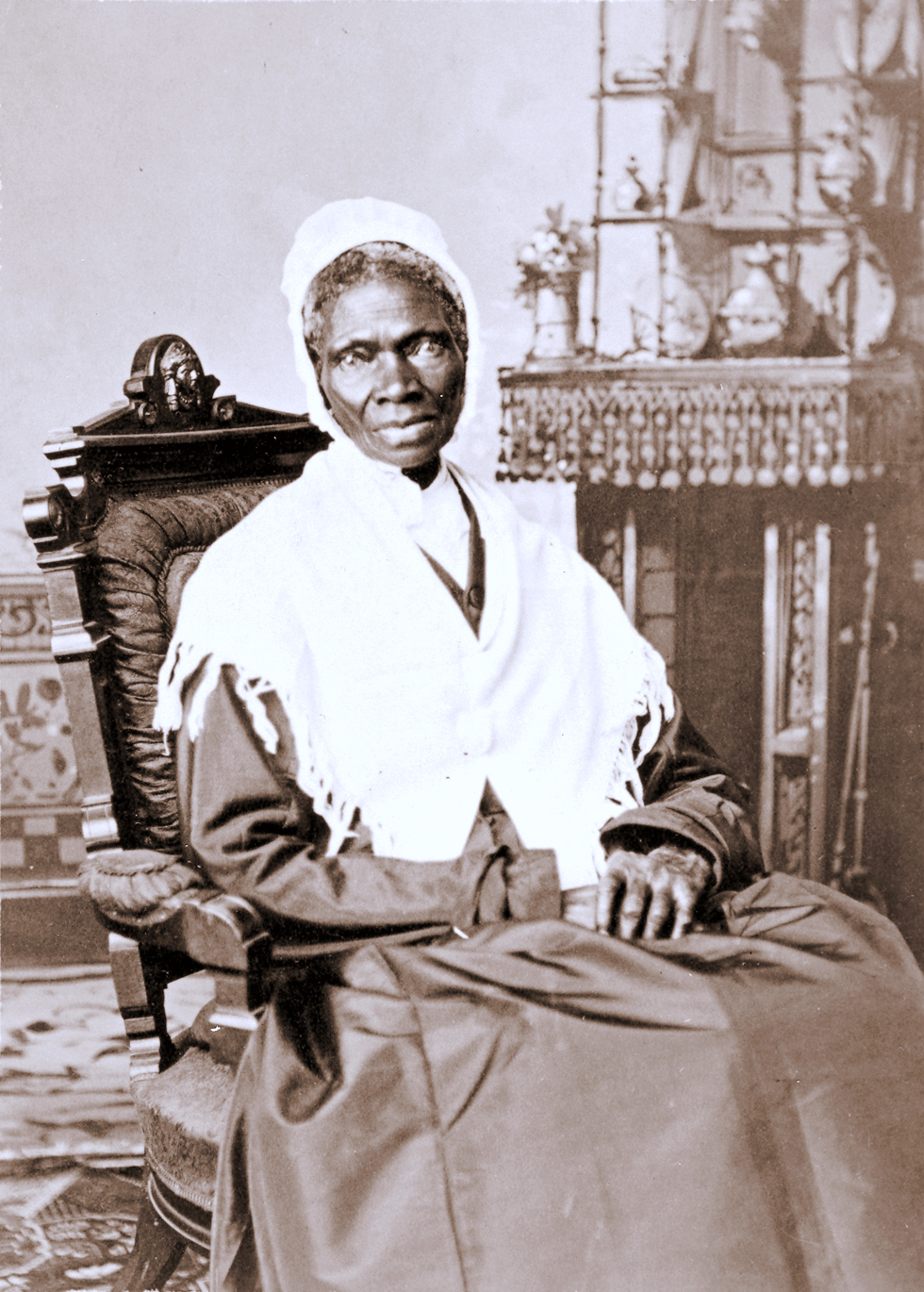
Perhaps you remember Sojourner Truth.


Sojourner_truth_c1870

(Photo from http://www.wikipedia.org.)


Sources:  www.biography.com; http://www.sojournertruth.org; http://www.; http://www.blackpast.org; http://www.americanswhotellthetruth.org; http://www.christianitytoday.com.)

Read Full Post »

Check a map that traces the trek of the Israelites from Egypt to Canaan, and you’ll see a meandering, looping pathway:

Wilderness Journey

God could have taken them along the coast of the Mediterranean Sea, a much more direct route. One commentator says that route would have required just days of travel. A short journey would have been so much easier on everyone, right?  Less chance of fatigue, boredom, and impatience to develop and create problems.

But God had his reasons for a long, winding route.

Reason #1: The Philistines. That’s not conjecture; that’s exactly what scripture tells us. “When Pharaoh let the people go, God did not lead them on the road through the Philistine country though that was shorter. For God said, ‘If they face war, they might change their minds and return to Egypt’ ” (Exodus 13:17).

The Philistines’ territory stretched for fifty miles along the Mediterranean Sea, with the southern border touching Egypt. They were a well-organized, warring people. Five great cities, strategically located throughout their coastal holdings, created an alliance, the famous Philistine pentapolis.

A people suppressed by slavery for four hundred years would not be able to fight such an adversary. The Israelites didn’t have any trained soldiers among them either. Could God have given them a rousing victory over the Philistines anyway? Of course. But he chose not to.

Reason #2: Perhaps God determined his people needed some wilderness experience to train them in his ways and build their trust in him. Instead of quick and easy, God chose slow, step-by-step progress. He was like an eagle, teaching his fledglings by degrees how to fly (Deuteronomy 32:11).

4ffd5fa25fbd4e401e15ae1fe344938f

I wonder if the Israelites thought, Does God have any idea where he’s taking us? What is he DOING?!

In hindsight we can see God’s purpose:

  • To prepare them to be his holy people by giving them the law. (By the way, according to Exodus 19:1, Moses went up to Mount Sinai during the third month after they left Egypt. God was certainly in no hurry to get his children to the Promised Land.)
  • To teach them.  Through the laws he gave Moses, God taught the Israelites how to treat one another and how to worship him. They were to be different from all other peoples on earth.   “I am the Lord your God; consecrate yourselves and be holy,” he said, “because I am holy” (Leviticus 11:44).
  • To challenge them. For example, God let them experience great thirst and hunger. Then he stepped in and supplied their needs. By degrees God taught them to trust him.

I have to admit: my life experiences have paralleled the Israelites’ in a number of ways. I’ve encountered a few winding roads, puzzling detours, uncomfortable wait times, and unanswered questions of my own.

You, too?

Here’s what we can remind ourselves of: God may not direct us by the nearest, fastest way—even though he could. In his omnipotent wisdom, he knows a better way. And he has perfectly sound reasons for his decision.

My choice in the matter? I can plead for the shorter route, complain about the delay, try to forge ahead on my own self-chosen fast track, OR…

…trust my all-knowing, all-wise Heavenly Father.

5db138f980d331b5ee31f939d399464e

Seeing the choices laid out in black and white, here on my computer screen, the decision is easy. However, complete trust in the moment of uncertainty, fatigue, and discomfort is much more challenging.

Perhaps I can encourage myself by reviewing God’s purposes for the Israelites. Chances are, he desires the same results in me:

  • God prepared the Israelites; he may be preparing me for the next chapter in my life.
  • God taught the Israelites; he may be teaching me what the next level of maturity includes.  (Yes, even an old Christian like me still has growing to do!)
  • God challenged the Israelites; he may be challenging me to trust him—in spite of a long, winding road and uncomfortable wait time.

In summary:  As I cooperate with him, God can transform me into a prepared, mature, trusting servant for the next chapter of my life.   I like the sound of that!

You, too?

*     *     *     *     *     *     *     *     *     *

“Who compares with you, O God?  Who compares with you in power, in holy majesty, in awesome praises, wonder-working God” (Exodus 15:11, The Message)?  You are over-the-top trustworthy!  So, in advance, I thank you for the good that will come out of the winding road, detours, and wait time in my life–experiences you ordained for me, before one of them came to be (Psalm 139:16).  I place my hand in yours, my caring, constant Companion.  Help me to focus on your strong grip, not the uncertainties ahead.  Amen.


(Art credits:  www.registrypartners.net; http://www.pinterest.com.)

Read Full Post »


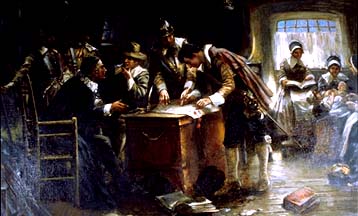
Mayflower_compact


They had been at sea for sixty-six days, enduring overcrowded conditions. Storms had caused damage to their ship and sea sickness plagued them all– passengers and crew alike. Meager provisions and no heat on chilly autumn days caused further discomfort.

So on November 9, 1620, when they finally saw the coastline of North America in the distance, the Pilgrims and others aboard the Mayflower must have cheered enthusiastically. Soon they could abandon the cramped, cold, and fetid ship and begin new lives in a new world.

But. All had not been peaceful and congenial among the passengers during the crossing. And when it became apparent the storms had blown them too far off course to land in the Virginia Colony as planned, relations deteriorated further.

Not all of the travelers were Pilgrims. Also aboard were merchants, craftsmen, skilled workers, and indentured servants. The Pilgrims called them “strangers.”

No sooner had the decision been made to anchor off Cape Cod, than an argument ensued. Several of the “strangers” pointed out that, since they were not going to be under the jurisdiction of the Virginia Company, they would “use their own libertie” and do as they pleased. “None had the power to command them, they said.” (Quoted words are from William Bradford’s records. He served as historian for the Pilgrims.)

To avoid anarchy, five men gathered in the cabin of the ship to create a basis for law and order. The result of their efforts: the Mayflower Compact.

The first words of the document give strong indication of the Pilgrims’ hearts.

In the name of God, Amen.

“Everything they did started with God” (The Founders’ Bible, p. 187).

Next, the Pilgrims stated their purpose for coming to America.

We, whose names are underwritten,…by the grace of God,…having undertaken for the glory of God, and advancement of the Christian faith, and honor of our King and country…

Several phrases indicate the Pilgrims’ desires for their new colony:

  • “For the glory of God” would be a guide for all manner of decisions.
  • “Advancement of the Christian faith” would encourage them to remain strong in Christian faith among themselves and to introduce others to Jesus.
  • “Honor of our King and country” indicates their loyalty to native England and its monarch, in spite of his untoward actions that caused their flight to America in the first place.

…[We] do solemnly and mutually in the presence God and of one another, covenant and combine ourselves together into a civil body politic…

The Mayflower Compact expressed their commitment to live together in a civil manner, in the sight of God.

[We] will enact…such just and equal laws, ordinances, acts, constitutions, and offices, from time to time, as shall be thought most meet and convenient for the general good of the colony, unto which we promise all due submission and obedience.” 

Note:  there is no mention of a leader who would oversee the colony. The Pilgrims created a democratic, representative form of government, in covenant with one another, rather than by a monarchy or dictatorship.

It was the first document of its kind in the history of the world.

But the Mayflower Compact would only be as good as the commitment of Pilgrims and Strangers alike to abide by its guidelines.

Would the mutinous Strangers sign?

John Carver, church deacon and one of the organizers of the voyage, was the first to affix his signature. Other Pilgrims followed.

One book says there was a long pause. Then Captain Myles Standish stepped forward to sign. Standish had been hired by the Pilgrims to be their military captain; he was with them, but not one of them.

Soon other Strangers followed Standish’s example.  In total, forty-one signatures appeared on the document. One freeman, two hired men and seven servants declined.

At long last, Pilgrims, Strangers, and crew were able to disembark. And what did they choose to do first?

Pray.

According to Bradford, they “blessed the God of heaven, who had brought them over the fast and furious ocean..and a sea of troubles before.” Then he quoted scripture:

“Let them therefore praise the Lord, because He is good and His mercies endure forever.” (Psalm 106:1).


*     *     *     *     *     *     *     *     *     *


We, too, praise you, Lord, for your goodness and mercy upon America all these years.  As we celebrate Thanksgiving on Thursday, may we remember the solemn history behind this occasion.  Thank you for the supreme example and sacrifice of our Pilgrim forefathers–strong in faith, commitment, and perseverance.  May we follow their example, not only because you are faithful to the faithful (2 Samuel 22:26), but out of appreciation for what you, our loving God, have already done.


(Sources:  By These Words by Paul M. Angle; The Founders’ Bible; The Intellectual Devotional:  American History by David S. Kidder & Noah D. Oppenheim; The Rebirth of America;  http://www.learningtogive.org; http://www.humanities360.com; http://www.crf-usa.org; http://www.americanhistory.about.com; http://www.tparents.org; http://www.mrkash.com; http://www.mayflowerhistory.com; http://www.plimoth.org.)


Art credit:  www.washingtonmayflower.org.  


Read Full Post »

borfarb


“Katherine, I’m terribly sorry, but there’s nothing else to do. We have no money to hire a nursemaid for you children, and now that your mother is gone…”  His voice trailed off.

Is that what Hans von Bora told his five-year old daughter?  No record has been left.  We do know that, in 1504, after the death of her mother, Katherine was sent to a convent in Nimbschen, Germany. At age nine, she was transferred to Convent Marienthron, where she took her vows and became a nun. Katherine was just sixteen years old.

Katherine’s duties gave her opportunity to learn management and care of a large estate, since the convent owned much property. Proceeds covered the expenses for the forty-four nuns and forty servants.  They also made a profit.

About this time a tract was secretly passed among the young nuns titled, “The Monastic Life, and the Marriage of Priests, Nuns and Monks.” Monks, nuns, and clergy should be free to marry, it said. Marriage should be kept; it is monasteries that should be given up.

As this message spread it was not just monasteries that began to empty but convents also. Twelve nuns from Marienthron chose to escape on Easter evening, in April of 1523.  Among them was Katherine. Three of the young women were returned to their families, the other nine secretly delivered by wagon under cover of night to a nearby town. It happened to be the home of the monk who wrote the tract, and he took personal responsibility to see that the nine nuns were well taken care of.

Husbands were found for some of the women; others were given positions in households. Katherine was in the latter group. One suitor, a university student, did court Katherine that summer. A deep friendship grew between them, but when he returned to school, Katherine never heard from him again. Perhaps his parents did not approve of a marriage between their son and a former nun.

Was Katherine’s heart broken after this first experience of love?  Did she wonder why God would allow such a painful turn of events?  Again, no record exists.  We can only surmise that Katherine felt great disappointment as would any young woman in such circumstances.

Several other suitors came forward, but Katherine was content to stay and work in the home of the Lucas Cranach family.

Meanwhile, the monk who wrote the tract about marriage had left the monastery. He was considering taking a bride himself. Katherine let it be known that she was interested, as affection for the caring man had developed during the two years she had known him.

On June 15, 1525, the couple announced their engagement before five witnesses.   Immediately following was the wedding!

An abandoned Augustinian cloister was given to the couple for their home. Katherine became mistress of this virtual estate.  (The first floor alone contained forty rooms with cells above.)

Eventually every room was occupied, not just by their own six children, but by widows, students, and orphans that the couple took in. In fact, Katherine and her husband adopted four orphaned children from their relatives.

Can you imagine caring for so many people—without such appliances as stove, refrigerator, washer, or dryer?

But God had prepared Katherine to manage the estate.  Remember her duties at Marienthron Convent?  Katherine  was on the go from daybreak to night, overseeing the multitude of household responsibilities, the animals, a large garden, the brewery, and large parcels of land she purchased in order to grow grain for the animals.

That’s not all. Katherine ministered to the needs in her community, giving care to the sick and counsel to the hurting.

She made it possible for her husband to travel, preach, and teach, knowing that all would be well taken care of at home.

Day after day, for twenty years, Katherine served others in and around her home.   How ironic that one of the few quotes of Katherine von Bora which has survived the centuries should be:

“I’ve read enough [of the Bible]. I’ve heard enough. I know enough. Would to God I lived it.”

According to the historical record, Katherine most certainly lived by the truth of God’s Word. Who can deny her courage, perseverance, love of others, and servant’s heart?  She stands as a worthy example for us to follow.

Katherine’s husband grew to appreciate her greatly and love her deeply. He called her “Kittie, My Rib” and  “The Morning Star of Wittenberg.”

Does the name of their hometown sound familiar? Wittenberg was the home of Martin Luther.

The husband of Katherine von Bora was none other than Martin Luther himself.


(Sources:  www.the-highway.com, http://www.rpmministries.org, http://www.helios.augustana.edu, http://www.lutheranhistory.org, http://www.thegospelcoalition.org, http://www.haventoday.org.  Art credit:  www.lutherin.de.)

Read Full Post »

White_Oak-15_acorns


Elena, almost eighteen months old, loves to collect acorns. A grand oak tree on the church property across the street from her home provides perfect hunting grounds. She trundles along the edge of the sidewalk, her eyes on the grassy edge. Now and then she bends over, chooses a prime specimen, and clutches it tightly to her chest.

Yesterday was a banner day for acorns. Way too many shiny nuts with perfect caps. Her little hands couldn’t carry them all. I was given the honor of transporting a few of her treasures home. And this opportunity became the starting point for a train of thoughts.

You’ve no doubt noticed this yourself:  acorns do not appear capable of producing oak trees.  They’re too small and too hard.  How can the seeds inside even escape those tough shells?   Yet given the right soil, the right climate, and plenty of time, the miracle of growth occurs.  White oak trees can reach the height of 150 feet, growing twelve to fourteen inches per year.  Acorns do not appear until the twentieth year.  In the end, the majestic giant provides hundreds of benefits (www.arborday.org and http://www.ehow.com).


white_oak_5036-320


Now a few tall plants, like bamboo, grow very quickly. But not tall, strong trees.  I wonder why?

We humans are also slow-growing–in body and spirit. And I wonder about that, too.  Why didn’t God make us more like bamboo, able to reach maturity quickly? Instead, we progress through a protracted, sometimes painful learning process to become “mature, lacking in nothing” (James 1:4).

Perhaps God willed our development to happen slowly so we have many opportunities to follow his chosen path and fulfill the potential he’s especially prepared for each of us. A false step in the wrong direction can be corrected, just as a crooked tree can be straightened if attended to promptly.


 HardMaple1


Yes, there are those who choose not to mature, not to participate with God.

But we know that God is good, that what he does is good. I want him to train and teach me (Psalm 119:68). My guess is you feel the same.

Day by day, choice by choice, we can progress along the spectrum from self-centered to selfless, from impatient to patient, from lesser to greater.  But we have to realize: it happens slowly over time.

Here’s another possibility, even better than just accepting slow progress.  Let’s embrace it.

You see, our culture tends to look at time as a thief who steals away our youth, worth, mental acuity, and energy.

But what if we view time as a gift–a gift of countless opportunities provided day by day, choice by choice–to grow into the mature and gracious people God ordained? Instead of regretting the passage of time we can celebrate:

  • Our progress to become rooted and built up in Jesus, strengthened in our faith (Colossians 2:6).
  • The growing ability to bear fruit (the fruit of the Spirit, exemplary living, glorifying God to others)–even into old age (Psalm 92:14).
  • Becoming “oaks of righteousness, a planting of the Lord, for the display of his splendor” (Isaiah 61:3).

Oh, I like that last verse especially, don’t you?

And it can happen through  slow and steady perseverance, with God as our guide.


(Photo credits:  www.bio.brandeis.edu; http://www.treetopics.com; http://www.awesometools.com.)


Read Full Post »

(As most of you know, Steve is retiring from the pastorate, after serving forty years in Florida. Very shortly we move to the Midwest, to be close to our sons and their families. If our daughter and her family would just move east from Washington State, life would be near-perfect!

No doubt you’re also aware that packing and unpacking are time-consuming tasks, so I’m putting the blog on hold for a few weeks. But please continue to visit! I’ll re-blog some previous posts, and hopefully you’ll find them meaningful again, or perhaps for the first time.

The following post was first published 5-16-13.)
220px-E-W-Wilcox

“With every deed you are sowing a seed, though the harvest you may not see”

(Ella Wheeler Wilcox, author and poet, 1850-1919).

Observation #1:

We never know when a small deed may plant a seed of faith or encouragement. We never know when that seed will reap a bountiful harvest in the life of someone else.

Live attentively to the fact that every deed is a seed. The people around us are watching and listening. Perhaps you’re familiar with the story of a church elder who once led a worship service for two. It happened over 150 years ago in England. A blizzard on Saturday night made it impossible for villagers to get to the church—including the pastor.


Oakwood_Park,_London_N14_-_snow_storm_-_geograph.org.uk_-_1146589


The elder almost sent home the two individuals who had come, an older man and a young boy. But something (Someone?) compelled him to speak. Later he confessed his words came out rather jumbled and brusque.

But. The elder planted a seed that immediately took root. The young boy accepted Jesus as his Savior that day. His name? Charles Spurgeon—preacher and author extraordinaire, whom God used mightily. People are still impacted by his writings to this day. (For an example of Dr. Spurgeon’s God-given genius, see the post, “Not Length But Strength,” from May 9, 1913).


Observation #2:

Our responsibility is the planting of “deed seeds”; the harvest is up to God.

The same principle that works in the physical realm works in the spiritual realm: A farmer may plant, fertilize, and water, but the germination of each seed is a miracle only God can bring about. Don’t become tightly focused on results.

The elder who led Charles to the Lord that snowy, wintry day, had no idea the boy would grow up to have such a profound effect on the world. The gentleman may not have lived long enough to see the results of his deed that morning. But we know, and we marvel.


Observation #3:

The true harvest is not measurable in physical terms, and it’s hidden from view in the spiritual realm.

Only now and then does God give us a glimpse of what our small deeds are accomplishing. Perhaps God planned it that way so pride and self-gratification do not taint the glory of the harvest.

Imagine the joy that elder continues to experience every time a saint comes through the gates of heaven–fourth and fifth generation Christians, who have been influenced by Charles Spurgeon, whose ancestors accepted Jesus because of him. In addition, thousands  have been influenced and encouraged by the preacher’s writings.

And it all began with that faithful elder.

You see, the positive influence of a man or woman of God never dies.


4 T


Such a possibility should translate into enthusiastic motivation for planting seeds wherever we go.


(Art and photo credits:  www.wikimedia.org and http://www.wikipedia.org.)

Read Full Post »

(As most of you know, Steve will soon be retiring from the pastorate, after serving forty years in Florida. Mid-June we move to the Midwest, to be close to our sons and their families. If our daughter and her family would just move east from Washington State, life would be near-perfect!

No doubt you’re also aware that packing and unpacking are time-consuming tasks, so I’m putting the blog on hold for a few weeks. But please continue to visit! I’ll re-blog some previous posts, and hopefully you’ll find them meaningful again, or perhaps for the first time.

The following post was first published 11-7-13.)


tears


Before my friend, Elizabeth, said a word, I knew something was wrong. The slump of her shoulders, the wrinkled brow, the tears welling up in her eyes–they spoke loud and clear.

“You know how Michael and I would like to have a little brother or sister for Ashley,” my friend said, dabbing her eyes with Kleenex. “Well, it’s become more than just a desire for me. I so desperately want another child.” Her voice became tight. “The waiting and uncertainty are becoming unbearable.”

We stood together, in the emptying sanctuary after church, arms entwined. And I prayed for Elizabeth and Michael.

Psalm 113:9, a verse which had ministered to me years before, came to mind. I included the promise in my prayer: “God, you’ve promised ‘to settle the barren woman in her home as a happy mother of children.’ We are claiming that promise today for Michael and Elizabeth. Even now we look forward to the day when they are holding a precious, new baby in their arms.”

Note the verse says children, not child.

The prayer came out of my mouth with certainty and brazen expectation, not in keeping with my cautious personality at all. I have to admit, the thought crossed my mind, What if God intends for Elizabeth and Michael to have just one child? You’ve gone way out on a limb with that prayer!

But I voiced no disclaimers. I let the prayer stand on its foundation of conviction–conviction that didn’t come from my spirit as much as from the Holy Spirit.

For the weeks that followed, I continued to pray that God would bless this couple with another child.

Weeks later, Elizabeth approached me once again. Before she said a word, I knew what she was going to say. Her outspread arms, wide grin, and sparkling eyes spoke loud and clear.

“I’m pregnant!” she cried.

We hugged each other tight and noisily exclaimed our jubilation.

Would I have been as excited had I not been praying for this family? Delighted, yes. But jump-up-and-down ecstatic? Probably not.

My joy was greatly expanded because I had invested myself in the outcome—with the effort of prayer.

Yes, there are many reasons to pray, including these benefits:

Our wills are aligned to God’s will (Psalm 37:4).
Strength of character is developed through the discipline of perseverance (Luke 11:5-8).
We have the opportunity to bring glory to God (John 14:13).
Prayer is a means of fighting against evil (Ephesians 6:10-18, especially verse 18).

But the wonder of prayer, for me, is the privilege God gives us to be part of the process, as he engineers circumstances to accomplish his will.

Every time God moves in situations for which we’ve prayed, he is giving us a precious gift: the gift of participation with him–in a miracle.

Maybe two.

Michael and Elizabeth had twin girls!


il_340x270.446306088_4ipl


*      *      *      *      *      *      *      *      *      *

Heavenly Father, thank you for the splendid privilege of participating with you in the healing, protection, provision, and guidance with which you bless others. May I never get tired of bringing my requests to you, knowing that the joyful conclusion will be worth every moment spent in prayer!

(Photo credit:  www.saveourschoolsnz.files.wordpress.com; http://www.etsy.com.)

Read Full Post »

 frazzled-career-woman


Ever had a pending appointment you didn’t want to keep? A person you didn’t want to encounter? A task you didn’t want to complete?

Some days are filled with unpleasantries. And if I’m not careful, it’s an easy slide down into a gloomy funk.

How does that happen?

My thoughts provide the slippery slope…

What a lousy day this is going to be. I sure hope So-and-So is in a good mood for that meeting this afternoon. Last time he was as irritable as Oscar the Grouch. And while I’m looking forward to that (Ha-Ha!), look at this impossible to-do list. Talk about crazy. And then there’s our double-date tonight with that new couple from church. I am in no mood to be sociable. All I want to do is go home, put on my sweats, and park on the couch!

 Can you identify my problem here? I’m focusing on the negative. The solution is obvious: turn my thoughts to the positive.

But some days that is next to impossible. It’s as if the problems and challenges are shouting giants, jumping up and down, with arms waving no less. They block any view of the positive.

Making the effort to think about praiseworthy things works for a while, but those negative thoughts often return, unbidden and oh, so unwanted. To make matters worse, I feel guilty for allowing those giants access to my mind and spirit.

Why can’t I get rid of them once and for all?

Maybe I’m not supposed to. Maybe God wants me to become more watchful, to learn perseverance, and to practice proactive behaviors, like gratitude and praise.

But one strategy for fighting the giants is particularly important: Get out my sword.

I’m talking about the Sword of the Spirit, which is the word of God (Ephesians 6:17).

Scripture is full of wisdom and encouragement for doing battle, like Psalm 73.

Asaph writes about his challenge: arrogant and wicked people (v. 3) who scoff and speak malice (v. 8).

“What is going on here?” he writes. “Is God out to lunch? Nobody’s tending the store. The wicked get by with everything; they have it made…When I tried to figure it out, all I got was a splitting headache” (vs. 11-14, The Message).

Sounds like the giants of negativity had been pestering Asaph, too.

But at the end of the psalm, Asaph affirms what he knows about God and his ways:


“You [God] hold me by my right hand.

You guide me with your counsel,

And afterward you will take me into glory.

Whom have I in heaven but you?

And earth has nothing I desire besides you.

My flesh and my heart may fail,

But God is the strength of my heart

And my portion forever.”

(Psalm 73:23-26)


I need to meditate on Asaph’s affirmations and make them my own:

  1. My loving Heavenly Father holds me by the hand, offering protection and security.
  1. He guides me with wisdom, especially through his Word, infusing me with comfort and strength.
  1. God gives me perspective for my earthly troubles as I look forward to blissful eternity with him.
  1. He is all I need.


Thank you, Asaph. I’m going to memorize those verses so they’re ready to draw like a sword—on a moment’s notice!


(photo credit:  www.ideas.tome.com.)


Read Full Post »

let_the_glory_out_tshirts-rf982b89d7b1846dbb186d467bd317390_8naah_324

Defeat may serve as well as victory

To shake the soul and let the glory out.

When the great oak is straining in the wind

The boughs drink in new beauty and the trunk

Sends down a deeper root on the windward side.

Only the soul that knows the mighty grief

Can know the mighty rapture.  Sorrows come

To stretch out spaces in the heart of joy.

–Edwin Markham (1852-1940)

Mr. Markham–educator, author, and poet– gives us much to contemplate in just eight lines, beginning with the first seven words:

“Defeat may serve as well as victory.”

No, thank you, my spirit says.  Defeat is humiliating, uncomfortable, and depressing.

Mr. Markham inspires a different perspective and a note-to-self:  God may very well bring defeats into my life “to shake my soul and let the glory out.”

Reminds me of Jonah, the reluctant prophet who tried to run from God.  The Lord told him to go east to Nineveh, an important city of Assyria.  Instead he headed west, boarding a ship for Tarshish.

But a fierce storm churned the seas into a boil.  In desperation to appease the gods, the sailors hurled Jonah overboard.  Surely in those tense moments of near-drowning and then being swallowed by a great fish, Jonah felt crushing defeat.  His life was over; it was just a matter of seconds.

Yet he didn’t die.  Hour after hour in the utter blackness of the fish’s belly, he remained alive.

No doubt he felt shaken in his soul, and in his distress, he called to the Lord (2:1ff).

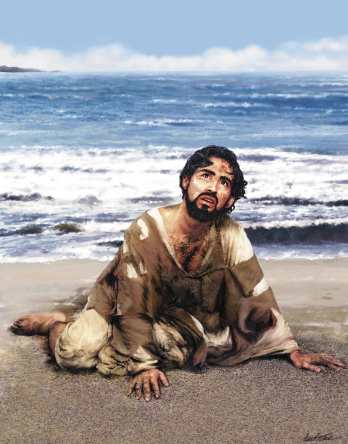
God heard his prayer and commanded the fish to vomit Jonah onto dry land.

Jonah_shore

 Then the Lord repeated Jonah’s marching orders: “Go to the great city of Nineveh and proclaim to it the message I give you” (3:1).

This time Jonah obeyed, and the glory came forth.   Jonah preached and the people repented. God had compassion upon the citizens of Nineveh, and did not bring destruction upon them.

What appeared to be a mortal defeat for Jonah turned into a glorious revival for a wicked city.

Read Mr. Markham’s poem again and you’ll discover more benefits of defeat, as outcomes of:

  • Straining in the wind.  Pressing on during adversity results in perseverance and strength of character.
  • Drinking in new beauty.  During times of distress we’re more aware of God’s glorious attributes at work in our spirits–attributes such as empowerment, faithfulness, peace, and grace.
  • Sending down deep roots.  Defeat often brings us to new depths of surrender and submission.  It also brings us to new depths of God’s love (Ephesians 3:17).
  • Experiencing grief.  Only those that know a mighty grief can know the mighty rapture.  Like diamonds against dark velvet, joy needs a backdrop of sadness in order to be appreciated fully.
  • Experiencing sorrow.  Sorrows create space for joy.  Joy is never so sweet and overwhelming as after sorrow.

God knows what he’s doing, and he doesn’t waste time or effort.  False starts and fruitless endeavors just don’t happen with our perfect Heavenly Father.

Therefore, when defeat comes into my life or yours, we can rest assured he is accomplishing his good purpose for us.

There will be victory in defeat.

Guaranteed.


(photo and art credits:  www.zazzle.co.nz.com; http://www.searchforbibletruths.blogspot.com.)


Read Full Post »

« Newer Posts - Older Posts »

When the House is Quiet

Impressions Becoming Expressions

Mitch Teemley

The Power of Story

Still Traveling

Impressions Becoming Expressions

Living Our Days

Gaining a heart of wisdom

He Said What?!

I'm Patty, and my husband and I are living with our adult son who has autism and epilepsy. I love sharing lessons learned from life around me, especially life with Aaron.

Meditations of my Heart

Impressions Becoming Expressions

Linda Stoll

Impressions Becoming Expressions

Signora Sheila

Notes on Life, Faith & Italy

Heidi Viars

Finding the Image of God