Feeds:
Posts
Comments

Archive for the ‘Bible Study’ Category

Thomas Jefferson gave us this bit of wisdom:

 https://www.azquotes.com/quotes/topics/brevity.html

Note how the following authors demonstrate this most valuable of all talents:

  • “It is good people who make good places.”—Anna Sewell, Black Beauty
  • “Trials come to prove and improve us.”—St. Augustine
  • “Change always comes bearing gifts.”—Price Pritchett

Conciseness contributes to effectiveness, agreed?

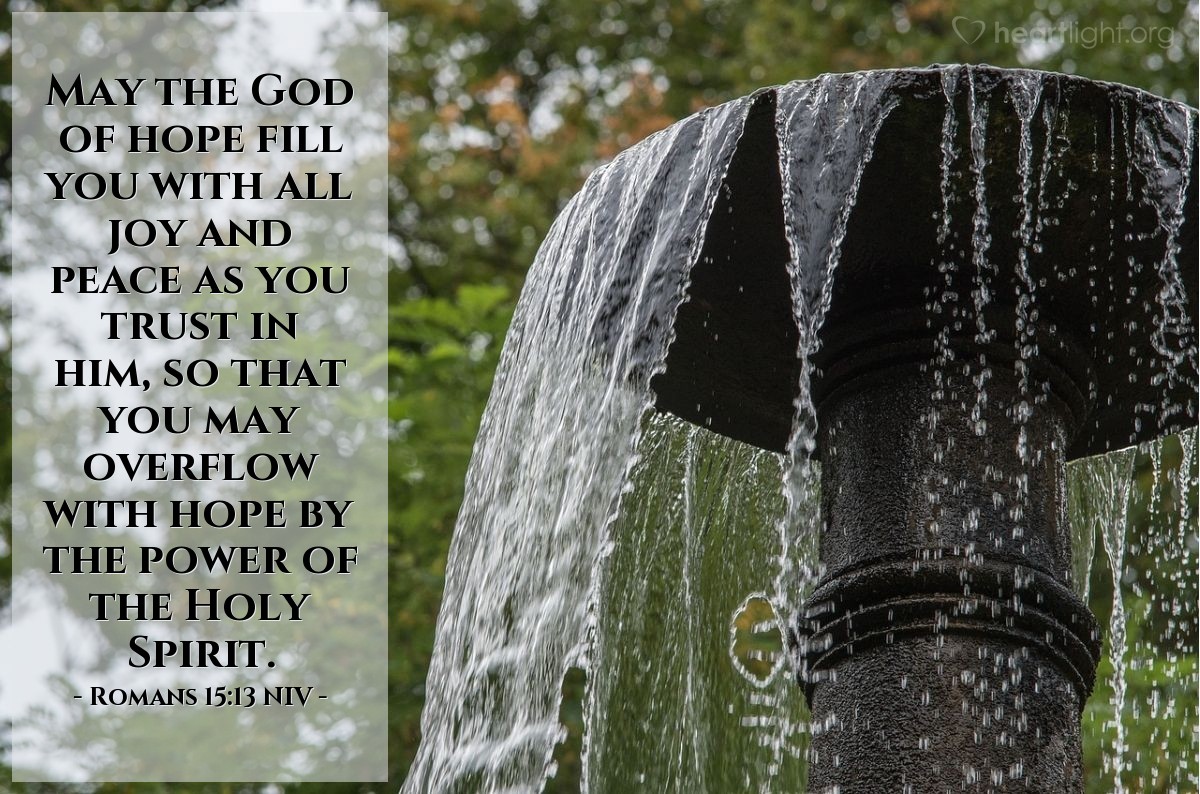
In Romans 15:13, the Apostle Paul wrote a magnificent but concise blessing for the Christians in Rome. He brought together five key concepts of our faith—hope, joy, peace, trust, and power—in just thirty words or so, depending on the translation:

Whole books have been written to expound on each concept. But since this is a blog post, not a treatise, I’ll try to keep it short—and concise!

HOPE

Our Christian hope is not wishful thinking; it is confident reliance on the sacred certainties of our Heavenly Father.

Paul calls him our God of hope because of his glorious attributes manifested in our lives—his omnipotent power, gracious mercy, continual patience, lavish kindness, and absolute reliability—to name a few.

And with statements of faith we can bolster our hope—statements such as these:

  • “God is kind and good, wise and powerful. All his attributes are always at work for my benefit.”
  • “God is accomplishing purpose in these circumstances, just as he always does.”
  • “He will bring me through this situation, and I’ll be a better person for it.”

JOY

Joy is not the absence of all misery and the presence of every whim; joy is found in the presence of God.

Sound silly? Talk to an old saint who has walked with Jesus many years—who’s felt the Lord’s presence surrounding him, heard God’s whispers in his heart, and experienced his guidance and provision again and again. 

This saint will tell you: the pleasures of this life don’t begin to compare to the soul-delight of intimacy with God.

PEACE

Peace is not found in circumstances; it’s found in a Person, the Prince of Peace. The better we know him, the better we know peace.

Tension decreases as we affirm:

  • He is completely trustworthy.
  • He knows everything; he’s in control of everything.
  • He takes pleasure in blessing us with all that we need.
  • He is with us to comfort, strengthen, and encourage.
  • Even in the midst of difficulty, we can experience his peace. In fact, it’s a promise.

TRUST

It’s God’s part to work all things for good; it’s our part to trust.

The question becomes, What can I do to grow in trust?

The answer: express gratitude. “The foremost quality of a trusting disciple is gratefulness”[1]

So thank God, even in the midst of frustration, disappointment, heartache, and pain. “There’s a good God leading, working all things into good. It is safe to trust”[2]!

POWER

The power to thrive does not come from within ourselves; it comes from the power of the Holy Spirit.

Do circumstances appear impossible to rectify? Think on the power of God. He scatters the stars in space. He breathes life into every creature. He provides everything necessary to sustain our little planet.

It’s that kind of absolute, unlimited power that will see each of us through every crisis until we’re home with him.

And so, in one concise verse Paul majestically highlights five pillars of the abundant life.

When we embrace the hope, joy, and peace that God offers, when we trust in him with expectancy and resolve, when we pray for his power to be released in and through us, our lives and outlook will become radiant and alive[3]!

Doesn’t that sound like a glorious way to live?

Scriptures for further reflection:

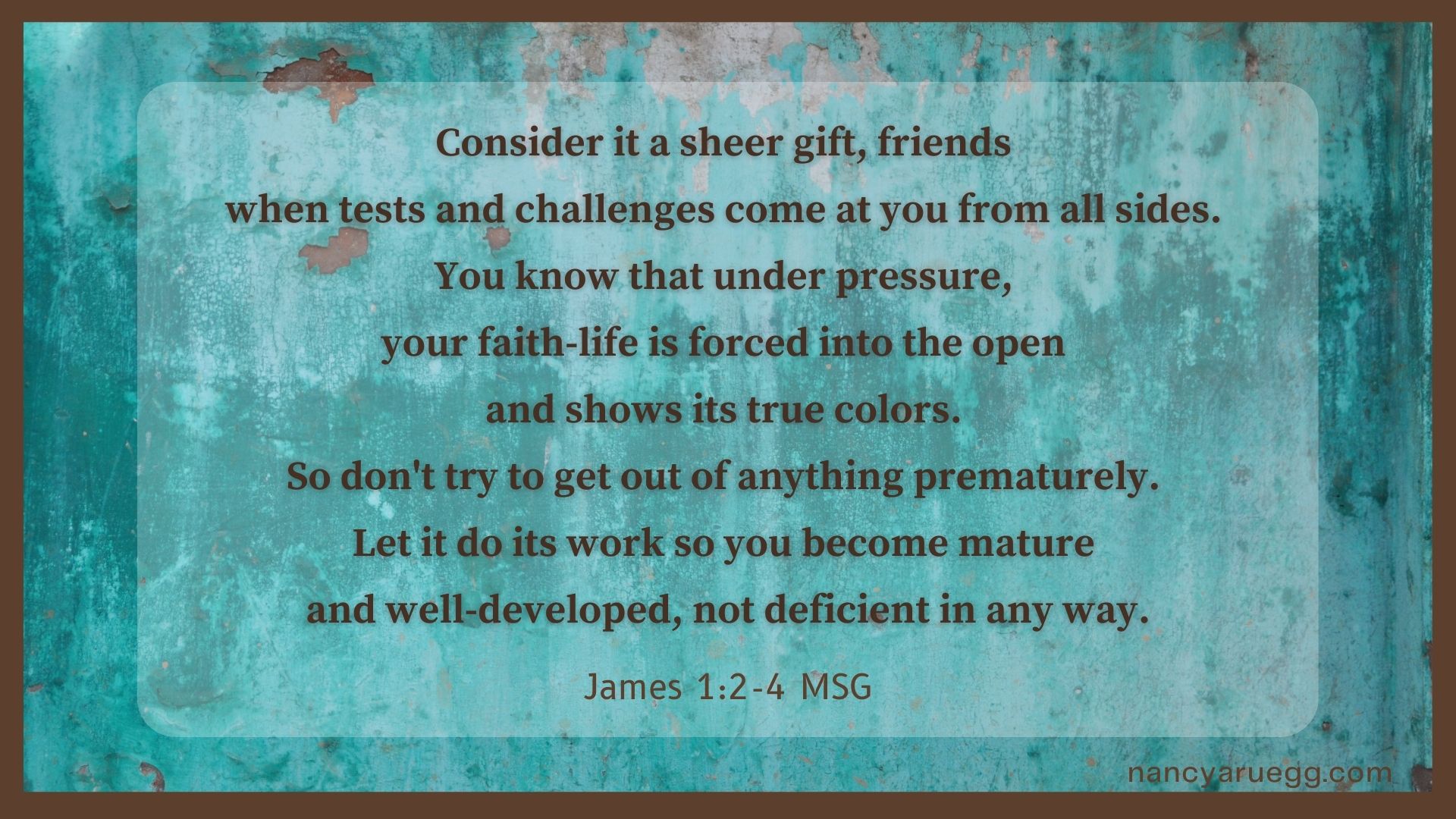
Hope–Psalm 145:8-9; Daniel 2:20; John 5:17; Philippians 1:6; Romans 8:28; James 1:2-4

Joy–Psalm 16:11; Psalm 71:5-8

Peace–Deuteronomy 32:4; 1 John 3:20b; Jeremiah 31:3; Philippians 4:19; Deuteronomy 31:8; Isaiah 40:29-31; Philippians 4:6-7

Trust–Proverbs 3:5-6; Psalm 9:10; 28:7; 112:7; Colossians 2:7; Psalm 110:4-5; 1 Peter 1:6-7

Power of the Holy Spirit–1 Corinthians 8:6; Psalm 8:3; Job 12:10; Psalm 46:1

Notes


[1] Brennan Manning, Ruthless Trust, 24.

[2] Ann Voskamp, 1000 Gifts, 155.

[3] The last clause is based on Touchstone’s revised version (1995) of the J. B. Phillips’ translation for Romans 15:13.

Art & photo credits: http://www.azquotes.com; http://www.heartlight.org; http://www.canva.com; http://www.pxhere.com; http://www.dailyverses.net; http://www.rawpixel.com; http://www.canva.com; http://www.pxhere.com.

Read Full Post »

Stuffed pork tenderloin, prepared by our son.

Our son became interested in cooking while attending university, and he’s been experimenting ever since. Now guests often say his fare is better than what many restaurants offer.

Father’s Day last Sunday was no exception. We enjoyed a sumptuous dinner off the grill: perfectly-seasoned, tender steaks; thick, golden, onion slices sprinkled with bleu cheese and slivered almonds; and polenta squares topped with lightly-sauced mushrooms.

The big surprise came skewered: Brussel sprouts alternated with radishes. I’d never eaten the latter cooked, but these were amazing—nothing like their raw flavor.

Our daughter-in-law creates memorable desserts. One time she constructed a rainbow cake—six layers of jewel-toned deliciousness under a cloud of butter cream frosting. All from scratch of course.

H.’s cake looked every bit as perfect as this one.

Now what if E. and H. invited new guests unfamiliar with the stellar meals these two can produce. And what if E. shared that the menu would include onions with bleu cheese and cooked radishes.

These unaware invitees might say, “Uh, no thanks, our schedule is really tight, plus we have other plans.” Later to themselves they’d likely comment, “E. and H. actually eat that stuff?! It sounds awful!”

But they’d miss out on a memorable meal.

God offers us gourmet cuisine too, but of a different variety.

“Open wide your mouth and I will fill it,” he says. “I would feed you with the finest of wheat; with honey from the rock I would satisfy you” (Psalm 81:10, 16).

God offers fine food for our souls, found first of all in the Bible. Some people believe the Book is out-of-touch and irrelevant, containing whole sections of unintelligible gibberish.

These folks are like those invited dinner guests, turning down a marvelous opportunity because the offerings sound unappealing. If they’d only come and try the dishes new to them, they’d be more than pleasantly surprised.

God’s soul food also includes wonderful surprises: useful wisdom, uplifting encouragement, fortifying support, and sweet comfort. We miss so much if we let a busy schedule and other interests interfere with the feeding of our souls.

A well-read Bible is a sign of a well-fed soul.

–Unknown

Just one of my father’s well-read Bibles.
Note the numerous and tiny comments he wrote in the margins.

To make time, we may have to give up something—like those long minutes on social media or watching TV. During my years as a teacher, making time meant getting up earlier than everyone else in the house. And the ten years I commuted a half-hour each way, the alarm sounded at 4:30 a.m.

But it was not a hardship; I just went to bed earlier. The feast each morning was well worth it. (For an example of one feast, you can read from an earlier post, “Down the Aisle of Your Years.” Scroll down to just below the James 1:17 image.)  

Another problem: The Bible looks like a huge buffet to some. They wonder where to start. Add all those puzzling cultural and historical references, and it’s tempting to give up before turning the first page and taking the first bite. What we may need are a few utensils.

Just like a shrimp fork or steak knife make it easier to eat those foods, certain tools help us consume God’s Word. Many are available online. For example, www.biblestudytools.com or www.studylight.org offer word definitions, cultural and historical background, commentaries, and more.

Bible study guides also help us dig into the sustenance the Bible has to offer. A few recommendations include:

  • NavPress LifeChange series, with each study focused on a book or two of the Bible. Luke is a good place to begin, with its many stories and teachings of Jesus.
  • LifeWay Press also produces worthwhile Bible studies, including an overview by Angie Smith, titled Seamless. Others I’ve enjoyed include: Believing God by Beth Moore and Discerning the Voice of God by Priscilla Shirer. You can’t go wrong with studies by these women.
  • Another LifeWay Press classic? Experiencing God by Henry T. Blackaby and Claude V. King. Millions of people have already benefited from this study.
  • Harper Christian Resources offers 40 Days through the Bible from Lysa Terkehurst and her team. They provide an overview by theme, including: identity, freedom, and fulfillment.

What if, when E. and H. invited dinner guests and shared what’s on the menu, I was there to add, “Oh, you’ve GOT to come. I’ve eaten at their house numerous times, and it’s always delicious!” Might they be more likely to come? Perhaps.

In the same vein, consider this post my affirmation of what God has to offer in His Word. I’m here to say, “You’ve GOT to read it, study it, digest it. I’ve dined at God’s table of truth countless times over the decades and have never been disappointed!”

What Bible study materials or methods have you found nourishing to your soul? Please share in the comment section below!

Art & photo credits: Nancy Ruegg; http://www.flickr.com (2); Nancy Ruegg; http://www.picryl.com; http://www.freebibleimages.org; http://www.canva.com.

Read Full Post »

Have you been pillow-shopping lately? If not, be forewarned: the number of options may cause nausea, dizziness, and high blood pressure.

There are pillows made with down, fiberfill, foam, latex, gel, and even buckwheat hulls. Manufacturers also provide different levels of cushioning, and now pillows come in different shapes, depending on your sleep position or special needs such as neck pain.

All they want is for you to get a good night’s sleep, right? Oh, and sell you lots of different pillows until you find the one best for you!

For proper rest though, we need a different kind of pillow—not made from feathers, foam, or buckwheat hulls; not made by Mike Lindell. The pillows I’m thinking of can easily be taken with us wherever we go and never need to be replaced. They’re free too!

These special pillows have been available a long time, but perhaps Charles Spurgeon, the famous preacher of Victorian England, was the first to make note of them. He suggested we “use the Lord’s words as our pillows,” and lie down upon them in restful faith [1].

We’d do well to understand:

God wants us to rest—physically (Psalm 127:2) and especially spiritually (Matthew 11:28-30).

In fact, the word rest, when referring to spiritual relaxation, is used over 200 times in scripture [2].

Spiritual rest brings tranquility of soul.

We can experience rest from anxiety and fear—even fear of death—as we place our confidence in God, our all-wise and powerful, ever-merciful and gracious, wholly-trustworthy and faithful Heavenly Father.

St. Augustine was right when he prayed:

The key to spiritual rest is acquainting ourselves thoroughly with God’s Word (Psalm 119:52).

It’s there we find the pillows of encouragement, hope, and peace we need in order to experience rest.

And what might some of those scriptural Word-pillows be? Here are three examples.

Pillow #1

My Presence will go with you, and I will give you rest.

–Exodus 33:14

Each moment we can choose to focus on God and his attributes, or on our problems and their difficulty. When we choose the former, He wields his attributes on our behalf.

  • His wisdom offers perspective, and keeps discouragement in check.
  • His power affords strength to endure.
  • His attentive care provides blessing in the midst of challenge.
  • His protection shields us from deep despair.
  • His provision supplies all that we need [3].

Pillow #2

Stand at the crossroads and look; ask for the ancient paths,

ask where the good way is and walk in it,

and you will find rest for your souls.

— Jeremiah 6:16

The more we know of God and his attributes, the better-equipped we’ll be when adversity strikes.

Pillow #3

Don’t worry about anything; instead, pray about everything.

Tell God what you need, and thank him for all he has done.

Then you will experience God’s peace,

which exceeds anything we can understand.

His peace will guard your hearts and minds as you live in Christ Jesus.

–Philippians 4:6-7 NLT

Such truths become all the more meaningful when we remember: the apostle Paul was in prison when he penned these words to the Philippians (1:14). From his own experience he wanted his readers to know that prayer and gratitude produce peace, as we depend upon our sovereign God whose ways are always right.[5]

*     *     *     *     *     *     *     *     *     *

O God, help me rest in you and upon your Word-pillows of scripture.

 I thank you for the pillows of promise, reminding me of your sovereign power to provide whatever I need.

I thank you for the pillows of assurance, affirming your glorious attributes, always at work for the best conclusion.

And I thank you for the pillows of encouragement, reminding me that with you all things are possible, with you I can stand firm through life’s trials, and with you I am NEVER without hope.

(Psalm 23:2-3; Proverbs 30:5; Psalm 145:15-16;

John 5:17; Job 42:2; Ephesians 6:10-17 and 1:18)

What Word-pillow from scripture gives rest to your soul ? Please share it in the comment section below!


[1] Faith’s Checkbook, January 3.

[2] Herbert Lockyer, Seasons of the Lord, 241.

[3] Proverbs 2:1-11; Isaiah 40:31: Jeremiah 17:7-8; Psalm 33:17-18; Philippians 4:19

[4] Psalm 18:30; Psalm 22:28; Deuteronomy 32:4

Photo credits: http://www.rawpixel.net; http://www.wikimedia.com; http://www.dailyverses.net; http://www.pixabay.com; http://www.piqsels.com; http://www.wikimedia.com.

Read Full Post »

Remember Christmas morning as a child—the first glimpse of the enticing packages tucked under the tree?  Did you hop and clap with delight?

Or how about that winning touchdown for your team—in the last few moments of the game with your school’s arch rival? Did you jump up and shout in celebration?

Perhaps a family member or dear friend recently announced glorious news—a baby on the way, better employment obtained, or a clean bill of health finally received.  Did you find yourself dancing for joy?

Over-the-top pleasure and exciting events will do that to us. And although the body may no longer respond with hops, jumps, or dance, our spirits certainly soar in the moment.

The prophet Habakkuk of Old Testament times wrote about just such a response.  I love the way Eugene Peterson paraphrased the verse: “I’m turning cartwheels of joy to my Savior God” (Habakkuk 3:18 MSG). Sounds like the prophet received the answer to a heartfelt prayer or perhaps a miracle had occurred.

Truth is, Habakkuk’s home city of Jerusalem faced imminent invasion by the brutal Babylonians.  Recent conquests of other kingdoms left no question about the city’s fate.

God had made clear why disaster loomed.  The people of Jerusalem had continually ignored his wise ways and reveled in wickedness. Multiple warnings had been proclaimed and disregarded.

In response God was about to provide a means of saving his people—not from the ruin of their city—but from the ruin of their souls.  He would allow the invasion and a period of captivity in a foreign culture 900 miles away (Isaiah 39:5-8; Jeremiah 25:1-11).

(Isaiah foretold this scene in the latter half of the eighth century BC,
Jeremiah in 605 BC. The invasion took place in 586 BC.)

Habakkuk questioned God’s decision, wondering why he would allow the Babylonians, a people more wicked than the inhabitants of Jerusalem, to “swallow those who are more righteous than they are (Habakkuk 1:13)?”

By the end of his book, however, the prophet’s doubts had turned to faith and he declared—in the face of calamity–“Yet I will celebrate the Lord. I will rejoice in the God of my salvation” (3:18 NIV).

The word rejoice in this verse is ‘alaz’ in the original Hebrew, and means to “spin around for joy.”* Can you imagine? Disaster loomed. All Habakkuk had ever known would be destroyed.  If not killed, he would be forced into captivity in a hostile country.

Yet Habakkuk determined to dance for joy in his spirit—spin cartwheels even.

How does a person acquire such joy? Not by setting her sights on things that make her momentarily happy.  Deep-down dancing joy grows in proportion to our trust in God, and our trust grows in proportion to our knowledge of God—knowledge gained as we spend time in His Word.

We’d also do well to remember the close relationship between joy and gratitude.

As 2022 unfolds, a number of crises threaten—in our cities and states, our country, and around the world.  With Habakkuk of old we have a choice: to sink into despair over the real possibility of disaster, or to rejoice in our God who will enable us to endure whatever we may face (James 1:2-4).

It is our turn to spin for joy–in the God of our salvation!

*Linda Dillow, Satisfy My Thirsty Soul, 202.

Art & photo credits: http://www.flickr.com; http://www.hippopx.com; http://www.maxpixelnet; http://www.wikimedia.org; http://www.pxhere.com; http://www.pixabay.com.

Read Full Post »

For most of us, the words Christmas scriptures bring to mind the first two chapters of Matthew and Luke.  We may even remember the prophecies of Isaiah, Jeremiah, and Micah.

Rarely will we think of the psalms as part of the Christmas story, yet at least a dozen passages from the Book of Songs include references related to Christ’s birth. A few qualify as outright prophecies; other statements are less direct, but hindsight allows us to make delightful connections.

So for each passage quoted below, see if an aspect of the Christmas story doesn’t come to mind!  (To keep this post from getting too long, I’ve included just six examples. Answers appear below.)

1. “The Lord said, ‘I have made a covenant with My chosen one, I have sworn to David, My servant, I will establish your offspring forever and build up your throne for all generations” (Psalm 89:3-4 HCSB).

2. “[The Lord] himself will redeem Israel from all their sins” (Psalm 130:8).

3. “Light shines on the righteous and joy on the upright in heart” (Psalm 97:11).

4. “The heavens proclaim his righteousness, and all peoples see his glory” (Psalm 97:6).

5. “Send me a sign of your favor.  Then those who hate me will be put to shame, for you, O Lord, help and comfort me” (Psalm 86:17 NLT).

6. “Praise the LORD and pray in his name! Tell everyone what he has done” (Psalm 105:1).

7. “Because of your temple at Jerusalem, kings will bring you gifts (Psalm 68:29). 

(The second Jewish temple; a model in the Israel Museum)

Answers:

1. Jesus’ lineage and reign described in Matthew and Luke fulfill this prophecy perfectly (Matthew 1:1; Luke 1:32-33).

2. Psalm 130:8 sounds very similar to Matthew 1:21, doesn’t it?

3. The Light of the world began to shine that night in Bethlehem, and the angel of the Lord proclaimed great joy for all people (Luke 2:9-10).

(by Philip James de Loutherbourg, 1740-1812)

4. The psalmist may have thought he was writing about the stars, sun, and moon—all declaring the power and glory of God.  Little did he know his words foreshadowed events on the night Jesus was born, when the heavenly host proclaimed, “Glory to God in the highest heaven” (Luke 2:9) and the shepherds saw the glory of the Lord shining around them (v. 9, 13-14).

5. This verse also brings to mind the lowly shepherds (whom others often despised) as well as the angel’s words, “This shall be a sign unto you . . .” The birth of the Messiah brought great help and comfort to all his people, but perhaps especially the marginalized. For everyone, the long wait for his appearing was over.

6. The shepherds followed this directive as they left Jesus’ birthplace and “spread the word concerning what had been told them about this child” (Luke 2:17).  They glorified and praised God for all the things they’d seen and heard, just as they had been told (v. 20).

7. That’s exactly where the Magi went first—Jerusalem—seeking the one born king of the Jews (Matthew 2:1-2.)  And of course they came bearing gifts–gold, frankincense, and myrrh (Matthew 2:10-11).

Isn’t it amazing–from the Book of Songs written eons ago, come the distant strains of the exquisite, eternal Christmas Song that we celebrate to this day:

All your works declare Your glory;

all creation joins to sing.

Praise resounds as earth rejoices

in the birth of Christ the King (2)!*

*the last four lines of “Joyful, Joyful, We Adore Thee,” stanza 2)

Art & photo credits: Steve Ruegg; http://www.stockvault.net; http://www.pixabay.com; http://www.wikimedia.org (2); http://www.pixabay.com.

Read Full Post »

The psalmists of old seemed to have a favorite metaphor for God: Rock. You’ll find the imagery used twenty-nine times.  Sometimes the writers included reasons why this was a meaningful comparison for them; sometimes they included synonyms:

  • “The Lord is my rock, my fortress” (18:2)
  • “My God is my rock, in whom I take refuge, my shield . . . my  stronghold” (also 18:2)
  • “Lead me to the rock that is higher than I” (61:2)
  • “God alone is the mighty rock that keeps me safe” (62:2 CEV)
  • “Be to me a rock of habitation to which I may continually come” (71:3 NASB)

David seemed especially fond of this metaphor, perhaps because he spent months hiding from King Saul in the rocky terrain of the Judean wilderness. Psalm 57 was written specifically when he escaped into a cave. It may have been the characteristics of the rock walls surrounding him that brought to mind descriptors of God—solid, strong, protective, and unchanging.

Perhaps a cave such as this hid David and his men.
Might such a formation as this have provided the inspiration behind
“Be the rock that is higher than I” (Psalm 61:2)?

Later when he became king, David composed Psalm 18, probably after the numerous battle victories summarized in 2 Samuel 8.  Four times in that psalm he extolled God as his Rock.

In the New Testament we find Jesus’ parable about a foolish man building his house on sand, and a wise man building his house on rock. The point is clear: God is a reliable foundation-Rock on which to build our lives.  He provides:

  • solid, trustworthy wisdom for decisions 
  • strength and power for life’s challenges
  • protection from our arch enemy, Satan
  • unchanging reliability, faithfulness, and love—to name a few unfailing attributes
“Anyone who listens to my teaching and follows it is wise,
like a person who builds a house on solid rock” Matthew 7:24.
(House in Meteora, Greece.)

One of my favorite examples of Bible imagery is found in Philippians 2:15.  To understand the context though, we have to start reading at verse fourteen:

Do everything without grumbling or arguing,

so that you may become blameless and pure,

children of God without fault in a warped and crooked generation.

Then you will shine among them like stars in the sky

as you hold firmly to the word of life.

–Philippians 2:14-15 NIV

Isn’t that a glorious statement in the fourth line above?  We can shine into the darkness of the world like stars as we allow the Spirit to foster purity within us!

Ngc 3603 Nebula Cluster Of Stars

Now why would letter-writer Paul choose stars to make his point? Perhaps their beauty reminded him: with kindness, patience, joy, and more we can bring beauty to the world around us–a world darkened by selfishness, greed, and hatred.

Paul would also have known about using stars for navigation.  As far back as 3000 B.C. ancient Minoans were using constellations to navigate the Mediterranean Sea (1).  Perhaps Paul connected the starlight to God’s wisdom shining in mature believers, enabling them to provide guidance to those around them.

But now, centuries later, we know more about stars than Paul did and further comparisons can be drawn:

Stars shine by burning hydrogen into helium in their cores.  We shine as the Holy Spirit burns away the dross in our lives—those unbecoming traits like pride, negativity, and ingratitude. That’s when we can become radiant.

One prominent star in the evening sky of Fall and Winter is Deneb in the constellation Cygnus (the Swan), which is 19 quadrillion miles from earth.  The gleam we see left Deneb about 1500 light years ago in 521 A.D (2). The gleam of our lives can also achieve far-reaching effect as one life touches another which touches another, and then another . . . ad infinitum.

Stars not only create beauty but fulfill function.  They manufacture and distribute into the universe such elements as carbon, nitrogen, and oxygen (3). As we shine like stars in our circles of influence, we too fulfill function, manufacturing and distributing such elements as goodness, encouragement, and helpfulness.

From earth and sky come these two insightful examples of biblical imagery:  rock and stars.

Do you see the connection between the two? As you plant yourself on the firm Rock of Almighty God and shine for him like a star . . .

. . . YOU are a Rock star!

Notes:

  1. https://nationalgeographic.org/encyclopedia/navigation/
  2. https://earthsky.org/space/ten-things-you-may-not-know-about-stars/
  3. https://science.nasa.gov/astrophysics/focus-areas/how-do-stars-from-and-evolve

Photo credits: http://www.hippopx.com; http://www.canva.com; http://www.wikimedia.org (2); http://www.pixfuel.com; http://www.maxpixel.net; http://www.heartlight.org; http://www.maxpixel.net.

Read Full Post »

Well-known preacher, C. H. Spurgeon (1834-1892), delivered at least twelve sermons on the same three verses of scripture, but attested that a minister could never preach too often on the passage. 

“In its depths are pearls for which we hope to dive,” he said [1].

Another anonymous enthusiast for these verses called them “the greatest invitation that was ever issued.”

What scripture were they referring to?  Jesus’ words recorded in Matthew 11:28-30.

Will you go diving with me for the pearls of this passage?  What new treasure might God present to us, even in such familiar verses as these? 

Each key word and phrase offers insight into the glorious ways Jesus wants to bless us:

Come 

To come to Christ is simply to put our trust in him. As our Savior who died for us, he is more than worthy of our trust. As the all-powerful King of kings over everything in the universe, he is more than qualified to warrant our trust.

All who are weary and burdened 

A 2017 Gallup Poll revealed eight out of ten Americans feel stress sometimes or frequently every day [2].  But Ann Voskamp, in her book, One Thousand Gifts, suggests that “to choose stress is an act of disbelief”[3]. I see her point.

On the other hand, choosing to trust in Christ—with praise and gratitude for all he is and all he does—results in peace and joy.

Rest 

Our souls find rest when we affirm the truths we know about our Lord, including his constant presence to strengthen, help, and guide.  “The very act of confidence is repose,” wrote theologian, Alexander Maclaren.

Take my yoke upon you 

Like the young ox who is teamed with a trained animal in the wooden harness holding them together, Jesus invites us to companion with him and follow his ways, his example.

Learn from me 

He’s anxious for us to enjoy the abundant life he offers, so Christ suggests we learn how he handled life—in close companionship with his Father.  And for his part, our Father delights in manifesting his life-enhancing attributes in our lives.[4]

I am humble and gentle 

You’ve probably noticed our Savior is not an unreasonable and stern taskmaster, wielding his omnipotent power to bully us into submission.  Time and again in the Bible record of his life we see evidence of Jesus’ being kind and understanding, gracious and tenderhearted.  He is the same toward us because:

My burden is easy and light 

Easy = well-fitting.  Just as the farmers of old would shape the wooden yokes to uniquely fit their oxen, the ways of Christ fit us perfectly.  After all, he designed us; he knows what’s best for us.  And his yoke is lined with love.[5]

Perhaps now you see why someone would call these verses the greatest invitation ever issued. Jesus offers:

  • Salvation from the consequences of our sin
  • Relief from our burden of cares
  • Rest in his all-sufficiency
  • Instruction in the ways of abundant living, side by side with the gracious King of the universe

No wonder Spurgeon called such blessings pearls—lustrous pearls that can transform our reality, when we simply come to Jesus.

Which pearl(s) particularly caught your attention today?  Share with us in the comment section below!


[1] www.preceptaustin.org

[2] https://news.gallup.com/poll/224336/eight-americans-afflicted-stress.aspx

[3] p. 148.

[4] Jeremiah 9:24

[5] Matthew Henry

Photo credits: http://www.heartlight.org; http://www.canva.com; http://www.maxpixel.net; http://www.dailyverses.net; http://www.wikimedia.org.

Read Full Post »


During a former chapter of my life, I taught fourth grade language arts and social studies.

One of the reading strategies we emphasized was looking for Ah-HA Moments—places in a book where readers finally receive answers to the questions they’ve been asking—questions like:

  • Why is the main character doing that?
  • Who could be responsible for this situation?
  • How will the main character(s) solve this problem?

The quest for Ah-HA Moments helps keep readers engaged, aids comprehension, and adds more pleasure to the reading experience.

I took great delight in seeing my students internalize this strategy. Even during other subjects, I’d hear “Ah-HA!” now and then, as a student found the perfect verb for her writing or a history research-team discovered why the Erie Canal was abandoned.

Eons ago the apostle Paul desired Ah-HA Moments for his children—the spiritual offspring he’d led to faith in Jesus.


(“St. Paul” by Rembrandt, c. 1657)


In Ephesians 1:18, Paul prays that his readers would experience spiritual Ah-HA Moments.

No, you won’t find those exact words in any translation. What you will find is a statement with similar meaning:


“I pray that the eyes of your heart

may be enlightened” (NIV).


And then Paul chose to highlight three aspects of our Christian experience that can create those Ah-HA moments: 1) Our hope in Jesus, 2) The riches of his glorious inheritance in his holy people, and 3) God’s incomparable power.

I wonder what Ah-HA Moments we might discover while meditating on each one?

Consider the following:


Hope


“Hope is the reality that is being constructed,

but is not yet visible.”

—William Stringfellow (emphasis added)


And just what does our reality-under-construction include?

  • God’s good work in us that is never-failing and never-ending (Philippians 1:6)
  • Peace and joy, because we hope in Jesus (Romans 15:13)
  • God’s delight in us—not when we’re finally perfectbut when we put our hope in him (Psalm 147:11)
  • Hope that translates into strength—especially strength to persevere (Isaiah 40:31)
  • Refinement, as the anticipation of Jesus’ return “acts as a purifying hope in our lives” (1 John 3:2-3 and Kay Arthur*)


Did any of those statements provide an Ah-HA Moment for you?

For me it was the third bullet point. God delights in me, simply because I hope in him. I don’t have to wait until I’m perfect to receive his approval.


The Riches of His Inheritance


Some Bible scholars believe Paul meant God’s inheritance in us.  

We are his treasured possession, adopted into his family when we accept Jesus into our lives (Deuteronomy 7:6; Galatians 3:29).

As such, he takes care of us, provides purpose for us, and even takes pleasure in us. He enjoys our company and looks forward to the day when we’ll all be together with him for eternity (Revelation 21:3).


Again, any Ah-HA Moments?

I, for one, am astounded to realize God treasures me—sinful and flawed as I am.


God’s Incomparable Power


Every one of us can relate stories of God’s miraculous work, as he’s provided, protected, and guided in ways beyond human explanation.

But sometimes he produces super-human perseverance, inner strength, and even joy through difficult circumstances.

The Christian who avails herself of God’s power is ready for both kinds of intervention. She knows that God will supply all her needs, including the wherewithal to turn every negative into a positive.

That last statement provides my final Ah-HA for this post; maybe for you too. We can find delight—in spite of distress—as we avail ourselves of God’s power.


Of course, these two verses from Ephesians aren’t the only places in scripture where we can experience Ah-HA Moments. In fact, we will never come to the end of them—for which I am very grateful.  You too?


“Nobody ever outgrows Scripture;

the book widens and deepens

with our years.”

–Charles Spurgeon


That’s especially true as we invite God to enlighten the eyes of our hearts—with Ah-HA moments.


*Kay Arthur, His Imprint, My Expression, p. 31.


Photo credits:  http://www.needpix.com; http://www.wikimedia.com; http://www.heartlight.org; http://www.dailyverses.net; http://www.canva.com; http://www.flickr.com.


Read Full Post »


If you have an extra $1,300 you need to spend, you’re in luck! A high-end department store offers an item of clothing you can purchase for just that amount: a belt.

You’d think the buckle would be gold at that price. Nope, it’s brass. And it’s shaped in the logo of the company. So you get to pay them to advertise for their company on your midsection.

Now some might treasure such a purchase, but I’d choose a different belt as my treasure: the belt of truth the Apostle Paul referenced in Ephesians 6:14. No doubt he wanted us to understand:

Just as a belt holds clothing close to the body, a belt of truth holds the confidence of our faith close to our hearts.

And truth is a treasure, in spite of ethical relativists who would throw it away.

Why?


(www.quotefancy.com/John Owen)


Some will say, “That’s a very arrogant and exclusive thing to say, that we have to accept absolutes revealed by God in the Bible!”

But isn’t it just as arrogant to dismiss him–and his Son Jesus? Can we afford to ignore Jesus’ claim to be the [only] way [to God], and the [real] truth, and the [real] life (John 14:6 AMP)– without thorough investigation? And isn’t it being exclusive to exclude the Son of God from careful consideration?


Such truth as presented in John 14:6 and Acts 4:12 requires a response. We can’t afford to ignore even the possibility of truth about such a life-and-death matter.

But then there are those who do not find John Owen’s statement (above) offensive, and would agree: We find reliable guidance, strengthening confidence, and expectant hope in the truths of God’s Word.


Imagine that belt of truth Paul wrote about, woven with spirit-strengthening statements. What truths would you choose?

Try on this combination for size. Cinch them snug around your heart by speaking each truth out loud:


  • God loves you and has your best interest at heart (Jeremiah 31:3; 29:11).


  • With perfect wisdom and understanding, he has thoughtfully planned out your life (Psalm 139:16). Therefore,


“Never be afraid of giving up your best

and God will give you his better.”

–Unknown


  • God is all-powerful and in control of all things, including your circumstances (Isaiah 14:24). How empowering to know…


…“There is no situation so chaotic that

God cannot from that situation,

create something surpassingly good.

He did it at the creation.

He did it at the cross.

He is doing it today.”

—Bishop Moule


  • He faithfully leads you in the way you should go (Psalm 23:3). You can count on him because:


  • All that God is, is always at work (John 5:17).


“If you are praying about it

God is working on it.”

–Unknown


  • He is constantly by your side, ready to help in a myriad of ways (Psalm 145:18-19).


“God hath in Himself all power to defend you,

all wisdom to direct you, all mercy to pardon you,

all grace to enrich you, all righteousness to clothe you,

all goodness to supply you, and all happiness to crown you.”

–Thomas Brooks


  • God’s peace, joy and hope are forever available (Psalm 29:11; John 15:11; Romans 5:5).  And what is hope?


And his word is absolute truth.

The more I learn about archaeological evidence, ancient manuscript verification, fulfilled prophecy, historical substantiation, and creation science, the more astounded I am by the great volume of proof upholding the authenticity of God’s truth in the Bible.

His truth is the reliable confidence of our faith, a treasure worth cinching close to our hearts.


What scriptural truths do you treasure?  Share your choice in the comment section below!


(Art & photo credits:  http://www.pexels.com; http://www.canva.com; http://www.quotefancy.com; http://www.dailyverses.net; http://www.heartlight.org; http://www.canva.com; http://www.azquotes.com; http://www.canva.com.)


Read Full Post »

The Miracle of the Loaves and Fishes

James Tissot, Brooklyn Museum


It’s a familiar story:

Crowds of people teemed the hillside—thousands of them. They had gathered hours before so Jesus could heal the sick and infirm. But soon the sun would set, and hunger gnawed at everyone’s belly.

One young boy offered his meager lunch, and with its contents Jesus provided an ample supper for the entire throng.

I can only imagine, Jesus breaking the pickled fish and barley rolls into pieces over and over, his hands hiding the actual multiplication. He must have worked fast too.

Let’s see…if 5,000 men were in attendance, and perhaps an additional 5,000 women and children, the total count may have approached 10,000 people.

And if each bread-and-fish meal required one second of Jesus’ time to create, he would have been producing food for two hours and forty-six minutes. (Math whizzes: please check my figuring.) In actuality, the process must have been much more rapid.

But even when everyone had eaten all they wanted, Jesus wasn’t finished yet.

“Gather all the leftovers,” he told his disciples. And they filled twelve baskets with broken pieces (Matthew 14:13-21; Mark 6:32-44; Luke 9:10-17; John 6:1-13).


Now why would Jesus create an overabundance? Such excessiveness seems without purpose. And why did he instruct the disciples to collect all those leftovers? The birds would have swooped in and quickly devoured the remains.

But Jesus had his reason. Like all the other miracles he performed, his objective was to make plain certain truths about himself and his Father.

Consider:

  • The sheer number of wonders proved he was the Messiah. No one before or since has achieved such a record number of miracles.
  • Jesus’ supernatural deeds for people of all walks of life demonstrated his love and compassion for everyone; a person’s nationality or social status didn’t matter.
  • The breadth of his power became clear as he turned water into wine, healed numerous kinds of diseases and infirmities, quieted the wind, caused nets to fill with fish, walked on water, and even raised the dead.


The Raising of Lazarus by Rembrandt


The miracle of multiplied bread and fish highlights God’s benevolence. And the leftovers in particular provide a memorable picture of God’s inexhaustible resources and overflowing grace, available to us through Jesus.

I wonder if the disciples were reminded of Psalm 31:19 as their baskets began to fill with roll fragments:


Such abundance none of them had ever seen before.  The fact that it was an abundance of bread is significant too, because the very next day Jesus called himself the Bread of Life (John 6:35).


Just as he had supernaturally provided an abundance of bread for a huge crowd, so he would supernaturally provide an abundance of life (John 10:10)a God-enhanced, satisfying, joy-filled life—to those who believe in him (John 11:25-26).

And what about those twelve baskets? Where might a band of wandering disciples find a dozen baskets on a Galilean hillside?

Historians can explain. Each man would have been carrying his own kophinos—a knapsack-type basket. It would have held food and necessary items for a journey, and also provided a place for acquired objects or supplies along the way.

The baskets might symbolize our hearts where the Bread of Life dwells. But unlike the disciples’ grapevine backpacks, our hearts are elastic, capable of stretching to hold more and more of the fullness of God.

And there is a wondrous and glorious abundance to be gathered.


*     *     *     *     *     *     *     *     *     *


I praise you, Father,

“We need not fear that we shall ever come to the end of your goodness or any experience for which you will have no blessing ready” (J. R. Miller).

You are our Almighty God, able to do above and beyond all that we ask or think. With you, amazing things are always ahead.  Hallelujah!  

(Luke 12:29-31; 2 Corinthians 9:8; Ephesians 3:20)


Art & photo credits:  http://www.wikimedia.org ( U.S. work public domain in the U.S. for unspecified reason but presumably because it was published in the U.S. before 1924.); http://www.pxhere.com; http://www.wikipedia.org; http://www.canva.com; http://www.dailyverses.net; http://www.heartlight.org.


Read Full Post »

« Newer Posts - Older Posts »

When the House is Quiet

Impressions Becoming Expressions

Mitch Teemley

The Power of Story

Still Traveling

Impressions Becoming Expressions

Living Our Days

Gaining a heart of wisdom

He Said What?!

I'm Patty, and my husband and I are living with our adult son who has autism and epilepsy. I love sharing lessons learned from life around me, especially life with Aaron.

Meditations of my Heart

Impressions Becoming Expressions

Linda Stoll

Impressions Becoming Expressions

Signora Sheila

Where faith meets la dolce vita

Heidi Viars

Finding the Image of God