Feeds:
Posts
Comments

Archive for the ‘God’s Power’ Category

Last week we embarked upon a reflection of one of the most important songs in the history of the Christian faith: “O Come, O Come, Emmanuel.”

The lyrics beautifully weave together the Old and New Testaments, telling the story of our Messiah, “the chosen One”—the One who would come to deliver his people from the consequences of their sins and establish his kingdom forever [1].

Each verse of “O Come, O Come, Emmanuel” directs our spiritual eyes toward Christ’s return by remembering his first coming, and then expressing hope, anticipation, and yearning for his second coming [2].

Our needs here in the present are also addressed as we look to him–our Emmanuel (God with us), our Wisdom from on high, our great Lord of might, and more.

As noted last week, the unknown lyricist carefully based each stanza on scripture. You’ll find a number of references listed at the end of this post for further reflection.

This week we meditate on verses two and three [3]:

VERSE 2

I praise you, Lord Jesus, that you are the wisdom of God from on high, and have become for us wisdom. In you are hidden all the treasures of discernment and knowledge—more profitable than silver, yielding better returns than gold, and more precious than rubies [4].

Through you, God Almighty made the universe, and he appointed you heir of all things. Your wisdom is on display in the order of everything: the orbits of planets, the balance of ecosystems, the cycle of seasons, and more [5].

I praise you, Lord Jesus! You are the radiance of God’s glory and the exact representation of his being. You wisely, actively, and expertly sustain all things by your powerful word [6]!

The Milky Way Galaxy is just one of approximately 200 billion galaxies in the universe–a conservative estimate.

It measures about 100, 000 lights years in diameter. Our whole planetary system occupies one tiny spot of the galaxy.

During your earthly life you exemplified the epitome of wisdom in what you taught and how you lived.

As if that wasn’t enough, you provide wisdom to those who trust you as their Lord and Savior and simply ask.

You know exactly when to give, how to give, what to give, and what to withhold [7].

We can trust you to show us the best path to follow, so that we may enjoy the abundant life you offer [8].

VERSE 3

I praise you, Lord Jesus, that you are our Lord of might, sovereign over all. You are leading everything to the conclusion you ordained before time began, by the same power, wisdom, and love with which you made it. Nothing can be amiss [9].

You will not fail to do your pre-ordained, unerring part, which is ultimately the only part that matters [10].

I praise you that just as the people of Israel saw the radiance of your glory on Mount Sinai as Moses received the law, we too can see evidence of your majesty and splendor. In fact, it’s all around us in:

  • The wonders of your creation
  • The truths in scripture
  • The love and compassion evident in your generous blessings
  • The beauty of your attributes on display—your knowledge, wisdom, power, goodness, and more
  • The scriptural prophecies fulfilled; the promises kept
  • The miracle of your grace that meets us where you find us but doesn’t leave us where you found us [11]

REFRAIN:

In all of this and more we REJOICE!

You have come to be with us, our Emmanuel. You support us with your perfect wisdom, omnipotent might, and more.

Hallelujah!


[1] Ace Collins, Stories Behind the Best-Loved Songs of Christmas, 127; Isaiah 59:20; John 1:40-49; Romans 6:23; Revelation 11:15

[2]  https://www.danielim.com/2017/12/19/the-hidden-theology-and-history-of-o-come-o-come-emmanuel/  

[3] From www.hymnary.org. The lyrics of this hymn vary depending on the source.

[4] 1 Corinthians 1:24, 30; Colossians 2:3; Proverbs 3:13-15

[5] Hebrews 1:2; Jeremiah 51:15

[6] Hebrews 1:3; Colossians 1:16-17

[7] Charles Spurgeon, Morning by Morning, 84.

[8] Proverbs 3:5-6

[9] Daniel 7:13-14. Last two sentences based on Julian of Norwich quote

[10] Based on Elisabeth Elliot quote

[11] Based on Anne LaMott quote

Art & photo credits: http://www.pixexid.com; http://www.stockvault.net (Mirko Fabian); http://www.pxhere.com; http://www.stockvault.net (Mirko Fabian); http://www.pxhere.com; http://www.pickpik.com.

Read Full Post »

Christian trudged to the church he pastored as rain drummed on his umbrella. His pant cuffs grew increasingly damp from his splashing boots.

Is this really worth the effort, he wondered. Only a handful of people attended the Monday night prayer meetings, which he’d established several years prior at Church of St. Nicholas.

And yet the faithful few who came demonstrated such hope, Christian always felt uplifted by the end of each gathering.

Encouragement of any kind was in short supply. Times were difficult; everyone was suffering except the government elite and their cronies.

In the third year of the weekly prayer sessions, Christian felt compelled to invite fifty people to his church to discuss the oppressive circumstances of their country. More than six hundred came, and subsequently, attendance at the Monday prayer meetings also grew.

Such a large crowd didn’t slip by the attention of authorities. They discouraged religious gatherings, but assumed that prayer meetings were harmless.

Attendees began bringing family and friends. Over the next few years the church started to fill to overflowing. Eventually eight thousand people gathered every Monday night, praying for peace in their land and throughout the world.

Other churches around the country organized their own prayer meetings. Some attendees would walk the streets afterward, carrying candles and praying or singing as they went.

The authorities finally ran out of patience with the demonstrations. They barricaded the streets around the Church of St. Nicholas to discourage attendees. Instead, the congregation grew.

The next step included peaceful protests. Thousands of people participated. And even though hundreds of demonstrators were beaten and arrested, they weren’t deterred.

Numerous threats were made; some lost their jobs. One woman reported that government officials took custody of her children for a while, due to her participation in what they called an extremist group.  

Worse yet, the protesters were threatened with death. And though many admitted to fearing for their lives, they did not back down.

“Our fear was not as big as our faith,” Christian explained later [1].

One night, after an hour-long service at St. Nicholas Church, Christian led the people outside to join a crowd of approximately 70,000, all gathering from various churches. Each one carried a candle and marched through the city chanting “we are the people” and “no violence” [2].

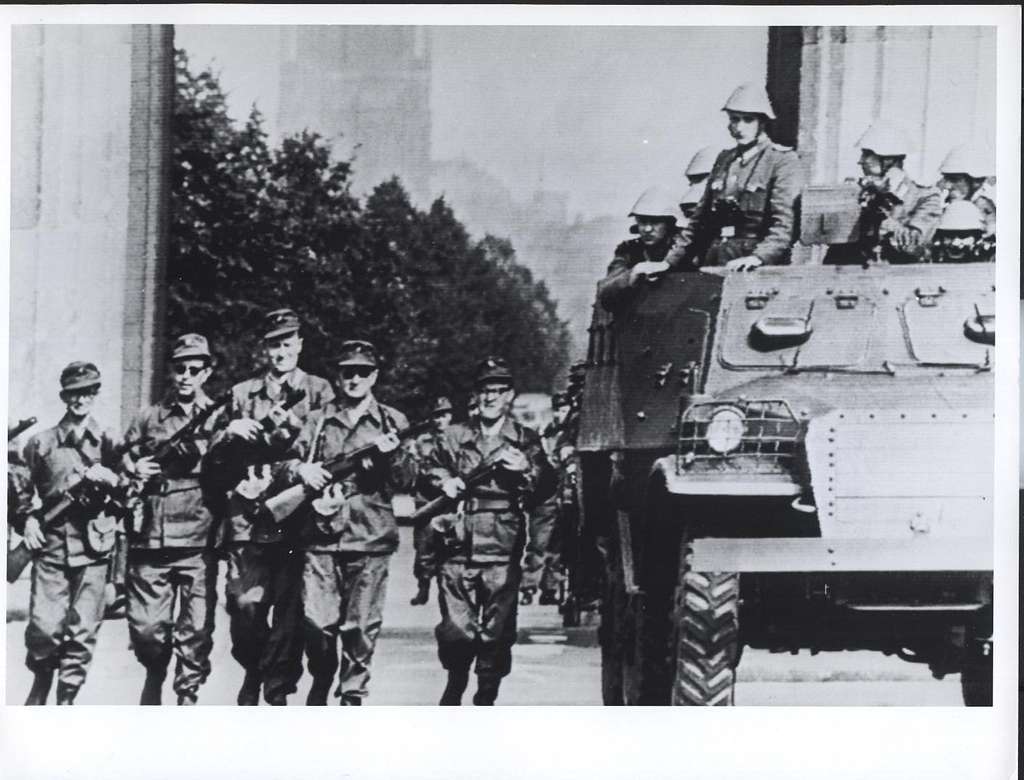
All along the way, long rows of armed police watched their every move.  More soldiers manned tanks, waiting for the order to disperse the crowd with murderous force.

But the order never came. Afterward it was revealed that government officials persuaded their leader to leave the protesters alone.

One of the demonstrators gave a soldier a lighted candle. He put down his weapon and accepted it. Others followed suit. “Soon all the soldiers had lowered their weapons and joined with the protestors” [3].

In the following weeks, the prayerful, candle-carrying crowd grew to 120,000, then 300,000, and finally 700,000.

A crowd such as this must have gathered.

The country’s leader resigned, knowing that without the army to back him, he had become powerless. Soon the whole regime resigned, unable to fight against the power of prayer and Light.

One month after the tide-changing protest, a government spokesperson mistakenly announced in a public broadcast that a monumental change was about to take place. Citizens would be allowed to travel freely, effective immediately [4].

News spread rapidly, reported across the world. Thousands of people soon gathered at the symbol of their thirty-year oppression, a barrier that had divided them into east and west: the Berlin Wall.

Harald Jager, commanding officer of the border guards that night, called his superiors to find out how to deal with the gathering crowd. He received no orders.

“People could have been injured or killed . . . if there had been panic among the thousands gathered at the border crossing,” he declared afterward. “That’s why I gave the order: Open the barrier” [5].

And so, on November 9,1989, thousands flowed through, celebrating and crying. Others climbed over the barrier, chipping away at the wall with hammers and pickaxes. Bulldozers and cranes soon made quick work of dismantling the entire structure [6].

Thirty-four years ago today, that menacing wall became rubble, and a tyrannical regime miraculously toppled with it.

And it all began with Pastor Christian Furher and a handful of praying saints.

Christian Furher (1943-2014)


[1] https://contemporarychurchhistory.org/2014/09/reflection-on-pastor-christian-fuhrer-of-the-nikolai-church-in-leipzig/

[2] https://embracingbrokenness.org/2020/10/prayer-and-the-berlin-wall-by-charles-buttigieg/

[3] http://storage.cloversites.com/worldhistoryinstitute/documents/WHI_03Mar014_Journal_4.pdf

[4] https://www.foxnews.com/lifestyle/this-day-history-nov-9-1989-berlin-wall-falls-cold-war-victory-us-allies

[5] https://www.bbc.com/news/world-europe-50013048

[6] https://www.history.com/topics/cold-war/berlin-wall

Additional Source: http://www.godgossip.org/article/did-a-prayer-meeting-really-bring-down-the-berlin-wall

Photo credits: http://www.commons.wikimedia.org; http://www.pxhere.com; http://www.rawpixel.net; http://www.picryl.com; http://www.commons.wikimedia.org; http://www.pexels.com; http://www.nara.getarchive.net; http://www.picryl.com; http://www.commons.wikimedia.org.

Read Full Post »

Of the two art installations below, which piece appeals to you the most?

Jackson Pollock’s #31 (1950)?

Or, the rose window of Strasbourg Cathedral, designed by the architect Erwin von Steinbach in the twelfth century?

Pollock’s work impresses us for his unique creativity at the time, its size (nearly 9’ x 18’), the gnarled texture, and the illusion of movement.

The second artwork dazzles us for its intricate design, its size (nearly 50 feet across), and the precise, colorful artistry.

Another factor that draws our eye: symmetry—the quality of being made up of similar parts facing each other or around an axis.

Imagine the number of glass pieces required for the Strasbourg window, each carefully cut to exact dimensions in order to complete sixteen matching petals. Note that the number doubles where the sixteen sections become thirty-two.

Research conducted with babies has proven: humans are born with a predilection for symmetry, whether it’s in art, nature, music, or the people we find attractive.

Beauty is bound up with symmetry.

Herman Weyl, physicist [1]

Even Pollock employed symmetry in his work. There’s balance between the right and left sides, the top and bottom, in the amount of paint used, and in the ratio of gray, white, and black paint (albeit not as precise as a rose window)!

Of course, it wasn’t a human who introduced symmetry into the universe, it was God, and it is everywhere.

Countless examples can be found in four basic forms.

Bilateral, with matching right and left sides:

Except for a few anomalies, all animals fall into this category.

Radial, with parts radiating outwards from a center:

Aeonium arboreum

Biradial, which combine both radial and bilateral symmetry:

See all those hundreds of barbs on each feather? They’re bilaterally symmetrical too.

And spherical:

Globe Thistle

But then there are numerous variations, including:

Fractal, where the same shape or pattern in various sizes is repeated over and over.

Romanesco Broccoli

Wallpaper, with its repeating pattern horizontally and vertically.

Macro Photography of actual honeycomb

Fibonacci, based on the ratio 1:1.618 and called the Golden Ratio [2], is found in the double spiral of sunflower seeds.

Rotational, when an object still looks the same after some distance of rotation.

Icosahedral, with its adjoining faces, each connected to the others at the same angle, creating a spherical shape.

Model of the Carbon 60 Molecule

The Carbon 60 molecule is just one example of symmetry at the microscopic level. But it also occurs at the cosmic.

For instance, on April 8, 2024, Planet Earth will experience a total solar eclipse—another example of bilateral symmetry. Such a phenomenon occurs because the sun is 400 times larger than the moon, but also 400 times farther from the earth, making the two bodies appear the exact same size in the sky [3].

Nearly everywhere we look, some form of symmetry is bound to be within view.

And what might we learn about God from his use of symmetry?

The wonder of creation is,

every encounter illuminates

something about God.

Margaret Feinberg [4]

Symmetry indicates that he loves order and organization, pattern and design, proportion and balance.

Symmetry gives evidence of his intentionality in creation, his attention to detail, his care and precision in the execution of his plan.

Symmetry affirms Intelligent Design. All of these astounding patterns could not have happened by chance, any more than pieces of glass can randomly come together in a rose window.

The more we know of God’s works, the better we know him.

The better we know God, the greater our awe and wonder.

And wending along the shoreline of wonder leads to worship [5].

*     *     *     *     *     *     *     *     *     *

Thank you, Glorious Creator, for the joy of discovery as we learn about you.  You ARE the Master Craftsman. Everything you’ve made has been thoughtfully and expertly fashioned by your hand. I delight in your deeds and happily sing in celebration of your handiwork!

1 Timothy 4:4a; Psalm 92:4


[1] Symmetry (Princeton, NJ: Princeton University Press, 1989).

[2] See https://nancyaruegg.com/2017/06/22/the-language-of-the-universe/ for a more detailed explanation and many astounding examples of the Golden Ratio in creation.

[3] https://solarsystem.nasa.gov/eclipses/science/geometry/

[4] Wonderstruck, 55.

[5] Though we intend our worship to bless God, he blesses us as we do. See https://nancyaruegg.com/2022/07/07/what-happens-when-we-pause-to-praise/

Photo credits: http://www.flickr.com (Wally Gobetz); http://www.commons.wikimedia.org (Martin Kraft); http://www.flickr.com (Chris Bertram); http://www.commons.wikimedia.org; http://www.flickr.com (Brian Auer); http://www.pexels.com; http://www.pxhere.com; http://www.wikimedia.org; http://www.wallpaperflare.com; http://www.pxfuel.com; http://www.flickr.com; http://www.commons.wikimedia.org (2); http://www.wallpaperflare.com.

Read Full Post »

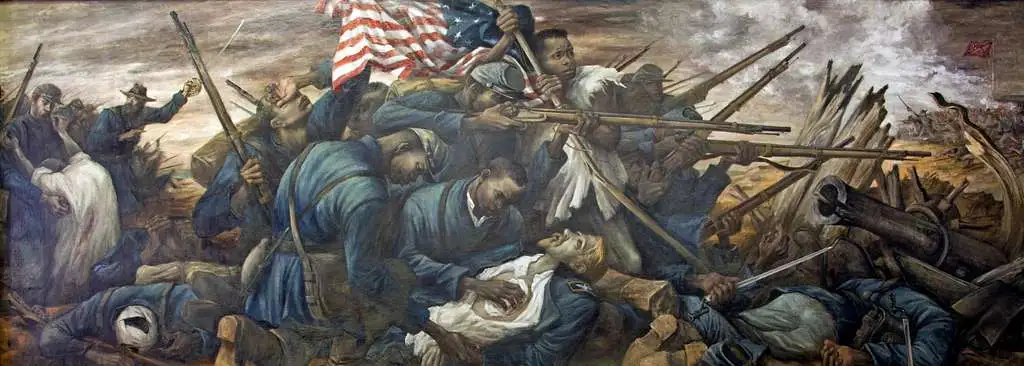
Gunfire blasts and booming cannons surrounded Union Army Private, William Carney. His regiment’s objective: to capture Fort Wagner near Charleston, South, Carolina.

The 54th Regiment of Massachusetts at the Civil War battle for Ft. Wagner, July 18, 1863.

Jerking movement nearby caught Carney’s eye. The color guard had been shot. As the dying man fell, the U.S. flag he carried began billowing toward the ground. Carney scrambled to rescue the flag from desecration and took a bullet himself.

Carney continued to crawl toward the fort, holding the flag high and calling encouragement for his fellow soldiers to follow. He was hit at least three more times, but made it to the walls of Fort Wagner, planting the flag into the sandy soil and holding it upright “until his near-lifeless body was rescued” [1] .

Even then Carney refused to let go of the flag until he was returned to his regiment’s camp. His heroism that day inspired a vital victory for the Union Army.

W. H. Carney with the flag he carried that day.

Years later Carney explained his motivation for joining the Union cause: “I had a strong inclination to prepare myself for the ministry; but when the country called for all persons, I could best serve my God by serving my country and my oppressed brothers. The sequel is short – I enlisted for the war” [2] .

Yes, Carney had been an oppressed brother himself, born into slavery in 1840. But during the 1850s he arrived in Massachusetts, either through the Underground Railroad, or perhaps his father—already a freed slave—was able to purchase his son.

Either way, Carney began to enjoy the freedoms that Blacks of the South were denied—freedoms like traveling, assembling, learning to read and write, and receiving pay for work. He passionately desired other slaves to experience the same.

That God-given passion for his fellow man surely inspired Carney that day at Fort Wagner, to give the fight his all no matter what duty fell to him. And for his tenacity and courage, William Carney received the Medal of Honor in 1900. He was the first Black soldier to do so.

Someone might ask, how was William Carney able to stay so strong?

Undoubtedly his firm stance was the result of:

  • Strong attention toward his God
  • Strong determination to live by God’s ways
  • Strong faith in God’s promises, confident that whether he lived or died, all would be well

We too can stand firm in what we face by applying the same.

Strong attention toward God includes not allowing our emotions to control us. For example, sorrow, fear, and exhaustion will insist we can’t go on, but God tells us he gives strength to the weary and increases power for the weak [3] .

Strong attention toward God includes being in relationship with him, through prayer, Bible reading, worship, and more. We can’t expect to sense his peace and strengthening presence if we never spend time with him.

Security is not the absence of danger

but the presence of God

no matter what the danger.

Unknown

Strong determination to follow God means choosing to live by his truth. Scripture is full of examples of men and women shaped by their faith and obedience in God, becoming as strong as steel: Huldah, Jeremiah, Daniel, Mary (Mother of Jesus), Peter, and Paul are among them.

We see such Bible heroes as extraordinary, but I’m sure they’d tell us they were just ordinary people who trusted in their extra-ordinary God.

Strong faith in God’s promises means we can hold on to hope with confidence and courage.

I wonder if scripture-promises echoed in William Carney’s mind as he held that flag high and emboldened his comrades–promises such as these?


  • “The Lord gives strength to his people; the Lord blesses his people with peace” (Psalm 29:11).
  • “With your help I can advance against a troop; with my God I can scale a wall. It is God who arms me with strength and makes my way perfect” (2 Samuel 22:30, 33).
  • “If I live, it will be for Christ, and if I die, I will gain even more.” (Philippians 1:21 CEV).

You and I may never fight in battle, but these same promises can echo in our minds as we confront such enemies of our souls as discouragement, anxiety, stress, guilt, and temptation.

Like William Carney WE can stand steadfast and strong [4] .

What helps you to stand strong? Please share your experience in the comment section!


[1]https://www.army.mil/article/181896/meet_sgt_william_carney_the_first_african_american_medal_of_honor_recipient

[2] https://www.nps.gov/articles/william-h-carney.htm

[3] Isaiah 40:29

[4] 1 Corinthians 15:58

Photo credits: http://www.picryl.com (2); http://www.nypl.getarchive.net; http://www.dir.es/album/hiking-in-wales-2019; http://www.wallpaperflare.com.

Read Full Post »

“I’m sorry, but we cannot treat those who cannot pay,” the doctor explained.

Katie Davis blinked in shock. How could a physician turn away an injured child, even if she was an orphan? Then again, this was Uganda, not Brentwood, Tennessee where she grew up. Fifty percent of the population here lived in poverty, and the under-resourced hospital couldn’t handle all the overwhelming needs.

People waiting in Ugandan hospital

But Katie, a kindergarten teacher, couldn’t accept the doctor’s pronouncement. This child was a student in her school, living in a shack down the street. She was the oldest of three and caretaker of the younger two; their parents had died of AIDS.

The orphanage was already full to capacity; Katie feared for the girls’ future. That very day she managed to secure custody papers, and single Katie became a mother of three—at age nineteen.[1]

What will Mom and Dad say about THIS? she must have thought.

They’d already been hesitant about Katie’s first three-week trip to Uganda, to work at a Christian orphanage her senior year of high school, 2006. Almost as soon as she arrived, Katie fell in love with the staff and students.

Upon returning to the States, Katie couldn’t wait to get back to Uganda after graduation, to take the kindergarten position offered her. The Davises had agreed, with the understanding she’d begin college the following year.

Katie returned home as promised, but her heart remained in Uganda. After one semester, her parents acquiesced and Katie flew back to the people and country she loved.

Uganda–a small land-locked country of East Africa

It was January 2008 when Katie’s adopted daughters moved into her small living quarters, but God soon provided a house to rent.

Over the next eighteen months, more orphans were brought to Katie—girls who’d been abandoned, abused, or whose parents had died of AIDS. One baby was given to Katie by an HIV-positive mother, just twelve years old herself. Child-by-child, Katie’s family grew to thirteen.

Of course, her teacher-salary couldn’t cover all the expenses. But Katie had already researched how to start a nonprofit organization, to aid Uganda’s children. Amazima International Ministries was established in 2008, based in Katie’s hometown of Brentwood.[2]

Soon 150 children were receiving assistance that included school supplies, basic medical care, and two hot meals a day—things their families couldn’t afford.

Two years passed. Katie’s life brimmed with all the responsibilities that thirteen children entail. In addition, numerous houseguests came and went—people in dire circumstances needing temporary lodging.

As with any household, disagreements and frustrations flared. But the word Katie chose to describe the atmosphere was elation—for the laughter, singing, happy noise and gratitude that filled her home.[3]

Then tragedy unfolded. A dear friend and mother of five, died. And the biological mother of one of Katie’s adoptees returned to claim her daughter—a mother unfit for parenting—but Katie had to let the child go. Grief beyond words gripped her heart as she turned to her Heavenly Father for solace. 

Early in 2014, twenty-something Benji Majors arrived in Uganda on a mission trip. He soon recognized the need for young men to be mentored. So Benji decided to stay and come alongside those wanting to become God’s men of integrity.

When Benji asked Katie out–twice, she said no both times, not sure if marriage was part of God’s plan. Besides, what man would commit himself to a woman with thirteen children? Better not to get involved, she thought. 

But Katie found herself attracted to Benji’s passionate heart for God and for people. She finally invited him for coffee—the first of many dates.

The following year Benji proposed over a picnic. When Katie said yes, her thirteen daughters jumped out of the bushes and tossed flowers at the couple. Benji had included them as part of the plan. He and Katie were married in late 2015.

The couple still lives in Uganda, running Amazima Ministries. They provide education for hundreds of children in their own Amazima School, food and health services for thousands of families, as well as job opportunities.

Who could have imagined such a far-reaching outcome when young Katie left for Uganda?

GOD could.

P.S. Ben and Katie no longer parent 13 children; the number has grown to 15 with their two biological sons.


[1] Though Ugandan law specifies an adoptive parent must be at least twenty-one, a judge can override the law in the best interest of the child(ren).

[2] Amazima means “truth” in Lugandan.

[3] https://youngadults.lifeway.com/2012/01/no-ordinary-life-katie-davis-story-of-serving-children-in-uganda/ 

Sources:

https://amazima.org/about/ . Visit here for numerous photos and information about Amazima Ministries.

https://www.christianpost.com/news/katie-davis-majors-young-adoptive-mother-of-13-ugandans-where-is-god-in-suffering-interview.html

https://justbetweenus.org/magazine/exclusive-interviews/extraordinary-love/

https://myhero.com/katie-davis-a-serving-heart-2

https://toptwentyfiveinterviews.transistor.fm/episodes/7-daring-to-hope-part-1-katie-davis-majors

Photo credits: http://www.commons.wikimedia.org (Toshihiro Horii); http://www.wikimedia.org; http://www.flickr.com; sni.no/Skole_og_utdanning_i_Uganda (Richard Lord); http://www.publicdomainpictures.com (Michael Spisak).

Read Full Post »

The Ruegg crew–1980

Years ago when my husband Steve was two-and-a-half years into his first pastorate and our three children were ages five and under, I found myself over-committed.

Sundays, of course, included Sunday School, church, and an evening service. Mondays we hosted a small group in our home that grew to about 30 (which, in my mind, required a clean house plus fresh iced tea and coffee). Thursday evening was choir practice.

From a handful of members to a loft-full; I’m 5th from the left

Every other week, I facilitated a Moms’ support group/Bible study. Also on the to-do list: leading Children’s Church each Sunday for a year, and participating in numerous other activities that happened on a less frequent schedule.

Do you see any issues here?! I didn’t.

All this activity felt important for the growth and community-building of our church that had been dying before we arrived. As a result, I was always on the go between the responsibilities there and at home. Sometimes I resented it (which can be one of the symptoms of striving too hard).  

But the bustle felt gratifying too. In seeking to please the people around me, I was feeding my own neediness for validation. Pride and self-satisfaction lurked in the corners of my soul—wrong reasons for the striving. In addition, I was discovering those attitudes are never satiated.

What’s a Type-A person–who wants to do what’s right–supposed to do?

The following questions can help us evaluate our choices of activity, how many we choose, as well as analyze the motivations behind them:  

Am I propelled most days by determination or devotion?

The determined person rarely reads her Bible or prays except on the run. Her calendar is impressively full of good-deed commitments for others, but contentment is illusive.

This woman may know that a quiet time spent with God refreshes and transforms the spirit, but she can’t seem to make it happen.

Do I find myself pressing on (to the point of exhaustion), while rarely pressing in to be strengthened?

Pressing in includes connecting with God throughout the day, especially in the thick of stress, frustration, or anxiety.  One means is to recite scripture verses that bring our focus back to our all-powerful, all-wise God. [1]

Such verses include:

  • “God is our refuge and strength, a very present help in trouble” (Psalm 46:1).
  • “Call on me in the day of trouble; I will deliver you, and you will honor me” (Psalm 50:15).
  • “The Lord is good to those whose hope is in him, to the one who seeks him” (Lamentations 3:25).

God is ever-ready to help—with the choices before us, when to say yes and when to say no, as well as the right motivations behind those choices.

Does people-pleasing supersede God-pleasing in my life?

Author Shauna Niequist speaks for some of us when she asks: “Why am I doing this? What is it in me that keeps things moving so breakneck fast, . . . that sacrifices my own health and happiness so that people who aren’t me will think I’m doing a good job, in some vague, moving-target kind of way?”[2]

I too find my service for others frequently tinged with people-pleasing. Does that mean I should forego such activity until I can purify my intentions?

No, wrote author and pastor, Tim Keller: “If you wait until your motives are pure and unselfish before you do something, you will wait forever.”[3]

BUT! Our heavenly Father offers this glorious hope:

Because we are covered by Jesus’ righteousness, even our imperfect efforts to please God are acceptable. And as we grow in dependence upon Christ, he’ll purify our hearts more and more.[4]

*     *     *     *     *     *     *     *     *     *

Father, I know it’s downright foolish of me to strive so hard, especially for all the wrong reasons. I want to be free from people-pleasing, self-gratification of the ego, and pride. Forgive me for giving room to such attitudes in my mind.

Help me to be an eager and compliant participant as you work within me to create a pure heart and make my attitudes new.

In the powerful name of Jesus, AMEN.

(Proverbs 4:23; Psalm 51:10; Romans 12:2)


[1] Psalm 72:12 ESV

[2] Present over Perfect, 58.

[3] The Reason for God: Belief in an Age of Skepticism

[4] Isaiah 61:10; Titus 2:11-14

Photo credits: Nancy Ruegg (2); http://www.dailyverses.net; http://www.pixabay.com (TheDigitalArtist); http://www.heartlight.org; http://www.dailyverses.net.

Read Full Post »

Sovereign Lord of Creation, who

Drapes morning mist across the hillsides,

Paints the dawn with ever-changing hues, and

Scatters sparkling crystals of dew on grass and flower,

I worship you with incredulous wonder.

Sovereign Lord of Salvation, who

Gave your precious Son, the King of kings,

To die a cruel, criminal’s death for my sin, and

Provide the way of eternal life,

I worship you with overflowing gratitude.

Sovereign Lord, who

Now considers me righteous,

Making possible an intimate relationship with you, and

Granting perfect peace and effervescent joy,

I worship you with a humbled spirit.

(Detail from The Return of the Prodigal Son

by Rembrandt)

Sovereign Lord of Affection, who

Mercifully withholds the punishment I deserve,

Graciously bestows blessings I have not earned, and

Carries me close to your heart,

I worship you with overwhelming love.

Sovereign Lord of Revelation, who

Gave us your timeless, trustworthy Word, that

Offers infallible wisdom, inspired instruction, and

Encouraging promises to lead us and lift us,

I want to worship you with my obedience.

Sovereign Lord of Transformation, who

Actively pursues my best interest,

To mold me into the image of Jesus

With ever-increasing splendor,

I want to worship you with my submission.

Sovereign Lord of Distinction,

There is no one like you.

Your greatness is beyond human comprehension.

I stand in awe of your splendor and majesty, and

I worship you with all that is within me.

(Revelation 17:14; Philippians 2:8; Romans 5:17; 2 Corinthians 5:21; Revelation 3:20; Romans 14:17; Micah 7:18; John 1:16; Isaiah 40:11; Psalm 119:160, 130, 50; Romans 8:26-29; 2 Corinthians 3:18; Psalm 145:1-5.)

Photo and art credits: http://www.pixabay.com; http://www.pxfuel.com; http://www.wikimedia.org; http://www.creazilla.com; http://www.flickr.com; http://www.pxfuel.com; http://www.wallpaperflare.com.  

(Reblogged from June 18, 2015 while we enjoy another visit from our younger son and daughter-in-love.)

Read Full Post »

Where might Jesus have spent his first afternoon after the resurrection? With his disciples or family? That would make sense.

But Jesus chose instead to take a solitary walk–on the road from Jerusalem to Emmaus–and happened upon Cleopas and an unnamed believer.

They didn’t recognize him; God chose to hide his Son’s identity from them. Almost immediately they began to talk about recent events in Jerusalem: Jesus’ death and resurrection.

The companions explained what they knew and expressed their disappointment in the outcome.

“We thought he’d rescue us from Roman rule and establish the kingdom of God he always talked about,” they confessed. “This morning some women and a few disciples went to his tomb and it was empty, but as far as we know, no one has actually seen him.”

Jesus chided them for focusing solely on the prophecies that presented a reigning Messiah who would overtake Israel’s enemies. He started expounding on other scriptures that foretold a suffering Messiah, who’d come to bear the penalty for humanity’s sins.

And as Jesus spoke, their spiritual eyes were opened to see how each prophecy had been fulfilled in Jesus Christ [1].

What scriptures did he share? The Bible doesn’t tell us. But perhaps Jesus included such examples as these:

1.“They conspire against me and plot to take my life” (Psalm 31:13b).

Fulfillment: “Then the Pharisees went out and began to plot with the Herodians how they might kill Jesus” (Mark 3:6).

2. “And the Lord said to me, ‘Throw it to the potter’—the handsome price at which they valued me! So I took the thirty pieces of silver and threw them to the potter at the house of the Lord” (Zechariah 11:13).

Fulfillment: Judas was paid thirty pieces of silver to betray Jesus. When he returned it out of remorse, the chief priests used the money to buy a potter’s field as a burial place for foreigners (Matthew 26:14-16; 27:6-10).

3.  “Dogs surround me, a pack of villains encircle me; they pierce my hands and my feet” (Psalm 22:16).

Fulfillment: Jesus was crucified, his hands and feet nailed to a cross (Matthew 27:35).

4. “They divide my clothes among them and cast lots for my garment” (Psalm 22:18).

Fulfillment: “When the soldiers crucified Jesus, they took his clothes, dividing them into four shares, one for each of them, with the undergarment remaining. This garment was seamless, woven in one piece from top to bottom.

“‘Let’s not tear it,’ they said to one another. ‘Let’s decide by lot who will get it.’” (John 19:23-24).

5. “All who see me mock me; they hurl insults, shaking their heads” (Psalm 22:7).

Fulfillment: Passersby, Romans soldiers, chief priests, teachers of the law, elders, and even those crucified with him all mocked Jesus (Matthew 27:27-31, 39-44).

6. “They . . . gave me vinegar for my thirst” (Psalm 69:21).

Fulfillment: Jesus said, “I am thirsty.” They dipped a sponge in wine vinegar, put the sponge on a stalk, and lifted it to Jesus’ lips (John 19:28-29).

Of course, the hour or two Jesus discussed prophecies with Cleopas and his companion wasn’t nearly enough time to cover them all. The Old Testament contains over 300 passages about him, revealing at least 48 details about his life, death, and resurrection [2].

But the evidence the men heard was enough to prompt this passionate response: “Didn’t our hearts burn within us as he talked with us on the road and explained the Scriptures to us” [3]?

Some have called their reaction holy heartburn!

Have you too felt your heart strangely warmed [4]?

As I’ve reviewed just these six prophecies listed above, my heart responded with the warm glow of wonder and worship. Only God could weave together so many precise circumstances into one Life—a Life that has defeated death for all who believe in him!

May such truths create a fire of devotion within us—holy heartburn that will warm and delight forever!


[1] Luke 24:13-32

[2] A recommended resource for more thorough study: The Moody Handbook of Messianic Prophecy, edited by Michael Reidelnik and Edwin Blum.

[3] Luke 24:32 NIV

[4] That was the description evangelist and theologian John Wesley gave of his spiritual encounter with Jesus (https://www.christianity.com/church/church-history/timeline/1701-1800/john-wesleys-heart-strangely-warmed-11630227.html).

Art & photo credits: “The Pilgrims of Emmaus on the Road,” by James Tissot, Brooklyn Museum; http://www.freebibleimages.org (4).

Read Full Post »

“This is your last chance!” shouted the leader of Columbian guerillas. “Join us, convince the Motilone to join us, and you will live. Otherwise, you are a dead man.”

The surrounding group of rebels aimed their guns at American missionary Bruce Olson. He fully expected to see Jesus in the next moment.

Of course, this was not the first time Bruce faced death during his twenty-seven years with the fierce Motilone tribe.

No sooner had he arrived in 1961, than Bruce was surrounded by tribal warriors who shot him in the leg with an arrow and took him captive. The guides who had led him to their village fled.

Bruce was just nineteen years old and had received no backing from any mission organization, because of his age and lack of training. But he’d seen a picture of the remote Columbian tribe and felt drawn to share with them about Jesus.

His own life had been wonderfully transformed by Christ, and Bruce desired that for others—especially for this people-group who knew nothing about Jesus.

(The Motilone live in northeastern Colombia and western Venezuela.)

Some would say, “Bruce must have misunderstood God’s plan. Otherwise, why would he experience calamity the minute he arrived?”

But look what God did.

First, the Motilone chief forbade the warriors to kill Bruce. Later he and his men would admit there was no reason to spare him; they just did.

The next day the chief’s son, Bobarishora, brought worms for Bruce to eat, which thankfully tasted like liquified bacon and eggs. In spite of the language barrier, Bruce and Bobarishora began to build a friendship.

The leg wound became infected. Bruce escaped and returned to civilization for treatment. But upon regaining strength, the young missionary went back to the tribe—only to contract dysentery and have to seek medical help again. He almost died in the effort.

For his third attempt to settle with the Motilone, Bruce brought medical supplies. The witch doctor took great interest in their healing powers and learned from Bruce how to use them. With Bobarishora and the witch doctor as allies, Bruce began to achieve acceptance in the tribe.

Over the next four years he learned the Motilone language and set about translating the New Testament into their language, putting to use his knowledge of Hebrew, Greek, and Latin.

Bobarishora, or “Bobby,” became the first to accept Jesus into his life. At a festival not long after, Bobby sang about the jungle trail of life, a metaphor familiar to the Motilone. Bobby explained he’d seen the footprints of God.

“There are many trails in the jungles,” he said. “But there is one trail that goes to the horizon.” (Bobby was referring to heaven.)  “Christ came to walk that trail so we can walk in his footsteps.”[1]

It wasn’t long before many tribespeople had become Jesus-followers. They began sending their own missionaries to neighboring tribes to tell them about Christ.

The Motilone wanted to learn how to read and write, so Bruce started a school. He also set up a medical clinic, and led the effort to grow cacao, to help support the tribe.

(Cutting a cacao pod from the tree.)

Over time the proceeds helped finance 48 schools, more than 20 health clinics, 12 farming cooperatives, and numerous scholarships for Motilone students to attend high school and university.[2]

Then came the day in 1988 when 15 Communist guerillas kidnapped Bruce with the plan of forcing his cooperation, and convincing the Motilone to do so also. Bruce spent several months chained to a palm tree and became very ill. Somehow he survived.

One of the leaders asked Bruce to teach them how to read and write. They brought a book to Bruce, not knowing it was a New Testament. Bruce used it to teach the men to read, and many became Jesus followers.

Bruce’s health continued to deteriorate. The guerillas decided to give him a blood transfusion.

“I will give him some of my blood,” one rebel announced.

The next day he told Bruce that when he was a young child, the Motilone had given food to his widowed mother for three years, never asking for anything in return. “You saved my life,” he said, “Now, I save your life.”[3]

Months passed. No amount of mistreatment had convinced Bruce to help their cause.

One day a group stood him against a tree, announced his execution, and aimed their guns at him. But when they fired, Bruce remained unharmed. They’d shot blanks at him, expecting this final test to break him.

Sometime later one of the leaders told Bruce that capturing him had been a mistake. He hoped that Bruce could forgive them.

He promised the rebels would leave the Motilone alone, and Bruce could continue his work. After nine months of captivity, they released him.

As a result of Bruce’s long devotion to the tribe, more than 400 Motilone have graduated from high school, and over 30 from university, trained as physicians, accountants, translators, forest rangers, agriculturalists, and more. Still others have received technical training.

All have returned to their jungle communities to share their expertise within the tribe.

As of 2018, more than 70% of the Motilone tribe are following in Christ’s footsteps to the horizon.[4]

As for Bruce Olson, now 80, you’ll find him still working with the people of 18 different tribes and languages of the jungles.[5]


 Notes:

[1] https://missionexus.org/an-interview-with-bruce-olson/

[2] https://www.tms-global.org/story-details/bruchko

[3] Ibid

[4] Ibid

[5] https://www.godreports.com/2021/02/legendary-american-missionary-ate-maggots-wore-a-flea-collar-to-survive/ 

Additional Sources:

https://www.bruceolson.com/en/index.html

https://www.theopedia.com/bruce-olson

Photo credits: http://www.picryl.com; http://www.pxhere.com; http://www.flickr.com; http://www.commons.wikipedia.org (2).

Read Full Post »

Pretend you’re on an ocean liner headed from New York City to England.   You and several thousand other passengers enjoy your days at sea, free to choose from dozens of activities—games, shopping, shows, sports, crafts, and more.

You can eat anytime you like, sleep whenever you feel drowsy, make friends among the other passengers or remain solitary. In other words, you make many choices during the voyage, but all the while the ship is headed towards its predetermined destination.

A.W. Tozer gave us this ocean-voyage illustration in his classic, The Knowledge of the Holy, to help us understand God’s sovereignty:

  • Our all-powerful God wields total authority in the universe, just as the shipping authorities exercise sovereignty over the course of a ship.
  • We’ve been given much freedom within the confines of God’s sovereignty to move about and make choices.

Now some folks take issue with God’s control. They want to direct the course of their life-ships.  I for one find great comfort in the numerous, reassuring scriptures about God’s sovereignty.

For example, everything in heaven and earth belongs to Him. He is the glorious head over all, the ruler of all things (1 Chronicles 29:11-12). That includes us–those who know Jesus and belong to the family of God.

As our Heavenly Father, he provides for our needs, guides us through decisions, bestows many blessings, and more. What encouraging truth! The Almighty God of the universe is in charge of our lives as we submit to him. We don’t have to navigate alone.

The key, however, is submission. God is a gentleman and will not force himself upon us. He’s chosen to limit his sovereignty, to allow humans free choice.

Another reassuring truth: God is totally competent. We’ve all known inept leaders who couldn’t fulfill their responsibilities.

But our Ruler is supremely capable. Nothing is too hard for him (Jeremiah 32:17).  As we focus on his complete sufficiency, our worries shrink in significance.

In addition, no plan of God’s can be thwarted (Job 42:2).   What God says, happens.

His sovereign plan is efficient and goal-oriented. He works out everything in conformity with the purpose of his perfect plan (Isaiah 25:1).

God’s sovereignty is also employed with infinite wisdom (Job 12:13).  No foolish decisions come from God’s throne!

And contrary to appearances, he does maintain over-arching rule on humankind (Daniel 4:35).

Consider how circumstances must have seemed to the people of Judah as the barbaric Babylonians destroyed Jerusalem in 586 B. C., murdered all the nobles, and took thousands of Jewish captives to Babylon.

That wasn’t an isolated case of oppression either. Good people have suffered at the hands of the wicked for eons, and it breaks our hearts. It breaks God’s heart too (Isaiah 63:10). 

Our question of why God allows bad things to happen to good people doesn’t always get answered. We’re not privy to everything God knows or all the reasons behind his decisions (Romans 11:33-36).

What we do know is this: evil never wins in the end. Every evil empire of history that rose in prominence and power eventually fell in ruin. Our sovereign God knows what he’s doing.

And he will have the last word.

So when the squeaky wheels of worry, doubt, or fear begin to spin in your head, and you wonder, Who’s in Charge Here?, apply the oil of gladness, delighting in who God is—your all-powerful, all-knowing, all-wise, and yes, in-control God!

Take joy in the knowledge that “if God is for us, who can be against us” (Romans 8:31)?

And rest in thIs affirmation: “from him and through him and to him are all things” (Romans 11:36, emphasis added).

*     *     *     *     *     *     *     *     *     *

Sovereign Lord of the universe, I bow in worshipful wonder of your magnificence. Your greatness shatters all boundaries! I stand in awe of your vast power and infinite wisdom, always at work in the world.

But for those times when I cannot understand your plan or your ways, help me stand in the truth of who you are.

(Revised and reblogged from February 26, 2015, while we enjoy the company of out-of-town family.)

Photo credits: http://www.commons.wikimedia.org; http://www.heartlight.org (2); http://www.dailyverses.net; http://www.canva.com; http://www.dailyverses.net.

Read Full Post »

« Newer Posts - Older Posts »

When the House is Quiet

Impressions Becoming Expressions

Mitch Teemley

The Power of Story

Still Traveling

Impressions Becoming Expressions

Living Our Days

Gaining a heart of wisdom

He Said What?!

I'm Patty, and my husband and I are living with our adult son who has autism and epilepsy. I love sharing lessons learned from life around me, especially life with Aaron.

Meditations of my Heart

Impressions Becoming Expressions

Linda Stoll

Impressions Becoming Expressions

Signora Sheila

Where faith meets la dolce vita

Heidi Viars

Finding the Image of God