Feeds:
Posts
Comments

Archive for the ‘God’s Provision’ Category

No, that’s not a typo in the title; I intentionally chose rust. However, that parody on an old hymn actually did result from a typo years ago.

Steve was just a few months into his first pastorate in St. Petersburg, FL. The mean age of the congregation was somewhere in the 70s. When the church secretary typed the opening hymn title for one Sunday’s bulletin, ‘Tis So Sweet to Trust in Jesus, she accidentally omitted the “T” in trust.

But there was a whole lot of truth in that typo-title. Many saints of that congregation could testify, even into old age: “Blessed is the man who makes the Lord his trust” (Psalm 40:4).

bd703f478e8eed5bd6013b55b582b8d3

And just what might those blessings be? A few possibilities quickly come to mind. When we put our trust in God, we enjoy:

  • Peace of mind (Isaiah 26:3-4)
  • Guidance (Proverbs 3:5-6)
  • Help (Isaiah 41:10)
  • Strength (Isaiah 12:2)

But there are many more blessings that come to those who trust in God—some of which are quite surprising. The following is undoubtedly just a partial list:

Intimacy with God–not just acquaintance. The more we exercise trust, the more we recognize his involvement in our lives. With David, we can affirm: “All those who know your mercy, Lord, will count on you for help. For you have never yet forsaken those who trust in you” (Psalm 9:10).

Hope. Praise God for his hope that fills us with all joy and peace as we trust in him (Romans 15:13)! I can’t imagine going to bed at night without hope for tomorrow—much less for eternity.

Joyful Expectation and Quiet Confidence. Our lives are in the hands of an absolutely perfect, all-powerful, loving God. We can count on him to see us through every situation. So with great delight we can say, “I don’t know what God’s up to, but I know it has to be good!”

imagesca5icqwx1

Life above the Fray. Like Paul, we can learn to be content in every situation (Philippians 4:12), knowing that God will give us the strength to endure (v. 13). A heart full of trust has no room for worry or stress. (Remind me of that when the challenges pile up, will you?)

Adventure. Think of the adrenalin rush these Bible heroes must have experienced, as they placed their trust in God:

  • Joshua fighting the battle of Jericho—with trumpets and loud shouts!
  • Elijah praying for fire to consume a drenched offering to God, in front of 450 prophets of Baal
  • Nehemiah watching the walls of Jerusalem reconstructed, after the Israelites had been held in Babylonian captivity for seventy years

Are we going to sit on the sidelines of life and miss the miracles, because we’re afraid to trust? Perish the thought!

Influence. The Light of Jesus shines most brightly through those who demonstrate trust in the midst of dark circumstances. People remember those saints who maintain a positive, faith-focused outlook in spite of trials.

6100-07639474er

For all these reasons and more, it is indeed sweet to (t)rust in Jesus–to rest secure in the loving, everlasting arms of our Heavenly Father.


*     *     *     *     *     *   *     *     *   *

I praise you, Lord, with all my heart,

for being a trustworthy God who never fails his children.

How glorious to know

I can trust in your unfailing love!

(Psalm 9:1; 13:5; 52:8)

Photo credits:  www.pinterest.com; http://www.pixgood.com; http://www.masterfile.com.)

Read Full Post »

il_570xN.485491692_idn6

“Mom, what’s that lovely perfume you’re wearing?” I exclaimed while greeting my mother-in-law with a hug.

“It’s called White Linen,” she responded. “I like it because it’s crisp and clean and not too heavy.”

The scent stayed with me, but I didn’t mind. Not only did the perfume have a pleasing aroma, but it belonged to one of the sweetest, most generous women I’ve ever known.

The apostle Paul taught that we should leave a pleasant scent wherever we go. But he wasn’t talking about perfume or cologne. He meant that our very lives ought to emit the fragrance of Christ:

“Through us, [God] brings knowledge of Christ.

Everywhere we go, people breathe in the exquisite fragrance.

Because of Christ, we give off a sweet scent rising to God,

which is recognized by those on the way of salvation—

an aroma redolent with life.”

(2 Corinthians 2:14-15, The Message)

 I’ve been privileged to enjoy the exquisite fragrance of a number of saints over the years:

  • My grandmother, who loved and served Jesus with a passion. She demonstrated kindness and thoughtfulness, and never raised her voice. (At least not that I heard!)
  • My parents, who lovingly guided me, and demonstrated what a Christian marriage should be:  two people committed to the best interest of the other.
  • A youth pastor who showed personal interest in each kid, and whose prayers were so heartfelt, we knew this guy was up-close-and-personal with God.
  • A professor and his wife at the seminary Steve attended, who took us under their wings and lovingly mentored us with great wisdom.
  • A mother of three who led the first women’s Bible study I attended.  She provided strong teaching, but better yet, an example of what it means to be a godly woman of excellence.
  • An older couple who listened, supported, and encouraged us as Steve began his pastoral career.
  • A younger couple who came alongside us in ministry over thirty years ago and are still caring friends to this day.
  • A choir director who taught by example what a calm and gentle spirit (2 Peter 3:4) looks like.
  • Countless friends and acquaintances over the years who have loved on us and prayed for us.

Some of these wonderful people have already departed for heaven. Yet their beautiful fragrance lingers in my life to this day—a memorable blend of selflessness, generosity, and grace.

And I wonder, Where would I be without their enduring examples providing strength and guidance?

To be honest, I would surely have ruined my life with poor choices, spurred by emotional immaturity, and spiritual depravity. But God provided all these saints and more, that I might acquire even a faint aroma of Christ. 

And now I plead with myself, YOU serve Jesus by being a sweet fragrance for others, redolent with the life of Christ. YOU be the listener, encourager, and grace-giver. YOU provide the example of Christian maturity. 

*     *     *     *     *   *     *    *     *     *

Oh, Father, I thank you for the countless people you have brought into my life, whose positive impact provided wisdom, direction, and inspiration. Guide me, I pray, to live just as fragrantly, spreading your love, grace, and joy wherever I go.

Whose exquisite aroma lingers in your life?  Tell us about him/her in the comments below.

(Photo credit:  www.etsy.com.)

Read Full Post »

a84324051bff03eaec8e389c6eb02608

Slow, somber music faded away.  All lights were extinguished, including the spot on the cave-like tomb, stage left.

Black silence enveloped us for several moments as the burial scene concluded, a dramatic part of the Easter musical production at our church.

In a hushed voice, the narrator picked up the story.  He explained that when Sunday morning came, women went to the tomb. We, the audience, could see them approaching from stage right, talking among themselves.

They peered into the tomb, and cried out as they discovered the body of Jesus was gone. No sooner did they begin to question what might have happened, than an angel suddenly appeared next to them.  I don’t mean, “walked up and joined them.”  No.  One moment that angel was nonexistent; the next moment there he stood, gleaming brightly.

How did the stage crew create such a startling scene? They used a scrim, a large sheet of gauzy fabric, behind the back of the tomb. When the tomb was lit from the front, everything behind the scrim was invisible. When the spotlight behind the scrim came up, suddenly the audience could see the angel.

That scrim-effect made me think: we live with a virtual scrim in front of us every day. We cannot see what God has planned for us in the future. Events of tomorrow—even this afternoon—are blocked from us by black silence. In his infinite wisdom God has determined that’s the best way for us to live.

But! Sometimes we’re able to look back to see behind the scrim, and note how God orchestrated events for our benefit.

I’m remembering a particularly difficult move years ago. We were leaving a much-loved church where my husband had pastored for six years, and beginning a new ministry across-state.

My personal challenge would be obtaining a teaching position in our new locale, at a time when there were more teachers than positions available.

But look what God did:

First, he “introduced” me to Diane, a delightful young woman—also a teacher. Her parents were members of our new church. Diane actually attended elsewhere, but every now and then would join her parents on a Sunday morning. She visited shortly after our arrival.

Second, God urged Diane to offer help with our unpacking. We spent a delightful morning emptying boxes and organizing various items while getting acquainted. I learned that she taught at a small private school, with just two classes at each grade level. The school was close by, too—only four minutes away. Diane suggested she submit my name for the substitute list. I told her, “Yes!”

Third, God created many substitute opportunities for me at Diane’s school, but fulltime employment seemed unlikely. No one was close to retirement; no one was moving. Meanwhile I applied at public schools within a reasonable commute of our home.

But in April, without even an interview, God prompted the headmaster at the private school to offer me a position. One of the fourth grade teachers had just been elected mayor. Trying to fulfill those responsibilities and teach was more than she wanted to tackle.

I started the following August, which gave me the entire summer to prepare. My classroom was right next door to Diane’s.

When that job opportunity opened up, it was as if the spotlight turned on behind the scrim. Suddenly I could see how God had carefully arranged the whole sequence of events.  My disappointment over leaving our previous home and church turned into a God-ordained appointment at that private school, one that lasted twenty-two years.

“Never underestimate what a redeeming God can do, “ says Karol Ladd.*

And keep your eye on that scrim, for the glorious moment when you can see how he’s been orchestrating events for your benefit (Jeremiah 29:11).


*from Thrive, Don’t Simply Survive by Karol Ladd, Howard Books, 2009.


*     *     *     *     *     *     *     *     *     *


When have you glimpsed behind the scrim of your life?  What events has God orchestrated for your benefit?  Share with us your story in the comments below!

Read Full Post »

inspire

Dove chocolates come wrapped in foil on which are printed positive and encouraging statements. Recently I found this one:

“The more you praise and celebrate your life, the more there is in life to celebrate.”

A positive attitude of praise and celebration, even for the little blessings, does contribute to a sense of well-being.  But there’s an important omission in this quote–the cause of all those blessings.  Perhaps the sentiment might be worded like this:

“The more you praise and celebrate God in your life, the more there is in life to celebrate.”

Now a pleasing sentiment has become solid truth, because with God in our lives, joy is our constant companion.

“You make me glad by your deeds, O Lord;

I sing for joy at the works of your hands.”

(Psalm 92:4)

 It requires such a small effort, really.

 Sometimes, all we need to do is focus on the pleasure of ordinary events:

  • Water vapor curling up from a cup of coffee
  • Sunbeams finally breaking through, after three days of unrelenting rain
  • The first butterfly of spring dancing among the daffodils

Sometimes all we need to do is change our perspective.  We can choose to:

  • Get depressed over the huge stack of dirty dishes in the kitchen, or reminisce (while we clean!) over the delightful meal just enjoyed with family and friends
  • Grumble that vacation is over, or celebrate that two weeks out-of-town makes even our scuffed-up, well-lived-in home look mighty inviting
  • Sigh with dissatisfaction that personal goals have not yet been reached, or take note of how far we’ve come

Sometimes all we need to do is make a celebration out of a small moment.

I had been shopping at the mall for several hours, scouring the sales racks to no avail. Suddenly I looked down at my purse on which I had draped my light jacket and sweater. The sweater was gone. It was one of my favorites.

So not only did I not purchase an addition for my wardrobe that afternoon, I had subtracted a piece of clothing I already owned.  That sweater had just been dry cleaned, too. “Insult to injury,” as they say.

Retracing my steps seemed pointless; I had been in so many stores.

Not long after realizing my sweater was gone, it was time to meet Steve for dinner at a restaurant attached to the mall.  We ordered our meals, and then I told him what happened.

“I’ll check the mall lost-and-found after we eat,” I said. “By then maybe someone will have found my sweater and turned it in.”

So that’s what we did.

No sweater.

Steve suggested we stop at the stores where I’d shopped, as we made our way back to the car.

At the very first store the eyes of the young sales girl lit up when I asked about a lost sweater. “What color was it?” she asked.

“Red,” I told her.

“We did find it! It’s right back here!” she enthusiastically replied, walking to the back of the store.

Sure enough, there it was. Someone had even put it on a hanger.

Well! I thanked her, and the manager behind the counter, not knowing which of them had found it and been so thoughtful.

One of them jokingly said something about doing good deeds for chocolate.

As it happened, just two doors down was the Godiva Chocolate Shop. Steve and I popped in, bought two little boxes, and went back to the clothing store.

When those two girls saw the Godiva bag they whooped in surprise and delight. Steve and I laughed, too.

“God blessed me through you by returning my sweater; we wanted to bless you,” I said.

“Oh! That remark about chocolate was just a joke!” the salesgirl cried. “But you have no idea how much I needed this. Today has been especially rough.” She started around the counter with her arms outstretched. “Come here! I need to give you a hug!”  Then she added, “Look!  I’m crying!”  I had tears in my eyes as well.

The level of endorphins was so high in that shop the lights shone brighter, the air smelled fresher, and the atmosphere crackled with joy.

And all because we took a small moment and magnified its significance, and we gave God the glory as we celebrated a God-orchestrated event.

Truly, “The more you praise and celebrate God in your life, the more there is in life to celebrate.”

And God celebrates, too.  After all, he loves a cheerful giver (2 Corinthians 9:7), right?  Surely that includes givers of chocolate and hugs.

(Photo credit:  www.inhabityourmoments.com.)

*     *     *     *     *     *     *     *     *     *

What are you celebrating in life today?  Share your joy in the comments below!

Read Full Post »

life-is-not-fair


“Here’s something that happens all the time and makes no sense at all: Good people get what’s coming to the wicked, and bad people get what’s coming to the good. I tell you, this makes no sense.”

Haven’t we all said or at least heard such comments? It’s a fact: life is not fair. But knowing it and accepting it are two different responses.

That quote above came from a guy who had it all—fame, wealth, and power. If anyone could claim that life had been fair to him, it was this guy. Yet in spite of the veneer of an enchanted life, he, too, experienced disappointment and confusion.

What was his name? King Solomon, the wisest man who ever lived. Those sentiments of his at the beginning of the post come from Ecclesiastes 8:14, as interpreted in The Message.

No doubt you’ve experienced your share of disappointment and confusion, too. Perhaps you’re floundering right now, desperately in need of a handhold to keep you from falling.

Selwyn Hughes, that wise, Welsh pastor from a generation ago, recommends we fight uncertainty with certainties.

Certainties would include truths from scripture that apply to our situations. Truths that we can hold tightly in our hearts, such as:

  1. God is in control over the difficulties as well as the blessings. Yes, he could rescue us from trouble in an instant. But in his infinite, all-knowing wisdom, he has chosen not to. The reasons why may never be revealed. What we do know is this: God never acts or withholds action without purpose.

 Think of Joseph, a poster-child for unfair treatment. Yet, to the brothers who sold him into slavery, he said, “You intended to harm me, but God intended it for good to accomplish what is now being done, the saving of many lives” (Genesis 50:20).


Joseph-brothers-reunited


God brings good out of all things—even the problems, hurts, and pain (Romans 8:28).

  1. God has you in his mighty hand—mighty in power (Psalm 89:13), mighty to save (Zephaniah 3:17), mighty in deed (Jeremiah 32:19).
  1. Out of his infinite might, God will provide strength to get us through. “God is our refuge and strength, an ever-present help in trouble” (Psalm 46:1).
  1. Even as we plod through adversity, “The Lord is good to those whose hope is in him, to the one who seeks him” (Lamentations 3:25). That goodness includes his comforting presence, his provision, his blessings in the midst of difficulty, and more.

King Solomon also observed:

“The good life is reserved to the person who fears God, who lives reverently in his presence,…the evil person will not experience a “good” life. No matter how many days he lives, they’ll all be as flat and colorless as a shadow—because he doesn’t fear God” (Ecclesiastes 8:12-13, The Message).

 In other words, life with God is far superior to life without God–no matter what.

These certainties are just a few God has graciously provided in his Word that can be applied when uncertainty threatens. But if you’re like me, simply reading them doesn’t help for very long. “Out of sight, out of mind” happens frequently.

Perhaps we can make the most of God’s promises by:

  • Keeping a list, particularly those that apply specifically to our situations. As the list grows, so will our faith.
  • Copy especially meaningful promises on Post-Its and tuck them in unlikely places. When we spot them they’ll provide a pleasant surprise and uplift. Possibilities include: inside a cabinet door, on the coffee container, on the dashboard. Move them every week to keep the surprise (and uplift) fresh.
  • Memorize promises while doing mindless tasks like washing the dishes, waiting at red lights, taking a walk. Soon you’ll be able to pray the promises back to God—anytime, anyplace–to bolster your spirit and strengthen your faith.


 Rainbow


Let’s stand on the certainties of scripture and God’s promises because:


“To stand is more important than to understand.”

–Selwyn Hughes, Every Day Light


*     *     *     *     *     *     *     *     *     *


Thank you, Heavenly Father, for the handholds in scripture, the truths and promises that help us keep our balance, so we can stand in the midst of adversity. Although I do not understand why troubles and heartache sometimes attack, I do understand that you are unequivocally reliable and you will see us through. I praise you, for you are the strength of my heart (Psalm 73:26b).


(Photo & art credits:  www.mygratitudelife.wordpress.com; http://www.ncbv.org; http://www.sjeciowa.org.)


Read Full Post »

prd_007161


His kayak paddle provided more steering than propulsion, as the tourist enjoyed a quiet excursion past tall conifers and wide-armed hardwoods. Slowly he meandered southward, confident that returning to his launching point would not be a challenge.  The man at the kayak-rental shack had assured him: surface water flowed at just over one mile per hour. And should he fall out of his craft, no real danger would threaten. The water was only three feet deep, and the shore not more than ten feet to either side.

It’s hard to imagine, the kayaker thought,  that this narrow, shallow stream actually becomes a mammoth river. He’d been told the stream was fed by underground springs, and flowed another 2,300 miles from where he paddled. Along the way, more rivers would flow into it. And when the fresh water finally met salt, the river would be over a mile wide.

Mississippi-River

Have you guessed the name of this waterway? It’s the grand and powerful Mississippi. Yet its headwaters is a tame little stream, fed by a few underground springs or fountains.

Such a river offers an illuminating picture of our relationship with God. We are the rivers, and…

…“[God] is the fountain of life,” (Psalm 36:9).

Anglican bishop John James Stewart Perowne (1823-1904) said: “These are some of the most wonderful words in the Old Testament. Their fullness of meaning no commentary can ever exhaust.”

But if we don’t at least try to grasp the wealth of truth in these six words, we stand to lose much profit.

So let’s consider that, as our fountain of life:

  • God the Son is the source of all life, and all life is sustained by him (Hebrews 1:3). Without him, all life would cease.
  • In him we live, and move, and have our being (Acts 17:28).
  • He is like a spring of water welling up to eternal life in our spirits (John 4:14).

Those are wonderful concepts, which Dr. Perowne surely had in mind as he contemplated Psalm 36:9. Yet our triune God is like a fountain of spring water in more ways.

First, a bit of digression. No doubt you’re aware that bottled spring water is a big business these days, supposedly offering water that is much superior to what comes out of the tap. Critics have their doubts.

But our God is 100% perfect! No doubt about it.

 psalm8-how-excellent-your-name0

“He is the Rock, his works are perfect, and all his ways are just. A faithful God who does no wrong, upright and just is he” (Deuteronomy 32:4).

Consider as well the following scriptures, which itemize his excellent perfections. And keep in mind they come to us in unending supply:

  • Presence.  “I am with you always” (Matt. 28:20).
  • Reliability.  “The plans of the Lord stand firm forever; the purposes of his heart through all generations” (Psalm 33:11).
  • Right-Doing. “His righteousness endures forever” (Psalm 111:3).
  • Faithfulness.  “The faithfulness of the Lord endures forever” (Psalm 117:2).
  • Sovereignty.  “He rules forever by his power, is eyes watch the nations” (Psalm 6:7).
  • Love.  “His love endures forever” (Psalm 100:5).
  • Compassion.  “[The Lord’s] compassions never fail” (Lam. 3:22).
  • Protection.  “Save your people and bless your inheritance; be their shepherd and carry them forever” (Psalm 28:9).
  • Stability.  “The Lord is the Rock eternal” (Isaiah 26:4).
  • Joy.  “With joy you will draw water from the wells of salvation” (Isaiah 12:3).
  • Blessing.  “Surely you have granted him eternal blessings and made him glad with the joy of your presence” (Psalm 21:6).
  • Grace.  “God is able to make all grace abound to you, so that in all things at all times, having all that you need, you will abound in every good work” (2 Cor. 9:8).

That’s an even dozen attributes. But since our God is infinite, his attributes are also infinite. We’ve barely begun to explore his perfections. In addition, he will forever expend those attributes for our good (Romans 8:28)—not only outwardly, as he engineers circumstances, but inwardly as we allow his attributes to flow in us.

In addition, God is flowing through us, so we can provide life-giving grace to those around us—grace that expresses itself in love, compassion, and blessing.

And that brings me to another metaphor–for those tributaries that pour into the Mississippi. They remind us of the influence of others in our lives–faithful and mature family members, friends, pastors, and teachers, who come alongside us by example and with wisdom, providing strength and growth.

Mississippi_watershed_map_1

Chances are, those tributaries of the Mississippi are also fed by springs. For every believer, our triune God is the pure, ever-flowing, life-giving source of all that is excellent, and everything we need for a fulfilling life.

Is your heart overflowing with praise?

*     *     *     *     *     *     *     *     *     *

We do give you praise, oh God! You are the fountain of our abundant and excellent spiritual life. You are the only spring that quenches our thirst for fulfillment, joy, peace, and satisfaction.  Thank you for flowing in us, so these desires and more are fully met. And thank you for flowing through us, so we might have the privilege of sharing your living water with others.


(Information about the headwaters of the Mississippi from the Mississippi Headwater Board and wikipedia.org.  Photo & art credits:  www.nature.org; http://www.1mississippi.org; http://www.fbcphil.org; http://www.agodman.com; http://www.wikipedia.org.)


Read Full Post »

slide_064_Wirtz_classroom

“Please write your name, home city and state, and your major on the index card in front of you,” requested Dr. R.

It was the first day of American History, my junior year of college.

We all complied, and Dr. R. collected the 3 x 5s. He took a few moments to study each face and card, commenting or asking a clarifying question. Then he proceeded to name every person in the class of thirty or so students—without the cards. Quite impressive.

Each day that first week of class, as we entered the room, we’d see Dr. R., leaning against the front of his desk, reviewing those 3 x 5s. He always used our names when addressing us.

On one occasion I ran into Dr. R. in the hall of one of the classroom buildings. “Hello, Nancy,” he called without hesitation. Now that might not seem very remarkable except I had graduated ten years before. Steve and I were on campus for homecoming.

Not only did Dr. R. remember my name that day, he asked if I still lived in Wheaton, and if I was teaching. I wasn’t simply “a” Nancy who had been in one of his classes. I was “the” Nancy from Wheaton, who majored in elementary education.  Who can remember such detail for so long?! And even if that moment was only the result of his incredible recall ability, I felt valued.

Few people have such a gift as Dr. R. But I know Someone with an even greater capability to remember names and details. Too many, in fact, to quantify.

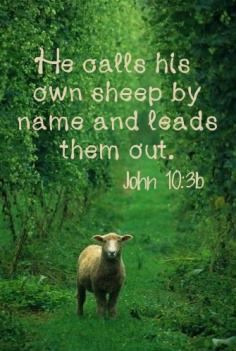
Jesus calls us by name (John 10:3).

5f0a69a406cc999a2cec2b5c02dc118d

Our names are more than labels to him, identifying one person from another. He knows our character and personalities, as well as intimate details—our likes and dislikes, concerns, feelings, and thoughts. He knows one Nancy from another, one Steve from another, one __________ (put your name here) from another.

However, calling us by name indicates not only profound knowledge about us but keen interest in us. He deeply cares about each individual (1 Peter 5:7).

fb6ee7a03664a8589ba2f3541c37745e

Now sympathy and compassion are comforting qualities, and Jesus demonstrates both. But true caring involves more. Care suggests action. And that’s exactly what he does. Jesus takes action when one of his own is in trouble (Luke 15:3-7).

In fact, every detail of our lives is under his capable, loving control.

  • His eye is ever watchful (Psalm 121:3).
  • His ear is always attentive (Psalm 34:15).
  • His heart beats with everlasting love (Jeremiah 31:3).
  • His powerful hand brings help when the time is right (Psalm 138:7-8).

Many of you are familiar with Sarah Young’s Jesus Calling (Thomas Nelson, 2004). Among the impressions from God she has recorded, is the following encouraging note. Our Heavenly Father wants us to know:

“If you could see how close I am to you and how constantly I work on your behalf, you would never again doubt that I am wonderfully caring for you” (December 12).

ex3-he-knows-your-name

God knows each and every one of our names.

How validating he is.

When God calls, “Nancy” or “Steve,” “John” or “Jennifer,” he’s remembering who we are—our unique personalities, backgrounds, needs, and deepest thoughts.

How compassionate our God is.

Best of all, is the love in his voice as he speaks. And the benevolent action he sets into motion—specifically tailored to our needs.

How astounding our God is.

*     *     *     *     *     *     *     *     *     *

Heavenly Father, I thank you for taking personal interest in each of your children. To think that you know me by name—out of the billions of people throughout the centuries–what a precious reality.   At those times I feel insignificant and small, may I hear your gentle voice calling my name.

(Photo & art credits:  www.cobniu.edu; pinterest.com; http://www.dwellingintheword.wordpress.com.)

Read Full Post »

 picture-uh=715ce81d4af48c56d62e992073bfe9-ps=3da463e4536b201b56c385877e59a7

 (Photo from http://www.trulia.com.)

“There it is, Mom, “ Steve remarked, as he pointed to a little white house in the middle of a city block. “That’s where we lived when I was growing up.”

“Oh, yes,” she replied. But did Mom really remember?

We were on an excursion through Columbus, Ohio, taking Steve’s mother past the landmarks of her life. Alzheimer’s disease had already stolen away much of her vibrancy and warmth, and, of course, her memory.

 corner

Steve drove by West High School and continued his commentary. “That’s where we all went to school, you, Dad, Karen, and me. You were the very first homecoming queen.  How about that?  No wonder Dad asked you out.”

She murmured assent to Steve’s comments, but added nothing of her own.

 unnamed

We drove past the brick ranch they built out in the country in 1966. Horses used to reside beyond the back fence. Just a few houses had dotted the area back then. By this time, however, they had been swallowed up by dozens more. The saplings Mom and Dad had planted were now tall shade trees.  And the glorious flower beds and window boxes that Mom had tended were gone. She registered no recollection.

 unnamed

But when we approached her childhood home, a white Dutch Colonial on a quiet street, all of a sudden she perked up.  Pointing to a second-story window, Mom stated firmly, “That was my room, right up there.”

In the midst of the fog that is Alzheimer’s, one memory–one glimmer of light–shone through that morning. Steve and I almost gasped at the wonder of the moment. Mom remembered!

And the rarity of her memories pointed to the preciousness of this ability. Memory is a gift to be treasured. The older I grow, the more I appreciate the miraculous power of the brain to store millions of memories—with astounding detail–and yet access a particular one in a mille-second.

 1033249144001_2034162247001_900944612-159-1355440419795

Not only do sights trigger memories, but also smells. Researchers say this sense is the most powerful memory-inducer. For me, the aroma of fresh-baked bread always takes me back to my grandmother’s kitchen.

Sounds trigger memories as well—particularly music. Tastes and textures work the same phenomenon.

But surely God had more purpose in mind for giving us memory than the pleasant pastime of reminiscing.

Indeed.

Memories foster gratitude, as we contemplate God’s goodness to us in the past:

  • His countless blessings (even when we haven’t been a blessing to him).
  • Those times he led us through the shadow of death, so that we might experience more completely the glory of his light.
  • Moments when we almost gave up hope, and God surprised us with his creative, abundant provision.
  • Leaving behind what we once were and celebrating what we have become, solely because of his Son, Jesus.

Memories foster faith, as we remember how God has met our needs in the past. See if each phrase from Psalm 103 doesn’t trigger a memory in your mind, and a song of praise in your heart:

“Oh, my soul, bless God,

Don’t forget a single blessing!

He forgives your sins—every one.

He heals your diseases—every one.

He redeems you from hell—saves your life!

He crowns you with love and mercy—a paradise crown.

He wraps you in goodness—beauty eternal…

…God makes everything come out right.

He puts victims back on their feet…

…God is sheer mercy and grace;

Not easily angered, he’s rich in love.

He doesn’t treat us as our sins deserve,

Nor pay us back in full for our wrongs.

(Psalm 103:2-10, The Message)

Memories inform the present and provide hope for the future. As we meditate on all those times God has wrapped us in his goodness (v. 5), we are strengthened for what we face today. As we consider the many times he made everything come out right (v. 6), we can trust he will continue to make our paths straight.

Of course, there are some memories we would like to erase—those that generate sadness, hurt, or regret. How do we deal with those? Here are a few suggestions I’ve collected over the years:

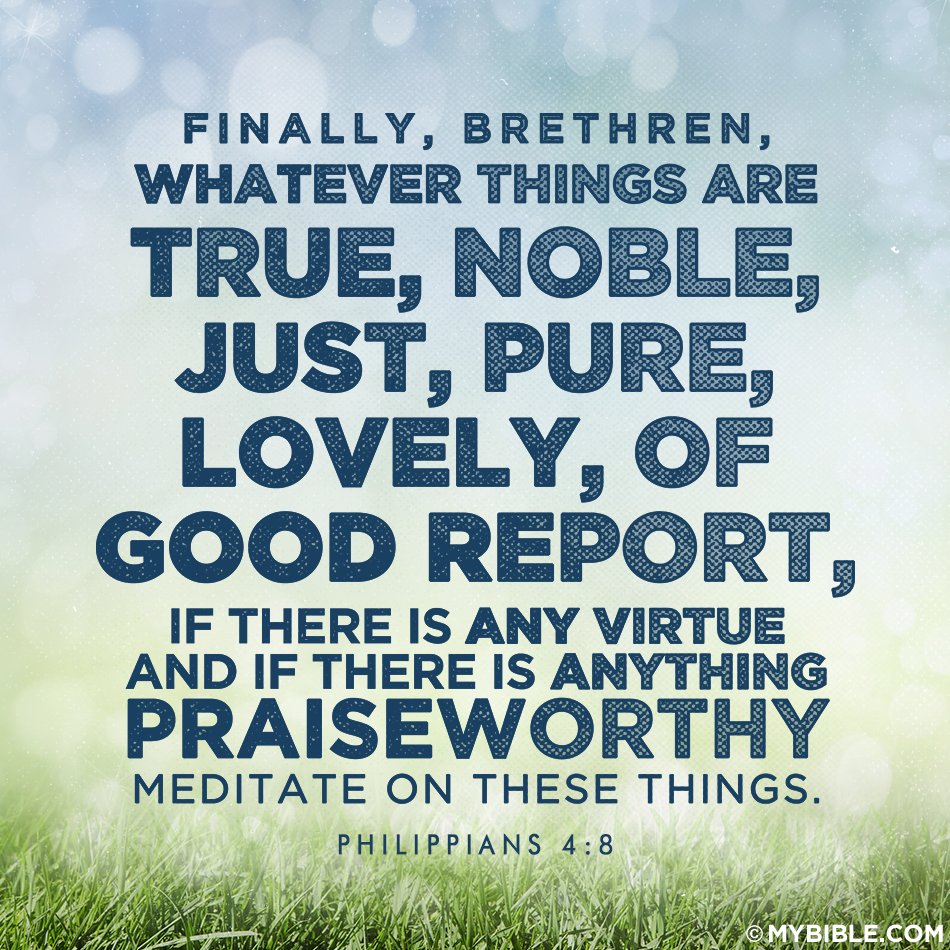
  1. We must resist self-pity—even in our thought life. Nowhere in scripture do we read that rehashing the negative is therapeutic. God’s way is to focus on the positive (Philippians 4:8).

Phil-4-8


  1. We can follow Paul’s example. He forgot what was in his past and pressed on to what lay ahead (Philippians 3:13). Not that amnesia had set in. Paul simply did not allow past failures to cripple his relationship with God and his service for God. God had forgiven and forgotten; Paul did too. No doubt he applied Philippians 4:8, not only to self-pity, but also to guilt. 
  1. We can leave the past in God’s hands. Oswald Chambers said it so well:

 c6d7d32bbdc18d2507a48f8aefa26359

(“Leave the irreparable Past in His hands, and step out into the Irresistible Future with Him”

–My Utmost for His Highest, Dec. 31.)


*     *     *     *     *     *     *     *    *     *    

Father, I do thank you for the gift of memories—the ability to remember with joy and appreciation the people, places, and experiences of the past. I even thank you for the not-so-good memories, knowing that you use every difficult situation for the development of my maturity (James 1:2-3). And may I take advantage of the wisdom gained in the past to guide me in the present, and lead me into the Irresistible Future with you.


Art & Photo credits:  www.trulia.com; http://www.westhighalumni.com; Steve’s photo collection; http://www.allrecipes.com; http://www.god.com; http://www.pinterest.com.

Read Full Post »

(In honor of Black History Month)


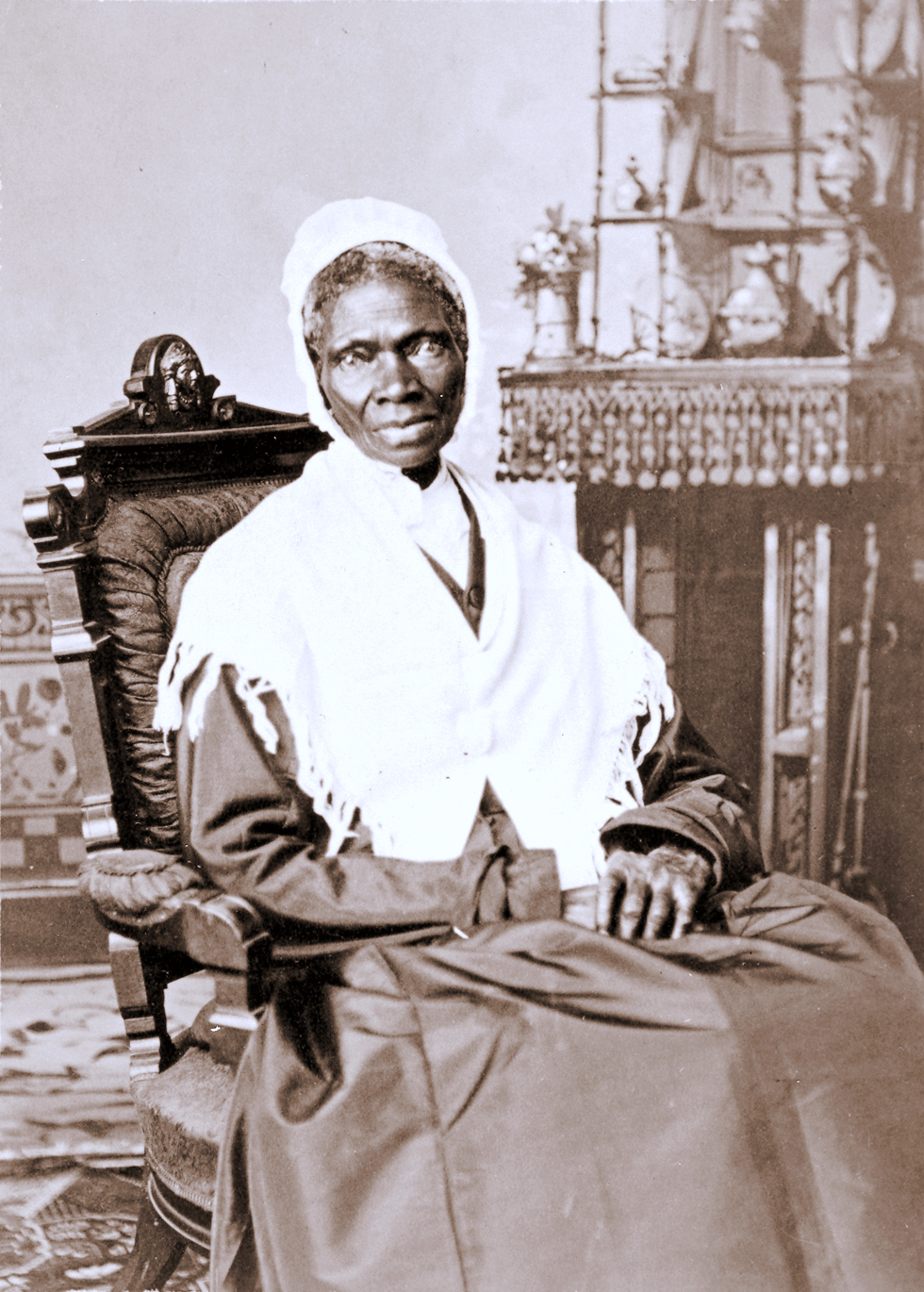
Isabella, the daughter of James and Elizabeth Baumfree, was born a slave in New York state about 1797. No one knows the exact date, because birth records weren’t kept for “property.”

Did her parents know the name means, “consecrated to God?” Even if they chose the name for its meaning, those parents could not have dreamed of the future awaiting their Baby Belle.

Her early years were difficult.  Belle was sold five times, several times to cruel masters.

At age eighteen or so, Belle fell in love with Robert, a young slave from a nearby farm. The couple had a daughter. But Belle’s master, John Dumont, forbade her to see Robert again. According to the law, all children of the union would belong to Robert’s master, not Dumont.

Two years later, Dumont forced Belle to marry an older slave. They had three children: Peter, Elizabeth, and Sophia.

In 1826, Belle escaped the Dumont farm with Baby Sophia. In a vision, God showed her a particular home to go to. That home belonged to a Quaker family, the Wageners, who took in the young woman and her baby. They even paid Belle’s price to Dumont and made her a free woman. Belle became a housekeeper, then a maid.

Shortly after her escape from slavery, Belle learned that her five-year old son, Peter, had been illegally sold in Alabama. She took the matter to court and won her case. Peter was returned to New York. That was the first time a black woman challenged a white man in a U.S. court. It was also the first time of many that Belle’s resolve and courage were put on display.

Several years later Belle was falsely accused of poisoning her former employer. In 1835 she took that case to court and won again.

Someone must have encouraged Belle to tell her story of being a slave and becoming a free woman. But she had never learned to read or write, so a friend wrote as Belle dictated. A Northern Slave was published in 1850.

In her book, Belle explained that several years after she was freed, God revealed himself to her, “with all the suddenness of a flash of lightning, showing her, in the twinkling of an eye, that he was all over, that he pervaded the universe, and that there was no place where God was not.”

The book sold many copies and Belle became well-known. She was asked to speak at a women’s rights convention in Massachusetts. Before long, Belle was traveling with abolitionist, George Thompson, speaking against slavery and for human rights.

In 1851, Belle gave a speech at another women’s conference, this time in Ohio. She spoke convincingly (and extemporaneously) about women being every bit as capable as a man:

“I have plowed and reaped and husked and chopped and mowed, and can any man do more than that?”

And, no doubt with a twinkle in her eye, she added:

“As for intellect, all I can say is, if a woman have a pint, and a man a quart — why can’t she have her little pint full? You need not be afraid to give us our rights for fear we will take too much, for we can’t take more than our pint’ll hold. The poor men seems to be all in confusion, and don’t know what to do. Why children, if you have woman’s rights, give it to her and you will feel better. You will have your own rights, and they won’t be so much trouble.”

She concluded by asking: “And how came Jesus into the world? Through God who created him and the woman who bore him. Man, where was your part?”

It’s not surprising that some were displeased with Belle’s speeches. One time she was told that the building where she was to preach would be burned down if she dared to speak. “Then I will speak to the ashes,” she replied.

Belle was also physically assaulted. One brutal attack caused permanent injury, and she had to walk with a cane for the rest of her life.

In 1863, Harriet Beecher Stowe wrote an article about Belle for the Atlantic Monthly:

“I do not recollect ever to have been conversant with anyone who had more of that silent and subtle power which we call personal presence…She seemed perfectly self-possessed and at her ease. An audience was what she wanted—it mattered not whether high or low, learned or ignorant. She had things to say, and was ready to say them at all times, and to anyone.”

Imagine. A slave woman who never had the opportunity to go to school, never learned to read or write. Yet the power of her spoken word helped bring the end of slavery and pave the way for women to be granted the right to vote.

Belle proved:

“There is no difficulty that cannot be defeated.

There is no victory that cannot be achieved,

if you believe in the power of God!”

— Anonymous

Of course, by the time she achieved notoriety, Belle was known by another name.

You see, Belle had asked God for a new name several decades before the Civil War. Again, it was the result of a vision. She said God chose her new first name based on the fact she would travel. Then Belle asked God for a second name, “’cause everybody has two names.” And the Lord granted her request. Her second name proclaimed what Belle always declared from her podium.

Perhaps you remember Sojourner Truth.


Sojourner_truth_c1870

(Photo from http://www.wikipedia.org.)


Sources:  www.biography.com; http://www.sojournertruth.org; http://www.; http://www.blackpast.org; http://www.americanswhotellthetruth.org; http://www.christianitytoday.com.)

Read Full Post »

iStock_000013894567XSmall-300x199


“What traits should you look for when determining if someone is trustworthy?” asked the subtitle of a magazine article.

That question piqued my interest, and I read further.

According to the researcher, integrity is a crucial component, but there’s another trait that’s equally important: competence. The author gave the following scenario as an example: His best friend, Charlie, had proven himself completely reliable, but he wouldn’t want that friend performing an operation on him.  Charlie is not a surgeon.

So a trustworthy person is not only honest and fair, he is also competent for what you need him to do.

Those of us who know God have just such a friend.  Think of all we know from scripture about the character of our virtuous, competent God.  He is:

  • just, faithful, and upright (Deuteronomy 32:4).
  • righteous (Psalm 119:142) and holy (Leviticus 19:2).
  • wise (Daniel 2:20) and good (Psalm 106:1).
  • truthful (Psalm 31:5).

An  enlightened understanding of our trustworthy God should calm our fears and doubts, right?

But perhaps you’re like me—struggling a bit from time to time, asking questions like:

  • Lord, I know you have a plan, but when are you going to reveal it to me?
  • Why hasn’t Bill been healed? We’ve prayed so hard and for so long!
  • Dealing with Meredith day after day is sapping my strength, God.  When will the frustration end?

According to Philip Yancey, faith boils down to the matter of trust in the relationship. Do I have confidence in God or not? If I do stand on a bedrock of trust, the worst of circumstances will not destroy the relationship (Grace Notes, p. 198).

Vintage country


So how can I develop that strong bedrock of trust? Saturating myself in scriptures about the character of God, such as those listed above, is a good place to start. Another worthy study-pursuit: the promises of God, because…

…“God is not a man, that he should lie, nor a son of man that he should change his mind. Does he speak and then not act? Does he promise and not fulfill” (Numbers 23:19)?  No, of course not.

To truly impact my trust quotient, a change of habit is necessary–a habit such as: T-squared. Any time I find doubt or fear creeping at the edges of my thoughts, I want to Turn, Trust, and Thank. T x 3 includes:

  1. Turn away from thinking about the what-ifs, the negative, the hurtful.
  1. Express trust in God through song, prayer, and scripture. “Doubts are dismantled by declarations,” says my good blogger-friend, Jody Collins.*
  1. Thank God for his attributes that he’s bringing to bear on any negative situation.  Thank him also for every scripture-promise that applies.

I think I’ll try it right now.

*     *     *     *     *     *     *     *     *     *

psalm287-nlt1


Oh, Father, I praise you that you are strong, and protect like a shield.   My heart leaps for joy knowing you care for me and will help me. I praise you for surrounding me with your love, because I trust in you. All my life you have proved yourself trustworthy; why would I want to stop trusting you now? Oh, how I praise you that, as I keep my mind steadfast upon you, you will fill me with your peace. You are my trustworthy Rock—reliable and unchanging.      

(Psalm 28:7; 32:10b; 71:5-6; Isaiah 26:3-4)

 *Visit Jody’s blog at http://www.threewaylight.blogspot.com.


(Photo credits:  www.pixgood.com., http://www.katherinepasour.net., http://www.tyndalerewards.com.)

Read Full Post »

« Newer Posts - Older Posts »

When the House is Quiet

Impressions Becoming Expressions

Mitch Teemley

The Power of Story

Still Traveling

Impressions Becoming Expressions

Living Our Days

Gaining a heart of wisdom

He Said What?!

I'm Patty, and my husband and I are living with our adult son who has autism and epilepsy. I love sharing lessons learned from life around me, especially life with Aaron.

Meditations of my Heart

Impressions Becoming Expressions

Linda Stoll

Impressions Becoming Expressions

Signora Sheila

Where faith meets la dolce vita

Heidi Viars

Finding the Image of God