Feeds:
Posts
Comments

Archive for the ‘God’ Category


“There is no fear in love.  But perfect love drives out fear.”

1 John 4:18a

M-m-m.  Interesting.  John doesn’t say perfect courage drives out fear.  Not even perfect faith.  Why does he say perfect love will drive out fear?

First of all, this verse is not talking about fears of financial ruin or life-threatening events.  Verse eighteen gives us the context.  John is talking about Judgment Day.  He’s reminding us that, if we know Jesus, there is nothing to fear when we leave this earth for eternity.  Jesus gave his life to save us from the consequences of our sin.  Our place in heaven is secure, if our faith is in him.

And once that matter has been settled, other fear-producing questions can be put in proper perspective. We have to remind ourselves that earthly life fades quickly like the leaves (Isaiah 64:6).  These questions will cease to matter–questions like:

  • Will my job survive the cutbacks?
  • Will I be able to keep my health insurance?
  • Will my kids make it through their personal crisis?

But such questions can cause torment to the point of ulcers and high blood pressure.  If we allow fear to control us, we’re saying that the troubles we face are more powerful than our God.

So here are a few ways to fight against fear:

  • Rename your difficulties as possibilities—possibilities for God to do something glorious.  Without a problem, there’s no opportunity for a miracle.
  • Picture God Almighty accompanying you all day long.  He’s standing right behind you at the sink.  He’s sitting beside you in the car.  His ever-watchful eye is upon you,  his infinite strength is available to you, and his perfect wisdom will guide you.
  • Don’t feed your fear with worry; feed your faith with the truth of God’s Word.  Psalm 23 is a perfect place to begin.  Remember verse four?  “Even though I walk through the valley of the shadow of death, I will fear no evil, for you are with me; your rod and your staff, they comfort me.”
  •  Listen to what he says:  “I am the Lord, your God, who takes hold of your right hand and says to you, do not fear; I will help you (Isaiah 41:13).  Visualize God holding you by the hand as you walk through each day.

Years ago, when a I was a young teenager, my family visited Lookout Mountain in Tennessee.  Dad and I were hiking over the mountain paths when we came to a deep, narrow ravine.  He easily jumped across, turned, and held out his hand for me.

“I can do it myself,” I announced confidently.  Then I looked down into that deep ravine.  What if I fall? I thought.  Grinning sheepishly at Dad, I said, “’Guess you’d better help me after all!”  I had great confidence in my father.  I knew he loved me and would never let me fall.

God is ready to walk hand-in-hand with me along the mountain paths of life.  Problems arise, though, when I repeat that moment on Lookout Mountain and focus on the ravine, the what-ifs.  The  result?  I’m frozen with fear.

How downright foolish of me, when my loving, trustworthy Heavenly Father has assured me:

“Don’t panic.  I’m with you.  There’s no need to fear for I’m your God.  I’ll give you strength.  I’ll help you.  I’ll hold you steady, keep a firm grip on you” (Isaiah 41:10, The Message).

 You see, perfect love drives out fear because we can trust the perfect love of our perfect God.

Read Full Post »

Sad Reba

She was a pitiful sight, the pit bull/Labrador/terrier mutt that our son, Jeremy, and his wife, Nancy, adopted from the Humane Society.  Her head hung down, and her tail did not wag.  Even her eyes conveyed great sadness.  She never barked and did not know how to play.

Jeremy and Nancy decided to keep the name given her by the society staff:  Reba.  No use adding confusion to the poor dog’s problems.

When they first brought her home, Reba wouldn’t  eat.  She also suffered from anxiety, shaking uncontrollably when faced with uncertainty.  (She still does, sometimes.)

Reba’s symptoms aren’t much different from those of humans, when we experience extreme stress.  Depression and anxiety can quickly take over.

Jeremy and Nancy adopted Reba the summer of 2010. That December when we saw Reba again, it was as if Jeremy and Nancy had adopted a new dog.  Now her head was up and her tail wagged merrily.  She could run and jump to catch a tossed tennis ball in mid-air.

Happy Reba

If Reba could talk, she would undoubtedly have abhorrent stories to tell of her past.  But I have a feeling she would finish by saying, “My new life with Jeremy and Nancy is completely different.  I love it here!”

Reba has found a sanctuary—a place of refuge and protection where she feels safe.  Her life has been transformed.

We, too, have a sanctuary available to us.  “The Lord is a refuge for the oppressed, a stronghold in times of trouble” (Psalm 9:9).

When David composed that psalm, the tabernacle tent-church was the sanctuary for the Israelites.  God had told Moses centuries before, “Have them make a sanctuary for me, and I will dwell among them” (Exodus 25:8).

For over fifteen hundred years, the tabernacle, and then the temple in Jerusalem, represented God’s presence among his people.

But that was only temporary.  God provided an even better way to be with his people, through his son, Jesus.

Those of us who know him now experience his sanctuary within. 

“Do you not know that your body is a temple of the Holy Spirit, who is in you, whom you have received from God?  You are not your own; you were bought at a price” (1 Corinthians 6:19).

At the cost of his Son’s life, God “bought” us as his dwelling place.

We don’t have to go to Jerusalem.  We don’t even have to be in a church building to experience the sanctuary of our God.  His love, peace, and comfort are available wherever we are, whatever we’re facing.

Now that is life-transforming news.  But I have to avail myself of its truth.

*     *     *     *     *     *     *     *     *     *

Thank you, God, for being a sanctuary within me.  At any moment I can turn to you, and you are attentive to my cry.  As I focus on you—your wisdom, power, and benevolent care, my concerns deflate.  I know you have a plan for my life, for those of my loved ones, for my country and the world. You are in control.  I imagine you taking hold of my hand, giving it a pat or two and reassuring me, “Don’t be afraid.  I will help you”.

 You are incredibly good to me, O God, my refuge.  I reaffirm my trust in you. 

(Psalm 34:15; Jeremiah 29:11; Psalm 9:7-8; Isaiah 41:13; Nahum 1:7; Psalm 91:2.)

Photo credits:  Jeremy Ruegg

Read Full Post »

I awoke around midnight one evening in December, crept out of bed, and peeked out the loft window facing the street.  All was quiet.  No cars passed, no breeze rustled the trees.  The pavement below glowed faintly under the street lamp.

Again, around two, the same tiptoe trip to the window.  Same view; same stillness.

No, I was not watching for Santa.  I was watching for snow.

The last snowfall this Floridian witnessed was thirty-eight years ago.  So during a rare Christmas visit to Ohio, when snow was forecast during the early hours of one morning, I didn’t want to miss it.

The third time I awoke, around three o’clock, my trip to the window was rewarded.  In the dim light, I could make out large flakes falling fast and straight.

As much as I anticipated its arrival, now I looked forward to the accumulation that had been forecasted: at least several inches.

Sure enough, the pale light of morning revealed a world transformed.  Each tree branch, even every twig, appeared iced in white frosting.

And yet more snow was falling.  Now the flakes were lighter and smaller, drifting gently and softly to the ground.

Donning my coat, I slipped out to the front porch, and extended my arm.  Soon I had a lovely collection of tiny star-shaped flakes on my sleeve.  Delicate displays of lacy symmetry.  Each one a magical wonder.

The next day, under a crystalline blue sky, we rode through a nearby cemetery where the snow created an even more stunning display.  Hillsides, ancient trees, and tangles of bushes were majestically trimmed in sparkling white.  Frozen ponds glistened subtly, like great pearls.  By contrast, the streams twinkled, as if crystals had been laid out on rippling, steel-gray silk.  I oohed and aahed at every turn.

Those of you who experience snow every winter may not be so enthusiastic.  There’s a dark side to the white stuff!  Bundling up in extra clothing for outdoors, then shedding the layers for indoors.  Slow, snarled traffic.  Shoveling.  Scraping off the car.

But, oh, the beauty!  The splendor!

“He spreads the snow like wool and scatters the frost like ashes” (Psalm 147:16)

*     *     *     *     *     *     *     *     *     *

Thank you, O God, for the glorious wonders of your winter creation.  I marvel that you design each tiny snowflake unique from all others.  How mind-boggling to consider the millions of flakes required to cover just one tree, much less a forest or a whole region.  And  I marvel at your artistry with just one color—white!

How great and glorious you are, the almighty Creator and Sustainer of the universe! How  awe-inspiring to know you are also our loving Heavenly Father.  And that same awesome power that paints winter-white landscapes is at work in our lives, creating the beauty of holiness.   Thank you.  Thank you.  Thank you. 

Read Full Post »

“…So the doctor recommended B-12 shots,” my friends explained.  “Hopefully they’ll do the trick.  I’m so tired of being tired!!”

Got me to thinking.  Some days I’ve had to drag my spirit around.  Discouragement, hurts, and concerns weigh me down.  Maybe what I need are some spiritual B-12 shots.

“B” might stand for beauty.  Something lovely and joy-inspiring is always energizing.

And the number twelve might stand for the twelve months of the year.

So what beauties are there to behold each month that would foster joy?  Here in Florida, the change of seasons is subtle, not offering as much variety as climate zones to the north.  But there are other splendors in which to delight.

January:  The fresh start of a new year, the reorganizing (after all the decorations are put away) that provides satisfaction in tidiness and motivation for productivity!

February:  I love our annual Festival of Choirs. A number of church choirs come together, provide two selections of their own, and then everyone joins together for several rousing anthems.  It’s a taste of heaven to hear 200-plus voices unite in praise!

March:  Such glorious weather we enjoy–the low humidity, balmy temperatures, and clear skies. Migrating birds passing through the area give us occasional glimpses of rare species.  One year a small flock of indigo buntings pecked about in our backyard.  Such intense blue I had never seen!

April:  I love the euphoria of Easter morning!  He is risen indeed!

May:  Roadways clear after the Snowbirds go home, and driving becomes less stressful.  However, there are a number of Northern friends we’d love to keep with us here!

June:  The schedule slows down as the summer warms up.  The slower pace is most welcome—at least for a while.

July:  I love the patriotism that comes to the forefront as we celebrate America’s Independence Day.  “The Star Spangled Banner” still stirs pride and gratitude in my heart.

  August:  The best time to visit the old-fashioned ice cream shop in town.  Such delightful flavors to choose from!  And a hot August day only augments the pleasure.

September:  Rehearsals begin for Christmas.  This is one of the reasons I love to sing in choirs and ensembles.  We get to enjoy the music of Christmas for three months instead of three weeks!

October:  The weather begins to cool a bit, renewing energy.  And while many northerners enjoy hillsides of fall foliage, we Floridians have our golden rain trees.

 November:  Right after Thanksgiving Steve and I decorate for Christmas.  I love unpacking the decorations, many of them given to us by family and friends.  Memories of times past bubble merrily in my heart as I arrange the crèches, angels, candles, and bows.

December:  Oh, how glorious to end the year with a crescendo of music, camaraderie, secrets, surprises, and worship.  Christmas would not be complete without the Christmas Eve candlelight service.

Beautiful moments through all twelve months of the year.  B-12 shots of joy.

What are your favorite B-12 shots?

*     *     *     *     *    *     *     *     *     *

Thank you, Heavenly Father, for providing a pleasing cadence to the year.  As one month flows into the next, your goodness is on display.  Thank you for those events and experiences that come at expected times, providing rhythm, delight, and comfort to our lives. 

Read Full Post »

The holiday season between Thanksgiving and New Year’s Day fills our senses with:

  • Sights of Christmas trees, candles, Santas, and angels.
  • Sounds of carols, from the light-hearted “Frosty the Snowman” to the heart-stirring “O Holy Night.”
  • Textures from prickly pine to plush velvet.
  • Aromas of cinnamon, spice, and gingerbread.
  • Tastes of iced sugar cookies and egg nog.

But the seasonal pleasures are over for another year.  And the uncertainties of our times—political, economical, as well as personal—that we set aside for a few weeks, are coming to the forefront again.  If we’re not careful, troublesome thoughts can raise our blood pressure and take away restful sleep!

What to do?  Take comfort in God’s Word.  “Great peace have they who love your law,” said the psalmist,” and nothing can make them stumble” (Psalm 119:165).  I suppose that would include uncertainties, don’t you?

Two verses have ministered to me lately, Romans 8:30-31:

“Those he [God] predestined, he also called; those he called, he also justified, those he justified, he also glorified.  What then, shall we say in response to this?  If God is for us, who can be against us?”

Of course, those key words in the first sentence beg to be examined more closely.

Predestination has been the subject of entire books and sometimes causes controversy.  I like the way the Living Application Bible explains the concept, in a footnote to Ephesians 1:5.  “Predestined” means marked out beforehand.

God knew each of us and loved us before we were even born.  He provided the way of salvation so we could be in relationship with him.  That does not negate our responsibility to believe in Jesus, in order to bring to pass God’s predetermined plan.

Called means we have been divinely summoned or invited.   Some Christians are divinely summoned for specific tasks.  Peter (John 21:15-17) and Paul (Acts 9:15) are perfect examples.

Most of us are called to love, obey, and serve God right where he’s placed us—in our homes, churches, business, schools, and neighborhoods.

Whatever our task, he cheers us on to work heartily because we’re doing it for him—to please him and bring him honor (Colossians 3:23-24).

And with his call comes hope, peace, joy, and blessing!

Justification is God’s way of making us right with him.  Out of his gracious love for us, he declares us “not guilty” for our sins. We deserve harsh punishment, but he treats us as righteous if we put our trust in Jesus.  Then the perfect sinlessness of God’s Son is credited to us  (Romans 3:22-25).

Imagine standing before a mighty king who’s dressed in elegant robes.  And there you are, wearing ragged, smelly clothes, staring at the floor, and wishing to be anywhere else but in this imposing throne room.

Suddenly the king’s words break through your embarrassment.  He’s calling for one of his son’s perfect robes to be brought for you.  He doesn’t just want to trade your rags for a  beautiful, pristine robe—he’s eager to do it!  And then, even more amazing, he welcomes you to his banquet table.

That’s justification—being treated as if we weren’t soiled by sin.  Being treated like  a royal son or daughter of the king, though it’s the last thing we deserve.

Full glorification  will occur when we arrive in heaven.  It refers to that moment when you and I will become like Christ (1 John 3:2.)  It is so certain, Paul uses past tense.  Our glorification is taken care of; it’s just a matter of when.

But the process has already begun.  Our glory—that is, anything that brings honor and praise to God—is developing day by day as we allow the Holy Spirit to have influence of our thoughts and choices.

*     *     *     *     *     *     *     *     *     *

Now consider the magnitude of these four processes which God lovingly, even anxiously, works within us.  I like the way Ken Taylor expresses verse twenty-nine in The Living Bible:

 “Having chosen us, he called us to come to him; and when we came he declared us ‘not guilty,’ filled us with Christ’s goodness, gave us right standing with himself, and promised us his glory.”

 And last, in light of whatever you may be facing in 2014, please take comfort in these joyous words:

“What can we ever say to such wonderful things as these?  If God is on our side, who can ever be against us?” (Romans 8:30, The Living Bible).


Read Full Post »

Like most expectant parents, Steve and I considered dozens of names before each of our three children were born.

First of all, the name had to have a pleasing ring with our unusual last name, Ruegg (pronounced “rug”).  We passed by Douglas.  Doug Ruegg rings too loudly.

We wanted a name that would not attract teasing or silly nicknames.  We passed by Dustin.  Dusty Ruegg would be too tempting.

And we wanted a name that meant something worthwhile, so we passed by Darnell.  “A-Type-of-Grass” Ruegg would not be very inspiring.

No doubt many of you who are parents experienced the same struggle to find appropriate names for your children.

Mary and Joseph, however, had no such struggle with their firstborn.  The angel who visited Joseph in a dream to tell him about Mary’s child, also informed him of the name.  “You are to give him the name Jesus,” he said (Matthew 1:21a).

And when an angel brought good news of great joy to the shepherds, he said, “A Savior has been born to you; he is Christ the Lord (Luke 2:11).

These two scriptures give us the three names we probably use most often when referring to God’s Son:  Jesus, Christ, and Lord.

And each name carries significant meaning.

Jesus, or Yeshua in Hebrew, means “Yahweh (the Lord) is Salvation.”  Could a more perfect name be chosen for the One who would “save his people from their sins?” (Matthew 1:21b).  Yeshua becomes “Joshua” when translated into English.  And in Greek (the language in which the New Testament was written), Yeshua becomes Iesous, or Jesus in English.

Jesus, our Savior.  The only perfect God-Man able to save us from the consequences of our sins.  He is our supreme Christmas gift, given by God, because he loves us.  Deeply.

Christ is English for Christos (Greek), which means “anointed.”  In Hebrew the word would be moshiach, or “Messiah.”

Anointing was a God-ordained custom, to dedicate someone for a special task.  You might remember the prophet, Samuel, anointed David to be king over Israel (1 Samuel 16).  That is, Samuel took oil (probably olive oil) and poured it over David’s head, signifying divine equipping for his royal position.

Again, what could more appropriate than our Savior to be symbolically anointed by God? Jesus was divinely equipped for the special task of saving his people from their sins.

Lord is also a name bestowed on God’s Son.  It is the name that is above every name.  And the glorious day is coming when every tongue will confess that Jesus Christ is Lord (Philippians 2:9-11).  Imagine that.  Millions of voices proclaiming his majesty!

Lord is a familiar term, come down to us from feudal times in England, when kings and nobles were addressed as “lord.”  It denoted power and influence.

The history of the word, though, reveals a fascinating connection to Jesus.

Lord is derived from a compound of two very early Old English words:  hlaf (pronounced with a long “a”)  and weardHlaf means “bread,” and weard means “ward” or “guardian.”  Lord literally means “guardian of the bread.”  In feudal times, such a position would be highly important to the household.  And so lord came to mean “a man of authority and rank” (Webster’s New College Dictionary).

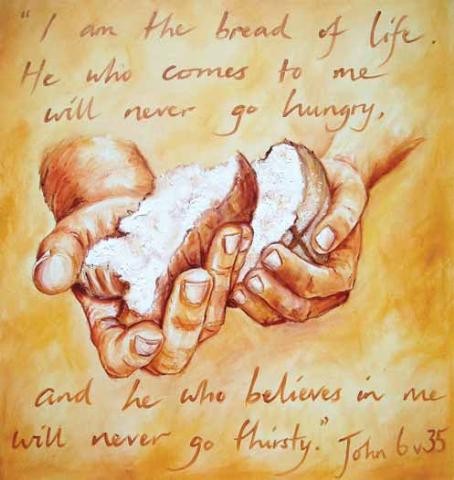
 Such background gives new meaning to Jesus’ words, “The bread of God is he who comes down from heaven and gives life to the world…I am the bread of life” (John 6:33, 35a).  In other words, he is the Sustainer of life.  Whoever comes to him can experience deep satisfaction of spirit (v. 35).

Jesus stands as the guardian of our abundant life now and eternal life in heaven yet to come.  He is also the guardian over of our minds and hearts, supplying peace, joy, comfort, and more.

Paul celebrated the magnificence of the Lord Jesus Christ at the close of Romans 8:

“I am convinced that neither death nor life, neither angels nor demons, neither the present nor the future, nor any powers, neither height nor depth, nor anything else in all creation, will be able to separate us from the love of God that is in Christ Jesus our Lord (vs. 38-39).

And now, what do these names signify to me?  Am I deeply grateful to my Lord Jesus Christ?  Are my thoughts, attitudes, and actions pure and holy gifts I can give back him– my Savior, anointed Deliverer, and Guardian of my life?

*     *     *     *     *     *     *     *     *     *

Lord Jesus, your very names proclaim astounding truths:  you are the Savior of the world!  In fact, you are the only Deliverer who can proclaim us “not guilty” before Almighty God.  And you are our Guardian, caring for our every need, when we depend upon you.  I praise and thank you for your love and grace, demonstrated supremely when you died in our stead.  Oh how I want my life to be a delightful Christmas present for you!

(photo & art credits:  www.babble.com, http://www.thefamily.com, http://www.ortzion.org, http://www.everydaywithmy savior.blogspot.com.)


Read Full Post »

 christmas-greetings-messages


When some folks say, “Merry Christmas” they mean, “I hope you have a fun and festive holiday.”

That would be in keeping with the definition of merry:  full of high-spirited gaiety, delightful, entertaining, joyful, and mirthful.

But centuries ago the word merry denoted peacefulness and blessedness.  “Merry Christmas” meant, “May you have a peaceful Christmas” and “May Christmas bring the blessing of God to you” (Christmas by Charles L. Allen and Charles L. Wallis, Fleming Revell Co., 1977).

An old carol highlighted this idea:

“God rest ye merry, gentlemen;

Let nothing you dismay.

Remember Christ our Savior

Was born on Christmas Day,

To save us all from Satan’s pow’r

When we were gone astray.”

Did you pause after the comma in the first line?  Without it, the meaning changes.  The anonymous poet was wishing peaceful, contented, joyful rest to others, as they remembered Christ their Savior.

“Merry Christmas,” then, can be a prayer within a greeting.  Something like:

Oh, Lord, may your spirit of peace rest upon the life of this person.  May he/she experience the blessing of your presence and your joy.”

There are many people around us who need a divine touch, especially during the Christmas season.  The merriment around these folks seems a mockery of their despair.  Perhaps that includes you.  May the prayers below speak a Merry Christmas blessing to you, especially if you are:

Lonely.  Oh, God, wrap a loving embrace of your comfort around those who do not have family or friends with them this Christmas.  I thank you for the promise that you are our refuge and strength, always ready to help when we need you (Psalm 46:1).  Be a warm solace, I pray, to the one who feels alone.

Enduring hardship.  Oh, God, may the blessing of Christmas include grace and mercy for your children who are suffering through difficulty.  Out of your compassionate mercy, ease their burden, and out of your unfailing grace, grant them strength and favor (Hebrews 4:16).

Struggling with painful memories of Christmases past.  Oh, God, shower your tender, loving care upon those with hurts from the past, hurts that cast a shadow over the joys of the present.  Grant them liberating freedom from emotional distress.  May your peace cover those memories, so they no longer cause anguish (John 14:27).

For all of us, Heavenly Father, may the blessing of Christmas include renewed wonder for the indescribable gift of your Son.  Thank you for providing through him the way to eternal life.  Such peace and blessing are ours in that single assurance! 

(art credit:  www.christmasgreetingsmessages.com.)

Read Full Post »

I love decorating our Christmas tree, even though it takes at least two days.

Two days?” you ask.  “Why so long?”

There are several very logical reasons – if you are me.

One:  It takes time to arrange the branches.  We have an artificial tree, you see.  (Cut evergreens don’t last long in Florida because of the heat, and Steve and I like to decorate right after Thanksgiving.)  That means, before decorating can begin, the tree has to be assembled and the branches spread out.

Two:  It takes time to string the lights.  Although pre-lit trees are convenient, they often include too few lights.  The rule of thumb is 100 lights per foot.  We put 1,000 lights on our eight-footer.  Some are tucked in, some arranged on the tips of branches.  This creates a tree that truly glows.

Three:  It takes time to hang the decorations — the ultimate 3-D jigsaw puzzle of Santas, angels, and miniature manger scenes, animals, toys, and traditional ball ornaments.  Dozens and dozens of them.  (And nearly all given to us by family, friends, members of the churches we’ve served, and students from my classes.)

Long ago I worked for a creative designer.  One aspect of her business included decorating Christmas trees for banks and businesses.  She taught me several tricks for creating a stunning display.  I’ve already shared the first rule:  Use lots of lights.

Two:  Consider the size, theme, and material of each ornament.  Try not to hang several Santas, or a group of red decorations, all together.

Three:  Just as lights are tucked in or perched on branch-tips, it’s important to do the same with ornaments.

Four:  Use the tree lights as spotlights for the ornaments, as often as possible.

A beautiful, glowing Christmas tree is in the carefully executed details.

tree 2012

(Photo taken before the last step:  settling the treetop angel in place.)

*     *     *     *     *     *     *     *     *     *

Something else that’s found in the details?  Wonder.

Yes, that statement could be applied to decorations.  There is a sense of wonder when studying a breath-taking display.

But more significant?  The glorious wonder to be found in the carefully executed details of the Christmas story, the events surrounding the birth of Jesus.

Beyond the familiar events of angel visitations, a trip to Bethlehem, Baby Jesus laid in a manger, and a shepherds’ hurried trek to see the newborn Messiah, there is much to appreciate in the details.

For example:

One:  Little did Caesar Augustus know he was being used by God to fulfill an ancient Messianic prophecy, when he decreed the census that sent Mary and Joseph to Bethlehem.  “But you, Bethlehem Ephrathah,…out of you will come for me one who will be ruler over Israel, whose origins are from of old, from ancient times” (Micah 5:2).  God is sovereign — even over those who do not know him.

Two:  Observe whom God chose to notify first about this pivotal event in history–the birth of his Son.  Shepherds!  Members of the lowest class in Jewish society!  Perhaps God wanted us to know that wealth, position, and even the respect of others is of little consequence in his eyes.  What does matter?  Faith.  “Without faith it is impossible to please God” (Hebrews 11:6).

The shepherds did believe – in the old Messianic prophecies and in the angel’s message:  “Today!  Right now!  In the little town of David, your Savior, the Messiah, has been born” (Luke 2:10-11)!  Those sheep herders scurried off to Bethlehem as fast as they could go.  And their faith was highly rewarded.  They were first to see the long-awaited King of kings, the Messiah.  Their lowly position in society didn’t matter.

Three:  Most wondrous of all?  The Son of God, who was with God and was God from the very beginning, became human (John 1:1-2).  The One who created all things (Colossians 1:15-16), chose to become a helpless baby, and embrace every aspect of the human experience through thirty-some years of earth-dwelling.

I like the way Eugene Peterson says it:  “God became one of us and moved into the neighborhood” (John 1:14, The Message)!

And how do we respond to such wondrous details?  We follow the example of those shepherds.  We praise and glorify our God for all the things we have heard and seen, which prove what we’ve been told (Luke 2:20).

*     *     *     *     *     *     *     *     *     *

I DO praise you, Heavenly Father, that early in life I heard about your Son and your gift of eternal life.  I invited you into my life, and have experienced your love, joy, and peace, just as you promised.  In fact, I have seen many of your promises fulfilled in my life and in the lives of others.  You have proven to me over and over that what we’ve been told in scripture is indeed 100% truth.  With Mary, I exult:  “My soul glorifies the Lord and my spirit rejoices in God my Savior” (Luke 1:46-47a)!

Read Full Post »

Christmas is a season of lights.

Candles glow and twinkling lights glimmer from houses, buildings, and trees.

People love all the flickering and shimmering!  Some spend weeks decorating their yards and rooftops in spectacles of light.  If you asked them why, they might be hard-pressed to express more than, “They’re beautiful, that’s all.”


But perhaps it’s more than just aesthetics.  Perhaps it’s a heart-response.

Light is symbolic for:

  • Beauty.  Light grabs our attention, whether it’s  soft and luminous, or sparkling and dazzling. It can also be refracted into a glorious spectrum of colors.
  • Safety.  Where there is light, we can see our surroundings.
  • Comfort.  A nightlight offers just that for many a child who is afraid of the dark.
  • Hope.  Light gleams triumphantly over the darkness, at the end of a tunnel.
  • Guidance.  Light illuminates the way.

Might it be that people are drawn to the lights of Christmas because the human spirit is drawn to the Light?

Jesus said, “I am the Light of the world (John 8:12).  He is Light because God the Father is Light (1 John 1:5).

And the Light of God the Father and God the Son is not merely symbolic.

God the Son is safety, because he offers eternal life.  “My sheep listen to my voice; I know them and they follow me.  I give them eternal life, and they shall never perish; no one can snatch them out of my hand.” (John 10:28-29).

God the Father is comfort, because he is loving and compassionate.  “Praise be to the God and Father of our Lord Jesus Christ, the Father of compassion and the God of all comfort, who comforts us in all our troubles” (2 Corinthians 1:3-4a).

God the Son is hope, because of his resurrectionHe was raised from the dead, and we will be also.  “In his great mercy [God] has given us new birth into a living hope through the resurrection of Jesus Christ from the dead, and into an inheritance that can never perish, spoil or fade—kept in heaven for you” (1 Peter 1:3b-4).

God the Father is beauty, because of all his glorious attributes.  “I’m asking God for one thing…To live with him in his house my whole life long.  I’ll contemplate his beauty; I’ll study at his feet” (Psalm 27:4, The Message).

God the Father is guidance.  “He will guide you always” (Isaiah 58:11a).

Christmas lights cast a soft glow; spotlights illuminate large areas.  But Jesus said, “I am the Light of the World.”   To every person in every corner, he offers his Light.

Let’s make time to linger in his dazzling Light this season!

“Blessed are those…who walk in the light of your presence, O Lord” (Psalm 89:15)!

(photo and art credits:  www.onebestwall.com, http://www.moyerlawncare.com, http://www.8thfire.net, http://www.naturewatcher.wordpress.com)

Read Full Post »

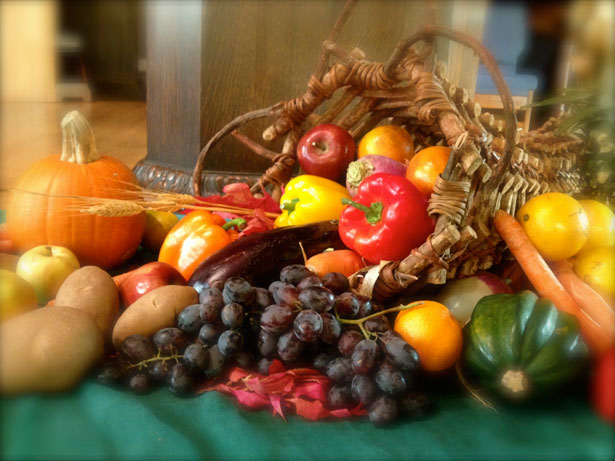
Cornucopia Free Stock Photo - Public Domain Pictures

The First Course:

“I would maintain that thanks are the highest form of thought, and that gratitude is happiness doubled by wonder.”

(G. K. Chesterton — 1874-1936. Columnist and author extraordinaire;  called the best writer of the twentieth century.)

The Second Course:

“The unthankful heart…discovers no mercies; but let the thankful heart sweep through the day and, as the magnet finds the iron, so it will find, in every hour, some heavenly blessings!”

(Henry Ward Beecher — 1813-1887.   Congregationalist minister, known for his support of the abolition of slavery.)

The Third Course:

“Thanksgiving gives effect to prayer, and frees from anxious carefulness by making all God’s dealings matter for praise, not merely for resignation, much less murmuring. Peace is the companion of thanksgiving.”

(Author Unknown – Quoted in Jamieson, Fausset and Brown Commentary on the Whole Bible, Philippians 4:6.)

May wonders and mercies surround you this Thanksgiving Day, bringing you peace and happiness!

(photo credit:  www.publicdomainpictures.net, George GrimmHowell)

Read Full Post »

« Newer Posts - Older Posts »

When the House is Quiet

Impressions Becoming Expressions

Mitch Teemley

The Power of Story

Still Traveling

Impressions Becoming Expressions

Living Our Days

Gaining a heart of wisdom

He Said What?!

I'm Patty, and my husband and I are living with our adult son who has autism and epilepsy. I love sharing lessons learned from life around me, especially life with Aaron.

Meditations of my Heart

Impressions Becoming Expressions

Linda Stoll

Impressions Becoming Expressions

Signora Sheila

Where faith meets la dolce vita

Heidi Viars

Finding the Image of God