Feeds:
Posts
Comments

Archive for the ‘Godly Character’ Category


Over-the-Rhine-12th-and-Vine

(Over-the-Rhine, Cincinnati, Ohio)


One benefit of living in an older city is the interesting architecture to enjoy. Our hometown for two years now, Cincinnati, includes an impressive collection of historic buildings, in a large variety of styles. Below are six examples.

  • Federal:

dsc1401-4-1

(Taft Museum of Art, built 1820)

  • Greek Revival: 


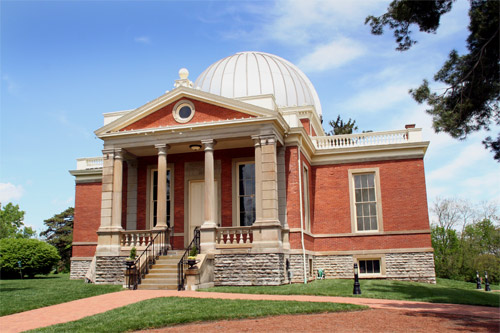
cincinnati

(Cincinnati Observatory Center, built 1873)

  • Venetian Gothic: 


Cincinnati-Music-Hall

(Cincinnati Music Hall, built 1878)


  • Romanesque: 


CincinnatiCityHall

(City Hall, built 1893)


  • Beaux Arts Classical: 


74_big

(Lincoln National Bank Building, built 1903)

  • Art Deco: 


union-terminal 700x254

(Union Terminal, now Cincinnati Museum Center, built 1933)

I, for one, am grateful to enjoy such artistic workmanship and beauty, created by architects and craftsmen long ago.

That’s one of the tenets author and artist, John Ruskin (1819-1900), promoted in his work The Seven Lamps of Architecture (1):


Buildings should be beautiful.


Ruskin’s seven “lamps,” intended as guidelines for architects, included:

  •  Sacrifice.  Buildings should reflect careful thought and strong effort.  No doubt he would agree:  “Whatever is worth doing at all, is worth doing well” (2).
  • Truth.  Ruskin disapproved of faux finishes and trompe l’oiel. Worse yet was shoddy workmanship hidden behind fancy facades. “A building should be honest,” he said.


0cfc41df3dd9d3179b1b42e957db5faa

(Ruskin probably wouldn’t approve of this trompe l’oeil

on a flat building in Cincinnati, at Central Parkway and Vine.)


  • Power.  Public buildings should exude strength and permanence. One surprising element to manifest strength: shadow— achieved with towering walls and deep recesses.  Smooth surfaces bathed in light do not achieve the same effect.
  • Beauty.  Ornamentation was important to Ruskin, distinguishing architecture from a simple building. No “voiceless buildings” devoid of expressiveness, he wrote.
  • Life.  Ruskin also said, “The life of the builder must be in the building.” He was “against mass production and any innovation that decreased the skill content” (3).
  • Memory.  Buildings ought to reflect the culture, its history and heritage. They should be built to last. As an architect sets about his work, he must take into consideration not only its current use but its use by future descendants.
  • Obedience.  Ruskin believed each nation should have a distinct style. And in much of the historical architecture of Europe, that’s exactly what we see. English Gothic, French Provincial, and Italianate are examples.


90da1a91af695c2ac2edb8d081e20639

(Italianate, above, as well as other European styles also seen in Cincinnati.

This is the John Hauck House built 1870).

Perhaps you’re noticing that the categories of Ruskin’s lamps illumine more than architecture. They enlighten our Christian experience as well. I wonder if you made similar connections to mine as you read about these seven components:

  • Sacrifice.  “Whatever you do, work heartily, as for the Lord and not for men” (Colossians 3:23). Such sacrifice is a joy, though, as we “serve the Lord with gladness” out of gratitude for all he has done for us.
  • Truth.  Just as Ruskin believed in honest buildings, so we desire to be people of integrity that reflect Jesus.
  • Power.  We also have available to us God’s strength, especially important in the valley of the shadow of death.

 

85b69ed50e50db3a1e98b9367bcd3553


  • Beauty.  Ruskin thought buildings should reflect creation, because the most beautiful shapes came from nature.  For example, columns resemble plant stems; pointed arches resemble leaves. Our inner “beauty” of spirit should reflect our Creator.
  • Life. “The life of the builder must be in the building,” Ruskin asserted. Doesn’t that perfectly mirror Paul’s words, “I no longer live, but Christ lives in me” (Galatians 2:20)? 
  • Memory.  Buildings should be constructed to last, useful now and for future generations. Likewise, we should strive to leave a worthy legacy to our descendants.
  • Obedience.  Just as Ruskin wanted each nationality to have its own set of architectural guidelines, we Christians have a set of guidelines from our Heavenly Father—to avail ourselves of a strong foundation (his powerful, attentive presence), and strong walls of scriptural truth for keeping out the elements–like fear, depression, and stress.

Praise the Architect of Heaven!

*     *     *     *     *     *     *     *     *     *

Thank you, Architect of Heaven, for exercising your creative and miraculous genius in my life. Sometimes, though, I resemble a big box store or factory—not reflecting your beauty at all. I do not rely fully on you–my Builder, nor follow your guidelines. But, oh how I praise you for never giving up on me! Day by day you are building me into a better version of myself, and you will bring your artistry to a flourishing finish when Jesus returns (Philippians 1:6, MSG). Glory!


maxresdefault


  1. Written in 1849. Another author, Ralph W. Sockman, mentioned this work in his book, The Higher Happiness (Abingdon Press, 1950), which I read recently. My curiosity sent me to the internet to learn about these seven lamps!
  2. Philip Stanhope, British statesman, b. 1694, d. 1773.
  3. Joffre Essley @ house-design-coffee.com
  4. However, here in America, with so many nationalities and climate zones , such strict adherence doesn’t seem as important. The wonderful variety in Cincinnati is a case in point.


(Art & photo credits:  www.wikipedia.org; http://www.taftmuseum.org; http://www.observatoriesofohio.org; http://www.wikipedia.org (2); http://www.wikimapia.org; http://www.cincymuseum.org; http://www.pinterest.com (3); http://www.youtube.com.)


Read Full Post »


Joseph_and_the_Amazing_Technicolor_Dreamcoat_(3640665731)


We’ve all heard the story of Joseph (or seen the musical, Joseph and the Amazing Technicolor Dream Coat). You’ll remember he’s the one who endured years of slavery and prison before his dreams (of bowing wheat sheaves and stars paying homage) came true.

We also know about Moses, an adopted prince in Pharaoh’s household who ended up in the wilderness herding sheep.  Forty years later God called him to lead the Hebrews out of Egypt.

And we’re familiar with Paul who spent years traveling from place to place and, yes, suffering all kinds of trials—beatings, imprisonment, dangers, shipwrecks—all for the privilege of serving God, introducing people to Jesus and establishing churches.

These Biblical stories and others teach us to never give up, because we never know when God will show up to turn a prisoner into a prime minister, a shepherd into a great leader, or a Pharisee tentmaker into a world evangelist.

Then there’s Jeremiah. His is a different kind of story altogether. He was called by God to warn the inhabitants of Judah that destruction would come if they did not return to God and follow his ways. It was not a one-time message. Over a period of forty years Jeremiah spoke many times of coming doom.


4ef160f6525a2c685725524e6193fbd9


Almost no one listened. (A brief revival took place under King Josiah, but when he died, the people returned to their complacency and evil ways.)

We love the stories of Joseph, Moses, Paul, and others, whose perseverance was rewarded with success. But what about Jeremiah?

He, too, persevered through trials–poverty and deprivation, imprisonment and ill-treatment, rejection and ridicule. For what? According to the evidence (minimal results for his efforts), Jeremiah was a wretched failure. Yet he had obeyed God faithfully, endured patiently, and preached courageously.

Perhaps visible evidence is not the best way to quantify success.

Instead, the true measure of success involves our characters, not our acquisitions (Joshua 1:8).


eac79fb6c5313818bb8b68fb51b50b24


The true measure of success may include the tenacity to get up every day and face the same tasks as yesterday, to persistently make choices that further God’s objectives for each of us, and to remain steadfast even when discouraged (1 Corinthians 15:58).

Last, a true measure of success is how our choices honor God (1 Kings 2:3). Jeremiah may not have turned thousands back to Yahweh, but that was not due to his lack of effort or disobedience to God. Jeremiah doggedly preached to the people of Judah—month after month, year after year.

So the true measure of success includes: 1) pursuing godly character, 2) persevering toward God-given purpose, and 3) making choices that honor him.


Zac-Poonen-Quote-Mans-Greatest-Honor1


Today, such successful people might look like:

  • The parent who has put his career on hold to invest time in his young children.
  • the business owner who drives a twelve-year old car so he can give generously to ministries.
  • The college student slowly working her way through school, anxious to return to her inner city neighborhood and teach school

For those of us looking for that kind of success, Jeremiah is our hero.

He lived out these precepts :

  • Do our prayerful best and leave the results with God.
  • Press on–day by day, month by month, year by year if necessary. Allow such perseverance to build our trust in God and strengthen our character.
  • Persist until God tells us to stop. (How do we know we’ve reached that moment? Peace, not uncertainty, will fill our spirits.)

We may not understand what God is doing, but we know him. And he is holy love and perfect wisdom.*


Pilgrims-Rock-gods-wisdom-is-faultless-application-of-his-perfect-knowledge-300w


*Oswald Chambers, My Utmost for His Highest, p. 129.


(Art & photo credits:  www.commons.wikimedia.org; http://www.pinterest.com (2); http://www.christianquotes.info; http://www.pilgrimsrock.com.)


Read Full Post »

How would you complete this statement?

“____________________ is the rarest and purest form of generosity.”

Possibilities might include:

A. Financial assistance

B. A thoughtful, meaningful present

C. A favor or kind deed

D. Attention

According to a speaker I heard on the radio, the answer is D.  He was evidently quoting Christian author and activist for the poor, Simone Weil (1909-1943):

eb658885a794a1c7c13c2be9604f8a12

Attention is a rare form of generosity, because it involves time and effort—both of which are precious commodities.

But every now and then, all of us need someone to focus her eyes on ours, listen to our words with mental concentration, and respond appropriately–even pick up on our facial expressions and tone of voice.

listening-ear

That’s often the exception, however, not the norm. Who has not tried to share a deep, heartfelt concern, only to have the listener look away at a slight distraction or steal a glance at her phone, then fail to react appropriately because she wasn’t tuned in to the story? Worse yet is when she interrupts with her own story, her own agenda.

I don’t want to be that distracted person. I’d like to follow my brother’s example. John has always been one to give up the precious commodity of time for others.

During our growing up years, we lived next door to a family with five children. Tragedy struck one afternoon when the father fell while repairing their roof.   He hit his head on the concrete driveway and never regained consciousness. The next day he was gone.

Though John was at least seven or eight years older than three of those neighbor boys, he would play ball with them now and again, giving them a bit of attention, which they surely needed.

One time when Fred, the third oldest child, came to our door and asked, “Can John come out to play?” we had to laugh. (Not in front of Fred, of course.) At the time, John was in his early twenties, serving in the Air Force and home on leave! But he did go out to play.

A silhouette of a father and his young child playing baseball outside, isolated against the sunsetting sky on a summer day.

I’d also like to follow the example of Dixie, the choir director of one of the churches where my husband served as pastor. She perfectly demonstrated how to live out Philippians 2:4 (NIV): “Each of you should look not only to your own interests, but also to the interests of others” (1).

Dixie always stayed focused on the persons sharing with her. She was responsive, without saying too much, letting the speakers know they were being heard and understood.

Great satisfaction can result from providing the gift of attention to another. But that’s not the only blessing.

  • We gain a better understanding of life while listening to the experiences of others. “A fool finds no pleasure in understanding but delights in airing his own opinions” (Proverbs 18:2 NIV).
  • Our own relationships can be strengthened as we learn from the examples of those who share with us.
  • Worthwhile ideas are discovered—ideas we may never have thought of on our own.
  • When we’re kind to the needy, we honor God (Proverbs 14:31b).

05dfa09e07bd1ea4ca76936a3b82618e

*     *     *     *    *     *     *     *     *     *

Lord, I don’t want to be wrapped up in my own agenda. I’d much rather be like my brother, John—generous with my time and communicating encouragement through my attentive presence. Help me also to be an attentive listener like Dixie. Remind me, Father, to slow down, embrace the moment and genuinely interact with those around me.


  1. Note to self: Concern for self is not wrong as long as true compassion for others balances the scale of my attention.

(Art & photo credits:  www.pinterest.com; http://www.publicdomainpictures.net; http://www.pinterest.com (2).

Who has provided the rare gift of attention for you?  What did you appreciate most about that gift?  Please share your story in the Comments section below!

Read Full Post »


“The whole meaning of history is in the proof that

there have lived people before the present time

whom it is important to meet” (1).


I greatly enjoy meeting the heroes of history and hope you do, too.

One such hero, a founding father of America, is remembered more for his words than his deeds–words such as:


“Give me liberty or give me death.”


His name: Patrick Henry, born May 29, 1736. (His birthday is this Sunday.)


Imacon Color Scanner


But what brought Patrick Henry to that pivotal moment in history and that immortal statement? What influence did he carry afterwards?

A bit of exploration revealed the following:

Patrick Henry’s education and faith began at home, under the guidance of his college-educated father and his namesake-uncle, an Episcopal minister. Uncle Patrick’s teaching, example, and encouragement helped instill in young Patrick the Christian virtues that would impact his entire life.

As Henry grew into manhood, he transitioned from business to law to government. He was elected to the Virginia House of Burgesses in 1765.

Soon after, Great Britain established the Stamp Act, which required almost everything printed in the American colonies to be inscribed on specially stamped paper, available only from agents of the British crown–with the payment of a hefty tax.

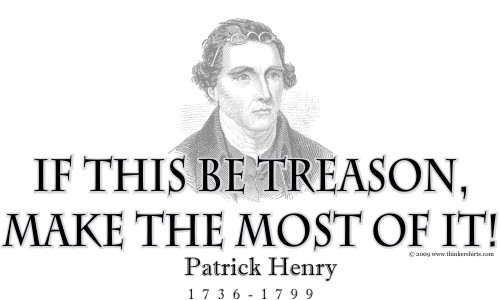
Henry spoke eloquently against the Stamp Act: “If this be treason, make the most of it,” he challenged. The Virginia Stamp Act Resolutions passed, and those with pro-British leanings did consider the action treasonous.


sku-gt184


In 1774, Patrick Henry was elected to the First Continental Congress. Delegates met to determine a course of action for the colonies, in response to Great Britain’s offenses: taxation without representation, searches and seizures without probable cause, confiscation of firearms, and more.

On March 23, 1775, Henry rallied the Second Virginia Convention, calling them to arms against advancing British troops. England was already at war against the colonies, he reasoned. Then Henry concluded with those famous, rousing words:


2015-06-03-d50a1173_large


(“Is life so dear, or peace so sweet

as to be purchased at the price of chains and slavery?

Forbid it, Almighty God!

I know not what course others may take;

but as for me, give me liberty, or give me death!”)


No doubt such eloquent and impassioned words held the delegates spellbound. But more astounding still? Henry had not prepared a speech for that day; he held no notes in his hands.

Another surprise for most of us: Henry spoke of God throughout that speech, and quoted from the Bible.  In one short paragraph, he used eight scriptural phrases.


patrick_henry5


Other examples include:

  • “Gentlemen may cry, Peace, Peace—but there is no peace (Jeremiah 6:14). The war is actually begun! 
  • “The battle, sir, is not to the strong alone” (Eccl. 9:11). 
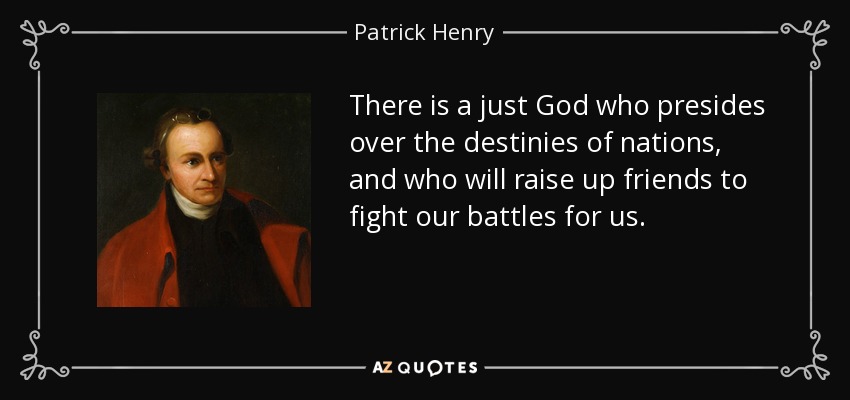
  • “There is a just God who presides over the destinies of nations, and who will raise up friends to fight our battles for us” (2 Chron. 32:8).


quote-there-is-a-just-god-who-presides-over-the-destinies-of-nations-and-who-will-raise-up-patrick-henry-53-32-60


Remember, his speech was delivered with no notes. These verses and many more were imprinted in Henry’s memory.

On many occasions during the war that ensued, he encouraged the beleaguered soldiers to pray for divine intervention, reminding them that:


“…the same God whose power divided the Red Sea for the deliverance of Israel,

still reigns in all of his glory, unchanged and unchangeable…” (3).


The American Revolution officially began April 19, 1775 at the Battle of Lexington and dragged on for  eight long years.  At first, Henry served in the military, as commander-in-chief of the Virginia militia.  But in 1776, Henry shifted his attention from the military to governmental aspects of the war and the development of a new nation.

In fact, governmental affairs were to be his main focus from that time forward. Henry served five terms as governor of Virginia and as a representative in the state legislature.

Yet it was not his accomplishments that he prized most.


thumbs_ph-beingachristian

(“Being a Christian…is a character which I prize

far above all this world has or can boast” (4).


After Henry’s death, this note was found, containing truth just as appropriate for today as in 1799:


“Whether this [the American Revolution] will prove a blessing or a curse

will depend upon the use our people make of the blessings

which a gracious God hath bestowed on us.

If they are wise, they will be great and happy.

If they are of a contrary character, they will be miserable.

Righteousness alone can exalt them as a nation [Proverbs 14:34].

Reader! – whoever thou art, remember this! –

and in thy sphere practice virtue thyself and encourage it in others.

–P. Henry” (5).


Patrick Henry certainly practiced Christian virtue himself, and is still encouraging it—in those who will listen.


Notes:

(1) Eugene Rosenstock Huessy, Speech and Reality, Argo Books, 1970, p. 167.

(2) The Founders’ Bible, p. 1734

3) http://www.christianhistorysociety.com

(4) www.faithofourfathers.net

(5) The Founders’ Bible, p. 957


Sources:

www.christianhistorysociety.com

www.faithofourfathers.net

The Founders’ Bible, Shiloh Road Publishers, 2012

www.patrickhenrycenter.com

www.wallbuilders.com


Art credits:  www.wikitree.com; http://www.thinkershirts.com; http://www.patriotpost.us; ce-wiki.wikispaces.com; http://www.azquotes.com http://www.thefederalistpapers.org.)

Read Full Post »

Say the word, “blessing,” and what immediately comes to mind?

For me, it’s happy events and lovely gifts, engineered or bestowed by God out of his loving kindness.

But James, the brother of Jesus, saw a different side of blessing: “Consider it a sheer gift, friends, when tests and challenges come at you from all sides” (James 1:2, MSG, italics added).

Tests and challenges as gifts?! Sounds a bit daft—until we consider:

What-Seems-To-Us-As-Bitter-Trials-Are-Often-Blessings-In-Disguise

Take, for example…

THE CRAZY BLESSING OF WANT

Do you wish you had a bigger house? A newer car? Better furniture? Consider yourself blessed, that you’re not like King Solomon–the wealthiest person who ever lived. For all his striving to achieve and accumulate, Solomon discovered that when every desire is gratified, the end result was nothing but meaningless smoke (Ecclesiastes 1:2, MSG).

The blessing of want protects us from the pit of depression caused by self-indulgence.

The blessing of want fosters contentment, as we learn to enjoy and be grateful for what we already have.

THE CRAZY BLESSING OF DIFFICULTY

Difficulties provide a surprising number of positive opportunities. Here are ten:

  • To press in closer to God and trust him more completely.
  • To experience the adventure of God’s sufficiency (Philippians 4:13) as he enables us to endure—in ways we never thought possible.

Philippians4_13

  • To see how God will bring beauty out of ashes (Isaiah 61:3).
  • To discover more of who God is.
  • To witness the fulfillment of his never-failing promises.
  • To present a sacrifice of praise to God, beginning with the affirmation that he has our best interests at heart—in spite of what we see.
  • To be prepared for greater usefulness for God (John 15:2), which fosters greater fulfillment and satisfaction in our spirits.

46dd131cacc19b855d589b3358b83851

  • To have a compelling story to share, as encouragement for others. Years ago I heard a speaker say, “With no test there is no testimony.” In the final analysis, I’d rather have the latter. You, too?
  • To become mature, complete, not lacking anything (James 1:4). That doesn’t happen without trials.  As Thomas Carlyle wrote:

quote-no-pressure-no-diamonds-thomas-carlyle-31833

  • To love our Savior more passionately. Josif Trif, a pastor from Romania during the days of Communism, said, “If it weren’t for Communism, I would not have loved our Lord as much. I kissed the cross the Communists gave me” (1).

THE CRAZY BLESSING OF FAILURE

If failure served no purpose in our lives, God would not allow it to happen. But since he does, we can know that failure is either for our benefit or for God’s glory—often both.

Failure is the soil from which great success can grow, beginning with a crop of positive character traits, such as perseverance, humility, and greater reliance upon God.

Green-Bean-Sprouts1

Out of failure comes experience; from experience comes greater wisdom; and wisdom leads to a godly life.

“How blessed are those who are hungry and thirsty for righteousness, because it is they who will be satisfied (Matthew 5:6, ISV)!

*    *     *     *     *     *     *     *     *     *

Crazy as it sounds, I want to praise you, Father, for the blessings of challenges and tough times. Thank you for your loving attention that carries me through, transforming me and makes me a better version of myself.  I also praise you for the glorious promise that through trouble, hardship, disappointment, or pain–“overwhelming victory is ours through Christ” (Romans 8:37, NLT)!

What crazy blessing have you experienced in the crucible of trouble, hardship, disappointment, or pain?  Please join the conversation below!

(1) His Imprint, My Expression, Kay Arthur, Harvest House, 1993, p. 135.

(Art & photo credits:  www.imagesbuddy,com; http://www.wallpaper4god.com; http://www.pinterest.com; http://www.izquotes.com; http://www.pinterest.com; http://www.harvesttotable.com.)

Read Full Post »

woman_sick_with_cold_314_208


After more than a week of full-blown cold symptoms—painful sore throat, totally stuffed-up nose, throbbing headache, and complete lack of energy–I finally woke up feeling more like my old self.

Such euphoria!  I could swallow without pain, take in glorious gulps of air through my nose, and function without the tight hat of sinus pressure on my head or the virtual suit of heavy armor on my body.  Throat, nose, head, and limbs were once again operating in unified wholeness!

But what if I still carried deep heartache, suffered from depression, or continually dealt with on-going stress at work? Relief of cold symptoms would be a small matter by comparison.

Unified wholeness must include mind and spirit as well as body.

This was the kind of completeness Jesus was referring to when he told a healed leper, “Arise, go your way: your faith has made you whole (Luke 17:19, King James 2000 Bible).


maxresdefault


You no doubt remember him, the one-out-of-ten healed lepers who took an extra step beyond healing, returned to Jesus, and expressed his gratitude.

Such effort demonstrated a spirit of humility and righteousness as he set aside his own agenda and did the right thing. His faith had impacted his body, yes, but also his mind and spirit.

The leper’s wholeness* manifested holiness—not perfection or proud piousness—but completeness and health of the total person as God fully intended.

Thomas Carlyle (1795-1881) explained it like this:

“The old word for holy in the German language, heilig, also means healthy. And so Heilbronn means holy-well, or healthy-well. You could not get any better definition of what holy really is than healthy—completely healthy.”

Wholeness is holiness, and God is our example. He is the picture of complete perfection with the sum of his glorious attributes: love, joy, peace, wisdom, and more.

By contrast, we are pictures of imperfection, with our deficient condition and inability to perfect ourselves on our own.

Yet God comes to us, arms outstretched in welcome, and says, “Your faith can make you whole.” We can turn to him like that one leper did, and he will begin the work of making us like him.


ephesians4_24


Oh, that sounds wonderful! Just as I desperately want to be made whole when a cold wreaks havoc in my body, so I want to be made whole as sin wreaks havoc in my spirit.

But such transformation involves choices.

During a cold, the choices of rest and plenty of fluids will speed the healing process toward wholeness.

My mental and spiritual wholeness this side of heaven will also require at least two choices:


120817-590x393


  1. “Look to the Lord and his strength; seek his face always” (1 Chronicles 16:11, NIV).
  1. Distill the positive out of the negative—goodness out of evil, peace out of pain, joy out of sorrow.


2corinthians12_9

And from the fullness of Jesus’ grace we will receive one blessing after another (John 1:16)—beginning with his power and wisdom to make these sound choices toward wholeness.


*     *     *     *     *     *     *     *     *     *


Oh Father, sound choices are easy to talk about, not so easy to live out. Remind me that from your wholeness, you provide grace upon grace—if only I look to you. Help me turn away from fear, self-pity, and anger, which lead to brokenness, not wholeness. How I praise you for your good will toward me and the good work of restoration you continue to develop within me!


*Synonyms from Webster’s New College Dictionary include: health, restoration, healing, and completeness.


(Art & photo credits:  www.families.com; http://www.youtube.com; http://www.verseoftheday.com; http://www.ourdailyblossom.com; http://www.verseoftheday.com.)


Read Full Post »


talk_too_much


Oh, boy. Here she comes again. ‘Seems like she seeks me out every week. Lord, help me.

As Mrs. T. approached me after church, I braced myself for a lengthy, one-sided conversation. Mrs. T. loved to talk, usually about herself, her pains and struggles. As annoyance and frustration would build within me, all I could think about was how to get away without offending.

Now I realize there is a remedy for such situations.

I could have had V-8!

No, not the fortified tomato juice—the VICTORY x 8!


field of spring grass and sunset


I can win over annoyance and frustration—when faced with situations I cannot change—even those circumstances much bigger than aggravating people.

The “times eight” refers to eight ways the battle can be fought. By implementing the following actions, victory can be mine:

  1. Confession and repentance provide the best place to begin. Lord, my attitude toward Mrs. T is negative and unloving; bitterness and self-pity have taken root. Help me to abandon those roots so they shrivel up and die.
  1. Forgiveness.  You, oh God, have forgiven me of so much; how dare I withhold forgiveness from Mrs. T? Help me to remember that forgiveness is not a feeling; it’s a commitment to lay aside the offense—as many times as necessary.
  1. Prayer for the person(s). Father, my first inclination is to pray you reveal to Mrs. T. how annoying her self-centered chatter can be! But your wisdom dictates I pray blessing upon her (Luke 6:28). Ease the distresses and frustrations in her.  Show me how I can help, beyond providing a listening ear.


d520ea38daca324cb2f460f1ce679ee6


  1. Thought Control. Those resentful, self-pitying thoughts in my mind want front-and-center attention, Lord. Turn my focus instead to gratitude. Thank you for the privilege of being your ears and perhaps your voice for Mrs. T.  
  1. Attitude Adjustment. Oh God, help me keep a proper perspective. On a “Scale of Measurement for Difficulties in Life”, Mrs. T rates only a 1 or 2. Forgive me for allowing such a small annoyance to steal my joy.
  1. Affirmation of God’s sovereignty and attributes. It is well within your power to redeem this situation, Lord. Help me to embrace the fact you may have a different plan– that redemptive change take place within me rather than in the situation. May I avail myself of your strength, determination, and wisdom for that change.
  1. Expectation. As Mrs. T. approaches, Father, remind me that you are working for my good and hers. My good undoubtedly includes growing the fruit of the Spirit. But it’s also possible you have planned an additional positive outcome that will surprise and delight—at the proper time.


b970a1bf7167a0962eeebd02bb23cda4

  1. Perseverance.  Thank you for that glorious promise in James 1:4–that perseverance in faith principles produces maturity and sound character. Thank you for the joy and peace that results—so much more satisfying that allowing frustration to fester!


9a2544d9327a7da1f434c3cfa2c08232


Since those days of listening to Mrs. T, have I always applied V-8 to difficult situations? No. Annoyance, bitterness, and a host of other negative emotions can still crop up as challenges arise. This post was much more for me than anyone else.

When the next problem occurs and I feel weak to handle it, I’m serving up some V-8!


(Art & photo credits:  www.quotes.gram.com; http://www.faithmessenger.com; http://www.pinterest.com; http://www.indulgy.com; http://www.pinterest.com.)

 

Read Full Post »

clothing-5

A friend and I enjoyed a bit of clearance shopping last week.  As she gleaned one rack, I gleaned another.  It was while scooting hangers left to right that a sweater fell to the floor. I bent over to pick it up and my sunglasses fell from their perch on my head. Quick as a wink, though, a nearby shopper (not my friend) retrieved them.

“Wow!” I exclaimed, taking back the sunglasses. “That has to be the fastest ‘pay it forward’ in history! Thank you!”

With a big smile for me, she returned to her shopping.

What a contrast to other shopping experiences, when someone has:

  • Bumped past me with her cart without an “Excuse me.”
  • Sauntered with two or three others down the middle of the parking lot lane, oblivious to the fact they’re holding up traffic.
  • Walked through a door I have held open without saying, “Thank you.”

Common courtesy seems to be disappearing from society, as some people have allowed the constant pursuit of self-interests to turn into self-absorption. Perhaps they think worrying about other people’s feelings is a waste of time and energy.   Others may see customs of politeness as downright archaic and puritanical.

The truth is, courtesy and consideration can do us a world of good. Research indicates that kind deeds release feel-good endorphins into our nervous systems. Benefits include diminished pain, decreased depression, and relieved stress (1).

Of course, the Bible has taught the value of kindness all along (2).

il_214x170.742284765_fg16

Yet some folks cringe at the thought of teaching scriptural principles to our children in school or holding ourselves to those standards. “Legalistic!” they claim.

But would it be so horrible if we:

  • Cheerfully greeted one another, even if we’re strangers?
  • Allowed others to enter a building or aisle first?
  • Held doors for one another?
  • Treated service personnel (clerks, wait staff, attendants, etc.) with friendly respect?
  • Said “thank you” at every opportunity?
  • Followed the Golden Rule that Jesus taught (Matthew 7:12)?

fadb62c793485a720e50c5010abae6a0

Good manners are based on good principles; good principles are found throughout the Bible.

And Biblical principles not only provide positive impact on people (and our own nervous systems!), but may very well form the foundation of a strong nation:

“Neither the wisest constitution nor the wisest laws

will secure the liberty and happiness of a people

whose manners are universally corrupt.”

–American statesman, Samuel Adams (1722-1803)

So…

quotes-about-love-kindness-footprints-890x593

*     *     *     *     *     *     *     *     *     *

Oh, Lord, help me leave footprints of kindness wherever I go, to live out your Golden Rule for the benefit of others and for the praise of your glory.  May others know I’m a Christian by the cross I wear and the love I share.

(1) Allan Luks, The Healing Power of Doing Good (2001).

(2) Examples include: Galatians 5:22-23, Ephesians 4:32, and 1 Peter 2:17.

(Art & photo credits:  www.allthingstarget.com; http://www.etsy.com; http://www.pinterest.com; http://www.askideas.com.)

Read Full Post »

psalm-90-12-230-130

“Teach us to number our days,

that we may present to you

a heart of wisdom”

–Psalm 90:12 (NAS)


I did the math and numbered my days: over 24,000 so far. That means I’m well past the half-way point of the average earthly life. And such a sobering thought would surely weigh heavy on my mind, if I did not have heaven to look forward to.

But I’m certain Moses (the author of Psalm 90, above) wasn’t asking God for a multiplication lesson.

Perhaps in learning how to number his days Moses wanted to: 

  • make each day count by accomplishing worthwhile tasks, or
  • live mindfully so steady growth and learning took place, or
  • dedicate himself to the well-being of others, or
  • look for God throughout each day, worshiping and praising, or
  • revel in the positive instead of grovel in the negative.

Perhaps Moses was thinking of all those things.

According to two commentators, Numbering our days means:  1) living in such a way that each day has value, and 2) living intentionally in ways that bring glory to God and blessing to others.

Then notice what Moses indicates will happen when we live with those supreme purposes:

We’ll be able to present to God a heart of wisdom—a heart with “the ability to see life from God’s perspective, and then to know the best course of action to take” (p. 1055, Living Application Bible). 

That seems to me a lovely gift to present to my Heavenly Father—accepting his perspective and acting upon it.


Charles-Spurgeon-Quote-Wisdom


But learning to number our days and grow in wisdom are such abstract processes. It’s difficult to determine progress. So how might we know that we’re learning and growing? These ten questions may help; they’re based on the Book of Wisdom, Proverbs. Try answering in the context of the last ten—maybe even twenty—years:

  1. Am I more aware of God’s daily gifts and more grateful to him for these blessings (15:13)?
  2. Do my thoughts frequently turn to God during the day? Am I continually turning to him for guidance? (2:1-6)
  3. Do I express trust in God more often than worry about circumstances (3:5-6)?
  4. Am I pursuing biblical instruction (8:33-34a)?
  5. Do I take great pleasure in building up others (10:11)?
  6. Am I able to think before I speak (10:19b)?
  7. Do I give people the benefit of the doubt (19:11)?
  8. Am I becoming more patient and kind–especially toward challenging people (25:21-22)?
  9. Do I thoughtfully consider the advice of those who are knowledgeable and wise (19:20)?
  10. Am I able to do what’s right even when there’s no one around to notice (10:9)?


a0ea4e208506c36a35ddbfffcd0cd872


Scripture tells us that when Abraham died, he was “satisfied with life” (Genesis 25:8, NAS).  Surely satisfaction with life includes the development of a heart of wisdom, which Abraham demonstrated by his life of faith–in spite of challenges, disappointments, and uncertainties.

But the pinnacle of satisfaction must have been presenting that heart of wisdom to God Almighty on the day he entered heaven’s gates.

My prayer is that I’ll be able to do the same.

You, too?

“What we weave in time

is what we’ll wear in eternity.”

– Mart DeHaan


(Photo and art credits:  www.faithgateway.com; http://www.quotesgram.com; http://www.pinterest.com.)

Read Full Post »

237521d60ffd35b9153d70894610fda3

(“The object of a new year is not that we should have a new year.

It is that we should have a new soul.”

G.K. Chesterton)

A new soul. I like the sound of that, don’t you? In my imagination I see a freshening of my attitudes, improved motivations, and increased spiritual strength.

But where do I start in order to achieve a new soul?

No doubt, a new soul begins with repentance—expressing to God my sorrow for wrongdoing and availing myself of his help to change. Just as King David prayed, I can ask God to:


small_efa4fbb2a9df56d01e2f4ab4


(“Create in me a pure heart, and renew a steadfast spirit within me.”

–Psalm 51:10, emphasis added)


Notice that David asked God to create in him a pure heart. David didn’t promise to clean up his act on his own. Only God could make David’s heart new and pure. The same goes for me. All I can do is submit myself to his transforming power and follow his lead.

That pure heart David asked for is a clear conscience. And with the release from guilt came a rush of joy and the restoration of sweet peace with God. Doesn’t that sound wonderful?

“No one is happier than the one who has repented of wrong” (Max Lucado).


A new soul involves renewal of the mind.


romans12_2


Or, put another way:


“Don’t copy the behavior and customs of this world,

but let God transform you into a new person

by changing the way you think.

Then you will learn to know God’s will for you,

which is good and pleasing and perfect.”

Romans 12:2, NLT (emphasis added)


Once the negative influences of sin have been removed, I need to fill my mind with excellent, praiseworthy contemplations.

Why waste my thoughts and allow them to wander on worthless topics or circle around pointless worries? Instead, I want to set my mind on the positive, especially on God himself.

A renewed mind is not problem-focused; it is Person-focused.


A new soul requires day-by-day rejuvenation.


“We do not lose heart.

Though outwardly we are wasting away,

yet inwardly we are being renewed day by day.”

–2 Corinthians 4:16 (emphasis added)

2-corinthians-4-16


God has established certain laws by which our world is governed. Gravity is one example. The law of entropy is another. It states that all elements of the universe tend to disintegrate over time. Plants and animals die and decay, iron rusts, rock erodes.

Our souls tend to disintegrate over time, too, when left unattended:

  • Worry and fear wreak havoc.
  • Self-centeredness creates an appetite for entertainment, possessions, and recognition—appetites that are never satiated.
  • Foolishness reigns because wisdom is ignored.
  • Rationalizations replace honest evaluations.
  • Uncontrolled behaviors harm relationships.

But when we avail ourselves of God’s influence day-by-day and step-by-step, the law of entropy has no effect on our souls.


f5c507e82ee69ce83a7b75164ed04bd8


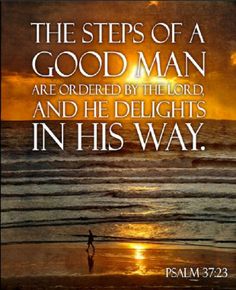
The Amplified Version expands the meaning:


“The steps of a [good and righteous] man

are directed and established by the Lord,

And He delights in his way

[and blesses his path].”

–Psalm 37:23, AMP


Consider the import of these key words:


Steps – Even spiritual achievement rarely happens in an instant. God values slow and steady progress.


Directed – He isn’t just interested in the details of our lives; he’s lovingly engineering them.


Established – There is always design and strategy in God’s endeavors, even if we only occasionally perceive it.


Delights – God is pleased with those who follow the path he has thoughtfully and wisely set.


Blesses – God lovingly bestows such gifts as peace, joy, hope, satisfaction, and purposeful living.


*     *     *     *     *     *     *     *     *     *


Holy Creator of new souls, as I stand on the brink of a new year, I do confess my failings to you. Purify my heart; show me how to refine even the motivations behind my right actions. Thank you for your gentle nudges to turn my mind toward you, and your loving attention upon every step of my life. I praise you that continual contact with you results in a soul–a life–that is continually refreshed and made new!


(Art & Photo credits:  www.pinterest.com; http://www.mybible.com; http://www.verseoftheday.com; http://www.dailylifeverse.com; http://www.pinterest.com.)

 

Read Full Post »

« Newer Posts - Older Posts »

When the House is Quiet

Impressions Becoming Expressions

Mitch Teemley

The Power of Story

Still Traveling

Impressions Becoming Expressions

Living Our Days

Gaining a heart of wisdom

He Said What?!

I'm Patty, and my husband and I are living with our adult son who has autism and epilepsy. I love sharing lessons learned from life around me, especially life with Aaron.

Meditations of my Heart

Impressions Becoming Expressions

Linda Stoll

Impressions Becoming Expressions

Signora Sheila

Notes on Life, Faith & Italy

Heidi Viars

Finding the Image of God