Feeds:
Posts
Comments

Archive for the ‘Salvation’ Category

Jesus-Praying-Last-Supper-570x377


Whether I heard it or read it, I don’t remember. But the words caught me by surprise, and I jotted them down:

“What was uppermost in Jesus’ mind as Good Friday approached?

“Joy.”

Do you find that surprising, too?

Yet at least three times on the eve of his crucifixion Jesus spoke about joy (John 15:11; 16:22, 24; 17:13)–a most unusual topic and completely unnatural.  Who thinks about joy when they know that catastrophe is about to strike?

Jesus, that’s who.

Within the next twenty-four hours he would face excruciating pain, total abandonment by his Father, and the most horrific death ever devised.

But his concern was for his disciples, not himself.  Jesus wanted them to remember the important principles of love, obedience, and joy–an empowering joy that no one could take away from them.

Perhaps you remember the scene. Jesus and his disciples had just finished their last Passover supper together. After the meal, he taught his final lesson.

The first mention of joy came near the end of his teaching about the vine and the branches:

“I have told you this

so that my joy may be in you

and that your joy may be complete”

(John 15:11).

The word, “this,” refers to the ways Jesus had just mentioned that will contribute to joy:

1.  Live close to him and produce much good in and through your life (vs.4-8).

2.  Live in obedience to Jesus and experience the warmth, peace, and care of His love (vs. 9-10).

 Note that Jesus wanted his joy to be in the hearts of his disciples. What characterized his joy, compared to that of others?

  1. Strong awareness of the Father’s love for him, and his own love for the Father (vs. 9-10).
  1. Absolute surrender and self-sacrifice of himself to his Father, and the joy of doing what his father had sent him to do. Even during his great travail in the Garden of Gethsemane, his one desire was to do his Father’s will (Luke 22:42).

Jesus’ joy coexisted with the profound sorrow of his impending suffering, because he was already well-acquainted with the satisfaction and fulfillment of obedience.

  1. The understanding that joy deferred to the future is anticipatory joy in the present. “For the joy set before him he endured the cross” (Hebrews 12:2).

And finally, Jesus told his disciples that he desired complete joy for them. What does complete joy look like? It is:

  • Not so much an emotion as it is a conviction (Keith Krell, “Moment by Moment,” http://www.bible.org).
  • Inner contentment, resulting from continually cultivating an intimate relationship with Jesus.
  • Constant, not dependent on circumstances.
  • Enduring, day after day. Indestructible.
  • Perfect—the perfect, joy-filled fulfillment of the destiny for which God created you, even when a portion of that destiny is suffering.

I’m thinking of the martyrs–Stephen, Polycarp, Ignatius of Antioch, William Tyndale, John Wycliffe and countless others who demonstrated complete joy even as they died in anguish.

Polycarp, disciple of the Apostle John and Bishop of Smyrna for many years, refused to revile Jesus. For that he was burned at the stake.

But before the flames rose up, Polycarp prayed:

“O Lord God Almighty, Father of thy blessed and beloved Son, Jesus Christ, through whom we have been given knowledge of thyself…I bless thee for granting me this day and hour, that I may be numbered amongst the martyrs, to share the cup of thine Anointed and to rise again unto life everlasting…”

Such devotion, courage, and supernatural strength are impossible to fathom apart from the enablement of the Holy Spirit.

Can you hear the grace in Polycarp’s voice as he blessed God for the privilege of dying a martyr?

That is complete joy, only experienced by those who trust in Jesus implicitly.

Complete joy that Jesus purchased for us at Calvary.

*     *     *     *     *     *     *     *     *

We marvel, Heavenly Father, in the extreme paradox that is the cross. Out of the evil unleashed upon your Son comes your holy, righteous goodness–upon us. Out of the horror of the crucifixion that Jesus endured comes inexpressible and glorious joy, to those who put their faith in him–not a temporary feeling of elation, but deep, abiding, abundant joy. 

All praise to you, our loving, gracious God!       

(Acts 3:13-16, 1 Peter 1:8, John 6:47, John 10:10)


(Photo credit:  www.rejesus.co.uk.)


Read Full Post »

The spacious, free life is from God,

It’s also protected and safe.

God-strengthened, we’re delivered from evil—

When we run to him, he saves us.

(Psalm 37:39-40, The Message)

Freedom-Quote


There are folks who think that Christians surrender their freedom when they choose to follow Jesus. They think we give up our freedom to do as we please and take part in everything life has to offer.

Those folks miss an important fact: Self-centeredness does not satisfy in the long-term.

Even secular research has proven that truth. Several years ago, the Journal of Research in Personality published a study conducted by psychologists. They recorded their therapy sessions and found that individuals who used more of the first-person singular pronouns (I, me, my) were more likely to suffer from depression.

The truth of the matter is, real freedom is not freedom to, but freedom from. God offers us a number of glorious freedoms. For example:

  • Freedom from guilt. God forgives my sins and remembers them no more (Isaiah 43:25).  How loving, merciful and gracious He is!
  • Freedom from fear. He is my stronghold in time of trouble (Psalm 37:39.) How often have I called out, “Oh, Jesus,” with my heart pounding in my chest—at the moment a car crash was imminent, a child approached with blood oozing from his head, or the phone rang just before curfew, and our teenager wasn’t home yet.

bible11

But fears can be quieted as we affirm who is in control. God is Lord of every circumstance. He is also the Source of solace, perspective, strength and wisdom–whatever I need, for every situation.

  • Freedom from worry. God has promised to supply my needs (Philippians 4:19). 

When worries begin to whirl in my head, I try to put into practice what Kay Arthur teaches: “Focus on God. Rehearse his character, his promises, his works. Remember his names, his attributes and how they suit your situation” (His Imprint, My Expression, p. 117). Extolling God’s greatness causes my problems to shrink.

Notice I said try. I’ve not always accepted God’s offer of freedom from worry. Sometimes dark clouds of concern fill my thoughts and blot out his goodness—his character, promises, and works. Sometimes it takes awhile for me to remember: My God is all-sufficient. He will see me through.

 As I grow older, the gap is shortening between worry-onset and God-focused thinking. Practice hasn’t made perfect yet, but at least it’s producing improvement.

  • Freedom from foolish decisions. He provides wisdom when I ask (James 1:5).

“I need not despair because the living God is my partner. I do not have sufficient wisdom to meet these difficulties, but He is able to direct me. I can pour out my heart to God and ask Him to guide and direct me and to supply me with wisdom. Then I have to believe that He will do so. I can go with good courage to my business and expect help from Him in the next difficulty that may come before me” – George Mueller

816184962d6bdc67aaa7f052c00369bf

  • Freedom from discouragement, because God is omnipotent. With him all things are possible (Matthew 19:26). He specializes in redeeming disappointment. And while we wait, our loving Father provides strength.

The shroud of discouragement can also be lifted through gratitude, praise, and worship. Focusing on who our God is and what he has already provided can relieve the ache for what has not come to pass—yet.

 This post is getting long, so I’ll just list another five briefly:

  • Freedom from despair. He is my God of hope, joy, and peace as I trust in him, so I can overflow with hope by the power of the Holy Spirit (Romans 15:13.)
  • Freedom from loneliness, because He is always with me (Psalm 23:4).
  • Freedom from prolonged sadness.  Weeping may remain for a night, but rejoicing comes in the morning (Psalm 30:5).
  • Freedom from feeling helpless. In God’s hands are strength and power (1 Chronicles 29:12).
  • Freedom from feeling useless, as we live each moment for the praise of His glory (Ephesians 1:11-12).

0a44f1bd0f54a3d2e22c78ec65923491

Jesus said, “If the Son sets you free, you will be free indeed” (John 8:36). What he offers is the spacious, free life–to those who follow him, to those who become the children of God.


*     *     *     *     *     *     *     *     *     *


My heart is overwhelmed, Father, as I skim down this list of miseries for which you provide relief. No doubt there are even more freedoms that could be included. I pray that when these negative emotions threaten to overtake my spirit, you would tap me on the shoulder and remind me: the more I turn my thoughts and feelings over to you, the more spacious my soul will become to enjoy the freedom of your peace. Praise you, gracious God, for such glorious provision.

(Photo credits:  www.moreofimministries.org; http://www.wallpaper4god.com; http://www.treasuring-christ.org; http://www.887thebridge.com.)


Read Full Post »

F7007


Christmas. The first syllable surely needs no explanation of origin. It speaks of the One we celebrate.

But what about the second syllable, -mas?

Christmas is a term that has been around for nearly a thousand years, coming to us from Old English. Cristes Maesse meant “Mass of Christ.” It was established by church leaders to disconnect the church celebration of Jesus’ birth from pagan holidays and customs—holidays such as Winter Solstice. (Even before the birth of Christ, Romans were celebrating the shortest day of the year, in anticipation of the sun’s gradual return.)

As a matter of fact, as early as the fourth century, Christians were creating their own wintertime celebration. One theologian pointed out in 320 A.D.: “We hold this day holy, not like the pagans because of the birth of the sun, but because of Him who made it.”

Yet there are those who wish to keep the customs of Christmas without including the One being celebrated. Seems they’d like to take away the first syllable, Christ. But then all that’s left is –mas.

Sounds like mess.

Indeed. I am confident that without Christ, my life would be a mess. 

A mess of fears.

A mess of brokenness.

A mess of worry.

A mess of guilt.

A mess of dissatisfaction.

It’s possible that for a long while I’d be able to hide the mess under glittery packages of stuff, noise and distraction, busy-ness.

But eventually, a body must stop and rest. That’s when my mind would kick into high gear and the mess would wreak havoc in my soul. Chances are I’d develop sleep problems, depression, or perhaps even physical manifestations like ulcers. Stress can do that to a person.

Shouldn’t I at least consider the alternative? What if I do allow Christ in my life?

Oh, my. The list of precious gifts He bestows is astounding and practically endless. To begin, he provides:

  • Calm in place of fear.

“Do not let your hearts be troubled. Trust in God; trust also in me” (John 14:1), Jesus said.

  • Restoration in place of brokenness.

 “Anyone united with the Messiah gets a fresh start, is created new. The old life is gone; a new life burgeons” (2 Corinthians 5:17, The Message)!

  • Peace of mind in place of worry.

 “Steep your life in God-reality, God-initiative, God-provisions. Don’t worry about missing out. You’ll find all your everyday human concerns will be met…God will help you deal with whatever hard things come up when the time comes” (Matthew 6:33-34, The Message).

  • Forgiveness in place of guilt.

 “Everyone who believes in [Jesus] receives forgiveness of sins through his name” (Acts 10:43).

  • Contentment in place of dissatisfaction.

 “Godliness with contentment is great gain” (1 Timothy 6:6).

 And among his many other gifts to us, Jesus grants us the incredible privilege of eternal life (John 3:16)—with him in heaven.

But how will I be able to enjoy all these gifts if I don’t give Christ a chance?

I really have nothing of value to lose. Just the mess.


“Thanks be to God for his indescribable gift” (2 Corinthians 9:15)–the Christ of Christmas!


(Art credit:  www.emblibrary.com .)

Read Full Post »


0ece76207bc564a5a08ba4dbb2a17fbf


I love all things Christmas–with a few exceptions for the silly (Dancing Santas I can do without.), the gaudy and over-glittered (unless my children made it), and the highly repetitious (“The Little Drummer Boy,” with its twenty-one pa-rum-pa-pum-pums is one example).

But I do look forward to:

  • Evergreen wreaths with cheery red bows perched on light poles in the business district.
  • Colorful lights twinkling from bushes and rooftops.
  • Vanilla-spice Christmas cookies, crisping in the oven and filling the house with sweet fragrance.
  • Candles glowing from table and shelf.
  • Delicate, porcelain figures, circled around Baby Jesus in our treasured family crèche.
  • Beloved carols resounding through the house or sung at church with family and friends.
  • Family gathered from near and far, nestled around the Christmas tree to hear the beloved story of the Nativity once more.

You get the idea.

I’m now getting to the age when all these things are very familiar. I’ve enjoyed them again and again over the decades. Yet they never lose their appeal. Every year, as Christmas approaches, I eagerly anticipate the repetition of each experience.

Why? Why hasn’t boredom set in? It’s not an easy question to answer. But these reasons occur to me as possibilities:

  • My relationship with Jesus influences my response to these Christmas traditions. My joy in the season is greatly augmented because I know him.  And celebrating Someone whom I love and worship is far superior to celebrating a stranger.
  • The Christmas story and its themes of peace, joy, and hope, provide stability in an uncertain, even fearful world. We Christians enjoy the benefit of Christ’s peace, joy, and hope in our hearts every day (Romans 5:1-2).  That, too, is something wondrous to celebrate.

But that’s not all! Jesus is coming again and all the perfections of heaven await those who believe in him. Did you know that for every single prophecy in scripture that foretold Jesus’ birth, there are eight which look forward to his return? Also consider: every prophecy about Jesus’ birth came true; therefore, we can be confident every prophecy about his second coming will also come true.  Christmas is a celebration that not only looks back with great joy, but forward with great hope.

  • Our King of kings and Lord of lords left his perfect heavenly home to dwell among us. He became human that we might be glorified (Philippians 2:6-9; Romans 8:30). He has made it possible for us to enjoy every spiritual blessing (Ephesians 1:3).   And, He is our:

Wonderful Counselor (Isaiah 9:6), guiding our way.

Emmanuel (Matthew 1:23), gracing us with his presence.

Shepherd (Hebrews 13:20), tenderly caring for us.

Rock (1 Corinthians 10:4), providing stability and refuge.

Advocate (Romans 8:34), interceding for us when Satan tries to condemn.

And so much more. Who can help but celebrate our loving Savior?

May all things Christmas turn our hearts and minds to him–his miraculous birth, his perfect life and sacrifice, his glory.

Read Full Post »

Tonight, the Thursday before Easter, we remember the Last Supper and the heart-wrenching scene in the Garden of Gethsemane.  It was there Jesus prayed, “Father, if you are willing, take this cup from me; yet not my will, but yours be done” (Luke 22:42).

In a matter of hours from that moment, Jesus would face unimaginable pain and suffering. Yet his prayers were not only for himself that night. He prayed for his disciples, and he even prayed for us—those who would believe in him in the future. (I marvel at such selflessness in a time of supreme crisis.) His desire was that God’s love and his presence would be in us (John 17:26).

As a result of his death on the cross and resurrection from the grave, Jesus made possible the fulfillment of that prayer. Our crucified, resurrected, and ascended Christ indwells every believer (Colossians 1:27).

Think of it! The all-powerful, all-wise Lord of the universe lives within us! Such an overwhelming, puzzling concept. What could that mean in practical terms?

I like Sarah Young’s explanation: We are intertwined with him in an intimacy involving every fiber of our beings (Jesus Calling, p. 332).

It means that God makes available to us everything we need:

  • Power to handle life’s challenges (2 Corinthians 12:9).
  • Wisdom to determine right actions from wrong (James 1:5).
  • Access to talk to him at any time (Hebrews 4:16).
  • Personalized purpose, to fulfill a God-ordained plan (Jeremiah 29:11).
  • Hope that can never be disappointed (Isaiah 40:31).
  • Resources that can never be exhausted (Philippians 4:19).

It means that in Christ we have:

  • Complete forgiveness (Hebrews 8:12).
  • Everlasting life (John 3:16).
  • Overflowing joy (Psalm 16:11).
  • Deep peace (John 14:27).
  • Attentive care (1 Peter 5:7).

Sometimes I act like the Israelites on their trek to the Promised Land. Remember the manna God provided so they wouldn’t go hungry? It tasted like wafers made with honey (Exodus 16:31). That sounds like baklava!! Yet they became so accustomed to the provision, they began to complain. Manna wasn’t good enough after a while.  “Yes, Lord,” they may have said.  “You have been very gracious to provide manna.  But we need meat!”

These blessings of “Christ-in-us” listed above are more precious even than miraculous manna. How could I take such astounding blessings for granted? Add to that the incredible price Jesus paid so I could enjoy those blessings. How dare I think, Yes, Lord, you have been very gracious, but I need more.

*     *     *     *     *     *     *   *     *     *

Dearest Jesus, as I contemplate your deep distress in the Garden, your suffering at the hands of Roman soldiers, and the unfathomable pain you endured on the cross, my petty wants become inconsequential.

Oh, God, forgive me for allowing familiarity to dull the senses—the senses of awe and gratitude for the sacrifice you made.  Willingly.  Lovingly.  

“Love so amazing, so divine, demands my soul, my life, my all” (from “When I Survey the Wondrous Cross”).  

So be it.

(Art credit:  www.ldschurchnews.com.)

Read Full Post »

The holiday season between Thanksgiving and New Year’s Day fills our senses with:

  • Sights of Christmas trees, candles, Santas, and angels.
  • Sounds of carols, from the light-hearted “Frosty the Snowman” to the heart-stirring “O Holy Night.”
  • Textures from prickly pine to plush velvet.
  • Aromas of cinnamon, spice, and gingerbread.
  • Tastes of iced sugar cookies and egg nog.

But the seasonal pleasures are over for another year.  And the uncertainties of our times—political, economical, as well as personal—that we set aside for a few weeks, are coming to the forefront again.  If we’re not careful, troublesome thoughts can raise our blood pressure and take away restful sleep!

What to do?  Take comfort in God’s Word.  “Great peace have they who love your law,” said the psalmist,” and nothing can make them stumble” (Psalm 119:165).  I suppose that would include uncertainties, don’t you?

Two verses have ministered to me lately, Romans 8:30-31:

“Those he [God] predestined, he also called; those he called, he also justified, those he justified, he also glorified.  What then, shall we say in response to this?  If God is for us, who can be against us?”

Of course, those key words in the first sentence beg to be examined more closely.

Predestination has been the subject of entire books and sometimes causes controversy.  I like the way the Living Application Bible explains the concept, in a footnote to Ephesians 1:5.  “Predestined” means marked out beforehand.

God knew each of us and loved us before we were even born.  He provided the way of salvation so we could be in relationship with him.  That does not negate our responsibility to believe in Jesus, in order to bring to pass God’s predetermined plan.

Called means we have been divinely summoned or invited.   Some Christians are divinely summoned for specific tasks.  Peter (John 21:15-17) and Paul (Acts 9:15) are perfect examples.

Most of us are called to love, obey, and serve God right where he’s placed us—in our homes, churches, business, schools, and neighborhoods.

Whatever our task, he cheers us on to work heartily because we’re doing it for him—to please him and bring him honor (Colossians 3:23-24).

And with his call comes hope, peace, joy, and blessing!

Justification is God’s way of making us right with him.  Out of his gracious love for us, he declares us “not guilty” for our sins. We deserve harsh punishment, but he treats us as righteous if we put our trust in Jesus.  Then the perfect sinlessness of God’s Son is credited to us  (Romans 3:22-25).

Imagine standing before a mighty king who’s dressed in elegant robes.  And there you are, wearing ragged, smelly clothes, staring at the floor, and wishing to be anywhere else but in this imposing throne room.

Suddenly the king’s words break through your embarrassment.  He’s calling for one of his son’s perfect robes to be brought for you.  He doesn’t just want to trade your rags for a  beautiful, pristine robe—he’s eager to do it!  And then, even more amazing, he welcomes you to his banquet table.

That’s justification—being treated as if we weren’t soiled by sin.  Being treated like  a royal son or daughter of the king, though it’s the last thing we deserve.

Full glorification  will occur when we arrive in heaven.  It refers to that moment when you and I will become like Christ (1 John 3:2.)  It is so certain, Paul uses past tense.  Our glorification is taken care of; it’s just a matter of when.

But the process has already begun.  Our glory—that is, anything that brings honor and praise to God—is developing day by day as we allow the Holy Spirit to have influence of our thoughts and choices.

*     *     *     *     *     *     *     *     *     *

Now consider the magnitude of these four processes which God lovingly, even anxiously, works within us.  I like the way Ken Taylor expresses verse twenty-nine in The Living Bible:

 “Having chosen us, he called us to come to him; and when we came he declared us ‘not guilty,’ filled us with Christ’s goodness, gave us right standing with himself, and promised us his glory.”

 And last, in light of whatever you may be facing in 2014, please take comfort in these joyous words:

“What can we ever say to such wonderful things as these?  If God is on our side, who can ever be against us?” (Romans 8:30, The Living Bible).


Read Full Post »

Like most expectant parents, Steve and I considered dozens of names before each of our three children were born.

First of all, the name had to have a pleasing ring with our unusual last name, Ruegg (pronounced “rug”).  We passed by Douglas.  Doug Ruegg rings too loudly.

We wanted a name that would not attract teasing or silly nicknames.  We passed by Dustin.  Dusty Ruegg would be too tempting.

And we wanted a name that meant something worthwhile, so we passed by Darnell.  “A-Type-of-Grass” Ruegg would not be very inspiring.

No doubt many of you who are parents experienced the same struggle to find appropriate names for your children.

Mary and Joseph, however, had no such struggle with their firstborn.  The angel who visited Joseph in a dream to tell him about Mary’s child, also informed him of the name.  “You are to give him the name Jesus,” he said (Matthew 1:21a).

And when an angel brought good news of great joy to the shepherds, he said, “A Savior has been born to you; he is Christ the Lord (Luke 2:11).

These two scriptures give us the three names we probably use most often when referring to God’s Son:  Jesus, Christ, and Lord.

And each name carries significant meaning.

Jesus, or Yeshua in Hebrew, means “Yahweh (the Lord) is Salvation.”  Could a more perfect name be chosen for the One who would “save his people from their sins?” (Matthew 1:21b).  Yeshua becomes “Joshua” when translated into English.  And in Greek (the language in which the New Testament was written), Yeshua becomes Iesous, or Jesus in English.

Jesus, our Savior.  The only perfect God-Man able to save us from the consequences of our sins.  He is our supreme Christmas gift, given by God, because he loves us.  Deeply.

Christ is English for Christos (Greek), which means “anointed.”  In Hebrew the word would be moshiach, or “Messiah.”

Anointing was a God-ordained custom, to dedicate someone for a special task.  You might remember the prophet, Samuel, anointed David to be king over Israel (1 Samuel 16).  That is, Samuel took oil (probably olive oil) and poured it over David’s head, signifying divine equipping for his royal position.

Again, what could more appropriate than our Savior to be symbolically anointed by God? Jesus was divinely equipped for the special task of saving his people from their sins.

Lord is also a name bestowed on God’s Son.  It is the name that is above every name.  And the glorious day is coming when every tongue will confess that Jesus Christ is Lord (Philippians 2:9-11).  Imagine that.  Millions of voices proclaiming his majesty!

Lord is a familiar term, come down to us from feudal times in England, when kings and nobles were addressed as “lord.”  It denoted power and influence.

The history of the word, though, reveals a fascinating connection to Jesus.

Lord is derived from a compound of two very early Old English words:  hlaf (pronounced with a long “a”)  and weardHlaf means “bread,” and weard means “ward” or “guardian.”  Lord literally means “guardian of the bread.”  In feudal times, such a position would be highly important to the household.  And so lord came to mean “a man of authority and rank” (Webster’s New College Dictionary).

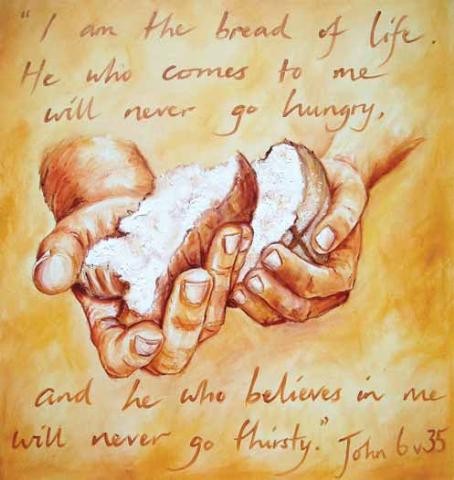
 Such background gives new meaning to Jesus’ words, “The bread of God is he who comes down from heaven and gives life to the world…I am the bread of life” (John 6:33, 35a).  In other words, he is the Sustainer of life.  Whoever comes to him can experience deep satisfaction of spirit (v. 35).

Jesus stands as the guardian of our abundant life now and eternal life in heaven yet to come.  He is also the guardian over of our minds and hearts, supplying peace, joy, comfort, and more.

Paul celebrated the magnificence of the Lord Jesus Christ at the close of Romans 8:

“I am convinced that neither death nor life, neither angels nor demons, neither the present nor the future, nor any powers, neither height nor depth, nor anything else in all creation, will be able to separate us from the love of God that is in Christ Jesus our Lord (vs. 38-39).

And now, what do these names signify to me?  Am I deeply grateful to my Lord Jesus Christ?  Are my thoughts, attitudes, and actions pure and holy gifts I can give back him– my Savior, anointed Deliverer, and Guardian of my life?

*     *     *     *     *     *     *     *     *     *

Lord Jesus, your very names proclaim astounding truths:  you are the Savior of the world!  In fact, you are the only Deliverer who can proclaim us “not guilty” before Almighty God.  And you are our Guardian, caring for our every need, when we depend upon you.  I praise and thank you for your love and grace, demonstrated supremely when you died in our stead.  Oh how I want my life to be a delightful Christmas present for you!

(photo & art credits:  www.babble.com, http://www.thefamily.com, http://www.ortzion.org, http://www.everydaywithmy savior.blogspot.com.)


Read Full Post »

 christmas-greetings-messages


When some folks say, “Merry Christmas” they mean, “I hope you have a fun and festive holiday.”

That would be in keeping with the definition of merry:  full of high-spirited gaiety, delightful, entertaining, joyful, and mirthful.

But centuries ago the word merry denoted peacefulness and blessedness.  “Merry Christmas” meant, “May you have a peaceful Christmas” and “May Christmas bring the blessing of God to you” (Christmas by Charles L. Allen and Charles L. Wallis, Fleming Revell Co., 1977).

An old carol highlighted this idea:

“God rest ye merry, gentlemen;

Let nothing you dismay.

Remember Christ our Savior

Was born on Christmas Day,

To save us all from Satan’s pow’r

When we were gone astray.”

Did you pause after the comma in the first line?  Without it, the meaning changes.  The anonymous poet was wishing peaceful, contented, joyful rest to others, as they remembered Christ their Savior.

“Merry Christmas,” then, can be a prayer within a greeting.  Something like:

Oh, Lord, may your spirit of peace rest upon the life of this person.  May he/she experience the blessing of your presence and your joy.”

There are many people around us who need a divine touch, especially during the Christmas season.  The merriment around these folks seems a mockery of their despair.  Perhaps that includes you.  May the prayers below speak a Merry Christmas blessing to you, especially if you are:

Lonely.  Oh, God, wrap a loving embrace of your comfort around those who do not have family or friends with them this Christmas.  I thank you for the promise that you are our refuge and strength, always ready to help when we need you (Psalm 46:1).  Be a warm solace, I pray, to the one who feels alone.

Enduring hardship.  Oh, God, may the blessing of Christmas include grace and mercy for your children who are suffering through difficulty.  Out of your compassionate mercy, ease their burden, and out of your unfailing grace, grant them strength and favor (Hebrews 4:16).

Struggling with painful memories of Christmases past.  Oh, God, shower your tender, loving care upon those with hurts from the past, hurts that cast a shadow over the joys of the present.  Grant them liberating freedom from emotional distress.  May your peace cover those memories, so they no longer cause anguish (John 14:27).

For all of us, Heavenly Father, may the blessing of Christmas include renewed wonder for the indescribable gift of your Son.  Thank you for providing through him the way to eternal life.  Such peace and blessing are ours in that single assurance! 

(art credit:  www.christmasgreetingsmessages.com.)

Read Full Post »

I love decorating our Christmas tree, even though it takes at least two days.

Two days?” you ask.  “Why so long?”

There are several very logical reasons – if you are me.

One:  It takes time to arrange the branches.  We have an artificial tree, you see.  (Cut evergreens don’t last long in Florida because of the heat, and Steve and I like to decorate right after Thanksgiving.)  That means, before decorating can begin, the tree has to be assembled and the branches spread out.

Two:  It takes time to string the lights.  Although pre-lit trees are convenient, they often include too few lights.  The rule of thumb is 100 lights per foot.  We put 1,000 lights on our eight-footer.  Some are tucked in, some arranged on the tips of branches.  This creates a tree that truly glows.

Three:  It takes time to hang the decorations — the ultimate 3-D jigsaw puzzle of Santas, angels, and miniature manger scenes, animals, toys, and traditional ball ornaments.  Dozens and dozens of them.  (And nearly all given to us by family, friends, members of the churches we’ve served, and students from my classes.)

Long ago I worked for a creative designer.  One aspect of her business included decorating Christmas trees for banks and businesses.  She taught me several tricks for creating a stunning display.  I’ve already shared the first rule:  Use lots of lights.

Two:  Consider the size, theme, and material of each ornament.  Try not to hang several Santas, or a group of red decorations, all together.

Three:  Just as lights are tucked in or perched on branch-tips, it’s important to do the same with ornaments.

Four:  Use the tree lights as spotlights for the ornaments, as often as possible.

A beautiful, glowing Christmas tree is in the carefully executed details.

tree 2012

(Photo taken before the last step:  settling the treetop angel in place.)

*     *     *     *     *     *     *     *     *     *

Something else that’s found in the details?  Wonder.

Yes, that statement could be applied to decorations.  There is a sense of wonder when studying a breath-taking display.

But more significant?  The glorious wonder to be found in the carefully executed details of the Christmas story, the events surrounding the birth of Jesus.

Beyond the familiar events of angel visitations, a trip to Bethlehem, Baby Jesus laid in a manger, and a shepherds’ hurried trek to see the newborn Messiah, there is much to appreciate in the details.

For example:

One:  Little did Caesar Augustus know he was being used by God to fulfill an ancient Messianic prophecy, when he decreed the census that sent Mary and Joseph to Bethlehem.  “But you, Bethlehem Ephrathah,…out of you will come for me one who will be ruler over Israel, whose origins are from of old, from ancient times” (Micah 5:2).  God is sovereign — even over those who do not know him.

Two:  Observe whom God chose to notify first about this pivotal event in history–the birth of his Son.  Shepherds!  Members of the lowest class in Jewish society!  Perhaps God wanted us to know that wealth, position, and even the respect of others is of little consequence in his eyes.  What does matter?  Faith.  “Without faith it is impossible to please God” (Hebrews 11:6).

The shepherds did believe – in the old Messianic prophecies and in the angel’s message:  “Today!  Right now!  In the little town of David, your Savior, the Messiah, has been born” (Luke 2:10-11)!  Those sheep herders scurried off to Bethlehem as fast as they could go.  And their faith was highly rewarded.  They were first to see the long-awaited King of kings, the Messiah.  Their lowly position in society didn’t matter.

Three:  Most wondrous of all?  The Son of God, who was with God and was God from the very beginning, became human (John 1:1-2).  The One who created all things (Colossians 1:15-16), chose to become a helpless baby, and embrace every aspect of the human experience through thirty-some years of earth-dwelling.

I like the way Eugene Peterson says it:  “God became one of us and moved into the neighborhood” (John 1:14, The Message)!

And how do we respond to such wondrous details?  We follow the example of those shepherds.  We praise and glorify our God for all the things we have heard and seen, which prove what we’ve been told (Luke 2:20).

*     *     *     *     *     *     *     *     *     *

I DO praise you, Heavenly Father, that early in life I heard about your Son and your gift of eternal life.  I invited you into my life, and have experienced your love, joy, and peace, just as you promised.  In fact, I have seen many of your promises fulfilled in my life and in the lives of others.  You have proven to me over and over that what we’ve been told in scripture is indeed 100% truth.  With Mary, I exult:  “My soul glorifies the Lord and my spirit rejoices in God my Savior” (Luke 1:46-47a)!

Read Full Post »

Crucifixion IV

Crucifixion IV (Photo credit: Remara Photography)

Seems like a cruel oxymoron, doesn’t it—to put the words glory and cross together. Glory carries positive connotations of splendor, radiance, and goodness. The cross is a symbol of horrific pain and suffering.

But the cross is also “an exhibition of the nature of God” (Oswald Chambers). You see, God’s glory is the fullness of who God is, his nature, and includes all his attributes and characters traits. Many of those attributes were at work when God provided the way of salvation for us. The glory of the cross includes:

1. Love

God demonstrated his own love for us in this: While we were still sinners, Christ died for us” (Romans 5:8).

Such love is incomprehensible. How could he possibly desire to be in relationship with us? How could he delight in us, frail and self-centered as we are? It makes no sense.

Yet, he sent his Son, Jesus, to take the punishment we deserved and to offer us eternal life. When we invite Jesus into our lives, God takes us from the gutter of depravity and elevates us to the status of beloved children. We are adopted into the family of God (Ephesians 1:5). Incredible!

2. Grace

“In him we have redemption through his blood, the forgiveness of sins, in accordance with the riches of God’s grace” (Ephesians 1:7).

What is grace? All the facets of God’s love—his forgiveness, benevolence, presence, peace, provision, and more—made available to us, who don’t deserve it. Grace prompted God to provide a way for us to experience his love—through the sacrifice of his only Son.

Did you notice? God is the one who provided the way to him; we do not have to figure it out for ourselves, and then hope for the best. By God’s grace, he has made salvation (rescue from death) a sure thing. We can know our place in heaven is secure!

God’s grace, put on display at Calvary, sets Christianity apart from any other belief system in the world.

3. Power

I pray that…you may know…his incomparably great power for us who believe…, which he exerted in Christ when he raised him from the dead” (Ephesians 1:18-21).

No one can raise someone from the dead except God. When Jesus was resurrected, he demonstrated his power over death, and proved the validity of eternal life, not only for himself, but for all those who believe in him.

But Jesus’ resurrection was not the end of his mission. Read the next couple of verses (22-23) to discover that, after Jesus rose from the dead and ascended back to heaven, God seated His Son at his right hand (the seat of honor). Now Jesus’ power and authority is above all other rule and authority in the universe.

And someday, Jesus will share that power with us. Those of us who have accepted Jesus into our lives will reign with him in heaven (2 Timothy 2:12). My heart is filled with wonder and awe at such a privilege.

4. Faithfulness

God, who has called you into fellowship with his Son Jesus Christ our Lord is faithful” (1 Corinthians 1:7).

Faithful to forgive. Faithful to see us through the journey of this life. Faithful to win the battle over evil in the end. Faithful to keep his promise of eternal life, because of the sacrifice of his Son on the cross.

Our faithful God made salvation so simple for us, but it cost him so much.

5. Justice

“All have sinned and fall short of the glory of God, and are justified freely by his grace through the redemption that came by Christ Jesus…He did this to demonstrate his justice” (Romans 3:23-26).

We all deserve punishment, and our guilty consciences confirm that truth. But God made it possible for us to be forgiven and ushered into relationship with him. He declared us “not guilty” because Jesus paid the penalty..

I love the way Eugene Peterson explains it in his paraphrase, The Message: “Out of sheer generosity he put us in right standing with himself. A pure gift. He got us out of the mess we’re in and restored us to where he always wanted us to be. And he did it by means of Jesus Christ” (Romans 3:23-24).

A pure, precious gift; paid for at Calvary. The glory of the cross.

For you. For me.

Read Full Post »

« Newer Posts - Older Posts »

When the House is Quiet

Impressions Becoming Expressions

Mitch Teemley

The Power of Story

Still Traveling

Impressions Becoming Expressions

Living Our Days

Gaining a heart of wisdom

He Said What?!

I'm Patty, and my husband and I are living with our adult son who has autism and epilepsy. I love sharing lessons learned from life around me, especially life with Aaron.

Meditations of my Heart

Impressions Becoming Expressions

Linda Stoll

Impressions Becoming Expressions

Signora Sheila

Notes on Life, Faith & Italy

Heidi Viars

Finding the Image of God