Feeds:
Posts
Comments

I AM


“I AM WHO I AM.”

That’s how God identified himself to Moses, as he spoke from the burning bush (Exodus 3:14).

On the face of it, God’s statement seems rather strange.

I don’t mean to be disrespectful, but doesn’t it sound like a line Lewis Carroll would write for the Mad Hatter, or Dr. Seuss for the cat in the hat?

Moses had asked a legitimate question in response to God’s directive to return to Egypt and tell Pharaoh to let the Israelite slaves leave the country (v. 11).  On what authority could he tell Pharaoh what to do?

But of course “I AM WHO I AM” was the perfect response. It’s a name that encompasses all the glorious complexities of almighty God.

And true to his word and character, the I AM of omnipotence and wisdom did take care of everything to release his people from Pharaoh’s grip and take them back to the land of their forefathers.


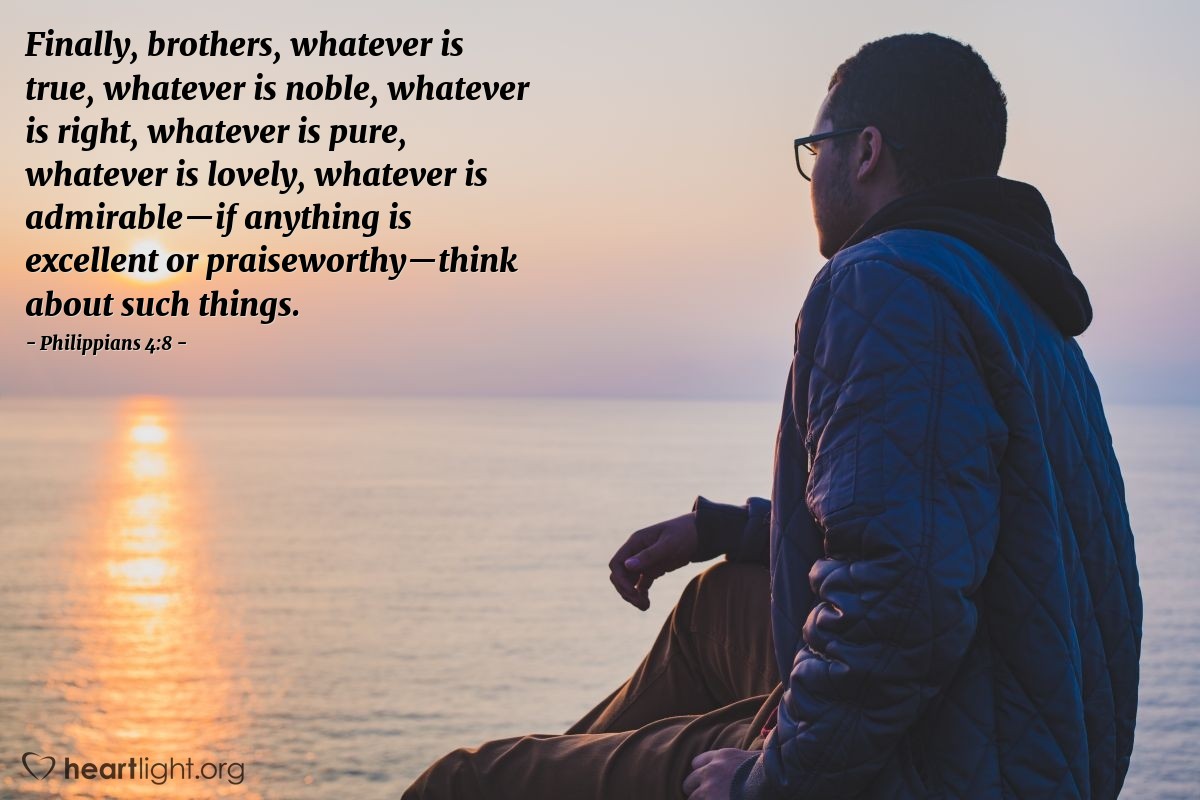
And since God never changes (Malachi 3:6), the same I AM is everything and anything we will ever need (Philippians 4:19), including the following.

Let’s shout these affirmations from our spirits:


The I AM of absolute power and sublime perfection

is our stability and security (1).


The I AM of self-existence and self-sufficiency

is our foundation and competence (2).


The I AM of supreme sovereignty and divine holiness

is our confidence and sanctification (3).


The I AM of firm constancy and unrivaled transcendency

is our inspiration and strength (4).


The I AM of complete wisdom and absolute knowledge

is our counselor and guide (5).


The I AM of abiding faithfulness and assured reliability

is our help and support (6).


The I AM of unfailing love and generous benevolence

is our encourager and comforter (7).


The I AM of enduring patience and exceeding kindness

is our peace and joy (8).


The I AM of deep understanding and gentle compassion

is our defender and reconciliation (9).


The I AM of bountiful mercy and lavish grace

is our Redeemer and Savior (10).


The I AM of righteous integrity and overflowing goodness

is our Shepherd and provider (11).


The I AM of splendorous glory and royal majesty

is our Father and Friend (12).


Listen to his affirming whisper:

“I AM in you, with you, and for you. 

When doubt or fear seep into your thoughts, remember who I AM and send those negative thoughts scurrying.  

Rest in who I AM; enjoy who I AM— the One who delights to bring all My attributes and blessings to bear upon your life.

Take joy also in the principle of reflection. The more time you spend in My presence, even as you’re involved in other tasks, the more you will reflect Me and My character to others. 

As you look to Me, you will be radiant.

And those around you will see who I AM.


(1 Corinthians 3:16; Psalm 23:4; Romans 8:31; Psalm 143:5;

Psalm 145; 2 Corinthians 3:18; Psalm 34:5; Matthew 5:16)


Notes:

  1. Matthew 19:26; Psalm 18:30; Psalm112:7; Proverbs 3:26
  1. Psalm 90:2; Acts 17:24-25 and Romans 11:36; Psalm 18:31; 2 Corinthians 3:4-5
  1. 1 Chronicles 29:9-11; Isaiah 6:3; Proverbs 3:26; 1 Corinthians 6:11
  1. James 1:17; Psalm 113:5-6; Isaiah 41:10; Psalm 46:1
  1. Romans 11:33; Job 37:15-16; Psalm 32:8; Isaiah 58:11
  1. Psalm 33:4; Psalm 121:3; Psalm 33:20; Psalm 18:35
  1. 1 John 4:8; Psalm 31:19; Isaiah 41:10; 2 Corinthians 1:3
  1. 1 Corinthians 13:4; 2 Thessalonians 3:16; Psalm 4:7
  1. Psalm 103:14, 8; Psalm 138:7; Colossians 1:20-22
  1. Exodus 34:6-7; Isaiah 44:22; Isaiah 45:21-22
  1. Deuteronomy 32:4; Psalm 25:8; Isaiah 40:11; Psalm 145:9
  1. Exodus 15:11; Psalm 93:1; 2 Corinthians 6:18; John 15:14


Photo credits:  http://www.maxpixel.net; http://www.canva.com (3); http://www.heartlight.org; http://www.needpix.com; http://www.flickr.com.


A Place of Honor

Ask a church gathering, “What’s your favorite psalm?” and many folks will name #91 for its reminders of God’s goodness and power.

They’d be in good company. The great theologian, Charles Spurgeon wrote:

“In the whole collection there is not a more cheering psalm,

its tone is elevated and sustained throughout,

faith is at its best, and speaks nobly…

He who can live in its spirit will be fearless” (1).

That fearlessness would certainly be encouraged by the eight promises of verses 14-16:

Note that God promises:

Rescue, protection, and deliverance (vs. 14-15)—not from trouble, but through it. He does not promise a life of ease and bliss. However, “the only things faithful people can lose in suffering are things that are finally expendable” (2).

Answers to every prayer (v. 15)—answers that always reflect God’s perfect knowledge of all things, his wisdom and grace, even when the answer is wait, or even no.

His steadfast presence (v. 15)—“Few delights can equal the mere presence of one whom we trust utterly” (George MacDonald).

Salvation (v. 16)—“I have summoned you by name; you are mine,” God has said (Isaiah 43:1). We belong to him, purchased at an exorbitant price:  the precious blood of his own Son.

But upon first reading, one promise puzzled me, and another actually startled me.

First, the puzzle. In verse 16 God promises long life. And yet all of us have been devastated by lives cut short.  How are we supposed to interpret this promise?

With a long view into eternity.

Once we experience the glory of God and his heaven, we’ll no longer be concerned about the number of days any of us spent on earth. We’ll only delight in the fullness of God’s presence and all the eternal pleasures he’s prepared for us (Psalm 16:11).

And then there is the startling promise: that God will honor us (v. 15), as in confer special esteem, respect, and distinction with deferential regard (3).

But he’s the one who deserves honor. Our God is all-powerful, all-wise, all-knowing, omnipresent and eternal—to name a few of his attributes.  What could we possibly do to warrant his honor?

Not a thing. But scripture assures us: those who honor him he has chosen to honor in return (1 Samuel 2:30).

Imagine standing in the splendorous throne room of almighty God as he announces:

  • The removal of your filthy rags of sin, to be taken as far as the east is from the west (Psalm 103:12)

  • The magnificent robes of His Son’s righteousness placed around your shoulders (Isaiah 61:10)
  • Your official standing as his child (Romans 8:15-17)

  • The privilege of companionship with him any time of day or night (Revelation 3:20)
  • Tasks to provide purpose and satisfaction in life (Ephesians 2:10)
  • Countless blessings to bestow joy and pleasure (Psalm 40:5)
  • Eternal life granted through his Son Jesus (1 John 5:11-12)

These honors and more are the extravagant expressions of God’s infinite love for you.

 https://www.azquotes.com/quote/1404884

An expanded excerpt from Ms. Smith increases the wonder:

Put together all the tenderest love you know,

The deepest you have ever felt,

And the strongest that has ever been poured out upon you,

And heap upon it all the love

Of all the loving human hearts in the world,

And then multiply it by infinity,

And you will begin, perhaps,

To have some faint glimpse of the love God has for you.”

–Hannah Whitall Smith

There are two caveats, however, presented in verse 14. These promises, including the conferral of God’s honor, are reserved for those who love him and acknowledge his name (affirm the reality of his attributes in their lives).

The psalmist is not talking about a warm, congenial feeling for God; he’s talking about a love put into action with trust and obedience.

As humans, our default mode is often self-reliance and independence. But what could be more sensible than to trust and obey One who is all-seeing and all-wise, who loves perfectly and honors lavishly?

*     *     *     *     *     *     *     *     *     *

Oh, Father, how foolish I have been at times, willfully rebelling against your leadership.  May I choose daily the place of honor you’ve sacrificially prepared for me by loving you wholeheartedly, trusting you for guidance, provision, and protection, and following your wise ways.      

Notes:

  1. Charles Spurgeon, The Treasury of David
  2. Timothy Keller and Kathy Keller, The Songs of Jesus, Viking, 2015, p. 226 (emphasis added)
  3. Webster’s II New College Dictionary

Art & photo credits:  http://www.flickr.com; http://www.canva.com (4); http://www.azquotes.com; http://www.pixhere.


Jurgen Moltmann’s eyes searched the German forest for a glimpse of his fellow soldiers’ Nazi gray uniforms. Somehow he’d gotten separated from his unit and was now alone near the front lines.

Not far ahead he detected movement in the trees, then spotted a brown army jacket and the unmistakable shape of the other soldier’s helmet: British.

Moltmann made a split-second decision. He put his hands on top of his head, and walked toward the enemy. After a year and half of war, after enduring nightly bombing raids in Hamburg and witnessing the horrific deaths of friends, Moltmann decided he’d endured enough.

It wasn’t a war he believed in anyway. Hitler had cut short his education in 1943 when Moltmann’s whole class was assigned to the anti-aircraft batteries in Hamburg. He’d been just sixteen years old.

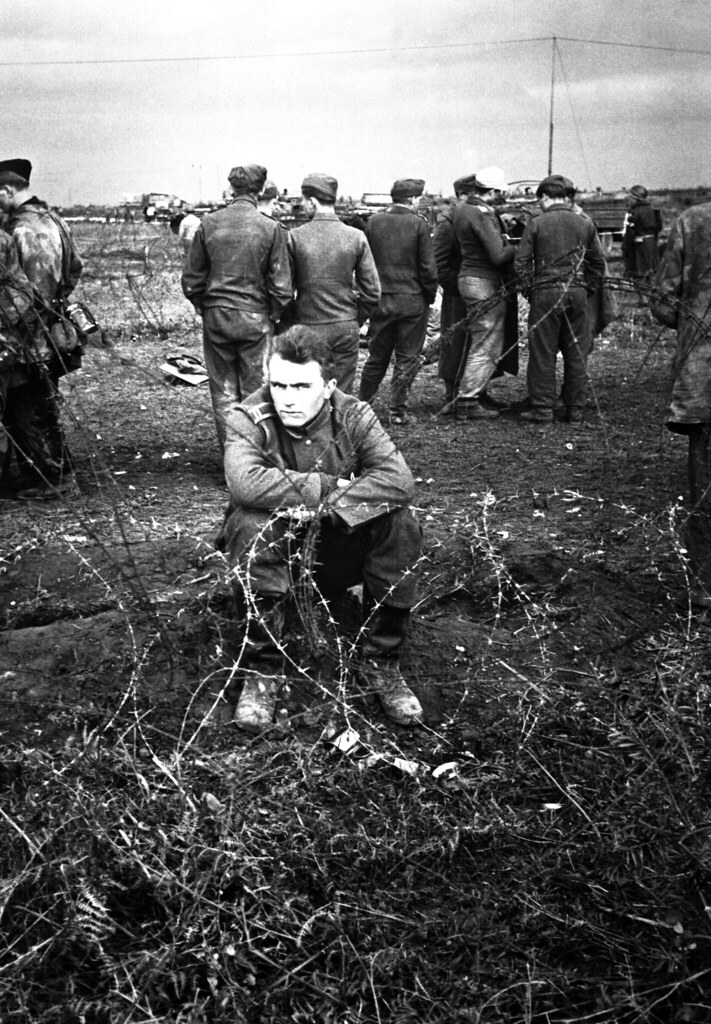
As he approached the British soldier, Moltmann thought, Being a POW can’t be worse than the war itself. But behind the barbed wire of the camp in Belgium he suffered horrific nightmares, felt unrelenting guilt for what his country had done, and collapsed into deep depression and hopelessness.


German prisoners, February 1944


Later Moltmann was transferred to Kilmarmock, Scotland, assigned to a POW road crew. Relentless rain drummed on their backs day after day. To and from the work site he and fellow prisoners rode in trucks—silent, with heads down near their knees. “It was a picture of real forsakenness,” Moltmann later recounted (1).

While in Scotland, a U.S. Army chaplain gave Moltmann a Bible, and out of boredom he started to read. In the book of Mark he encountered another Man who also knew forsakenness, and soon the young soldier came to believe in Christ.

The war ended in April of 1945 but at least 400,000 German prisoners were kept in the British camps, to be repatriated to their homeland one boatload at a time. Germany had been decimated; there weren’t enough places to live nor enough food to eat if all the prisoners were returned en masse.


In 1946, Moltmann was transferred to Norton Camp in Nottinghamshire, England, which the YMCA helped to run. Though still prisoners, the men were allowed to study education or theology.

Moltmann chose the latter, anxious to understand more of his newfound Christian faith. He took advantage of the large library and proffered lectures. He learned Hebrew and Greek.

Frank and Nellie Baker, a young pastor and his wife, served several small churches in the area. God gave them the desire to minister to the POWs of Norton Camp. With the commander’s permission, the couple took a prisoner home for dinner each Sunday after worship.

Moltmann was one of them. “The seed of hope was planted in my heart around Frank and Nellie Baker’s Sunday dinner table,” he said (2).

In 1947, he attended a Student Christian Movement conference. There he experienced reconciliation with young men and women who had fought for the Allies.

As a result of the forgiveness and increasing hope in his spirit, Moltmann decided to continue his study of theology once he returned to Germany, to better understand “the power of hope that had saved his life” (3).


Since Moltmann had been one of the last Germans captured, he was one of the last to be sent home, in 1948. By 1952, he had earned a doctorate degree and become pastor of the Evangelical Church of Bremen-Wasserhorst.

In subsequent years he taught theology at an academy (1958-1963), then Bonn University (1963-1967), and finally the University of Tubingen (1967-1994).

Moltmann also wrote forty-three books. The first, published in 1964, carried a highly appropriate title: The Theology of Hope. And today he is regarded as “one of the most significant theologians of the age” (4).


Jurgen Moltmann, March, 2016


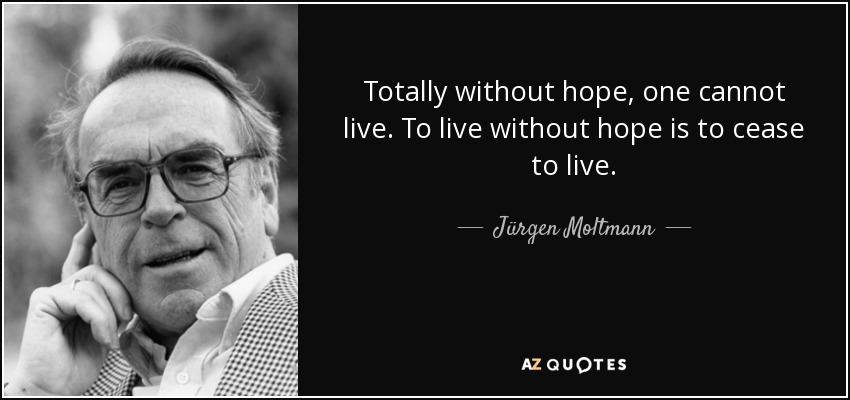
But if it weren’t for hope, we’d surely not know of Jurgen Moltmann because “without hope one cannot live,” he wrote. “To live without hope is to cease to live. Hell is hopelessness. It is no accident that above the entrance to Dante’s hell is the inscription: ‘Leave behind all hope, you who enter here’” (Theology Of Hope).


https://www.azquotes.com/quote/843177


Moltmann’s transcending hope prospered in the war’s aftermath, even amidst the decimation, grief, and uncertainty, because he embraced what Christ offered him: resurrection hope.

“Hope finds in Christ not only a consolation in suffering, but also the protest of the divine promise against suffering. If Paul calls death the ‘last enemy’ (1 Cor. 15:26), then the opposite is also true: that the risen Christ, and with him the resurrection hope, must be declared to be the enemy of death” (Theology of Hope) (5).

That gleam of resurrection hope has now been shining through Jurgen Moltmann for over seventy years, impacting for eternity countless others.

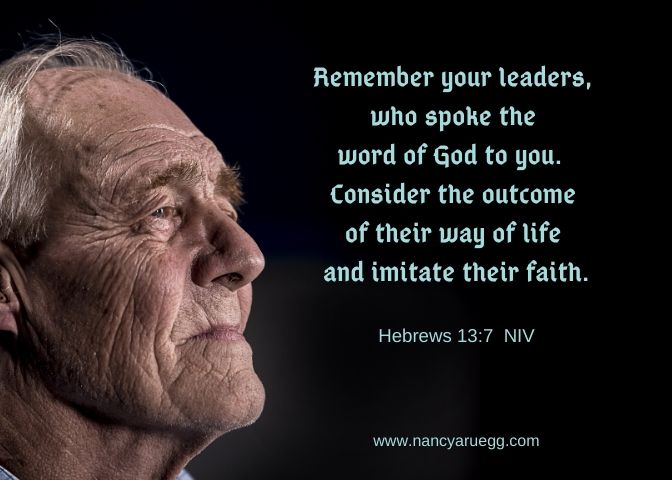
We would do well to remember him, consider his way of life, and imitate his faith (Hebrews 13:7).


Notes:

  1. https://highprofiles.info/interview/jurgen-moltman/
  2. http://www.jacoblupfer.com/blog/2015/2/28/where-jurgen-moltmann-found-hope
  3. https://scienceandbelief.org/tag/norton-camp/
  4. https://www.christiantoday.com/article/liberation-and-hope-10-of-the-best-jurgen-moltmann-quotes/83599.htm
  5. https://ryandueck.com/2007/06/19/moltmann-on-hope/


Sources:

https://highprofiles.info/interview/jurgen-moltman/

www.jacoblupfer.com/blog

https://scienceandbelief.org/tag/Norton-camp/

https://spu.edu/depts/uc/response/spring2k8/features/wartime-blessings.asp

Grace Notes by Phillip Yancey, Zondervan, 2009, p. 116.

Volume 10, Tome 1, Kierkegaard’s Influence on Theology: German Protestant Theology, edited by Jon Stewart.


Photo credits:  http://www.needpix.com; http://www.flickr.com (2); http://www.dailyverses.net; http://www.simple.m.wikimedia.org; http://www.az quotes.com; http://www.canva.com.


Heaven to Your Soul

(from https://quotefancy.com)


Heaven to our souls.

Sounds glorious, doesn’t it? No stress, no pain, no enigmas.

But on any given day, doubt and worry crowd heaven out:

  • When will God answer our prayer? And what if it’s not the answer we’re hoping for?
  • Where is God? Why doesn’t he come to our rescue?
  • Did I miss his guidance?

Such questions have plagued us all at sometime or other. But watch the saints of great faith. You’ll see men and women who demonstrate considerable confidence and assurance with negligible doubt and worry.


Their great faith isn’t just happenstance. Observe closely and you’ll note various habits of those saints—habits we’d do well to adopt:

To begin, Ask God for more faith. Such an obvious step; so easy to overlook. Yet it’s a request God surely delights to fulfill (1).

Affirm the truths and promises of the Bible. Soak up its wisdom, examples, and encouragement (2)—daily.

Pray about everything to ward off the worry. Write down requests, leaving room to record answers. As visible evidence of God’s faithfulness increases, so will our faith in him.

Twenty years ago I switched from using a prayer list to writing requests on 3 x 5s. They offer more room to note progress and resolutions when they come. I’ve kept the cards as concrete proof of God’s faithfulness.

Here’s the 3″ stack of answered prayers so far.  (Some cards contain multiple concerns and answers.):


Granted, God has not fulfilled every request to my preference. Instead, he did what was right, according to his infallible wisdom and far-reaching purpose (3)—and for that I’m most grateful.

Thank God—in advance—for his responses to prayer. “There is nothing that so fully solidifies faith as being so sure of the answer that you can thank God for it” (Rev. Charles Henry Parkhurst, 1842-1933).

In addition, praise God for his power at work, even though there’s no evidence yet (4).


Envision the outcome, perhaps something like this:

 It breaks our hearts, Father, to see _______________ suffer because of health issues, a dysfunctional family, and financial pressures. We put our hope in you, our Great Physician, the Prince of Peace, and the Lord who Provides. We look forward to the day when physical limitations are removed, family members respond to your Spirit, and miraculous provision eases her financial burden. We praise you in advance, knowing you are already at work to bless ________________.  Amen! 

Surround yourself with other believers in pursuit of great faith. “Iron sharpens iron” (5); faith-seekers sharpen faith-seekers–with their support, challenge, and encouragement.


Adopt faith-building practices. For example, post encouraging scriptures around the house. One useful spot is the bathroom mirror. While face-washing and teeth-brushing, recite faith-enhancing words from the Bible.


Expect your faith to be tested. Just as our physical bodies require strenuous exercise for optimum health, so does our faith. It’s the difficulties of life that provide it.

“Faith untried is simply a promise and a possibility,” said Oswald Chambers. “Tried faith is pure gold.”

~  ~  ~ ~  ~  ~  ~  ~  ~  ~  ~  ~  ~  ~  ~

These seven habits will produce great faith, which in turn bring heaven of the soul.

 And what might heaven of the soul include? Three elements make my short-list:

  • Peace

As we pour out our concerns in prayer, God pours in his peace—peace so profound it transcends all understanding (6).


  • Joy

Author and life coach Paul Sailhamer offers this definition of joy born out of great faith: “Joy is that deep settled confidence that God is in control of every area of my life.” Such joy provides rock-solid strength, not shaken by circumstances.

  • Optimism

People of great faith focus on the positive, affirm God will bring good out of every situation, and look forward with eager anticipation to see what God will do (7).

Imagine the interior of your soul filled with the ambiance of peace, the beauty of joy, and the golden light of optimism. Sound heavenly?


Great faith makes it happen.


What habits of faith-filled people have you noticed?  Or, what habits do you personally practice that build confidence in God?  Please share your observation/experience in the comment section below!


Notes:

  1. Matthew 21:22
  2. Romans 10:17
  3. Romans 11:33-36
  4. Hebrews 11:1
  5. Proverbs 27:17
  6. Philippians 4:6-7
  7. Philippians 4:8; Romans 8:28; Ephesians 3:20


Photo credits:  http://www.quotefancy.com; http://www.maxpixel.net; Nancy Ruegg; http://www.dailyverses.net; http://www.jble.af.mil; http://www.maxpixel.net; http://www.dailyverses.net; http://www.pxhere.com.


Walking Sticks


“Here’s what I’ve been looking for!” My husband propped his walking stick against a forest tree and pulled from the underbrush a straight, stout branch about my height. With his pocketknife he whittled off several small branches and gifted me my own walking stick. “Try this, “ he coaxed. “It really helps.”

I’d been groaning through the incline portions of our hike in the Appalachian foothills. Yes, exercise and walking were part of my routine at home, but we lived in the flatlands of Florida at the time. The upward slopes of this footpath were causing my leg muscles to complain loudly.

What a surprising difference that branch made!  Swinging it ahead helped propel me forward. I felt more stable in the uneven and slippery places with the walking stick to provide balance.  And leaning into it as I hefted myself up steep inclines did take some of the stress off my aching legs.

That experience brings to mind a familiar truth tucked in Psalm 23:


Your rod and your staff comfort me.”


Just as that walking stick gave me relief on the trail, the staff of God’s Word has offered much relief on the path of life.

For example:

As a young wife and mother, discouraged by the mindless repetition of housework, I came across this staff of scripture to propel me forward:


The realization dawned that taking care of my family was equivalent to serving him. And though it would be a lie to say from that day forward I happily swept, scrubbed, and sanitized, I did carry with me a new perspective.


When distraught over my faults and deficiencies, God handed me this walking stick of relief:


“I am sure of this, that He who started a good work in you

will carry it on to completion until the day of Christ Jesus…

For it is God who is working in you,

enabling you both to desire and to work out His good purpose.”

–Philippians 1:6; 2:13 HCSB


What a loving, attentive Father he is, day after day working out his plan and blessing upon our lives, slowly but surely transforming us into our best selves.


When distraught over election results, I leaned on the comforting truth of Daniel 2:20-21:


“Praise be to the name of God for ever and ever; wisdom and

power are his. He changes times and seasons; he deposes kings and

raises up others. He gives wisdom to the wise

and knowledge to the discerning.”


What a relief to know he is sovereign over the universe, and everything is under his control.


When I was heartbroken after a young friend died as the result of a car accident, I desperately wanted to know why. Why didn’t God answer the prayers of countless people and bring her out of the coma?

Shelly was a talented pianist with a short-term missionary assignment pending. Why didn’t he save her?

God gave me the stabilizing staff of Romans 11:33-36, to help me walk through my questions and grief:


“Oh, the depth of the riches of the wisdom and knowledge of God!

How unsearchable his judgments, and his paths beyond tracing out!

Who has known the mind of the Lord? Or who has been his counselor?

Who has ever given to God, that God should repay them?

For from him and through him and for him are all things.

To him be the glory forever! Amen.”


Those last two statements brought sudden clarity. Everything—even painful eventscome through God first before they touch us. And somehow it all has potential to bring him honor and praise. The answer to my question why isn’t necessary.


“Each of us may be sure that

if God sends us over rocky paths,

He will provide us with sturdy shoes.

He will never send us on a journey

without equipping us well.”

–Alexander MacLaren


And with those sturdy shoes of equipping, praise God he also provides walking sticks of stability, support, relief, and comfort in his Word–if we keep a watchful eye.


What walking sticks in scripture have offered you stability, support, relief, and comfort?  Please share in the comments section below!


Photo credits:  http://www.pxhere.com; http://www.dailyverses.net; http://www.flickr.com; http://www.heartlight.org;  http://www.canva.com (2); http://www.wikimedia.org.


Mindfulness PLUS

“Would you look at this?” my friend exclaimed. Her outstretched hand waved over a selection of magazines in our favorite place to meet, a local bookstore/cafe.


Do you see what caught Cindy’s* eye? That word “Mindfulness” or “Mindful” shouted from nine different periodicals.

After the initial surprise, we realized why mindfulness is such a hot topic.  These days many adults are under great pressure to push themselves hard, move faster and accomplish more each day. All the while electronic devices are demanding their attention.

Add to that the worries rasping in their minds: the mistakes and failures of yesterday, the tight schedule and uncertainties of tomorrow, and fears for the future.

The pace, stress, and anxiety take their toll in the form of health problems, sleep disorders, and relational strain.


As a result, many have embraced mindfulness—a pleasurable time-out to capture the joy of now–like pausing to savor the tart, crisp, juiciness of an apple, stopping to listen as small bare feet patter down the stairs, or taking a moment to study a chipmunk collecting acorns.

And according to the research, just a brief interlude of mindfulness can calm the nerves, reset one’s emotional equilibrium, and foster contentment—all to positive effect upon our physical, mental, and spiritual well-being.

But I wonder, how many people know God offers even more–if we augment mindfulness with gratitude and praise?


For example, while doing the dishes I can focus on the hot water warming my hands, the clean scent of soap, the rainbowed bubbles floating in a bowl, the burbling water cascading over glasses and cups–then add a short prayer:

Thank you, Father, for giving us five senses

with which to enjoy your world.


While traveling in the car I can take note of the late summer haze clinging to the hillsides, today’s cloud exhibition, and the leaves on the roadside performing pirouettes on the breeze–then honor the Lord of all things:

I praise you, Father, for your creative genius

on display everywhere I look.


While reading a book with my two-year old granddaughter, I can pay attention to the sensation of her little body snuggled into my side, the sweet sound of her toddler-voice “reading” some of the words, and the dimples on the back of her hand as she points to a picture–then express gratitude to the Giver of all good gifts:

Thank you, Father, for the delights to be found

beneath the surface of ordinary experience.


Each day I can pause to observe the rose-pink tint of dawn, the dappled treetops in the noonday sun, and the slow glide of shadows at sunset–then rejoice in God’s power and glory.

My mouth is filled with your praise, O God,

declaring your splendor all day long.”

–Psalm 71:8


Mindfulness may prod us to notice God’s gifts in the moment, and that’s good.

But mindfulness plus gratitude and praise prompt us to treasure him, and that’s transformational.

God’s presence becomes palpable (James 4:8), joy sings in our hearts (Psalm 92:4), contentment settles in our spirits (Isaiah 26:3).

And the Giver of all good things surely smiles with pleasure in response.


*Name changed.


Photo credits:  Nancy Ruegg; http://www.pxhere.com; http://www.dailyverses.net; http://www.pexels.com; http://www.pixabay.com; http://www.pexels.com; http://www.pixabay.com; ww.canva.com.)


Interesting, isn’t it, how the slightest trigger can transport us back through time?

  • A song might remind us of that first date with our spouse
  • The fragrance of lilacs brings to mind a previous home
  • The first bite of a family recipe at Thanksgiving conjures up bittersweet memories of another table long ago


They say that the memory of everyone we’ve known, every place we’ve been, and everything that’s happened to us is submerged in our subconscious. And the slightest nudge—haphazard as it might be–can bring a memory bobbing to the surface with surprising force.

But there’s another kind of remembering—a deliberate quest to seek truth for our lives—to understand how the hurts, mistakes, and losses, the treasured times, precious people, and lessons learned, reveal God’s work within us and for us, bringing good from it all.

For example, looking back through our memories we see:


God has given us strength to persevere.

At times we thought we’d never make it. Friends proved unfriendly and while the sting smarted we struggled to understand why the relationship went wrong.

Circumstances turned our lives upside down and we couldn’t see how to make things right again.

Death claimed a loved one and the pain seemed unbearable, unending.


But here we are. We survived, because God brought us through each calamity.


God has taught us the value of his wisdom.

Most of us have made choices along the way that seemed right but proved wrong.

Perhaps it was a relationship with someone whose habits provided troubling warning signs, but we ignored them and later suffered heart-rending hurt.

Or, perhaps we pursued an appealing, self-serving dream, only to discover its fulfillment did not produce the satisfaction we expected.

Some of us had to learn the hard way: God’s wisdom in scripture is truth after all, including his warning against relationships with fools (Proverbs 13:20) and the emptiness of selfish gain (Ecclesiastes 2:1-11).


But he also promised blessing for those who follow his all-wise guidance:


“Whoever gives heed to instruction prospers,

and blessed is the one who trusts in the Lord.”

–Proverbs 16:20


God has demonstrated his faithfulness in countless ways.

Consider the categories listed below and allow your memory to plumb the depths, bringing to the surface people, places, and events from the past that reflect God’s faithfulness:


  • Nurturing family members
  • Loyal, supportive friends
  • Secure places of contentment
  • Health issues resolved
  • Knots of circumstances untangled
  • Necessities miraculously provided
  • Blessings bestowed, not even asked for

 And what can we anticipate as the result of this kind of remembering?

Peace.

Because we realize for all our yesterdays, God has…

…enabled us to power through on his strength,

…provided his wisdom to guide us through murky circumstances,

…and been at work in our lives for our benefit—sometimes in the form of gifts, sometimes in the form of lessons.


Such reassurances can settle fear, doubt, and worry, allowing peace to flourish today and into all our tomorrows.

This kind of remembering intentionally entwines past and future so memories become woven into faith-filled expectation.


(Photo credits:  http://www.flickr.com; http://www.pixnio.com; http://www.canva.com; http://www.needpix.com; dailyverses.net.)


Here We Go A-Marveling


Generations ago, an ancestor of pastor Fred Craddock suggested that Sunday afternoons be spent on nature walks to find and admire God’s handiwork. He called it, “going marveling (1).”

That phrase brought to mind the old Christmas carol, “Here We Come A-Wassailing.”  ‘Remember the first few lines?


Here we come a-wassailing

Among the leaves so green,

Here we come a-wand’ring

So fair to be seen.


If we’d accompanied Pastor Craddock’s forbearers on one of those woodland hikes, perhaps we would have sung:


Here we go a-marveling

Among the leaves so green,

All around creation charms;

Such fairness to be seen.


Indeed, our God of wonders provides fairness (as a synonym for splendor) in countless ways:


from the majestic…


…to the minute,


From the firm…


…to the fragile,


From the colorful…


…to the camouflaged.


“Wows come in all shapes and sizes.”

–Anne Lamott


But there are many more sources of jaw-dropping awe that deserve our attention.

We can go a-marveling at the wonder of us.

Consider these wows:

  • Approximately sixty thousand miles of blood vessels course through the human body—enough to wrap the earth more than twice (2).
  • Blood travels 12,000 miles per day through the vascular system.  That’s equivalent to the distance from coast to coast across the U.S.—four times (3).
  • Human hemoglobin that makes our blood red is made up of extremely complex molecules. Each contains 9520 atoms of various elements, hooked together in a precise pattern (4).


Hemoglobin Molecule


Astounding, isn’t it?  And with King David we can certainly affirm:


We can go a-marveling through our memories. Perhaps you remember such delights as these: 

  • Coming in from the cold to be warmed by thick, hot soup and familial love around the table
  • Almost floating down the sidewalk on the first warm day of spring—with no coat or boots to weigh you down
  • A board game with friends—complete with popcorn and laughter


Even such ordinary events as these inspire wonder, because they point to a God who orchestrates satisfying moments into all our days.

We can also go a-marveling through the memories of miracles.

No doubt you’ve experienced spectacular moments such as these:

  • A new job provided just as the old one was terminated
  • The cost of a new refrigerator covered by a surprise check in the mail
  •  A baby born dangerously premature that not only survives but thrives


And while marveling at the miracles…

…We can go a-marveling at the wonder of prayer, which often precedes God’s astounding works.

First, our all-powerful God allows mere humans to come alongside him as he engineers events and accomplishes his good purposes.

Second, and even more marvelous, his Spirit comes alongside us as our partner in prayer, helping us pray as we should.


How wondrous is that?

Finally, we can go a-marveling through scripture.

The Bible was written by at least forty authors from different walks of life, over the span of 1500+ years, on three continents. No other book has come into existence out of such wide-reaching diversity. And yet the reader can’t help but notice the unity of its content.

Within the pages of scripture we find wisdom and inspiration for living, strength for difficulty, comfort for pain, and peace for unrest.

It’s true:  those who know their Bibles best, marvel at its truths the most. They notice “wonder after wonder, and every wonder true” (St. Brude).


And where might all this marveling lead?  To still more wonders:   stronger faith, deeper contentment, and greater joy.


*     *     *     *     *    *     *     *     *     *


Who is like you, O God—majestic in holiness, awesome in glory, continually working wonders? Our lives are FULL of marvels, O God!  May we be lost in wonder, love, and praise, just like the old hymn writer proclaimed. 

(Exodus 15:11; “Love Divine, All Loves Excelling” by Charles Wesley)


What are you marveling in today?  Tell us in the comment section below!


Notes:

  1. Fred B. Craddock, Craddock Stories, ed. Mike Graves and Richard F. Ward, p. 65.
  2. https://my.cleveleandclinic.org>health>articles>17059
  3. https://iheartintelligence.com/35-incredible-facts-about-the-human-body-that-might-surprise-you/
  4. John Phillips, Exploring John’s First Epistle, Kregel Publications, 2003, p. 36.


Art & photo credits:  http://www.pixabay.com (2); http://www.pxhere.com; http://www.usnhistory.navylive.dodlive.mil; http://www.maxpixel.net; http://www.flickr.com (2); http://www.wikipedia.org; http://www.heartlight.org; http://www.maxpixel.net; http://www.usafe.af.mil; http://www.dailyverses.net; http://www.needpix.com.


The In-Crowd


Remember the in-crowd at your high school–the cool kids who wore the latest fashions, knew the latest songs, and seemed more attractive, confident, and important than everyone else?

‘Truth is, research has established “those who cared most about their social standing [as teenagers] often grow up to have difficulties with their interpersonal relationships years later.” Their fixation on status stays with them, and they are the ones most likely to suffer from anxiety, depression, and problems with substance abuse (1).

Now I’m thankful to never have been a part of that group.

But another in-crowd beckons–one that everyone is invited to join–that offers satisfaction in life and purpose.

It’s God’s in-group.


And just what does he have to offer?

God’s in-crowd is in their right minds (2 Timothy 1:7 NKJV).

They strive to focus on the positive, and turn their attention toward God himself—His attributes and works. People in their right minds are Presence-focused, remembering the almighty, all-wise God is with them. They’re also promise-fortified, affirming that God WILL keep their minds calm because they trust in him.

Such trust requires effort, since we often lean toward the negative. But like a wrangler who captures and subdues a wild horse, the in-crowd takes their problematic thoughts captive, and tames them with the bridle of God’s truth (2).

They also pray—perhaps like Selwyn Hughes: Lord, “I give You my mind—so that You can give me Yours” (3).


God’s in-crowd is in balance.

The Apostle John wrote to Gaius: “I pray that you may enjoy good health and that all may go well with you, even as your soul is getting along well” (3 John 2).

That’s quite a compliment. If John had written such a greeting to me, he may very well have reversed his statement, praying that my soul might prosper as well as my physical health.

Of course, both are necessary for overall well being. So just as proper diet, exercise, and sufficient rest are necessary for the body, the in-crowd keeps their souls healthy through a steady diet of God’s Word, the exercise of obedience, and rest in him.


God’s in-crowd is held in his hands.

King David wrote about the phenomenon in a prayer song to God: “My times are in your hands” (Psalm 31:15a). Those hands are powerful and mighty, open and generous, protective and secure—even when someone faces difficult challenges like the Apostle Paul.

While imprisoned in Rome and anticipating his execution, Paul affirmed the strength God provided him, the generosity of God to supply all needs, his contentment in spite of circumstances, and the security of knowing all would be well whether he lived or died (4).

The in-crowd faces their challenges with the same affirmations.


God’s in-crowd lives in God’s ways (Psalm 25:8-10).

Wisdom would have us know this: “Blessed are those who keep my ways. Listen to my instruction and be wise; do not ignore it. For whoever finds me finds life and receives favor from the Lord” (Proverbs 8:32-33, 35).

Critics may say, “Oh, but the Bible is so out-of-date. Times change; morals shift. What was once considered wise has been replaced by post-modern sensibilities.”

They need to observe God’s in-crowd, who delight in his Word because they find instruction for a life of purpose and meaning, preservation of life in his encouragement, and peace of mind in his truth—things post-modern sensibilities do not offer (5).


God’s in-crowd is in unity with one another, just as he desires (Ephesians 4:3; Colossians 3:13-14).

They remember: all God’s people belong to each other (Romans 12:5). So they focus on common ground and find ways to support one another rather than fuss over non-essential differences.

And as a unified group, God’s in-crowd is a force to be reckoned with.

Like snowflakes:


“Snowflakes are one of nature’s most fragile things.

But just look at what they can do when they stick together.”

–Vesta M. Kelly


*     *     *     *     *     *     *     *     *     *


I praise you, Heavenly Father, that as we trust in your Son Jesus for eternal life, you also provide in-crowd status with all its privileges and spiritual blessings—to every believer. You are the God of surpassing goodness to your people!

(John 3:16; Ephesians 1:3-8; Psalm 84:11)


Notes:

  1. https://www.scientificamerican.com/article/cracking-the-popularity-code/
  2. Philippians 4:8; Romans 12:2; Deuteronomy 31:8; Isaiah 26:3; 2 Corinthians 10:5.
  3. Every Day Light, Broadman and Holman, 1997, p. 121.
  4. Psalm 118:15-16; 145:13b-21; John 10:29; Philippians 4:13,19, 11-12, and 1:21-24.
  5. Psalm 119:24, Philippians 2:13; John 10:10; Psalm 119:50 MSG, 93, 165.


Photo credits:  http://www.pexels.com; http://www.dailyverses.net; http://www.pxhere.com (2), http://www.dailyverses.net (2); http://www.flickr.com; http://www.pexels.com.


Did you catch last week’s post, “There’s No Such Thing as a Christian Genius?”

That title came from a blog-responder some years ago who didn’t realize evidence refuted his opinion. Intelligence is to be found among believers in Jesus—in the sciences (as we discovered last week), and in the humanities, as presented below:

ART 

Albrecht Durer (1471-1528)—considered by many as the greatest Renaissance artist of northern Europe. His career began at the dawn of the Reformation under Martin Luther, whom Durer supported.

One of his prayers penned five hundred years ago is just as applicable today. Included here are excerpts:

O God in heaven, have mercy on us!

Preserve in us the true genuine Christian faith,

Help us recognize your voice,

Help us not to be allured by the madness of the world,

So that we may never fall away from you,

O Lord Jesus Christ (1).

Self-portrait of Durer

Casper David Friedrich (1774-1840) produced more than 500 works. He is best known for his landscapes, all of which possessed a spiritual quality and meaning.

Friedrich expressed his convictions in poetry as well:

Through the gloomy clouds break

Blue sky, sunshine,

On the heights and in the valley

Sing the lark and the nightingale.

God, I thank you that I live

Not forever in this world

Strengthen me that my soul rise

Upward toward your firmament (2).

Two Men Contemplating the Moon by Friedrich, ca. 1824

Thomas Cole (1801-1848) was one of several who led the Hudson River School, a group of painters known for their realistic landscapes.

They desired to portray the presence of God in his creation. One technique was to include small human figures surrounded by mammoth trees and vast meadows.

Cole saw “the mission of the artist as a spiritual one, to spread the Word of God through art devoted to nature” (3). To that end, Cole prayed before he painted.

Dream of Arcadia by Cole, ca. 1838

MUSIC

George Frideric Handel produced numerous works in at least seven genres. His most remarkable effort is perhaps his most famous composition, Messiah, which he accomplished in just twenty-four days.

In 1759, while receiving an ovation after his last performance, Handel cried out: “Not from me…but from Heaven…comes all” (4).

He hoped to die on Easter, hoping to “meet his good God, his sweet Lord and Savior, on the day of his Resurrection” (5). Handel arrived in heaven the day before, in 1759.

George Frideric Handel

Johann Sebastian Bach, another prolific composer, is considered one of the greatest Western composers of all time.

While serving as a church organist and teacher, he set an impossible goal: write a different cantata for every Sunday, for three years. Not only did Bach create the music, but made sure his singers and instrumentalists had copies, and time to rehearse with him before each Sunday’s service.

Even on his secular works, Bach often wrote “I.N.J.” for “in the name of Jesus.” Finished manuscripts were frequently initialed, “S.D.G.”—Soli Deo Gloria (to God alone, the glory) (6).

“Soli Deo Gloria” in Bach’s own hand, bottom right

Felix Mendelssohn excelled in numerous fields: philosophy, linguistics, watercolor painting, poetry, gymnastics, and of course, music. During his brief life of only thirty-eight years, Mendelssohn produced approximately 750 musical works in nearly every genre.

He gained great popularity and prestige as a musician, yet maintained a humble and devout faith in Christ.  In one of his letters, Mendelssohn wrote: “Pray to God that He may create in us a clean heart and renew a right spirit within us” (7).

LITERATURE 

Elizabeth Barrett Browning (1806-1861) had no equal in the literary history of any country, according to the Edinburg Review (8). Her literary works reflected keen intelligence and deep faith. As a teenager, she taught herself Hebrew so she could read the Old Testament with greater understanding.

Browning’s writings often explored Christian themes:

“Earth is crammed with heaven,

and every common bush is afire with God.

And only those who see take off their shoes;

the rest sit around and pluck blackberries” (9).

–from Aurora Leigh

And from the poem, “Comfort”:

“SPEAK low to me, my Saviour, low and sweet
From out the hallelujahs, sweet and low
Lest I should fear and fall, and miss Thee so
Who art not missed by any that entreat” (10).

Elizabeth Barrett Browning

G. K. Chesterton (1874-1936) distinguished himself as an essayist, columnist, humorist, poet, and novelist. About him, one evangelical scholar wrote : “There has not been a more articulate champion of classic Christianity, virtue, and decency.”

Articulate indeed:

“Just going to church doesn’t make you a Christian any more than standing in your garage makes you a car”—original source unknown (11).

“These are the days when the Christian is expected to praise every creed except his own.”—from the Illustrated News, 8-11-1928 (12).

G. K. Chesterton

Clive Staples Lewis (1898–1963), professor at Oxford and then Cambridge, is considered one of the intellectual giants of the twentieth century. He authored more than thirty books; many are popular to this day.

Lewis came to Christian faith out of atheism, through the reading of such authors as George MacDonald, G. K. Chesterton, and others. Also influential, other intellectuals of faith associated with Oxford, including J. R. R. Tolkien.

C. S. Lewis came to understand:

“Look for yourself and you will find in the long run only hatred, loneliness despair, rage, ruin, and decay. But look for Christ and you find Him, and with Him, everything else thrown in”from Mere Christianity (13).

C. S. Lewis, ca. 1940

______________________________

As noted last week, it is a fact many acclaimed geniuses have chosen not to become Christians.

But it cannot be said there is no such thing as a Christian genius.

Again, who would you add to the list?  Please share in the comment section below!

Notes:

  1. historyofpainters.com/durer/
  2. As quoted and translated by Linda Siegel in Caspar David Friedrich and the Age of German Romanticism, 1978, p. 48.
  3. https://www.equip.org/article/what-has-art-to-do-with-evangelism/
  4. christianheritageedinburgh.uk
  5. https://www.christianitytoday.com/history/people/musiciansartistsandwriters/george-frideric-handel.html
  6. christianheritageedinburgh.uk
  7. thirdmill.org/paul/impact_mendelssohn.asp
  8. poetryfoundation.org/poets/elizabeth-barrett-browning
  9. https://www.bartleby.com/236/86.html
  10. https://www.poemhunter.com/poem/comfort/
  11. http://famousquotefrom.com/g-k-chesterton/
  12. https://www.chesterton.org/quotations-of-g-k-chesterton/
  13. http://www.cslewisinstitute.org/cslewisonauthenticdiscipleshippage4

Photo credits:  http://www.flickr.com; http://www.picryl.com; http://www.wikimedia.org; http://www.wikipedia.org; http://www.wikimedia.org; http://www.wikipedia.org; http://www.wikimedia.org (2); http://www.flickr.com.

Still Traveling

Impressions Becoming Expressions

Living Our Days

Gaining a heart of wisdom

He Said What?!

I'm Patty, and my husband and I are living with our adult son who has autism and epilepsy. I love sharing lessons learned from life around me, especially life with Aaron.

Meditations of my Heart

Impressions Becoming Expressions

Linda Stoll

Impressions Becoming Expressions

Debby Thompson

Impressions Becoming Expressions

Signora Sheila

Notes on Life, Faith & Italy

Colleen Scheid

Writing, Acting, Living in God's Love

Mitch Teemley

The Power of Story

Heidi Viars

Finding the Image of God